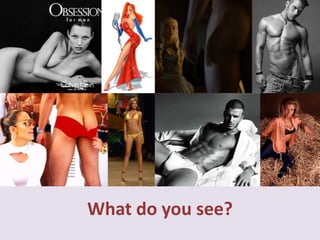
What do you see?
What is the gaze?
• How an audience views the people presented
• Male gaze
• Female gaze
Laura Mulvey – Male Gaze
• How men look at women
• How women look at
themselves
• How women look at other
women
• Coined phrase in 1975
• Audiences have to view characters from the
perspective of a heterosexual male
Laura Mulvey – Male Gaze
• Denies women human
identity
• Status of objects
• Admired for physical
appearance
• Women often watch from a secondary
perspective; viewing themselves only from a
man’s perspective
Laura Mulvey – Male Gaze
• Women seen as vital in
film/TV
• Often has no real
importance herself;
it’s how she makes the man
feel or act that becomes
important
• The female only exists in
relation to the male
Laura Mulvey – Male Gaze
• Male gaze leads to Hegemonic
ideologies in our society – the
idea of dominance in political
and social contexts
• Mulvey argues that women find
themselves taking the male gaze
in a society where the media
presents women from the male perspective
• Women end up objectifying women in the
same way a man would
Laura Mulvey – Male Gaze
• Visual pleasure
• The role of women
has 2 narrative
functions:
– Erotic object for
characters to view
– Erotic object for
audience to view
Laura Mulvey – Male Gaze
• Characters looking at others are active (male)
• Characters being looked at are passive
(female)
• Passive characters under control of male
• Only exist for visual pleasure
• Females (passives) often slow narrative down
– are inspiration for men to act
• Males (actives) push narrative on and create
the ‘action’
Objectification
• Linked to male gaze
• People gazed upon are
objectified
• Sole value to be enjoyed
or possessed by voyeur
• Devalued and humanity
removed
Laura Mulvey – Male Gaze
• Patriarchal society sets
rules
• Constructs and represents
ideal visions, roles and
male dominance over
women
• Passive audience may
be influenced by this
representation of reality
Criticism of Mulvey
• The question around male/female dichotomy
• Ethnicity, class, age, etc. not considered
• Not always men who have power over passive
women
• Suggests that gaze cannot be conceived of
representation outside of heterosexuality
• Suggests women cannot be strong
protagonists
• Some women like the ‘gaze’ and play up to it
Facial expressions of the male gaze
• Women:
– Chocolate box
– Invitational
– Super-smiler
– Romantic or sexual
• Marjorie Ferguson (1980)
• Chocolate Box: half or full-smile, lips together or slightly parted, teeth
barely visible, full or three-quarter face to camera. Projected mood:
blandly pleasing, warm bath warmth, where uniformity of features in their
smooth perfection is devoid of uniqueness or of individuality.
• Invitational: emphasis on the eyes, mouth shut or with only a hint of a
smile, head to one side or looking back to camera. Projected mood:
suggestive of mischief or mystery, the hint of contact potential rather than
sexual promise, the cover equivalent of advertising’s soft sell.
• Super-smiler: full face, wide open toothy smile, head thrust forward or
chin thrown back, hair often wind-blown. Projected mood: aggressive,
‘look-at-me’ demanding, the hard sell, ‘big come-on’ approach.
• Romantic or Sexual: a fourth and more general classification devised to
include male and female ‘two-somes’; or the dreamy, heavy-lidded,
unsmiling big-heads, or the overtly sensual or sexual. Projected moods:
possible ‘available’ and definitely ‘available’.
The female gaze
• Argument that there’s
no such thing
• Argument that it isn’t
equivalent to the male
gaze
• What is fetishized in the female gaze is
strength, virility, vigor, capability, fortitude,
power.
• Reaffirming male power and dominance.
The female gaze
• Men can be motivation
• Men are rarely decorative
• Male sexuality is
celebrated
• Opposed to the view that:
– Women are the prize (motivation)
– Women are decoration
– Female sexuality is dangerous (Femme Fatale, Vamp,
Honey Trap, etc).
The female gaze – not…
• Men save themselves
or are helped by other
men
• Pressure on actors
to ‘buff up’ is about
asserting male virility and physical embodiment
of male power – rather than pleasing women
• Men rarely passive or dominated by women
(without some form of ‘comeuppance’ or
resolution where ‘balance’ is restored
Facial expressions of the female gaze
• Men:
– Carefree
– Practical
– Seductive
– Comic
– Catalogue
• Trevor Millum (1975)
Is the gaze really just about gender
and sexuality?
• Jonathan Schroeder – the gaze represents
psychological relationship of power. The
person with the ‘gaze’ is superior to the
person being ‘gazed’ upon.
Watch the trailer and consider how
gender is represented through the
mise en scene and camerawork
• https://www.youtube.com/watch?v=ISm8my1
IciQ
• Is the notion of the gaze supported or
subverted?

Gender gaze

  • 1.
  • 2.
    What is thegaze? • How an audience views the people presented • Male gaze • Female gaze
  • 3.
    Laura Mulvey –Male Gaze • How men look at women • How women look at themselves • How women look at other women • Coined phrase in 1975 • Audiences have to view characters from the perspective of a heterosexual male
  • 4.
    Laura Mulvey –Male Gaze • Denies women human identity • Status of objects • Admired for physical appearance • Women often watch from a secondary perspective; viewing themselves only from a man’s perspective
  • 5.
    Laura Mulvey –Male Gaze • Women seen as vital in film/TV • Often has no real importance herself; it’s how she makes the man feel or act that becomes important • The female only exists in relation to the male
  • 6.
    Laura Mulvey –Male Gaze • Male gaze leads to Hegemonic ideologies in our society – the idea of dominance in political and social contexts • Mulvey argues that women find themselves taking the male gaze in a society where the media presents women from the male perspective • Women end up objectifying women in the same way a man would
  • 7.
    Laura Mulvey –Male Gaze • Visual pleasure • The role of women has 2 narrative functions: – Erotic object for characters to view – Erotic object for audience to view
  • 8.
    Laura Mulvey –Male Gaze • Characters looking at others are active (male) • Characters being looked at are passive (female) • Passive characters under control of male • Only exist for visual pleasure • Females (passives) often slow narrative down – are inspiration for men to act • Males (actives) push narrative on and create the ‘action’
  • 9.
    Objectification • Linked tomale gaze • People gazed upon are objectified • Sole value to be enjoyed or possessed by voyeur • Devalued and humanity removed
  • 10.
    Laura Mulvey –Male Gaze • Patriarchal society sets rules • Constructs and represents ideal visions, roles and male dominance over women • Passive audience may be influenced by this representation of reality
  • 11.
    Criticism of Mulvey •The question around male/female dichotomy • Ethnicity, class, age, etc. not considered • Not always men who have power over passive women • Suggests that gaze cannot be conceived of representation outside of heterosexuality • Suggests women cannot be strong protagonists • Some women like the ‘gaze’ and play up to it
  • 12.
    Facial expressions ofthe male gaze • Women: – Chocolate box – Invitational – Super-smiler – Romantic or sexual • Marjorie Ferguson (1980)
  • 13.
    • Chocolate Box:half or full-smile, lips together or slightly parted, teeth barely visible, full or three-quarter face to camera. Projected mood: blandly pleasing, warm bath warmth, where uniformity of features in their smooth perfection is devoid of uniqueness or of individuality. • Invitational: emphasis on the eyes, mouth shut or with only a hint of a smile, head to one side or looking back to camera. Projected mood: suggestive of mischief or mystery, the hint of contact potential rather than sexual promise, the cover equivalent of advertising’s soft sell. • Super-smiler: full face, wide open toothy smile, head thrust forward or chin thrown back, hair often wind-blown. Projected mood: aggressive, ‘look-at-me’ demanding, the hard sell, ‘big come-on’ approach. • Romantic or Sexual: a fourth and more general classification devised to include male and female ‘two-somes’; or the dreamy, heavy-lidded, unsmiling big-heads, or the overtly sensual or sexual. Projected moods: possible ‘available’ and definitely ‘available’.
  • 14.
    The female gaze •Argument that there’s no such thing • Argument that it isn’t equivalent to the male gaze • What is fetishized in the female gaze is strength, virility, vigor, capability, fortitude, power. • Reaffirming male power and dominance.
  • 15.
    The female gaze •Men can be motivation • Men are rarely decorative • Male sexuality is celebrated • Opposed to the view that: – Women are the prize (motivation) – Women are decoration – Female sexuality is dangerous (Femme Fatale, Vamp, Honey Trap, etc).
  • 16.
    The female gaze– not… • Men save themselves or are helped by other men • Pressure on actors to ‘buff up’ is about asserting male virility and physical embodiment of male power – rather than pleasing women • Men rarely passive or dominated by women (without some form of ‘comeuppance’ or resolution where ‘balance’ is restored
  • 17.
    Facial expressions ofthe female gaze • Men: – Carefree – Practical – Seductive – Comic – Catalogue • Trevor Millum (1975)
  • 18.
    Is the gazereally just about gender and sexuality? • Jonathan Schroeder – the gaze represents psychological relationship of power. The person with the ‘gaze’ is superior to the person being ‘gazed’ upon.
  • 19.
    Watch the trailerand consider how gender is represented through the mise en scene and camerawork • https://www.youtube.com/watch?v=ISm8my1 IciQ • Is the notion of the gaze supported or subverted?