Lab (4):
Renal Function test (RFT)
Khadija Balubaid
KAU-Faculty of Science- Biochemistry department
Clinical biochemistry lab (Bioc 416) 2013
The Function of Urinary System
1. Excretion & Elimination: ( major function)
removal of organic wastes products from body fluids (urea,
creatinine, uric acid)
2. Homeostatic regulation:
a. Water -Salt Balance(Regulates the body balance in water and
minerals. (sodium, potassium, chloride, calcium and phosphate)
b. Acid - base Balance(Maintains blood volume, pressure and pH.)
3. Endocrine function:
produce hormones (erythropoietin, renin and prostaglandin).
An Introduction to the Urinary System
Produces urine
Transports urine
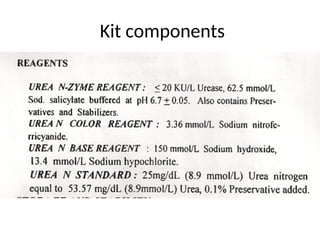
towards bladder
Temporarily store
urine
Conducts urine
to exterior
Kidneys Structure
• The functional unit of kidney is Nephrone
• Each kidney contains million nephrone
• Nephrone consists from two major parts:
 Glmulus: Filtration
(it is high pressure mass of capillaries that filter blood)
 System of tubules: re-absorption
System of
tubules
Glmulus
Each kidney consists of one million functional
units: Nephrone
A) Glomerulus
B) Glomerular Capsule
C) Renal Tubule
 proximal convoluted tubule
• loop of Henle
• distal convoluted tubule
D) Collecting Duct
Nephron structure
1- Glumular:
• is capsulated with double walled capsule called Boman’s capsule
• Glomular capilary membrane consists of three layers which allows
some partials of blood to pass though but not all, blood cells and
proteins are large and can't pass
• The fluid that filtered and passed through membrane is called
filtrate
• Filtrate is diffused across Bowman’s space to tubules system of
nephrone
What gets filtered in the glomerulus
?
?
Freely filtared
(filterd = passed)
• H2O
• Elements : (Na+
, K+
,
Cl-
, Mg2+
, PO4
)
• Glucose
• Urea
• Creatinine
• Insulin
Not filtred
(not passed)
• Protein
• Blood cells
Kidney structure
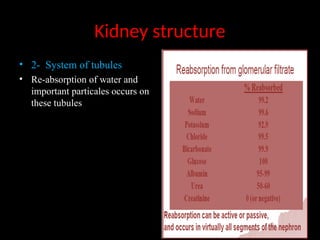
• 2- System of tubules
• Re-absorption of water and
important particales occurs on
these tubules
Urine Formation
• Urine formation requires :
 Glomerular Filtration
Due to differences in pressure water, small molecules
move from the glomerulus capillaries into the
glomerular capsule
 Tubular reabsorption
many molecules are reabsorbed from the nephron
into the capillary (diffusion, facilitated
diffusion, osmosis, and active transport) i.e.
Glucose is actively reabsorbed with transport
carriers.
If the carriers are inactive glucose appears in the
urine indicating diabetes
 Tubular secretion
Substances are actively removed from blood and
added to tubular fluid (active transport)
ie. H+, creatinine, and some drugs are moved by
active transport from the blood into the distal
convoluted tubule
 glomerular filtration rate
(GFR)
 urine volume
 urine urea
 minerals in urine
 urine protein
 urine glucose
 hematuria
 Osmolality
 Urea or BUN.
 Creatinine.
 uric acid.
 levels of several
elements : Na+
, K+
, Cl-
,
Ca2+
, Mg2+
, H2CO3 and
phosphorus
Measurement of GFR
 Clearance tests
 Plasma creatinine
 Urea, uric acid and
β2 microglobulinrea
Biochemical Tests of
Renal Function
Renal tubular
function tests
 Osmolality
measurements
 Specific
proteinurea
 Glycouria
 Aminoaciduria
 Urinalysis
 Appearance
 Specific gravity
and osmolality
 pH
 osmolality
 Glucose
 Protein
 Urinary
sediments
• Many factors can affect on kidney function leads to kidney
damage;
 Anatomical structure (congenital disease)
 Infections
 Diabetes
 Renal stones
 Smoking
 Diet and water
 Most common causes : Diabetes and high blood pressure
• Kidney damage occurs in stages that can early detected.
• Abnormal results of kidney function tests may be obtained due to a temporary
renal dysfunction.
• Therefore, the test should be performed repeatedly and interpreted on the basis
of a series of results.
• Urea is waste product of protein metabolism, it synthesized in
liver via urea cycle then it transported by blood to kidney to be
excreted in urine.
• Blood urea level is sensitive but not specific indicator for renal
dysfunction, because:
 Its level is affected by dietary protein
 Other non renal causes such as heart failure and blood pressure
may effect on its level.
 Its level is elevated in last stages of renal failure after 50% of
renal function is lost.
BUN= 50% urea
BUN= 50% urea
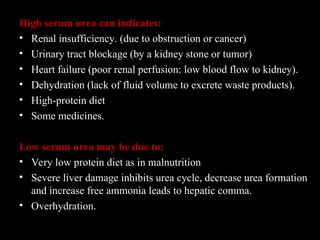
High serum urea can indicates:
• Renal insufficiency. (due to obstruction or cancer)
• Urinary tract blockage (by a kidney stone or tumor)
• Heart failure (poor renal perfusion: low blood flow to kidney).
• Dehydration (lack of fluid volume to excrete waste products).
• High-protein diet
• Some medicines.
Low serum urea may be due to:
• Very low protein diet as in malnutrition
• Severe liver damage inhibits urea cycle, decrease urea formation
and increase free ammonia leads to hepatic comma.
• Overhydration.
• Is the end product of purine metabolism and excreted in urine.
• Purine in body comes from food and break down of body
cells.
• Elevated level of uric acid in blood is one of the markers of
kidney dysfunction.
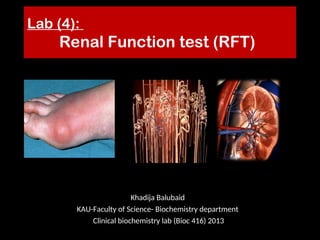
Gout:
Is disease characterized by high level of uric acid which
deposited in solid form in the joins causing arthritis.
High blood uric acid occurs in:
• Gout
• Renal failure (due to decreased excretion in urine)
• Leukemia (increased turnover of cells)
• Alcoholism
• Toxaemia of pregnancy.
• Diabetes Mellitues.
• Starvation.
• Drugs like diuretics.
Low blood uric acid occurs in:
- Liver diseases (cirrhosis)
- Renal disease that decrease renal tubular re-absorption
- Some drugs
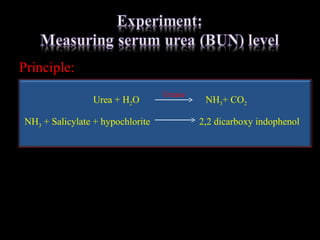
Principle:
Urea + H2O NH3+ CO2
NH3 + Salicylate + hypochlorite 2,2 dicarboxy indophenol
Urease
Kit components
•
Reagents
:
•
Sulfanalic acid reagent
•
Sodium nitrate reagent
•
Methanol reagent
•
Bilirubinequavalent standard (5mg/dl T.bil; 2.5
mg/dl D.bil)
•
Procedure
Procedure
:
:
C
Calculations
Abs of Bilirubinequavelant
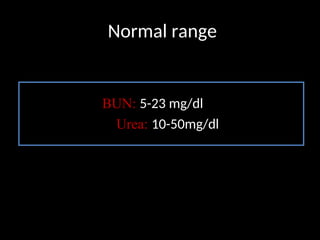
BUN: 5-23 mg/dl
Urea: 10-50mg/dl
Normal range

Kidney function test (Renal function test)

  • 1.
    Lab (4): Renal Functiontest (RFT) Khadija Balubaid KAU-Faculty of Science- Biochemistry department Clinical biochemistry lab (Bioc 416) 2013
  • 2.
    The Function ofUrinary System 1. Excretion & Elimination: ( major function) removal of organic wastes products from body fluids (urea, creatinine, uric acid) 2. Homeostatic regulation: a. Water -Salt Balance(Regulates the body balance in water and minerals. (sodium, potassium, chloride, calcium and phosphate) b. Acid - base Balance(Maintains blood volume, pressure and pH.) 3. Endocrine function: produce hormones (erythropoietin, renin and prostaglandin).
  • 3.
    An Introduction tothe Urinary System Produces urine Transports urine towards bladder Temporarily store urine Conducts urine to exterior
  • 4.
    Kidneys Structure • Thefunctional unit of kidney is Nephrone • Each kidney contains million nephrone • Nephrone consists from two major parts:  Glmulus: Filtration (it is high pressure mass of capillaries that filter blood)  System of tubules: re-absorption System of tubules Glmulus
  • 5.
    Each kidney consistsof one million functional units: Nephrone A) Glomerulus B) Glomerular Capsule C) Renal Tubule  proximal convoluted tubule • loop of Henle • distal convoluted tubule D) Collecting Duct Nephron structure
  • 6.
    1- Glumular: • iscapsulated with double walled capsule called Boman’s capsule • Glomular capilary membrane consists of three layers which allows some partials of blood to pass though but not all, blood cells and proteins are large and can't pass • The fluid that filtered and passed through membrane is called filtrate • Filtrate is diffused across Bowman’s space to tubules system of nephrone
  • 7.
    What gets filteredin the glomerulus What gets filtered in the glomerulus ? ? Freely filtared (filterd = passed) • H2O • Elements : (Na+ , K+ , Cl- , Mg2+ , PO4 ) • Glucose • Urea • Creatinine • Insulin Not filtred (not passed) • Protein • Blood cells
  • 8.
    Kidney structure • 2-System of tubules • Re-absorption of water and important particales occurs on these tubules
  • 9.
    Urine Formation • Urineformation requires :  Glomerular Filtration Due to differences in pressure water, small molecules move from the glomerulus capillaries into the glomerular capsule  Tubular reabsorption many molecules are reabsorbed from the nephron into the capillary (diffusion, facilitated diffusion, osmosis, and active transport) i.e. Glucose is actively reabsorbed with transport carriers. If the carriers are inactive glucose appears in the urine indicating diabetes  Tubular secretion Substances are actively removed from blood and added to tubular fluid (active transport) ie. H+, creatinine, and some drugs are moved by active transport from the blood into the distal convoluted tubule
  • 10.
     glomerular filtrationrate (GFR)  urine volume  urine urea  minerals in urine  urine protein  urine glucose  hematuria  Osmolality  Urea or BUN.  Creatinine.  uric acid.  levels of several elements : Na+ , K+ , Cl- , Ca2+ , Mg2+ , H2CO3 and phosphorus
  • 11.
    Measurement of GFR Clearance tests  Plasma creatinine  Urea, uric acid and β2 microglobulinrea Biochemical Tests of Renal Function Renal tubular function tests  Osmolality measurements  Specific proteinurea  Glycouria  Aminoaciduria  Urinalysis  Appearance  Specific gravity and osmolality  pH  osmolality  Glucose  Protein  Urinary sediments
  • 12.
    • Many factorscan affect on kidney function leads to kidney damage;  Anatomical structure (congenital disease)  Infections  Diabetes  Renal stones  Smoking  Diet and water  Most common causes : Diabetes and high blood pressure • Kidney damage occurs in stages that can early detected. • Abnormal results of kidney function tests may be obtained due to a temporary renal dysfunction. • Therefore, the test should be performed repeatedly and interpreted on the basis of a series of results.
  • 13.
    • Urea iswaste product of protein metabolism, it synthesized in liver via urea cycle then it transported by blood to kidney to be excreted in urine. • Blood urea level is sensitive but not specific indicator for renal dysfunction, because:  Its level is affected by dietary protein  Other non renal causes such as heart failure and blood pressure may effect on its level.  Its level is elevated in last stages of renal failure after 50% of renal function is lost. BUN= 50% urea BUN= 50% urea
  • 14.
    High serum ureacan indicates: • Renal insufficiency. (due to obstruction or cancer) • Urinary tract blockage (by a kidney stone or tumor) • Heart failure (poor renal perfusion: low blood flow to kidney). • Dehydration (lack of fluid volume to excrete waste products). • High-protein diet • Some medicines. Low serum urea may be due to: • Very low protein diet as in malnutrition • Severe liver damage inhibits urea cycle, decrease urea formation and increase free ammonia leads to hepatic comma. • Overhydration.
  • 15.
    • Is theend product of purine metabolism and excreted in urine. • Purine in body comes from food and break down of body cells. • Elevated level of uric acid in blood is one of the markers of kidney dysfunction.
  • 16.
    Gout: Is disease characterizedby high level of uric acid which deposited in solid form in the joins causing arthritis.
  • 17.
    High blood uricacid occurs in: • Gout • Renal failure (due to decreased excretion in urine) • Leukemia (increased turnover of cells) • Alcoholism • Toxaemia of pregnancy. • Diabetes Mellitues. • Starvation. • Drugs like diuretics. Low blood uric acid occurs in: - Liver diseases (cirrhosis) - Renal disease that decrease renal tubular re-absorption - Some drugs
  • 18.
    Principle: Urea + H2ONH3+ CO2 NH3 + Salicylate + hypochlorite 2,2 dicarboxy indophenol Urease
  • 19.
    Kit components • Reagents : • Sulfanalic acidreagent • Sodium nitrate reagent • Methanol reagent • Bilirubinequavalent standard (5mg/dl T.bil; 2.5 mg/dl D.bil) •
  • 20.
  • 21.
  • 22.
    BUN: 5-23 mg/dl Urea:10-50mg/dl Normal range

Editor's Notes

  • #6 Filtration process occurs in glomulus: lareg mwt compunds as protein and RBCs can’t pass through the glomulus membrane so it reterun back to blood, the filtrate is collectd in Bowmans space and transferred to tubule where the reabsoprtion process occurs in.
  • #8 This filtration process is much like the making of espresso or cappuccino. In a cappuccino machine, water is forced under pressure through a fine sieve containing ground coffee; the filtrate is the brewed coffee. The arrangement of the glomerular capillaries in series with the peritubular capillaries is important to maintain a constant pressure in the glomerular capillaries, and thus a constant rate of filtration, despite momentary fluctuations in blood pressure. Once the filtrate has entered the Bowman's capsule, it flows through the lumen of the nephron into the proximal tubule.
  • #10 I shall review the tests in the left column today. The measurement of urine protein is important in certain conditions, e.g.diabetes. The detection of substances such as red cells or glucose could be an early indicator of renal damage.