Dr. D Y Patil Arts Commerce And Science College
Pimpri Pune 411018
Chemistry Department
Mrs. Tarannum S Attar
CONTENT
Introduction
Principle
Factorsaffecting
Conventionalelectrophoresis
Generaloperation
Technicaland practicalConsideration
Typesofelectrophoresis
3
INTRODUCTION
Electrophoresis is the migration of charged particles
or molecules in a medium under the influence of an
applied electric field.
4
The rate of migration of an ion in electrical field depend on
factors,
o Net charge of molecule
o Size and shape of particle
o Strength of electrical field
o Properties of supporting medium
o Temperature of operation
o Ionic strength of buffer
Peak broadening of samples
Decrease resolution
Formation of temperature gradient –convection current -
resulting mixing of analytes
Denaturation of enzymes and proteins
Effect of heat
H=I2R
Electro endosmosis
Cathode
Anode
Conventionalelectrophoresis
18
Buffer
The bufferin electrophoresishastwofoldpurpose:
Carry appliedelectricalcurrent
Theyset the pH atwhichelectrophoresisiscarried out.
Thustheydetermine;
Typeof chargeon solute.
Extentofionizationof solute
Electrodetowardswhichthe solutewill migrate.
Thebufferionicstrengthwilldeterminethe thicknessofthe
ionic cloud.
19
Commonly buffersused;
Buffer
22
pH value
Phosphate buffer around7.0
Tris-Borate-EDTAbuffer(TBE) around8.0
Tris-Acetate EDTAbuffer(TAE) above8.0
TrisGlycine buffer(TG) more than8.5
Tris-Citrate-EDTAbuffer (TCE) around7.0
Tris-EDTAbuffer(TE) around8.0
Tris-Maleic acid -EDTAbuffer(TME) around7.5
Lithium Borate - buffer(LB) around8.6
Supporting medium
Supporting medium is a matrix in which the
protein separation takes place.
V
arious type has been used for the separation
either on slab or capillary form.
Separation is based on charge and mass of
protein,depending on the pore size of the
medium.
23
Chemical nature Inert
Availability easy
Electrical conductivity high
Adsorptivity low
Sievingeffect desirable
Porosity controlled
Transparency high
Electro-endosmosis(EEO) low
Preservation feasible
Toxicity low
Preparation easy
- Starchgel
- Celluloseacetate
- Agarose
- Polyacrylamidegel
25
TYPES OF ELECTROPHORESIS
1)Zone Electrophoresis
a)Paper Electrophoresis
b)Gel Electrophoresis
c)Cellulose acetate Electrophoresis
d)Isoelectric Focusing
e)ImmunoElectrophoresis
2)Moving Boundary Electrophoresis
a)Capillary Electrophoresis
b)Isotachophoresis
39
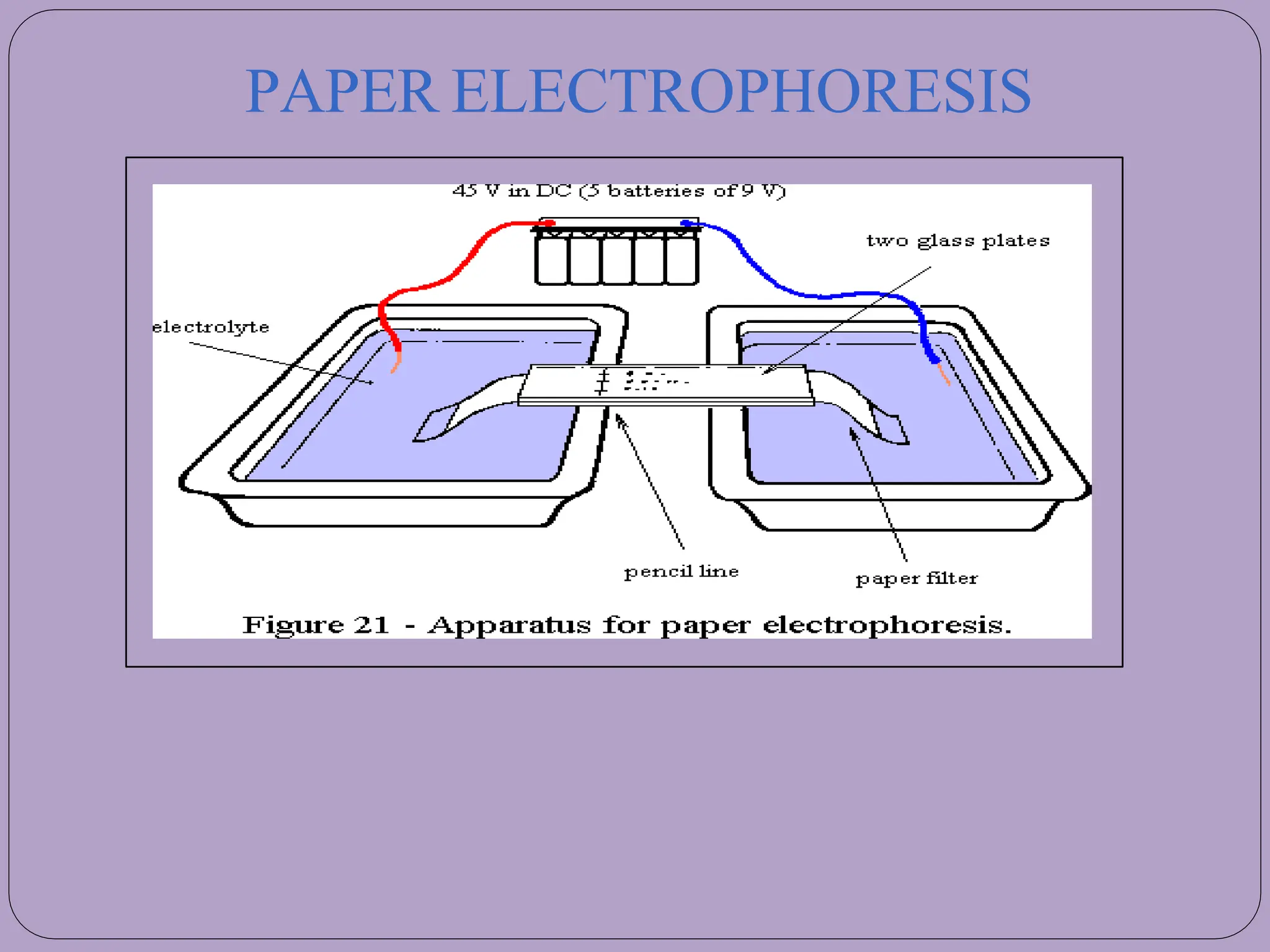
PAPER ELECTROPHORESIS
 Filter paper such as Whatmann no1 and no 3mm in strip of 3 or 5cm
wide have been used.
 Separation takes place in 12 to14hrs.
ADVANTAGES:
 It is economical.
 Easy to use.
DISADVANTAGES:
 Certain compounds such as proteins, hydrophilic molecules cannot be
resolved properly due to the adsorptive and ionogenic properties of paper
which results in tailing and distortion of componentbands.
 Electro osmosis.
 Separation is brought about through molecular sieving technique,
based on the molecular size of the substances. Gel material acts as
a "molecular sieve”.
 Gel is a colloid in a solid form (99% is water).
 It is important that the support media is electrically neutral.
 Different types of gels which can be used are; Agar and Agarose
gel, Starch, Polyacrylamide gels.
2
Gel electrophoresis
Agarose Gel
(made-up of repeat unit of
30
unit of galactose and 3,6-
 A linear polysaccharide
agarobiose-alternating
anhydrogalactose).
 Used in conc as 1% and 3%.
 The gelling property are attributed to both inter- and
intramolecular hydrogen bonding
 Pore size is controlled by the % of agarose used.
 Large pore size are formed with lower conc and vice versa.
 Purity of the agarose is based on the number of sulphate
conc, lower the conc of sulphate higher is the purity of
agarose.
Resolution is superior to that of
filter paper.
Large quantities of proteins can be
separated and recovered.
It adsorbs proteins relatively less
when compared to other medium.
agar tend to give different
results and purification isoften
31
necessary.
Sharp zones are obtained due to less
adsorption.
APPLICATION:
Toseparate DNA, proteins, Hb variants, iso-enzymes etc.
DISADVANTAGES:
 Resolution is less compared
to polyacrylamide gels.
 Different sources and batches of
ADVANTAGES:
Easy to prepare and small
concentration of agar is required.
4
TYPES OF ELECTROPHORESIS
1)Zone Electrophoresis
a)Paper Electrophoresis
b)Gel Electrophoresis
c)Cellulose acetate Electrophoresis
d)Isoelectric Focusing
e)ImmunoElectrophoresis
2)Moving Boundary Electrophoresis
a)Capillary Electrophoresis
b)Isotachophoresis
39
POLYACRYLAMIDE GEL ELECTROPHORESIS
Frequently referred to as PAGE.
Cross-linked polyacrylamide gel are formed from the
polymerization of the monomer in presence of small amount
of N,N”-methylene- bisacrylamide.
Bisacrylamide – two acrylamide linked by the methylene group.
The polymerization of the acrylamide is an example for free
radical catalysis.
Made in conc. between 3-30% acrylamide.
low % has large pore size and vice versa.
43
SDS-PAGE
Sodium dodecyl sulphate- polyacrylamide
gel electrophoresis.
Most widely used method for analysing protein
mixture qualitatively.
Useful for monitoring protein purification – as separation
of protein is based on the size of the particle.
Can also be used for determining the relative molecular
mass of a protein.
45
Mercaptoethanolwillbreakthe disulphidebridges.
SDSbindsstronglyto anddenaturesthe protein.
Eachproteinis fullydenatured and open into rod-shapewith
seriesofnegativelychargedSDSmoleculeon polypeptide chain.
SDSisananionic
detergent.
The sample is first
boiled for 5min in
buffercontaining
• Beta-
Mercaptoethanol
• SDS
46
On average, One SDS molecule bind for every two
amino acid residue.
Hence original native charge is completely swamped by
the negative charge of SDS molecule.
47
Components
48
Stacking gel:
ordering/arrangingand conc. the macromoleculebefore
entering the fieldofseparation. (4% ofacrylamide)
Purpose is to concentrate protein sample in sharp band
beforeit enters main separatinggel.
Running gel:
the actualzoneof separationof the particle/molecules based
on their mobility.(15%of acrylamide)
Movementofparticle
[Cl]> [protein-SDS]> [Glycinate]
54
55
- Researchtool
- Measuringmolecularweight
- Peptidemapping
- Proteinidentification
- Determination of samplepurity
- Separationofproteins and
establishing size
- Blotting
- Smaller fragments ofDNA
APPLICATION:
ADV
ANT
AGES:
-Gels are stable over wide range of pH and
temperature.
-Gels of different pore size can be formed.
-Simple and separation speed is good comparatively.
-Exhibitreasonablemechanicalstrength
-Low endosmosiseffect
DISADV
ANT
AGES
-Gel preparationand castingis time-consuming
-carcinogenic
-Completereproducibilityofgelpreparationnot possible
STAINING:
Fluorescentstains- Ethidiumbromide – Nucleicacids
Silverstainfor proteingel(sensitive50 timesdyebased)
Dyebased– Coomassieblue–proteinband
Trackingdyes– BPB>xylenecyanol
Native(buffer)gel
Donebyusingthepolyacrylamidegel(7.5%).
SDSis absent.
pH of8.7
Proteinsareseparatedaccordingto the electrophoretic
mobility&Sievingeffectofthe gel.
60
Isoelectricfocussing
of the
First described by- H.Svensson in Sweden.
Method is ideal for the separation
amphoteric substances.
Method has high resolution.
Able to separate the protein which differ in isoelectric
point by as little as little 0.01 of pH unit.
61
Differentgradient of thepH along
the lengthof the separatinggel.
62
Establishmentof phgradient:
This is achieved by the ampholyte & must have following
prop:
Must dictate pH course (buffering capacity at their pI)
Should have conductance at their pI.
Low molecular weight
Soluble in water
Low light absorbance at 280nm.
Available commercially with pH band (3-11)
Eg: Ampholine, Pharmalyte and Bio-lyte.
63
64
Movement
65
Application:
- Highlysensitiveforstudyingthemicroheterogeneity of
proteins
- Usefulforseparatingthe isoenzymes.
- Researchinenzymology,immunology
- Forensic,foodandagriculture industry
66
Two-dimensional polyacrylamide
gel electrophoresis
Principle:
Techniquecombineswith
IEFasfirstdimensional.
• Whichseparateaccordingto
thecharge.
Seconddimensionby
SDS-PAGE
• Separateaccording molecular
size.
67
 This combinationgives sophisticated analytical method
for analysing the protein mixture.
 Size very from 20*20cm to the minigel.
 IEF is carried on acrylamide gel (18cm*3mm), with
8M urea.
68
for further
 After separation, placed on 10% SDS-PAGE
separation .
 Usedinfieldof proteomics.
 Canseparate1000to 3000proteinsfromthe cellor tissueextract.
69
Isotachophoresis
 Used for separation of smaller ionic substances.
 They migrate adjacent in contact with one another, but not
overlapping.
 The sample is not mixed with the buffer prior to run.
 Hence current flow is carried entirely by the sample ions.
 Faster moving ions migrate first and the adjacent ones next
with no gap between the zone .
Allionsmigrateatthe rate offastestionin zones.
Thenit ismeasuredbyUVabsorbance.
Application-
Separationofsmallanionsand cations
Aminoacids
Peptides
Nucleotides
Nucleosides
Proteins.
71
Pulsed-FieldElectrophoresis
Powerisappliedalternativelyto differentpair ofelectrodes
Electrophoreticfieldiscycledat 105-1800
Becauseofwhichthemoleculehaveto orient to thenewfielddirection
Thispermit separationoflargemoleculelike DNA.
Applied:for typingvariousstrainsof DNA.
72
under an
 Immunoelectrophoresis refers to precipitation in agar
electric field.
 It is a process of combination of immuno-diffusionand
electrophoresis.
 An antigen mixture is first separated into its component parts by
electrophoresis and then tested by double immuno-diffusion.
 Antigens are placed into wells cut in a gel (without antibody) and
electrophoresed. A trough is then cut in the gel into which
antibodies are placed.
 The antibodies diffuse laterally to meet diffusing antigen, and
lattice formation and precipitation occur permitting determination
of the nature of the antigens.
 The term “immunoelectrophoresis” was first coined by Grabar and
Williams in 1953.
Immuno electrophoresis
Principle
When electric current is applied to a slide layered with
gel, antigen mixture placed in wells is separated into
individual antigen components according to their
charge and size. Following electrophoresis, the
separated antigens are reacted with specific antisera
placed in troughs parallel to the electrophoretic
migration and diffusion is allowed to occur. Antiserum
present in the trough moves toward the antigen
components resulting in formation of separate
precipitin lines in 18-24 hrs, each indicating reaction
between individual proteins with itsantibody.
-Precipitation reactions arebasedon the interaction of antibodies andantigens.They
are based on two soluble reactants that come together to makeone insoluble
product, the precipitate(Figure).
-Thesereactions depend on the formation of lattices (cross-links) when antigen and
antibody existin optimal proportions.[ it isknown aszoneofequivalence andappears
to us asprecipitation].
-Excessof either component reduceslattice formation andsubsequentprecipitation.
Procedure
Agarose gel is prepared on a glass slide put in a horizontal position.
Using sample template, wells are borne on the application zone carefully.
The sample is diluted 2:3 with protein diluent solution (20μl antigen solution
+10 μl diluent).
Using a 5 μl pipette, 5 μl of control and sample is applied across each
corresponding slit (Control slit and Sample slit).
The gel is placed into the electrophoresis chamber with the samples on the
cathode side, and electrophoresis run for 20 mins/ 100 volts.
After electrophoresis completes, 20 μl of the corresponding antiserum is added
to troughs in moist chamber and incubated for 18- 20 hours at room
temperature on a horizontal position.
The agarose gel is placed on a horizontal position, and dried with blotter
sheets.
The gel in saline solution is soaked for 10 minutes and the drying and washing
repeated twice again.
The gel is dried at a temperature less than 70°C and may be stained with
Results
o Presence of elliptical precipitin arcs represents antigen-
antibody interaction.
o Absence of formation of precipitate suggests no
reaction.
o Different antigens (proteins) can be identified based on
the intensity, shape, and position of the precipitation
lines.
Applications
The test helps in identification and approximate quantization of
various antigens in immunology.
suspected monoclonal and polyclonal gammopathies.
Used to analyze complex protein mixtures containingdifferent
antigens.
The medical diagnostic use is of value where certain proteins are
suspected of being absent (e.g., hypogammaglobulinemia) or
overproduced (e.g., multiple myeloma).
This method is useful to monitor antigen and antigen-antibody
purity and to identify a single antigen in a mixture ofantigens.
50μm – ID.
300 μm –ED.
Length– 50-100cm.
Fusedsilicacapillarytube.
Polyimidecoatingexternal.
Packedwiththebufferin use.
82
oTechnique first described by- Jorgensen and Lukas (1980’s). As the
name suggest, the separationis carried in a narrow bore Capillary
Capillary electrophoresis
Components:
83
Sampleapplicationisdonebyeitherofone method
Highvoltage
injection
High voltageinjection
The bufferreservoir is
replacedbythe sample
reservoir the high
voltageis applied(+
electrode) buffer
reservoir is placedagain
andvoltageappliedforthe
separation.
Pressure
injection
Pressure injection
Anodicend of capillaryis
removed from bufferand
placedin air tight sample
sol with pressuresample
is pushedintocapillary
kept backin the
buffersampleandvoltage
isapplied.
84
 High voltage is applied (up to 50 kV)
 The components migrate at different rate along the length.
 Although separated by the electrophoretic migration, all the
sample is drawn towards cathode by electroendosmosis.
 Since this flow is strong, the rate of electro endosmotic flow is
greater than the Electrophoretic velocity of the analyte ion,
regardless of the charge.
85
Positivelychargedmoleculereach the cathodefirst
(electrophoretic migration+ electroosmoticflow).
86
DETECTION:
87
Troubleshooting :
Adsorption of protein to the wall of capillary – leading to
smearing of protein – viewed as peak broadening – or
complete loss of protein.
- Use of neutral coating group to the inner surface of
the capillary.
88
clinical
applications
include
Multiplemyelomatesting
Haemoglobinopathy
screening.
HbA1c
Monitoringchronic
alcoholism(GGT).
• Online detection.
• Improved quantification.
• Almost complete automation.
• Reduced analysis time.
90
Advantageover conventional
Microchipelectrophoresis
Current advanced method.
Development in technique include
Integrated microchip design
Advanced detection system
separation can be
91
New application
Protein and DNA
done
Instrumentation
Similarto thecapillaryelectrophoresis.
Separationchannel
Sampleinjection(50-100pL)
Reservoirs
V
oltage(1-4kV)
samplepreparation
Precolumnor postcolumnreactors.
ClassicalCross-T design.
Timeperiodof 50-200sec.
92
Detector :
Laserinducedfluorescence
Electrochemical detectors
Pulsedamperometricdetector
Sinusoidalvoltametry
93
References
Tietz- Textbookofclinicalchemistry.
Kaplan- clinicalchemistry.
YouTubeand Googleimages.
95
THANK
YOU

ELECTROPHORESIS -and its types ppt.pptx

  • 1.
    Dr. D YPatil Arts Commerce And Science College Pimpri Pune 411018 Chemistry Department Mrs. Tarannum S Attar
  • 4.
  • 5.
    INTRODUCTION Electrophoresis is themigration of charged particles or molecules in a medium under the influence of an applied electric field. 4
  • 6.
    The rate ofmigration of an ion in electrical field depend on factors, o Net charge of molecule o Size and shape of particle o Strength of electrical field o Properties of supporting medium o Temperature of operation o Ionic strength of buffer
  • 10.
    Peak broadening ofsamples Decrease resolution Formation of temperature gradient –convection current - resulting mixing of analytes Denaturation of enzymes and proteins Effect of heat
  • 11.
  • 12.
  • 17.
  • 19.
  • 20.
    Buffer The bufferin electrophoresishastwofoldpurpose: Carryappliedelectricalcurrent Theyset the pH atwhichelectrophoresisiscarried out. Thustheydetermine; Typeof chargeon solute. Extentofionizationof solute Electrodetowardswhichthe solutewill migrate. Thebufferionicstrengthwilldeterminethe thicknessofthe ionic cloud. 19
  • 23.
    Commonly buffersused; Buffer 22 pH value Phosphatebuffer around7.0 Tris-Borate-EDTAbuffer(TBE) around8.0 Tris-Acetate EDTAbuffer(TAE) above8.0 TrisGlycine buffer(TG) more than8.5 Tris-Citrate-EDTAbuffer (TCE) around7.0 Tris-EDTAbuffer(TE) around8.0 Tris-Maleic acid -EDTAbuffer(TME) around7.5 Lithium Borate - buffer(LB) around8.6
  • 24.
    Supporting medium Supporting mediumis a matrix in which the protein separation takes place. V arious type has been used for the separation either on slab or capillary form. Separation is based on charge and mass of protein,depending on the pore size of the medium. 23
  • 25.
    Chemical nature Inert Availabilityeasy Electrical conductivity high Adsorptivity low Sievingeffect desirable Porosity controlled Transparency high Electro-endosmosis(EEO) low Preservation feasible Toxicity low Preparation easy
  • 26.
    - Starchgel - Celluloseacetate -Agarose - Polyacrylamidegel 25
  • 27.
    TYPES OF ELECTROPHORESIS 1)ZoneElectrophoresis a)Paper Electrophoresis b)Gel Electrophoresis c)Cellulose acetate Electrophoresis d)Isoelectric Focusing e)ImmunoElectrophoresis 2)Moving Boundary Electrophoresis a)Capillary Electrophoresis b)Isotachophoresis 39
  • 28.
  • 29.
     Filter papersuch as Whatmann no1 and no 3mm in strip of 3 or 5cm wide have been used.  Separation takes place in 12 to14hrs. ADVANTAGES:  It is economical.  Easy to use. DISADVANTAGES:  Certain compounds such as proteins, hydrophilic molecules cannot be resolved properly due to the adsorptive and ionogenic properties of paper which results in tailing and distortion of componentbands.  Electro osmosis.
  • 30.
     Separation isbrought about through molecular sieving technique, based on the molecular size of the substances. Gel material acts as a "molecular sieve”.  Gel is a colloid in a solid form (99% is water).  It is important that the support media is electrically neutral.  Different types of gels which can be used are; Agar and Agarose gel, Starch, Polyacrylamide gels. 2 Gel electrophoresis
  • 31.
    Agarose Gel (made-up ofrepeat unit of 30 unit of galactose and 3,6-  A linear polysaccharide agarobiose-alternating anhydrogalactose).  Used in conc as 1% and 3%.  The gelling property are attributed to both inter- and intramolecular hydrogen bonding  Pore size is controlled by the % of agarose used.  Large pore size are formed with lower conc and vice versa.  Purity of the agarose is based on the number of sulphate conc, lower the conc of sulphate higher is the purity of agarose.
  • 32.
    Resolution is superiorto that of filter paper. Large quantities of proteins can be separated and recovered. It adsorbs proteins relatively less when compared to other medium. agar tend to give different results and purification isoften 31 necessary. Sharp zones are obtained due to less adsorption. APPLICATION: Toseparate DNA, proteins, Hb variants, iso-enzymes etc. DISADVANTAGES:  Resolution is less compared to polyacrylamide gels.  Different sources and batches of ADVANTAGES: Easy to prepare and small concentration of agar is required.
  • 35.
  • 43.
    TYPES OF ELECTROPHORESIS 1)ZoneElectrophoresis a)Paper Electrophoresis b)Gel Electrophoresis c)Cellulose acetate Electrophoresis d)Isoelectric Focusing e)ImmunoElectrophoresis 2)Moving Boundary Electrophoresis a)Capillary Electrophoresis b)Isotachophoresis 39
  • 44.
    POLYACRYLAMIDE GEL ELECTROPHORESIS Frequentlyreferred to as PAGE. Cross-linked polyacrylamide gel are formed from the polymerization of the monomer in presence of small amount of N,N”-methylene- bisacrylamide. Bisacrylamide – two acrylamide linked by the methylene group. The polymerization of the acrylamide is an example for free radical catalysis. Made in conc. between 3-30% acrylamide. low % has large pore size and vice versa. 43
  • 46.
    SDS-PAGE Sodium dodecyl sulphate-polyacrylamide gel electrophoresis. Most widely used method for analysing protein mixture qualitatively. Useful for monitoring protein purification – as separation of protein is based on the size of the particle. Can also be used for determining the relative molecular mass of a protein. 45
  • 47.
    Mercaptoethanolwillbreakthe disulphidebridges. SDSbindsstronglyto anddenaturestheprotein. Eachproteinis fullydenatured and open into rod-shapewith seriesofnegativelychargedSDSmoleculeon polypeptide chain. SDSisananionic detergent. The sample is first boiled for 5min in buffercontaining • Beta- Mercaptoethanol • SDS 46
  • 48.
    On average, OneSDS molecule bind for every two amino acid residue. Hence original native charge is completely swamped by the negative charge of SDS molecule. 47
  • 49.
  • 53.
    Stacking gel: ordering/arrangingand conc.the macromoleculebefore entering the fieldofseparation. (4% ofacrylamide) Purpose is to concentrate protein sample in sharp band beforeit enters main separatinggel. Running gel: the actualzoneof separationof the particle/molecules based on their mobility.(15%of acrylamide)
  • 55.
  • 56.
  • 58.
    - Researchtool - Measuringmolecularweight -Peptidemapping - Proteinidentification - Determination of samplepurity - Separationofproteins and establishing size - Blotting - Smaller fragments ofDNA APPLICATION:
  • 59.
    ADV ANT AGES: -Gels are stableover wide range of pH and temperature. -Gels of different pore size can be formed. -Simple and separation speed is good comparatively. -Exhibitreasonablemechanicalstrength -Low endosmosiseffect DISADV ANT AGES -Gel preparationand castingis time-consuming -carcinogenic -Completereproducibilityofgelpreparationnot possible
  • 60.
    STAINING: Fluorescentstains- Ethidiumbromide –Nucleicacids Silverstainfor proteingel(sensitive50 timesdyebased) Dyebased– Coomassieblue–proteinband Trackingdyes– BPB>xylenecyanol
  • 61.
  • 62.
    Isoelectricfocussing of the First describedby- H.Svensson in Sweden. Method is ideal for the separation amphoteric substances. Method has high resolution. Able to separate the protein which differ in isoelectric point by as little as little 0.01 of pH unit. 61
  • 63.
    Differentgradient of thepHalong the lengthof the separatinggel. 62
  • 64.
    Establishmentof phgradient: This isachieved by the ampholyte & must have following prop: Must dictate pH course (buffering capacity at their pI) Should have conductance at their pI. Low molecular weight Soluble in water Low light absorbance at 280nm. Available commercially with pH band (3-11) Eg: Ampholine, Pharmalyte and Bio-lyte. 63
  • 65.
  • 66.
  • 67.
    Application: - Highlysensitiveforstudyingthemicroheterogeneity of proteins -Usefulforseparatingthe isoenzymes. - Researchinenzymology,immunology - Forensic,foodandagriculture industry 66
  • 68.
    Two-dimensional polyacrylamide gel electrophoresis Principle: Techniquecombineswith IEFasfirstdimensional. •Whichseparateaccordingto thecharge. Seconddimensionby SDS-PAGE • Separateaccording molecular size. 67
  • 69.
     This combinationgivessophisticated analytical method for analysing the protein mixture.  Size very from 20*20cm to the minigel.  IEF is carried on acrylamide gel (18cm*3mm), with 8M urea. 68 for further  After separation, placed on 10% SDS-PAGE separation .  Usedinfieldof proteomics.  Canseparate1000to 3000proteinsfromthe cellor tissueextract.
  • 70.
  • 71.
    Isotachophoresis  Used forseparation of smaller ionic substances.  They migrate adjacent in contact with one another, but not overlapping.  The sample is not mixed with the buffer prior to run.  Hence current flow is carried entirely by the sample ions.  Faster moving ions migrate first and the adjacent ones next with no gap between the zone .
  • 72.
    Allionsmigrateatthe rate offastestioninzones. Thenit ismeasuredbyUVabsorbance. Application- Separationofsmallanionsand cations Aminoacids Peptides Nucleotides Nucleosides Proteins. 71
  • 73.
    Pulsed-FieldElectrophoresis Powerisappliedalternativelyto differentpair ofelectrodes Electrophoreticfieldiscycledat105-1800 Becauseofwhichthemoleculehaveto orient to thenewfielddirection Thispermit separationoflargemoleculelike DNA. Applied:for typingvariousstrainsof DNA. 72
  • 75.
    under an  Immunoelectrophoresisrefers to precipitation in agar electric field.  It is a process of combination of immuno-diffusionand electrophoresis.  An antigen mixture is first separated into its component parts by electrophoresis and then tested by double immuno-diffusion.  Antigens are placed into wells cut in a gel (without antibody) and electrophoresed. A trough is then cut in the gel into which antibodies are placed.  The antibodies diffuse laterally to meet diffusing antigen, and lattice formation and precipitation occur permitting determination of the nature of the antigens.  The term “immunoelectrophoresis” was first coined by Grabar and Williams in 1953. Immuno electrophoresis
  • 76.
    Principle When electric currentis applied to a slide layered with gel, antigen mixture placed in wells is separated into individual antigen components according to their charge and size. Following electrophoresis, the separated antigens are reacted with specific antisera placed in troughs parallel to the electrophoretic migration and diffusion is allowed to occur. Antiserum present in the trough moves toward the antigen components resulting in formation of separate precipitin lines in 18-24 hrs, each indicating reaction between individual proteins with itsantibody.
  • 77.
    -Precipitation reactions arebasedonthe interaction of antibodies andantigens.They are based on two soluble reactants that come together to makeone insoluble product, the precipitate(Figure). -Thesereactions depend on the formation of lattices (cross-links) when antigen and antibody existin optimal proportions.[ it isknown aszoneofequivalence andappears to us asprecipitation]. -Excessof either component reduceslattice formation andsubsequentprecipitation.
  • 80.
    Procedure Agarose gel isprepared on a glass slide put in a horizontal position. Using sample template, wells are borne on the application zone carefully. The sample is diluted 2:3 with protein diluent solution (20μl antigen solution +10 μl diluent). Using a 5 μl pipette, 5 μl of control and sample is applied across each corresponding slit (Control slit and Sample slit). The gel is placed into the electrophoresis chamber with the samples on the cathode side, and electrophoresis run for 20 mins/ 100 volts. After electrophoresis completes, 20 μl of the corresponding antiserum is added to troughs in moist chamber and incubated for 18- 20 hours at room temperature on a horizontal position. The agarose gel is placed on a horizontal position, and dried with blotter sheets. The gel in saline solution is soaked for 10 minutes and the drying and washing repeated twice again. The gel is dried at a temperature less than 70°C and may be stained with
  • 81.
    Results o Presence ofelliptical precipitin arcs represents antigen- antibody interaction. o Absence of formation of precipitate suggests no reaction. o Different antigens (proteins) can be identified based on the intensity, shape, and position of the precipitation lines.
  • 82.
    Applications The test helpsin identification and approximate quantization of various antigens in immunology. suspected monoclonal and polyclonal gammopathies. Used to analyze complex protein mixtures containingdifferent antigens. The medical diagnostic use is of value where certain proteins are suspected of being absent (e.g., hypogammaglobulinemia) or overproduced (e.g., multiple myeloma). This method is useful to monitor antigen and antigen-antibody purity and to identify a single antigen in a mixture ofantigens.
  • 83.
    50μm – ID. 300μm –ED. Length– 50-100cm. Fusedsilicacapillarytube. Polyimidecoatingexternal. Packedwiththebufferin use. 82 oTechnique first described by- Jorgensen and Lukas (1980’s). As the name suggest, the separationis carried in a narrow bore Capillary Capillary electrophoresis
  • 84.
  • 85.
    Sampleapplicationisdonebyeitherofone method Highvoltage injection High voltageinjection Thebufferreservoir is replacedbythe sample reservoir the high voltageis applied(+ electrode) buffer reservoir is placedagain andvoltageappliedforthe separation. Pressure injection Pressure injection Anodicend of capillaryis removed from bufferand placedin air tight sample sol with pressuresample is pushedintocapillary kept backin the buffersampleandvoltage isapplied. 84
  • 86.
     High voltageis applied (up to 50 kV)  The components migrate at different rate along the length.  Although separated by the electrophoretic migration, all the sample is drawn towards cathode by electroendosmosis.  Since this flow is strong, the rate of electro endosmotic flow is greater than the Electrophoretic velocity of the analyte ion, regardless of the charge. 85
  • 87.
  • 88.
  • 89.
    Troubleshooting : Adsorption ofprotein to the wall of capillary – leading to smearing of protein – viewed as peak broadening – or complete loss of protein. - Use of neutral coating group to the inner surface of the capillary. 88
  • 90.
  • 91.
    • Online detection. •Improved quantification. • Almost complete automation. • Reduced analysis time. 90 Advantageover conventional
  • 92.
    Microchipelectrophoresis Current advanced method. Developmentin technique include Integrated microchip design Advanced detection system separation can be 91 New application Protein and DNA done
  • 93.
  • 94.
  • 95.
  • 96.