Level 5 Award in Leadership and
Management Skills
Day 2
Objectives for today … to
• Reflect on thoughts, observations or questions
after Day 1
• Explain the communication process and
evaluate strategies to overcome barriers
• Evaluate how interpersonal and
communication skills affect managerial
performance
• Develop an understanding of how a personal
development plan can improve your
managerial performance
Communication and Interpersonal
Skills
Activity
• Define communication
• Define interpersonal skills
• What are the key differences?
Importance of Communication
• Effective communication dictates operational
efficiency and facilitates teamwork. It
underlies the efficiency of key functions such
as managing, training, selling and resolving
conflicts within an organisation
Communication skills are…
The ability to convey information to another
effectively and efficiently. Business managers
with good verbal, non verbal and written
communication skills help facilitate the sharing
of information between people within a
company for its operational benefit.
Interpersonal skills are…
The set of abilities enabling a person to interact
positively and work effectively with others.
These skills include the areas of communication,
listening, delegation of tasks and leadership.
Interpersonal Skills
• Strong interpersonal communication is at the heart
of any successful organisation. It goes beyond
merely words and involves a variety of
communication methods, such as gestures, voice
tone, facial expression and body language.
• The successful use of interpersonal skills by a
manager can create a proactive, hard-working and
united culture. Equally, poor interpersonal skills can
negatively affect a teams performance
Communication – linear model
‘transmission of information, ideas, attitudes, or
emotion from one person to another, primarily
through symbols’.
… is dependent on the quality of the linkages
between the various elements in the process
(Shannon and Weaver 1949)
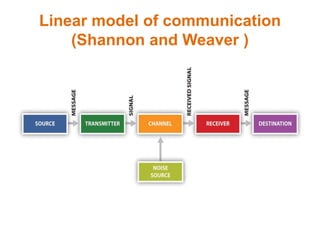
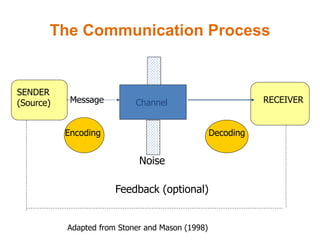
Linear model of communication
(Shannon and Weaver )
Linear model – a ‘done to’ process
• Sender: the message creator.
• Encoding: the process of putting thoughts into messages
through the creation of content and symbols.
• Decoding: the process of interpreting and assigning meaning
to a message.
• Message: the transmitted information.
• Channel: the medium through which the message passes.
• Receiver: the target of the sender and collector of the
message.
• Noise: those distractions which interfere with the
transmission of the message
A model of the communication process
SENDER
(Source) RECEIVERChannel
Encoding Decoding
Feedback (optional)
Noise
Message Channel
The Communication Process
Adapted from Stoner and Mason (1998)
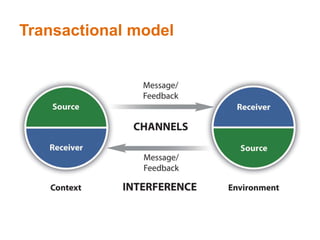
Transactional model… a ‘do with’
process
‘both people involved in the interaction are
communicators, and instead of the process
illustrated as linear, it becomes circular in its
function. Thus the process is an exchange. The
two people engaged constantly respond to each
other by initiating messages and sending
responses back and forth’ (DeFleur, 2005).
Transactional model
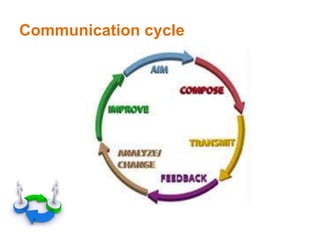
Communication cycle
Exercise in groups……
Look at the various methods of communicating
within business
Weigh up the advantages and disadvantages ?
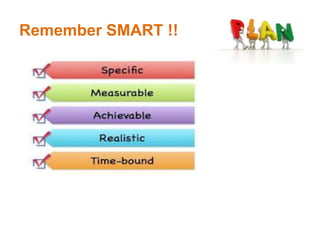
Remember SMART !!
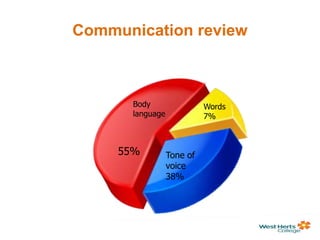
Communication review
Body
language
55% Tone of
voice
38%
Words
7%
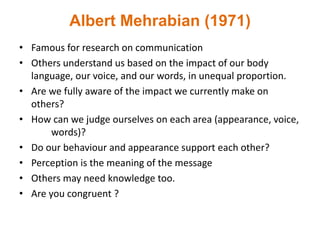
Albert Mehrabian (1971)
• Famous for research on communication
• Others understand us based on the impact of our body
language, our voice, and our words, in unequal proportion.
• Are we fully aware of the impact we currently make on
others?
• How can we judge ourselves on each area (appearance, voice,
words)?
• Do our behaviour and appearance support each other?
• Perception is the meaning of the message
• Others may need knowledge too.
• Are you congruent ?
Non verbal communication /
body language – see memory stick
• Facial expressions
• Gestures
• Posture
• Body position
• Use of space
Understanding Body langauage
• Situation
• Normal Patterns
• Congruence – Does it match?
• Sensory Preferences – questionnaire on
memory stick
Developing Rapport
• Rapport is being able to relate to others in a
way that creates a climate of trust and
understand
• A close and harmonious relationship in which
the people or groups concerned understand
each other’s feelings or ideas and
communicate well
http://www.oxforddictionaries.com
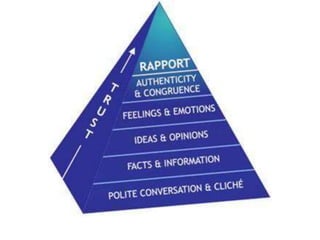
Rapport
Representational system quiz
How we use language ?
• Big picture v small picture ?
• Visually – what you see
• By sounds – what you hear
• By feelings – what you sense and can feel,
taste or smell.
• By how you talk to yourself
• Language is subjective !!
Visual thinkers
• Talk quickly
• See memories as pictures
• Breathe from top of lungs
• Need minimum detail
• Get bored quickly
• Interested in how things ‘look’
• Think in bigger picture
• Like to be ‘shown things’
• Will change subject
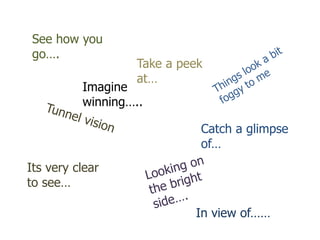
• Use words like
See how you
go….
Its very clear
to see…
Imagine
winning…..
Catch a glimpse
of…
Take a peek
at…
In view of……
Auditory thinkers
• Easily distracted by noise
• Love the phone and music
• Breathe from middle of chest
• May talk to themselves.
• May repeat what you have said to them
• Tone of voice is very important
• Like steps and procedures
• Love to be told how they are doing
• Love stories
• Use words like……….
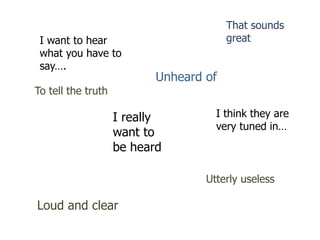
I want to hear
what you have to
say….
I think they are
very tuned in…
I really
want to
be heard
That sounds
great
To tell the truth
Unheard of
Utterly useless
Loud and clear
KINAESTHETIC- FEELINGS THINKERS
• Includes taste and smells
• Want to know how things feel
• May talk slowly
• Breathe lower
• Respond to physical rewards
• Memorise by doing something or walking it
through.
• Speak deliberately
• Will want the details
• Think things through
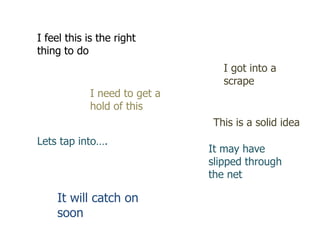
I feel this is the right
thing to do
I need to get a
hold of this
Lets tap into….
This is a solid idea
It may have
slipped through
the net
I got into a
scrape
It will catch on
soon
Analytical thinker
• Always comes secondary to the others
• Spend time processing internally
• May talk to themselves out loud
• Will look for things to make sense
• Logical and process driven
• May want extensive details
• May talk in long sentences
• Memorise by steps
• Often uses the language of logic and business
• Visual language
• Auditory language
• Kinaesthetic language
• Analytical and logical language
Exercise – Sell the pen
Listening
There are two types of listening:
Active Listening is when you are concentrating
on the message being given by the other
person
Passive Listening is when you find yourself
waiting for the other person to stop speaking
so that you can say something yourself.
Exercise…
Now think about how you will assess and
measure that your communication is effective ?
• Qualitative ?
• Quantitative ?
• Did it drive change ?
• Feedback ?
• Choose one written and one verbal method ?
• Feedback to the group
Using questions….
• Use short, clear, simple questions, starting
with words such as:
• Who?
• How?
• Where?
• When?
• What?
• In what way?
• Tell me about?
• Use ‘why’ with caution
• How specifically – what do you mean by?
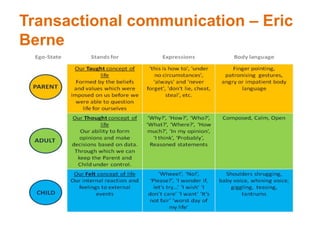
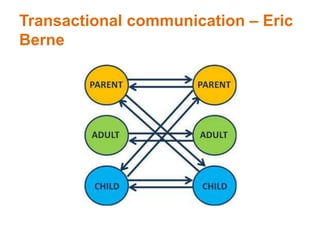
Transactional communication – Eric
Berne
Transactional communication – Eric
Berne
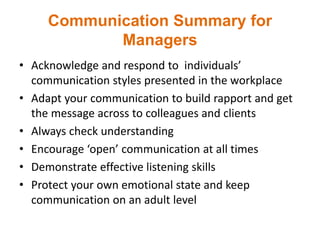
Communication Summary for
Managers
• Acknowledge and respond to individuals’
communication styles presented in the workplace
• Adapt your communication to build rapport and get
the message across to colleagues and clients
• Always check understanding
• Encourage ‘open’ communication at all times
• Demonstrate effective listening skills
• Protect your own emotional state and keep
communication on an adult level
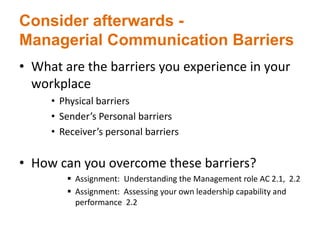
Consider afterwards -
Managerial Communication Barriers
• What are the barriers you experience in your
workplace
• Physical barriers
• Sender’s Personal barriers
• Receiver’s personal barriers
• How can you overcome these barriers?
 Assignment: Understanding the Management role AC 2.1, 2.2
 Assignment: Assessing your own leadership capability and
performance 2.2
Interpersonal skills … how do you
relate and communicate with
others?
What do you think the important interpersonal
skills are for a manager ?... And why ?
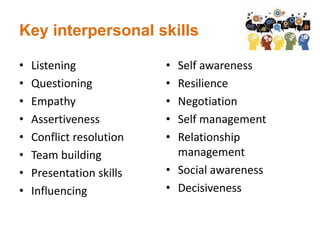
Key interpersonal skills
• Listening
• Questioning
• Empathy
• Assertiveness
• Conflict resolution
• Team building
• Presentation skills
• Influencing
• Self awareness
• Resilience
• Negotiation
• Self management
• Relationship
management
• Social awareness
• Decisiveness
Personal Development
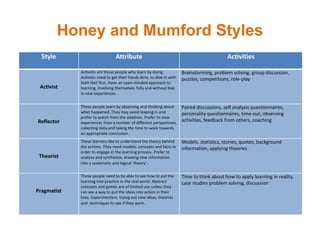
Honey and Mumford Styles
Style Attribute Activities
Activist
Activists are those people who learn by doing.
Activists need to get their hands dirty, to dive in with
both feet first. Have an open-minded approach to
learning, involving themselves fully and without bias
in new experiences.
Brainstorming, problem solving, group discussion,
puzzles, competitions, role-play
Reflector
These people learn by observing and thinking about
what happened. They may avoid leaping in and
prefer to watch from the sidelines. Prefer to view
experiences from a number of different perspectives,
collecting data and taking the time to work towards
an appropriate conclusion.
Paired discussions, self analysis questionnaires,
personality questionnaires, time out, observing
activities, feedback from others, coaching
Theorist
These learners like to understand the theory behind
the actions. They need models, concepts and facts in
order to engage in the learning process. Prefer to
analyse and synthesise, drawing new information
into a systematic and logical ‘theory’.
Models, statistics, stories, quotes, background
information, applying theories
Pragmatist
These people need to be able to see how to put the
learning into practice in the real world. Abstract
concepts and games are of limited use unless they
can see a way to put the ideas into action in their
lives. Experimenters, trying out new ideas, theories
and techniques to see if they work.
Time to think about how to apply learning in reality,
case studies problem solving, discussion
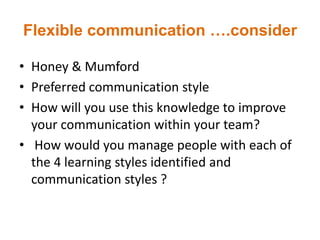
Flexible communication ….consider
• Honey & Mumford
• Preferred communication style
• How will you use this knowledge to improve
your communication within your team?
• How would you manage people with each of
the 4 learning styles identified and
communication styles ?
Your development plan should be…
• Based on feedback – seek it out !
• SMART development objectives
• Based on a critical assessment of your own
knowledge, skills, personal attributes and behaviour
and their effect on your managerial ability
• Demonstrate self awareness
• Linked to your development needs and priorities
• Easy to read and understand – see development plan
handout
Understanding the management role: 3.1, 3.2, 3.3
For Next Session
• Complete Day 2 Worksheet
• Start Development Plan activities

Day 2 ILM award in L&M

  • 1.
    Level 5 Awardin Leadership and Management Skills Day 2
  • 2.
    Objectives for today… to • Reflect on thoughts, observations or questions after Day 1 • Explain the communication process and evaluate strategies to overcome barriers • Evaluate how interpersonal and communication skills affect managerial performance • Develop an understanding of how a personal development plan can improve your managerial performance
  • 3.
  • 4.
    Activity • Define communication •Define interpersonal skills • What are the key differences?
  • 5.
    Importance of Communication •Effective communication dictates operational efficiency and facilitates teamwork. It underlies the efficiency of key functions such as managing, training, selling and resolving conflicts within an organisation
  • 6.
    Communication skills are… Theability to convey information to another effectively and efficiently. Business managers with good verbal, non verbal and written communication skills help facilitate the sharing of information between people within a company for its operational benefit.
  • 7.
    Interpersonal skills are… Theset of abilities enabling a person to interact positively and work effectively with others. These skills include the areas of communication, listening, delegation of tasks and leadership.
  • 8.
    Interpersonal Skills • Stronginterpersonal communication is at the heart of any successful organisation. It goes beyond merely words and involves a variety of communication methods, such as gestures, voice tone, facial expression and body language. • The successful use of interpersonal skills by a manager can create a proactive, hard-working and united culture. Equally, poor interpersonal skills can negatively affect a teams performance
  • 9.
    Communication – linearmodel ‘transmission of information, ideas, attitudes, or emotion from one person to another, primarily through symbols’. … is dependent on the quality of the linkages between the various elements in the process (Shannon and Weaver 1949)
  • 10.
    Linear model ofcommunication (Shannon and Weaver )
  • 11.
    Linear model –a ‘done to’ process • Sender: the message creator. • Encoding: the process of putting thoughts into messages through the creation of content and symbols. • Decoding: the process of interpreting and assigning meaning to a message. • Message: the transmitted information. • Channel: the medium through which the message passes. • Receiver: the target of the sender and collector of the message. • Noise: those distractions which interfere with the transmission of the message
  • 12.
    A model ofthe communication process SENDER (Source) RECEIVERChannel Encoding Decoding Feedback (optional) Noise Message Channel The Communication Process Adapted from Stoner and Mason (1998)
  • 13.
    Transactional model… a‘do with’ process ‘both people involved in the interaction are communicators, and instead of the process illustrated as linear, it becomes circular in its function. Thus the process is an exchange. The two people engaged constantly respond to each other by initiating messages and sending responses back and forth’ (DeFleur, 2005).
  • 14.
  • 15.
  • 16.
    Exercise in groups…… Lookat the various methods of communicating within business Weigh up the advantages and disadvantages ?
  • 17.
  • 19.
  • 20.
    Albert Mehrabian (1971) •Famous for research on communication • Others understand us based on the impact of our body language, our voice, and our words, in unequal proportion. • Are we fully aware of the impact we currently make on others? • How can we judge ourselves on each area (appearance, voice, words)? • Do our behaviour and appearance support each other? • Perception is the meaning of the message • Others may need knowledge too. • Are you congruent ?
  • 21.
    Non verbal communication/ body language – see memory stick • Facial expressions • Gestures • Posture • Body position • Use of space
  • 22.
    Understanding Body langauage •Situation • Normal Patterns • Congruence – Does it match? • Sensory Preferences – questionnaire on memory stick
  • 23.
    Developing Rapport • Rapportis being able to relate to others in a way that creates a climate of trust and understand • A close and harmonious relationship in which the people or groups concerned understand each other’s feelings or ideas and communicate well http://www.oxforddictionaries.com
  • 24.
  • 25.
  • 26.
    How we uselanguage ? • Big picture v small picture ? • Visually – what you see • By sounds – what you hear • By feelings – what you sense and can feel, taste or smell. • By how you talk to yourself • Language is subjective !!
  • 27.
    Visual thinkers • Talkquickly • See memories as pictures • Breathe from top of lungs • Need minimum detail • Get bored quickly • Interested in how things ‘look’ • Think in bigger picture • Like to be ‘shown things’ • Will change subject • Use words like
  • 28.
    See how you go…. Itsvery clear to see… Imagine winning….. Catch a glimpse of… Take a peek at… In view of……
  • 29.
    Auditory thinkers • Easilydistracted by noise • Love the phone and music • Breathe from middle of chest • May talk to themselves. • May repeat what you have said to them • Tone of voice is very important • Like steps and procedures • Love to be told how they are doing • Love stories • Use words like……….
  • 30.
    I want tohear what you have to say…. I think they are very tuned in… I really want to be heard That sounds great To tell the truth Unheard of Utterly useless Loud and clear
  • 31.
    KINAESTHETIC- FEELINGS THINKERS •Includes taste and smells • Want to know how things feel • May talk slowly • Breathe lower • Respond to physical rewards • Memorise by doing something or walking it through. • Speak deliberately • Will want the details • Think things through
  • 32.
    I feel thisis the right thing to do I need to get a hold of this Lets tap into…. This is a solid idea It may have slipped through the net I got into a scrape It will catch on soon
  • 33.
    Analytical thinker • Alwayscomes secondary to the others • Spend time processing internally • May talk to themselves out loud • Will look for things to make sense • Logical and process driven • May want extensive details • May talk in long sentences • Memorise by steps • Often uses the language of logic and business
  • 34.
    • Visual language •Auditory language • Kinaesthetic language • Analytical and logical language Exercise – Sell the pen
  • 35.
    Listening There are twotypes of listening: Active Listening is when you are concentrating on the message being given by the other person Passive Listening is when you find yourself waiting for the other person to stop speaking so that you can say something yourself.
  • 36.
    Exercise… Now think abouthow you will assess and measure that your communication is effective ? • Qualitative ? • Quantitative ? • Did it drive change ? • Feedback ? • Choose one written and one verbal method ? • Feedback to the group
  • 37.
    Using questions…. • Useshort, clear, simple questions, starting with words such as: • Who? • How? • Where? • When? • What? • In what way? • Tell me about? • Use ‘why’ with caution • How specifically – what do you mean by?
  • 38.
  • 39.
  • 40.
    Communication Summary for Managers •Acknowledge and respond to individuals’ communication styles presented in the workplace • Adapt your communication to build rapport and get the message across to colleagues and clients • Always check understanding • Encourage ‘open’ communication at all times • Demonstrate effective listening skills • Protect your own emotional state and keep communication on an adult level
  • 41.
    Consider afterwards - ManagerialCommunication Barriers • What are the barriers you experience in your workplace • Physical barriers • Sender’s Personal barriers • Receiver’s personal barriers • How can you overcome these barriers?  Assignment: Understanding the Management role AC 2.1, 2.2  Assignment: Assessing your own leadership capability and performance 2.2
  • 42.
    Interpersonal skills …how do you relate and communicate with others? What do you think the important interpersonal skills are for a manager ?... And why ?
  • 43.
    Key interpersonal skills •Listening • Questioning • Empathy • Assertiveness • Conflict resolution • Team building • Presentation skills • Influencing • Self awareness • Resilience • Negotiation • Self management • Relationship management • Social awareness • Decisiveness
  • 44.
  • 45.
    Honey and MumfordStyles Style Attribute Activities Activist Activists are those people who learn by doing. Activists need to get their hands dirty, to dive in with both feet first. Have an open-minded approach to learning, involving themselves fully and without bias in new experiences. Brainstorming, problem solving, group discussion, puzzles, competitions, role-play Reflector These people learn by observing and thinking about what happened. They may avoid leaping in and prefer to watch from the sidelines. Prefer to view experiences from a number of different perspectives, collecting data and taking the time to work towards an appropriate conclusion. Paired discussions, self analysis questionnaires, personality questionnaires, time out, observing activities, feedback from others, coaching Theorist These learners like to understand the theory behind the actions. They need models, concepts and facts in order to engage in the learning process. Prefer to analyse and synthesise, drawing new information into a systematic and logical ‘theory’. Models, statistics, stories, quotes, background information, applying theories Pragmatist These people need to be able to see how to put the learning into practice in the real world. Abstract concepts and games are of limited use unless they can see a way to put the ideas into action in their lives. Experimenters, trying out new ideas, theories and techniques to see if they work. Time to think about how to apply learning in reality, case studies problem solving, discussion
  • 46.
    Flexible communication ….consider •Honey & Mumford • Preferred communication style • How will you use this knowledge to improve your communication within your team? • How would you manage people with each of the 4 learning styles identified and communication styles ?
  • 47.
    Your development planshould be… • Based on feedback – seek it out ! • SMART development objectives • Based on a critical assessment of your own knowledge, skills, personal attributes and behaviour and their effect on your managerial ability • Demonstrate self awareness • Linked to your development needs and priorities • Easy to read and understand – see development plan handout Understanding the management role: 3.1, 3.2, 3.3
  • 48.
    For Next Session •Complete Day 2 Worksheet • Start Development Plan activities