Schedule Network Analysis:
•Critical path method.
•Schedule compression.
•Modeling.
•Resource optimization.
•Critical chain method.
1
2
By Rita
Benefits:
1. Project length.
2. Focus areas.
3. Warnings.
4. Compression vehicle.
5. Acceptable delays (float activities).
3
4
5
6
7
8
9
10
11
12
13
14
15
16
17
18
19
20
Monte Carlo Analysis:
21
22
http://www.katmarsoftware.com/pra.htm
Resource Optimization
23
https://www.izenbridge.com/
24
25
26
27
28
29
30
31
Trends (Adaptive; Agile)
Iterative (rollingwave)
On-Demand (Knaban)
32
33
Schedule Management
Ref# Scheule Management Process Process Group
6.1 Plan schedule management Planning
6.2 Define activities Planning
6.3 Sequence activities Planning
6.4 Estimate activity durations Planning
6.5 Develop schedule Planning
6.6 Control schedule
Monitoring &
controlling
34
Control Schedule
35
What activities are involved in this
process?
36
37
38
0. Introduction
1. Plan Cost Management
2. Estimate Costs
3. Determine Budget
4. Control Costs
39
40
Terms :
 Life Cycle Cost
 Value Analysis (value engineering)
 Direct vs. Indirect Cost
 Fixed vs. Variable Cost
 Funding
 Resources
 Analysis
 Cost of quality
 Bid analysis
 Cost aggregation
 Reserve analysis
 Funding limit reconciliation
 Cost baseline 41
Cost estimates
Contingency Reserve
Management Reserve
Cost
Budget
Cost
Baseline
42
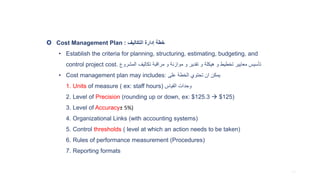
Cost Management Plan : ‫التكاليف‬ ‫إدارة‬ ‫خطة‬
• Establish the criteria for planning, structuring, estimating, budgeting, and
control project cost. ‫المشروع‬ ‫تكاليف‬ ‫مراقبة‬ ‫و‬ ‫موازنة‬ ‫و‬ ‫تقدير‬ ‫و‬ ‫هيكلة‬ ‫و‬ ‫تخطيط‬ ‫معايير‬ ‫تأسيس‬
• Cost management plan may includes: ‫على‬ ‫الخطة‬ ‫تحتوي‬ ‫ان‬ ‫يمكن‬
1. Units of measure ( ex: staff hours) ‫القياس‬ ‫وحدات‬
2. Level of Precision (rounding up or down, ex: $125.3  $125)
3. Level of Accuracy± 5%)
4. Organizational Links (with accounting systems)
5. Control thresholds ( level at which an action needs to be taken)
6. Rules of performance measurement (Procedures)
7. Reporting formats
O
43
44
Cost Estimates:
Costs are estimated for all resources such as:
• Direct Cost (Labor, materials, equipment, services, facilities, IT)
• Cost of financing (interest), inflation allowance, exchange rates.
• Contingency reserve.
• Insurance fees.
• Taxes
• Overhead (Site overhead and main office)
O
45
Basis of Estimates :
• Supporting documentation which provides understanding of how the cost estimate was
derived.
• This may includes:
• Assumptions.
• Constraints.
• Ranges of accuracy (ex:± 5%).
• Confidence level of the final cost estimate.
O
Types of Estimation:
1. One-point (Bottom-up).
2. Analogous (top-down).
3. Parametric.
4. Heuristics.
5. Three-point.
46
47
48
49
Earned Value Management : ‫المكتسبة‬ ‫القيمة‬ ‫ادارة‬
• Planned Value (PV) = Budgeted cost for work scheduled (BCWS)
‫محددة‬ ‫زمنية‬ ‫نقطة‬ ‫عند‬ ‫تنفيذها‬ ‫المخطط‬ ‫األعمال‬ ‫قيمة‬
• Earned value (EV) = Budgeted cost for work performed (BCWP)
‫محددة‬ ‫زمنية‬ ‫نقطة‬ ‫عند‬ ‫فعلية‬ ‫اعمال‬ ‫تنفيذ‬ ‫من‬ ‫المكتسبة‬ ‫القيمة‬
• Actual Cost (AC) = Actual cost for work performed (ACWP)
‫تنفيذها‬ ‫تم‬ ‫التي‬ ‫لالعمال‬ ‫الفعلية‬ ‫التكاليف‬
• Schedule Variance (SV) = EV – PV ‫انحراف‬
(
‫تباين‬
)
‫الزمني‬ ‫الجدول‬
• Cost Variance (CV) = EV – AC ‫التكلفة‬ ‫انحراف‬
• Schedule Performance Index (SPI) = EV / PV ‫الزمني‬ ‫الجدول‬ ‫أداء‬ ‫مؤشر‬
• Cost Performance Index (CPI) = EV / AC ‫التكلفة‬ ‫أداء‬ ‫مؤشر‬
Behind Schedule ‫متأخر‬
‫الجدول‬ ‫عن‬
SV < 0
On Schedule ‫الجدول‬ ‫مع‬
SV = 0
Ahead of Schedule ‫الجدول‬ ‫سابق‬
SV > 0
Over Budget ‫الميزانية‬ ‫تعدى‬
CV < 0
On Budget ‫الميزانية‬ ‫مع‬
CV = 0
Under Budget ‫الميزانية‬ ‫نطاق‬ ‫داخل‬
CV > 0
Behind Schedule
SPI < 1
On Schedule
SPI = 1
Ahead of Schedule
SPI > 1
Over Budget ‫الميزانية‬ ‫تعدى‬
CPI < 1
On Budget ‫الميزانية‬ ‫مع‬
CPI = 1
Under Budget ‫الميزانية‬ ‫نطاق‬ ‫داخل‬
CPI > 1
TT
50
Forecasting : ‫معايير‬ ‫خالل‬ ‫من‬ ‫التوقع‬
• Estimate at Completion (EAC) = Actual Cost+ Estimate to Complete (ETC).
‫المشروع‬ ‫نهاية‬ ‫في‬ ‫المتوقعة‬ ‫القيمة‬
=
‫اآلن‬ ‫حتى‬ ‫الفعلية‬ ‫القيمة‬
+
‫المشروع‬ ‫النهاء‬ ‫المتوقع‬
• There are various methods to calculate the Estimate to Complete (ETC)
‫المشروع‬ ‫النهاء‬ ‫المتوقعة‬ ‫القيمة‬ ‫لحساب‬ ‫طرق‬ ‫عدة‬ ‫يوجد‬
1- At the budgeted rate :
EAC = AC + (BAC – EV)
2- Considering CPI :
EAC = AC + [ (BAC – EV) / CPI ] = AC + BAC/CPI – EV/CPI
= AC + BAC/CPI – AC = BAC / CPI
3- Considering CPI and SPI :
EAC = AC + [ (BAC – EV) / (CPI x SPI) ]
TT
51
To Complete Performance Index (TCPI) : ‫المشروع‬ ‫إلكمال‬ ‫المطلوبة‬ ‫للقيمة‬ ‫اآلداء‬ ‫مؤشر‬
• It’s the cost performance that must be achieved on the remaining work to
meet a specified goal like BAC or EAC ‫القادمة‬ ‫الفترة‬ ‫في‬ ‫تحقيقه‬ ‫المطلوب‬ ‫المالي‬ ‫االداء‬
• It represents the ratio between remaining works and remaining funds.
‫المتبقي‬ ‫التمويل‬ ‫قيمة‬ ‫و‬ ‫المتبقية‬ ‫االعمال‬ ‫قيمة‬ ‫بين‬ ‫النسبة‬ ‫تمثل‬
• TCPI = (BAC-EV) / (BAC – AC)
Or TCPI = (BAC-EV) / (EAC – AC) “If the BAC is no longer valid”
• Ex :
BAC = 500’000.00 , EV = 200’000.00, AC= 250’000.00
TCPI = (300’000.00 ) / (250’000.00) = 1.2
TT
Performance Reviews :
• Variance at completion (VAC) = BAC – EAC
• Trend Analysis: Graphical analysis examines project performance over time.
• EVM
TT
52
53
54
55
56
57
58
Project
Charter
SH s
Requiremen
ts
Scope
Statement
WBS
Risk
Identificatio
n
Risk analysis
Risk
Responses
Activities
Resources
CP
Procuremen
t
Quality
SH s/Comm.
plan
Cost
Budget
Questions
59

day 3-2 PMP.pptx

  • 1.
    Schedule Network Analysis: •Criticalpath method. •Schedule compression. •Modeling. •Resource optimization. •Critical chain method. 1
  • 2.
  • 3.
    Benefits: 1. Project length. 2.Focus areas. 3. Warnings. 4. Compression vehicle. 5. Acceptable delays (float activities). 3
  • 4.
  • 5.
  • 6.
  • 7.
  • 8.
  • 9.
  • 10.
  • 11.
  • 12.
  • 13.
  • 14.
  • 15.
  • 16.
  • 17.
  • 18.
  • 19.
  • 20.
  • 21.
  • 22.
  • 23.
  • 24.
  • 25.
  • 26.
  • 27.
  • 28.
  • 29.
  • 30.
  • 31.
  • 32.
    Trends (Adaptive; Agile) Iterative(rollingwave) On-Demand (Knaban) 32
  • 33.
  • 34.
    Schedule Management Ref# ScheuleManagement Process Process Group 6.1 Plan schedule management Planning 6.2 Define activities Planning 6.3 Sequence activities Planning 6.4 Estimate activity durations Planning 6.5 Develop schedule Planning 6.6 Control schedule Monitoring & controlling 34
  • 35.
  • 36.
    What activities areinvolved in this process? 36
  • 37.
  • 38.
  • 39.
    0. Introduction 1. PlanCost Management 2. Estimate Costs 3. Determine Budget 4. Control Costs 39
  • 40.
  • 41.
    Terms :  LifeCycle Cost  Value Analysis (value engineering)  Direct vs. Indirect Cost  Fixed vs. Variable Cost  Funding  Resources  Analysis  Cost of quality  Bid analysis  Cost aggregation  Reserve analysis  Funding limit reconciliation  Cost baseline 41 Cost estimates Contingency Reserve Management Reserve Cost Budget Cost Baseline
  • 42.
  • 43.
    Cost Management Plan: ‫التكاليف‬ ‫إدارة‬ ‫خطة‬ • Establish the criteria for planning, structuring, estimating, budgeting, and control project cost. ‫المشروع‬ ‫تكاليف‬ ‫مراقبة‬ ‫و‬ ‫موازنة‬ ‫و‬ ‫تقدير‬ ‫و‬ ‫هيكلة‬ ‫و‬ ‫تخطيط‬ ‫معايير‬ ‫تأسيس‬ • Cost management plan may includes: ‫على‬ ‫الخطة‬ ‫تحتوي‬ ‫ان‬ ‫يمكن‬ 1. Units of measure ( ex: staff hours) ‫القياس‬ ‫وحدات‬ 2. Level of Precision (rounding up or down, ex: $125.3  $125) 3. Level of Accuracy± 5%) 4. Organizational Links (with accounting systems) 5. Control thresholds ( level at which an action needs to be taken) 6. Rules of performance measurement (Procedures) 7. Reporting formats O 43
  • 44.
  • 45.
    Cost Estimates: Costs areestimated for all resources such as: • Direct Cost (Labor, materials, equipment, services, facilities, IT) • Cost of financing (interest), inflation allowance, exchange rates. • Contingency reserve. • Insurance fees. • Taxes • Overhead (Site overhead and main office) O 45 Basis of Estimates : • Supporting documentation which provides understanding of how the cost estimate was derived. • This may includes: • Assumptions. • Constraints. • Ranges of accuracy (ex:± 5%). • Confidence level of the final cost estimate. O
  • 46.
    Types of Estimation: 1.One-point (Bottom-up). 2. Analogous (top-down). 3. Parametric. 4. Heuristics. 5. Three-point. 46
  • 47.
  • 48.
  • 49.
  • 50.
    Earned Value Management: ‫المكتسبة‬ ‫القيمة‬ ‫ادارة‬ • Planned Value (PV) = Budgeted cost for work scheduled (BCWS) ‫محددة‬ ‫زمنية‬ ‫نقطة‬ ‫عند‬ ‫تنفيذها‬ ‫المخطط‬ ‫األعمال‬ ‫قيمة‬ • Earned value (EV) = Budgeted cost for work performed (BCWP) ‫محددة‬ ‫زمنية‬ ‫نقطة‬ ‫عند‬ ‫فعلية‬ ‫اعمال‬ ‫تنفيذ‬ ‫من‬ ‫المكتسبة‬ ‫القيمة‬ • Actual Cost (AC) = Actual cost for work performed (ACWP) ‫تنفيذها‬ ‫تم‬ ‫التي‬ ‫لالعمال‬ ‫الفعلية‬ ‫التكاليف‬ • Schedule Variance (SV) = EV – PV ‫انحراف‬ ( ‫تباين‬ ) ‫الزمني‬ ‫الجدول‬ • Cost Variance (CV) = EV – AC ‫التكلفة‬ ‫انحراف‬ • Schedule Performance Index (SPI) = EV / PV ‫الزمني‬ ‫الجدول‬ ‫أداء‬ ‫مؤشر‬ • Cost Performance Index (CPI) = EV / AC ‫التكلفة‬ ‫أداء‬ ‫مؤشر‬ Behind Schedule ‫متأخر‬ ‫الجدول‬ ‫عن‬ SV < 0 On Schedule ‫الجدول‬ ‫مع‬ SV = 0 Ahead of Schedule ‫الجدول‬ ‫سابق‬ SV > 0 Over Budget ‫الميزانية‬ ‫تعدى‬ CV < 0 On Budget ‫الميزانية‬ ‫مع‬ CV = 0 Under Budget ‫الميزانية‬ ‫نطاق‬ ‫داخل‬ CV > 0 Behind Schedule SPI < 1 On Schedule SPI = 1 Ahead of Schedule SPI > 1 Over Budget ‫الميزانية‬ ‫تعدى‬ CPI < 1 On Budget ‫الميزانية‬ ‫مع‬ CPI = 1 Under Budget ‫الميزانية‬ ‫نطاق‬ ‫داخل‬ CPI > 1 TT 50
  • 51.
    Forecasting : ‫معايير‬‫خالل‬ ‫من‬ ‫التوقع‬ • Estimate at Completion (EAC) = Actual Cost+ Estimate to Complete (ETC). ‫المشروع‬ ‫نهاية‬ ‫في‬ ‫المتوقعة‬ ‫القيمة‬ = ‫اآلن‬ ‫حتى‬ ‫الفعلية‬ ‫القيمة‬ + ‫المشروع‬ ‫النهاء‬ ‫المتوقع‬ • There are various methods to calculate the Estimate to Complete (ETC) ‫المشروع‬ ‫النهاء‬ ‫المتوقعة‬ ‫القيمة‬ ‫لحساب‬ ‫طرق‬ ‫عدة‬ ‫يوجد‬ 1- At the budgeted rate : EAC = AC + (BAC – EV) 2- Considering CPI : EAC = AC + [ (BAC – EV) / CPI ] = AC + BAC/CPI – EV/CPI = AC + BAC/CPI – AC = BAC / CPI 3- Considering CPI and SPI : EAC = AC + [ (BAC – EV) / (CPI x SPI) ] TT 51
  • 52.
    To Complete PerformanceIndex (TCPI) : ‫المشروع‬ ‫إلكمال‬ ‫المطلوبة‬ ‫للقيمة‬ ‫اآلداء‬ ‫مؤشر‬ • It’s the cost performance that must be achieved on the remaining work to meet a specified goal like BAC or EAC ‫القادمة‬ ‫الفترة‬ ‫في‬ ‫تحقيقه‬ ‫المطلوب‬ ‫المالي‬ ‫االداء‬ • It represents the ratio between remaining works and remaining funds. ‫المتبقي‬ ‫التمويل‬ ‫قيمة‬ ‫و‬ ‫المتبقية‬ ‫االعمال‬ ‫قيمة‬ ‫بين‬ ‫النسبة‬ ‫تمثل‬ • TCPI = (BAC-EV) / (BAC – AC) Or TCPI = (BAC-EV) / (EAC – AC) “If the BAC is no longer valid” • Ex : BAC = 500’000.00 , EV = 200’000.00, AC= 250’000.00 TCPI = (300’000.00 ) / (250’000.00) = 1.2 TT Performance Reviews : • Variance at completion (VAC) = BAC – EAC • Trend Analysis: Graphical analysis examines project performance over time. • EVM TT 52
  • 53.
  • 54.
  • 55.
  • 56.
  • 57.
  • 58.
  • 59.