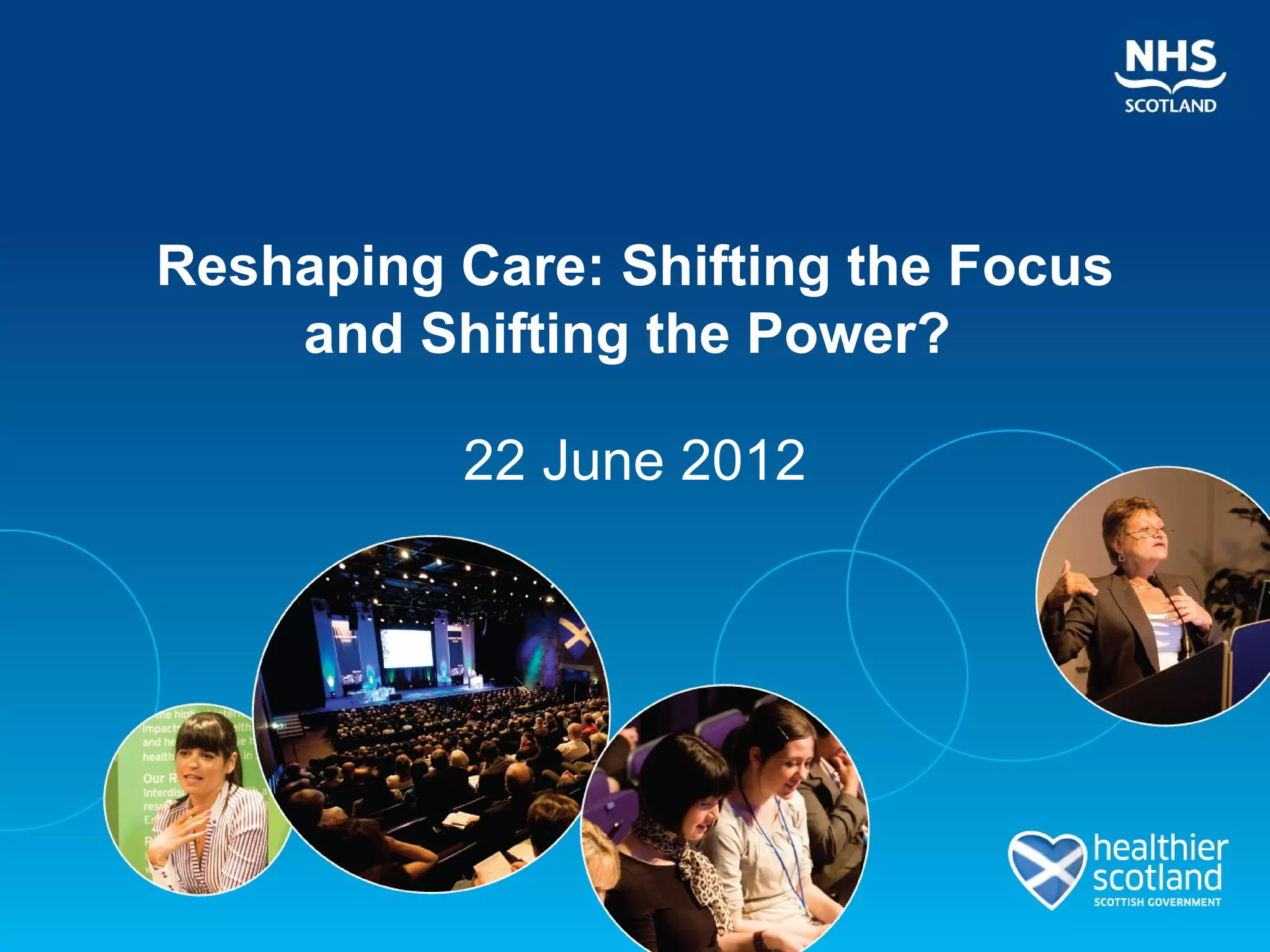
Reshaping Care: Shifting the Focus
    and Shifting the Power?

          22 June 2012
Chair:

                Martin Sime
             Chief Executive
Scottish Council for Voluntary Organisations
                   (SCVO)
Elaine Lamont
     NHS Dumfries & Galloway

Community Engagement, Resilience &
   Health Service Development
     in Annandale & Eskdale
Community…


• Engagement
• Resilience
• Health Service Development
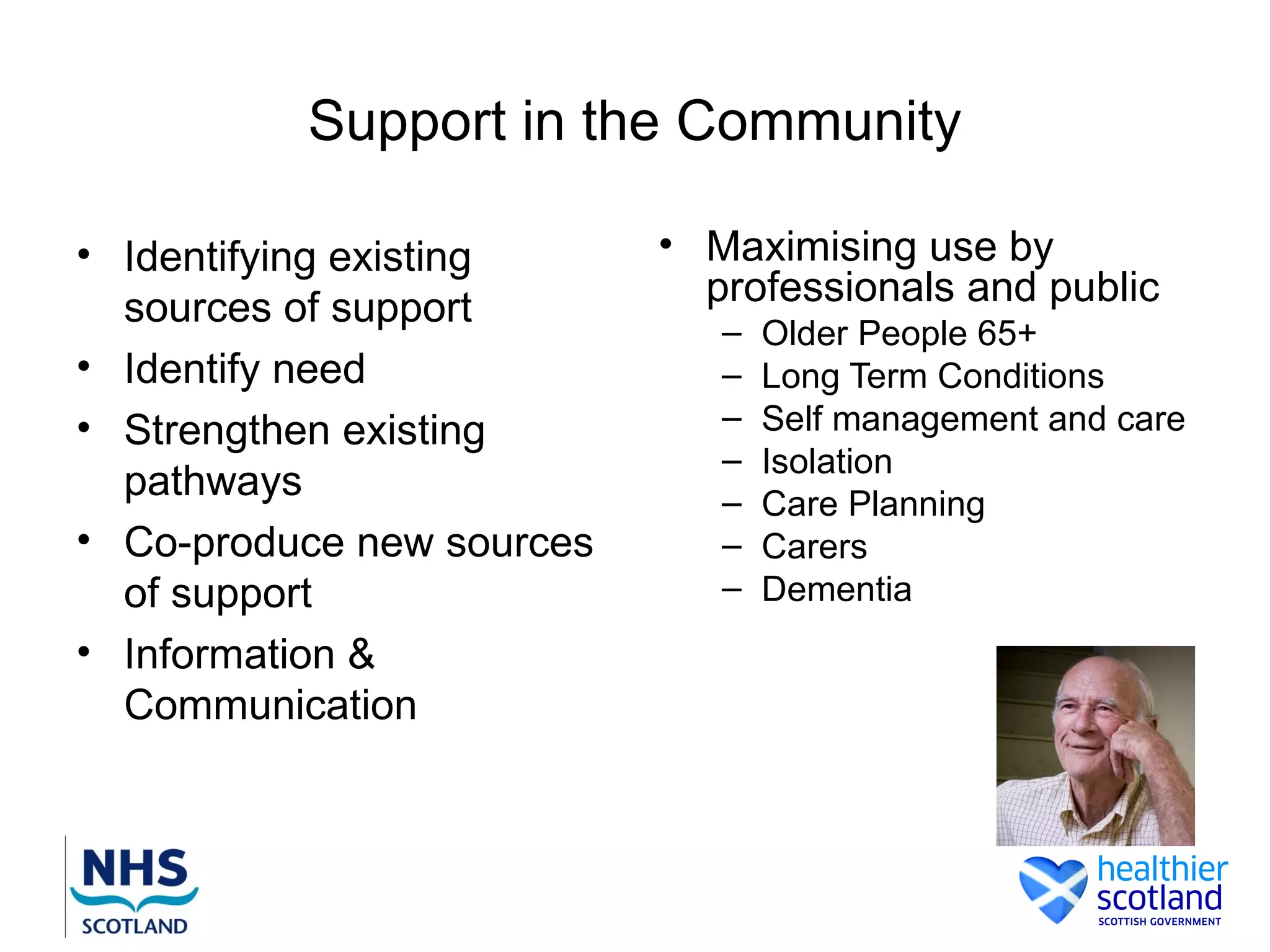
Support in the Community

• Identifying existing     • Maximising use by
  sources of support         professionals and public
                              –   Older People 65+
• Identify need               –   Long Term Conditions
• Strengthen existing         –   Self management and care
                              –   Isolation
  pathways                    –   Care Planning
• Co-produce new sources      –   Carers
  of support                  –   Dementia
• Information &
  Communication
‘Tests of change’

1. Establish appropriate methods to ensure information is
   accessible to those who need it.
2. Increase wellbeing and confidence to self- manage
   through better provision and use of appropriate support
   in the community
3. Create and co-ordinate health and wellbeing related
   learning opportunities – individuals, communities and
   organisations
4. Carers are informed, involved and supported
How are we doing this...?
•   Community Agents and                   Strengthening capacity and
    Development Worker                        resilience across all sectors
     – Mapping                             – Cultural/attitude/behaviour
                                              change
     – Gathering and sharing
       information and views               – Connecting people,
                                              communities, professionals
     – Identifying hidden Carers              and services Identifying
     – co-production of support               learning needs for health and
       services                               wellbeing
     – Signposting and enabling            – Consistent and sustainable
       access                                 delivery

•   Communication and information     •   Evaluation
     – Information Hubs                    – Local measurement tools
     – ALISS                               – Consistent measurement
     – Broadband Pathfinder - Annan          methods across projects e.g.
       TV                                    Wellbeing Tool, Carers
                                             Assessment, Staff Survey,
                                             Service User Questionnaire,
                                             Story Telling and Focus
                                             Groups.
Norrie Moane
          Signpost Recovery

Community Development and Older Adults
    Support in Clackmannanshire
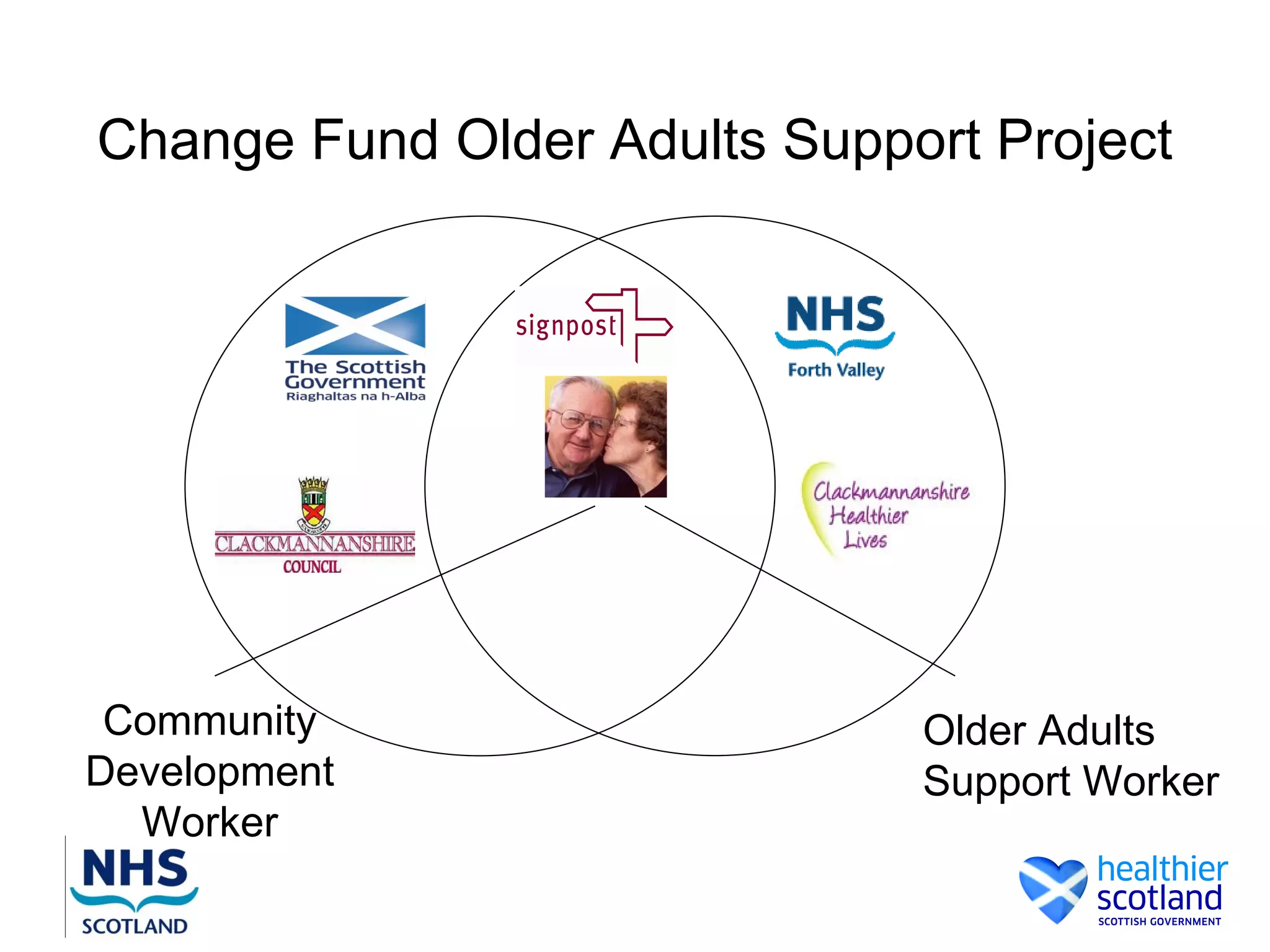
Change Fund Older Adults Support Project


 Community                    Older Adults
Development                   Support Worker
  Worker
Project Methodology

• Delivered by Signpost Recovery through its CHL function
• Service has two distinct complimentary arms –Support &
  Development
• Implementation – Moane (2012)
• Local Change Plan JIT Clackmannanshire (2012)–
  Project Outcomes
• Interventions and Monitoring
• Evidence and Evaluation
• The Project in Action?
Clackmannanshire Older Adults Forum


Early Successes
Flora Henderson
       Thistle Foundation
“We believe that life is for living.”

    Lifestyle Management for
     Long Terms Conditions
Lifestyle Management
• Lifestyle management addresses common needs,
  concerns and hopes people have when living with a
  long term condition.
• The service is staff led, but co-facilitated by peer
  volunteers who have come through the programme and
  have personal experience of a long term condition.
• The 10 x 3 h sessions are informed by person-centred
  working, solution focused practice and medical
  rehabilitation programmes.
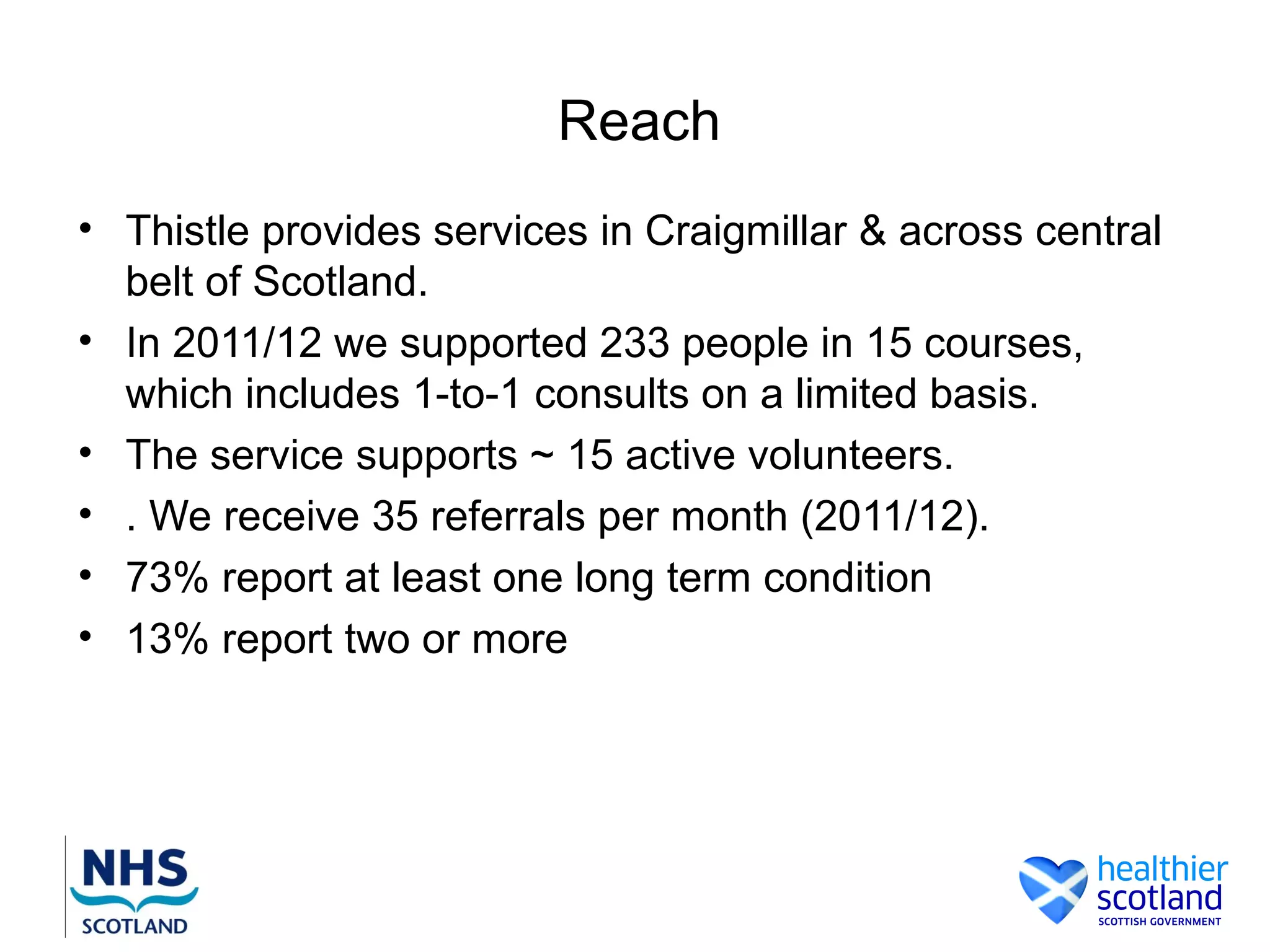
Reach
• Thistle provides services in Craigmillar & across central
  belt of Scotland.
• In 2011/12 we supported 233 people in 15 courses,
  which includes 1-to-1 consults on a limited basis.
• The service supports ~ 15 active volunteers.
• . We receive 35 referrals per month (2011/12).
• 73% report at least one long term condition
• 13% report two or more
Outcomes

• As a result of our programme, people increase their
  confidence, ability to cope, and mood.
• As a result of improving their situation, we notice that
  people want to stay connected through volunteering.
• People who access our service value peer support highly,
  and volunteers say it helps them maintain and continue
  positive health behaviours.
• We notice that people use lifestyle management skills to
  better manage relapses and sometimes use other
  services differently
What Makes “The Difference”

• Personal outreach for people in complex situations: there
  is a need for persistence and a personal approach.
•      - encourage access of other services & follow up
• A non-expert approach which is about noticing small
  changes and exploring what helps a person move on.
• An inclusive approach
•      - it’s ok to drop out and come back later
•      - it’s ok to stop volunteering and use the service
•      - promoting choice (not exclusion criteria)
Irene Oldfather
Long Term Conditions Alliance Scotland
              (LTCAS)

            Active Ageing
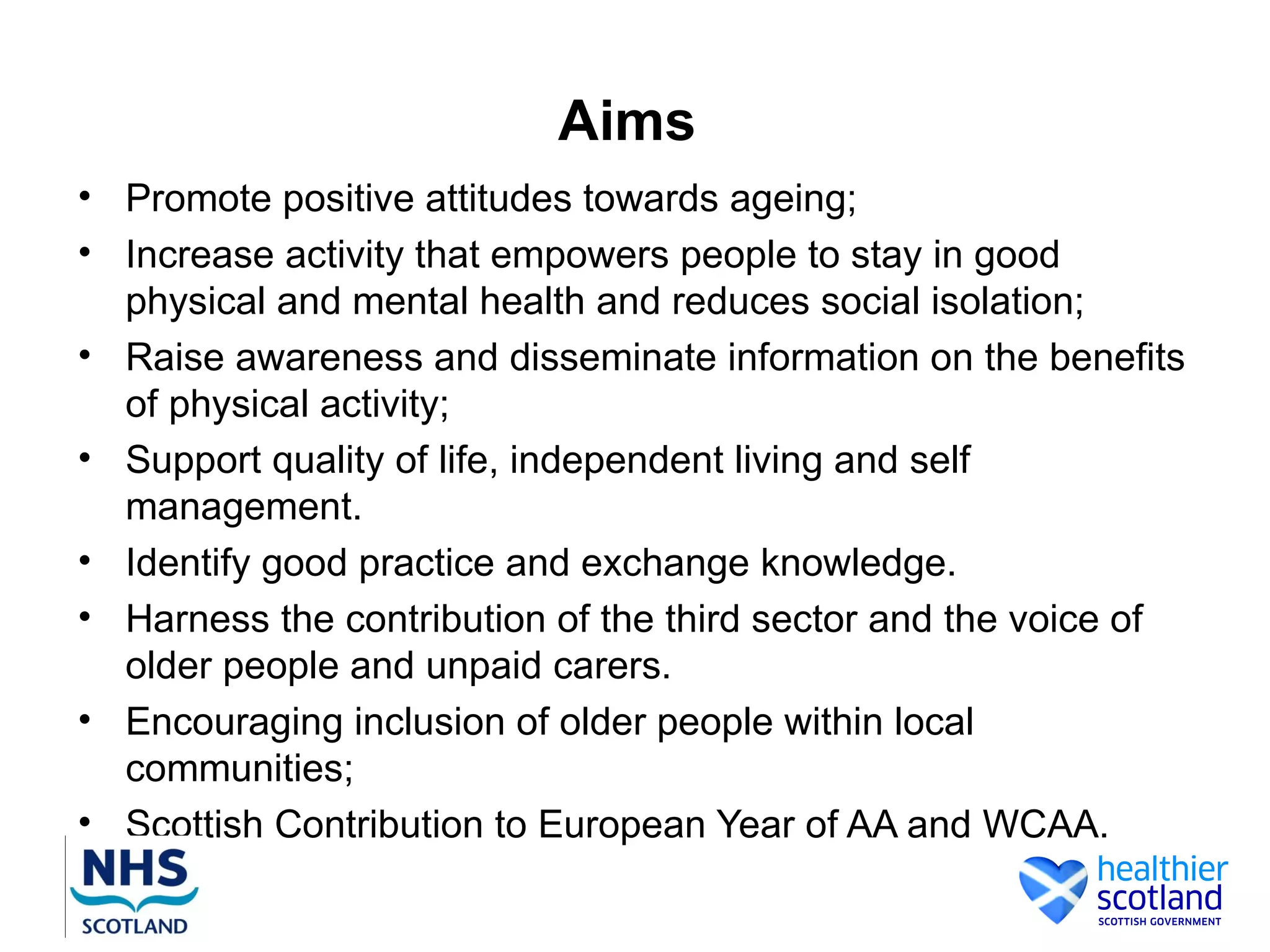
Aims
• Promote positive attitudes towards ageing;
• Increase activity that empowers people to stay in good
  physical and mental health and reduces social isolation;
• Raise awareness and disseminate information on the benefits
  of physical activity;
• Support quality of life, independent living and self
  management.
• Identify good practice and exchange knowledge.
• Harness the contribution of the third sector and the voice of
  older people and unpaid carers.
• Encouraging inclusion of older people within local
  communities;
• Scottish Contribution to European Year of AA and WCAA.
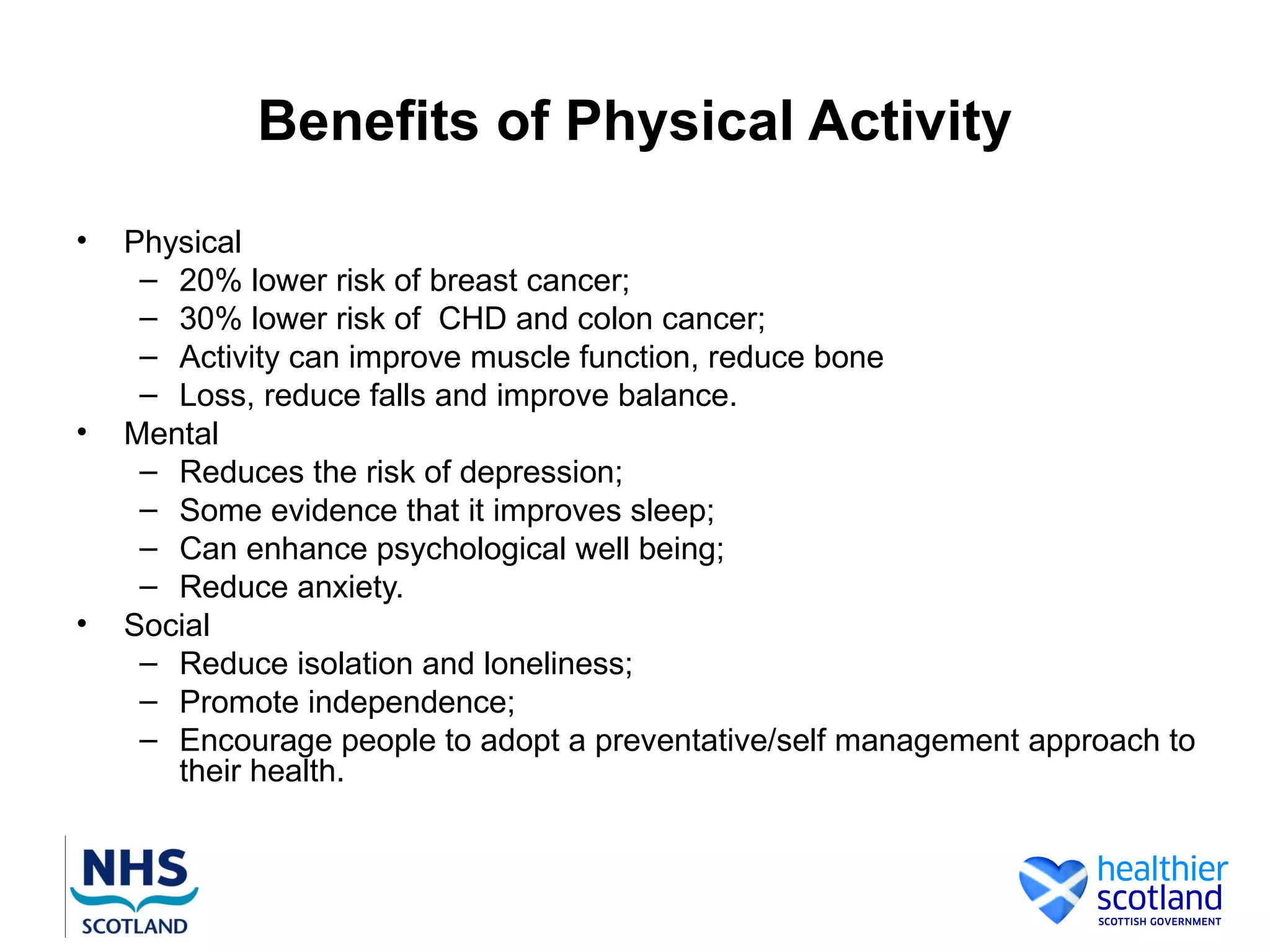
Benefits of Physical Activity
•   Physical
     – 20% lower risk of breast cancer;
     – 30% lower risk of CHD and colon cancer;
     – Activity can improve muscle function, reduce bone
     – Loss, reduce falls and improve balance.
•   Mental
     – Reduces the risk of depression;
     – Some evidence that it improves sleep;
     – Can enhance psychological well being;
     – Reduce anxiety.
•   Social
     – Reduce isolation and loneliness;
     – Promote independence;
     – Encourage people to adopt a preventative/self management approach to
       their health.
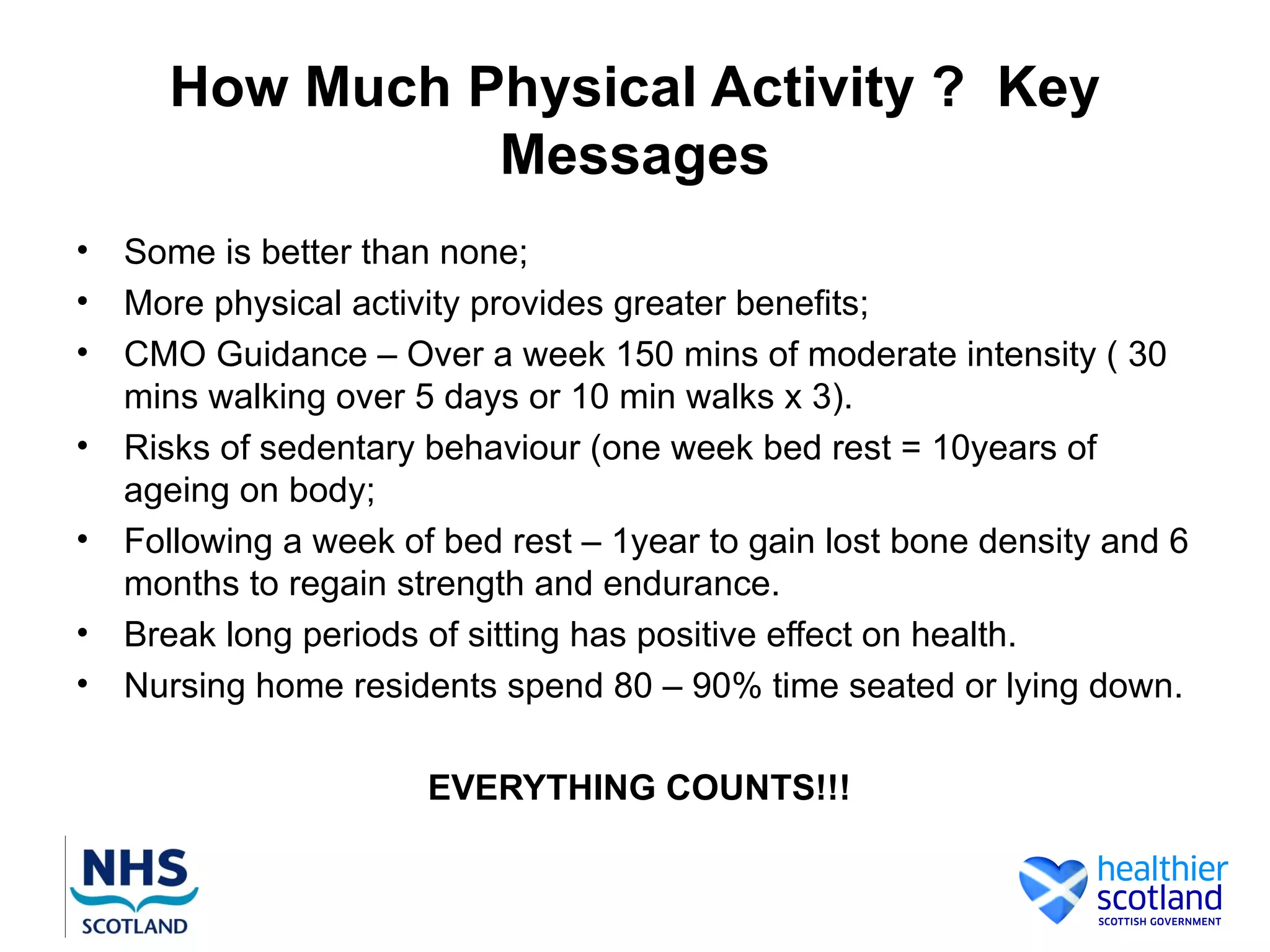
How Much Physical Activity ? Key
                Messages
•   Some is better than none;
•   More physical activity provides greater benefits;
•   CMO Guidance – Over a week 150 mins of moderate intensity ( 30
    mins walking over 5 days or 10 min walks x 3).
•   Risks of sedentary behaviour (one week bed rest = 10years of
    ageing on body;
•   Following a week of bed rest – 1year to gain lost bone density and 6
    months to regain strength and endurance.
•   Break long periods of sitting has positive effect on health.
•   Nursing home residents spend 80 – 90% time seated or lying down.

                       EVERYTHING COUNTS!!!
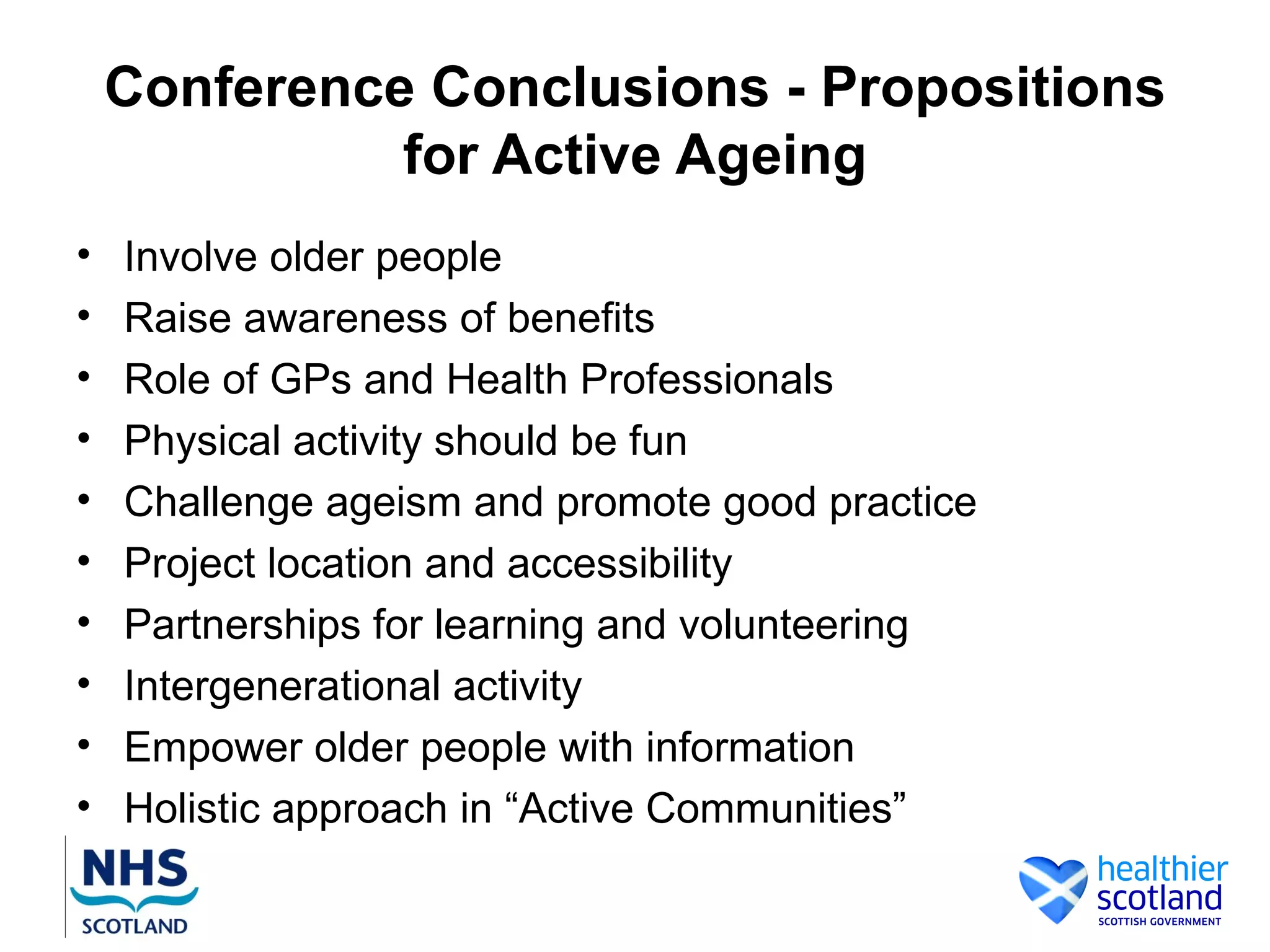
Conference Conclusions - Propositions
              for Active Ageing
•   Involve older people
•   Raise awareness of benefits
•   Role of GPs and Health Professionals
•   Physical activity should be fun
•   Challenge ageism and promote good practice
•   Project location and accessibility
•   Partnerships for learning and volunteering
•   Intergenerational activity
•   Empower older people with information
•   Holistic approach in “Active Communities”
Gerry Power
        National Lead
Community Capacity Building
      & Coproduction
  Joint Improvement Team

Parallel Session 3.6 Reshaping Care - Shifting the Focus and Shifting the Power?

  • 1.
    Reshaping Care: Shiftingthe Focus and Shifting the Power? 22 June 2012
  • 2.
    Chair: Martin Sime Chief Executive Scottish Council for Voluntary Organisations (SCVO)
  • 3.
    Elaine Lamont NHS Dumfries & Galloway Community Engagement, Resilience & Health Service Development in Annandale & Eskdale
  • 4.
  • 5.
    Support in theCommunity • Identifying existing • Maximising use by sources of support professionals and public – Older People 65+ • Identify need – Long Term Conditions • Strengthen existing – Self management and care – Isolation pathways – Care Planning • Co-produce new sources – Carers of support – Dementia • Information & Communication
  • 6.
    ‘Tests of change’ 1.Establish appropriate methods to ensure information is accessible to those who need it. 2. Increase wellbeing and confidence to self- manage through better provision and use of appropriate support in the community 3. Create and co-ordinate health and wellbeing related learning opportunities – individuals, communities and organisations 4. Carers are informed, involved and supported
  • 7.
    How are wedoing this...? • Community Agents and Strengthening capacity and Development Worker resilience across all sectors – Mapping – Cultural/attitude/behaviour change – Gathering and sharing information and views – Connecting people, communities, professionals – Identifying hidden Carers and services Identifying – co-production of support learning needs for health and services wellbeing – Signposting and enabling – Consistent and sustainable access delivery • Communication and information • Evaluation – Information Hubs – Local measurement tools – ALISS – Consistent measurement – Broadband Pathfinder - Annan methods across projects e.g. TV Wellbeing Tool, Carers Assessment, Staff Survey, Service User Questionnaire, Story Telling and Focus Groups.
  • 8.
    Norrie Moane Signpost Recovery Community Development and Older Adults Support in Clackmannanshire
  • 9.
    Change Fund OlderAdults Support Project Community Older Adults Development Support Worker Worker
  • 10.
    Project Methodology • Deliveredby Signpost Recovery through its CHL function • Service has two distinct complimentary arms –Support & Development • Implementation – Moane (2012) • Local Change Plan JIT Clackmannanshire (2012)– Project Outcomes • Interventions and Monitoring • Evidence and Evaluation • The Project in Action?
  • 11.
    Clackmannanshire Older AdultsForum Early Successes
  • 12.
    Flora Henderson Thistle Foundation “We believe that life is for living.” Lifestyle Management for Long Terms Conditions
  • 13.
    Lifestyle Management • Lifestylemanagement addresses common needs, concerns and hopes people have when living with a long term condition. • The service is staff led, but co-facilitated by peer volunteers who have come through the programme and have personal experience of a long term condition. • The 10 x 3 h sessions are informed by person-centred working, solution focused practice and medical rehabilitation programmes.
  • 14.
    Reach • Thistle providesservices in Craigmillar & across central belt of Scotland. • In 2011/12 we supported 233 people in 15 courses, which includes 1-to-1 consults on a limited basis. • The service supports ~ 15 active volunteers. • . We receive 35 referrals per month (2011/12). • 73% report at least one long term condition • 13% report two or more
  • 15.
    Outcomes • As aresult of our programme, people increase their confidence, ability to cope, and mood. • As a result of improving their situation, we notice that people want to stay connected through volunteering. • People who access our service value peer support highly, and volunteers say it helps them maintain and continue positive health behaviours. • We notice that people use lifestyle management skills to better manage relapses and sometimes use other services differently
  • 16.
    What Makes “TheDifference” • Personal outreach for people in complex situations: there is a need for persistence and a personal approach. • - encourage access of other services & follow up • A non-expert approach which is about noticing small changes and exploring what helps a person move on. • An inclusive approach • - it’s ok to drop out and come back later • - it’s ok to stop volunteering and use the service • - promoting choice (not exclusion criteria)
  • 17.
    Irene Oldfather Long TermConditions Alliance Scotland (LTCAS) Active Ageing
  • 18.
    Aims • Promote positiveattitudes towards ageing; • Increase activity that empowers people to stay in good physical and mental health and reduces social isolation; • Raise awareness and disseminate information on the benefits of physical activity; • Support quality of life, independent living and self management. • Identify good practice and exchange knowledge. • Harness the contribution of the third sector and the voice of older people and unpaid carers. • Encouraging inclusion of older people within local communities; • Scottish Contribution to European Year of AA and WCAA.
  • 19.
    Benefits of PhysicalActivity • Physical – 20% lower risk of breast cancer; – 30% lower risk of CHD and colon cancer; – Activity can improve muscle function, reduce bone – Loss, reduce falls and improve balance. • Mental – Reduces the risk of depression; – Some evidence that it improves sleep; – Can enhance psychological well being; – Reduce anxiety. • Social – Reduce isolation and loneliness; – Promote independence; – Encourage people to adopt a preventative/self management approach to their health.
  • 20.
    How Much PhysicalActivity ? Key Messages • Some is better than none; • More physical activity provides greater benefits; • CMO Guidance – Over a week 150 mins of moderate intensity ( 30 mins walking over 5 days or 10 min walks x 3). • Risks of sedentary behaviour (one week bed rest = 10years of ageing on body; • Following a week of bed rest – 1year to gain lost bone density and 6 months to regain strength and endurance. • Break long periods of sitting has positive effect on health. • Nursing home residents spend 80 – 90% time seated or lying down. EVERYTHING COUNTS!!!
  • 21.
    Conference Conclusions -Propositions for Active Ageing • Involve older people • Raise awareness of benefits • Role of GPs and Health Professionals • Physical activity should be fun • Challenge ageism and promote good practice • Project location and accessibility • Partnerships for learning and volunteering • Intergenerational activity • Empower older people with information • Holistic approach in “Active Communities”
  • 22.
    Gerry Power National Lead Community Capacity Building & Coproduction Joint Improvement Team