COMMUNITY DEVELOPMENT,
  TRANSFORMATION AND
 DEPRIVED COMMUNITIES

        Dr Brian Fisher MBE
   GP and lead for the HELP project
     Chair of the Socialist Health
             Association
THE CONVERSATION TODAY
• An opportunity for change
• The evidence for community
  development in health
• The HELP approach
• Outcomes of HELP
• Cost-benefit
AN OPPORTUNITY
• A new approach to population health through
  community development
• Wraps around primary care
• Enhances community strength and resilience.
• Saves money – joint funding from LA/CCG
  through HWBs
• A number of models to choose from
  – HELP
  – Altogether Better
  – Turning Point
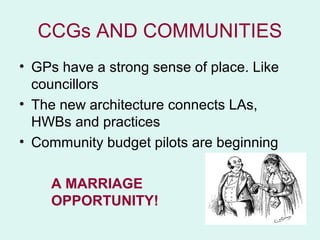
CCGs AND COMMUNITIES
• GPs have a strong sense of place. Like
  councillors
• The new architecture connects LAs,
  HWBs and practices
• Community budget pilots are beginning

    A MARRIAGE
    OPPORTUNITY!
A BIT OF THEORY
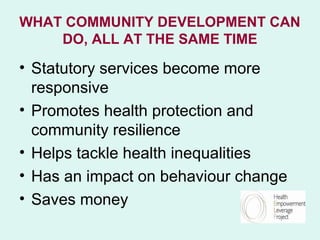
WHAT COMMUNITY DEVELOPMENT CAN
    DO, ALL AT THE SAME TIME

• Statutory services become more
  responsive
• Promotes health protection and
  community resilience
• Helps tackle health inequalities
• Has an impact on behaviour change
• Saves money
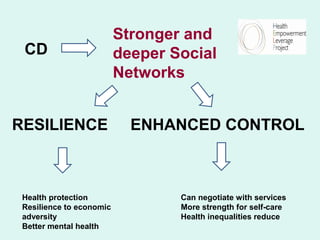
Stronger and
 CD                       deeper Social
                          Networks


RESILIENCE                  ENHANCED CONTROL


 Health protection                Can negotiate with services
 Resilience to economic           More strength for self-care
 adversity                        Health inequalities reduce
 Better mental health
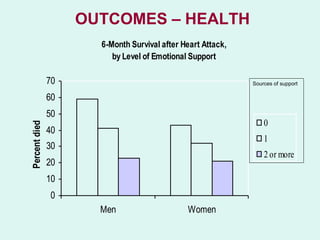
OUTCOMES – HEALTH
                      6-Month Survival after Heart Attack,
                         by Level of Emotional Support

               70                                            Sources of support

               60
               50
                                                                 0
Percent died


               40
                                                                 1
               30
                                                                 2 or more
               20
               10
               0
                      Men                     Women
SOCIAL NETWORKS
        REDUCE MORTALITY RISK
• 50 % increased likelihood of survival for people
  with stronger social relationships .
• Comparable with risks such as smoking, alcohol,
  BMI and physical activity.
• Consistent across age,
  sex, cause of death.

•   2010 meta-analysis of data [1] across 308,849 individuals,
    followed for an average of 7.5 years
    1] Social relationships and mortality risk: a meta-analytic review. Holt-Lunstadt,
    Smith, Bradley Layton.Plos Medicine July 2010, Vol 7, Issue 7.
    www.plosmedicine.org doi:10.1371/journal.pmed.1000316
www.healthempowermentgroup.org.uk
THE HELP PROJECT
• A business case for investment in CD
  in health
• Small team supporting work in 3
  estates in 3 areas - Devon,
  Wandsworth, Solihull
• Builds on 12 years experience
• Evidence-based, replicable
THE HELP APPROACH
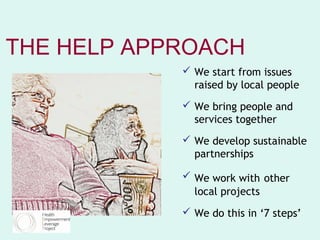
             We start from issues
              raised by local people
             We bring people and
              services together
             We develop sustainable
              partnerships

             We work with other
              local projects
             We do this in ‘7 steps’
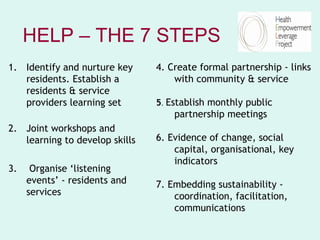
HELP – THE 7 STEPS
1. Identify and nurture key     4. Create formal partnership - links
   residents. Establish a           with community & service
   residents & service
   providers learning set       5. Establish monthly public
                                    partnership meetings
2. Joint workshops and
   learning to develop skills   6. Evidence of change, social
                                    capital, organisational, key
                                    indicators
3.    Organise ‘listening
     events’ - residents and    7. Embedding sustainability -
     services                       coordination, facilitation,
                                    communications
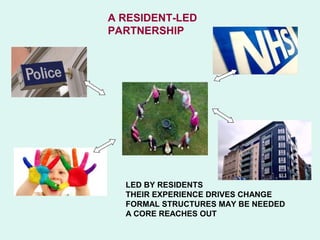
A RESIDENT-LED
PARTNERSHIP


  LED BY RESIDENTS
  THEIR EXPERIENCE DRIVES CHANGE
  FORMAL STRUCTURES MAY BE NEEDED
  A CORE REACHES OUT
WHAT COMMUNITY DEVELOPMENT CAN
    DO, ALL AT THE SAME TIME

• Statutory services become more
  responsive
• Promotes health protection and
  community resilience
• Helps tackle health inequalities
• Has an impact on behaviour change
• Saves money
OUTCOMES - RESPONSIVE
         SERVICES
• Services begin to change within 6
  months
• Affects many sectors simultaneously
  (health, police, education)
• Communities gain confidence and
  leaders emerge
• Staff enjoy their jobs more
RESPONSIVE SERVICES
• A new dental service established
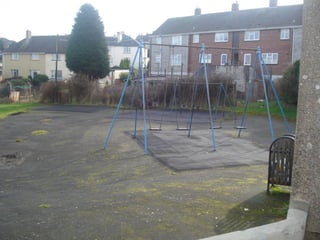
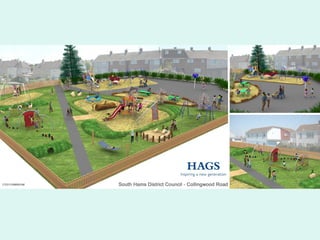
• Funding of £95k to transform a derelict area into
  a playpark awarded
• A new GP surgery planned
• Well attended social events and football
  sessions
• Relations with the housing department improved
  and tenants more satisfied.
• Summer holiday activities for all ages
• A cooperative plan for social renewal agreed
  between the community and public agencies
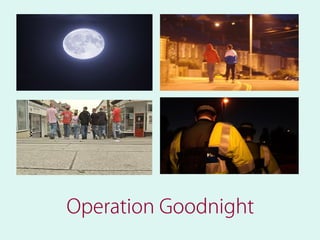
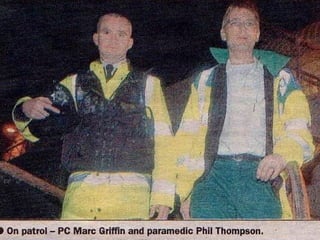
Operation Goodnight
OUTCOMES - TACKLING
     HEALTH INEQUALITIES
• Strong communities are key
• Health Inequalities are mediated through
  feelings of lack of control
• Unequal communities have few SNs and
  lack a sense of control
• More confidence breeds more SNs,
  stronger more vibrant communities
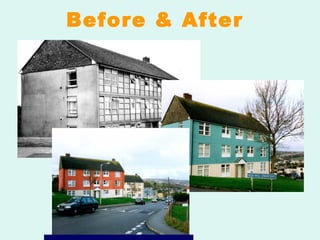
Before & After
OUTCOMES - BEHAVIOUR
         CHANGE – NICE
•   safer cycling
•   improved housing
•   reducing alcohol-related crashes,
•   improving alcohol-related behaviours
•   helping prevent injuries to children,
•   promoting a healthy diet in children.
•   effective promotion of physical activity
    through walking.
COST-BENEFIT MODEL
• Agreed baseline indicators relevant to
  partnership activity
• Evidence base relevant to indicator
• Cost indicator: agreed indicative
  reduction applied to current baseline
• Add social capital dividend
• Add value of extension of healthcare
  pathways into active community
INDICATORS
•   Cardiovascular disease admissions age <75
•   Depression – GP practice data
•   Obesity – adult and child
•   Older people falls
•   Emergency hospital admissions
•   A&E Attendance
•   Emergency ambulance calls
•   Crime and fear of crime
•   NEET
•   Special Educational Needs
A WORKED EXAMPLE - CVD
    •More trust, cooperation, social and physical activity
• weight management;
• smoking cessation;
• buggy walking route;
• health trainers;
• Pedal Power - bikes supplied by Police, aimed at ‘families with
  complex needs’ (older sibs as well as parents teaching younger sibs);
• woodland management including coppicing and den building;
• dance initiatives
 •Higher levels of social trust are associated with lower rates of
CHD; areas with higher social capital have lower CHD esp
amongst people with lower income. Physical activity
beneficial
 • Indicative 5% reduction in CVD admissions to be
substantiated: 12 admissions in n’hood of 4,200, saving
£55,000
CRIME – A CASE STUDY
• “This downward trend is more than likely due to
  the introduction of a permanent PCSO for
  Townstal and a more regular link with the
  Dartmouth Community College and the school.”


• “The community involvement of the Townstal
  Community Partnership giving the residents
  ownership and a ‘say’ in what they want for
  Townstal has brought the community together
  and must be considered as a factor in this
  reduction of crime.”
                   • Townstal Beat Police sergeant
SOCIAL RETURN ON
           INVESTMENT
• With modest gains on the eight indicators, the
  model posits a saving of £559,000 over three
  years in a neighbourhood of 5,000 people, for an
  investment of £145,000: a return of 1:3.8
• For £233,655 invested across four authorities
  the social return was £3.5 million.
• For every £1 a local authority invests, £15 of
  value is created.
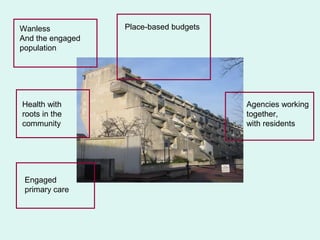
Wanless           Place-based budgets
And the engaged
population


Health with                             Agencies working
roots in the                            together,
community                               with residents


 Engaged
 primary care
A HELP INTERVENTION
• Options
   – Evaluation
   – Advice
   – Support for intervention
• The Full Monty
   – Assessment of local scene, working with existing
     activities and people
   – Training your staff, leaving lasting skills
   – CD worker, a HELP associate
   – 90K per community

Community development, transformation and deprived communities

  • 1.
    COMMUNITY DEVELOPMENT, TRANSFORMATION AND DEPRIVED COMMUNITIES Dr Brian Fisher MBE GP and lead for the HELP project Chair of the Socialist Health Association
  • 2.
    THE CONVERSATION TODAY •An opportunity for change • The evidence for community development in health • The HELP approach • Outcomes of HELP • Cost-benefit
  • 3.
    AN OPPORTUNITY • Anew approach to population health through community development • Wraps around primary care • Enhances community strength and resilience. • Saves money – joint funding from LA/CCG through HWBs • A number of models to choose from – HELP – Altogether Better – Turning Point
  • 4.
    CCGs AND COMMUNITIES •GPs have a strong sense of place. Like councillors • The new architecture connects LAs, HWBs and practices • Community budget pilots are beginning A MARRIAGE OPPORTUNITY!
  • 5.
    A BIT OFTHEORY
  • 6.
    WHAT COMMUNITY DEVELOPMENTCAN DO, ALL AT THE SAME TIME • Statutory services become more responsive • Promotes health protection and community resilience • Helps tackle health inequalities • Has an impact on behaviour change • Saves money
  • 7.
    Stronger and CD deeper Social Networks RESILIENCE ENHANCED CONTROL Health protection Can negotiate with services Resilience to economic More strength for self-care adversity Health inequalities reduce Better mental health
  • 8.
    OUTCOMES – HEALTH 6-Month Survival after Heart Attack, by Level of Emotional Support 70 Sources of support 60 50 0 Percent died 40 1 30 2 or more 20 10 0 Men Women
  • 9.
    SOCIAL NETWORKS REDUCE MORTALITY RISK • 50 % increased likelihood of survival for people with stronger social relationships . • Comparable with risks such as smoking, alcohol, BMI and physical activity. • Consistent across age, sex, cause of death. • 2010 meta-analysis of data [1] across 308,849 individuals, followed for an average of 7.5 years 1] Social relationships and mortality risk: a meta-analytic review. Holt-Lunstadt, Smith, Bradley Layton.Plos Medicine July 2010, Vol 7, Issue 7. www.plosmedicine.org doi:10.1371/journal.pmed.1000316
  • 10.
  • 11.
    THE HELP PROJECT •A business case for investment in CD in health • Small team supporting work in 3 estates in 3 areas - Devon, Wandsworth, Solihull • Builds on 12 years experience • Evidence-based, replicable
  • 12.
    THE HELP APPROACH  We start from issues raised by local people  We bring people and services together  We develop sustainable partnerships  We work with other local projects  We do this in ‘7 steps’
  • 14.
    HELP – THE7 STEPS 1. Identify and nurture key 4. Create formal partnership - links residents. Establish a with community & service residents & service providers learning set 5. Establish monthly public partnership meetings 2. Joint workshops and learning to develop skills 6. Evidence of change, social capital, organisational, key indicators 3. Organise ‘listening events’ - residents and 7. Embedding sustainability - services coordination, facilitation, communications
  • 15.
    A RESIDENT-LED PARTNERSHIP LED BY RESIDENTS THEIR EXPERIENCE DRIVES CHANGE FORMAL STRUCTURES MAY BE NEEDED A CORE REACHES OUT
  • 16.
    WHAT COMMUNITY DEVELOPMENTCAN DO, ALL AT THE SAME TIME • Statutory services become more responsive • Promotes health protection and community resilience • Helps tackle health inequalities • Has an impact on behaviour change • Saves money
  • 17.
    OUTCOMES - RESPONSIVE SERVICES • Services begin to change within 6 months • Affects many sectors simultaneously (health, police, education) • Communities gain confidence and leaders emerge • Staff enjoy their jobs more
  • 18.
    RESPONSIVE SERVICES • Anew dental service established • Funding of £95k to transform a derelict area into a playpark awarded • A new GP surgery planned • Well attended social events and football sessions • Relations with the housing department improved and tenants more satisfied. • Summer holiday activities for all ages • A cooperative plan for social renewal agreed between the community and public agencies
  • 19.
  • 21.
    OUTCOMES - TACKLING HEALTH INEQUALITIES • Strong communities are key • Health Inequalities are mediated through feelings of lack of control • Unequal communities have few SNs and lack a sense of control • More confidence breeds more SNs, stronger more vibrant communities
  • 22.
  • 25.
    OUTCOMES - BEHAVIOUR CHANGE – NICE • safer cycling • improved housing • reducing alcohol-related crashes, • improving alcohol-related behaviours • helping prevent injuries to children, • promoting a healthy diet in children. • effective promotion of physical activity through walking.
  • 27.
    COST-BENEFIT MODEL • Agreedbaseline indicators relevant to partnership activity • Evidence base relevant to indicator • Cost indicator: agreed indicative reduction applied to current baseline • Add social capital dividend • Add value of extension of healthcare pathways into active community
  • 28.
    INDICATORS • Cardiovascular disease admissions age <75 • Depression – GP practice data • Obesity – adult and child • Older people falls • Emergency hospital admissions • A&E Attendance • Emergency ambulance calls • Crime and fear of crime • NEET • Special Educational Needs
  • 29.
    A WORKED EXAMPLE- CVD •More trust, cooperation, social and physical activity • weight management; • smoking cessation; • buggy walking route; • health trainers; • Pedal Power - bikes supplied by Police, aimed at ‘families with complex needs’ (older sibs as well as parents teaching younger sibs); • woodland management including coppicing and den building; • dance initiatives •Higher levels of social trust are associated with lower rates of CHD; areas with higher social capital have lower CHD esp amongst people with lower income. Physical activity beneficial • Indicative 5% reduction in CVD admissions to be substantiated: 12 admissions in n’hood of 4,200, saving £55,000
  • 30.
    CRIME – ACASE STUDY • “This downward trend is more than likely due to the introduction of a permanent PCSO for Townstal and a more regular link with the Dartmouth Community College and the school.” • “The community involvement of the Townstal Community Partnership giving the residents ownership and a ‘say’ in what they want for Townstal has brought the community together and must be considered as a factor in this reduction of crime.” • Townstal Beat Police sergeant
  • 31.
    SOCIAL RETURN ON INVESTMENT • With modest gains on the eight indicators, the model posits a saving of £559,000 over three years in a neighbourhood of 5,000 people, for an investment of £145,000: a return of 1:3.8 • For £233,655 invested across four authorities the social return was £3.5 million. • For every £1 a local authority invests, £15 of value is created.
  • 32.
    Wanless Place-based budgets And the engaged population Health with Agencies working roots in the together, community with residents Engaged primary care
  • 33.
    A HELP INTERVENTION •Options – Evaluation – Advice – Support for intervention • The Full Monty – Assessment of local scene, working with existing activities and people – Training your staff, leaving lasting skills – CD worker, a HELP associate – 90K per community

Editor's Notes

  • #11 Welcome to HELP presentation will explain ¥ what HELP is ¥ who we are ¥ how we work ¥ our impact