People and communities
in the 5YFV Vanguards
Jeremy Taylor, CEO, National Voices
Chair, People & Communities Board
22 April 2015
National Voices
• Coalition of 160+ charities
• Founded 2008
• Our mission: person centred care.
• “Few bodies have done more than National
Voices to promote person centred care” Health
Service Journal June 2014
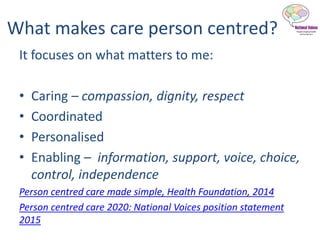
What makes care person centred?
It focuses on what matters to me:
• Caring – compassion, dignity, respect
• Coordinated
• Personalised
• Enabling – information, support, voice, choice,
control, independence
Person centred care made simple, Health Foundation, 2014
Person centred care 2020: National Voices position statement
2015
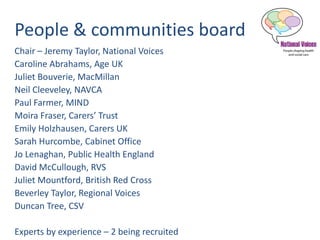
People & communities board
Chair – Jeremy Taylor, National Voices
Caroline Abrahams, Age UK
Juliet Bouverie, MacMillan
Neil Cleeveley, NAVCA
Paul Farmer, MIND
Moira Fraser, Carers’ Trust
Emily Holzhausen, Carers UK
Sarah Hurcombe, Cabinet Office
Jo Lenaghan, Public Health England
David McCullough, RVS
Juliet Mountford, British Red Cross
Beverley Taylor, Regional Voices
Duncan Tree, CSV
Experts by experience – 2 being recruited
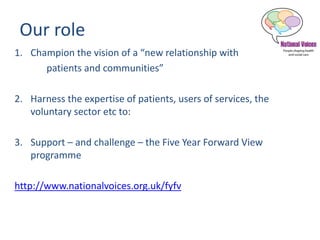
Our role
1. Champion the vision of a “new relationship with
patients and communities”
2. Harness the expertise of patients, users of services, the
voluntary sector etc to:
3. Support – and challenge – the Five Year Forward View
programme
http://www.nationalvoices.org.uk/fyfv
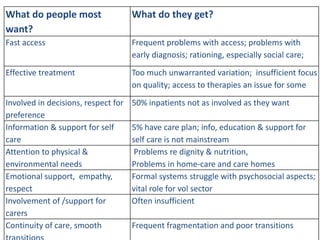
What do people most
want?
What do they get?
Fast access Frequent problems with access; problems with
early diagnosis; rationing, especially social care;
Effective treatment Too much unwarranted variation; insufficient focus
on quality; access to therapies an issue for some
Involved in decisions, respect for
preference
50% inpatients not as involved as they want
Information & support for self
care
5% have care plan; info, education & support for
self care is not mainstream
Attention to physical &
environmental needs
Problems re dignity & nutrition,
Problems in home-care and care homes
Emotional support, empathy,
respect
Formal systems struggle with psychosocial aspects;
vital role for vol sector
Involvement of /support for
carers
Often insufficient
Continuity of care, smooth Frequent fragmentation and poor transitions
Out-of-
Hours
Doctors
GP
District
Nurses
Social
Worker
Malcolm &
Barbara
Consultant
Continence
Adviser
Speech &
Language Adviser
Dietician
Community
Dentist
Occupational
Therapist
Equipment
Service
Physiotherapist
Alternating
Mattress technician
Wheelchair
Service
Oxygen
serviceDirect
Payments
Team;
Rowan
Org.
Alzheimer’s
Soc outreach
worker
Care team
2 live-in carers
(alternating weekly)
Replacement carer
[Some night nursing
– Health]
Emergency carers
& Barbara
The Web of
Care
(Last 7 yrs)
Dementia
Advisory
Nurse?
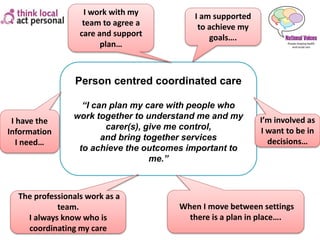
Person centred coordinated care
“I can plan my care with people who
work together to understand me and my
carer(s), give me control,
and bring together services
to achieve the outcomes important to
me.”
I have the
Information
I need…
I am supported
to achieve my
goals….
The professionals work as a
team.
I always know who is
coordinating my care
I’m involved as
I want to be in
decisions…
I work with my
team to agree a
care and support
plan…
When I move between settings
there is a plan in place….
Evidence based interventions
• shared decisions about treatments,
• care and support planning, using the principles and stages outlined
by National Voices and others.
• information, education and support for self-management,
including peer support, for people living with long term conditions
and disabilities
• coordinating care, following the narratives co-created by National
Voices and partners
• access to personal records – proven to support self management,
shared decisions and people’s commitment to courses of
prevention and treatment
• personal budgets to give people greater control over the way they
maintain their health and wellbeing
• training and development in the skills required for person centred
care for large cohorts of practitioners – such as health coaching,
motivational interviewing, risk communication and eliciting people’s
values and preferences
www.nationalvoices.org.uk/evidence
People powered services
• valuing and supporting carers and families
• ‘social prescribing’, where statutory professionals have access to,
and refer people into, local community sector provision of health-
supporting activities
• use of the Social Value Act 2012, which makes building social
capital a key criterion in contracts and tenders, and which was
intended to open up more opportunities for social enterprises
• community development approaches, such as those piloted in
Croydon and Halton, which involve the community in identifying
their needs and demands, and determining how these can be met
• investment in voluntary and community sector (VCS)
infrastructure capacity to ensure that a full range of groups and
organisations can play their part in developing and providing care
and support locally
• investment in patient and lay leadership to help coproduce local
strategies, plans and services and ensure a more powerful citizen
voice in the governance of provider trusts, clinical commissioning
groups, health and wellbeing boards and Healthwatch.
• encouraging volunteering
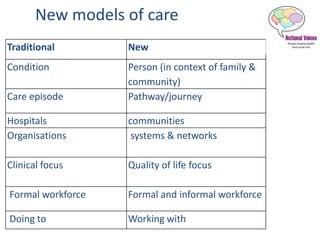
New models of care
Traditional New
Condition Person (in context of family &
community)
Care episode Pathway/journey
Hospitals communities
Organisations systems & networks
Clinical focus Quality of life focus
Formal workforce Formal and informal workforce
Doing to Working with
Final thoughts….
“A new relationship with patients and
communities” means:
1. Person centred care, not just better
communications
2. Different ways of working, not just integrated
structures
3. We are here to help!
Thanks for listening!
• www.nationalvoices.org.uk
– @NVTweeting
– @JeremyTaylorNV
• You can sign up for our newsletter: email
info@nationalvoices.org.uk
• You can become a member, partner or
supporter: email info@nationalvoices.org.uk

20150422 slides for vanguard kick off

  • 1.
    People and communities inthe 5YFV Vanguards Jeremy Taylor, CEO, National Voices Chair, People & Communities Board 22 April 2015
  • 2.
    National Voices • Coalitionof 160+ charities • Founded 2008 • Our mission: person centred care. • “Few bodies have done more than National Voices to promote person centred care” Health Service Journal June 2014
  • 3.
    What makes careperson centred? It focuses on what matters to me: • Caring – compassion, dignity, respect • Coordinated • Personalised • Enabling – information, support, voice, choice, control, independence Person centred care made simple, Health Foundation, 2014 Person centred care 2020: National Voices position statement 2015
  • 4.
    People & communitiesboard Chair – Jeremy Taylor, National Voices Caroline Abrahams, Age UK Juliet Bouverie, MacMillan Neil Cleeveley, NAVCA Paul Farmer, MIND Moira Fraser, Carers’ Trust Emily Holzhausen, Carers UK Sarah Hurcombe, Cabinet Office Jo Lenaghan, Public Health England David McCullough, RVS Juliet Mountford, British Red Cross Beverley Taylor, Regional Voices Duncan Tree, CSV Experts by experience – 2 being recruited
  • 5.
    Our role 1. Championthe vision of a “new relationship with patients and communities” 2. Harness the expertise of patients, users of services, the voluntary sector etc to: 3. Support – and challenge – the Five Year Forward View programme http://www.nationalvoices.org.uk/fyfv
  • 6.
    What do peoplemost want? What do they get? Fast access Frequent problems with access; problems with early diagnosis; rationing, especially social care; Effective treatment Too much unwarranted variation; insufficient focus on quality; access to therapies an issue for some Involved in decisions, respect for preference 50% inpatients not as involved as they want Information & support for self care 5% have care plan; info, education & support for self care is not mainstream Attention to physical & environmental needs Problems re dignity & nutrition, Problems in home-care and care homes Emotional support, empathy, respect Formal systems struggle with psychosocial aspects; vital role for vol sector Involvement of /support for carers Often insufficient Continuity of care, smooth Frequent fragmentation and poor transitions
  • 7.
    Out-of- Hours Doctors GP District Nurses Social Worker Malcolm & Barbara Consultant Continence Adviser Speech & LanguageAdviser Dietician Community Dentist Occupational Therapist Equipment Service Physiotherapist Alternating Mattress technician Wheelchair Service Oxygen serviceDirect Payments Team; Rowan Org. Alzheimer’s Soc outreach worker Care team 2 live-in carers (alternating weekly) Replacement carer [Some night nursing – Health] Emergency carers & Barbara The Web of Care (Last 7 yrs) Dementia Advisory Nurse?
  • 8.
    Person centred coordinatedcare “I can plan my care with people who work together to understand me and my carer(s), give me control, and bring together services to achieve the outcomes important to me.” I have the Information I need… I am supported to achieve my goals…. The professionals work as a team. I always know who is coordinating my care I’m involved as I want to be in decisions… I work with my team to agree a care and support plan… When I move between settings there is a plan in place….
  • 9.
    Evidence based interventions •shared decisions about treatments, • care and support planning, using the principles and stages outlined by National Voices and others. • information, education and support for self-management, including peer support, for people living with long term conditions and disabilities • coordinating care, following the narratives co-created by National Voices and partners • access to personal records – proven to support self management, shared decisions and people’s commitment to courses of prevention and treatment • personal budgets to give people greater control over the way they maintain their health and wellbeing • training and development in the skills required for person centred care for large cohorts of practitioners – such as health coaching, motivational interviewing, risk communication and eliciting people’s values and preferences www.nationalvoices.org.uk/evidence
  • 10.
    People powered services •valuing and supporting carers and families • ‘social prescribing’, where statutory professionals have access to, and refer people into, local community sector provision of health- supporting activities • use of the Social Value Act 2012, which makes building social capital a key criterion in contracts and tenders, and which was intended to open up more opportunities for social enterprises • community development approaches, such as those piloted in Croydon and Halton, which involve the community in identifying their needs and demands, and determining how these can be met • investment in voluntary and community sector (VCS) infrastructure capacity to ensure that a full range of groups and organisations can play their part in developing and providing care and support locally • investment in patient and lay leadership to help coproduce local strategies, plans and services and ensure a more powerful citizen voice in the governance of provider trusts, clinical commissioning groups, health and wellbeing boards and Healthwatch. • encouraging volunteering
  • 11.
    New models ofcare Traditional New Condition Person (in context of family & community) Care episode Pathway/journey Hospitals communities Organisations systems & networks Clinical focus Quality of life focus Formal workforce Formal and informal workforce Doing to Working with
  • 12.
    Final thoughts…. “A newrelationship with patients and communities” means: 1. Person centred care, not just better communications 2. Different ways of working, not just integrated structures 3. We are here to help!
  • 13.
    Thanks for listening! •www.nationalvoices.org.uk – @NVTweeting – @JeremyTaylorNV • You can sign up for our newsletter: email info@nationalvoices.org.uk • You can become a member, partner or supporter: email info@nationalvoices.org.uk