Glasgow City Council Telecare Presentation 1 st  June 2011
Contact Details James Jordan Resource Worker Social Work Adult Services Telephone: 0141 276 5646 E-Mail: [email_address]
What is telecare? ‘ Telecare is the remote or enhanced delivery of care services to people in their own home or a community setting by means of telecommunications and computerised services’ (Joint Improvement Team, 2011). Telecare can be defined simply as devices which enable a person to summon assistance (‘care’) remotely via technology (‘tele’).
What does telecare consist of? Basic telecare system: Alarm Unit Pendant Smoke Alarm
Basic Alarm System Usually connected to Cordia’s Direct Response Centre. Alternatively can be connected to a family member or carer for more personalised support. Used to provide support in a generalised manner. Alarm Unit Pendant Smoke Alarm
Additional Telecare Devices Operate through basic alarm unit. Tend to be ‘risk specific’ – for example seizure  sensors are used to alert carers in the event of a seizure and exit sensors are used to raise an alert when a person is exiting the property.
Points to consider when referring Telecare does not replace people as a support network is required for the equipment to be effective. Does the person have a landline telephone? Is someone able to answer and respond to alerts if required?  For ‘extra’ or ‘peripheral’ telecare devices the service user requires a family member to respond to and answer calls Ethical Issues
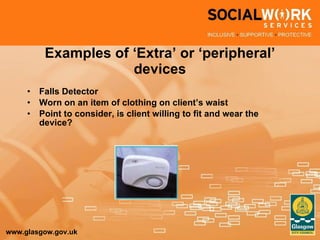
Examples of ‘Extra’ or ‘peripheral’ devices Falls Detector Worn on an item of clothing on client’s waist Point to consider, is client willing to fit and wear the device?
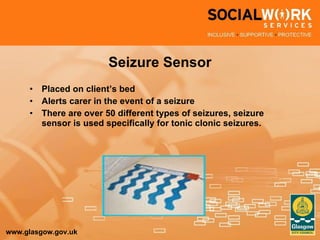
Seizure Sensor Placed on client’s bed Alerts carer in the event of a seizure There are over 50 different types of seizures, seizure sensor is used specifically for tonic clonic seizures.
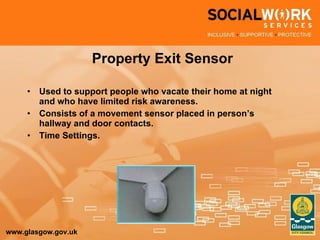
Property Exit Sensor Used to support people who vacate their home at night and who have limited risk awareness. Consists of a movement sensor placed in person’s hallway and door contacts. Time Settings.
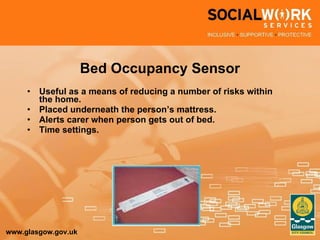
Bed Occupancy Sensor Useful as a means of reducing a number of risks within the home. Placed underneath the person’s mattress. Alerts carer when person gets out of bed. Time settings.
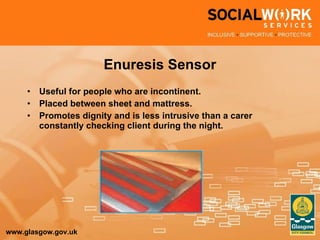
Enuresis Sensor Useful for people who are incontinent. Placed between sheet and mattress. Promotes dignity and is less intrusive than a carer constantly checking client during the night.
Glasgow City Council’s Telecare Service Since late 1980s Glasgow City Council has supported a number of vulnerable people in their homes via telecare. 15,000 people have a basic telecare package or ‘community alarm’. 3,000 people have an ‘enhanced’ telecare package which consists of a movement sensor added to the ‘community alarm’ system. Generally, as with most other authorities, the main client group has been older people, but this will gradually change with the introduction of Self Directed Support and other initiatives such as ‘personalisation’.
Glasgow City Council’s Telecare Service Contd. In the last 2 years approximately 150 extra telecare devices have been installed to support people in their own homes. The expansion of the service has been limited to an extent due to other factors (e.g. modernisation programme involving 10,000 people).
Cordia’s Direct Response Service Centre. Cordia’s Direct Response Service Centre provides a 24 hour call handling and response service. Generally, the basic community alarm alerts are directed to Cordia’s call handling centre. A smaller number of supported living providers and family receive alerts from service users. The service answers and responds to a large number of emergency calls each month. In December 2010 the centre handled 52,777 emergency calls and made 780 home visits.
Referral Process Anyone can apply for the basic telecare system at present, including prospective service users, professionals and friends and family. At present Social Workers and OTs refer for ‘extra’ telecare devices.  Prospective service users are unable to refer for ‘extra’ telecare devices themselves.
Future of GCC’s Telecare Service Ongoing training for frontline staff Development of assessor’s guide Assessment Tools (lifestyle monitoring)
Further Information on Telecare GCC’s main equipment supplier: www.tunstall.co.uk Joint Improvement Team’s Practice Guides: www.jitscotland.org.uk/publications-1/telecare/   Telecare database which is particularly useful for families/service users who want to purchase equipment privately: www.alvoution.co.uk
Thank You Any Questions?

Telecare presentation 1 6-11 james jordan

  • 1.
    Glasgow City CouncilTelecare Presentation 1 st June 2011
  • 2.
    Contact Details JamesJordan Resource Worker Social Work Adult Services Telephone: 0141 276 5646 E-Mail: [email_address]
  • 3.
    What is telecare?‘ Telecare is the remote or enhanced delivery of care services to people in their own home or a community setting by means of telecommunications and computerised services’ (Joint Improvement Team, 2011). Telecare can be defined simply as devices which enable a person to summon assistance (‘care’) remotely via technology (‘tele’).
  • 4.
    What does telecareconsist of? Basic telecare system: Alarm Unit Pendant Smoke Alarm
  • 5.
    Basic Alarm SystemUsually connected to Cordia’s Direct Response Centre. Alternatively can be connected to a family member or carer for more personalised support. Used to provide support in a generalised manner. Alarm Unit Pendant Smoke Alarm
  • 6.
    Additional Telecare DevicesOperate through basic alarm unit. Tend to be ‘risk specific’ – for example seizure sensors are used to alert carers in the event of a seizure and exit sensors are used to raise an alert when a person is exiting the property.
  • 7.
    Points to considerwhen referring Telecare does not replace people as a support network is required for the equipment to be effective. Does the person have a landline telephone? Is someone able to answer and respond to alerts if required? For ‘extra’ or ‘peripheral’ telecare devices the service user requires a family member to respond to and answer calls Ethical Issues
  • 8.
    Examples of ‘Extra’or ‘peripheral’ devices Falls Detector Worn on an item of clothing on client’s waist Point to consider, is client willing to fit and wear the device?
  • 9.
    Seizure Sensor Placedon client’s bed Alerts carer in the event of a seizure There are over 50 different types of seizures, seizure sensor is used specifically for tonic clonic seizures.
  • 10.
    Property Exit SensorUsed to support people who vacate their home at night and who have limited risk awareness. Consists of a movement sensor placed in person’s hallway and door contacts. Time Settings.
  • 11.
    Bed Occupancy SensorUseful as a means of reducing a number of risks within the home. Placed underneath the person’s mattress. Alerts carer when person gets out of bed. Time settings.
  • 12.
    Enuresis Sensor Usefulfor people who are incontinent. Placed between sheet and mattress. Promotes dignity and is less intrusive than a carer constantly checking client during the night.
  • 13.
    Glasgow City Council’sTelecare Service Since late 1980s Glasgow City Council has supported a number of vulnerable people in their homes via telecare. 15,000 people have a basic telecare package or ‘community alarm’. 3,000 people have an ‘enhanced’ telecare package which consists of a movement sensor added to the ‘community alarm’ system. Generally, as with most other authorities, the main client group has been older people, but this will gradually change with the introduction of Self Directed Support and other initiatives such as ‘personalisation’.
  • 14.
    Glasgow City Council’sTelecare Service Contd. In the last 2 years approximately 150 extra telecare devices have been installed to support people in their own homes. The expansion of the service has been limited to an extent due to other factors (e.g. modernisation programme involving 10,000 people).
  • 15.
    Cordia’s Direct ResponseService Centre. Cordia’s Direct Response Service Centre provides a 24 hour call handling and response service. Generally, the basic community alarm alerts are directed to Cordia’s call handling centre. A smaller number of supported living providers and family receive alerts from service users. The service answers and responds to a large number of emergency calls each month. In December 2010 the centre handled 52,777 emergency calls and made 780 home visits.
  • 16.
    Referral Process Anyonecan apply for the basic telecare system at present, including prospective service users, professionals and friends and family. At present Social Workers and OTs refer for ‘extra’ telecare devices. Prospective service users are unable to refer for ‘extra’ telecare devices themselves.
  • 17.
    Future of GCC’sTelecare Service Ongoing training for frontline staff Development of assessor’s guide Assessment Tools (lifestyle monitoring)
  • 18.
    Further Information onTelecare GCC’s main equipment supplier: www.tunstall.co.uk Joint Improvement Team’s Practice Guides: www.jitscotland.org.uk/publications-1/telecare/ Telecare database which is particularly useful for families/service users who want to purchase equipment privately: www.alvoution.co.uk
  • 19.
    Thank You AnyQuestions?