Continuous Service Improvement
in a SIAM Environment
Chris Bryan
Introduction
Who am I and what am I talking about?
Agenda
1. Introduction & Agenda
2. What is CSI?
3. What is SIAM?
4. How to Improve ‘Service Improvement’ using SIAM
5. Questions?
CSI Overview
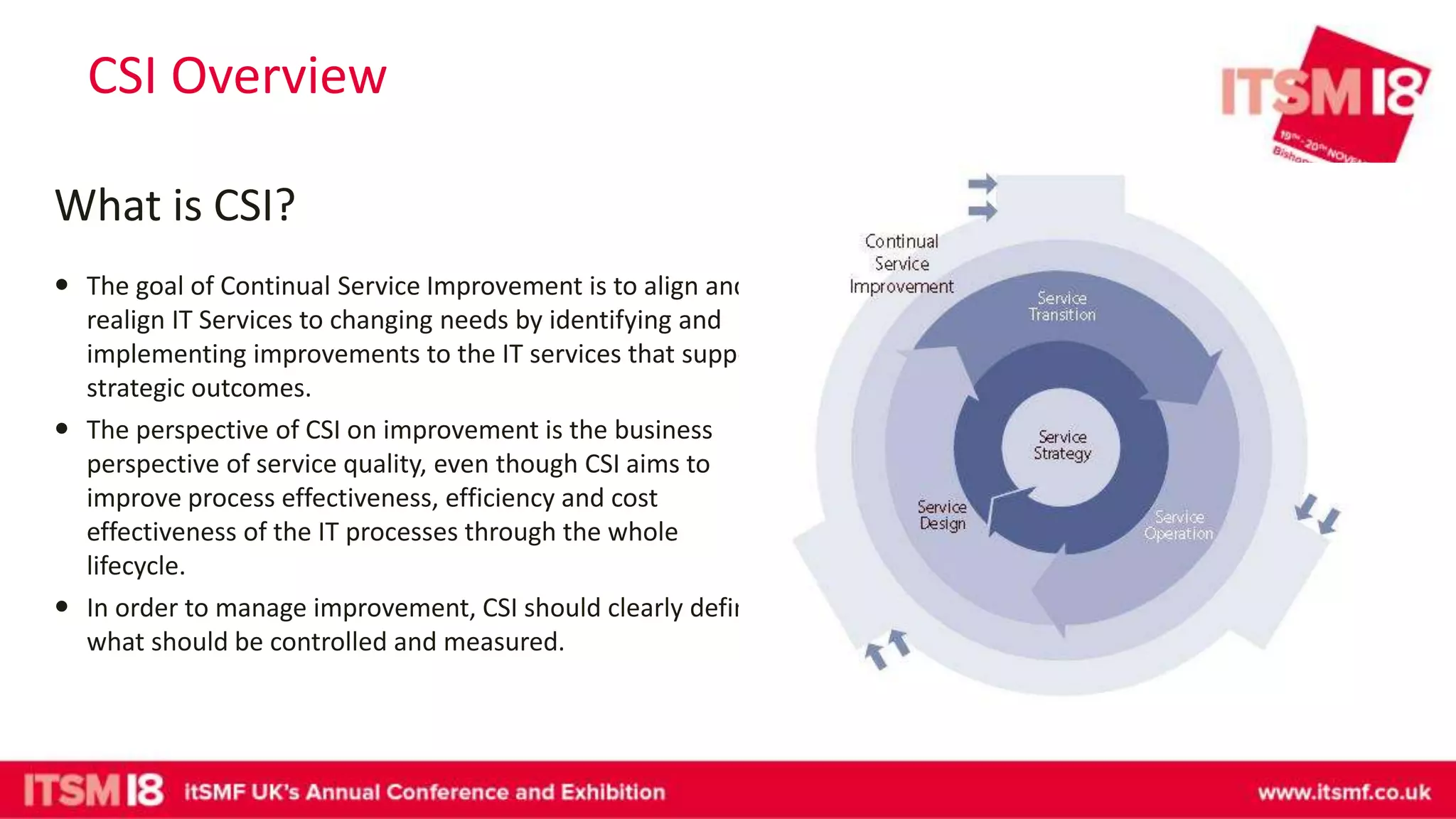
What is CSI?
 The goal of Continual Service Improvement is to align and
realign IT Services to changing needs by identifying and
implementing improvements to the IT services that support
strategic outcomes.
 The perspective of CSI on improvement is the business
perspective of service quality, even though CSI aims to
improve process effectiveness, efficiency and cost
effectiveness of the IT processes through the whole
lifecycle.
 In order to manage improvement, CSI should clearly define
what should be controlled and measured.
The Problem With Continual Service
Improvement
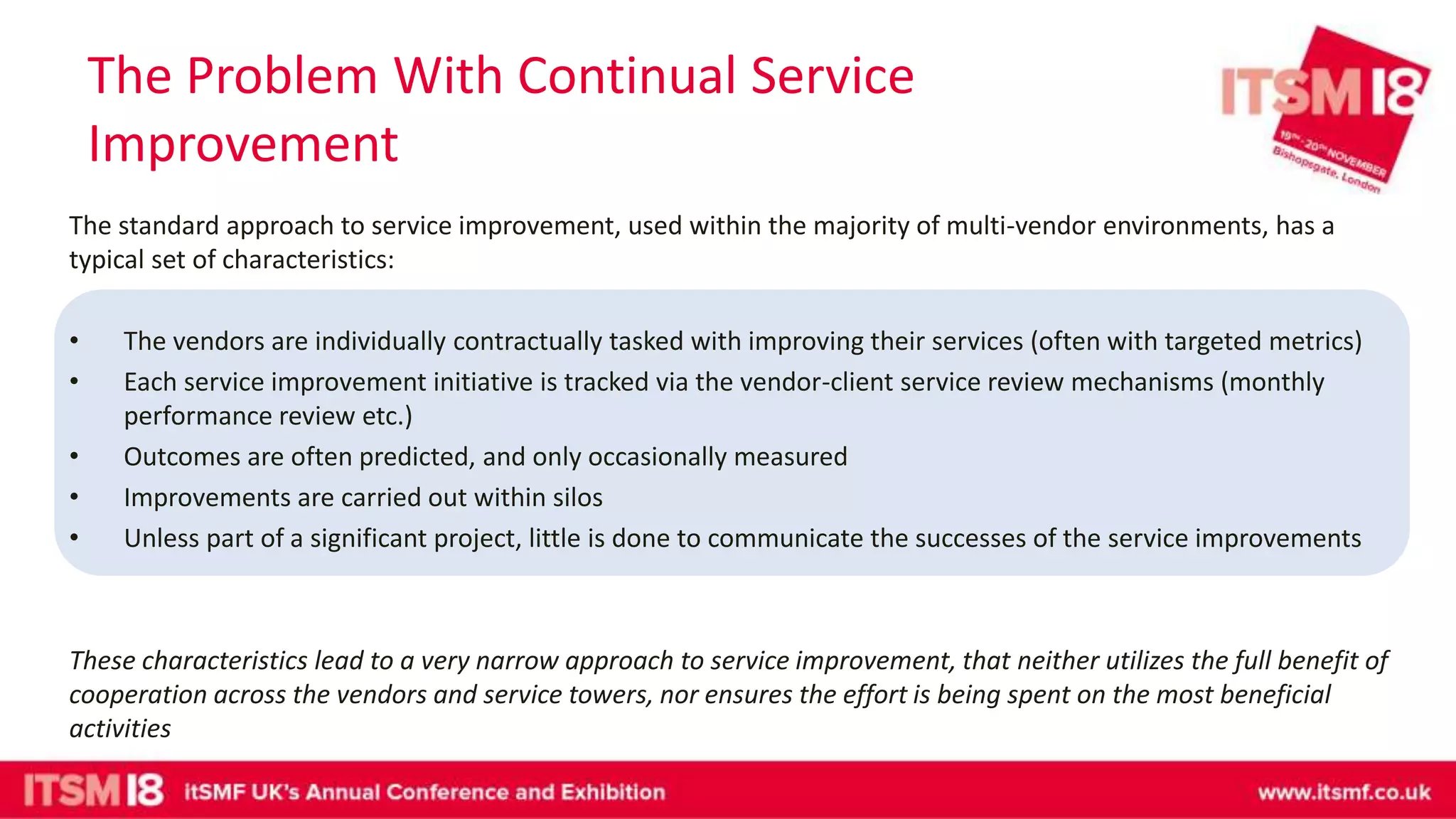
The standard approach to service improvement, used within the majority of multi-vendor environments, has a
typical set of characteristics:
• The vendors are individually contractually tasked with improving their services (often with targeted metrics)
• Each service improvement initiative is tracked via the vendor-client service review mechanisms (monthly
performance review etc.)
• Outcomes are often predicted, and only occasionally measured
• Improvements are carried out within silos
• Unless part of a significant project, little is done to communicate the successes of the service improvements
These characteristics lead to a very narrow approach to service improvement, that neither utilizes the full benefit of
cooperation across the vendors and service towers, nor ensures the effort is being spent on the most beneficial
activities
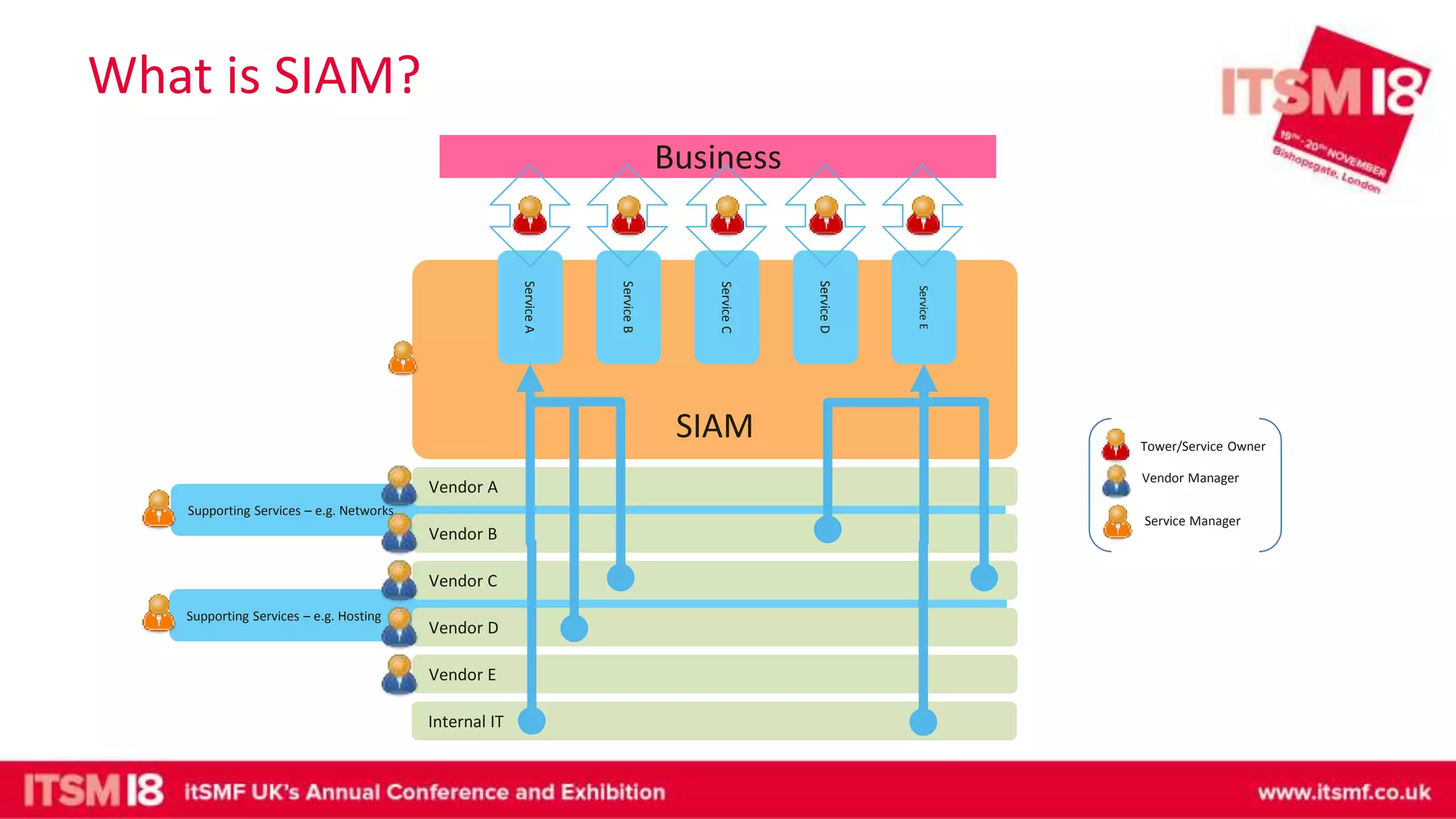
What is SIAM?
Internal IT
Supporting Services – e.g. Hosting
Supporting Services – e.g. Networks
SIAM
Vendor B
Vendor A
Vendor C
Vendor D
Vendor E
ServiceA
ServiceB
ServiceC
ServiceD
ServiceE
Business
Tower/Service Owner
Vendor Manager
Service Manager
How to improve Service Improvement using SIAM
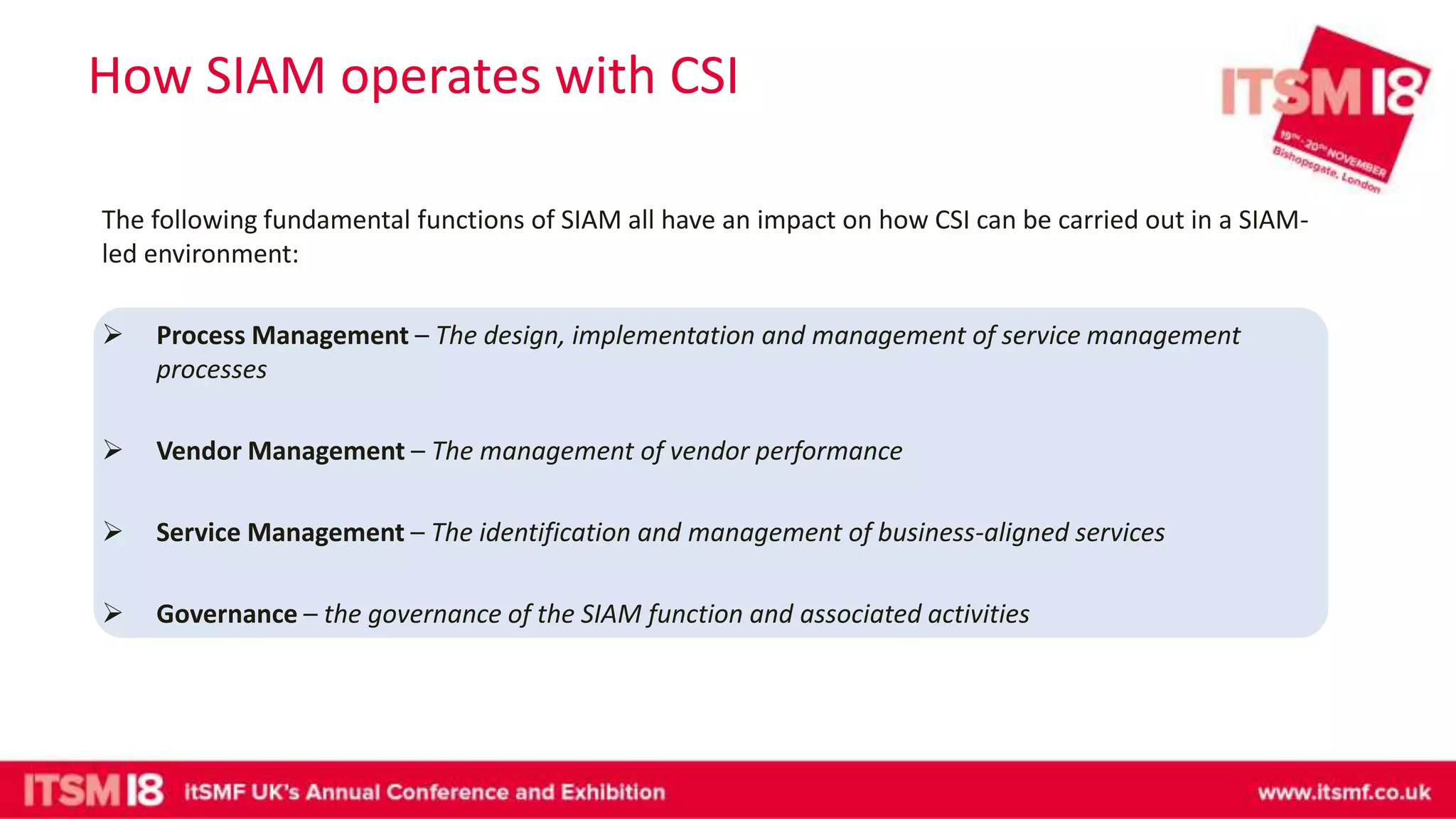
How SIAM operates with CSI
The following fundamental functions of SIAM all have an impact on how CSI can be carried out in a SIAM-
led environment:
 Process Management – The design, implementation and management of service management
processes
 Vendor Management – The management of vendor performance
 Service Management – The identification and management of business-aligned services
 Governance – the governance of the SIAM function and associated activities
SIAM Process Management and CSI
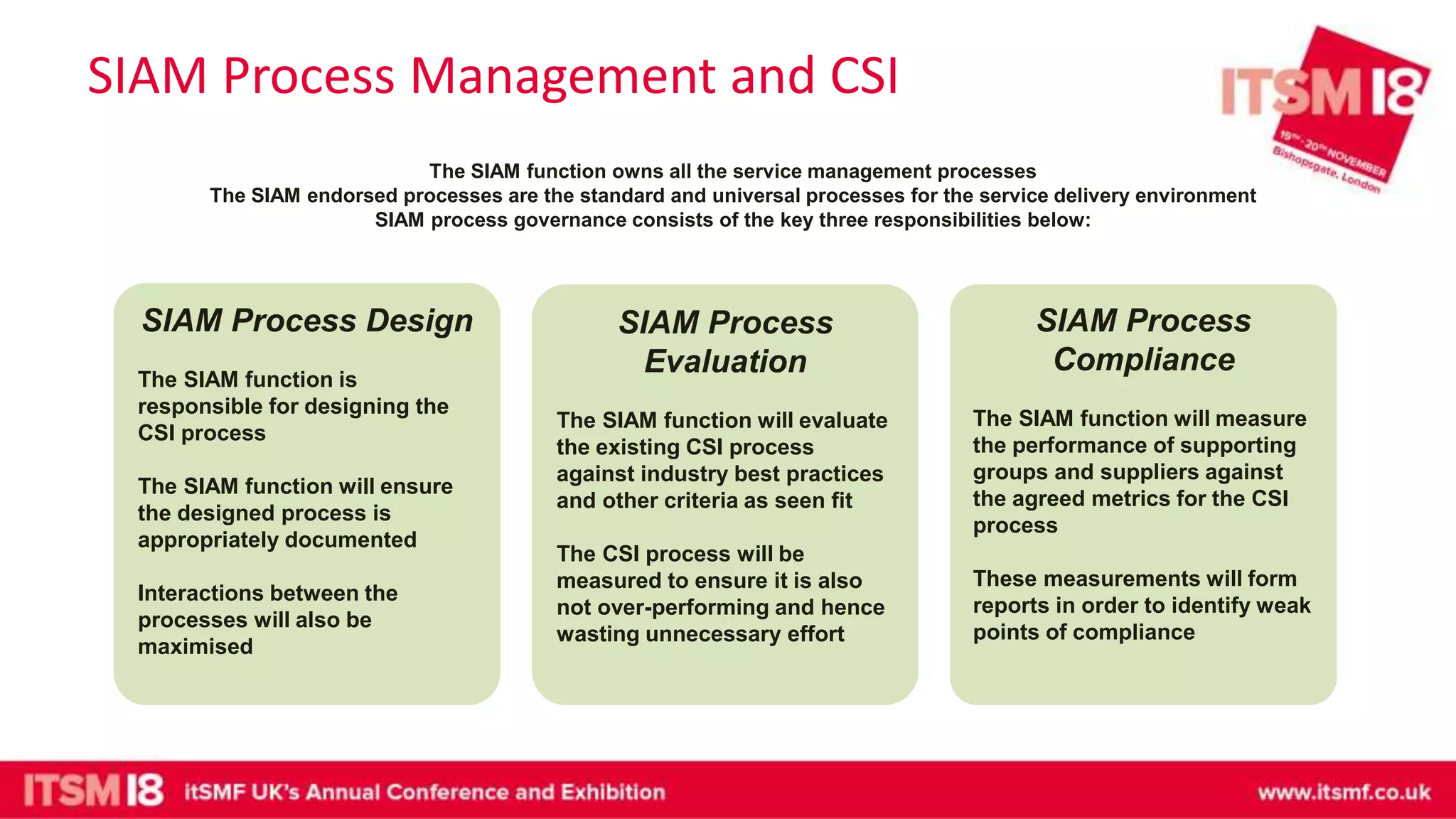
SIAM Process Design
The SIAM function is
responsible for designing the
CSI process
The SIAM function will ensure
the designed process is
appropriately documented
Interactions between the
processes will also be
maximised
SIAM Process
Evaluation
The SIAM function will evaluate
the existing CSI process
against industry best practices
and other criteria as seen fit
The CSI process will be
measured to ensure it is also
not over-performing and hence
wasting unnecessary effort
SIAM Process
Compliance
The SIAM function will measure
the performance of supporting
groups and suppliers against
the agreed metrics for the CSI
process
These measurements will form
reports in order to identify weak
points of compliance
The SIAM function owns all the service management processes
The SIAM endorsed processes are the standard and universal processes for the service delivery environment
SIAM process governance consists of the key three responsibilities below:
SIAM Vendor Management and CSI
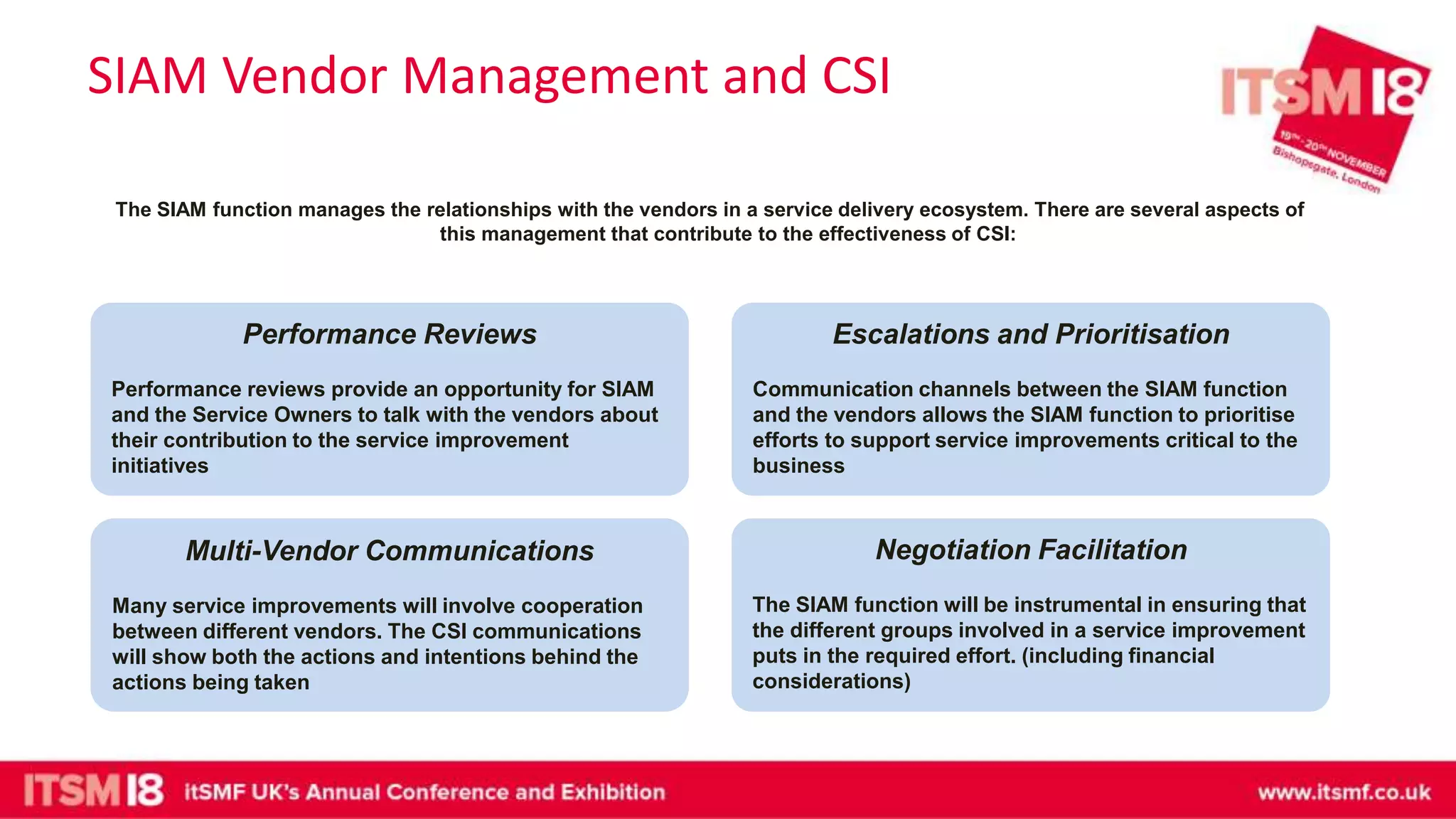
The SIAM function manages the relationships with the vendors in a service delivery ecosystem. There are several aspects of
this management that contribute to the effectiveness of CSI:
Escalations and Prioritisation
Communication channels between the SIAM function
and the vendors allows the SIAM function to prioritise
efforts to support service improvements critical to the
business
Multi-Vendor Communications
Many service improvements will involve cooperation
between different vendors. The CSI communications
will show both the actions and intentions behind the
actions being taken
Negotiation Facilitation
The SIAM function will be instrumental in ensuring that
the different groups involved in a service improvement
puts in the required effort. (including financial
considerations)
Performance Reviews
Performance reviews provide an opportunity for SIAM
and the Service Owners to talk with the vendors about
their contribution to the service improvement
initiatives
SIAM Service Management and CSI
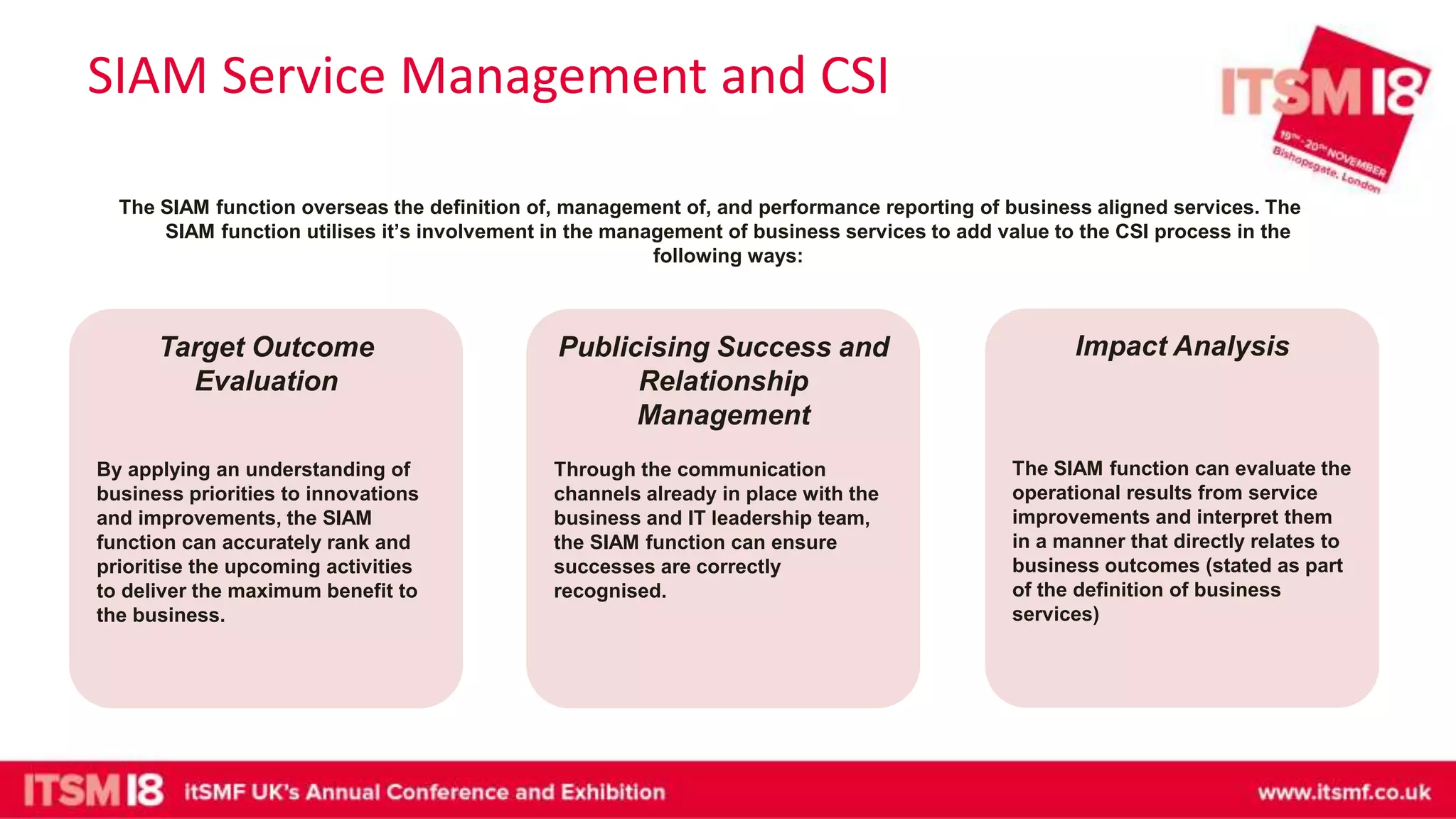
The SIAM function overseas the definition of, management of, and performance reporting of business aligned services. The
SIAM function utilises it’s involvement in the management of business services to add value to the CSI process in the
following ways:
Publicising Success and
Relationship
Management
Through the communication
channels already in place with the
business and IT leadership team,
the SIAM function can ensure
successes are correctly
recognised.
Impact Analysis
The SIAM function can evaluate the
operational results from service
improvements and interpret them
in a manner that directly relates to
business outcomes (stated as part
of the definition of business
services)
Target Outcome
Evaluation
By applying an understanding of
business priorities to innovations
and improvements, the SIAM
function can accurately rank and
prioritise the upcoming activities
to deliver the maximum benefit to
the business.
CSI Process – Quarterly Cycle
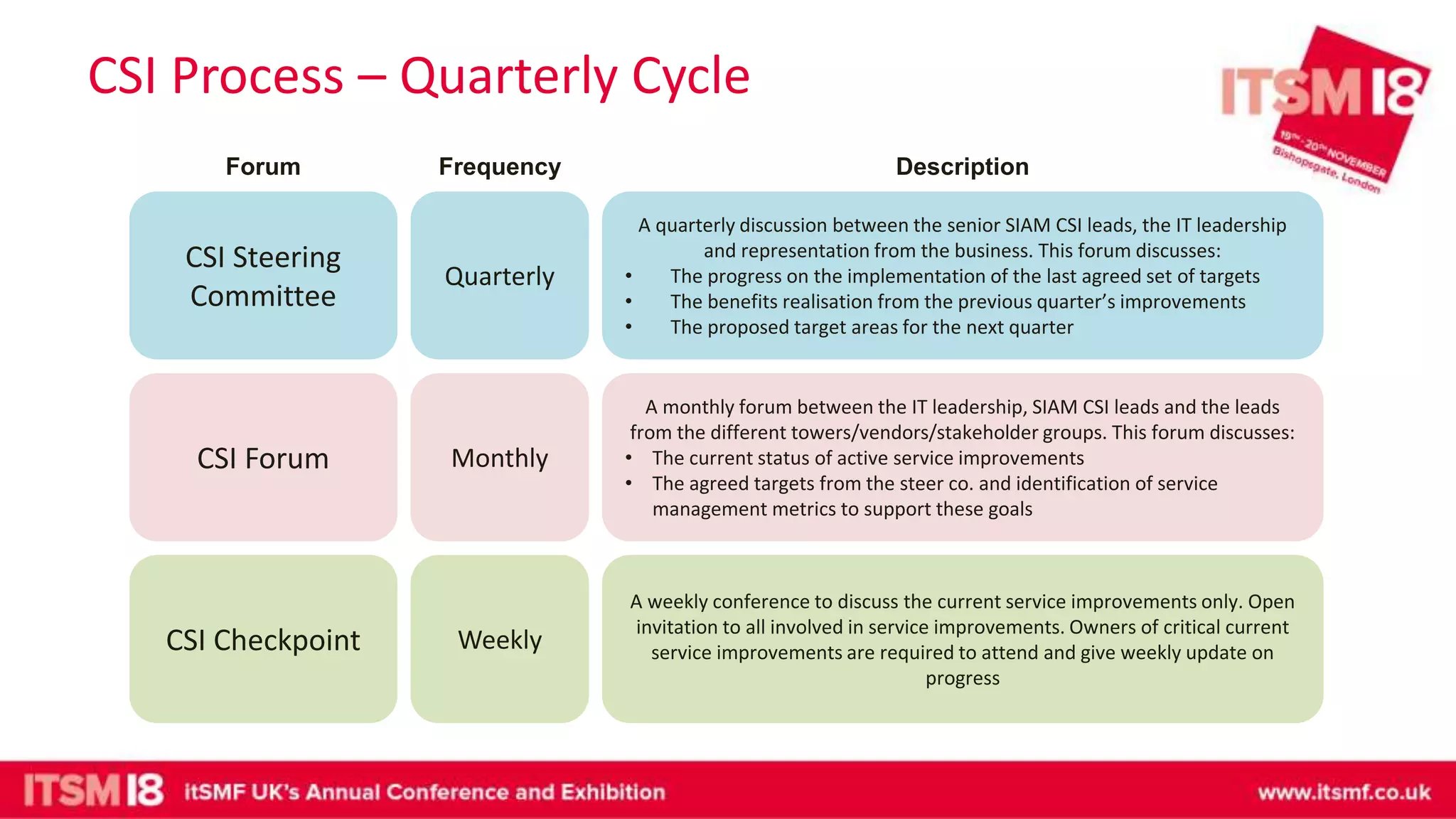
A quarterly discussion between the senior SIAM CSI leads, the IT leadership
and representation from the business. This forum discusses:
• The progress on the implementation of the last agreed set of targets
• The benefits realisation from the previous quarter’s improvements
• The proposed target areas for the next quarter
A monthly forum between the IT leadership, SIAM CSI leads and the leads
from the different towers/vendors/stakeholder groups. This forum discusses:
• The current status of active service improvements
• The agreed targets from the steer co. and identification of service
management metrics to support these goals
A weekly conference to discuss the current service improvements only. Open
invitation to all involved in service improvements. Owners of critical current
service improvements are required to attend and give weekly update on
progress
Quarterly
Monthly
Weekly
CSI Steering
Committee
CSI Forum
CSI Checkpoint
Forum Frequency Description
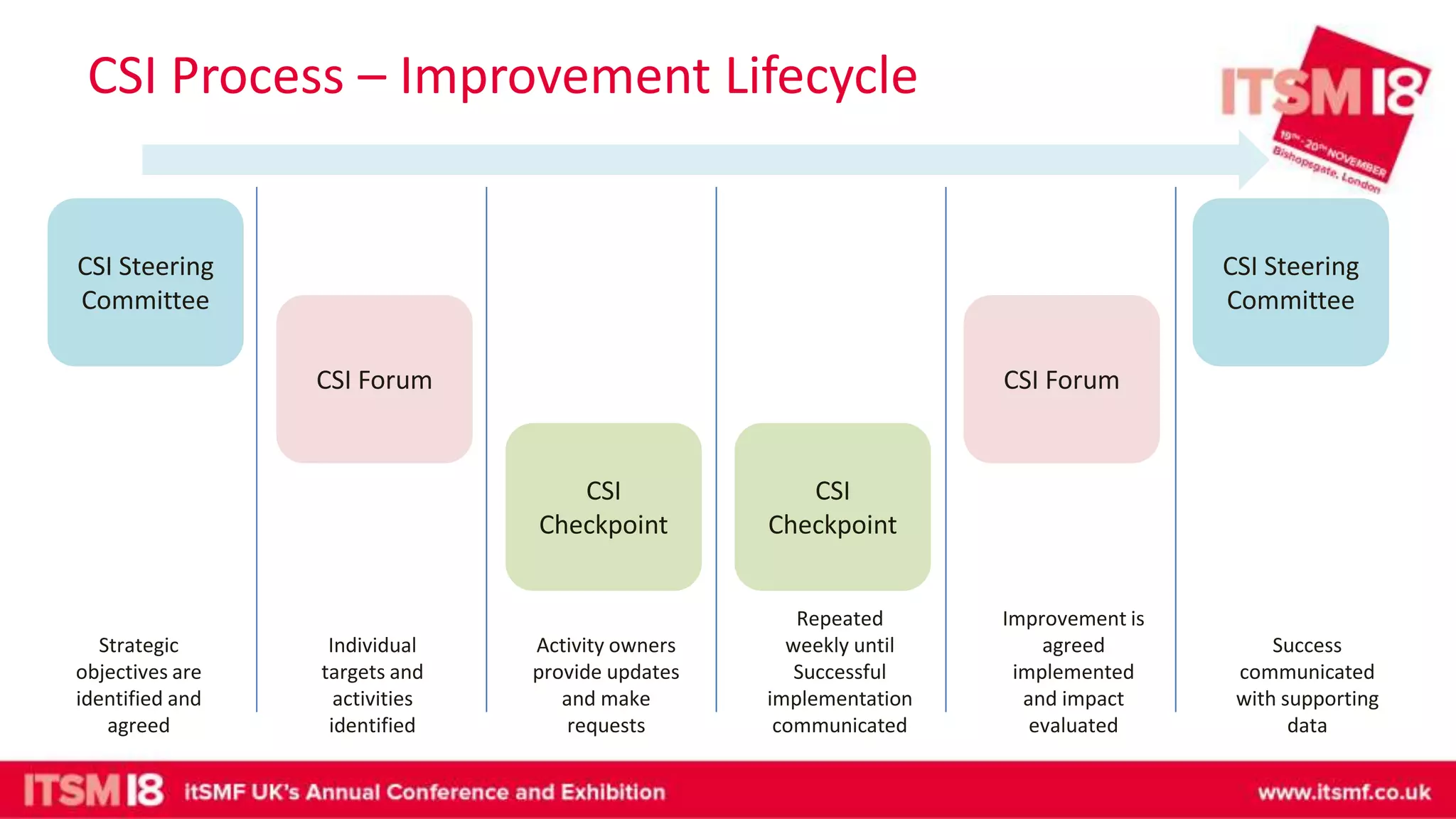
CSI Process – Improvement Lifecycle
CSI Steering
Committee
CSI Forum
CSI
Checkpoint
CSI
Checkpoint
CSI Forum
CSI Steering
Committee
Repeated
weekly until
Successful
implementation
communicated
Individual
targets and
activities
identified
Activity owners
provide updates
and make
requests
Strategic
objectives are
identified and
agreed
Improvement is
agreed
implemented
and impact
evaluated
Success
communicated
with supporting
data
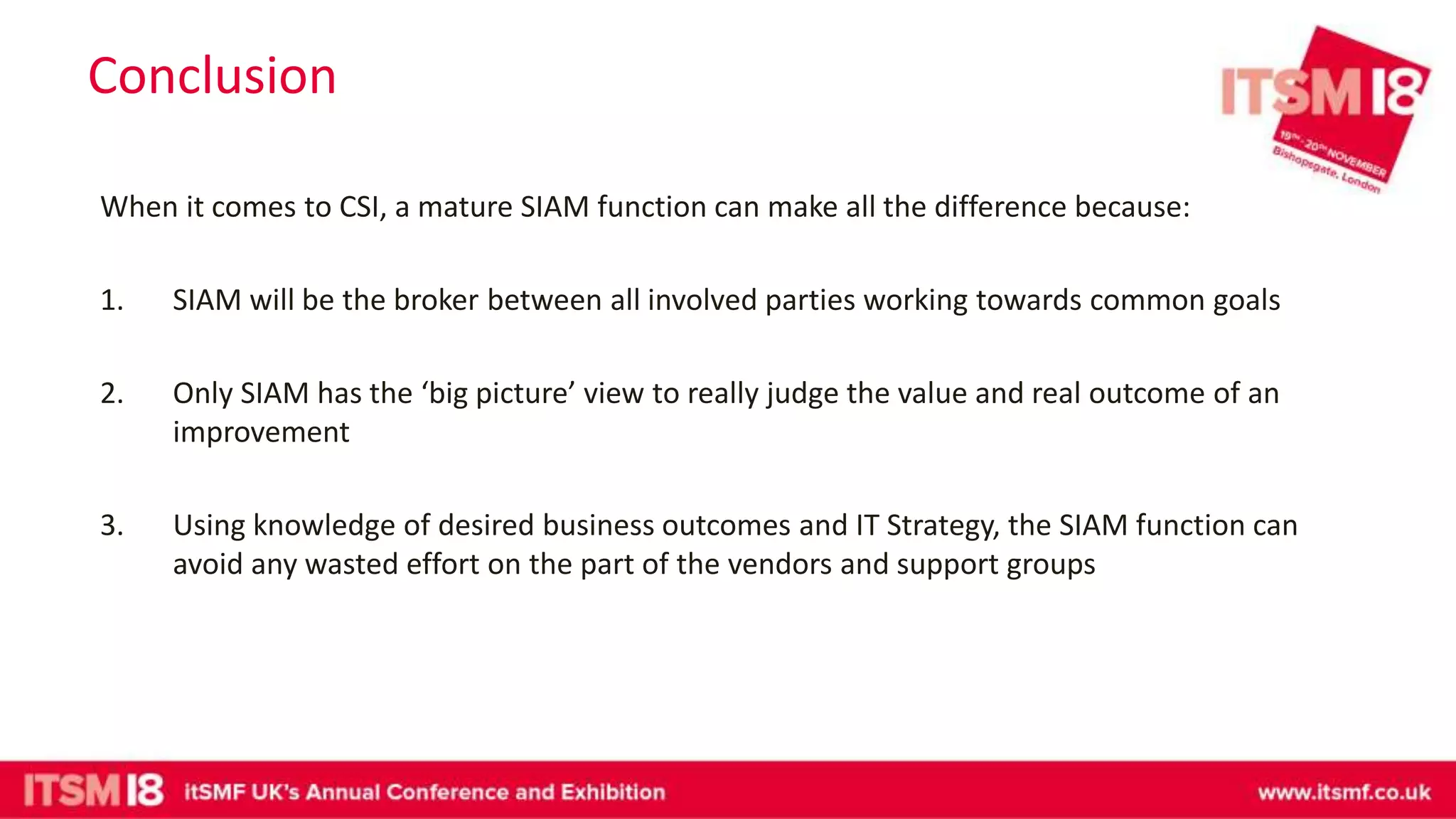
Conclusion
When it comes to CSI, a mature SIAM function can make all the difference because:
1. SIAM will be the broker between all involved parties working towards common goals
2. Only SIAM has the ‘big picture’ view to really judge the value and real outcome of an
improvement
3. Using knowledge of desired business outcomes and IT Strategy, the SIAM function can
avoid any wasted effort on the part of the vendors and support groups
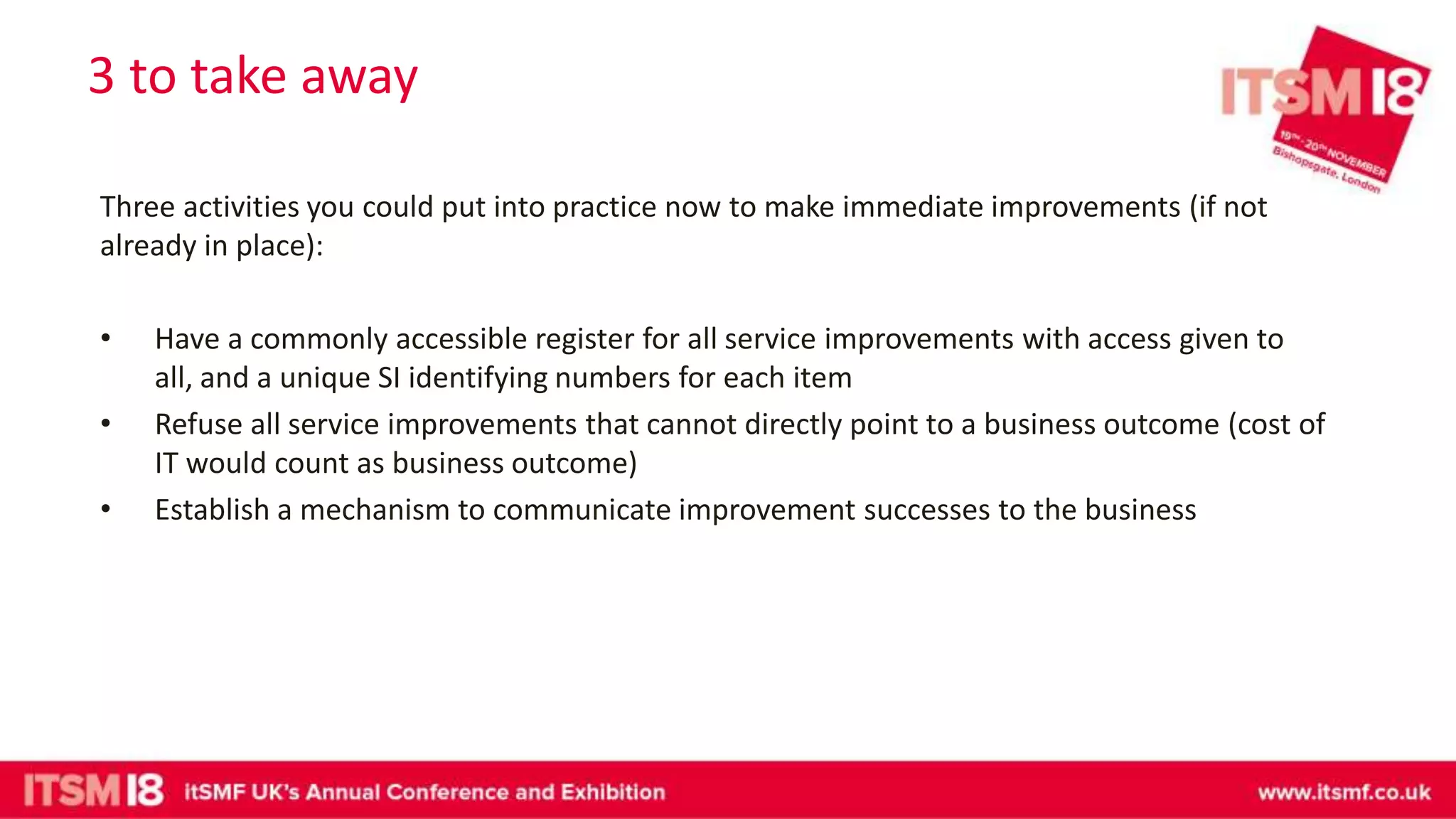
3 to take away
Three activities you could put into practice now to make immediate improvements (if not
already in place):
• Have a commonly accessible register for all service improvements with access given to
all, and a unique SI identifying numbers for each item
• Refuse all service improvements that cannot directly point to a business outcome (cost of
IT would count as business outcome)
• Establish a mechanism to communicate improvement successes to the business
Questions?
Chris Bryan: Continuous Service Improvement in a SIAM Environment

Chris Bryan: Continuous Service Improvement in a SIAM Environment

  • 1.
    Continuous Service Improvement ina SIAM Environment Chris Bryan
  • 2.
    Introduction Who am Iand what am I talking about?
  • 3.
    Agenda 1. Introduction &Agenda 2. What is CSI? 3. What is SIAM? 4. How to Improve ‘Service Improvement’ using SIAM 5. Questions?
  • 4.
    CSI Overview What isCSI?  The goal of Continual Service Improvement is to align and realign IT Services to changing needs by identifying and implementing improvements to the IT services that support strategic outcomes.  The perspective of CSI on improvement is the business perspective of service quality, even though CSI aims to improve process effectiveness, efficiency and cost effectiveness of the IT processes through the whole lifecycle.  In order to manage improvement, CSI should clearly define what should be controlled and measured.
  • 5.
    The Problem WithContinual Service Improvement The standard approach to service improvement, used within the majority of multi-vendor environments, has a typical set of characteristics: • The vendors are individually contractually tasked with improving their services (often with targeted metrics) • Each service improvement initiative is tracked via the vendor-client service review mechanisms (monthly performance review etc.) • Outcomes are often predicted, and only occasionally measured • Improvements are carried out within silos • Unless part of a significant project, little is done to communicate the successes of the service improvements These characteristics lead to a very narrow approach to service improvement, that neither utilizes the full benefit of cooperation across the vendors and service towers, nor ensures the effort is being spent on the most beneficial activities
  • 6.
    What is SIAM? InternalIT Supporting Services – e.g. Hosting Supporting Services – e.g. Networks SIAM Vendor B Vendor A Vendor C Vendor D Vendor E ServiceA ServiceB ServiceC ServiceD ServiceE Business Tower/Service Owner Vendor Manager Service Manager
  • 7.
    How to improveService Improvement using SIAM
  • 8.
    How SIAM operateswith CSI The following fundamental functions of SIAM all have an impact on how CSI can be carried out in a SIAM- led environment:  Process Management – The design, implementation and management of service management processes  Vendor Management – The management of vendor performance  Service Management – The identification and management of business-aligned services  Governance – the governance of the SIAM function and associated activities
  • 9.
    SIAM Process Managementand CSI SIAM Process Design The SIAM function is responsible for designing the CSI process The SIAM function will ensure the designed process is appropriately documented Interactions between the processes will also be maximised SIAM Process Evaluation The SIAM function will evaluate the existing CSI process against industry best practices and other criteria as seen fit The CSI process will be measured to ensure it is also not over-performing and hence wasting unnecessary effort SIAM Process Compliance The SIAM function will measure the performance of supporting groups and suppliers against the agreed metrics for the CSI process These measurements will form reports in order to identify weak points of compliance The SIAM function owns all the service management processes The SIAM endorsed processes are the standard and universal processes for the service delivery environment SIAM process governance consists of the key three responsibilities below:
  • 10.
    SIAM Vendor Managementand CSI The SIAM function manages the relationships with the vendors in a service delivery ecosystem. There are several aspects of this management that contribute to the effectiveness of CSI: Escalations and Prioritisation Communication channels between the SIAM function and the vendors allows the SIAM function to prioritise efforts to support service improvements critical to the business Multi-Vendor Communications Many service improvements will involve cooperation between different vendors. The CSI communications will show both the actions and intentions behind the actions being taken Negotiation Facilitation The SIAM function will be instrumental in ensuring that the different groups involved in a service improvement puts in the required effort. (including financial considerations) Performance Reviews Performance reviews provide an opportunity for SIAM and the Service Owners to talk with the vendors about their contribution to the service improvement initiatives
  • 11.
    SIAM Service Managementand CSI The SIAM function overseas the definition of, management of, and performance reporting of business aligned services. The SIAM function utilises it’s involvement in the management of business services to add value to the CSI process in the following ways: Publicising Success and Relationship Management Through the communication channels already in place with the business and IT leadership team, the SIAM function can ensure successes are correctly recognised. Impact Analysis The SIAM function can evaluate the operational results from service improvements and interpret them in a manner that directly relates to business outcomes (stated as part of the definition of business services) Target Outcome Evaluation By applying an understanding of business priorities to innovations and improvements, the SIAM function can accurately rank and prioritise the upcoming activities to deliver the maximum benefit to the business.
  • 12.
    CSI Process –Quarterly Cycle A quarterly discussion between the senior SIAM CSI leads, the IT leadership and representation from the business. This forum discusses: • The progress on the implementation of the last agreed set of targets • The benefits realisation from the previous quarter’s improvements • The proposed target areas for the next quarter A monthly forum between the IT leadership, SIAM CSI leads and the leads from the different towers/vendors/stakeholder groups. This forum discusses: • The current status of active service improvements • The agreed targets from the steer co. and identification of service management metrics to support these goals A weekly conference to discuss the current service improvements only. Open invitation to all involved in service improvements. Owners of critical current service improvements are required to attend and give weekly update on progress Quarterly Monthly Weekly CSI Steering Committee CSI Forum CSI Checkpoint Forum Frequency Description
  • 13.
    CSI Process –Improvement Lifecycle CSI Steering Committee CSI Forum CSI Checkpoint CSI Checkpoint CSI Forum CSI Steering Committee Repeated weekly until Successful implementation communicated Individual targets and activities identified Activity owners provide updates and make requests Strategic objectives are identified and agreed Improvement is agreed implemented and impact evaluated Success communicated with supporting data
  • 14.
    Conclusion When it comesto CSI, a mature SIAM function can make all the difference because: 1. SIAM will be the broker between all involved parties working towards common goals 2. Only SIAM has the ‘big picture’ view to really judge the value and real outcome of an improvement 3. Using knowledge of desired business outcomes and IT Strategy, the SIAM function can avoid any wasted effort on the part of the vendors and support groups
  • 15.
    3 to takeaway Three activities you could put into practice now to make immediate improvements (if not already in place): • Have a commonly accessible register for all service improvements with access given to all, and a unique SI identifying numbers for each item • Refuse all service improvements that cannot directly point to a business outcome (cost of IT would count as business outcome) • Establish a mechanism to communicate improvement successes to the business
  • 16.