IT Managed Services
A Brief About Managed Services
Managed services is
the practice of
outsourcing on a
proactive basis
management
responsibilities and
functions and a
strategic method for
improving operations
and cutting expenses.
Managed Services
Managed Services Need
• M.S. model can be can be used for
following situations:
- The organization has multiple locations of operation
- The organization has large number of work force
- The resource pool for processes are underutilized.
- The skills required for managing operations are specialized.
- The cost of operations is going up.
Benefits for Managed Services
• Key customer benefits of Managed
Services are:
- Customer peace of mind – monitor network on 24x7x365 basis
proactively.
- Single point of contact for all issues.
- Single supplier instead of multiple vendors.
- Defined Service Levels (SLA’s)
- Avoid costs of building own management & reporting systems
- Lower Total Cost Ownership (TCO) for client
- Provides in lesser cycle time, more value to the Client.
Benefits for Service Providers
• Key service providers benefits of
Managed IT support services are:
- More Business contracts – extended longevity.
- Increased ARPU (average revenue per user) .
- Ability to interact with & influence customers at a
business/application decision making level.
- Providing value to the client of the Services availed by adding
value.
The Architecture
• A typical high-level architecture of a
managed services platform consists of : -
– Data center.
– Provisioning manager.
– Monitoring server.
– Application server.
– Virtualization components.
• These components serve as the back-
end of the managed services
environment.
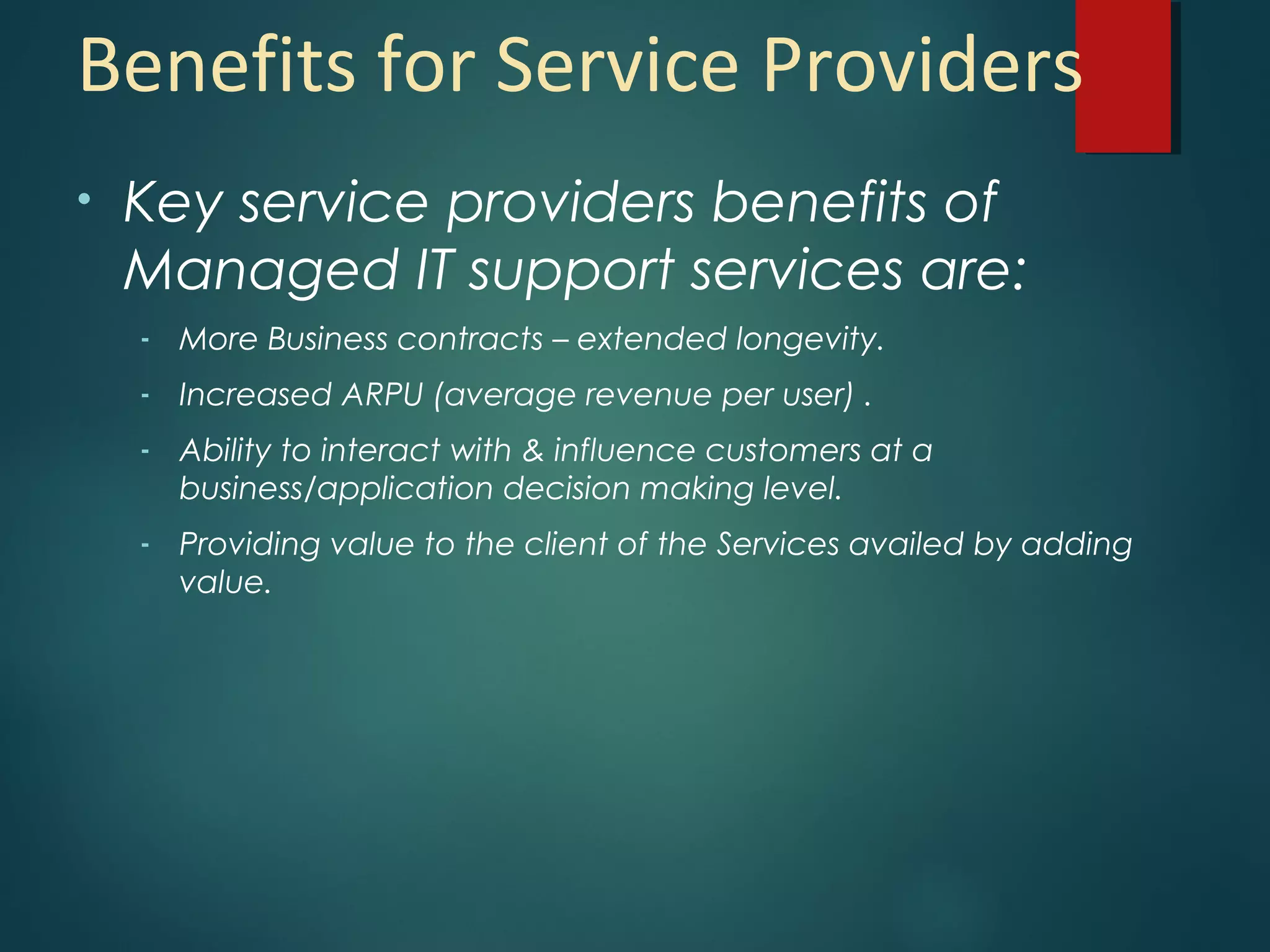
Managed Services - Usage
Characteristics
• Users do not own the physical infrastructure.
• They rent usage from a third-party provider.
• They consume resources as a service.
• They pay only for resources that they use.
• Servers are not unnecessarily left idle.
• Users do not have to engineer for peak load limits.
• With increased high-speed bandwidth, response
times has been greatly reduced.
Managed Services Trends
• To sustain Managed Services model, it is not enough to focus
on the mere Centralization of transaction processing activities.
• MSP are to be “business-focused” and develop a high
performance service culture and establishing best practice
processes.
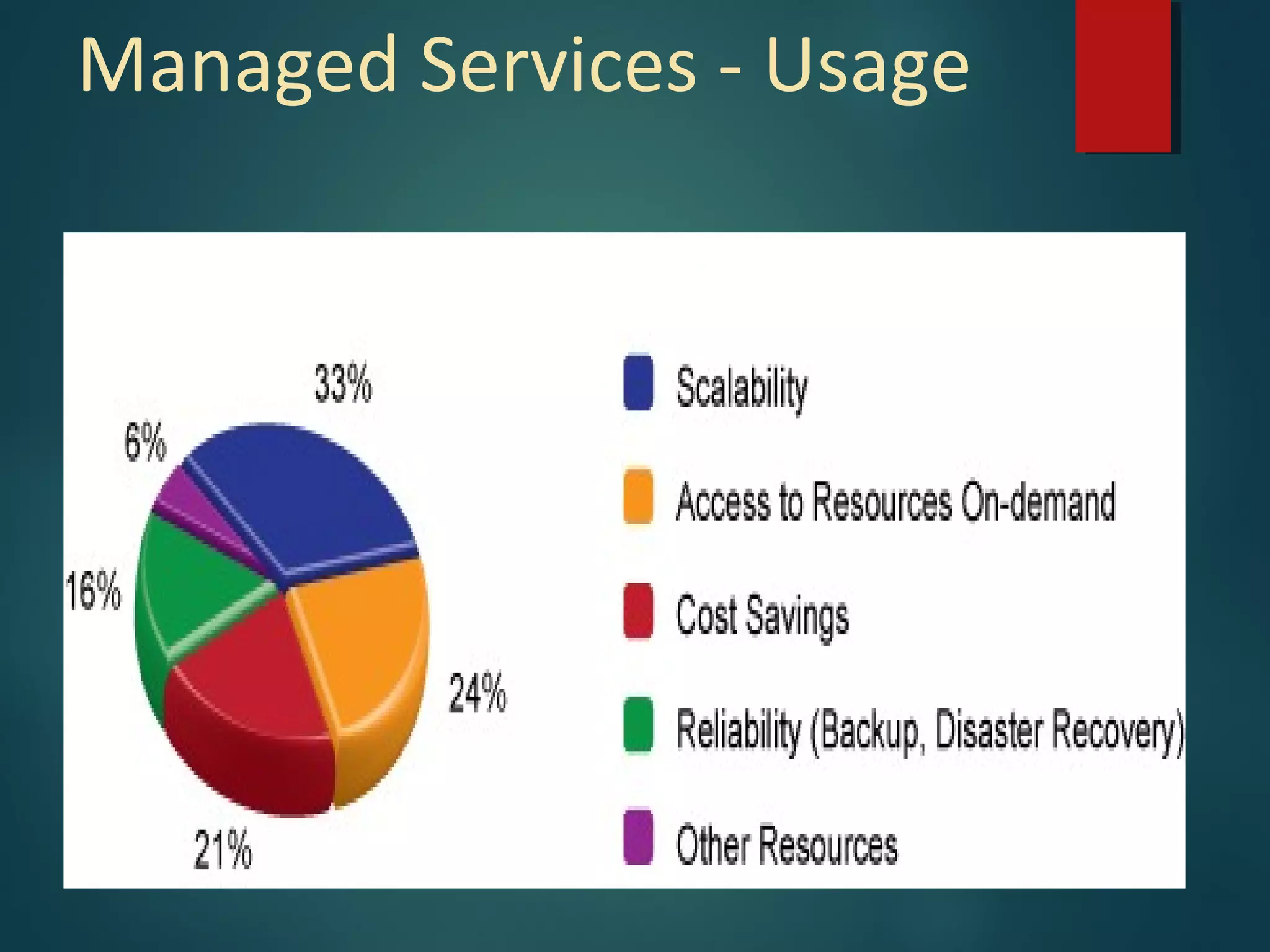
Managed Services Drivers
• Managed Services providers can generate scale-based
synergies as more Managed Services contracts are agreed.
• The larger the scope of the agreement, the greater the
potential for Managed Services providers to maximize
efficiencies and reduce costs.
Approach for delivering a
Managed Services Model
 The process of transitioning a Managed Services
model can be split into three manageable
phases, each phase being crucial for the success
of Managed Services to be operational.
 Developing the Strategy
 Operational Blue Print
 Implementation
Managed Services Models
• Staff Augmentation Model : Previously organizations were
once confined to the staff augmentation model for growth,
they can now engage managed services – a model that can
allow organizations to grow without hiring additional
employees.
• The Managed Services Model: Managed service is a model
within which client organizations outsource the management
and operation of support systems to external service providers
which includes management, monitoring, and maintenance
of systems and datacenter infrastructure
Managed Service Providers
 Significant resources and expertise in building and
managing next-generation data centers.
 The barrier to entry is also significantly higher with capital
expenditure required and billing and management creates
some overhead.
 Nonetheless, significant operational efficiency and agility
advantages can be realized, even by small organizations,
and server consolidation and virtualization rollouts are
already well underway.
Contact Us – info@fltcase.com

A Brief about IT Managed Services

  • 1.
  • 2.
    A Brief AboutManaged Services Managed services is the practice of outsourcing on a proactive basis management responsibilities and functions and a strategic method for improving operations and cutting expenses.
  • 3.
  • 4.
    Managed Services Need •M.S. model can be can be used for following situations: - The organization has multiple locations of operation - The organization has large number of work force - The resource pool for processes are underutilized. - The skills required for managing operations are specialized. - The cost of operations is going up.
  • 5.
    Benefits for ManagedServices • Key customer benefits of Managed Services are: - Customer peace of mind – monitor network on 24x7x365 basis proactively. - Single point of contact for all issues. - Single supplier instead of multiple vendors. - Defined Service Levels (SLA’s) - Avoid costs of building own management & reporting systems - Lower Total Cost Ownership (TCO) for client - Provides in lesser cycle time, more value to the Client.
  • 6.
    Benefits for ServiceProviders • Key service providers benefits of Managed IT support services are: - More Business contracts – extended longevity. - Increased ARPU (average revenue per user) . - Ability to interact with & influence customers at a business/application decision making level. - Providing value to the client of the Services availed by adding value.
  • 7.
    The Architecture • Atypical high-level architecture of a managed services platform consists of : - – Data center. – Provisioning manager. – Monitoring server. – Application server. – Virtualization components. • These components serve as the back- end of the managed services environment.
  • 8.
  • 9.
    Characteristics • Users donot own the physical infrastructure. • They rent usage from a third-party provider. • They consume resources as a service. • They pay only for resources that they use. • Servers are not unnecessarily left idle. • Users do not have to engineer for peak load limits. • With increased high-speed bandwidth, response times has been greatly reduced.
  • 10.
    Managed Services Trends •To sustain Managed Services model, it is not enough to focus on the mere Centralization of transaction processing activities. • MSP are to be “business-focused” and develop a high performance service culture and establishing best practice processes.
  • 11.
    Managed Services Drivers •Managed Services providers can generate scale-based synergies as more Managed Services contracts are agreed. • The larger the scope of the agreement, the greater the potential for Managed Services providers to maximize efficiencies and reduce costs.
  • 12.
    Approach for deliveringa Managed Services Model  The process of transitioning a Managed Services model can be split into three manageable phases, each phase being crucial for the success of Managed Services to be operational.  Developing the Strategy  Operational Blue Print  Implementation
  • 13.
    Managed Services Models •Staff Augmentation Model : Previously organizations were once confined to the staff augmentation model for growth, they can now engage managed services – a model that can allow organizations to grow without hiring additional employees. • The Managed Services Model: Managed service is a model within which client organizations outsource the management and operation of support systems to external service providers which includes management, monitoring, and maintenance of systems and datacenter infrastructure
  • 14.
    Managed Service Providers Significant resources and expertise in building and managing next-generation data centers.  The barrier to entry is also significantly higher with capital expenditure required and billing and management creates some overhead.  Nonetheless, significant operational efficiency and agility advantages can be realized, even by small organizations, and server consolidation and virtualization rollouts are already well underway.
  • 15.
    Contact Us –info@fltcase.com

Editor's Notes

  • #8 Virtualization is a framework or methodology of dividing the resources of a computer into multiple execution environments by applying one or more concepts or technologies such as hardware and software partitioning, time-sharing, partial or complete machine simulation, emulation, quality of service, and many others.
  • #13 These phases can be sub tasked as detailed road map. The major milestones in getting the Managed Services strategy operational would be: 1. Identification and prioritization of the processes: Here we need to prioritize the list of processes which need to be transitioned to a Managed Services operating model. The key factors that decide the processes to be selected are: Process that has large volumes of inflow The tasks & sub tasks to be performed are repetitive 2. Cost benefit analysis: Perform a cost benefit analysis in terms of FTE’s utilization and other infrastructure resourcing. 3. Design the to be model: Org Structure Process flows Process checks and controls KPI's / KGI's & Reporting of MIS 4. Mobilization of Resources People IT Administrative support 5. Establishment of center: This phase is challenging, as this activity is done in parallel to the activity in point 4. In this phase the Managed Services operations commence only when the staffing is done along with the required infrastructure support. 6. Transition of people and process: In this phase getting people to commence work in the Managed Services model would take about 2 to 3 months for stabilization. During transitioning phase there would drop in productivity as high as 40% There would be challenges in terms of synchronization of the other departments to this model with respect to providing inputs and taking the output of the function Post transition, one should be looking at having a process improvement plan in place along with the job rotation plan for the process doers. 7. Change Management: Managing change and training the resources to work in the new model is a critical success factor. The process doers will have to be prepared in accordance to this need. 8. Process stabilization & reporting: Generation of key performance indicators at all times prior to stabilization and post stabilization would help us understand how to act on ensuring effective control and monitoring the process productivity. We can setup stage wise reporting and MIS circulation for activities 9. Continuous Improvement: Having a continuous improvement plan would take the Managed Services center to the next level where we can drive higher productivity and enhanced process capacity, thus facilitating for taking on additional load from the remote locations.