Stress
Management
Strategies for
Students
Corona virus pandemic
Presented By-
Aditya Nag
Contents
A brief introduction on the virus.
Corona Virus
01
Introduction and understanding.
What is Stress?
02
Strategies to cope stress
03
Conclusion
04
 It is an infectious disease.
 The virus that causes COVID-19 is mainly transmitted through droplets
generated when an infected person coughs, sneezes, or exhales.
 These droplets are too heavy to hang in the air, and quickly fall on
floors or surfaces
 One can be infected by breathing in the virus if you are within close
proximity of someone who has COVID-19, or by touching a
contaminated surface and then your eyes, nose or mouth.
What is Stress?
WHAT IS STRESS ?
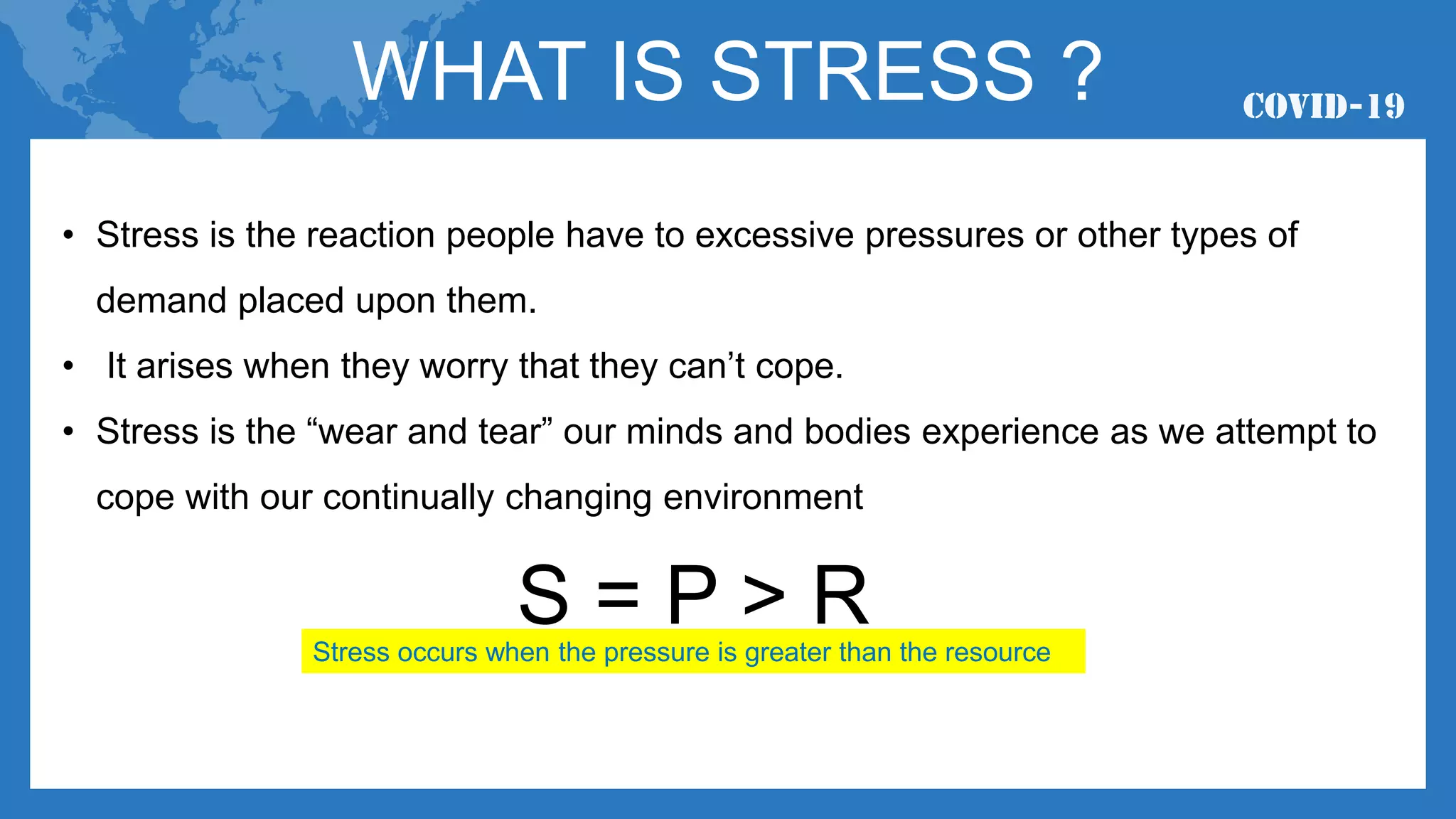
• Stress is the reaction people have to excessive pressures or other types of
demand placed upon them.
• It arises when they worry that they can’t cope.
• Stress is the “wear and tear” our minds and bodies experience as we attempt to
cope with our continually changing environment
S = P > RStress occurs when the pressure is greater than the resource
Strategies to cope
stress, anxiety or distress
Strategies to cope with stress, anxiety or
distress
Acknowledge your feelings
Whatever you are feeling right now, know that it’s okay to feel that way. Allow
yourself time to notice and express what you’re feeling.
This could be through journaling, talking with others, or channeling your
emotions into something creative (e.g., drawing, painting, poetry,
music). Mindfulness meditation and exercises can help us stay grounded in
the midst of an emotional storm.
Learn how to witness and let thoughts and feelings come and go in their
own time, without getting overwhelmed by them
Strategies to cope with stress, anxiety or
distress
Maintain your day-to-day activities and a
routine as much as possible
• Having a healthy routine can have a positive impact on your
thoughts and feelings.
• Go back to basics: eating healthy meals, physical exercise (e.g., walking,
stretching, running, cycling), getting enough sleep, and doing things you
enjoy.
• Even if you're in self-quarantine, or working from home, there are many
ways to develop new routines and stay healthy.
Strategies to cope with stress, anxiety or
distress
• During this time of change, it's natural for our minds to think of all the
usual activities we may not be able to do at the moment. Make a
conscious shift to focus on the activities we are still able to do, or those
that we may have more opportunity to do if we're at home more often.
Some ideas could be to:
 Keep learning and maintaining your study
 Read a book
 Listen to a podcast
 Try out a new hobby or skill (e.g., cook a new recipe, play
an instrument, learn a language, learn how to sew,
gardening).
Strategies to cope with stress, anxiety or
distress
Stay connected
• Receiving support and care from others has a powerful effect on helping
us cope with challenges. Spending time with supportive family and
friends can bring a sense of comfort and stability.
• Talking through our concerns, thoughts, and feelings with others can
also help us find helpful ways of thinking about or dealing with a stressful
situation
• A great way to connect with other students from home is via The Social
Connecting, where you can take part in individual and team missions.
Strategies to cope with stress, anxiety or
distress
Remember that physical distancing does
not need to mean social disconnection
There are many ways we can use technology to stay connected, and
both give and receive support (remotely). You could:
 Call, text, or video-chat with friends and family
 Share quick and easy recipes
 Start a virtual book or movie club
 Schedule a workout together over video chat
 Join an online group or peer forum.
Strategies to cope with stress, anxiety or
distress
Contribute
Showing care towards friends, family, or vulnerable people in our
community can be all the more important during times like this. It can
foster a sense of hope, purpose, and meaning. Some ideas can be
to:
 Send someone you care about a
message of encouragement or
affirmation
 Cook, pack and deliver a meal to
someone in your neighborhood
 Donate to a cause.
Strategies to cope with stress, anxiety or
distress
Seek accurate information
Finding credible sources you can trust is important to avoid
the fear and panic that can be caused by misinformation
Stay up to date with university advice and support
Check the University's student support website for
important information, including course-specific updates
and other advice for affected students.
Helpful
resources and support
Helpful resources and support
Mobile apps
Smiling Mind - free mindfulness meditation app to help you
look after your mental health and manage stress and daily
challenges.
Headspace - free "Weathering the Storm" program available to
help support the global community through this time
including a curated list of calming meditations, help with sleep,
and at-home workouts or movement exercises.
Self-help programs
There are many online programs available for the students.
Lots of universities are giving opportunity to avail free online
courses.
Free online program for Indian tertiary students to improve
their wellbeing and study more effectively.
Helpful resources and support
Conclusion
• Stress is a fact of life
o Stress is one of the leading causes of anxiety
disorders, which affect over 20 million Americans
• Tools and techniques available to
handle stress
• Be pro-active and take charge
THANK YOU

Stress Management for Students

  • 1.
  • 2.
    Contents A brief introductionon the virus. Corona Virus 01 Introduction and understanding. What is Stress? 02 Strategies to cope stress 03 Conclusion 04
  • 3.
     It isan infectious disease.  The virus that causes COVID-19 is mainly transmitted through droplets generated when an infected person coughs, sneezes, or exhales.  These droplets are too heavy to hang in the air, and quickly fall on floors or surfaces  One can be infected by breathing in the virus if you are within close proximity of someone who has COVID-19, or by touching a contaminated surface and then your eyes, nose or mouth.
  • 4.
  • 5.
    WHAT IS STRESS? • Stress is the reaction people have to excessive pressures or other types of demand placed upon them. • It arises when they worry that they can’t cope. • Stress is the “wear and tear” our minds and bodies experience as we attempt to cope with our continually changing environment S = P > RStress occurs when the pressure is greater than the resource
  • 6.
    Strategies to cope stress,anxiety or distress
  • 7.
    Strategies to copewith stress, anxiety or distress Acknowledge your feelings Whatever you are feeling right now, know that it’s okay to feel that way. Allow yourself time to notice and express what you’re feeling. This could be through journaling, talking with others, or channeling your emotions into something creative (e.g., drawing, painting, poetry, music). Mindfulness meditation and exercises can help us stay grounded in the midst of an emotional storm. Learn how to witness and let thoughts and feelings come and go in their own time, without getting overwhelmed by them
  • 8.
    Strategies to copewith stress, anxiety or distress Maintain your day-to-day activities and a routine as much as possible • Having a healthy routine can have a positive impact on your thoughts and feelings. • Go back to basics: eating healthy meals, physical exercise (e.g., walking, stretching, running, cycling), getting enough sleep, and doing things you enjoy. • Even if you're in self-quarantine, or working from home, there are many ways to develop new routines and stay healthy.
  • 9.
    Strategies to copewith stress, anxiety or distress • During this time of change, it's natural for our minds to think of all the usual activities we may not be able to do at the moment. Make a conscious shift to focus on the activities we are still able to do, or those that we may have more opportunity to do if we're at home more often. Some ideas could be to:  Keep learning and maintaining your study  Read a book  Listen to a podcast  Try out a new hobby or skill (e.g., cook a new recipe, play an instrument, learn a language, learn how to sew, gardening).
  • 10.
    Strategies to copewith stress, anxiety or distress Stay connected • Receiving support and care from others has a powerful effect on helping us cope with challenges. Spending time with supportive family and friends can bring a sense of comfort and stability. • Talking through our concerns, thoughts, and feelings with others can also help us find helpful ways of thinking about or dealing with a stressful situation • A great way to connect with other students from home is via The Social Connecting, where you can take part in individual and team missions.
  • 11.
    Strategies to copewith stress, anxiety or distress Remember that physical distancing does not need to mean social disconnection There are many ways we can use technology to stay connected, and both give and receive support (remotely). You could:  Call, text, or video-chat with friends and family  Share quick and easy recipes  Start a virtual book or movie club  Schedule a workout together over video chat  Join an online group or peer forum.
  • 12.
    Strategies to copewith stress, anxiety or distress Contribute Showing care towards friends, family, or vulnerable people in our community can be all the more important during times like this. It can foster a sense of hope, purpose, and meaning. Some ideas can be to:  Send someone you care about a message of encouragement or affirmation  Cook, pack and deliver a meal to someone in your neighborhood  Donate to a cause.
  • 13.
    Strategies to copewith stress, anxiety or distress Seek accurate information Finding credible sources you can trust is important to avoid the fear and panic that can be caused by misinformation Stay up to date with university advice and support Check the University's student support website for important information, including course-specific updates and other advice for affected students.
  • 14.
  • 15.
    Helpful resources andsupport Mobile apps Smiling Mind - free mindfulness meditation app to help you look after your mental health and manage stress and daily challenges. Headspace - free "Weathering the Storm" program available to help support the global community through this time including a curated list of calming meditations, help with sleep, and at-home workouts or movement exercises.
  • 16.
    Self-help programs There aremany online programs available for the students. Lots of universities are giving opportunity to avail free online courses. Free online program for Indian tertiary students to improve their wellbeing and study more effectively. Helpful resources and support
  • 17.
    Conclusion • Stress isa fact of life o Stress is one of the leading causes of anxiety disorders, which affect over 20 million Americans • Tools and techniques available to handle stress • Be pro-active and take charge
  • 18.