1
Data Mining:
Concepts and Techniques
(3rd
ed.)
— Chapter 3 —
Jiawei Han, Micheline Kamber, and Jian Pei
University of Illinois at Urbana-Champaign &
Simon Fraser University
©2011 Han, Kamber & Pei. All rights reserved.
2
2
Chapter 3: Data Preprocessing
 Data Preprocessing: An Overview
 Data Quality
 Major Tasks in Data Preprocessing
 Data Cleaning
 Data Integration
 Data Reduction
 Data Transformation and Data Discretization
 Summary
3
Data Quality: Why Preprocess the Data?
 Measures for data quality: A multidimensional view
 Accuracy: correct or wrong, accurate or not
 Completeness: not recorded, unavailable, …
 Consistency: some modified but some not, dangling, …
 Timeliness: timely update?

Believability: how trustable the data are correct?
 Interpretability: how easily the data can be
understood?
4
Major Tasks in Data Preprocessing
 Data cleaning

Fill in missing values, smooth noisy data, identify or remove
outliers, and resolve inconsistencies
 Data integration
 Integration of multiple databases, data cubes, or files
 Data reduction

Dimensionality reduction
 Numerosity reduction
 Data compression
 Data transformation and data discretization

Normalization

Concept hierarchy generation
5
5
Chapter 3: Data Preprocessing
 Data Preprocessing: An Overview
 Data Quality
 Major Tasks in Data Preprocessing
 Data Cleaning
 Data Integration
 Data Reduction
 Data Transformation and Data Discretization
 Summary
6
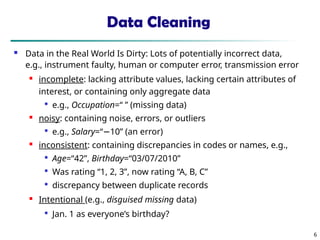
Data Cleaning
 Data in the Real World Is Dirty: Lots of potentially incorrect data,
e.g., instrument faulty, human or computer error, transmission error
 incomplete: lacking attribute values, lacking certain attributes of
interest, or containing only aggregate data

e.g., Occupation=“ ” (missing data)

noisy: containing noise, errors, or outliers

e.g., Salary=“−10” (an error)
 inconsistent: containing discrepancies in codes or names, e.g.,

Age=“42”, Birthday=“03/07/2010”

Was rating “1, 2, 3”, now rating “A, B, C”

discrepancy between duplicate records

Intentional (e.g., disguised missing data)

Jan. 1 as everyone’s birthday?
7
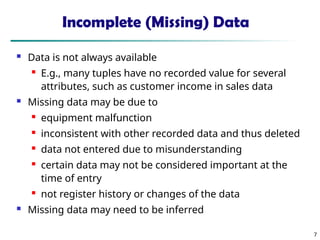
Incomplete (Missing) Data
 Data is not always available

E.g., many tuples have no recorded value for several
attributes, such as customer income in sales data
 Missing data may be due to
 equipment malfunction

inconsistent with other recorded data and thus deleted
 data not entered due to misunderstanding
 certain data may not be considered important at the
time of entry

not register history or changes of the data
 Missing data may need to be inferred
8
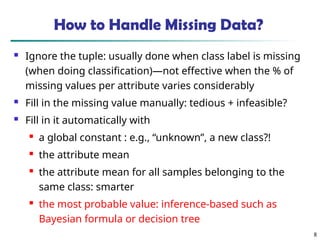
How to Handle Missing Data?
 Ignore the tuple: usually done when class label is missing
(when doing classification)—not effective when the % of
missing values per attribute varies considerably
 Fill in the missing value manually: tedious + infeasible?
 Fill in it automatically with

a global constant : e.g., “unknown”, a new class?!

the attribute mean

the attribute mean for all samples belonging to the
same class: smarter

the most probable value: inference-based such as
Bayesian formula or decision tree
9
Noisy Data
 Noise: random error or variance in a measured variable
 Incorrect attribute values may be due to

faulty data collection instruments
 data entry problems
 data transmission problems
 technology limitation
 inconsistency in naming convention
 Other data problems which require data cleaning

duplicate records
 incomplete data

inconsistent data
10
How to Handle Noisy Data?
 Binning

first sort data and partition into (equal-frequency)
bins

then one can smooth by bin means, smooth by bin
median, smooth by bin boundaries, etc.
 Regression

smooth by fitting the data into regression functions
 Clustering

detect and remove outliers
 Combined computer and human inspection

detect suspicious values and check by human (e.g.,
deal with possible outliers)
11
Data Cleaning as a Process
 Data discrepancy detection
 Use metadata (e.g., domain, range, dependency, distribution)
 Check field overloading
 Check uniqueness rule, consecutive rule and null rule
 Use commercial tools

Data scrubbing: use simple domain knowledge (e.g., postal
code, spell-check) to detect errors and make corrections

Data auditing: by analyzing data to discover rules and
relationship to detect violators (e.g., correlation and
clustering to find outliers)
 Data migration and integration
 Data migration tools: allow transformations to be specified
 ETL (Extraction/Transformation/Loading) tools: allow users to
specify transformations through a graphical user interface
 Integration of the two processes
 Iterative and interactive
12
12
Data Preprocessing
 Data Preprocessing: An Overview
 Data Quality
 Major Tasks in Data Preprocessing
 Data Cleaning
 Data Integration
 Data Reduction
 Data Transformation and Data Discretization
 Summary
13
13
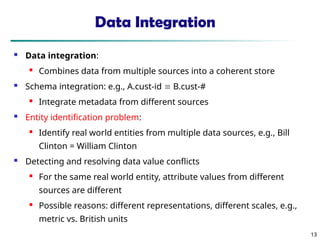
Data Integration
 Data integration:

Combines data from multiple sources into a coherent store
 Schema integration: e.g., A.cust-id  B.cust-#

Integrate metadata from different sources
 Entity identification problem:

Identify real world entities from multiple data sources, e.g., Bill
Clinton = William Clinton
 Detecting and resolving data value conflicts

For the same real world entity, attribute values from different
sources are different

Possible reasons: different representations, different scales, e.g.,
metric vs. British units
14
14
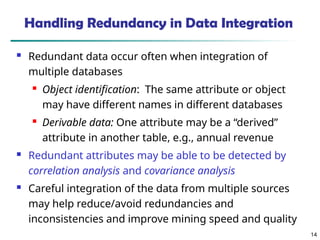
Handling Redundancy in Data Integration
 Redundant data occur often when integration of
multiple databases
 Object identification: The same attribute or object
may have different names in different databases
 Derivable data: One attribute may be a “derived”
attribute in another table, e.g., annual revenue
 Redundant attributes may be able to be detected by
correlation analysis and covariance analysis
 Careful integration of the data from multiple sources
may help reduce/avoid redundancies and
inconsistencies and improve mining speed and quality
15
15
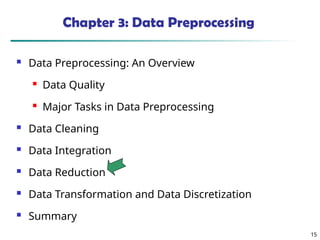
Chapter 3: Data Preprocessing
 Data Preprocessing: An Overview
 Data Quality
 Major Tasks in Data Preprocessing
 Data Cleaning
 Data Integration
 Data Reduction
 Data Transformation and Data Discretization
 Summary
16
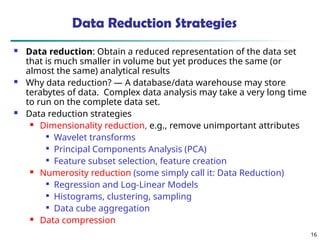
Data Reduction Strategies
 Data reduction: Obtain a reduced representation of the data set
that is much smaller in volume but yet produces the same (or
almost the same) analytical results
 Why data reduction? — A database/data warehouse may store
terabytes of data. Complex data analysis may take a very long time
to run on the complete data set.
 Data reduction strategies
 Dimensionality reduction, e.g., remove unimportant attributes

Wavelet transforms

Principal Components Analysis (PCA)

Feature subset selection, feature creation
 Numerosity reduction (some simply call it: Data Reduction)

Regression and Log-Linear Models

Histograms, clustering, sampling

Data cube aggregation
 Data compression
17
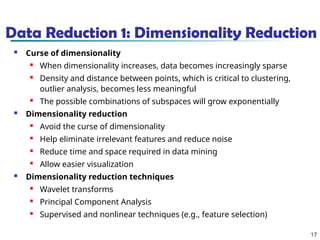
Data Reduction 1: Dimensionality Reduction
 Curse of dimensionality
 When dimensionality increases, data becomes increasingly sparse
 Density and distance between points, which is critical to clustering,
outlier analysis, becomes less meaningful
 The possible combinations of subspaces will grow exponentially
 Dimensionality reduction
 Avoid the curse of dimensionality
 Help eliminate irrelevant features and reduce noise
 Reduce time and space required in data mining
 Allow easier visualization
 Dimensionality reduction techniques
 Wavelet transforms
 Principal Component Analysis
 Supervised and nonlinear techniques (e.g., feature selection)
18
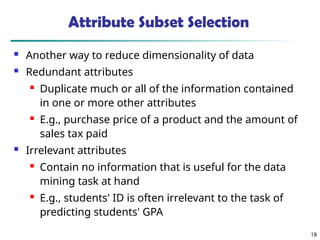
Attribute Subset Selection
 Another way to reduce dimensionality of data
 Redundant attributes
 Duplicate much or all of the information contained
in one or more other attributes
 E.g., purchase price of a product and the amount of
sales tax paid
 Irrelevant attributes
 Contain no information that is useful for the data
mining task at hand
 E.g., students' ID is often irrelevant to the task of
predicting students' GPA

preproccessing level 3 for students.ppt

  • 1.
    1 Data Mining: Concepts andTechniques (3rd ed.) — Chapter 3 — Jiawei Han, Micheline Kamber, and Jian Pei University of Illinois at Urbana-Champaign & Simon Fraser University ©2011 Han, Kamber & Pei. All rights reserved.
  • 2.
    2 2 Chapter 3: DataPreprocessing  Data Preprocessing: An Overview  Data Quality  Major Tasks in Data Preprocessing  Data Cleaning  Data Integration  Data Reduction  Data Transformation and Data Discretization  Summary
  • 3.
    3 Data Quality: WhyPreprocess the Data?  Measures for data quality: A multidimensional view  Accuracy: correct or wrong, accurate or not  Completeness: not recorded, unavailable, …  Consistency: some modified but some not, dangling, …  Timeliness: timely update?  Believability: how trustable the data are correct?  Interpretability: how easily the data can be understood?
  • 4.
    4 Major Tasks inData Preprocessing  Data cleaning  Fill in missing values, smooth noisy data, identify or remove outliers, and resolve inconsistencies  Data integration  Integration of multiple databases, data cubes, or files  Data reduction  Dimensionality reduction  Numerosity reduction  Data compression  Data transformation and data discretization  Normalization  Concept hierarchy generation
  • 5.
    5 5 Chapter 3: DataPreprocessing  Data Preprocessing: An Overview  Data Quality  Major Tasks in Data Preprocessing  Data Cleaning  Data Integration  Data Reduction  Data Transformation and Data Discretization  Summary
  • 6.
    6 Data Cleaning  Datain the Real World Is Dirty: Lots of potentially incorrect data, e.g., instrument faulty, human or computer error, transmission error  incomplete: lacking attribute values, lacking certain attributes of interest, or containing only aggregate data  e.g., Occupation=“ ” (missing data)  noisy: containing noise, errors, or outliers  e.g., Salary=“−10” (an error)  inconsistent: containing discrepancies in codes or names, e.g.,  Age=“42”, Birthday=“03/07/2010”  Was rating “1, 2, 3”, now rating “A, B, C”  discrepancy between duplicate records  Intentional (e.g., disguised missing data)  Jan. 1 as everyone’s birthday?
  • 7.
    7 Incomplete (Missing) Data Data is not always available  E.g., many tuples have no recorded value for several attributes, such as customer income in sales data  Missing data may be due to  equipment malfunction  inconsistent with other recorded data and thus deleted  data not entered due to misunderstanding  certain data may not be considered important at the time of entry  not register history or changes of the data  Missing data may need to be inferred
  • 8.
    8 How to HandleMissing Data?  Ignore the tuple: usually done when class label is missing (when doing classification)—not effective when the % of missing values per attribute varies considerably  Fill in the missing value manually: tedious + infeasible?  Fill in it automatically with  a global constant : e.g., “unknown”, a new class?!  the attribute mean  the attribute mean for all samples belonging to the same class: smarter  the most probable value: inference-based such as Bayesian formula or decision tree
  • 9.
    9 Noisy Data  Noise:random error or variance in a measured variable  Incorrect attribute values may be due to  faulty data collection instruments  data entry problems  data transmission problems  technology limitation  inconsistency in naming convention  Other data problems which require data cleaning  duplicate records  incomplete data  inconsistent data
  • 10.
    10 How to HandleNoisy Data?  Binning  first sort data and partition into (equal-frequency) bins  then one can smooth by bin means, smooth by bin median, smooth by bin boundaries, etc.  Regression  smooth by fitting the data into regression functions  Clustering  detect and remove outliers  Combined computer and human inspection  detect suspicious values and check by human (e.g., deal with possible outliers)
  • 11.
    11 Data Cleaning asa Process  Data discrepancy detection  Use metadata (e.g., domain, range, dependency, distribution)  Check field overloading  Check uniqueness rule, consecutive rule and null rule  Use commercial tools  Data scrubbing: use simple domain knowledge (e.g., postal code, spell-check) to detect errors and make corrections  Data auditing: by analyzing data to discover rules and relationship to detect violators (e.g., correlation and clustering to find outliers)  Data migration and integration  Data migration tools: allow transformations to be specified  ETL (Extraction/Transformation/Loading) tools: allow users to specify transformations through a graphical user interface  Integration of the two processes  Iterative and interactive
  • 12.
    12 12 Data Preprocessing  DataPreprocessing: An Overview  Data Quality  Major Tasks in Data Preprocessing  Data Cleaning  Data Integration  Data Reduction  Data Transformation and Data Discretization  Summary
  • 13.
    13 13 Data Integration  Dataintegration:  Combines data from multiple sources into a coherent store  Schema integration: e.g., A.cust-id  B.cust-#  Integrate metadata from different sources  Entity identification problem:  Identify real world entities from multiple data sources, e.g., Bill Clinton = William Clinton  Detecting and resolving data value conflicts  For the same real world entity, attribute values from different sources are different  Possible reasons: different representations, different scales, e.g., metric vs. British units
  • 14.
    14 14 Handling Redundancy inData Integration  Redundant data occur often when integration of multiple databases  Object identification: The same attribute or object may have different names in different databases  Derivable data: One attribute may be a “derived” attribute in another table, e.g., annual revenue  Redundant attributes may be able to be detected by correlation analysis and covariance analysis  Careful integration of the data from multiple sources may help reduce/avoid redundancies and inconsistencies and improve mining speed and quality
  • 15.
    15 15 Chapter 3: DataPreprocessing  Data Preprocessing: An Overview  Data Quality  Major Tasks in Data Preprocessing  Data Cleaning  Data Integration  Data Reduction  Data Transformation and Data Discretization  Summary
  • 16.
    16 Data Reduction Strategies Data reduction: Obtain a reduced representation of the data set that is much smaller in volume but yet produces the same (or almost the same) analytical results  Why data reduction? — A database/data warehouse may store terabytes of data. Complex data analysis may take a very long time to run on the complete data set.  Data reduction strategies  Dimensionality reduction, e.g., remove unimportant attributes  Wavelet transforms  Principal Components Analysis (PCA)  Feature subset selection, feature creation  Numerosity reduction (some simply call it: Data Reduction)  Regression and Log-Linear Models  Histograms, clustering, sampling  Data cube aggregation  Data compression
  • 17.
    17 Data Reduction 1:Dimensionality Reduction  Curse of dimensionality  When dimensionality increases, data becomes increasingly sparse  Density and distance between points, which is critical to clustering, outlier analysis, becomes less meaningful  The possible combinations of subspaces will grow exponentially  Dimensionality reduction  Avoid the curse of dimensionality  Help eliminate irrelevant features and reduce noise  Reduce time and space required in data mining  Allow easier visualization  Dimensionality reduction techniques  Wavelet transforms  Principal Component Analysis  Supervised and nonlinear techniques (e.g., feature selection)
  • 18.
    18 Attribute Subset Selection Another way to reduce dimensionality of data  Redundant attributes  Duplicate much or all of the information contained in one or more other attributes  E.g., purchase price of a product and the amount of sales tax paid  Irrelevant attributes  Contain no information that is useful for the data mining task at hand  E.g., students' ID is often irrelevant to the task of predicting students' GPA