Database Systems Security Paul J. Wagner  University of Wisconsin – Eau Claire
Database Systems Security –  Background Need Security curriculum is relatively light in database systems area Focus currently on protecting information through network configuration, systems administration, application security Need to specifically consider database system security issues Goals Understand security issues in a specific Oracle environment and in a general database system environment Consider database security issues in context of general security principles and ideas
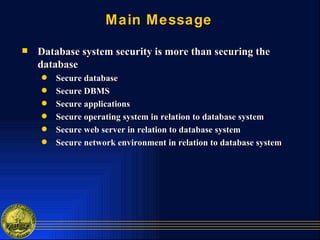
Main Message Database system security is more than securing the database Secure database Secure DBMS Secure applications  Secure operating system in relation to database system Secure web server in relation to database system Secure network environment in relation to database system
Secure databases Traditional database security topics and issues Users, Passwords Default users/passwords sys, system accounts – privileged, with default passwords scott account – well-known account and password, part of public group e.g. public can access all_users table general password policies (length, domain, changing, protection) Privileges, Roles, Grant/Revoke Privileges System - actions Objects – data Roles Collections of system privileges Grant / Revoke Giving (removing )privileges or roles to (from) users
Secure DBMS Possible Holes in DBMS http:// technet.oracle.com/deploy/security/alerts.htm   (50+ listed) Buffer overflow problems in DBMS code Miscellaneous attacks (Denial of Service, source code disclosure of JSPs, others) UTL_FILE package in PL/SQL allows read/write access to files in directory specified in utl_file_dir parameter in init.ora possible access through symbolic links Need for continual patching of DBMS Encourage awareness of issues, continuous vigilance Cost of not patching SQL Slammer Worm
Secure Application Development Access to Oracle Database or Environment Through Applications Example: SQL Injection Attack through Web Application Application tracks own usernames and passwords in database Client accepts username and password, passes as parameters Application Java code contains SQL statement: String query =  "SELECT * FROM users_table " +   " WHERE username = " +  " ‘ " + username + " ‘ " + " AND password = " + " ‘ " + password + " ‘ "  ; Expecting one row to be returned if success, no rows if failure Attacker enters any username, password of:  Aa ‘  OR ‘ ‘  = ‘ Query becomes:  SELECT * FROM users_table WHERE username = ‘anyname‘ AND password = ‘Aa‘ OR ‘ ‘ = ‘ ‘;  // F or T => T All user rows returned to application If application checking for 0 vs. more than 0 rows, attacker is in
Secure Application Development Application Security in the Enterprise Environment J2EE .NET Use of Proxy Applications Assume network filtering most evil traffic Application can control fine-grain behavior, application protocol security Security Patterns (from J2EE Design Patterns Applied) Single-Access Point Pattern single point of entry into system Check Point Pattern centralized enforcement of authentication and authorization Role Pattern disassociation of users and privileges
Secure Operating System Interaction of Oracle and OS Windows Secure administrative accounts Control registry access Need good account policies Others… Linux/Unix Choose different account names than standard suggestions Restrict use of the account that owns Oracle software Secure temporary directory Some Oracle files are SUID (root) Command line SQL*Plus with user/pass parameters appears under ps output Others…
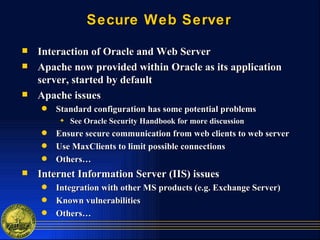
Secure Web Server Interaction of Oracle and Web Server Apache now provided within Oracle as its application server, started by default Apache issues Standard configuration has some potential problems See Oracle Security Handbook for more discussion Ensure secure communication from web clients to web server Use MaxClients to limit possible connections Others… Internet Information Server (IIS) issues Integration with other MS products (e.g. Exchange Server) Known vulnerabilities Others…
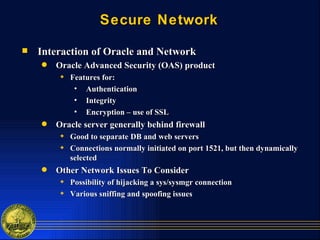
Secure Network Interaction of Oracle and Network Oracle Advanced Security (OAS) product Features for: Authentication Integrity Encryption – use of SSL Oracle server generally behind firewall Good to separate DB and web servers Connections normally initiated on port 1521, but then dynamically selected Other Network Issues To Consider Possibility of hijacking a sys/sysmgr connection Various sniffing and spoofing issues
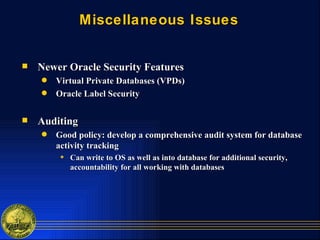
Miscellaneous Issues Newer Oracle Security Features Virtual Private Databases (VPDs) Oracle Label Security Auditing Good policy: develop a comprehensive audit system for database activity tracking Can write to OS as well as into database for additional security, accountability for all working with databases
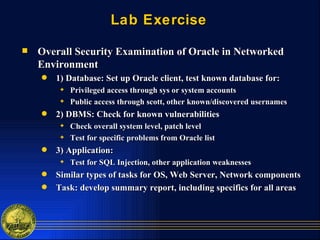
Lab Exercise Overall Security Examination of Oracle in Networked Environment 1) Database: Set up Oracle client, test known database for: Privileged access through sys or system accounts Public access through scott, other known/discovered usernames 2) DBMS: Check for known vulnerabilities Check overall system level, patch level Test for specific problems from Oracle list 3) Application: Test for SQL Injection, other application weaknesses Similar types of tasks for OS, Web Server, Network components Task: develop summary report, including specifics for all areas
References “ Oracle Security Handbook” by Theriault and Newman; Osborne/Oracle Press, 2001. “ Oracle Database Administration: The Essential Reference”, Kreines and Laskey; O’Reilly, 1999. “ Investigation of Default Oracle Accounts”, http://www.pentest-limited.com/user-tables.pdf

Database Systems Security

  • 1.
    Database Systems SecurityPaul J. Wagner University of Wisconsin – Eau Claire
  • 2.
    Database Systems Security– Background Need Security curriculum is relatively light in database systems area Focus currently on protecting information through network configuration, systems administration, application security Need to specifically consider database system security issues Goals Understand security issues in a specific Oracle environment and in a general database system environment Consider database security issues in context of general security principles and ideas
  • 3.
    Main Message Databasesystem security is more than securing the database Secure database Secure DBMS Secure applications Secure operating system in relation to database system Secure web server in relation to database system Secure network environment in relation to database system
  • 4.
    Secure databases Traditionaldatabase security topics and issues Users, Passwords Default users/passwords sys, system accounts – privileged, with default passwords scott account – well-known account and password, part of public group e.g. public can access all_users table general password policies (length, domain, changing, protection) Privileges, Roles, Grant/Revoke Privileges System - actions Objects – data Roles Collections of system privileges Grant / Revoke Giving (removing )privileges or roles to (from) users
  • 5.
    Secure DBMS PossibleHoles in DBMS http:// technet.oracle.com/deploy/security/alerts.htm (50+ listed) Buffer overflow problems in DBMS code Miscellaneous attacks (Denial of Service, source code disclosure of JSPs, others) UTL_FILE package in PL/SQL allows read/write access to files in directory specified in utl_file_dir parameter in init.ora possible access through symbolic links Need for continual patching of DBMS Encourage awareness of issues, continuous vigilance Cost of not patching SQL Slammer Worm
  • 6.
    Secure Application DevelopmentAccess to Oracle Database or Environment Through Applications Example: SQL Injection Attack through Web Application Application tracks own usernames and passwords in database Client accepts username and password, passes as parameters Application Java code contains SQL statement: String query = "SELECT * FROM users_table " + " WHERE username = " + " ‘ " + username + " ‘ " + " AND password = " + " ‘ " + password + " ‘ " ; Expecting one row to be returned if success, no rows if failure Attacker enters any username, password of: Aa ‘ OR ‘ ‘ = ‘ Query becomes: SELECT * FROM users_table WHERE username = ‘anyname‘ AND password = ‘Aa‘ OR ‘ ‘ = ‘ ‘; // F or T => T All user rows returned to application If application checking for 0 vs. more than 0 rows, attacker is in
  • 7.
    Secure Application DevelopmentApplication Security in the Enterprise Environment J2EE .NET Use of Proxy Applications Assume network filtering most evil traffic Application can control fine-grain behavior, application protocol security Security Patterns (from J2EE Design Patterns Applied) Single-Access Point Pattern single point of entry into system Check Point Pattern centralized enforcement of authentication and authorization Role Pattern disassociation of users and privileges
  • 8.
    Secure Operating SystemInteraction of Oracle and OS Windows Secure administrative accounts Control registry access Need good account policies Others… Linux/Unix Choose different account names than standard suggestions Restrict use of the account that owns Oracle software Secure temporary directory Some Oracle files are SUID (root) Command line SQL*Plus with user/pass parameters appears under ps output Others…
  • 9.
    Secure Web ServerInteraction of Oracle and Web Server Apache now provided within Oracle as its application server, started by default Apache issues Standard configuration has some potential problems See Oracle Security Handbook for more discussion Ensure secure communication from web clients to web server Use MaxClients to limit possible connections Others… Internet Information Server (IIS) issues Integration with other MS products (e.g. Exchange Server) Known vulnerabilities Others…
  • 10.
    Secure Network Interactionof Oracle and Network Oracle Advanced Security (OAS) product Features for: Authentication Integrity Encryption – use of SSL Oracle server generally behind firewall Good to separate DB and web servers Connections normally initiated on port 1521, but then dynamically selected Other Network Issues To Consider Possibility of hijacking a sys/sysmgr connection Various sniffing and spoofing issues
  • 11.
    Miscellaneous Issues NewerOracle Security Features Virtual Private Databases (VPDs) Oracle Label Security Auditing Good policy: develop a comprehensive audit system for database activity tracking Can write to OS as well as into database for additional security, accountability for all working with databases
  • 12.
    Lab Exercise OverallSecurity Examination of Oracle in Networked Environment 1) Database: Set up Oracle client, test known database for: Privileged access through sys or system accounts Public access through scott, other known/discovered usernames 2) DBMS: Check for known vulnerabilities Check overall system level, patch level Test for specific problems from Oracle list 3) Application: Test for SQL Injection, other application weaknesses Similar types of tasks for OS, Web Server, Network components Task: develop summary report, including specifics for all areas
  • 13.
    References “ OracleSecurity Handbook” by Theriault and Newman; Osborne/Oracle Press, 2001. “ Oracle Database Administration: The Essential Reference”, Kreines and Laskey; O’Reilly, 1999. “ Investigation of Default Oracle Accounts”, http://www.pentest-limited.com/user-tables.pdf