
DATABASE MODELA large, regularly updated file of digitized information
(bibliographic records, abstract, full-text documents,
directory entries, images, statistics, etc.) related to a specific
subject or field, consisting of records of uniform format
organized for ease and speed of research and retrieval and
manage with the aid of database management (DBMS)
software. Content is created by the database producer ( for
ex., the American Psychological association), which usually
publishes a print version (psychological Abstracts) and
leases the content to one or more database vendors
(EBSCO, OCLC, etc.) that provide electronic access to the
data after it has been converted to machine-readable form
(PsycINFO), usually on CD-Rom or online via the internet,
using proprietary search software.
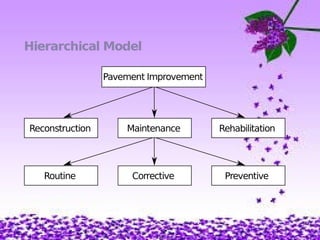
Hierarchical Model
 organizes data in a tree structure,
Implies that a record can have repeating
information
It collects all the instances of a specific
record together as a record type
 were popular from the late 1960’s with
the introduction of IBM’s Information
Management System (IMS) DBMS
through 1970’s.
4
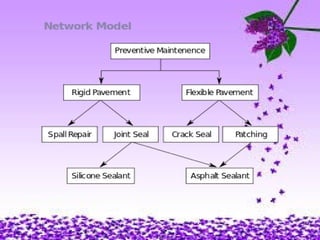
Network Model
 permitted the modeling of many-to-many
relationship in data.
 in 1971, the Conference on Data System
Languages (CODASYL) formally defined the
network model.
Its base on mathematical theory
6
Relational Model
 is the best known and in today’s most often
implemented database model.
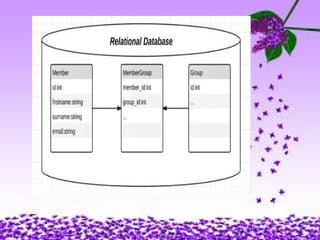
 a database as a collection of tables (relations)
which contain all data.
 (RDBMS-relational database management
system) A database based on the relational
model developed by E.F Codd, A.
A relational database allows the definition
structures, storage and retrieval operations
and integrity constraints.
 its based on the Relational Algebra
Properties of Relational Tables:
o Values Are Atomic
o Each row is Unique
o column Values Are of the Same Kind
o The Sequence of Columns is Insignificant
o The Sequence of Rows in Insignificant
oEach Column Has a Unique Name
9
Object/Relational Model
 Object/ relational database management
system (ORDBMS) add new object storage
capabilities to the relational system at the
core of modern information systems.
 the object/relational (OR) approach has
inherit the robust transaction- and
performance-management features of its
relational ancestor and the flexibility of its
object-oriented cousin.
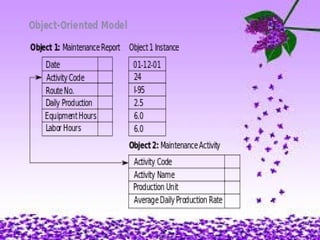
Object-Oriented Model
Object DBMSs add database functionality to
object programming languages;
 according to Rao (1993), “the object-oriented
database (OODB) paradigm is the combination
of object-oriented programming language
(OOPL) system and persistent system. The
power of the OODB comes from the seamless
treatment of both persistent data, as found in
databases, and transient data, as found in
executing programs.”
12
Semistructured Model
 the information that is normally associated
with a schema is contained within the data,
which sometimes called “self-describing”.
 a data is naturally modelled in terms of
graphs which contain labels which give
semantics to its underlying structure.
 semistuctured data has recently emerged
as an important topic of study for a variety of
reasons:
1. there are data sources such as the Web,
which we would like to treat as databases
but which cannot be constrained by a
schema;
2. it may be desirable to have an extremely
flexible format for data exchange between
disparate databases;
3. even when dealing with structured data, it
may be helpful to view it as semistructured
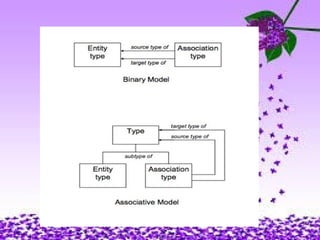
Associative Model
a. Entities are things that have discrete,
independent existence;
b. An entity’s existence does not depend on
any other thing.
2 Data Structures:
1. A set of items, each of which has a unique
identifier, a name and a type;
2. A set of links, each of which has a unique
identifier, together with the unique
identifiers of three other things, that
represent the source source, verb and target
15
16
Entity-Attribute-Value (EAV)
 generalized form;
 involves a single table with three table
columns, an entity (such as an olfactory
receptor ID), an attribute (such as species,
which is actually a pointer into metadata
table) and a value for the attribute.
 is appropriate when the number of
parameters that potentially apply to an entity
is vastly more than those actually apply to an
individual entity.
17
18
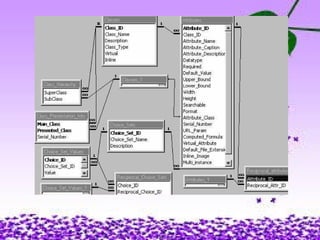
Context Model
The fundamental unit of information storage of
CONTEXT is a CLASS. CLASS contains
METHODS and describe OBJECT. The OBJECT
contains FIELDS and PROPERTY. The field may
be composite, in the case the field contains
SubFields etc. the property is a set of fields
that belongs to a particular Object. (similar to
AVL Database).
19
The header of Class contains the definition of
the internal structure of the Object, which
includes the description of each fields such
as their:
I. Type;
II. Length;
III. Attributes; and
IV. name
20
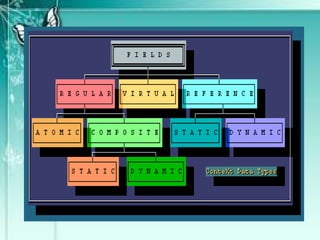
3 Main Data Types:
A. REGULAR
B. VIRTUAL
C. REFERENCE
REGULAR (local)
 field can be ATOMIC or COMPOSITE.
 ATOMIC field has no inner structure
 COMPOSITE field may have a complex
structure, and its type is described in the
header of class.
2 types of COMPOSITE FIELDS
1. static
2. Dynamic
1. Static composite field
― stored in the header and is permanent.
2. Dynamic composite field
― stored within the Object and can vary from
Object to Object
 Virtual fields
- is like a regular field: it can be read or
written into.
- this field is not physically stored in the
database, and in it does have a type
described in the scheme.
02/24/15
Context Database
 does not have composite or pointer fields and
property is essentially RELATIONAL
 with static composite and pointer fields, context
database become OBJECT-ORIENTED.
 if the context database has only Property in this case
it is an ENTITY-ATTRIBUTE-VALUE database.
 with dynamic composite fields a context database
becomes what is now known as a SEMISTRUCTURED
database.
 if the database has all available types...in this case ot
is ConteXt database
Database model BY ME

Database model BY ME

  • 1.
    DATABASE MODELA large,regularly updated file of digitized information (bibliographic records, abstract, full-text documents, directory entries, images, statistics, etc.) related to a specific subject or field, consisting of records of uniform format organized for ease and speed of research and retrieval and manage with the aid of database management (DBMS) software. Content is created by the database producer ( for ex., the American Psychological association), which usually publishes a print version (psychological Abstracts) and leases the content to one or more database vendors (EBSCO, OCLC, etc.) that provide electronic access to the data after it has been converted to machine-readable form (PsycINFO), usually on CD-Rom or online via the internet, using proprietary search software.
  • 2.
    Hierarchical Model  organizesdata in a tree structure, Implies that a record can have repeating information It collects all the instances of a specific record together as a record type  were popular from the late 1960’s with the introduction of IBM’s Information Management System (IMS) DBMS through 1970’s.
  • 4.
    4 Network Model  permittedthe modeling of many-to-many relationship in data.  in 1971, the Conference on Data System Languages (CODASYL) formally defined the network model. Its base on mathematical theory
  • 6.
    6 Relational Model  isthe best known and in today’s most often implemented database model.  a database as a collection of tables (relations) which contain all data.  (RDBMS-relational database management system) A database based on the relational model developed by E.F Codd, A. A relational database allows the definition structures, storage and retrieval operations and integrity constraints.  its based on the Relational Algebra
  • 7.
    Properties of RelationalTables: o Values Are Atomic o Each row is Unique o column Values Are of the Same Kind o The Sequence of Columns is Insignificant o The Sequence of Rows in Insignificant oEach Column Has a Unique Name
  • 9.
    9 Object/Relational Model  Object/relational database management system (ORDBMS) add new object storage capabilities to the relational system at the core of modern information systems.  the object/relational (OR) approach has inherit the robust transaction- and performance-management features of its relational ancestor and the flexibility of its object-oriented cousin.
  • 10.
    Object-Oriented Model Object DBMSsadd database functionality to object programming languages;  according to Rao (1993), “the object-oriented database (OODB) paradigm is the combination of object-oriented programming language (OOPL) system and persistent system. The power of the OODB comes from the seamless treatment of both persistent data, as found in databases, and transient data, as found in executing programs.”
  • 12.
    12 Semistructured Model  theinformation that is normally associated with a schema is contained within the data, which sometimes called “self-describing”.  a data is naturally modelled in terms of graphs which contain labels which give semantics to its underlying structure.
  • 13.
     semistuctured datahas recently emerged as an important topic of study for a variety of reasons: 1. there are data sources such as the Web, which we would like to treat as databases but which cannot be constrained by a schema; 2. it may be desirable to have an extremely flexible format for data exchange between disparate databases; 3. even when dealing with structured data, it may be helpful to view it as semistructured
  • 14.
    Associative Model a. Entitiesare things that have discrete, independent existence; b. An entity’s existence does not depend on any other thing. 2 Data Structures: 1. A set of items, each of which has a unique identifier, a name and a type; 2. A set of links, each of which has a unique identifier, together with the unique identifiers of three other things, that represent the source source, verb and target
  • 15.
  • 16.
    16 Entity-Attribute-Value (EAV)  generalizedform;  involves a single table with three table columns, an entity (such as an olfactory receptor ID), an attribute (such as species, which is actually a pointer into metadata table) and a value for the attribute.  is appropriate when the number of parameters that potentially apply to an entity is vastly more than those actually apply to an individual entity.
  • 17.
  • 18.
    18 Context Model The fundamentalunit of information storage of CONTEXT is a CLASS. CLASS contains METHODS and describe OBJECT. The OBJECT contains FIELDS and PROPERTY. The field may be composite, in the case the field contains SubFields etc. the property is a set of fields that belongs to a particular Object. (similar to AVL Database).
  • 19.
    19 The header ofClass contains the definition of the internal structure of the Object, which includes the description of each fields such as their: I. Type; II. Length; III. Attributes; and IV. name
  • 20.
    20 3 Main DataTypes: A. REGULAR B. VIRTUAL C. REFERENCE
  • 21.
    REGULAR (local)  fieldcan be ATOMIC or COMPOSITE.  ATOMIC field has no inner structure  COMPOSITE field may have a complex structure, and its type is described in the header of class. 2 types of COMPOSITE FIELDS 1. static 2. Dynamic
  • 22.
    1. Static compositefield ― stored in the header and is permanent. 2. Dynamic composite field ― stored within the Object and can vary from Object to Object
  • 23.
     Virtual fields -is like a regular field: it can be read or written into. - this field is not physically stored in the database, and in it does have a type described in the scheme.
  • 24.
    02/24/15 Context Database  doesnot have composite or pointer fields and property is essentially RELATIONAL  with static composite and pointer fields, context database become OBJECT-ORIENTED.  if the context database has only Property in this case it is an ENTITY-ATTRIBUTE-VALUE database.  with dynamic composite fields a context database becomes what is now known as a SEMISTRUCTURED database.  if the database has all available types...in this case ot is ConteXt database