1
C O M P I L E D B Y : G / S L A S S I E E .
2
C O M P I L E D B Y : G / S L A S S I E E .
3
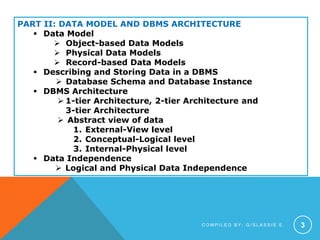
PART II: DATA MODEL AND DBMS ARCHITECTURE
 Data Model
 Object-based Data Models
 Physical Data Models
 Record-based Data Models
 Describing and Storing Data in a DBMS
 Database Schema and Database Instance
 DBMS Architecture
 1-tier Architecture, 2-tier Architecture and
3-tier Architecture
 Abstract view of data
1. External-View level
2. Conceptual-Logical level
3. Internal-Physical level
 Data Independence
 Logical and Physical Data Independence
C O M P I L E D B Y : G / S L A S S I E E .
Cont.
Data Model
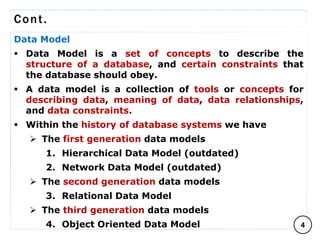
 Data Model is a set of concepts to describe the
structure of a database, and certain constraints that
the database should obey.
 A data model is a collection of tools or concepts for
describing data, meaning of data, data relationships,
and data constraints.
 Within the history of database systems we have
 The first generation data models
1. Hierarchical Data Model (outdated)
2. Network Data Model (outdated)
 The second generation data models
3. Relational Data Model
 The third generation data models
4. Object Oriented Data Model 4
C O M P I L E D B Y : G / S L A S S I E E .
Cont.
Data model Evolution
 File Systems
 Hierarchical Model (Tree-based)
 Network Model (Graph-based)
 Relational Model
 Object Oriented Model
 Object/Relational Model
5
C O M P I L E D B Y : G / S L A S S I E E .
Cont.
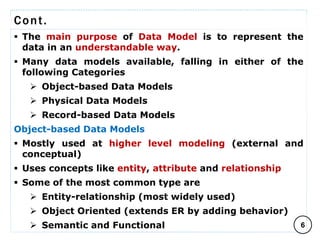
 The main purpose of Data Model is to represent the
data in an understandable way.
 Many data models available, falling in either of the
following Categories
 Object-based Data Models
 Physical Data Models
 Record-based Data Models
Object-based Data Models
 Mostly used at higher level modeling (external and
conceptual)
 Uses concepts like entity, attribute and relationship
 Some of the most common type are
 Entity-relationship (most widely used)
 Object Oriented (extends ER by adding behavior)
 Semantic and Functional 6
C O M P I L E D B Y : G / S L A S S I E E .
Cont.
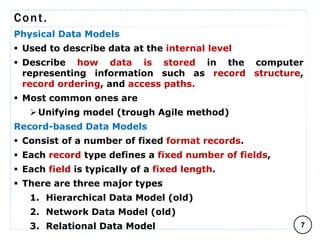
Physical Data Models
 Used to describe data at the internal level
 Describe how data is stored in the computer
representing information such as record structure,
record ordering, and access paths.
 Most common ones are
Unifying model (trough Agile method)
Record-based Data Models
 Consist of a number of fixed format records.
 Each record type defines a fixed number of fields,
 Each field is typically of a fixed length.
 There are three major types
1. Hierarchical Data Model (old)
2. Network Data Model (old)
3. Relational Data Model 7
C O M P I L E D B Y : G / S L A S S I E E .
Cont.
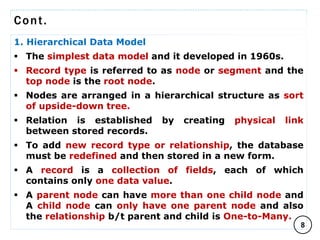
1. Hierarchical Data Model
 The simplest data model and it developed in 1960s.
 Record type is referred to as node or segment and the
top node is the root node.
 Nodes are arranged in a hierarchical structure as sort
of upside-down tree.
 Relation is established by creating physical link
between stored records.
 To add new record type or relationship, the database
must be redefined and then stored in a new form.
 A record is a collection of fields, each of which
contains only one data value.
 A parent node can have more than one child node and
A child node can only have one parent node and also
the relationship b/t parent and child is One-to-Many.
8
C O M P I L E D B Y : G / S L A S S I E E .
Cont.
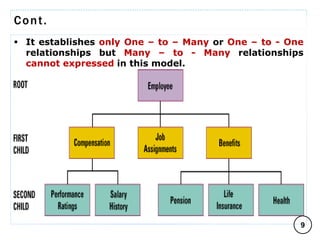
 It establishes only One – to – Many or One – to - One
relationships but Many – to - Many relationships
cannot expressed in this model.
9
C O M P I L E D B Y : G / S L A S S I E E .
Cont.
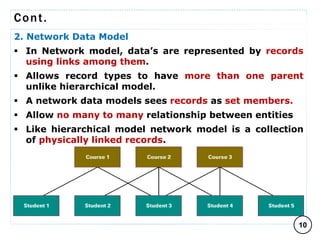
2. Network Data Model
 In Network model, data’s are represented by records
using links among them.
 Allows record types to have more than one parent
unlike hierarchical model.
 A network data models sees records as set members.
 Allow no many to many relationship between entities
 Like hierarchical model network model is a collection
of physically linked records.
10
C O M P I L E D B Y : G / S L A S S I E E .
Cont.
3. Relational Data Model
 The most popular data storage model is the relational
database, Developed by Dr. Edgar Frank Codd in 1970
(famous paper, 'A Relational Model for Large Shared
Data Banks') which grew from the seminal paper.
 A terminology originates from the branch of
mathematics called Set Theory and Relation Algebra.
 Dr. Codd's 12 Rules for a Relational Database Model - A
relational DBMS must be able to manage databases
entirely through its relational capabilities.
1. Information Rule - All information in a relational database
(including table and column names) is represented explicitly as
values in tables.
2. Guaranteed Access - Every value in a relational database is
guaranteed to be accessible by using a combination of the table
name, primary key value, and column name.
3. Systematic Null Value Support - systematic support for the
treatment of null values (unknown or inapplicable data), distinct
from default values, and independent of any domain. 11
C O M P I L E D B Y : G / S L A S S I E E .
Cont.
4. Active, Online Relational Catalog - The description of the
database and its contents is represented at the logical level as
tables and can therefore be queried using the database
language.
5. Comprehensive Data Sublanguage - At least one supported
language must have a well-defined syntax and be
comprehensive. It must support data definition, manipulation,
integrity rules, authorization, and transactions.
6. View Updating Rule - All views that are theoretically updatable
can be updated through the system.
7. Set-Level Insertion, Update, And Deletion - The DBMS supports
not only set-level retrievals but also set-level inserts, updates,
and deletes.
8. Physical Data Independence - Application programs are logically
unaffected when physical access methods or storage structures
are altered.
9. Logical Data Independence - Application programs are logically
unaffected, to the extent possible, when changes are made to
the table structures.
10.Integrity Independence - The database language must be
capable of defining integrity rules.
12
C O M P I L E D B Y : G / S L A S S I E E .
Cont.
11.Distribution Independence - Application programs requests are
logically unaffected when data is first distributed or when it is
redistributed.
12.Nonsubversion - It must not be possible to bypass the integrity
rules defined through the database language by using lower-
level languages
 Allow many to many relationship between entities.
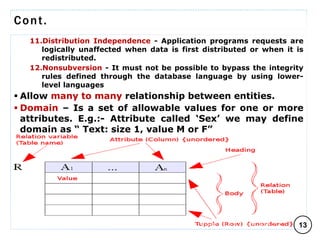
 Domain – Is a set of allowable values for one or more
attributes. E.g.:- Attribute called ‘Sex’ we may define
domain as “ Text: size 1, value M or F”
13
C O M P I L E D B Y : G / S L A S S I E E .
Cont.
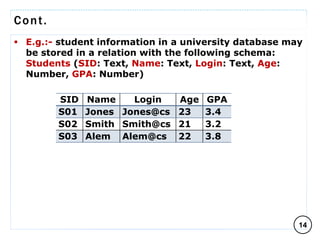
 E.g.:- student information in a university database may
be stored in a relation with the following schema:
Students (SID: Text, Name: Text, Login: Text, Age:
Number, GPA: Number)
14
SID Name Login Age GPA
S01 Jones Jones@cs 23 3.4
S02 Smith Smith@cs 21 3.2
S03 Alem Alem@cs 22 3.8
C O M P I L E D B Y : G / S L A S S I E E .
Cont.
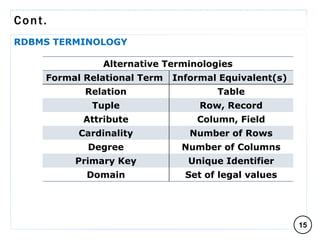
RDBMS TERMINOLOGY
15
Alternative Terminologies
Formal Relational Term Informal Equivalent(s)
Relation Table
Tuple Row, Record
Attribute Column, Field
Cardinality Number of Rows
Degree Number of Columns
Primary Key Unique Identifier
Domain Set of legal values
C O M P I L E D B Y : G / S L A S S I E E .
Cont.
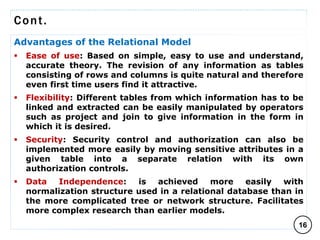
Advantages of the Relational Model
 Ease of use: Based on simple, easy to use and understand,
accurate theory. The revision of any information as tables
consisting of rows and columns is quite natural and therefore
even first time users find it attractive.
 Flexibility: Different tables from which information has to be
linked and extracted can be easily manipulated by operators
such as project and join to give information in the form in
which it is desired.
 Security: Security control and authorization can also be
implemented more easily by moving sensitive attributes in a
given table into a separate relation with its own
authorization controls.
 Data Independence: is achieved more easily with
normalization structure used in a relational database than in
the more complicated tree or network structure. Facilitates
more complex research than earlier models.
16
C O M P I L E D B Y : G / S L A S S I E E .
Cont.
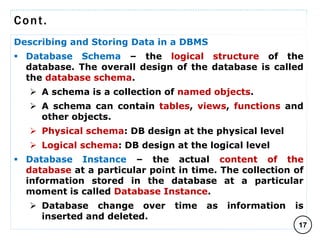
Describing and Storing Data in a DBMS
 Database Schema – the logical structure of the
database. The overall design of the database is called
the database schema.
 A schema is a collection of named objects.
 A schema can contain tables, views, functions and
other objects.
 Physical schema: DB design at the physical level
 Logical schema: DB design at the logical level
 Database Instance – the actual content of the
database at a particular point in time. The collection of
information stored in the database at a particular
moment is called Database Instance.
 Database change over time as information is
inserted and deleted.
17
C O M P I L E D B Y : G / S L A S S I E E .
Cont.
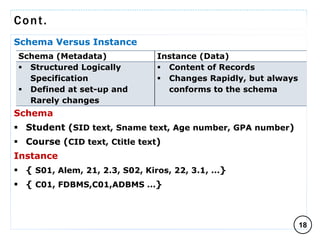
Schema Versus Instance
Schema
 Student (SID text, Sname text, Age number, GPA number)
 Course (CID text, Ctitle text)
Instance
 { S01, Alem, 21, 2.3, S02, Kiros, 22, 3.1, ...}
 { C01, FDBMS,C01,ADBMS ...}
18
Schema (Metadata) Instance (Data)
 Structured Logically
Specification
 Defined at set-up and
Rarely changes
 Content of Records
 Changes Rapidly, but always
conforms to the schema
C O M P I L E D B Y : G / S L A S S I E E .
Cont.
DBMS Architecture
 The design of a Database Management System highly
depends on its architecture.
 It can be centralized or decentralized or hierarchical.
 DBMS architecture can be seen as single tier or multi
tier.
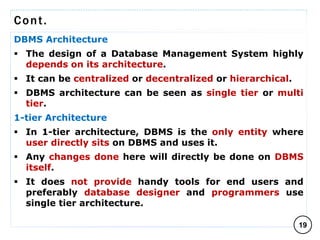
1-tier Architecture
 In 1-tier architecture, DBMS is the only entity where
user directly sits on DBMS and uses it.
 Any changes done here will directly be done on DBMS
itself.
 It does not provide handy tools for end users and
preferably database designer and programmers use
single tier architecture.
19
C O M P I L E D B Y : G / S L A S S I E E .
Cont.
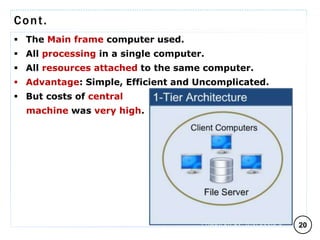
 The Main frame computer used.
 All processing in a single computer.
 All resources attached to the same computer.
 Advantage: Simple, Efficient and Uncomplicated.
 But costs of central
machine was very high.
20
C O M P I L E D B Y : G / S L A S S I E E .
Cont.
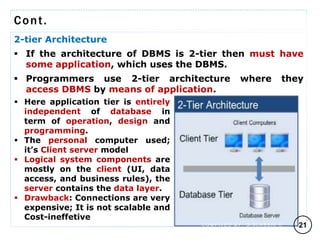
2-tier Architecture
 If the architecture of DBMS is 2-tier then must have
some application, which uses the DBMS.
 Programmers use 2-tier architecture where they
access DBMS by means of application.
 Here application tier is entirely
independent of database in
term of operation, design and
programming.
 The personal computer used;
it’s Client server model
 Logical system components are
mostly on the client (UI, data
access, and business rules), the
server contains the data layer.
 Drawback: Connections are very
expensive; It is not scalable and
Cost-ineffetive
21
C O M P I L E D B Y : G / S L A S S I E E .
Cont.
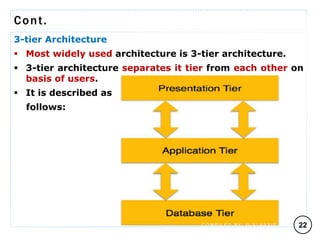
3-tier Architecture
 Most widely used architecture is 3-tier architecture.
 3-tier architecture separates it tier from each other on
basis of users.
 It is described as
follows:
22
C O M P I L E D B Y : G / S L A S S I E E .
Cont.
 Database (Data) Tier:
 At this tier, only database resides.
 Database along with its query processing languages
sits in layer-3 of 3-tier architecture.
 It also contains all relations and their constraints.
 Application (Middle) Tier:
 At this tier the application server and program,
which access database, resides.
 For a user this application tier works as abstracted
view of database.
 Database tier is not aware of any other user beyond
application tier.
 Application tier works as mediator between the
two.
23
C O M P I L E D B Y : G / S L A S S I E E .
Cont.
 User (Presentation) Tier:
 An end user sits on this tier. From a user’s aspect
this tier is everything.
 He/she doesn't know about any existence or form
of database beyond this layer.
 At this layer multiple views of database can be
provided by the application.
 All views are generated by applications, which
reside in application tier.
 Multiple tier database architecture is highly modifiable
as almost all its components are independent and can
be changed independently.
 It is client/server model but from a web server.
24
C O M P I L E D B Y : G / S L A S S I E E .
Cont.
25
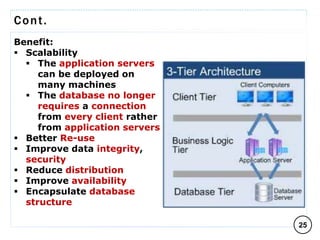
Benefit:
 Scalability
 The application servers
can be deployed on
many machines
 The database no longer
requires a connection
from every client rather
from application servers
 Better Re-use
 Improve data integrity,
security
 Reduce distribution
 Improve availability
 Encapsulate database
structure
C O M P I L E D B Y : G / S L A S S I E E .
Cont.
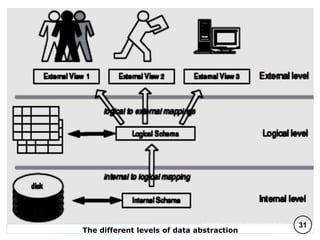
Abstract View of Data
 A major purpose of a database system is to provide
users with an abstract view of the data.
 That is, the system hides certain details of how the
data are stored and maintained.
 The designers use complex data structure to represent
the data, so that data can be efficiently stored and
retrieved, but it is not necessary for the users to know
physical database storage details.
 The developers hide the complexity from users
through several levels of abstraction.
 Agreement with the ANSI/SPARC (American national
Standards Institute/standards planning and
requirement committee) study group on Database
Management Systems.
26
C O M P I L E D B Y : G / S L A S S I E E .
Cont.
 3 Level ANSI/SPARC Architecture - Proposed to
support DBMS characteristics of:
 Support the program data independence
 Support of multiple views of the data
 The architecture for DBMSs is divided into three
general levels:
1. External-View level
2. Conceptual-Logical level
3. Internal-Physical level
 Three levels of Abstract View of Data in describing
data
 For better understanding of DB functionalities
 Made databases more independent of application
 Became a standard for the organisation of DBMS
27
C O M P I L E D B Y : G / S L A S S I E E .
Cont.
1. External (View) Level
 Users' view of the database; concerned with the way
individual users see the data.
 Describes that part of database that is relevant to a
particular user.
 Different users have their own customized view of the
database independent of other users.
 Data access to be authorized at the level of individual
users or groups of users.
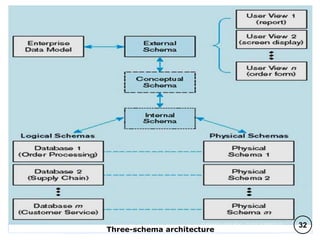
 External (Sub) Schema - defines the external view of
data as seen by a user or program.
 In General, Any given database has exactly one
conceptual schema and one physical schema because it
has just one set of stored relations, but it may have
several external schemas, each tailored to a particular
group of users. 28
C O M P I L E D B Y : G / S L A S S I E E .
Cont.
2. Conceptual (Logical) Level
 Describes what data is stored in database and
relationships among the data
 Can be regarded as a community user view a formal
description of data of interest to the organisation,
independent of any storage considerations.
 It describes the stored data in terms of the data model
of the DBMS.
 The process of arriving at a good conceptual schema is
called conceptual database design.
 Conceptual Schema - defines the logical view of data
as seen by all users and programs.
29
C O M P I L E D B Y : G / S L A S S I E E .
Cont.
3. Internal (Physical) Level
 Physical representation of the database on the
computer.
 Concerned with the way in which the data is actually
stored; Storage spacing allocation for data and Record
description for storage.
 The Internal level describes complex low-level data
structures in detail.
 Decisions about the physical schema are based on an
understanding of how the data is typically accessed.
 The process of arriving at a good physical schema is
called physical database design.
 Physical (Internal) Schema - defines the physical view
of data as seen by a DBMS.
30
C O M P I L E D B Y : G / S L A S S I E E .
The different levels of data abstraction
31
C O M P I L E D B Y : G / S L A S S I E E .
Three-schema architecture
32
C O M P I L E D B Y : G / S L A S S I E E .
Cont.
Data Independence
 This is a prime advantage of a database.
 In File Base Approach systems applications are data-
dependent.
 Data independence can be defined as ‘The protection
of applications to change in storage structure and
access scheme’.
 Data independence is the ability to change the schema
at one level of the database system without changing
the schema at the next higher level.
 In DBMS there are two types of data independence
exist:
1. Logical Data Independence - Protection from
changes in logical structure of data.
2. Physical Data Independence - Protection from
changes in physical structure of data. 33
C O M P I L E D B Y : G / S L A S S I E E .
Cont.
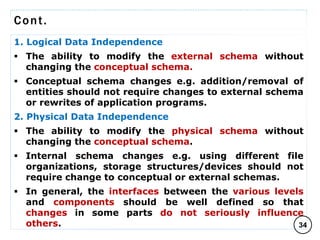
1. Logical Data Independence
 The ability to modify the external schema without
changing the conceptual schema.
 Conceptual schema changes e.g. addition/removal of
entities should not require changes to external schema
or rewrites of application programs.
2. Physical Data Independence
 The ability to modify the physical schema without
changing the conceptual schema.
 Internal schema changes e.g. using different file
organizations, storage structures/devices should not
require change to conceptual or external schemas.
 In general, the interfaces between the various levels
and components should be well defined so that
changes in some parts do not seriously influence
others. 34
C O M P I L E D B Y : G / S L A S S I E E .
Cont.
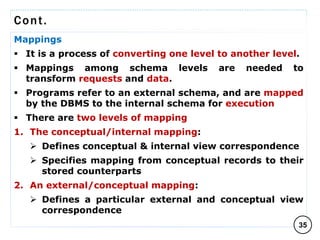
Mappings
 It is a process of converting one level to another level.
 Mappings among schema levels are needed to
transform requests and data.
 Programs refer to an external schema, and are mapped
by the DBMS to the internal schema for execution
 There are two levels of mapping
1. The conceptual/internal mapping:
 Defines conceptual & internal view correspondence
 Specifies mapping from conceptual records to their
stored counterparts
2. An external/conceptual mapping:
 Defines a particular external and conceptual view
correspondence
35
C O M P I L E D B Y : G / S L A S S I E E .

02 CHAPTER ONE PART II - DATA MODEL AND DBMS ARCHITECTURE.pptx

  • 1.
    1 C O MP I L E D B Y : G / S L A S S I E E .
  • 2.
    2 C O MP I L E D B Y : G / S L A S S I E E .
  • 3.
    3 PART II: DATAMODEL AND DBMS ARCHITECTURE  Data Model  Object-based Data Models  Physical Data Models  Record-based Data Models  Describing and Storing Data in a DBMS  Database Schema and Database Instance  DBMS Architecture  1-tier Architecture, 2-tier Architecture and 3-tier Architecture  Abstract view of data 1. External-View level 2. Conceptual-Logical level 3. Internal-Physical level  Data Independence  Logical and Physical Data Independence C O M P I L E D B Y : G / S L A S S I E E .
  • 4.
    Cont. Data Model  DataModel is a set of concepts to describe the structure of a database, and certain constraints that the database should obey.  A data model is a collection of tools or concepts for describing data, meaning of data, data relationships, and data constraints.  Within the history of database systems we have  The first generation data models 1. Hierarchical Data Model (outdated) 2. Network Data Model (outdated)  The second generation data models 3. Relational Data Model  The third generation data models 4. Object Oriented Data Model 4 C O M P I L E D B Y : G / S L A S S I E E .
  • 5.
    Cont. Data model Evolution File Systems  Hierarchical Model (Tree-based)  Network Model (Graph-based)  Relational Model  Object Oriented Model  Object/Relational Model 5 C O M P I L E D B Y : G / S L A S S I E E .
  • 6.
    Cont.  The mainpurpose of Data Model is to represent the data in an understandable way.  Many data models available, falling in either of the following Categories  Object-based Data Models  Physical Data Models  Record-based Data Models Object-based Data Models  Mostly used at higher level modeling (external and conceptual)  Uses concepts like entity, attribute and relationship  Some of the most common type are  Entity-relationship (most widely used)  Object Oriented (extends ER by adding behavior)  Semantic and Functional 6 C O M P I L E D B Y : G / S L A S S I E E .
  • 7.
    Cont. Physical Data Models Used to describe data at the internal level  Describe how data is stored in the computer representing information such as record structure, record ordering, and access paths.  Most common ones are Unifying model (trough Agile method) Record-based Data Models  Consist of a number of fixed format records.  Each record type defines a fixed number of fields,  Each field is typically of a fixed length.  There are three major types 1. Hierarchical Data Model (old) 2. Network Data Model (old) 3. Relational Data Model 7 C O M P I L E D B Y : G / S L A S S I E E .
  • 8.
    Cont. 1. Hierarchical DataModel  The simplest data model and it developed in 1960s.  Record type is referred to as node or segment and the top node is the root node.  Nodes are arranged in a hierarchical structure as sort of upside-down tree.  Relation is established by creating physical link between stored records.  To add new record type or relationship, the database must be redefined and then stored in a new form.  A record is a collection of fields, each of which contains only one data value.  A parent node can have more than one child node and A child node can only have one parent node and also the relationship b/t parent and child is One-to-Many. 8 C O M P I L E D B Y : G / S L A S S I E E .
  • 9.
    Cont.  It establishesonly One – to – Many or One – to - One relationships but Many – to - Many relationships cannot expressed in this model. 9 C O M P I L E D B Y : G / S L A S S I E E .
  • 10.
    Cont. 2. Network DataModel  In Network model, data’s are represented by records using links among them.  Allows record types to have more than one parent unlike hierarchical model.  A network data models sees records as set members.  Allow no many to many relationship between entities  Like hierarchical model network model is a collection of physically linked records. 10 C O M P I L E D B Y : G / S L A S S I E E .
  • 11.
    Cont. 3. Relational DataModel  The most popular data storage model is the relational database, Developed by Dr. Edgar Frank Codd in 1970 (famous paper, 'A Relational Model for Large Shared Data Banks') which grew from the seminal paper.  A terminology originates from the branch of mathematics called Set Theory and Relation Algebra.  Dr. Codd's 12 Rules for a Relational Database Model - A relational DBMS must be able to manage databases entirely through its relational capabilities. 1. Information Rule - All information in a relational database (including table and column names) is represented explicitly as values in tables. 2. Guaranteed Access - Every value in a relational database is guaranteed to be accessible by using a combination of the table name, primary key value, and column name. 3. Systematic Null Value Support - systematic support for the treatment of null values (unknown or inapplicable data), distinct from default values, and independent of any domain. 11 C O M P I L E D B Y : G / S L A S S I E E .
  • 12.
    Cont. 4. Active, OnlineRelational Catalog - The description of the database and its contents is represented at the logical level as tables and can therefore be queried using the database language. 5. Comprehensive Data Sublanguage - At least one supported language must have a well-defined syntax and be comprehensive. It must support data definition, manipulation, integrity rules, authorization, and transactions. 6. View Updating Rule - All views that are theoretically updatable can be updated through the system. 7. Set-Level Insertion, Update, And Deletion - The DBMS supports not only set-level retrievals but also set-level inserts, updates, and deletes. 8. Physical Data Independence - Application programs are logically unaffected when physical access methods or storage structures are altered. 9. Logical Data Independence - Application programs are logically unaffected, to the extent possible, when changes are made to the table structures. 10.Integrity Independence - The database language must be capable of defining integrity rules. 12 C O M P I L E D B Y : G / S L A S S I E E .
  • 13.
    Cont. 11.Distribution Independence -Application programs requests are logically unaffected when data is first distributed or when it is redistributed. 12.Nonsubversion - It must not be possible to bypass the integrity rules defined through the database language by using lower- level languages  Allow many to many relationship between entities.  Domain – Is a set of allowable values for one or more attributes. E.g.:- Attribute called ‘Sex’ we may define domain as “ Text: size 1, value M or F” 13 C O M P I L E D B Y : G / S L A S S I E E .
  • 14.
    Cont.  E.g.:- studentinformation in a university database may be stored in a relation with the following schema: Students (SID: Text, Name: Text, Login: Text, Age: Number, GPA: Number) 14 SID Name Login Age GPA S01 Jones Jones@cs 23 3.4 S02 Smith Smith@cs 21 3.2 S03 Alem Alem@cs 22 3.8 C O M P I L E D B Y : G / S L A S S I E E .
  • 15.
    Cont. RDBMS TERMINOLOGY 15 Alternative Terminologies FormalRelational Term Informal Equivalent(s) Relation Table Tuple Row, Record Attribute Column, Field Cardinality Number of Rows Degree Number of Columns Primary Key Unique Identifier Domain Set of legal values C O M P I L E D B Y : G / S L A S S I E E .
  • 16.
    Cont. Advantages of theRelational Model  Ease of use: Based on simple, easy to use and understand, accurate theory. The revision of any information as tables consisting of rows and columns is quite natural and therefore even first time users find it attractive.  Flexibility: Different tables from which information has to be linked and extracted can be easily manipulated by operators such as project and join to give information in the form in which it is desired.  Security: Security control and authorization can also be implemented more easily by moving sensitive attributes in a given table into a separate relation with its own authorization controls.  Data Independence: is achieved more easily with normalization structure used in a relational database than in the more complicated tree or network structure. Facilitates more complex research than earlier models. 16 C O M P I L E D B Y : G / S L A S S I E E .
  • 17.
    Cont. Describing and StoringData in a DBMS  Database Schema – the logical structure of the database. The overall design of the database is called the database schema.  A schema is a collection of named objects.  A schema can contain tables, views, functions and other objects.  Physical schema: DB design at the physical level  Logical schema: DB design at the logical level  Database Instance – the actual content of the database at a particular point in time. The collection of information stored in the database at a particular moment is called Database Instance.  Database change over time as information is inserted and deleted. 17 C O M P I L E D B Y : G / S L A S S I E E .
  • 18.
    Cont. Schema Versus Instance Schema Student (SID text, Sname text, Age number, GPA number)  Course (CID text, Ctitle text) Instance  { S01, Alem, 21, 2.3, S02, Kiros, 22, 3.1, ...}  { C01, FDBMS,C01,ADBMS ...} 18 Schema (Metadata) Instance (Data)  Structured Logically Specification  Defined at set-up and Rarely changes  Content of Records  Changes Rapidly, but always conforms to the schema C O M P I L E D B Y : G / S L A S S I E E .
  • 19.
    Cont. DBMS Architecture  Thedesign of a Database Management System highly depends on its architecture.  It can be centralized or decentralized or hierarchical.  DBMS architecture can be seen as single tier or multi tier. 1-tier Architecture  In 1-tier architecture, DBMS is the only entity where user directly sits on DBMS and uses it.  Any changes done here will directly be done on DBMS itself.  It does not provide handy tools for end users and preferably database designer and programmers use single tier architecture. 19 C O M P I L E D B Y : G / S L A S S I E E .
  • 20.
    Cont.  The Mainframe computer used.  All processing in a single computer.  All resources attached to the same computer.  Advantage: Simple, Efficient and Uncomplicated.  But costs of central machine was very high. 20 C O M P I L E D B Y : G / S L A S S I E E .
  • 21.
    Cont. 2-tier Architecture  Ifthe architecture of DBMS is 2-tier then must have some application, which uses the DBMS.  Programmers use 2-tier architecture where they access DBMS by means of application.  Here application tier is entirely independent of database in term of operation, design and programming.  The personal computer used; it’s Client server model  Logical system components are mostly on the client (UI, data access, and business rules), the server contains the data layer.  Drawback: Connections are very expensive; It is not scalable and Cost-ineffetive 21 C O M P I L E D B Y : G / S L A S S I E E .
  • 22.
    Cont. 3-tier Architecture  Mostwidely used architecture is 3-tier architecture.  3-tier architecture separates it tier from each other on basis of users.  It is described as follows: 22 C O M P I L E D B Y : G / S L A S S I E E .
  • 23.
    Cont.  Database (Data)Tier:  At this tier, only database resides.  Database along with its query processing languages sits in layer-3 of 3-tier architecture.  It also contains all relations and their constraints.  Application (Middle) Tier:  At this tier the application server and program, which access database, resides.  For a user this application tier works as abstracted view of database.  Database tier is not aware of any other user beyond application tier.  Application tier works as mediator between the two. 23 C O M P I L E D B Y : G / S L A S S I E E .
  • 24.
    Cont.  User (Presentation)Tier:  An end user sits on this tier. From a user’s aspect this tier is everything.  He/she doesn't know about any existence or form of database beyond this layer.  At this layer multiple views of database can be provided by the application.  All views are generated by applications, which reside in application tier.  Multiple tier database architecture is highly modifiable as almost all its components are independent and can be changed independently.  It is client/server model but from a web server. 24 C O M P I L E D B Y : G / S L A S S I E E .
  • 25.
    Cont. 25 Benefit:  Scalability  Theapplication servers can be deployed on many machines  The database no longer requires a connection from every client rather from application servers  Better Re-use  Improve data integrity, security  Reduce distribution  Improve availability  Encapsulate database structure C O M P I L E D B Y : G / S L A S S I E E .
  • 26.
    Cont. Abstract View ofData  A major purpose of a database system is to provide users with an abstract view of the data.  That is, the system hides certain details of how the data are stored and maintained.  The designers use complex data structure to represent the data, so that data can be efficiently stored and retrieved, but it is not necessary for the users to know physical database storage details.  The developers hide the complexity from users through several levels of abstraction.  Agreement with the ANSI/SPARC (American national Standards Institute/standards planning and requirement committee) study group on Database Management Systems. 26 C O M P I L E D B Y : G / S L A S S I E E .
  • 27.
    Cont.  3 LevelANSI/SPARC Architecture - Proposed to support DBMS characteristics of:  Support the program data independence  Support of multiple views of the data  The architecture for DBMSs is divided into three general levels: 1. External-View level 2. Conceptual-Logical level 3. Internal-Physical level  Three levels of Abstract View of Data in describing data  For better understanding of DB functionalities  Made databases more independent of application  Became a standard for the organisation of DBMS 27 C O M P I L E D B Y : G / S L A S S I E E .
  • 28.
    Cont. 1. External (View)Level  Users' view of the database; concerned with the way individual users see the data.  Describes that part of database that is relevant to a particular user.  Different users have their own customized view of the database independent of other users.  Data access to be authorized at the level of individual users or groups of users.  External (Sub) Schema - defines the external view of data as seen by a user or program.  In General, Any given database has exactly one conceptual schema and one physical schema because it has just one set of stored relations, but it may have several external schemas, each tailored to a particular group of users. 28 C O M P I L E D B Y : G / S L A S S I E E .
  • 29.
    Cont. 2. Conceptual (Logical)Level  Describes what data is stored in database and relationships among the data  Can be regarded as a community user view a formal description of data of interest to the organisation, independent of any storage considerations.  It describes the stored data in terms of the data model of the DBMS.  The process of arriving at a good conceptual schema is called conceptual database design.  Conceptual Schema - defines the logical view of data as seen by all users and programs. 29 C O M P I L E D B Y : G / S L A S S I E E .
  • 30.
    Cont. 3. Internal (Physical)Level  Physical representation of the database on the computer.  Concerned with the way in which the data is actually stored; Storage spacing allocation for data and Record description for storage.  The Internal level describes complex low-level data structures in detail.  Decisions about the physical schema are based on an understanding of how the data is typically accessed.  The process of arriving at a good physical schema is called physical database design.  Physical (Internal) Schema - defines the physical view of data as seen by a DBMS. 30 C O M P I L E D B Y : G / S L A S S I E E .
  • 31.
    The different levelsof data abstraction 31 C O M P I L E D B Y : G / S L A S S I E E .
  • 32.
    Three-schema architecture 32 C OM P I L E D B Y : G / S L A S S I E E .
  • 33.
    Cont. Data Independence  Thisis a prime advantage of a database.  In File Base Approach systems applications are data- dependent.  Data independence can be defined as ‘The protection of applications to change in storage structure and access scheme’.  Data independence is the ability to change the schema at one level of the database system without changing the schema at the next higher level.  In DBMS there are two types of data independence exist: 1. Logical Data Independence - Protection from changes in logical structure of data. 2. Physical Data Independence - Protection from changes in physical structure of data. 33 C O M P I L E D B Y : G / S L A S S I E E .
  • 34.
    Cont. 1. Logical DataIndependence  The ability to modify the external schema without changing the conceptual schema.  Conceptual schema changes e.g. addition/removal of entities should not require changes to external schema or rewrites of application programs. 2. Physical Data Independence  The ability to modify the physical schema without changing the conceptual schema.  Internal schema changes e.g. using different file organizations, storage structures/devices should not require change to conceptual or external schemas.  In general, the interfaces between the various levels and components should be well defined so that changes in some parts do not seriously influence others. 34 C O M P I L E D B Y : G / S L A S S I E E .
  • 35.
    Cont. Mappings  It isa process of converting one level to another level.  Mappings among schema levels are needed to transform requests and data.  Programs refer to an external schema, and are mapped by the DBMS to the internal schema for execution  There are two levels of mapping 1. The conceptual/internal mapping:  Defines conceptual & internal view correspondence  Specifies mapping from conceptual records to their stored counterparts 2. An external/conceptual mapping:  Defines a particular external and conceptual view correspondence 35 C O M P I L E D B Y : G / S L A S S I E E .