RFM
CUSTOMER SEGMENTATION
HELLO!
Kamil Bartocha
Follow me at @WhiteRavenPL
or drop me an email:
kamil.bartocha@marketingdistillery.com
WHAT IS RFM?
RFM stands for Recency, Frequency and Monetary
⊡ It is the easiest form of customer database
segmentation
⊡ Often used for reactivation campaigns, high
valued customer programs, combating churn etc.
RFM IS BASED ON
USER ACTIVITY DATA
Anything from actual orders, website visits,
app launches etc.
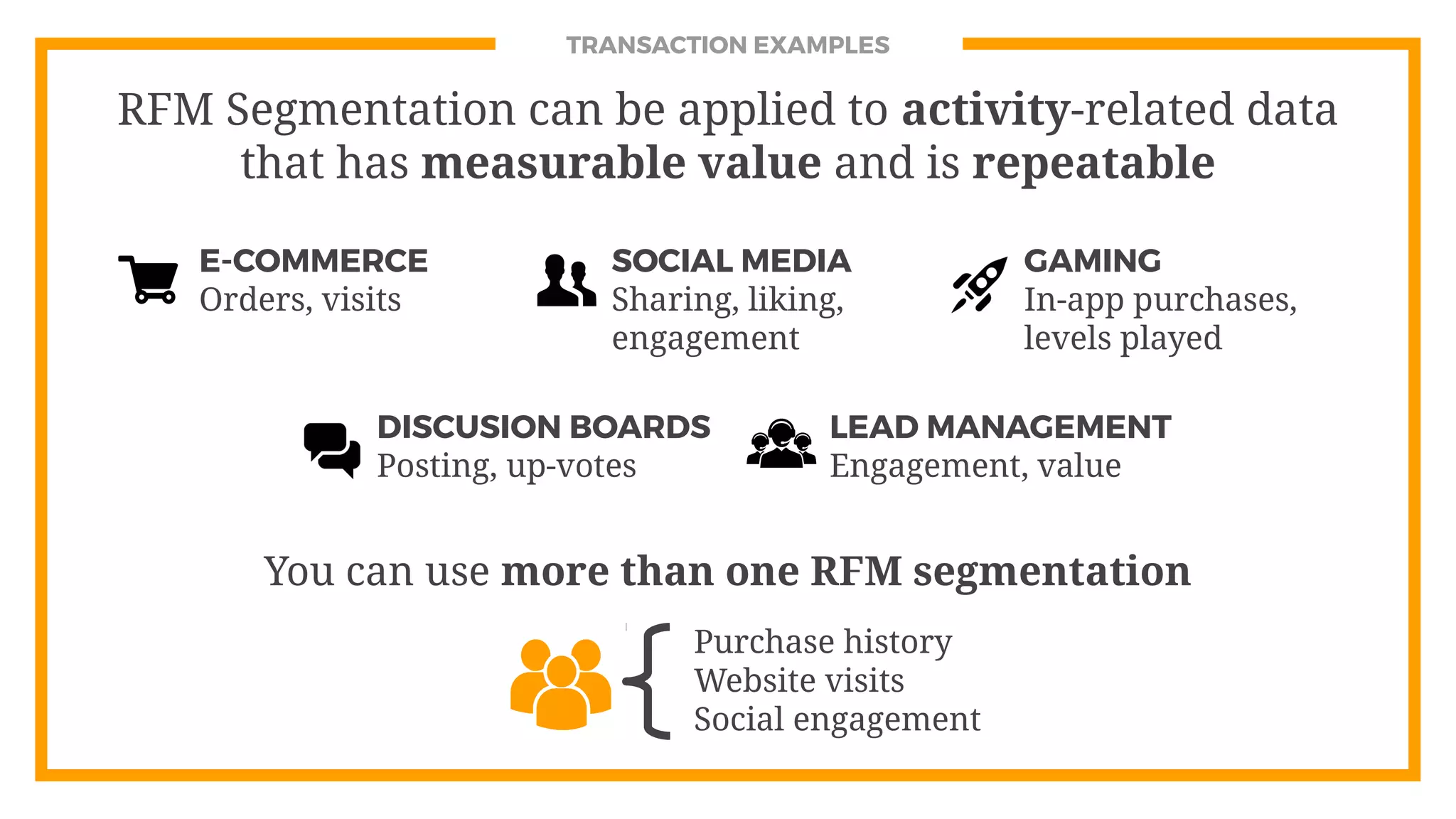
TRANSACTION EXAMPLES
E-COMMERCE
Orders, visits
SOCIAL MEDIA
Sharing, liking,
engagement
GAMING
In-app purchases,
levels played
Purchase history
Website visits
Social engagement
You can use more than one RFM segmentation
RFM Segmentation can be applied to activity-related data
that has measurable value and is repeatable
DISCUSION BOARDS
Posting, up-votes
LEAD MANAGEMENT
Engagement, value
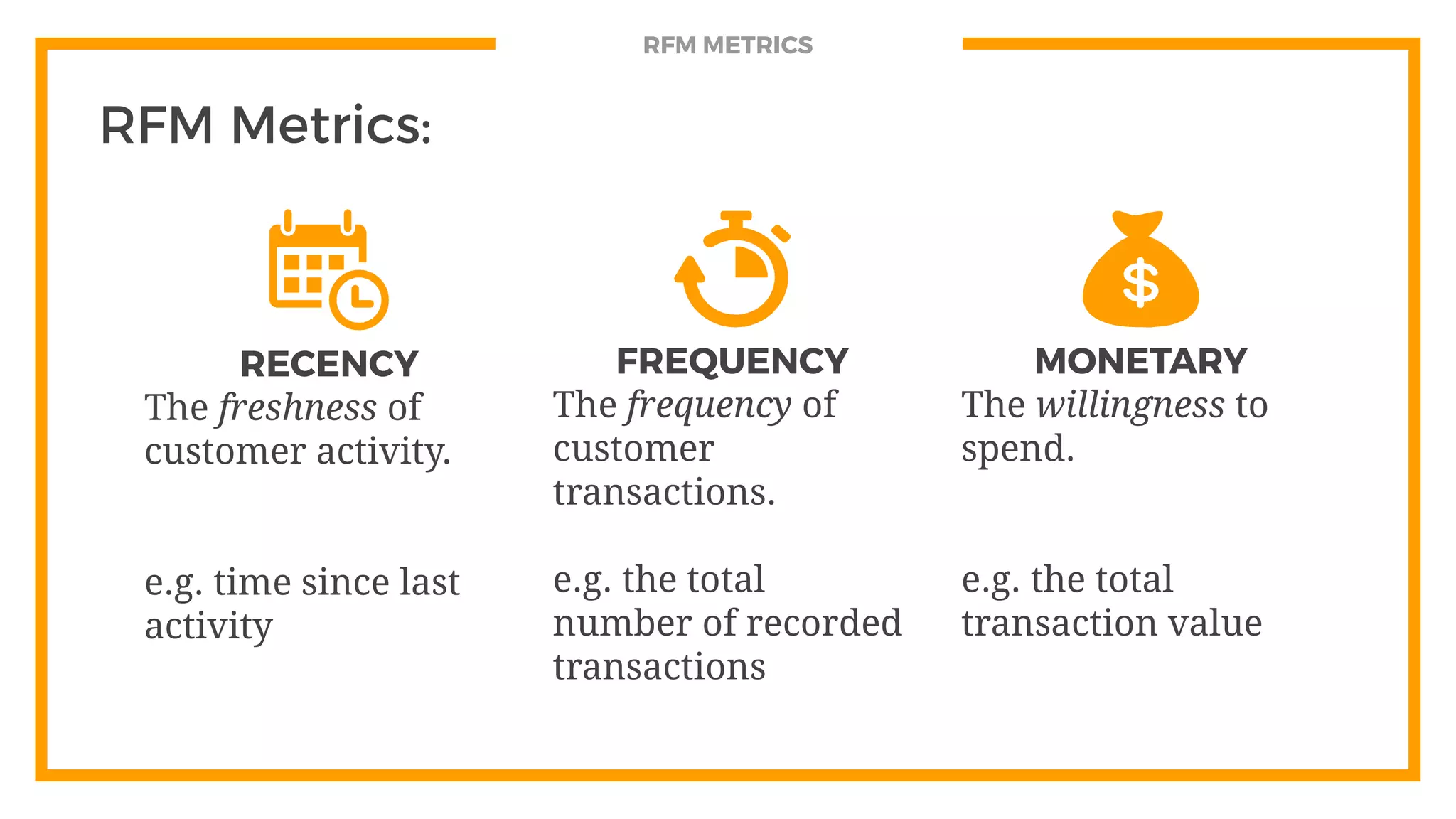
RFM METRICS
RECENCY
The freshness of
customer activity.
e.g. time since last
activity
FREQUENCY
The frequency of
customer
transactions.
e.g. the total
number of recorded
transactions
MONETARY
The willingness to
spend.
e.g. the total
transaction value
RFM Metrics:
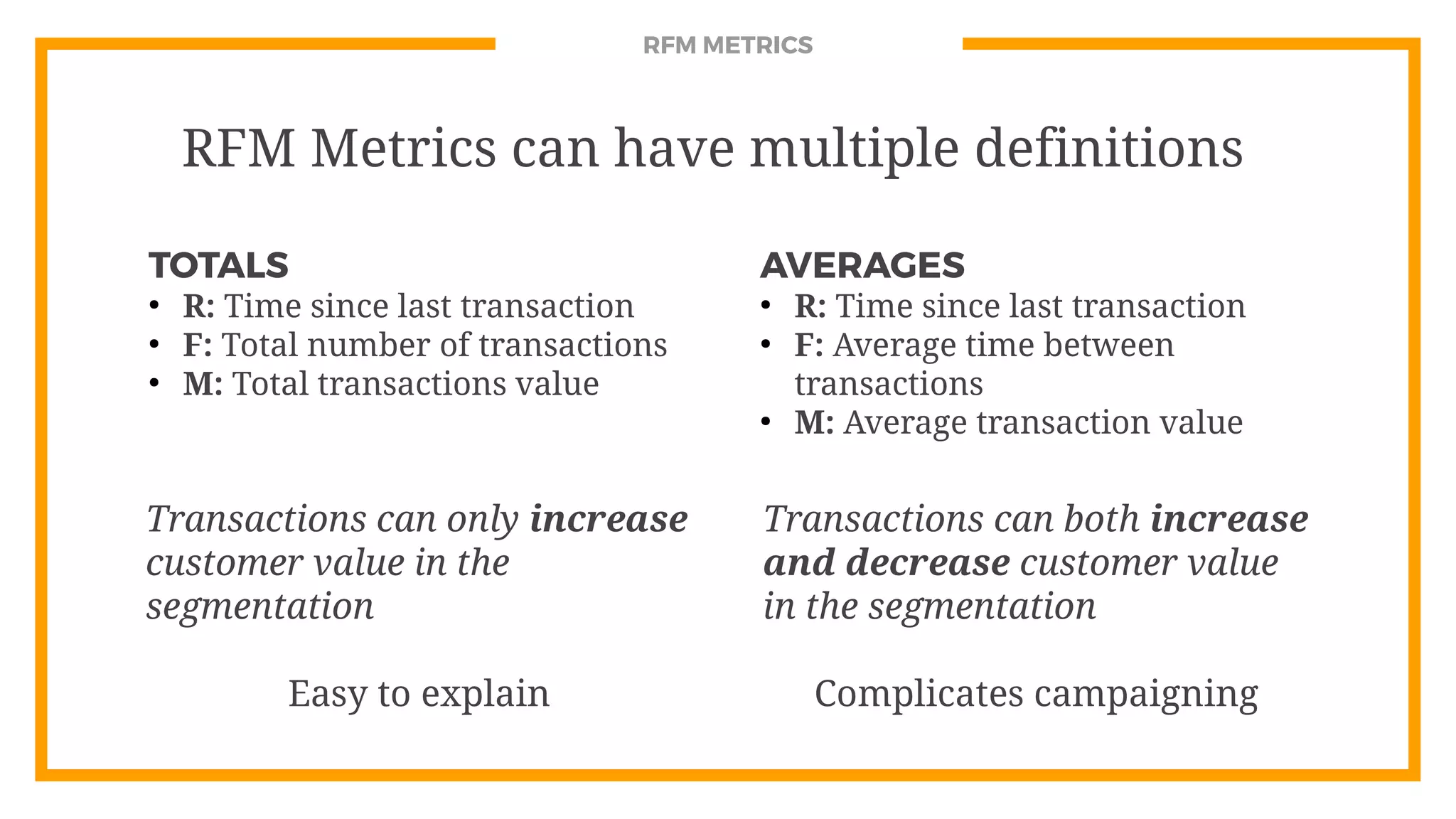
TOTALS
●
R: Time since last transaction
●
F: Total number of transactions
●
M: Total transactions value
RFM METRICS
AVERAGES
●
R: Time since last transaction
●
F: Average time between
transactions
●
M: Average transaction value
RFM Metrics can have multiple definitions
Transactions can only increase
customer value in the
segmentation
Easy to explain
Transactions can both increase
and decrease customer value
in the segmentation
Complicates campaigning
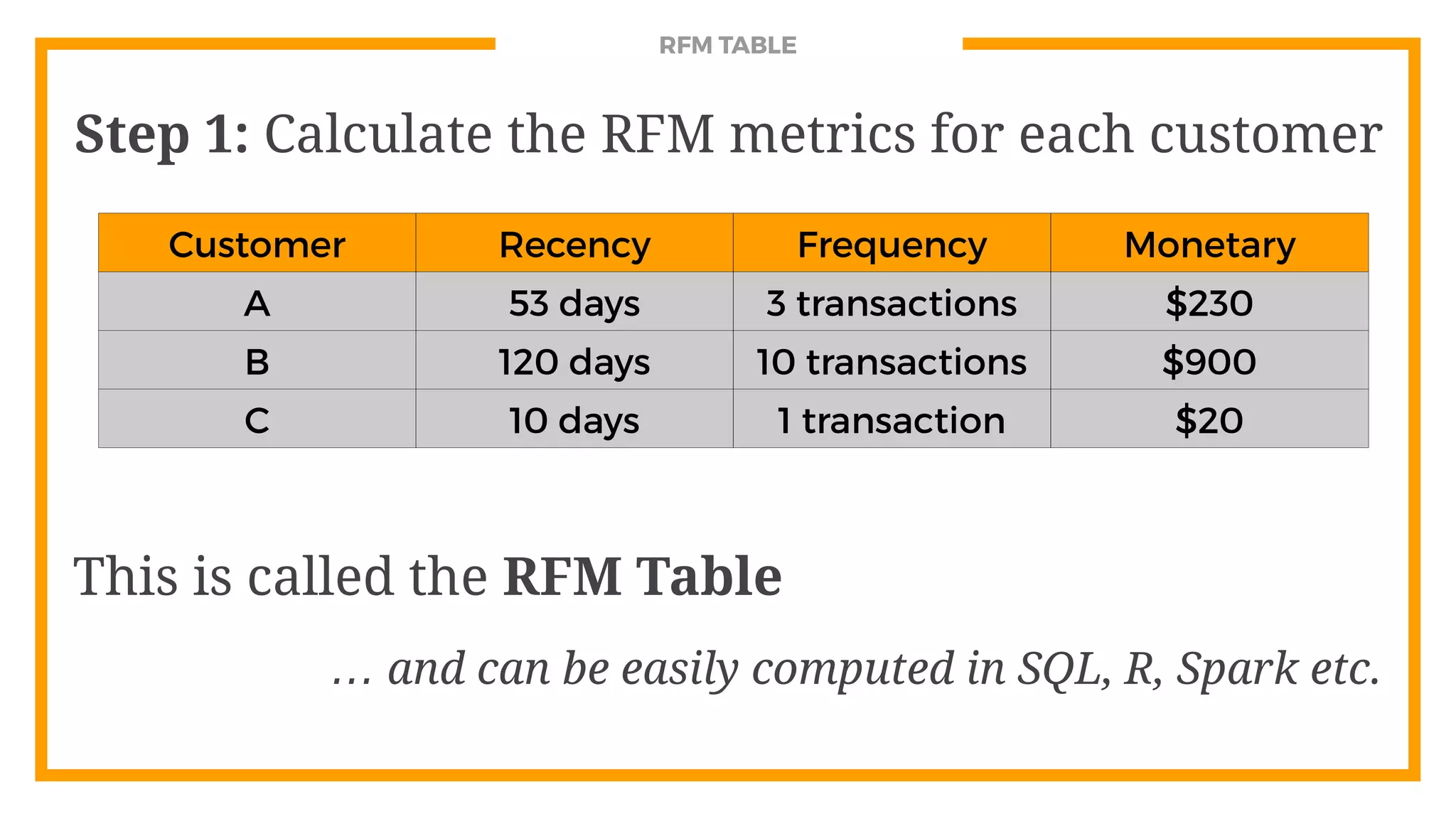
RFM TABLE
Step 1: Calculate the RFM metrics for each customer
Customer Recency Frequency Monetary
A 53 days 3 transactions $230
B 120 days 10 transactions $900
C 10 days 1 transaction $20
This is called the RFM Table
… and can be easily computed in SQL, R, Spark etc.
RFM SEGMENTATION
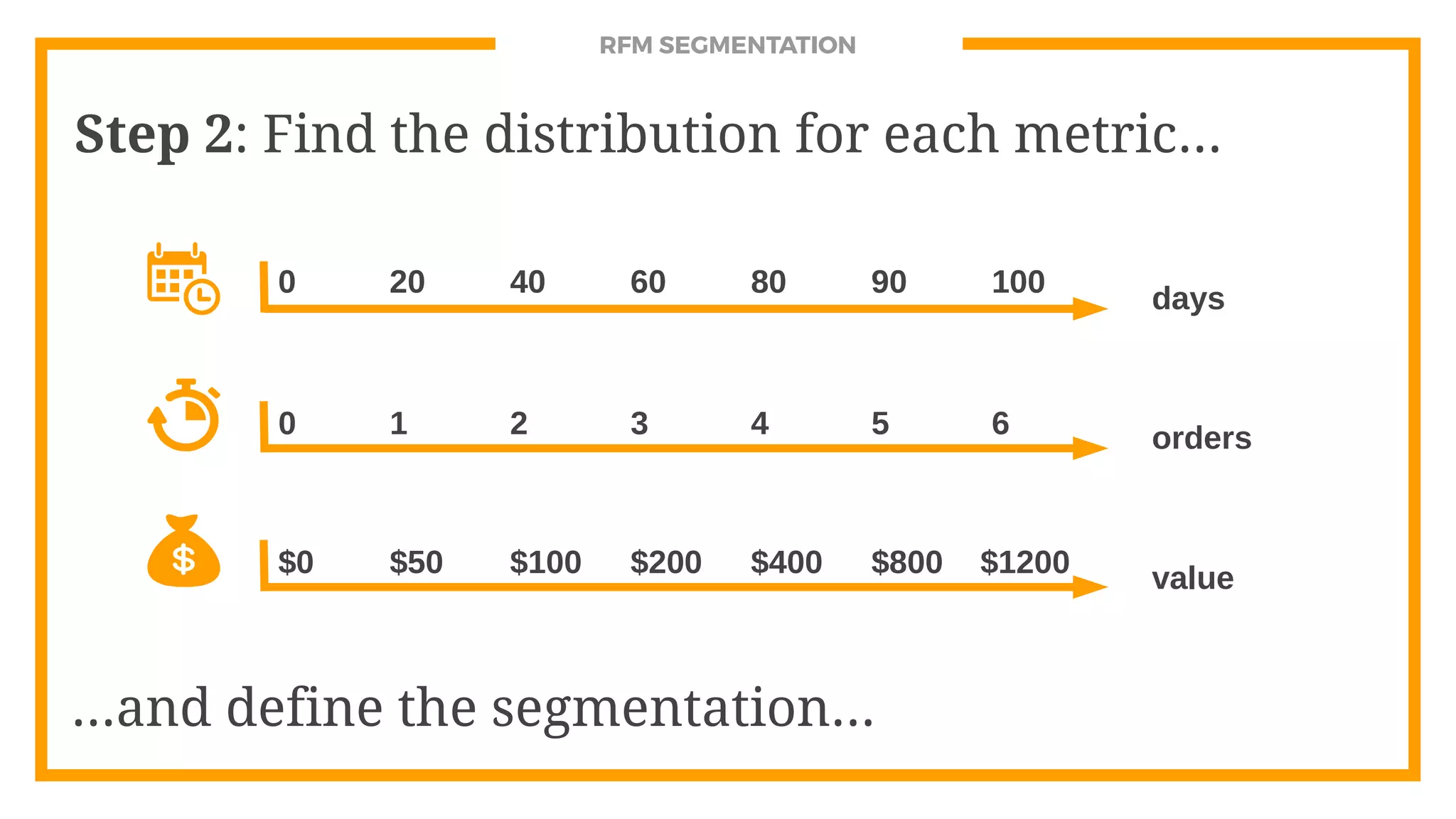
Step 2: Find the distribution for each metric...
...and define the segmentation...
0 20 40 60 80 90 100
days
$800
0 1 2 3 4 5 6 orders
$0 $50 $100 $200 $400 $1200 value
RFM SEGMENTATION
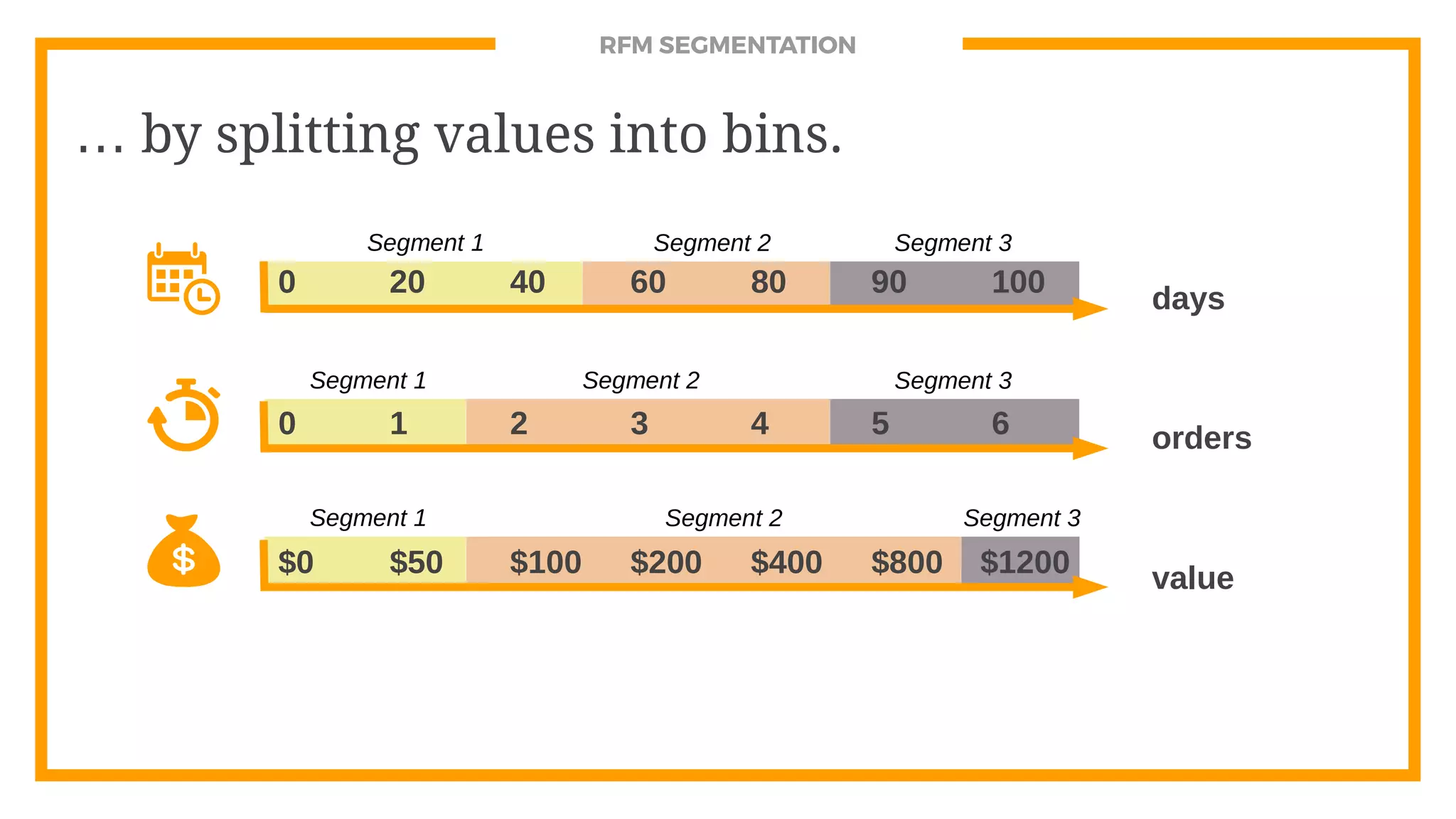
… by splitting values into bins.
0 20 40 60 80 90 100
days
$800
0 1 2 3 4 5 6 orders
$0 $50 $100 $200 $400 $1200 value
Segment 1 Segment 2 Segment 3
RFM SEGMENTATION
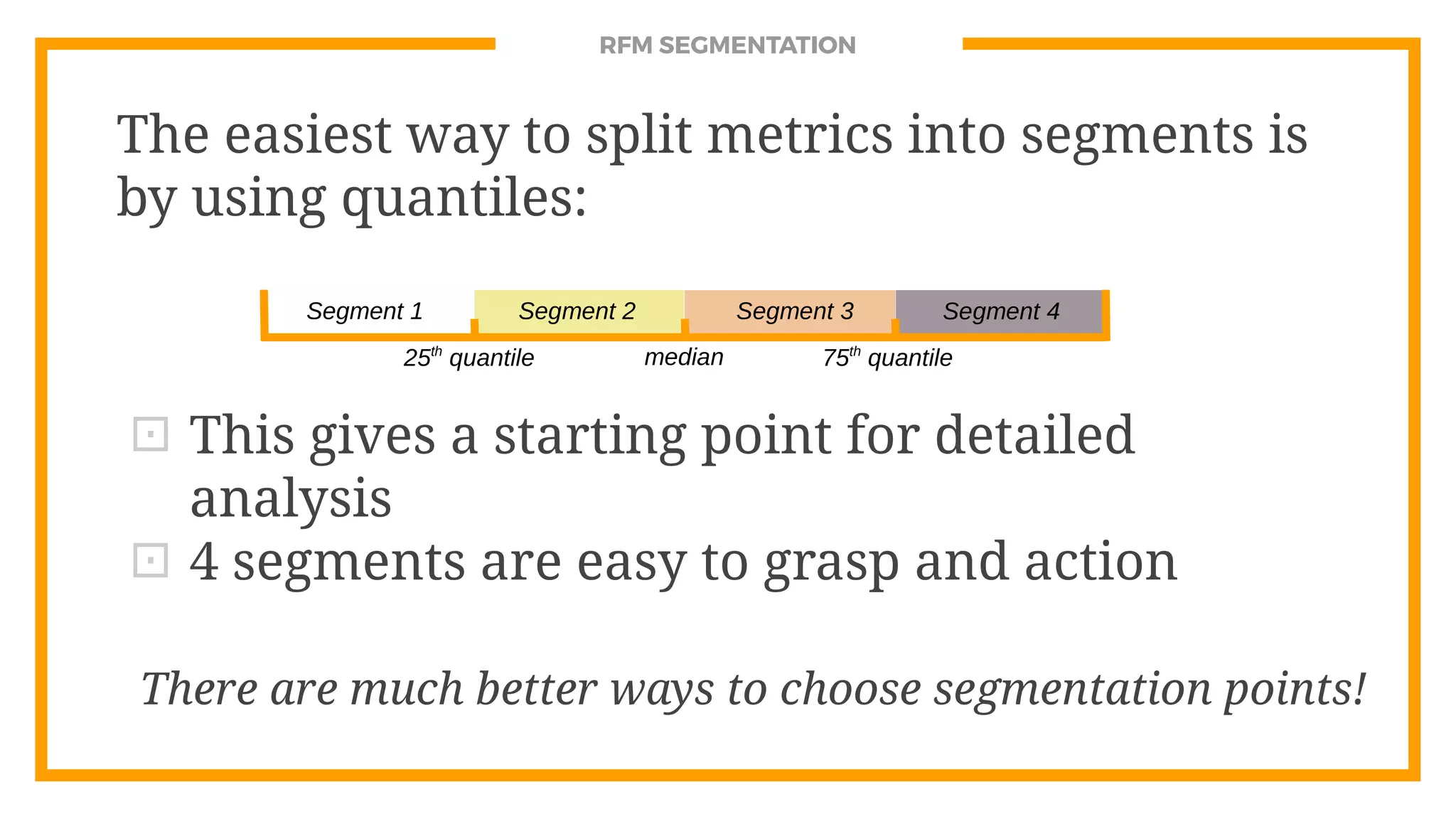
The easiest way to split metrics into segments is
by using quantiles:
⊡ This gives a starting point for detailed
analysis
⊡ 4 segments are easy to grasp and action
Segment 1 Segment 2 Segment 3 Segment 4
25th
quantile median 75th
quantile
There are much better ways to choose segmentation points!
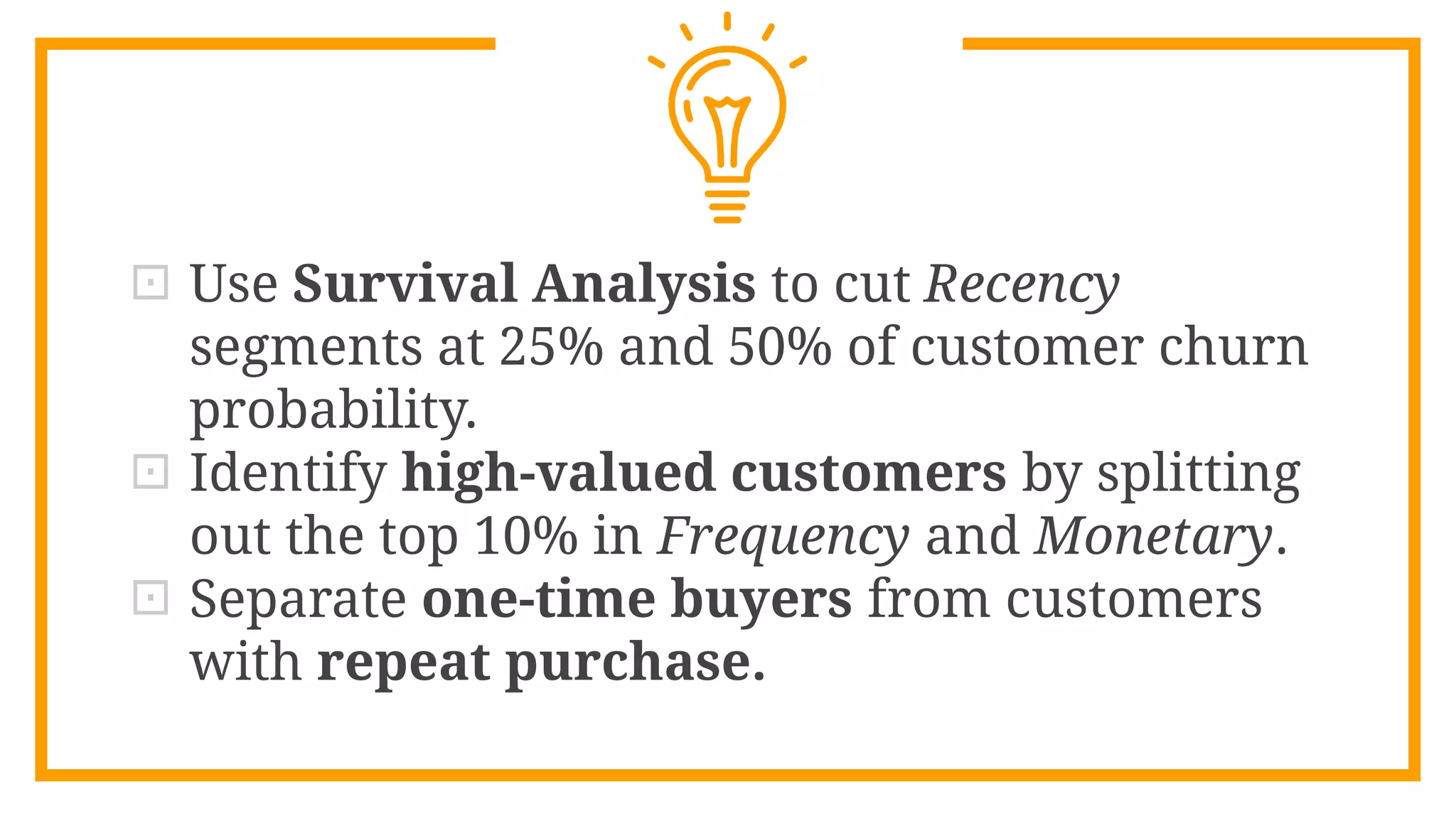
⊡ Use Survival Analysis to cut Recency
segments at 25% and 50% of customer churn
probability.
⊡ Identify high-valued customers by splitting
out the top 10% in Frequency and Monetary.
⊡ Separate one-time buyers from customers
with repeat purchase.
RFM TABLE
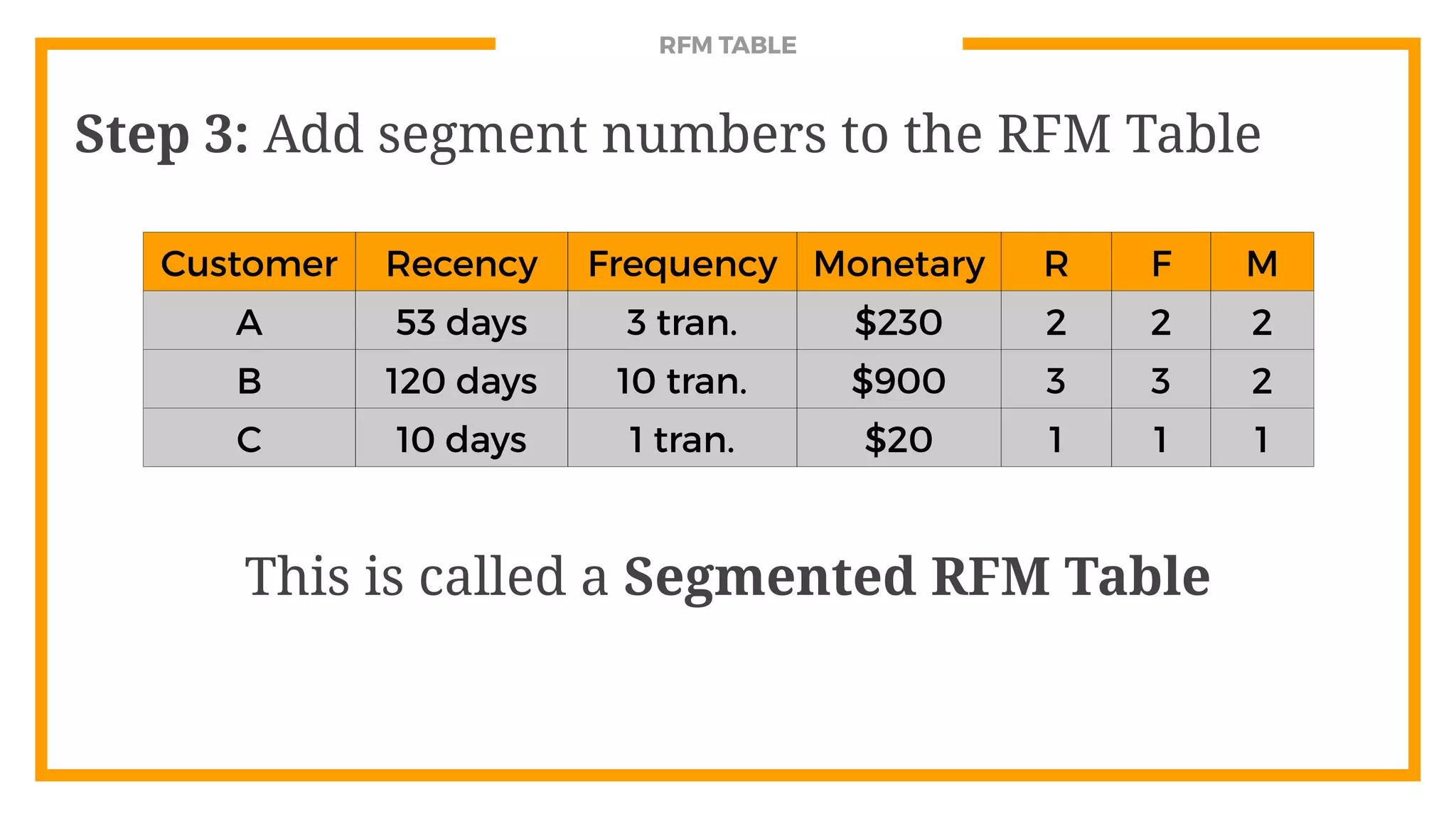
Step 3: Add segment numbers to the RFM Table
Customer Recency Frequency Monetary R F M
A 53 days 3 tran. $230 2 2 2
B 120 days 10 tran. $900 3 3 2
C 10 days 1 tran. $20 1 1 1
This is called a Segmented RFM Table
RFM SEGMENTATION
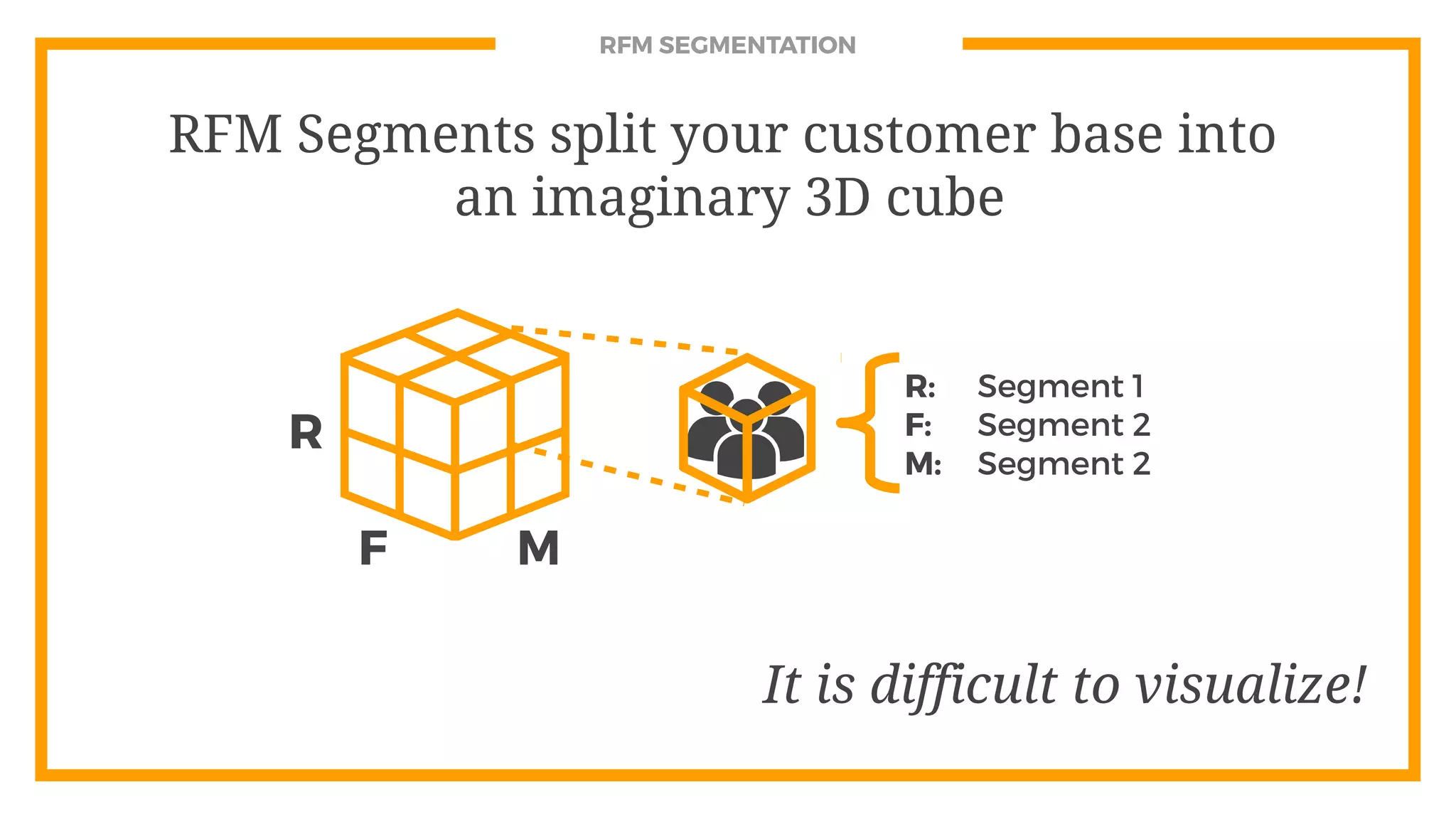
RFM Segments split your customer base into
an imaginary 3D cube
It is difficult to visualize!
R
F M
R: Segment 1
F: Segment 2
M: Segment 2
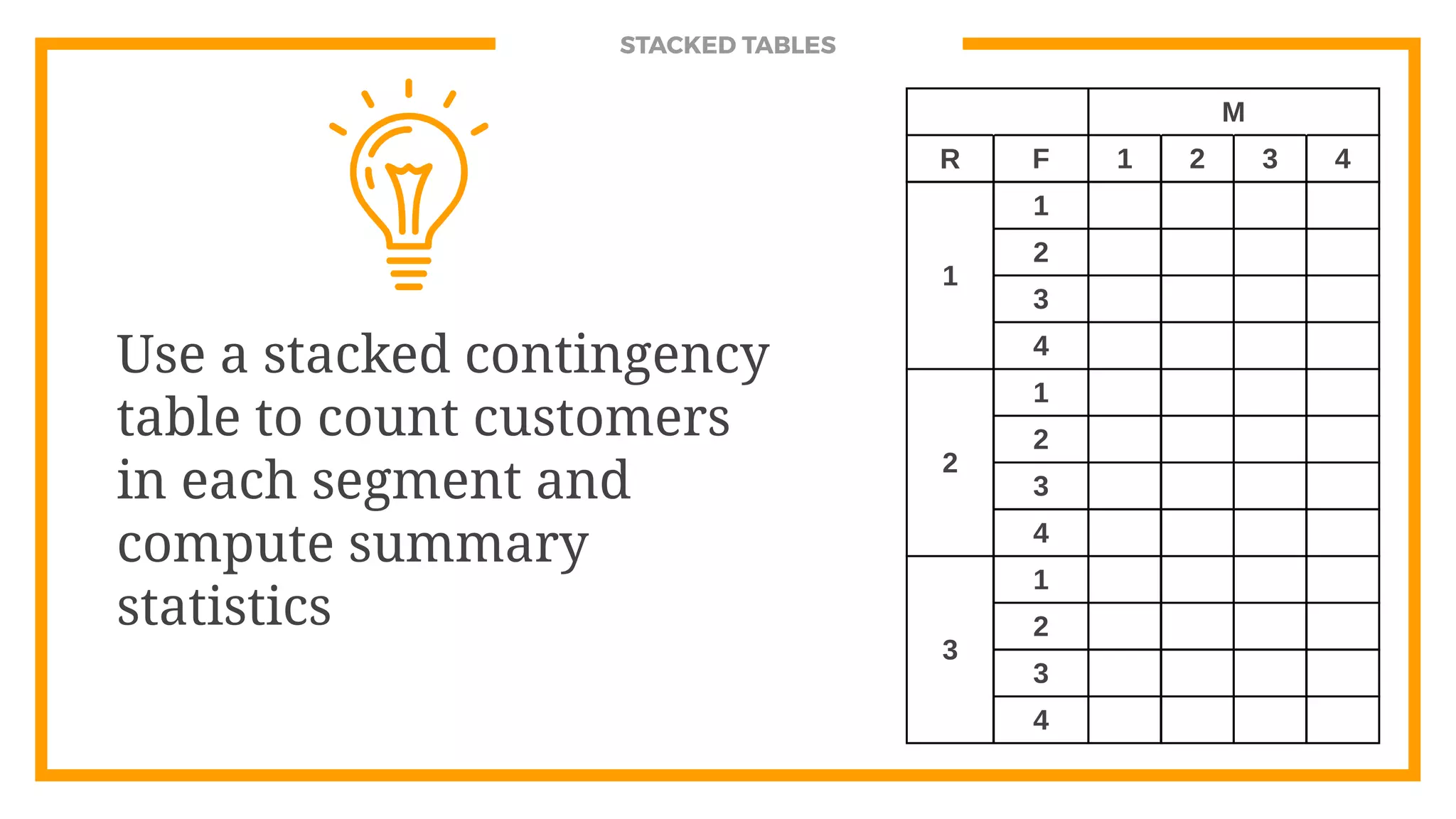
Use a stacked contingency
table to count customers
in each segment and
compute summary
statistics
STACKED TABLES
M
R F 1 2 3 4
1
1
2
3
4
2
1
2
3
4
3
1
2
3
4
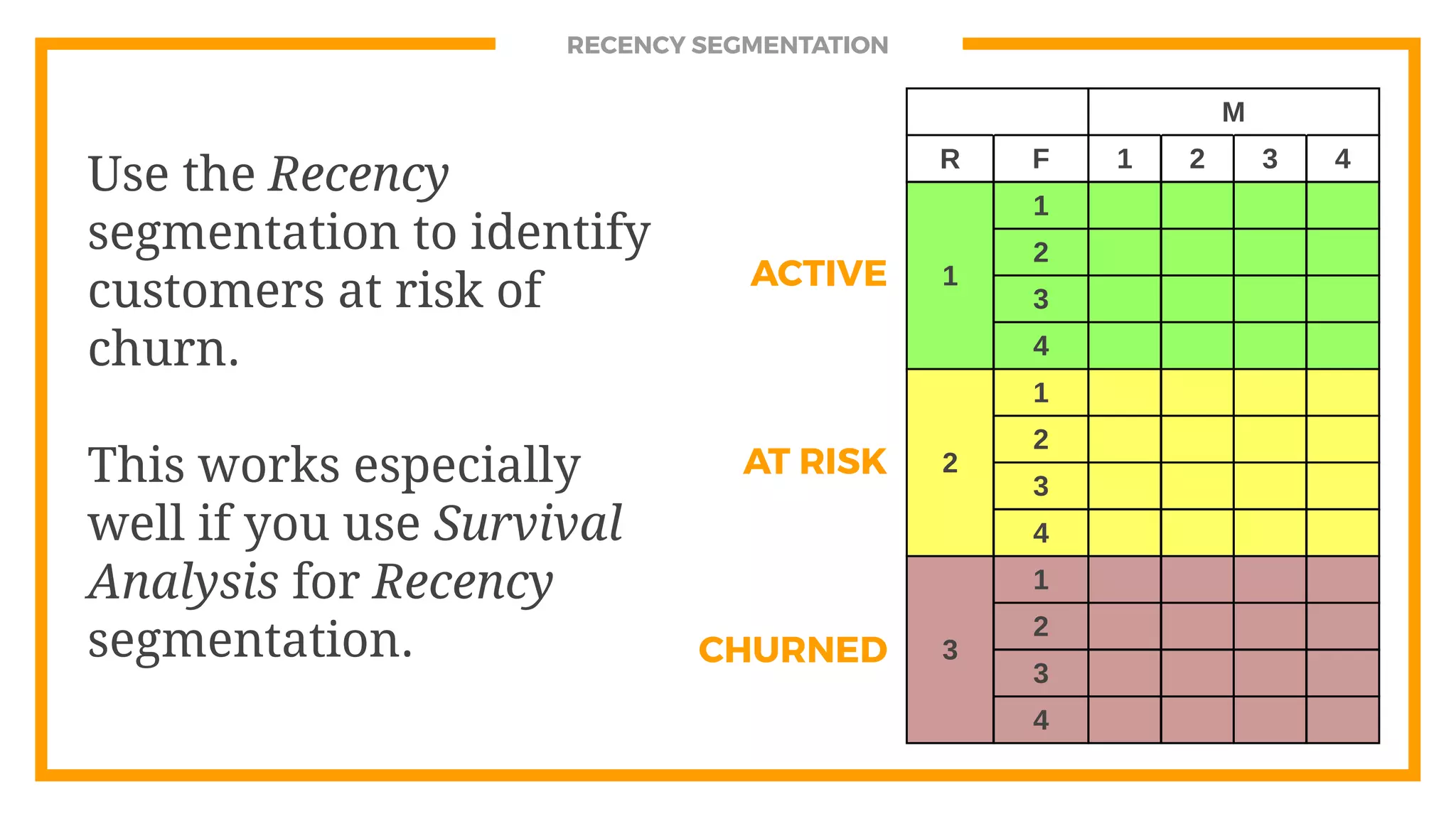
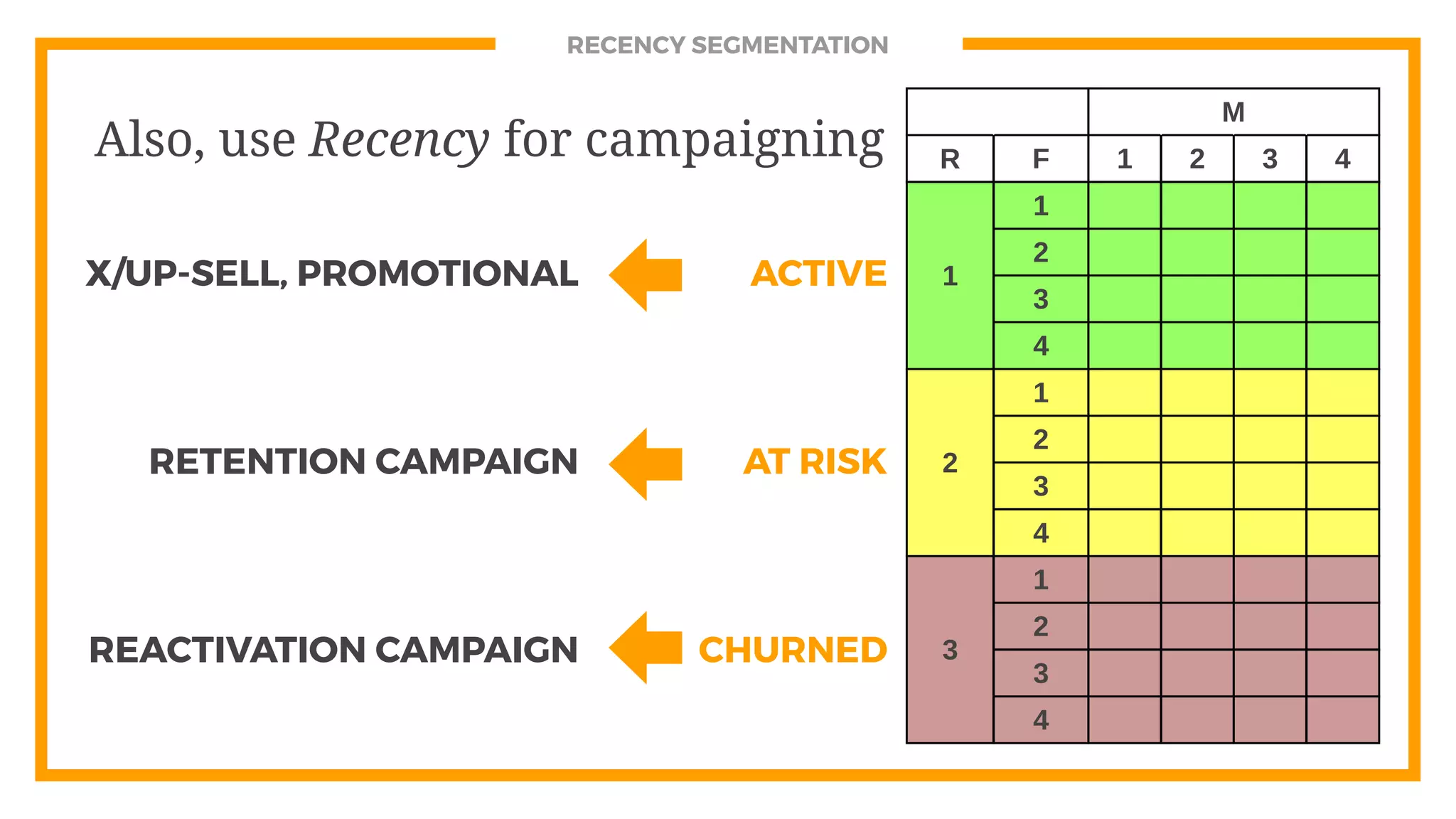
Use the Recency
segmentation to identify
customers at risk of
churn.
This works especially
well if you use Survival
Analysis for Recency
segmentation.
RECENCY SEGMENTATION
M
R F 1 2 3 4
1
1
2
3
4
2
1
2
3
4
3
1
2
3
4
ACTIVE
AT RISK
CHURNED
RECENCY SEGMENTATION
M
R F 1 2 3 4
1
1
2
3
4
2
1
2
3
4
3
1
2
3
4
ACTIVE
AT RISK
CHURNED
X/UP-SELL, PROMOTIONAL
RETENTION CAMPAIGN
REACTIVATION CAMPAIGN
Also, use Recency for campaigning
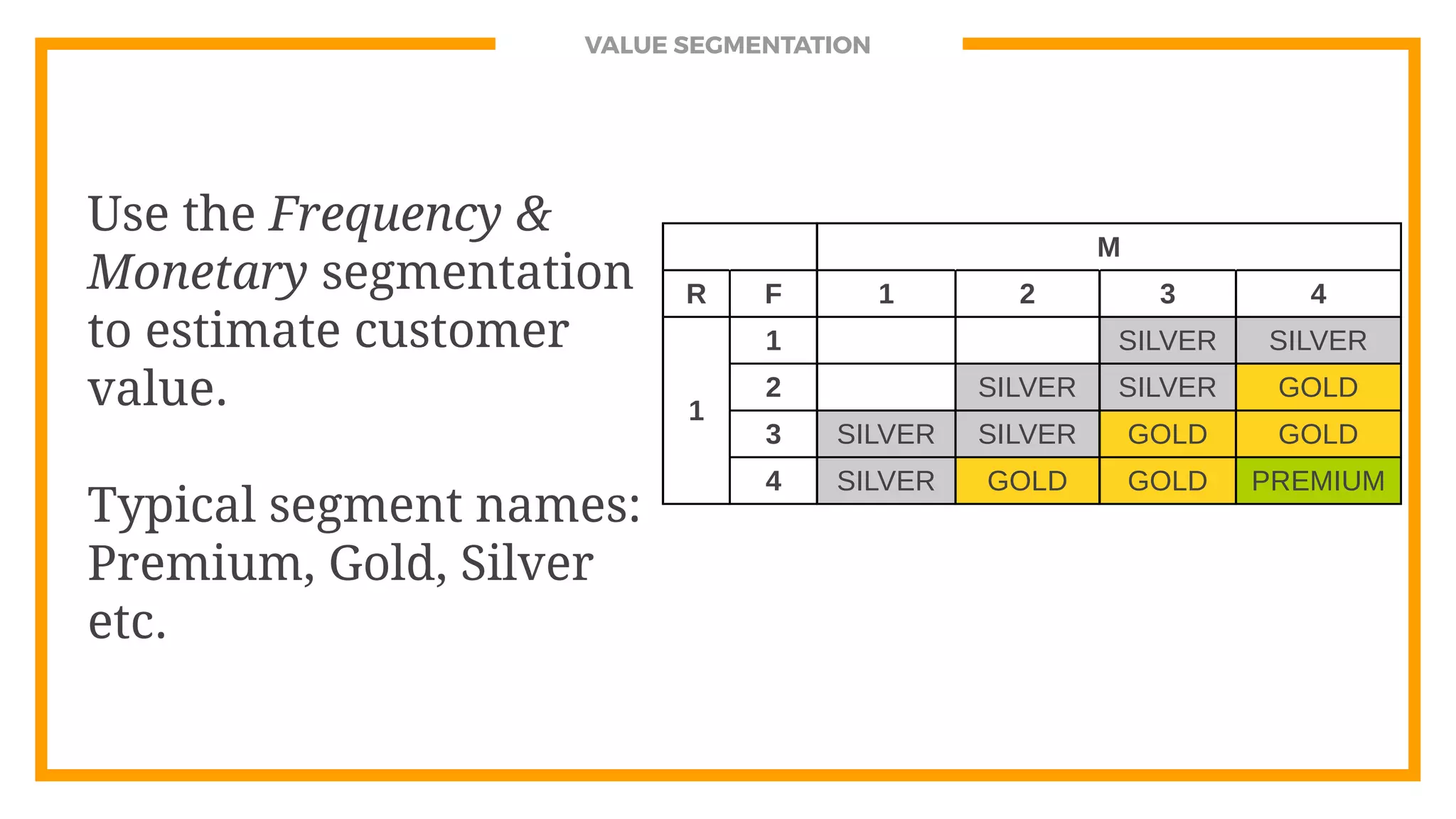
Use the Frequency &
Monetary segmentation
to estimate customer
value.
Typical segment names:
Premium, Gold, Silver
etc.
VALUE SEGMENTATION
M
R F 1 2 3 4
1
1 SILVER SILVER
2 SILVER SILVER GOLD
3 SILVER SILVER GOLD GOLD
4 SILVER GOLD GOLD PREMIUM
VALUE TIERS
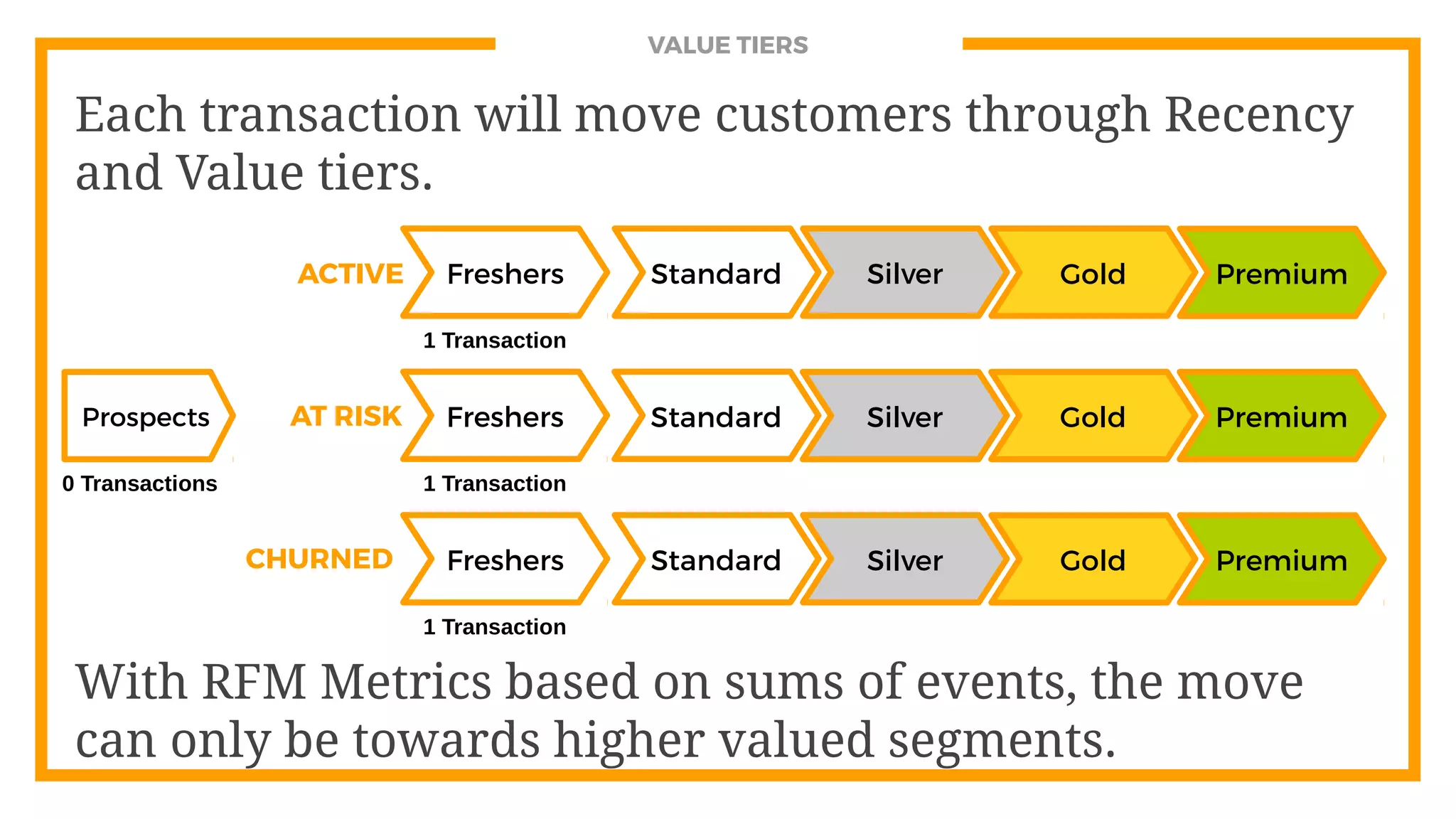
Each transaction will move customers through Recency
and Value tiers.
Prospects Freshers Standard Silver Gold Premium
0 Transactions 1 Transaction
Freshers Standard Silver Gold Premium
ACTIVE
AT RISK
CHURNED
1 Transaction
1 Transaction
With RFM Metrics based on sums of events, the move
can only be towards higher valued segments.
RFM VERIFICATION
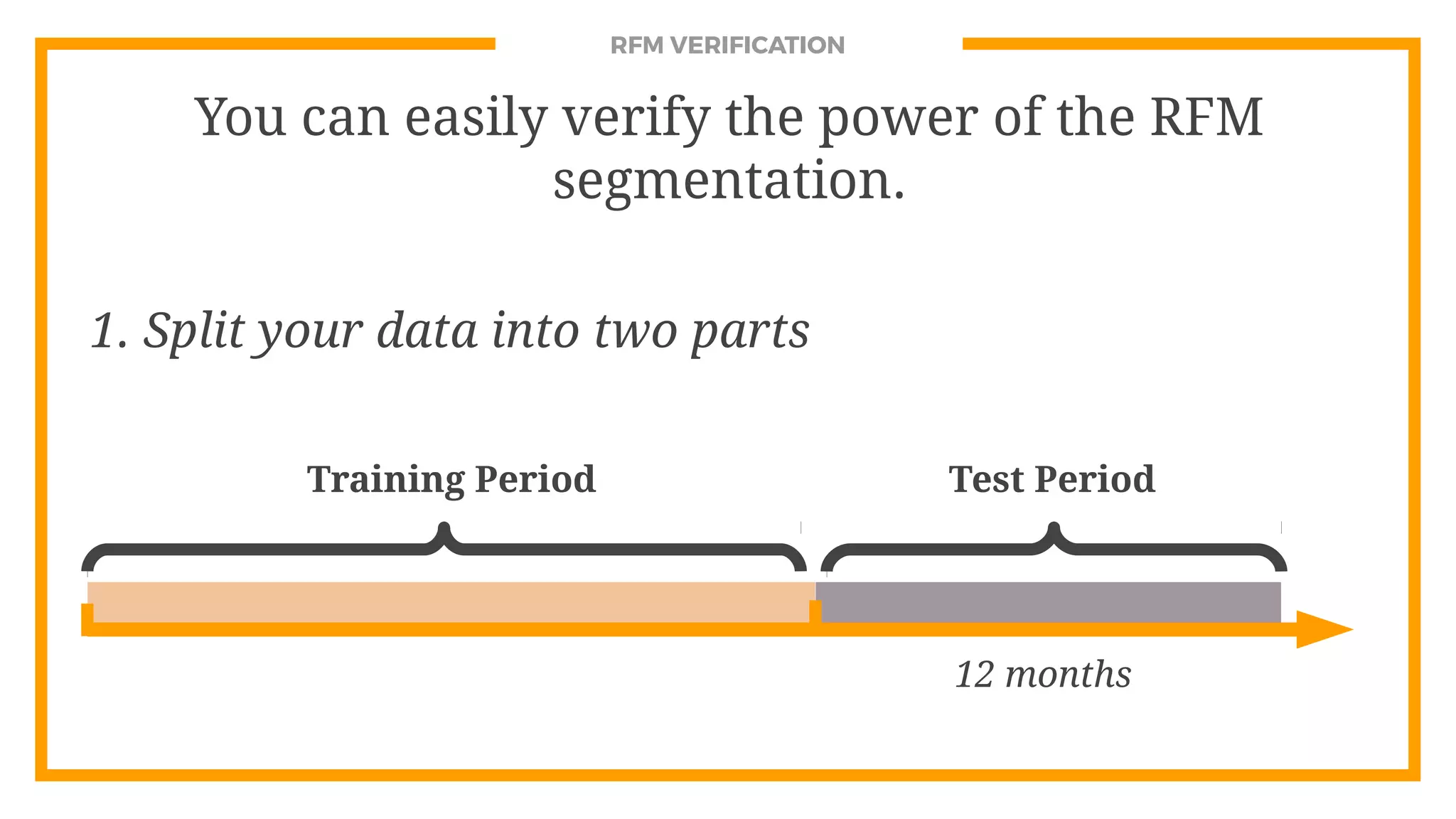
You can easily verify the power of the RFM
segmentation.
1. Split your data into two parts
Training Period Test Period
12 months
RFM VERIFICATION
You can easily verify the power of the RFM
segmentation.
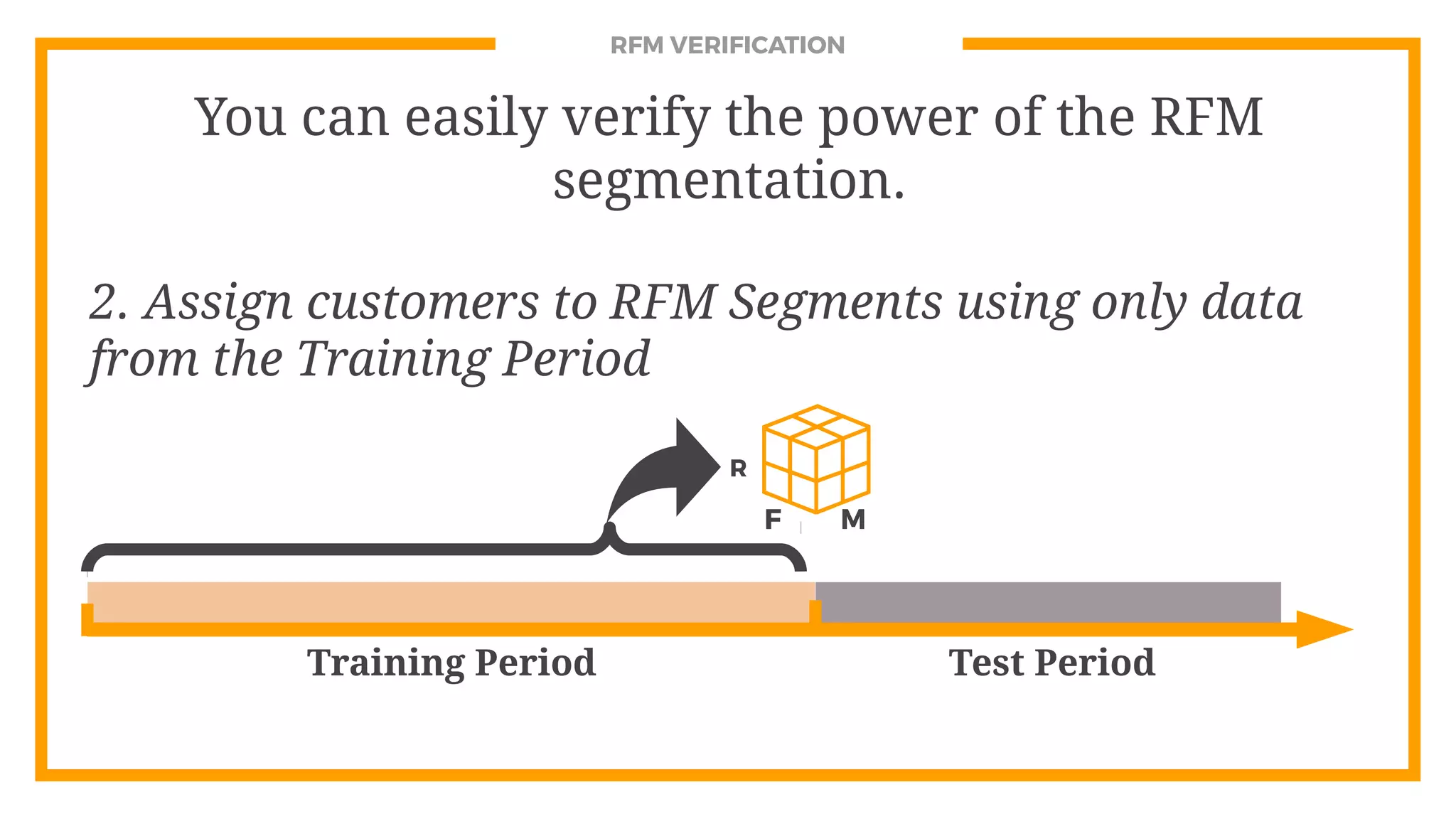
2. Assign customers to RFM Segments using only data
from the Training Period
R
F M
Training Period Test Period
RFM VERIFICATION
You can easily verify the power of the RFM
segmentation.
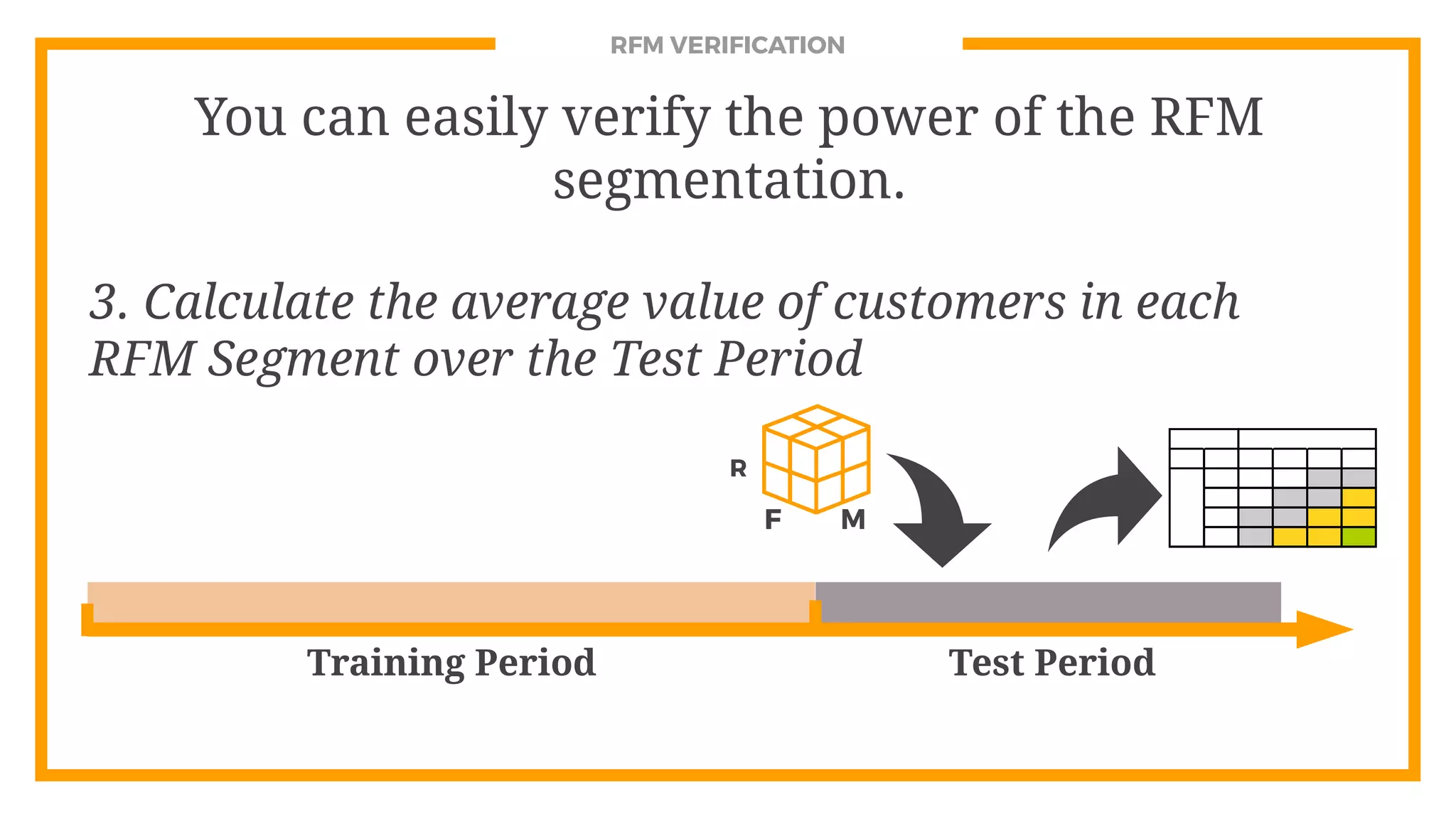
3. Calculate the average value of customers in each
RFM Segment over the Test Period
R
F M
Training Period Test Period
RFM VERIFICATION
You can easily verify the power of the RFM
segmentation.
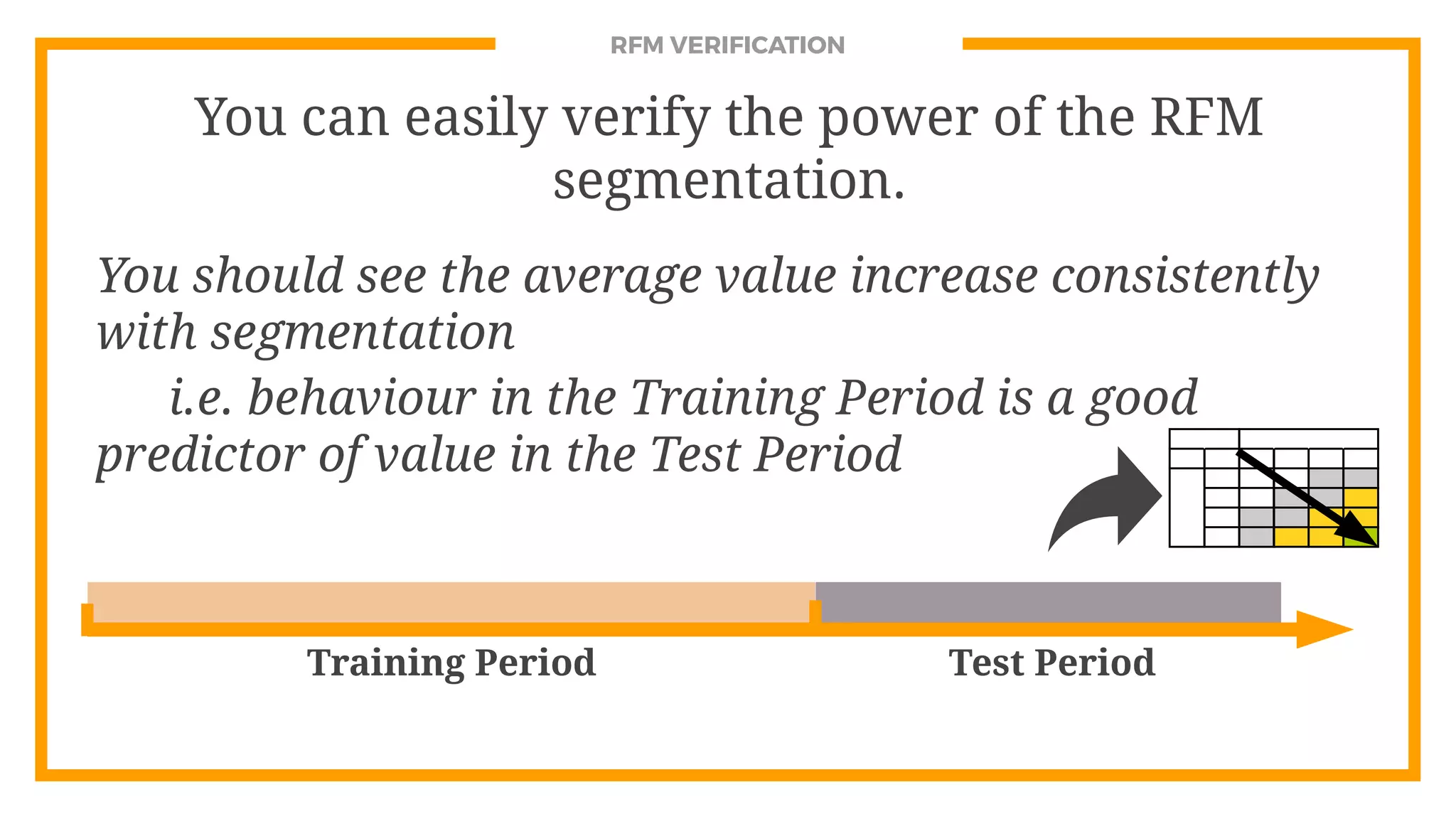
You should see the average value increase consistently
with segmentation
i.e. behaviour in the Training Period is a good
predictor of value in the Test Period
Training Period Test Period
THANKS!
Find out more at
http://www.marketingdistillery.com
THANKS!
This presentation is licensed under Creative Commons BY 4.0,
Icons (CC) BY 3.0 from www.flaticon.com by:
● Daniel Bruce, http://www.flaticon.com/authors/daniel-bruce
● Designerz Base, http://www.flaticon.com/authors/designerz-base
● Freepik, http://www.flaticon.com/authors/freepik

RFM Segmentation

  • 1.
  • 2.
    HELLO! Kamil Bartocha Follow meat @WhiteRavenPL or drop me an email: kamil.bartocha@marketingdistillery.com
  • 3.
    WHAT IS RFM? RFMstands for Recency, Frequency and Monetary ⊡ It is the easiest form of customer database segmentation ⊡ Often used for reactivation campaigns, high valued customer programs, combating churn etc.
  • 4.
    RFM IS BASEDON USER ACTIVITY DATA Anything from actual orders, website visits, app launches etc.
  • 5.
    TRANSACTION EXAMPLES E-COMMERCE Orders, visits SOCIALMEDIA Sharing, liking, engagement GAMING In-app purchases, levels played Purchase history Website visits Social engagement You can use more than one RFM segmentation RFM Segmentation can be applied to activity-related data that has measurable value and is repeatable DISCUSION BOARDS Posting, up-votes LEAD MANAGEMENT Engagement, value
  • 6.
    RFM METRICS RECENCY The freshnessof customer activity. e.g. time since last activity FREQUENCY The frequency of customer transactions. e.g. the total number of recorded transactions MONETARY The willingness to spend. e.g. the total transaction value RFM Metrics:
  • 7.
    TOTALS ● R: Time sincelast transaction ● F: Total number of transactions ● M: Total transactions value RFM METRICS AVERAGES ● R: Time since last transaction ● F: Average time between transactions ● M: Average transaction value RFM Metrics can have multiple definitions Transactions can only increase customer value in the segmentation Easy to explain Transactions can both increase and decrease customer value in the segmentation Complicates campaigning
  • 8.
    RFM TABLE Step 1:Calculate the RFM metrics for each customer Customer Recency Frequency Monetary A 53 days 3 transactions $230 B 120 days 10 transactions $900 C 10 days 1 transaction $20 This is called the RFM Table … and can be easily computed in SQL, R, Spark etc.
  • 9.
    RFM SEGMENTATION Step 2:Find the distribution for each metric... ...and define the segmentation... 0 20 40 60 80 90 100 days $800 0 1 2 3 4 5 6 orders $0 $50 $100 $200 $400 $1200 value
  • 10.
    RFM SEGMENTATION … bysplitting values into bins. 0 20 40 60 80 90 100 days $800 0 1 2 3 4 5 6 orders $0 $50 $100 $200 $400 $1200 value Segment 1 Segment 2 Segment 3 Segment 1 Segment 2 Segment 3 Segment 1 Segment 2 Segment 3
  • 11.
    RFM SEGMENTATION The easiestway to split metrics into segments is by using quantiles: ⊡ This gives a starting point for detailed analysis ⊡ 4 segments are easy to grasp and action Segment 1 Segment 2 Segment 3 Segment 4 25th quantile median 75th quantile There are much better ways to choose segmentation points!
  • 12.
    ⊡ Use SurvivalAnalysis to cut Recency segments at 25% and 50% of customer churn probability. ⊡ Identify high-valued customers by splitting out the top 10% in Frequency and Monetary. ⊡ Separate one-time buyers from customers with repeat purchase.
  • 13.
    RFM TABLE Step 3:Add segment numbers to the RFM Table Customer Recency Frequency Monetary R F M A 53 days 3 tran. $230 2 2 2 B 120 days 10 tran. $900 3 3 2 C 10 days 1 tran. $20 1 1 1 This is called a Segmented RFM Table
  • 14.
    RFM SEGMENTATION RFM Segmentssplit your customer base into an imaginary 3D cube It is difficult to visualize! R F M R: Segment 1 F: Segment 2 M: Segment 2
  • 15.
    Use a stackedcontingency table to count customers in each segment and compute summary statistics STACKED TABLES M R F 1 2 3 4 1 1 2 3 4 2 1 2 3 4 3 1 2 3 4
  • 16.
    Use the Recency segmentationto identify customers at risk of churn. This works especially well if you use Survival Analysis for Recency segmentation. RECENCY SEGMENTATION M R F 1 2 3 4 1 1 2 3 4 2 1 2 3 4 3 1 2 3 4 ACTIVE AT RISK CHURNED
  • 17.
    RECENCY SEGMENTATION M R F1 2 3 4 1 1 2 3 4 2 1 2 3 4 3 1 2 3 4 ACTIVE AT RISK CHURNED X/UP-SELL, PROMOTIONAL RETENTION CAMPAIGN REACTIVATION CAMPAIGN Also, use Recency for campaigning
  • 18.
    Use the Frequency& Monetary segmentation to estimate customer value. Typical segment names: Premium, Gold, Silver etc. VALUE SEGMENTATION M R F 1 2 3 4 1 1 SILVER SILVER 2 SILVER SILVER GOLD 3 SILVER SILVER GOLD GOLD 4 SILVER GOLD GOLD PREMIUM
  • 19.
    VALUE TIERS Each transactionwill move customers through Recency and Value tiers. Prospects Freshers Standard Silver Gold Premium 0 Transactions 1 Transaction Freshers Standard Silver Gold Premium Freshers Standard Silver Gold Premium ACTIVE AT RISK CHURNED 1 Transaction 1 Transaction With RFM Metrics based on sums of events, the move can only be towards higher valued segments.
  • 20.
    RFM VERIFICATION You caneasily verify the power of the RFM segmentation. 1. Split your data into two parts Training Period Test Period 12 months
  • 21.
    RFM VERIFICATION You caneasily verify the power of the RFM segmentation. 2. Assign customers to RFM Segments using only data from the Training Period R F M Training Period Test Period
  • 22.
    RFM VERIFICATION You caneasily verify the power of the RFM segmentation. 3. Calculate the average value of customers in each RFM Segment over the Test Period R F M Training Period Test Period
  • 23.
    RFM VERIFICATION You caneasily verify the power of the RFM segmentation. You should see the average value increase consistently with segmentation i.e. behaviour in the Training Period is a good predictor of value in the Test Period Training Period Test Period
  • 24.
    THANKS! Find out moreat http://www.marketingdistillery.com
  • 25.
    THANKS! This presentation islicensed under Creative Commons BY 4.0, Icons (CC) BY 3.0 from www.flaticon.com by: ● Daniel Bruce, http://www.flaticon.com/authors/daniel-bruce ● Designerz Base, http://www.flaticon.com/authors/designerz-base ● Freepik, http://www.flaticon.com/authors/freepik