CUSTOMER VALUE SCORING
PROCESS
Prepared by
Barbara Brown
April 22, 2008
1
– James Barrett
– Charles Noland
– Eleanor Hong
– Barbara Brown
– Gina Grossman
– Charles de Gruchy
Following our analytics planning meeting we began implementation of the
value scoring model (RFM).
The purpose of this presentation is to confirm why we kicked off the change
from the current segmentation and timing.
OVERVIEW
2
The proposed RFM segmentation will be tested against the current
demographic segmentation.
The forecast for the proposed RFM segmentation is to deliver an
incremental $11M to the business. The test will confirm the forecast across
all business segments ( ref: 04/09 business plan)
TESTING
3
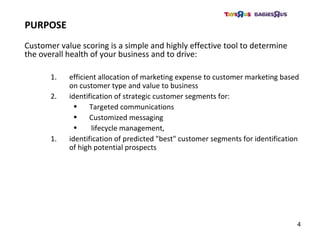
Customer value scoring is a simple and highly effective tool to determine
the overall health of your business and to drive:
1. efficient allocation of marketing expense to customer marketing based
on customer type and value to business
2. identification of strategic customer segments for:
• Targeted communications
• Customized messaging
• lifecycle management,
1. identification of predicted "best" customer segments for identification
of high potential prospects
PURPOSE
4
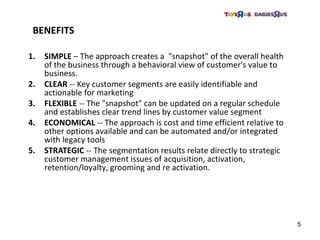
1. SIMPLE – The approach creates a "snapshot" of the overall health
of the business through a behavioral view of customer's value to
business.
2. CLEAR -- Key customer segments are easily identifiable and
actionable for marketing
3. FLEXIBLE -- The "snapshot" can be updated on a regular schedule
and establishes clear trend lines by customer value segment
4. ECONOMICAL -- The approach is cost and time efficient relative to
other options available and can be automated and/or integrated
with legacy tools
5. STRATEGIC -- The segmentation results relate directly to strategic
customer management issues of acquisition, activation,
retention/loyalty, grooming and re activation.
BENEFITS
5
THE PROCESS
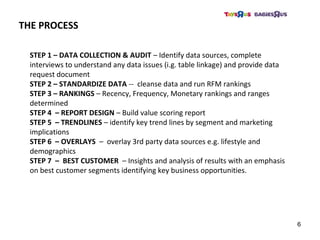
STEP 1 – DATA COLLECTION & AUDIT – Identify data sources, complete
interviews to understand any data issues (i.g. table linkage) and provide data
request document
STEP 2 – STANDARDIZE DATA -- cleanse data and run RFM rankings
STEP 3 – RANKINGS – Recency, Frequency, Monetary rankings and ranges
determined
STEP 4 – REPORT DESIGN – Build value scoring report
STEP 5 – TRENDLINES – identify key trend lines by segment and marketing
implications
STEP 6 – OVERLAYS – overlay 3rd party data sources e.g. lifestyle and
demographics
STEP 7 – BEST CUSTOMER – Insights and analysis of results with an emphasis
on best customer segments identifying key business opportunities.
6
NEXT STEPS
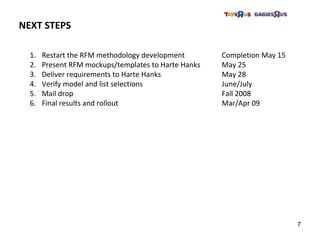
1. Restart the RFM methodology development Completion May 15
2. Present RFM mockups/templates to Harte Hanks May 25
3. Deliver requirements to Harte Hanks May 28
4. Verify model and list selections June/July
5. Mail drop Fall 2008
6. Final results and rollout Mar/Apr 09
7

Value scoring next steps

  • 1.
    CUSTOMER VALUE SCORING PROCESS Preparedby Barbara Brown April 22, 2008 1 – James Barrett – Charles Noland – Eleanor Hong – Barbara Brown – Gina Grossman – Charles de Gruchy
  • 2.
    Following our analyticsplanning meeting we began implementation of the value scoring model (RFM). The purpose of this presentation is to confirm why we kicked off the change from the current segmentation and timing. OVERVIEW 2
  • 3.
    The proposed RFMsegmentation will be tested against the current demographic segmentation. The forecast for the proposed RFM segmentation is to deliver an incremental $11M to the business. The test will confirm the forecast across all business segments ( ref: 04/09 business plan) TESTING 3
  • 4.
    Customer value scoringis a simple and highly effective tool to determine the overall health of your business and to drive: 1. efficient allocation of marketing expense to customer marketing based on customer type and value to business 2. identification of strategic customer segments for: • Targeted communications • Customized messaging • lifecycle management, 1. identification of predicted "best" customer segments for identification of high potential prospects PURPOSE 4
  • 5.
    1. SIMPLE –The approach creates a "snapshot" of the overall health of the business through a behavioral view of customer's value to business. 2. CLEAR -- Key customer segments are easily identifiable and actionable for marketing 3. FLEXIBLE -- The "snapshot" can be updated on a regular schedule and establishes clear trend lines by customer value segment 4. ECONOMICAL -- The approach is cost and time efficient relative to other options available and can be automated and/or integrated with legacy tools 5. STRATEGIC -- The segmentation results relate directly to strategic customer management issues of acquisition, activation, retention/loyalty, grooming and re activation. BENEFITS 5
  • 6.
    THE PROCESS STEP 1– DATA COLLECTION & AUDIT – Identify data sources, complete interviews to understand any data issues (i.g. table linkage) and provide data request document STEP 2 – STANDARDIZE DATA -- cleanse data and run RFM rankings STEP 3 – RANKINGS – Recency, Frequency, Monetary rankings and ranges determined STEP 4 – REPORT DESIGN – Build value scoring report STEP 5 – TRENDLINES – identify key trend lines by segment and marketing implications STEP 6 – OVERLAYS – overlay 3rd party data sources e.g. lifestyle and demographics STEP 7 – BEST CUSTOMER – Insights and analysis of results with an emphasis on best customer segments identifying key business opportunities. 6
  • 7.
    NEXT STEPS 1. Restartthe RFM methodology development Completion May 15 2. Present RFM mockups/templates to Harte Hanks May 25 3. Deliver requirements to Harte Hanks May 28 4. Verify model and list selections June/July 5. Mail drop Fall 2008 6. Final results and rollout Mar/Apr 09 7