Data Structure(Part 2)
BY:SURBHI SAROHA
Syllabus
• Trees
• Binary search trees
• Multidimensional arrays
Trees
• Trees: Unlike Arrays, Linked Lists, Stack and queues, which are linear
data structures, trees are hierarchical data structures.
• Tree Vocabulary: The topmost node is called root of the tree.
• The elements that are directly under an element are called its children.
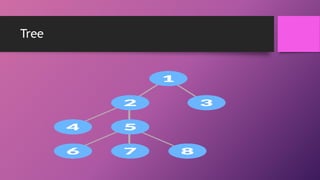
• A tree is a nonlinear hierarchical data structure that consists of nodes
connected by edges.
• The element directly above something is called its parent.
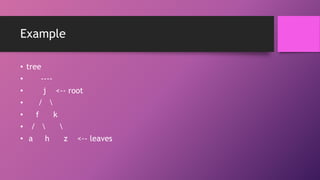
• For example, ‘a’ is a child of ‘f’, and ‘f’ is the parent of ‘a’. Finally,
elements with no children are called leaves.
Example
• tree
• ----
• j <-- root
• / 
• f k
• /  
• a h z <-- leaves
Tree
Tree Terminologies
• Node
• A node is an entity that contains a key or value and pointers to its
child nodes.
• The last nodes of each path are called leaf nodes or external
nodes that do not contain a link/pointer to child nodes.
• The node having at least a child node is called an internal node.
• Edge
• It is the link between any two nodes.
Cont…
• Root
• It is the topmost node of a tree.
• Height of a Node
• The height of a node is the number of edges from the node to the
deepest leaf (ie. the longest path from the node to a leaf node).
• Depth of a Node
• The depth of a node is the number of edges from the root to the node.
• Height of a Tree
• The height of a Tree is the height of the root node or the depth of the
deepest node.
Cont….
• Degree of a Node
• The degree of a node is the total number of branches of that node.
• Forest
• A collection of disjoint trees is called a forest.
• Types of Tree
• Binary Tree
• Binary Search Tree
• AVL Tree
• B-Tree
Binary search trees
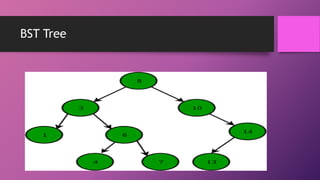
• Binary Search Tree is a node-based binary tree data structure
which has the following properties:
• The left subtree of a node contains only nodes with keys lesser
than the node’s key.
• The right subtree of a node contains only nodes with keys greater
than the node’s key.
• The left and right subtree each must also be a binary search tree.
BST Tree
Cont…..
• A Binary Search Tree (BST) is a tree in which all the nodes follow the below-
mentioned properties −
• The value of the key of the left sub-tree is less than the value of its parent (root)
node's key.
• The value of the key of the right sub-tree is greater than or equal to the value of its
parent (root) node's key.
• Following are the basic operations of a tree −
• Search − Searches an element in a tree.
• Insert − Inserts an element in a tree.
• Pre-order Traversal − Traverses a tree in a pre-order manner.
• In-order Traversal − Traverses a tree in an in-order manner.
• Post-order Traversal − Traverses a tree in a post-order manner.
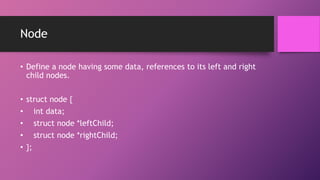
Node
• Define a node having some data, references to its left and right
child nodes.
• struct node {
• int data;
• struct node *leftChild;
• struct node *rightChild;
• };
Multidimensional arrays
• A multi-dimensional array is an array of arrays. 2-dimensional
arrays are the most commonly used. They are used to store data in
a tabular manner.
• Consider following 2D array, which is of the size 3×5. For an array
of size N×M, the rows and columns are numbered
from 0 to N−1 and columns are numbered from 0 to M−1,
respectively. Any element of the array can be accessed
by arr[i][j] where 0≤i<N and 0≤j<M. For example, in the following
array, the value stored at arr[1][3] is 14.
Cont…
• 2D array declaration:
• To declare a 2D array, you must specify the following:
• Row-size: Defines the number of rows
• Column-size: Defines the number of columns
• Type of array: Defines the type of elements to be stored in the
array i.e. either a number, character, or other such datatype. A
sample form of declaration is as follows:
• type arr[row_size][column_size]
Cont….
Thank you 

Data structure(Part 2)

  • 1.
  • 2.
    Syllabus • Trees • Binarysearch trees • Multidimensional arrays
  • 3.
    Trees • Trees: UnlikeArrays, Linked Lists, Stack and queues, which are linear data structures, trees are hierarchical data structures. • Tree Vocabulary: The topmost node is called root of the tree. • The elements that are directly under an element are called its children. • A tree is a nonlinear hierarchical data structure that consists of nodes connected by edges. • The element directly above something is called its parent. • For example, ‘a’ is a child of ‘f’, and ‘f’ is the parent of ‘a’. Finally, elements with no children are called leaves.
  • 4.
    Example • tree • ---- •j <-- root • / • f k • / • a h z <-- leaves
  • 5.
  • 6.
    Tree Terminologies • Node •A node is an entity that contains a key or value and pointers to its child nodes. • The last nodes of each path are called leaf nodes or external nodes that do not contain a link/pointer to child nodes. • The node having at least a child node is called an internal node. • Edge • It is the link between any two nodes.
  • 7.
    Cont… • Root • Itis the topmost node of a tree. • Height of a Node • The height of a node is the number of edges from the node to the deepest leaf (ie. the longest path from the node to a leaf node). • Depth of a Node • The depth of a node is the number of edges from the root to the node. • Height of a Tree • The height of a Tree is the height of the root node or the depth of the deepest node.
  • 8.
    Cont…. • Degree ofa Node • The degree of a node is the total number of branches of that node. • Forest • A collection of disjoint trees is called a forest. • Types of Tree • Binary Tree • Binary Search Tree • AVL Tree • B-Tree
  • 9.
    Binary search trees •Binary Search Tree is a node-based binary tree data structure which has the following properties: • The left subtree of a node contains only nodes with keys lesser than the node’s key. • The right subtree of a node contains only nodes with keys greater than the node’s key. • The left and right subtree each must also be a binary search tree.
  • 10.
  • 11.
    Cont….. • A BinarySearch Tree (BST) is a tree in which all the nodes follow the below- mentioned properties − • The value of the key of the left sub-tree is less than the value of its parent (root) node's key. • The value of the key of the right sub-tree is greater than or equal to the value of its parent (root) node's key. • Following are the basic operations of a tree − • Search − Searches an element in a tree. • Insert − Inserts an element in a tree. • Pre-order Traversal − Traverses a tree in a pre-order manner. • In-order Traversal − Traverses a tree in an in-order manner. • Post-order Traversal − Traverses a tree in a post-order manner.
  • 12.
    Node • Define anode having some data, references to its left and right child nodes. • struct node { • int data; • struct node *leftChild; • struct node *rightChild; • };
  • 13.
    Multidimensional arrays • Amulti-dimensional array is an array of arrays. 2-dimensional arrays are the most commonly used. They are used to store data in a tabular manner. • Consider following 2D array, which is of the size 3×5. For an array of size N×M, the rows and columns are numbered from 0 to N−1 and columns are numbered from 0 to M−1, respectively. Any element of the array can be accessed by arr[i][j] where 0≤i<N and 0≤j<M. For example, in the following array, the value stored at arr[1][3] is 14.
  • 14.
    Cont… • 2D arraydeclaration: • To declare a 2D array, you must specify the following: • Row-size: Defines the number of rows • Column-size: Defines the number of columns • Type of array: Defines the type of elements to be stored in the array i.e. either a number, character, or other such datatype. A sample form of declaration is as follows: • type arr[row_size][column_size]
  • 15.
  • 16.