Data Structures
Trees
Summary
• Topics
• general trees, definitions and properties
• interface and implementation
• tree traversal algorithms
• depth and height
• pre-order traversal
• post-order traversal
Trees
• So far we have seen linear structures
• linear: before and after relationship
• lists, vectors, arrays, stacks, queues, etc
• Non-linear structure: trees
• probably the most fundamental structure in
computing
• hierarchical structure
• Terminology: from family trees (genealogy)
root
Trees
• store elements hierarchically
• the top element: root
• except the root, each element has a parent
• each element has 0 or more children
Trees
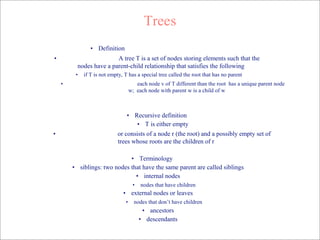
• Definition
• A tree T is a set of nodes storing elements such that the
nodes have a parent-child relationship that satisfies the following
• if T is not empty, T has a special tree called the root that has no parent
• each node v of T different than the root has a unique parent node
w; each node with parent w is a child of w
• Recursive definition
• T is either empty
• or consists of a node r (the root) and a possibly empty set of
trees whose roots are the children of r
• Terminology
• siblings: two nodes that have the same parent are called siblings
• internal nodes
• nodes that have children
• external nodes or leaves
• nodes that don’t have children
• ancestors
• descendants
Trees
root
inter
nal nodes
leav
es
Trees
ancestors of u
u
Trees
descendants of u
u
Application of trees
• Applications of trees
• class hierarchy
in Java
• file system
• storing
hierarchies in
organizations
Tree ADT
• Whatever the implementation of a tree is, its interface is
the following
• root()
• size()
• isEmpty()
• parent(v)
• children(v)
• isInternal(v)
• isExternal(v)
• isRoot()
Algorithms on trees
• Definition:
• depth(T, v) is the number of ancestors of v, excluding v itself
• //compute the depth of a node v in tree T
• int depth(T, v)
• recursive formulation
• if v == root, then depth(v) = 0
• else, depth(v) is 1 + depth (parent(v))
• Algorithm:
int depth(T,v) {
if T.isRoot(v) return 0
return 1 + depth(T, T.parent(v))
}
• Analysis:
• O(number of ancestors) = O(depth_v)
• in the worst case the path is a linked-list and v is the leaf
• ==> O(n), where n is the number of nodes in the tree
Algorithms on trees
• Definition:
• height of a node v in T is the length of the longest path from v to any leaf
• //compute the height of tree T
• int height(T,v)
• recursive definition:
• if v is leaf, then its height is 0
• else height(v) = 1 + maximum height of a child of v
• definition:
• the height of a tree is the height of its root
• Proposition: the height of a tree T is the maximum depth of one of its leaves.
Height
• Algorithm:
int height(T,v) {
if T.isExternal(v) return 0;
int h = 0;
for each child w of v in T do
h = max(h, height(T, w))
return h+1;
}
• Analysis:
• total time: the sum of times spent at each
node, for all nodes
• the algorithm is recursive;
• v calls height(w) on all children w of v
• height() will eventually be called on
every descendant of v
• is called on each node precisely once,
because each node has one parent
• aside from recursion
• for each node v: go through all
children of v
• O(1 + c_v) where c_v is the
number of children of v
• over all nodes: O(n) + SUM (c_v)
• each node is child of only one
node, so its processed once as a

Basic of trees 2

  • 1.
  • 2.
    Summary • Topics • generaltrees, definitions and properties • interface and implementation • tree traversal algorithms • depth and height • pre-order traversal • post-order traversal
  • 3.
    Trees • So farwe have seen linear structures • linear: before and after relationship • lists, vectors, arrays, stacks, queues, etc • Non-linear structure: trees • probably the most fundamental structure in computing • hierarchical structure • Terminology: from family trees (genealogy)
  • 4.
    root Trees • store elementshierarchically • the top element: root • except the root, each element has a parent • each element has 0 or more children
  • 5.
    Trees • Definition • Atree T is a set of nodes storing elements such that the nodes have a parent-child relationship that satisfies the following • if T is not empty, T has a special tree called the root that has no parent • each node v of T different than the root has a unique parent node w; each node with parent w is a child of w • Recursive definition • T is either empty • or consists of a node r (the root) and a possibly empty set of trees whose roots are the children of r • Terminology • siblings: two nodes that have the same parent are called siblings • internal nodes • nodes that have children • external nodes or leaves • nodes that don’t have children • ancestors • descendants
  • 6.
  • 7.
  • 8.
  • 9.
    Application of trees •Applications of trees • class hierarchy in Java • file system • storing hierarchies in organizations
  • 10.
    Tree ADT • Whateverthe implementation of a tree is, its interface is the following • root() • size() • isEmpty() • parent(v) • children(v) • isInternal(v) • isExternal(v) • isRoot()
  • 11.
    Algorithms on trees •Definition: • depth(T, v) is the number of ancestors of v, excluding v itself • //compute the depth of a node v in tree T • int depth(T, v) • recursive formulation • if v == root, then depth(v) = 0 • else, depth(v) is 1 + depth (parent(v)) • Algorithm: int depth(T,v) { if T.isRoot(v) return 0 return 1 + depth(T, T.parent(v)) } • Analysis: • O(number of ancestors) = O(depth_v) • in the worst case the path is a linked-list and v is the leaf • ==> O(n), where n is the number of nodes in the tree
  • 12.
    Algorithms on trees •Definition: • height of a node v in T is the length of the longest path from v to any leaf • //compute the height of tree T • int height(T,v) • recursive definition: • if v is leaf, then its height is 0 • else height(v) = 1 + maximum height of a child of v • definition: • the height of a tree is the height of its root • Proposition: the height of a tree T is the maximum depth of one of its leaves.
  • 13.
    Height • Algorithm: int height(T,v){ if T.isExternal(v) return 0; int h = 0; for each child w of v in T do h = max(h, height(T, w)) return h+1; } • Analysis: • total time: the sum of times spent at each node, for all nodes • the algorithm is recursive; • v calls height(w) on all children w of v • height() will eventually be called on every descendant of v • is called on each node precisely once, because each node has one parent • aside from recursion • for each node v: go through all children of v • O(1 + c_v) where c_v is the number of children of v • over all nodes: O(n) + SUM (c_v) • each node is child of only one node, so its processed once as a