z
MOBILE
COMPUTING
UNIT 2
BY:SURBHI SAROHA
z
SYLLABUS
 ISM band, Spread Spectrum, physical layer accessing
techniques – FHSS, DSSS, OFDM, (IEEE 802.11a) HR-DSSS,
OFDM (IEEE 802.11g)Wireless Networking, Wireless LAN
 Overview: MAC issues, IEEE 802.11, BlueTooth, Wireless
multiple access protocols, Wireless applications, data
broadcasting, Mobile IP-entities and terminology, IP Packet
delivery, Agent discovery, Registration, Tunneling and
encapsulation, optimization and reverse tunneling
 WAP: Architecture, protocol stack, application environment,
applications.
z
ISM band
 In mobile computing, the ISM (Industrial, Scientific, and Medical)
bands are essential for enabling various wireless communication
technologies.
 These bands are non-licensed spectrum bands available for use
by any device or application that adheres to the regulations
governing these frequencies.
 The ISM bands facilitate numerous applications in mobile
computing, from basic device connectivity to advanced Internet
of Things (IoT) applications.
z
Key ISM Bands
 The most commonly used ISM bands in mobile computing are:
 2.4 GHz Band: Ranges from 2.4 GHz to 2.5 GHz.
 5 GHz Band: Includes several sub-bands, ranging from 5.15
GHz to 5.85 GHz.
 900 MHz Band: Ranges from 902 MHz to 928 MHz (primarily
used in North America).
z
Spread Spectrum
 Spread spectrum is a method used in mobile computing and
wireless communications to spread the signal across a wider
frequency band than the minimum bandwidth required for
transmitting the information.
 This technique enhances signal robustness, reduces
interference, and improves security.
 It is widely used in mobile communication systems, Wi-Fi, and
other wireless technologies.
z
Advantages of Spread Spectrum in
Mobile Computing
 Interference Mitigation: Spreads the signal across a wide
band, reducing the impact of narrowband interference.
 Security: Makes unauthorized interception and jamming more
difficult.
 Robustness: Enhances resistance to multipath fading, which is
common in mobile environments.
 Capacity: Allows multiple users to share the same frequency
band with minimal interference.
z
Challenges in Mobile Computing
 Complexity: Implementation of spread spectrum techniques can be
complex and require sophisticated hardware.
 Bandwidth Efficiency: Spread spectrum techniques can be less
bandwidth-efficient compared to some other methods.
 Power Consumption: May increase power consumption, which is a critical
factor for battery-operated mobile devices.
In summary, spread spectrum techniques play a crucial role in enhancing the
performance, reliability, and security of wireless communications in mobile
computing. By spreading the signal across a wider frequency range, these
techniques help mitigate interference, improve robustness, and enable efficient
use of the spectrum in various applications, from Wi-Fi and Bluetooth to cellular
networks and GPS.
z
Physical layer accessing techniques –
FHSS, DSSS, OFDM
 Accessing techniques in the physical layer are methods used to
manage how multiple users share the available spectrum. Here are
the details of three key techniques:
 Frequency Hopping Spread Spectrum (FHSS)
 Principle:
 FHSS works by rapidly switching the carrier frequency among many
frequency channels.
 This hopping sequence is known to both the transmitter and the
receiver.
z
Frequency Hopping Spread Spectrum
(FHSS)
 Advantages:
 Resistant to narrowband interference.
 Provides security through frequency hopping.
 Disadvantages:
 Complex synchronization between transmitter and receiver.
 Less bandwidth efficient compared to other methods.
z
Direct Sequence Spread Spectrum
(DSSS)
 Principle:
 DSSS spreads the signal over a wider frequency band than the minimum
required.
 The signal is multiplied by a pseudo-random noise code which has a higher bit
rate than the data being transmitted.
 The receiver uses the same pseudo-random noise code to demodulate the
signal.
 Advantages:
 Resistant to narrowband interference and multipath fading.
 Provides some level of security since the pseudo-random code is known only to
the transmitter and receiver.
z
Disadvantages:
 Requires more bandwidth than non-spread-spectrum
techniques.
 Complexity in generating and synchronizing the pseudo-random
code.
z
Orthogonal Frequency Division
Multiplexing (OFDM)
 Principle:
 OFDM divides the available spectrum into multiple orthogonal sub-
carriers.
 Data is transmitted in parallel on these sub-carriers.
 Advantages:
 Highly efficient in terms of bandwidth.
 Robust against multipath fading and interference.
 Simplifies equalization since it transforms a frequency-selective
channel into multiple flat-fading sub-channels.
z
Disadvantages:
 Sensitive to frequency offset and phase noise.
 Requires complex synchronization and channel estimation
techniques.
 High Peak-to-Average Power Ratio (PAPR) can reduce power
efficiency.
z
Comparison and Applications
 FHSS:
 Common in Bluetooth technology and some military
communications due to its resilience against interference and
eavesdropping.
z
DSSS
 Used in Wi-Fi (802.11b) and CDMA (Code Division Multiple
Access) mobile communications due to its robustness against
interference and ability to support multiple users.
z
OFDM
 Widely used in modern wireless communication systems, such
as Wi-Fi (802.11a/g/n/ac), LTE (Long-Term Evolution), and
digital television broadcasting (DVB-T) due to its spectral
efficiency and robustness against multipath effects.
 These techniques play crucial roles in enhancing the
performance, reliability, and security of communication systems
at the physical layer.
z
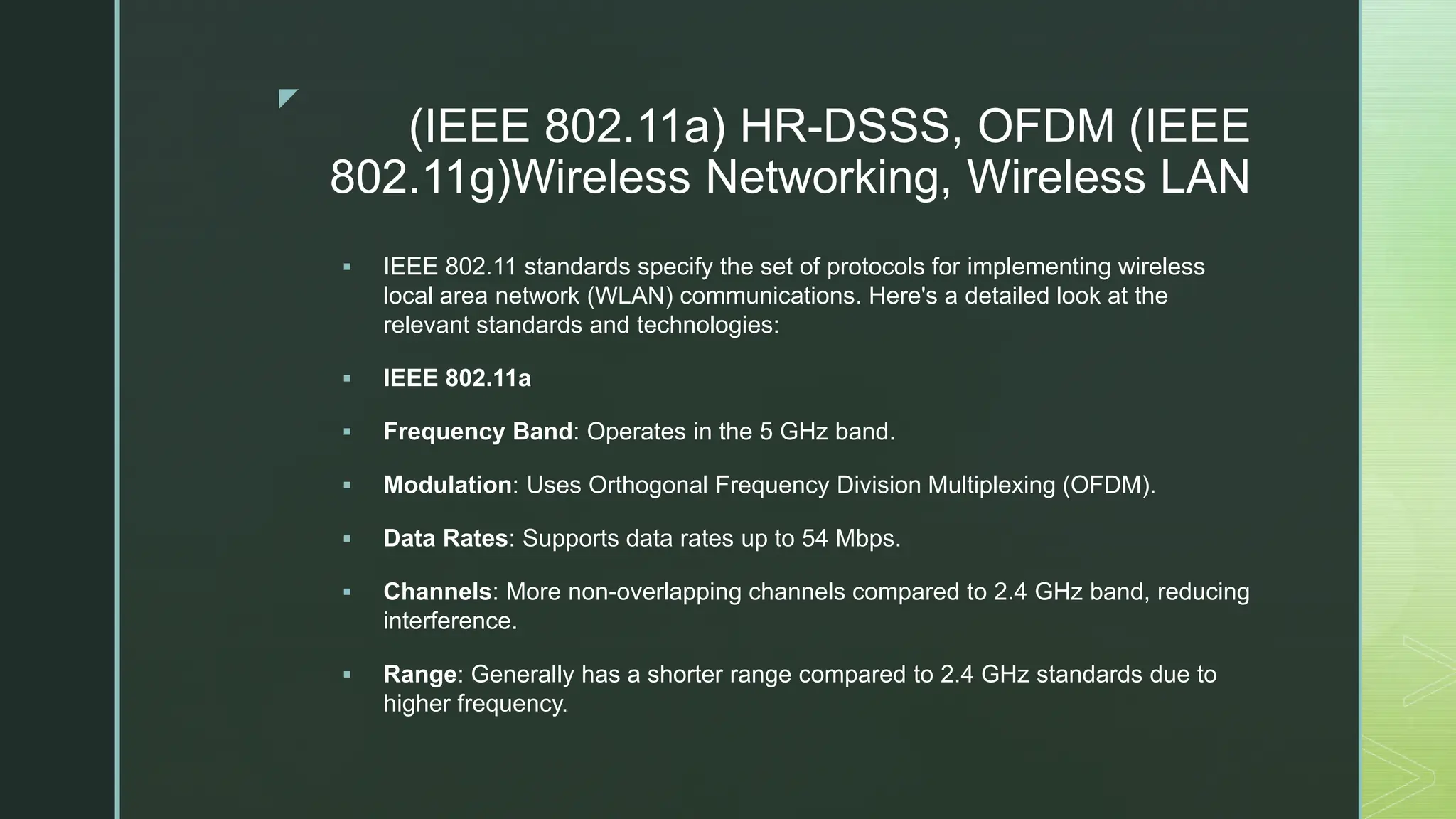
(IEEE 802.11a) HR-DSSS, OFDM (IEEE
802.11g)Wireless Networking, Wireless LAN
 IEEE 802.11 standards specify the set of protocols for implementing wireless
local area network (WLAN) communications. Here's a detailed look at the
relevant standards and technologies:
 IEEE 802.11a
 Frequency Band: Operates in the 5 GHz band.
 Modulation: Uses Orthogonal Frequency Division Multiplexing (OFDM).
 Data Rates: Supports data rates up to 54 Mbps.
 Channels: More non-overlapping channels compared to 2.4 GHz band, reducing
interference.
 Range: Generally has a shorter range compared to 2.4 GHz standards due to
higher frequency.
z
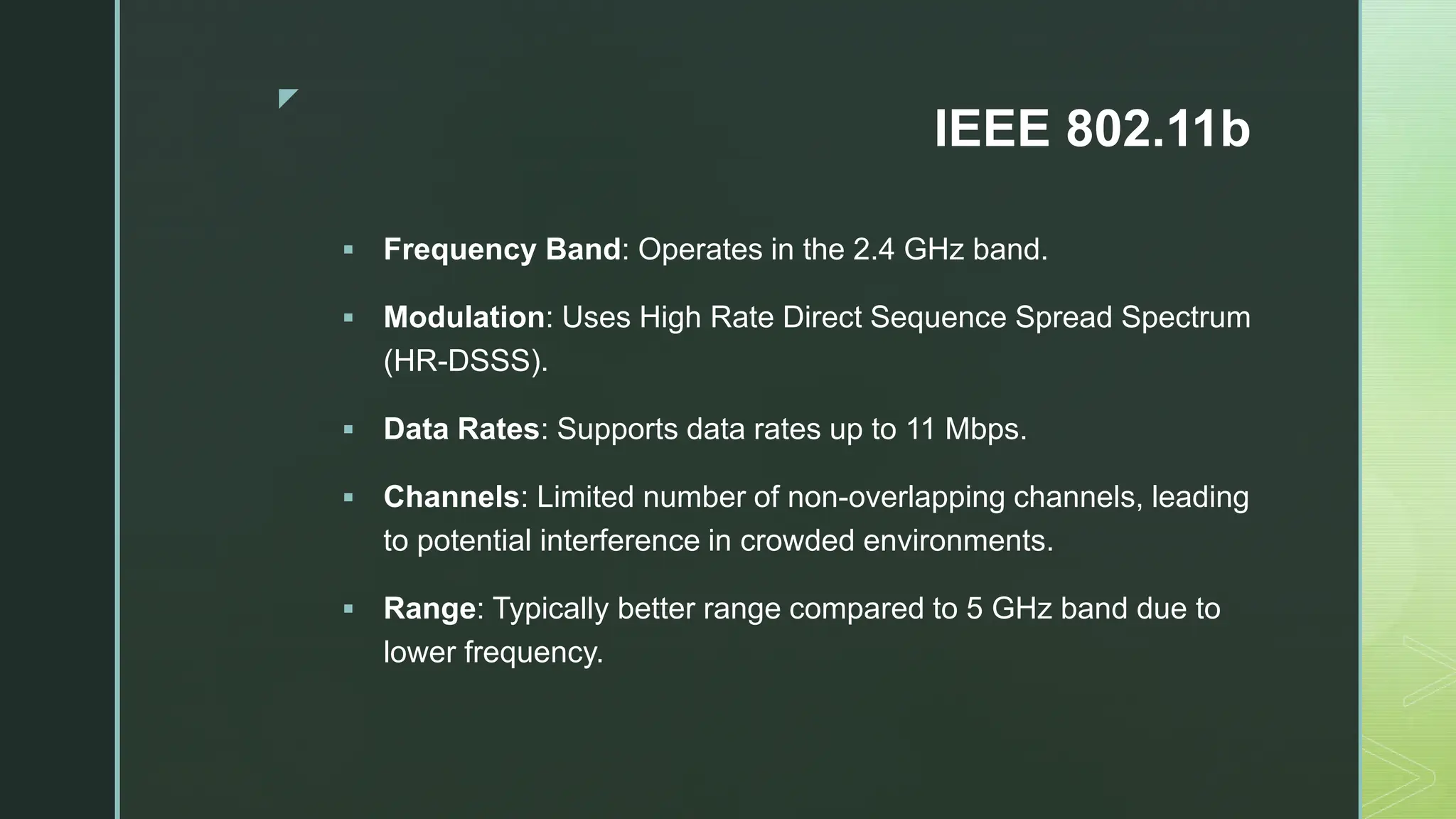
IEEE 802.11b
 Frequency Band: Operates in the 2.4 GHz band.
 Modulation: Uses High Rate Direct Sequence Spread Spectrum
(HR-DSSS).
 Data Rates: Supports data rates up to 11 Mbps.
 Channels: Limited number of non-overlapping channels, leading
to potential interference in crowded environments.
 Range: Typically better range compared to 5 GHz band due to
lower frequency.
z
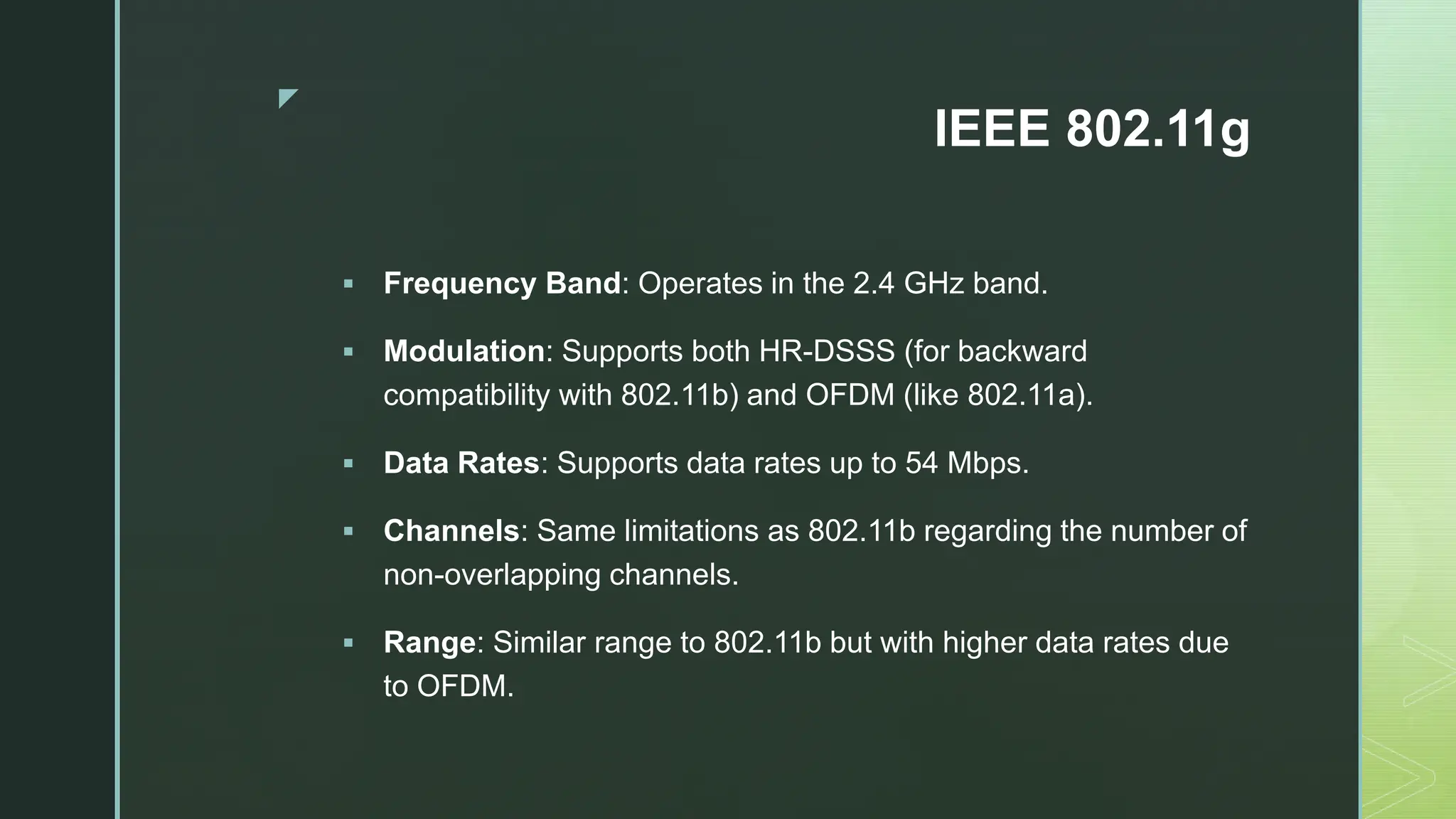
IEEE 802.11g
 Frequency Band: Operates in the 2.4 GHz band.
 Modulation: Supports both HR-DSSS (for backward
compatibility with 802.11b) and OFDM (like 802.11a).
 Data Rates: Supports data rates up to 54 Mbps.
 Channels: Same limitations as 802.11b regarding the number of
non-overlapping channels.
 Range: Similar range to 802.11b but with higher data rates due
to OFDM.
z
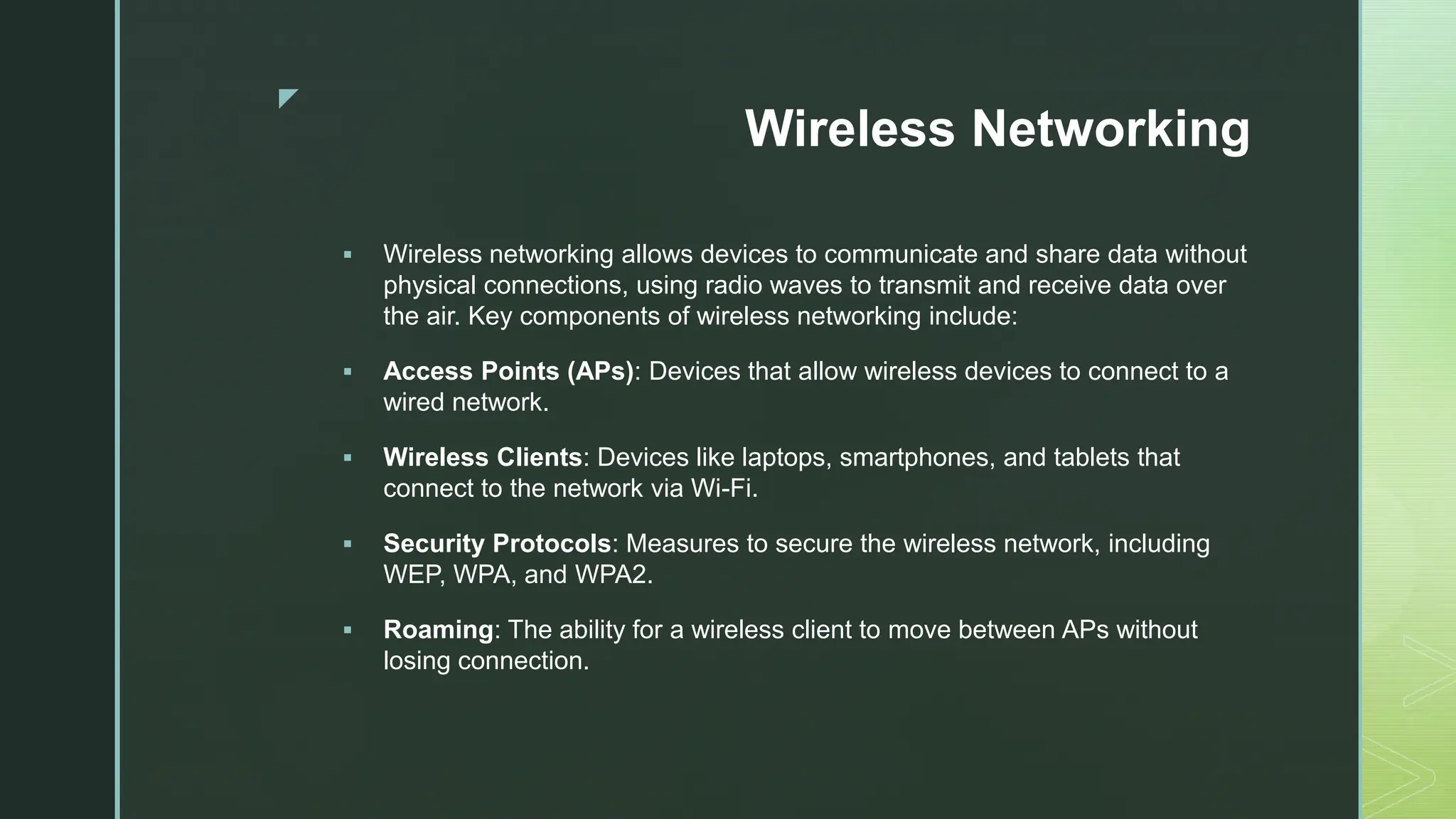
Wireless Networking
 Wireless networking allows devices to communicate and share data without
physical connections, using radio waves to transmit and receive data over
the air. Key components of wireless networking include:
 Access Points (APs): Devices that allow wireless devices to connect to a
wired network.
 Wireless Clients: Devices like laptops, smartphones, and tablets that
connect to the network via Wi-Fi.
 Security Protocols: Measures to secure the wireless network, including
WEP, WPA, and WPA2.
 Roaming: The ability for a wireless client to move between APs without
losing connection.
z
Wireless LAN (WLAN)
 Wireless LANs are networks that connect devices over short distances
using wireless communication. Key features and benefits include:
 Mobility: Allows users to move around within the network area while
maintaining a network connection.
 Ease of Installation: No need for physical cables, making installation and
reconfiguration easier.
 Scalability: Easy to expand the network by adding more APs and clients.
 Flexibility: Supports a variety of devices and can be set up in different
environments (e.g., offices, homes, public spaces).
z
Overview: MAC issues
 The Medium Access Control (MAC) layer is a crucial component of
the Data Link Layer in the OSI model, responsible for controlling
how devices in a network gain access to the medium and
permission to transmit data.
 There are several key issues and considerations related to the
MAC layer in wireless networking:
 1. Collision Avoidance and Detection
 Issue:
 In wireless networks, multiple devices may attempt to transmit data
simultaneously, leading to collisions.
z
Techniques:
 Carrier Sense Multiple Access with Collision Avoidance
(CSMA/CA): Used in IEEE 802.11 (Wi-Fi) networks, this
technique requires devices to sense the medium before
transmitting and to back off for a random period if the medium is
busy.
 Request to Send / Clear to Send (RTS/CTS): A handshake
protocol to further reduce collisions, especially in environments
with hidden nodes.
z
2. Hidden Node Problem
 Issue:
 Occurs when two devices cannot sense each other’s
transmission because they are out of range, leading to potential
collisions at the receiver.
 Solution:
 RTS/CTS: Helps mitigate this by reserving the medium before
the actual data transmission.
z
3. Exposed Node Problem
 Issue:
 Happens when a device refrains from transmitting to avoid a
collision with another device that is transmitting to a different
receiver, even though it could have transmitted successfully.
 Solution:
 Adjusting transmission power and using directional antennas
can help, but it remains a challenging problem without a perfect
solution.
z
4. Throughput Efficiency
 Issue:
 Efficiency is affected by overhead from control frames,
acknowledgments, and collision management mechanisms.
 Optimization:
 Frame Aggregation: Combining multiple frames into one
transmission to reduce overhead.
 Block Acknowledgment: Acknowledging multiple frames with a
single acknowledgment frame to improve efficiency.
z
5. Quality of Service (QoS)
 Issue:
 Ensuring timely delivery of data, especially for applications requiring
low latency and high reliability (e.g., VoIP, video streaming).
 Mechanisms:
 Traffic Prioritization: Differentiating between types of traffic and
giving higher priority to time-sensitive data.
 Enhanced Distributed Channel Access (EDCA): A QoS
mechanism in IEEE 802.11e that provides differentiated access to
the medium based on traffic categories.
z
6. Power Management
 Issue:
 Devices, especially battery-powered ones, need to manage their
power consumption to extend battery life.
 Techniques:
 Power Save Mode: Devices can enter low power states when not
actively transmitting or receiving.
 Adaptive Power Control: Dynamically adjusting transmission
power based on the distance to the receiver and current network
conditions.
z
7. Security
 Issue:
 Protecting data from unauthorized access and ensuring integrity
and confidentiality in wireless transmissions.
 Solutions:
 Encryption: Using protocols like WPA2/WPA3 to encrypt data.
 Authentication: Ensuring only authorized devices can join the
network.
z
8. Mobility Management
 Issue:
 Managing device movement within the network, maintaining
connections as devices move between different APs.
 Techniques:
 Handoff/ Roaming: Seamlessly transferring a connection from
one AP to another.
 Fast Transition (FT): An IEEE 802.11r feature that reduces
handoff times for mobile clients.
z
9. Scalability
 Issue:
 Ensuring the network can handle a large number of devices and
high traffic volumes without performance degradation.
 Approaches:
 Load Balancing: Distributing the load evenly across multiple
APs.
 Channel Management: Dynamically adjusting channel
assignments to minimize interference and optimize performance.
z
IEEE 802.11
 IEEE 802.11 refers to a set of standards developed by the
Institute of Electrical and Electronics Engineers (IEEE) for
wireless local area networks (WLANs).
 These standards define the protocols for implementing wireless
networking communication in various frequencies, including 2.4
GHz, 5 GHz, and 6 GHz bands.
 The most well-known of these standards is Wi-Fi, which allows
devices to connect to the internet wirelessly.
z
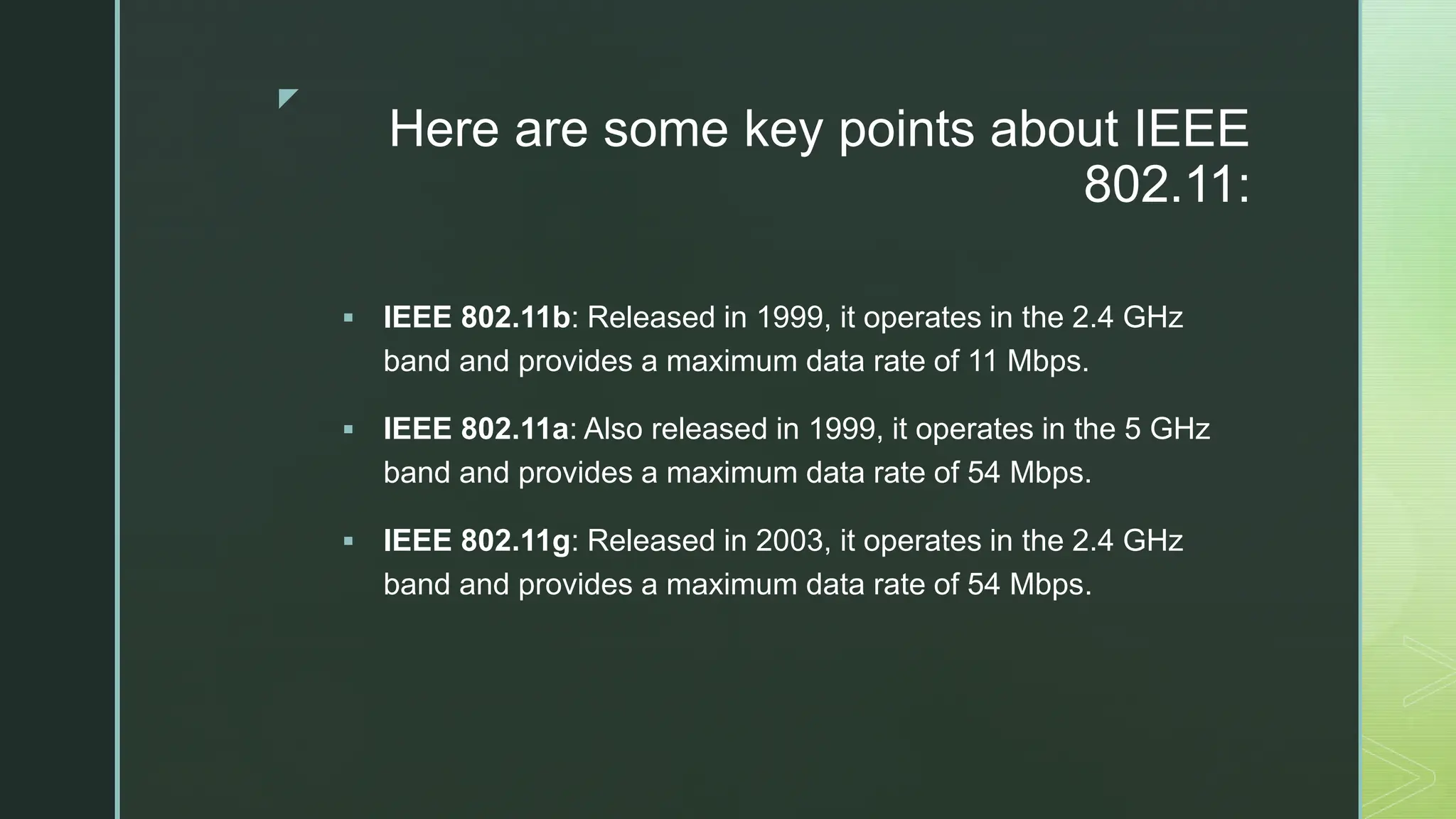
Here are some key points about IEEE
802.11:
 IEEE 802.11b: Released in 1999, it operates in the 2.4 GHz
band and provides a maximum data rate of 11 Mbps.
 IEEE 802.11a: Also released in 1999, it operates in the 5 GHz
band and provides a maximum data rate of 54 Mbps.
 IEEE 802.11g: Released in 2003, it operates in the 2.4 GHz
band and provides a maximum data rate of 54 Mbps.
z
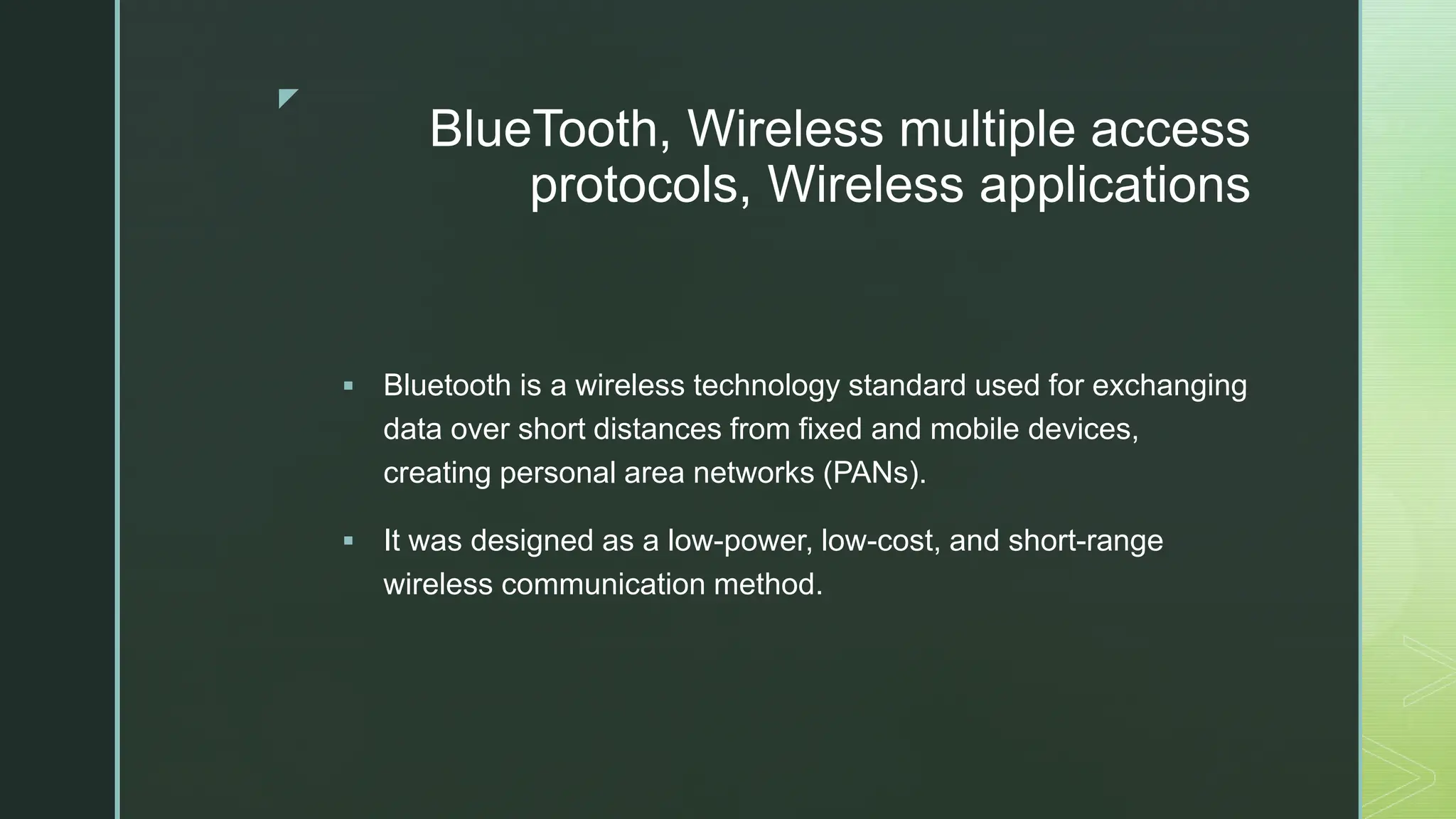
BlueTooth, Wireless multiple access
protocols, Wireless applications
 Bluetooth is a wireless technology standard used for exchanging
data over short distances from fixed and mobile devices,
creating personal area networks (PANs).
 It was designed as a low-power, low-cost, and short-range
wireless communication method.
z
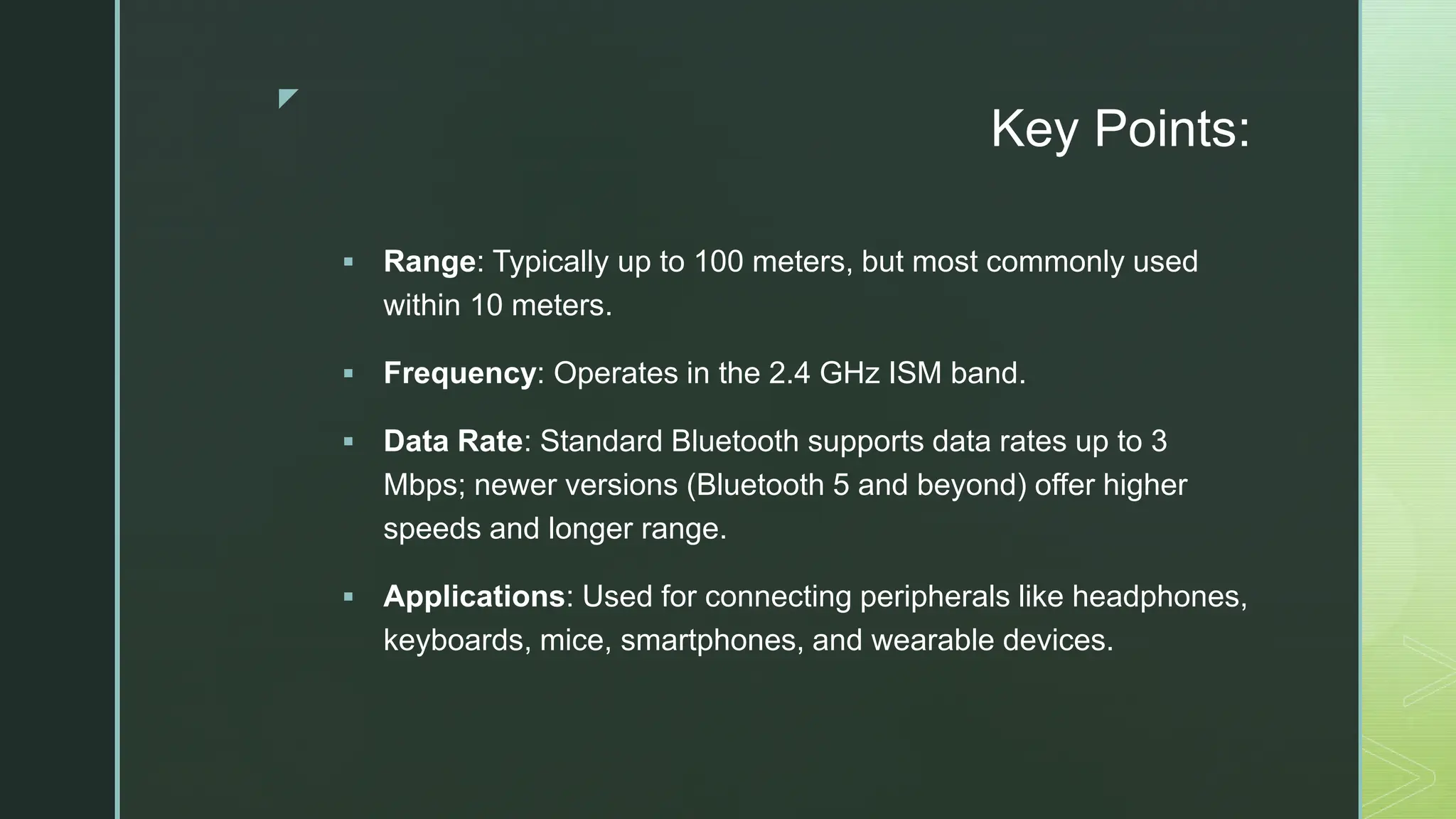
Key Points:
 Range: Typically up to 100 meters, but most commonly used
within 10 meters.
 Frequency: Operates in the 2.4 GHz ISM band.
 Data Rate: Standard Bluetooth supports data rates up to 3
Mbps; newer versions (Bluetooth 5 and beyond) offer higher
speeds and longer range.
 Applications: Used for connecting peripherals like headphones,
keyboards, mice, smartphones, and wearable devices.
z
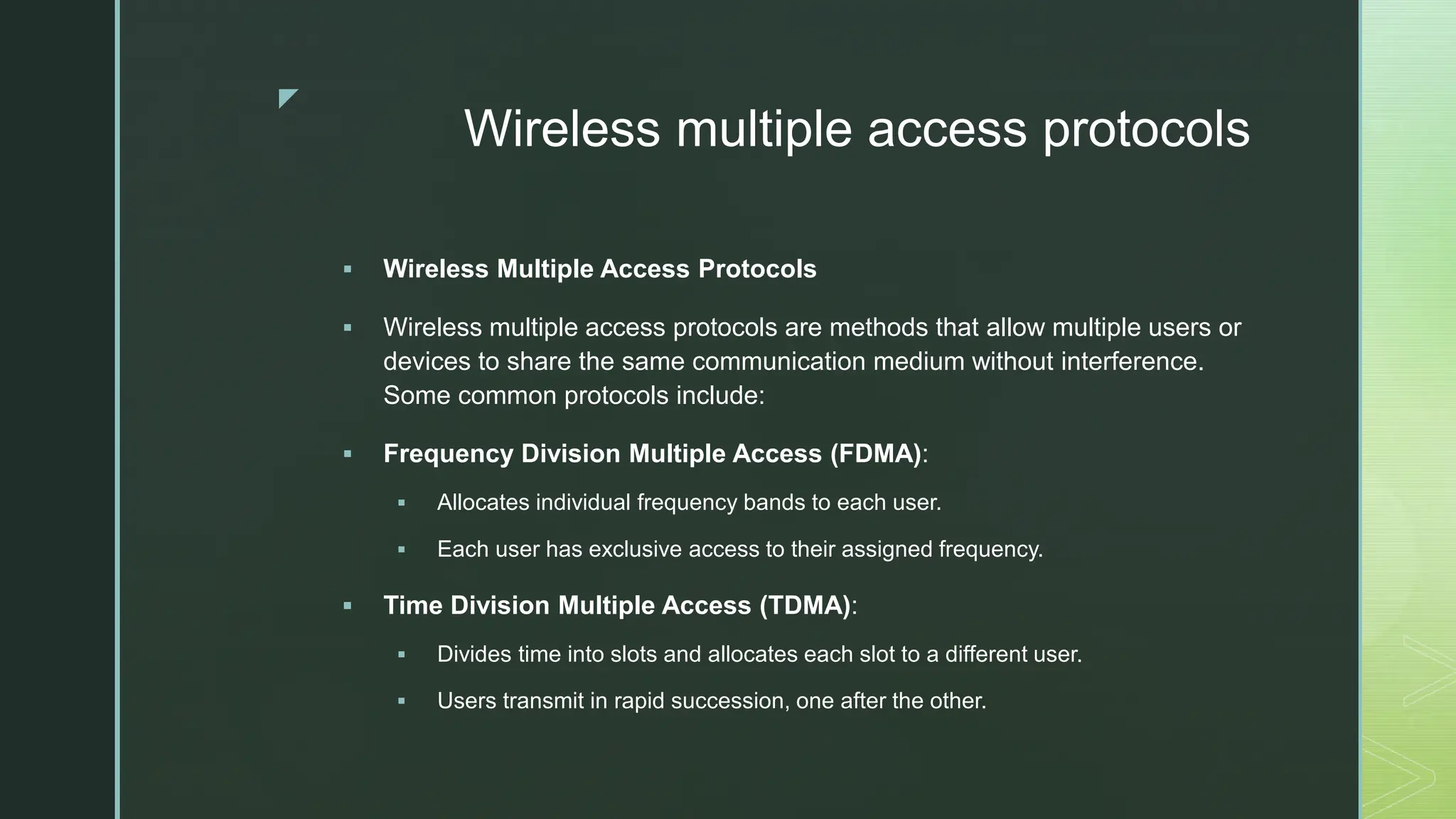
Wireless multiple access protocols
 Wireless Multiple Access Protocols
 Wireless multiple access protocols are methods that allow multiple users or
devices to share the same communication medium without interference.
Some common protocols include:
 Frequency Division Multiple Access (FDMA):
 Allocates individual frequency bands to each user.
 Each user has exclusive access to their assigned frequency.
 Time Division Multiple Access (TDMA):
 Divides time into slots and allocates each slot to a different user.
 Users transmit in rapid succession, one after the other.
z
Cont…..
 Code Division Multiple Access (CDMA):Uses unique codes to distinguish
between different users.All users share the same frequency and time but
are separated by unique spreading codes.
 Orthogonal Frequency Division Multiple Access (OFDMA):An extension
of FDMA.Divides the frequency band into multiple subcarriers and allocates
subsets of these subcarriers to different users.Used in LTE and Wi-Fi 6.
 Carrier Sense Multiple Access with Collision Avoidance (CSMA/CA):
 Used in Wi-Fi networks (IEEE 802.11).
 Devices sense the medium before transmitting and use collision avoidance
techniques to minimize data collisions.
z
Wireless Applications
 Wireless technology has numerous applications across various fields, including:
 Personal and Home Use:
 Wi-Fi: Wireless internet connectivity for devices such as laptops, smartphones, and
smart home devices.
 Bluetooth: Connecting personal devices like headphones, fitness trackers, and
smartwatches.
 Industrial and Commercial Use:
 Wireless Sensor Networks (WSNs): Monitoring and controlling industrial processes,
environmental conditions, and security systems.
 RFID (Radio Frequency Identification): Inventory management, asset tracking, and
access control.
z
Cont….
 Healthcare:
 Wearable Devices: Monitoring patient vitals, fitness tracking, and remote
health monitoring.
 Telemedicine: Remote consultations and diagnostics using wireless
communication.
 Public Services:
 Smart Cities: Integrating wireless technology for smart lighting, waste
management, and traffic control.
 Emergency Services: Wireless communication for first responders and
disaster management.
z
data broadcasting, Mobile IP-entities
and terminology
 Data broadcasting refers to the transmission of data to multiple recipients
simultaneously. It is a method used to distribute data widely and efficiently to a
large audience. Common uses of data broadcasting include television and radio
broadcasting, as well as digital data dissemination over networks.
 Key Concepts:
 Broadcast Medium: Data can be broadcast over various mediums such as
satellite, cable, terrestrial radio waves, and the internet.
 One-to-Many Communication: Unlike unicast (one-to-one) or multicast (one-to-
many but with a specific group), broadcasting sends data to all possible
receivers in the network or area.
 Applications: Digital TV, radio, software updates, news, weather alerts, financial
data, and emergency notifications.
z
Mobile IP
 Mobile IP is a protocol that allows mobile devices to move across different
networks while maintaining a permanent IP address. This enables continuous
internet connectivity without changing the IP address as the device moves.
 Entities and Terminology in Mobile IP
 Mobile Node (MN):
 A device that can change its point of attachment to the internet while maintaining
constant IP connectivity (e.g., smartphones, tablets, laptops).
 Home Agent (HA):
 A router on the home network of the mobile node.
 Maintains the current location information (care-of address) of the mobile node.
 Forwards packets to the mobile node when it is away from home.
z
Cont…..
•Foreign Agent (FA):
•A router on the visited network that provides routing services to the mobile
node when it is away from its home network.
•Assigns a care-of address to the mobile node.
 Care-of Address (CoA):
 A temporary IP address assigned to the mobile node by the foreign agent when
it is visiting a foreign network.
 Used by the home agent to forward packets to the mobile node.
•Correspondent Node (CN):
•Any device that communicates with the mobile node,
typically without knowing the mobile node's current location.
z
Terminology:
 Tunneling:
 The process by which packets are encapsulated and forwarded
from the home agent to the mobile node's care-of address.
 Ensures that the mobile node can receive data while away from its
home network.
 Binding:
 The association of the mobile node's home address with its care-of
address.
 Maintained by the home agent to forward data correctly.
z
Cont…..
•Agent Advertisement:
•Messages broadcast by home and foreign agents to advertise their presence and services.
•Mobile nodes use these advertisements to determine their location and to register with foreign agents.
•Registration:
•The process by which a mobile node informs its home agent of its care-of address.
•Ensures that the home agent can forward packets to the mobile node's current location.
z
IP Packet delivery, Agent discovery,
Registration
 IP Packet Delivery
 IP packet delivery in a Mobile IP environment involves ensuring
that packets reach a mobile node regardless of its current
location. This process includes several key steps:
 Packet Forwarding:
 When a correspondent node (CN) sends an IP packet to the mobile
node (MN), it uses the MN's home address as the destination.
 The packet is routed to the home network, where the home agent
(HA) resides.
z
Cont….
 Tunneling:
 The home agent intercepts the packet intended for the mobile
node.
 The home agent encapsulates the original packet within a new
IP packet, using the mobile node's care-of address (CoA) as the
new destination.
 This process is known as tunneling.
z
Cont….
 Decapsulation and Delivery:The encapsulated packet is routed to the
foreign agent (FA) on the foreign network where the mobile node currently
resides.The foreign agent decapsulates the packet, extracting the original
IP packet.The foreign agent then delivers the original packet to the mobile
node.
 Reverse Path:
 When the mobile node sends a packet to the correspondent node, it
typically sends it directly to the CN without involving the home agent.
 This is often referred to as triangular routing.
z
Agent Discovery
 Agent discovery is the process by which a mobile node determines
whether it is on its home network or a foreign network and
discovers the presence of home or foreign agents. This involves
two main methods:
 Agent Advertisement:
 Home and foreign agents periodically broadcast agent advertisement
messages.
 These messages are typically ICMP Router Advertisement messages
with additional Mobile IP extensions.
 The advertisement includes information about the agent, such as the
type (home or foreign), care-of address, and supported services.
z
Cont….
 Agent Solicitation:
 If a mobile node does not receive an agent advertisement within
a certain period, it can send an agent solicitation message.
 This is an ICMP Router Solicitation message with a Mobile IP
extension.
 Agents that receive this solicitation respond with an agent
advertisement, allowing the mobile node to discover available
agents.
z
Registration
 Registration is the process by which a mobile node informs its
home agent of its current care-of address. This ensures that the
home agent can correctly forward packets to the mobile node. The
registration process involves the following steps:
 Registration Request:
 The mobile node sends a registration request to the foreign agent if it
is on a foreign network.
 The foreign agent forwards this request to the home agent.
 The registration request includes the mobile node's home address,
care-of address, requested lifetime, and identification information for
authentication.
z
Cont….
 Processing the Request:
 The home agent verifies the registration request, checking the
authenticity and validity of the information.
 If the request is valid, the home agent updates its binding table
with the mobile node's new care-of address and the registration
lifetime.
z
Cont….
 Registration Reply:
 The home agent sends a registration reply back to the foreign
agent.
 The foreign agent forwards the reply to the mobile node.
 The registration reply indicates whether the registration was
successful or if there were errors.
z
Cont…..
 Re-Registration:
 The mobile node must periodically re-register with its home agent
before the registration lifetime expires.
 This ensures the home agent maintains an up-to-date binding of
the mobile node's location.
 By using these processes, Mobile IP allows a mobile node to
maintain continuous internet connectivity and communication
while moving across different networks.
z
Tunneling and encapsulation,
optimization and reverse tunneling
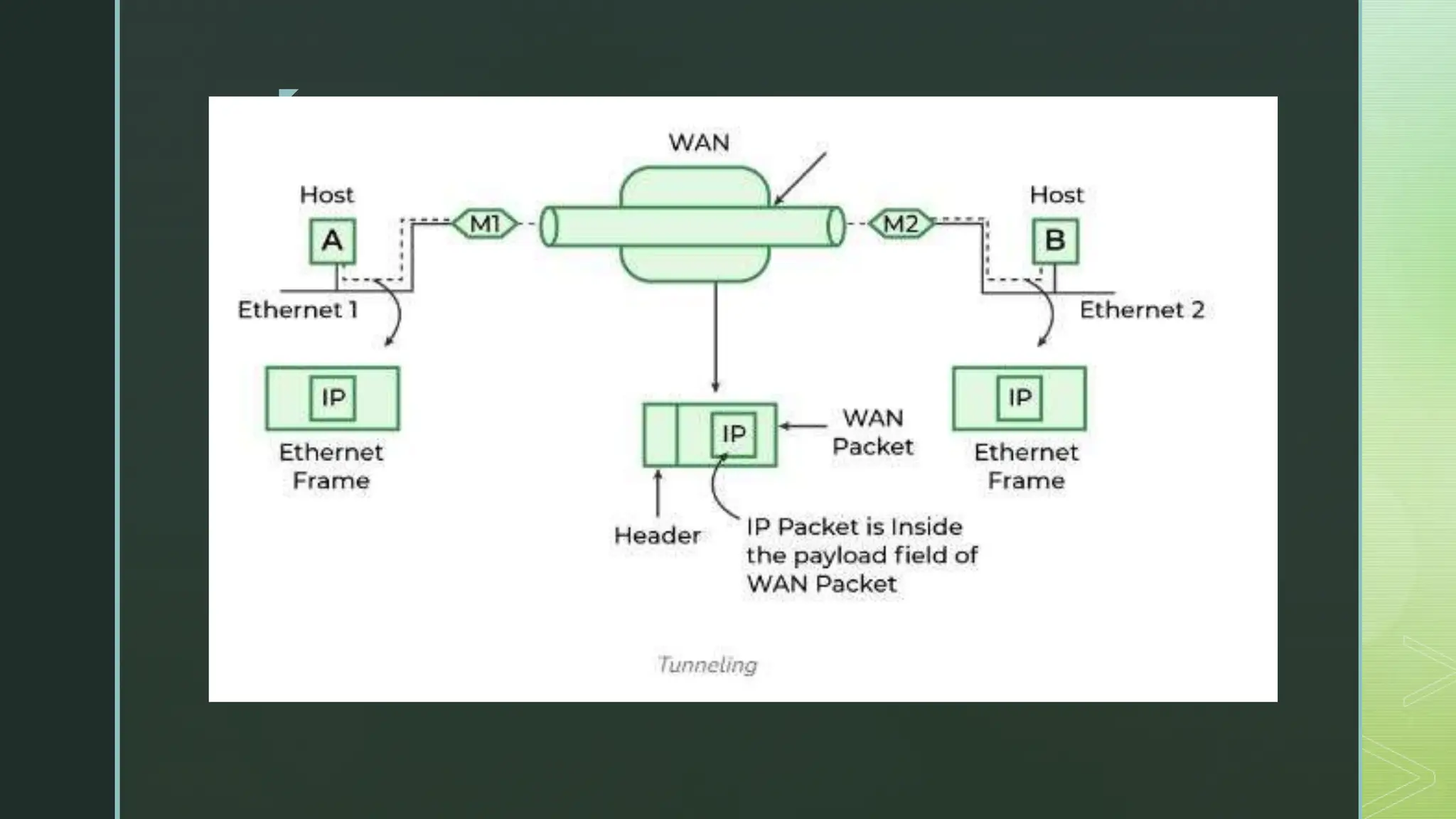
 A technique of inter-networking called Tunneling is used when
source and destination networks of the same type are to be
connected through a network of different types.
 Tunneling uses a layered protocol model such as those of the
OSI or TCP/IP protocol suite.
 So, in other words, when data moves from host A to B it covers
all the different levels of the specified protocol (OSI, TCP/IP,
etc.) while moving between different levels, data conversion
(Encapsulation) to suit different interfaces of the particular layer
is called tunneling.
z
z
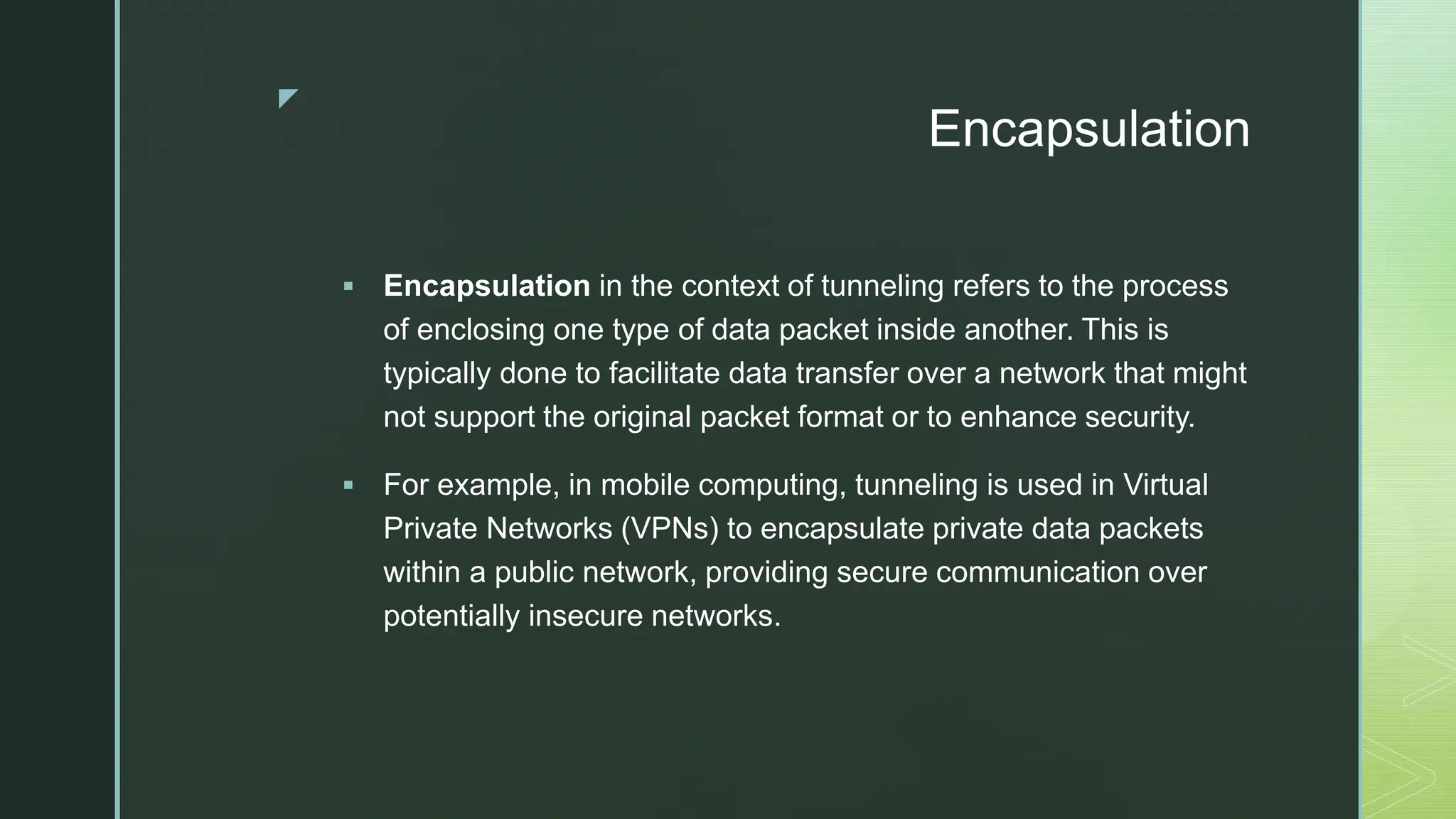
Encapsulation
 Encapsulation in the context of tunneling refers to the process
of enclosing one type of data packet inside another. This is
typically done to facilitate data transfer over a network that might
not support the original packet format or to enhance security.
 For example, in mobile computing, tunneling is used in Virtual
Private Networks (VPNs) to encapsulate private data packets
within a public network, providing secure communication over
potentially insecure networks.
z
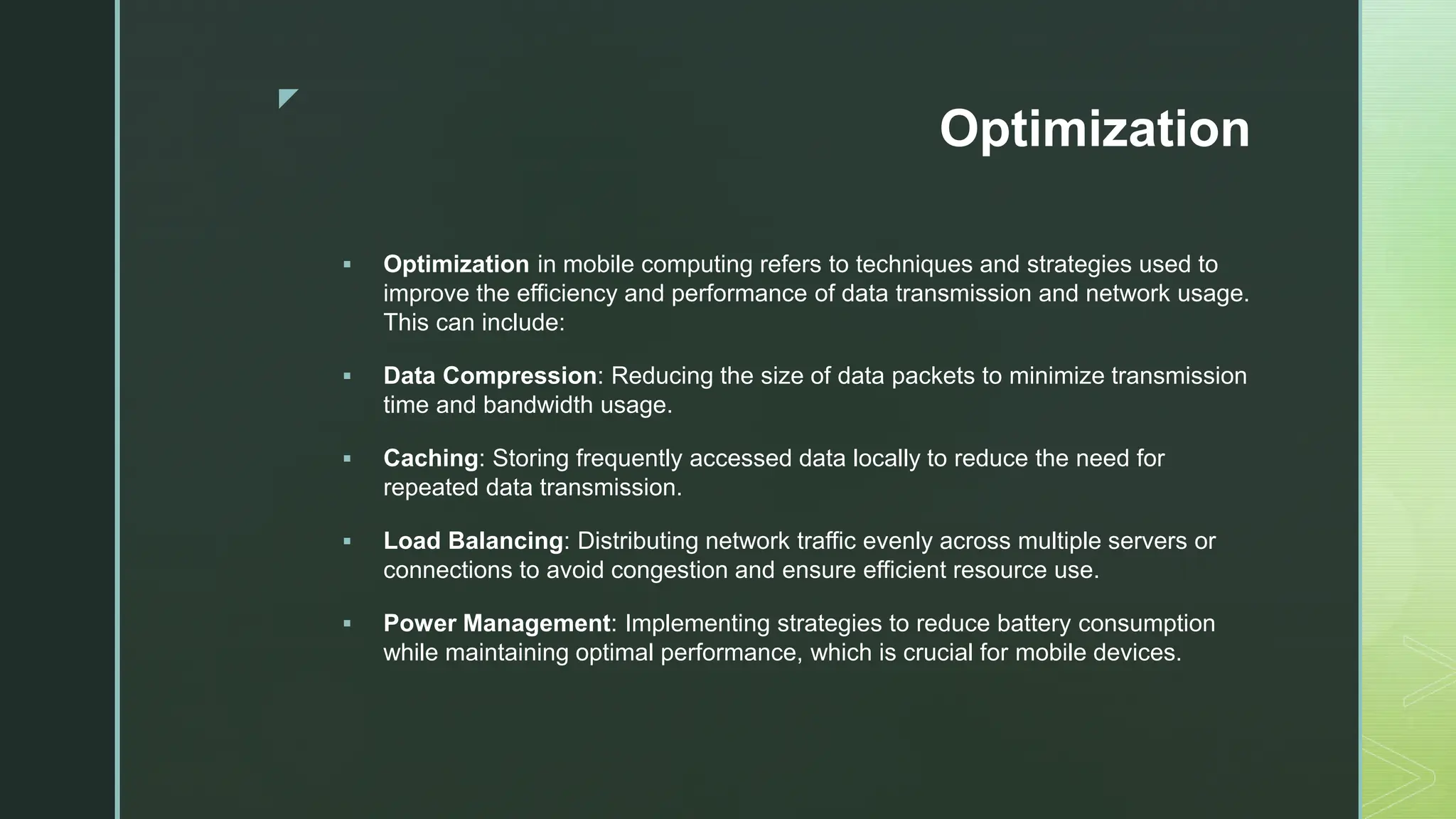
Optimization
 Optimization in mobile computing refers to techniques and strategies used to
improve the efficiency and performance of data transmission and network usage.
This can include:
 Data Compression: Reducing the size of data packets to minimize transmission
time and bandwidth usage.
 Caching: Storing frequently accessed data locally to reduce the need for
repeated data transmission.
 Load Balancing: Distributing network traffic evenly across multiple servers or
connections to avoid congestion and ensure efficient resource use.
 Power Management: Implementing strategies to reduce battery consumption
while maintaining optimal performance, which is crucial for mobile devices.
z
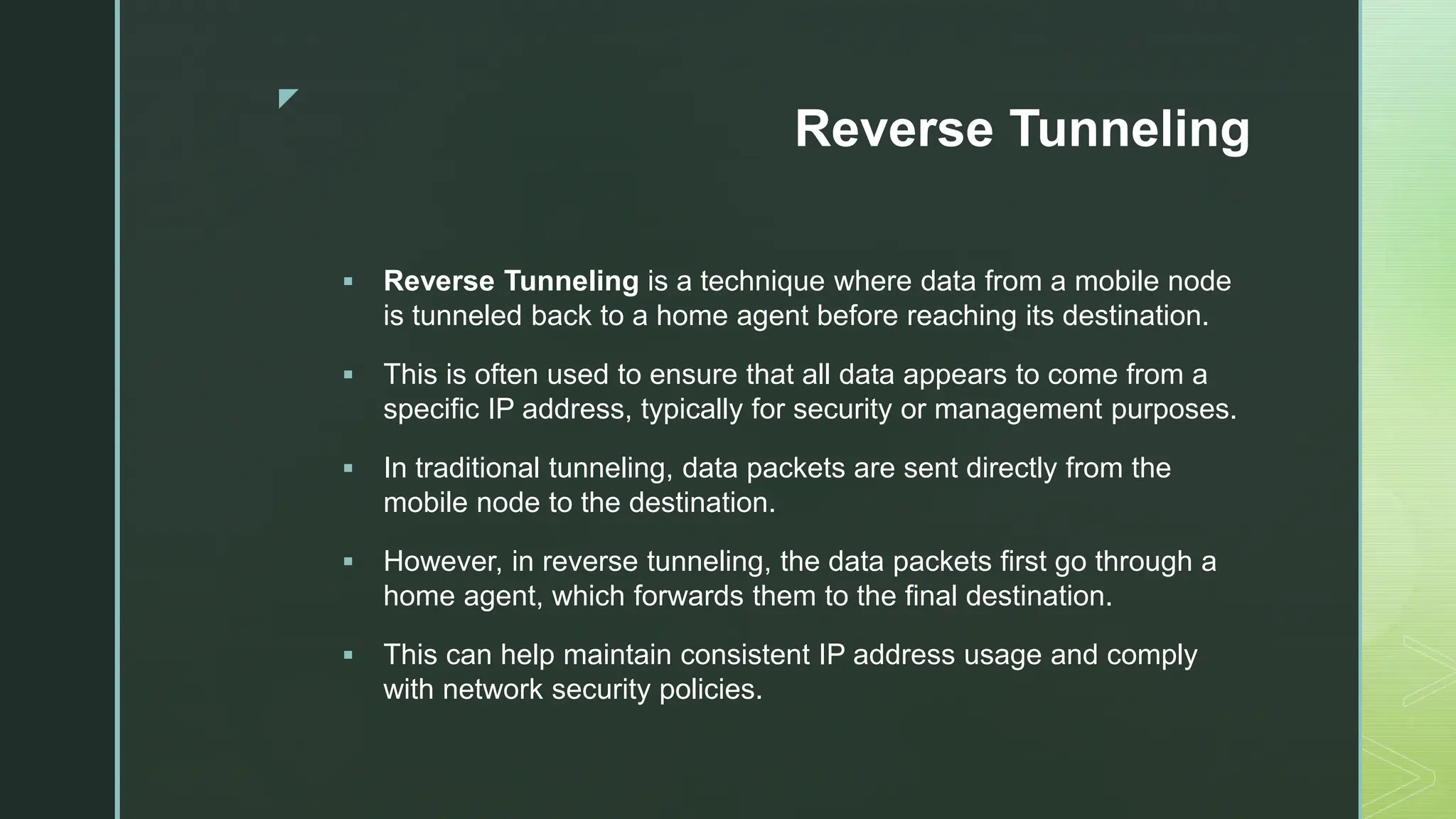
Reverse Tunneling
 Reverse Tunneling is a technique where data from a mobile node
is tunneled back to a home agent before reaching its destination.
 This is often used to ensure that all data appears to come from a
specific IP address, typically for security or management purposes.
 In traditional tunneling, data packets are sent directly from the
mobile node to the destination.
 However, in reverse tunneling, the data packets first go through a
home agent, which forwards them to the final destination.
 This can help maintain consistent IP address usage and comply
with network security policies.
z
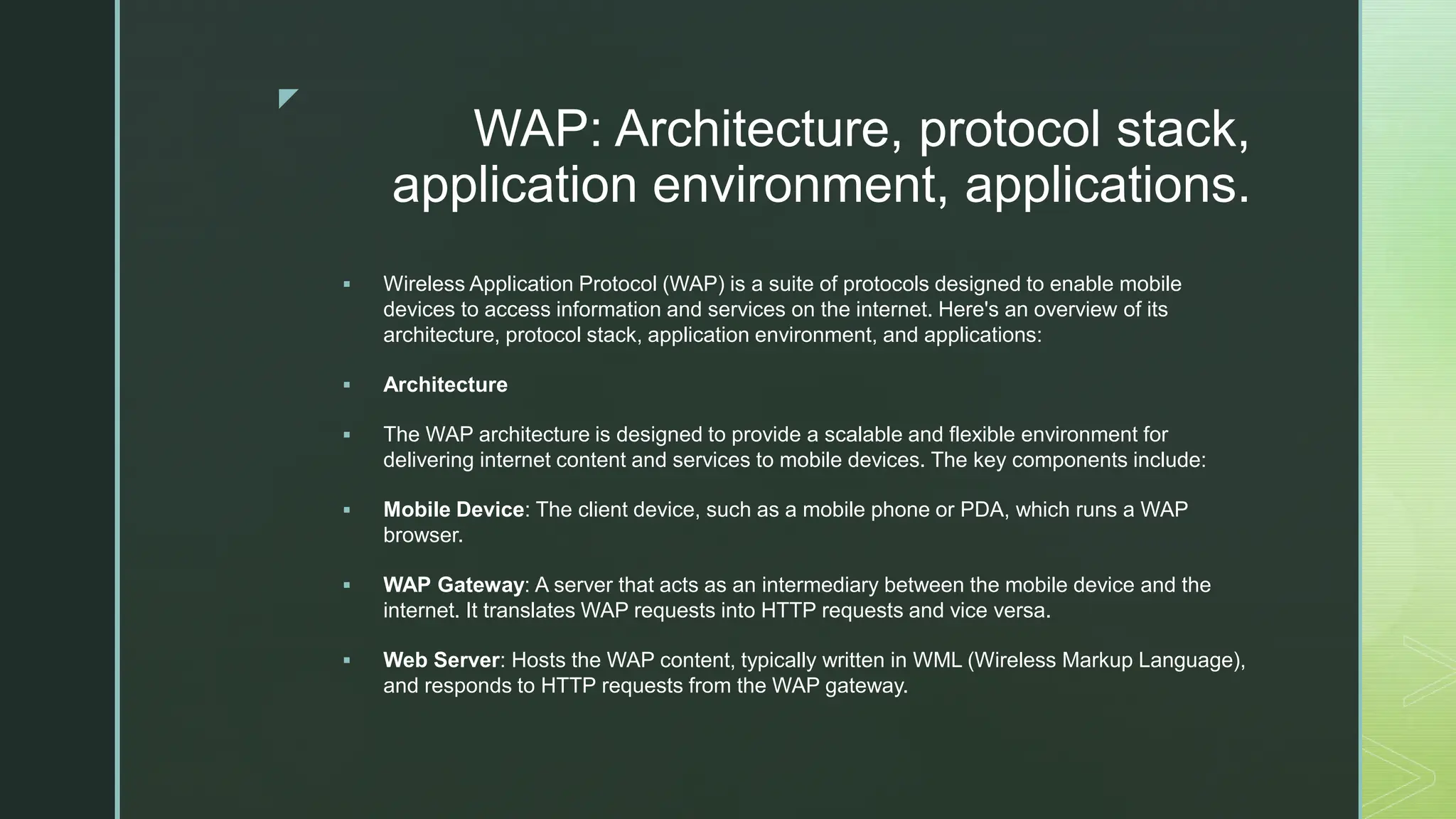
WAP: Architecture, protocol stack,
application environment, applications.
 Wireless Application Protocol (WAP) is a suite of protocols designed to enable mobile
devices to access information and services on the internet. Here's an overview of its
architecture, protocol stack, application environment, and applications:
 Architecture
 The WAP architecture is designed to provide a scalable and flexible environment for
delivering internet content and services to mobile devices. The key components include:
 Mobile Device: The client device, such as a mobile phone or PDA, which runs a WAP
browser.
 WAP Gateway: A server that acts as an intermediary between the mobile device and the
internet. It translates WAP requests into HTTP requests and vice versa.
 Web Server: Hosts the WAP content, typically written in WML (Wireless Markup Language),
and responds to HTTP requests from the WAP gateway.
z
Protocol Stack
 The WAP protocol stack is analogous to the OSI model and consists of several layers:
 Application Layer: Includes WML, WMLScript, and WTAI (Wireless Telephony Application
Interface).
 Session Layer: WSP (Wireless Session Protocol) provides session management for maintaining a
connection between the client and server.
 Transaction Layer: WTP (Wireless Transaction Protocol) ensures reliable message delivery.
 Security Layer: WTLS (Wireless Transport Layer Security) provides security features like data
integrity, privacy, and authentication.
 Transport Layer: WDP (Wireless Datagram Protocol) ensures data transport across different
wireless networks.
 Bearer Layer: Uses existing wireless network protocols (e.g., GSM, CDMA) to transmit data.
z
Application Environment
 The WAP application environment is built on WAE (Wireless
Application Environment), which provides a framework for
developing applications and content. Key components include:
 WML (Wireless Markup Language): A markup language similar to
HTML but optimized for mobile devices. It is used to create pages
that can be displayed in a WAP browser.
 WMLScript: A scripting language similar to JavaScript, used for
client-side scripting in WAP applications.
 WTA (Wireless Telephony Application): Provides APIs for
telephony services, allowing WAP applications to interact with the
mobile device's phone functionalities.
z
Applications
 WAP enables various applications and services for mobile users, including:
 Mobile Banking: Accessing banking services and performing transactions via mobile devices.
 Mobile Commerce (m-commerce): Shopping and purchasing goods and services using a mobile
device.
 Email and Messaging: Sending and receiving emails, SMS, and instant messages.
 News and Information Services: Accessing news, weather updates, stock quotes, and other
information.
 Entertainment: Downloading ringtones, wallpapers, games, and streaming music or video.
 Location-Based Services: Accessing maps, navigation, and location-specific information.
 Corporate Applications: Accessing intranet services, corporate email, and other enterprise
applications.
z
 THANK YOU 

MOBILE COMPUTING UNIT 2 by surbhi saroha

  • 1.
  • 2.
    z SYLLABUS  ISM band,Spread Spectrum, physical layer accessing techniques – FHSS, DSSS, OFDM, (IEEE 802.11a) HR-DSSS, OFDM (IEEE 802.11g)Wireless Networking, Wireless LAN  Overview: MAC issues, IEEE 802.11, BlueTooth, Wireless multiple access protocols, Wireless applications, data broadcasting, Mobile IP-entities and terminology, IP Packet delivery, Agent discovery, Registration, Tunneling and encapsulation, optimization and reverse tunneling  WAP: Architecture, protocol stack, application environment, applications.
  • 3.
    z ISM band  Inmobile computing, the ISM (Industrial, Scientific, and Medical) bands are essential for enabling various wireless communication technologies.  These bands are non-licensed spectrum bands available for use by any device or application that adheres to the regulations governing these frequencies.  The ISM bands facilitate numerous applications in mobile computing, from basic device connectivity to advanced Internet of Things (IoT) applications.
  • 4.
    z Key ISM Bands The most commonly used ISM bands in mobile computing are:  2.4 GHz Band: Ranges from 2.4 GHz to 2.5 GHz.  5 GHz Band: Includes several sub-bands, ranging from 5.15 GHz to 5.85 GHz.  900 MHz Band: Ranges from 902 MHz to 928 MHz (primarily used in North America).
  • 5.
    z Spread Spectrum  Spreadspectrum is a method used in mobile computing and wireless communications to spread the signal across a wider frequency band than the minimum bandwidth required for transmitting the information.  This technique enhances signal robustness, reduces interference, and improves security.  It is widely used in mobile communication systems, Wi-Fi, and other wireless technologies.
  • 6.
    z Advantages of SpreadSpectrum in Mobile Computing  Interference Mitigation: Spreads the signal across a wide band, reducing the impact of narrowband interference.  Security: Makes unauthorized interception and jamming more difficult.  Robustness: Enhances resistance to multipath fading, which is common in mobile environments.  Capacity: Allows multiple users to share the same frequency band with minimal interference.
  • 7.
    z Challenges in MobileComputing  Complexity: Implementation of spread spectrum techniques can be complex and require sophisticated hardware.  Bandwidth Efficiency: Spread spectrum techniques can be less bandwidth-efficient compared to some other methods.  Power Consumption: May increase power consumption, which is a critical factor for battery-operated mobile devices. In summary, spread spectrum techniques play a crucial role in enhancing the performance, reliability, and security of wireless communications in mobile computing. By spreading the signal across a wider frequency range, these techniques help mitigate interference, improve robustness, and enable efficient use of the spectrum in various applications, from Wi-Fi and Bluetooth to cellular networks and GPS.
  • 8.
    z Physical layer accessingtechniques – FHSS, DSSS, OFDM  Accessing techniques in the physical layer are methods used to manage how multiple users share the available spectrum. Here are the details of three key techniques:  Frequency Hopping Spread Spectrum (FHSS)  Principle:  FHSS works by rapidly switching the carrier frequency among many frequency channels.  This hopping sequence is known to both the transmitter and the receiver.
  • 9.
    z Frequency Hopping SpreadSpectrum (FHSS)  Advantages:  Resistant to narrowband interference.  Provides security through frequency hopping.  Disadvantages:  Complex synchronization between transmitter and receiver.  Less bandwidth efficient compared to other methods.
  • 10.
    z Direct Sequence SpreadSpectrum (DSSS)  Principle:  DSSS spreads the signal over a wider frequency band than the minimum required.  The signal is multiplied by a pseudo-random noise code which has a higher bit rate than the data being transmitted.  The receiver uses the same pseudo-random noise code to demodulate the signal.  Advantages:  Resistant to narrowband interference and multipath fading.  Provides some level of security since the pseudo-random code is known only to the transmitter and receiver.
  • 11.
    z Disadvantages:  Requires morebandwidth than non-spread-spectrum techniques.  Complexity in generating and synchronizing the pseudo-random code.
  • 12.
    z Orthogonal Frequency Division Multiplexing(OFDM)  Principle:  OFDM divides the available spectrum into multiple orthogonal sub- carriers.  Data is transmitted in parallel on these sub-carriers.  Advantages:  Highly efficient in terms of bandwidth.  Robust against multipath fading and interference.  Simplifies equalization since it transforms a frequency-selective channel into multiple flat-fading sub-channels.
  • 13.
    z Disadvantages:  Sensitive tofrequency offset and phase noise.  Requires complex synchronization and channel estimation techniques.  High Peak-to-Average Power Ratio (PAPR) can reduce power efficiency.
  • 14.
    z Comparison and Applications FHSS:  Common in Bluetooth technology and some military communications due to its resilience against interference and eavesdropping.
  • 15.
    z DSSS  Used inWi-Fi (802.11b) and CDMA (Code Division Multiple Access) mobile communications due to its robustness against interference and ability to support multiple users.
  • 16.
    z OFDM  Widely usedin modern wireless communication systems, such as Wi-Fi (802.11a/g/n/ac), LTE (Long-Term Evolution), and digital television broadcasting (DVB-T) due to its spectral efficiency and robustness against multipath effects.  These techniques play crucial roles in enhancing the performance, reliability, and security of communication systems at the physical layer.
  • 17.
    z (IEEE 802.11a) HR-DSSS,OFDM (IEEE 802.11g)Wireless Networking, Wireless LAN  IEEE 802.11 standards specify the set of protocols for implementing wireless local area network (WLAN) communications. Here's a detailed look at the relevant standards and technologies:  IEEE 802.11a  Frequency Band: Operates in the 5 GHz band.  Modulation: Uses Orthogonal Frequency Division Multiplexing (OFDM).  Data Rates: Supports data rates up to 54 Mbps.  Channels: More non-overlapping channels compared to 2.4 GHz band, reducing interference.  Range: Generally has a shorter range compared to 2.4 GHz standards due to higher frequency.
  • 18.
    z IEEE 802.11b  FrequencyBand: Operates in the 2.4 GHz band.  Modulation: Uses High Rate Direct Sequence Spread Spectrum (HR-DSSS).  Data Rates: Supports data rates up to 11 Mbps.  Channels: Limited number of non-overlapping channels, leading to potential interference in crowded environments.  Range: Typically better range compared to 5 GHz band due to lower frequency.
  • 19.
    z IEEE 802.11g  FrequencyBand: Operates in the 2.4 GHz band.  Modulation: Supports both HR-DSSS (for backward compatibility with 802.11b) and OFDM (like 802.11a).  Data Rates: Supports data rates up to 54 Mbps.  Channels: Same limitations as 802.11b regarding the number of non-overlapping channels.  Range: Similar range to 802.11b but with higher data rates due to OFDM.
  • 20.
    z Wireless Networking  Wirelessnetworking allows devices to communicate and share data without physical connections, using radio waves to transmit and receive data over the air. Key components of wireless networking include:  Access Points (APs): Devices that allow wireless devices to connect to a wired network.  Wireless Clients: Devices like laptops, smartphones, and tablets that connect to the network via Wi-Fi.  Security Protocols: Measures to secure the wireless network, including WEP, WPA, and WPA2.  Roaming: The ability for a wireless client to move between APs without losing connection.
  • 21.
    z Wireless LAN (WLAN) Wireless LANs are networks that connect devices over short distances using wireless communication. Key features and benefits include:  Mobility: Allows users to move around within the network area while maintaining a network connection.  Ease of Installation: No need for physical cables, making installation and reconfiguration easier.  Scalability: Easy to expand the network by adding more APs and clients.  Flexibility: Supports a variety of devices and can be set up in different environments (e.g., offices, homes, public spaces).
  • 22.
    z Overview: MAC issues The Medium Access Control (MAC) layer is a crucial component of the Data Link Layer in the OSI model, responsible for controlling how devices in a network gain access to the medium and permission to transmit data.  There are several key issues and considerations related to the MAC layer in wireless networking:  1. Collision Avoidance and Detection  Issue:  In wireless networks, multiple devices may attempt to transmit data simultaneously, leading to collisions.
  • 23.
    z Techniques:  Carrier SenseMultiple Access with Collision Avoidance (CSMA/CA): Used in IEEE 802.11 (Wi-Fi) networks, this technique requires devices to sense the medium before transmitting and to back off for a random period if the medium is busy.  Request to Send / Clear to Send (RTS/CTS): A handshake protocol to further reduce collisions, especially in environments with hidden nodes.
  • 24.
    z 2. Hidden NodeProblem  Issue:  Occurs when two devices cannot sense each other’s transmission because they are out of range, leading to potential collisions at the receiver.  Solution:  RTS/CTS: Helps mitigate this by reserving the medium before the actual data transmission.
  • 25.
    z 3. Exposed NodeProblem  Issue:  Happens when a device refrains from transmitting to avoid a collision with another device that is transmitting to a different receiver, even though it could have transmitted successfully.  Solution:  Adjusting transmission power and using directional antennas can help, but it remains a challenging problem without a perfect solution.
  • 26.
    z 4. Throughput Efficiency Issue:  Efficiency is affected by overhead from control frames, acknowledgments, and collision management mechanisms.  Optimization:  Frame Aggregation: Combining multiple frames into one transmission to reduce overhead.  Block Acknowledgment: Acknowledging multiple frames with a single acknowledgment frame to improve efficiency.
  • 27.
    z 5. Quality ofService (QoS)  Issue:  Ensuring timely delivery of data, especially for applications requiring low latency and high reliability (e.g., VoIP, video streaming).  Mechanisms:  Traffic Prioritization: Differentiating between types of traffic and giving higher priority to time-sensitive data.  Enhanced Distributed Channel Access (EDCA): A QoS mechanism in IEEE 802.11e that provides differentiated access to the medium based on traffic categories.
  • 28.
    z 6. Power Management Issue:  Devices, especially battery-powered ones, need to manage their power consumption to extend battery life.  Techniques:  Power Save Mode: Devices can enter low power states when not actively transmitting or receiving.  Adaptive Power Control: Dynamically adjusting transmission power based on the distance to the receiver and current network conditions.
  • 29.
    z 7. Security  Issue: Protecting data from unauthorized access and ensuring integrity and confidentiality in wireless transmissions.  Solutions:  Encryption: Using protocols like WPA2/WPA3 to encrypt data.  Authentication: Ensuring only authorized devices can join the network.
  • 30.
    z 8. Mobility Management Issue:  Managing device movement within the network, maintaining connections as devices move between different APs.  Techniques:  Handoff/ Roaming: Seamlessly transferring a connection from one AP to another.  Fast Transition (FT): An IEEE 802.11r feature that reduces handoff times for mobile clients.
  • 31.
    z 9. Scalability  Issue: Ensuring the network can handle a large number of devices and high traffic volumes without performance degradation.  Approaches:  Load Balancing: Distributing the load evenly across multiple APs.  Channel Management: Dynamically adjusting channel assignments to minimize interference and optimize performance.
  • 32.
    z IEEE 802.11  IEEE802.11 refers to a set of standards developed by the Institute of Electrical and Electronics Engineers (IEEE) for wireless local area networks (WLANs).  These standards define the protocols for implementing wireless networking communication in various frequencies, including 2.4 GHz, 5 GHz, and 6 GHz bands.  The most well-known of these standards is Wi-Fi, which allows devices to connect to the internet wirelessly.
  • 33.
    z Here are somekey points about IEEE 802.11:  IEEE 802.11b: Released in 1999, it operates in the 2.4 GHz band and provides a maximum data rate of 11 Mbps.  IEEE 802.11a: Also released in 1999, it operates in the 5 GHz band and provides a maximum data rate of 54 Mbps.  IEEE 802.11g: Released in 2003, it operates in the 2.4 GHz band and provides a maximum data rate of 54 Mbps.
  • 34.
    z BlueTooth, Wireless multipleaccess protocols, Wireless applications  Bluetooth is a wireless technology standard used for exchanging data over short distances from fixed and mobile devices, creating personal area networks (PANs).  It was designed as a low-power, low-cost, and short-range wireless communication method.
  • 35.
    z Key Points:  Range:Typically up to 100 meters, but most commonly used within 10 meters.  Frequency: Operates in the 2.4 GHz ISM band.  Data Rate: Standard Bluetooth supports data rates up to 3 Mbps; newer versions (Bluetooth 5 and beyond) offer higher speeds and longer range.  Applications: Used for connecting peripherals like headphones, keyboards, mice, smartphones, and wearable devices.
  • 36.
    z Wireless multiple accessprotocols  Wireless Multiple Access Protocols  Wireless multiple access protocols are methods that allow multiple users or devices to share the same communication medium without interference. Some common protocols include:  Frequency Division Multiple Access (FDMA):  Allocates individual frequency bands to each user.  Each user has exclusive access to their assigned frequency.  Time Division Multiple Access (TDMA):  Divides time into slots and allocates each slot to a different user.  Users transmit in rapid succession, one after the other.
  • 37.
    z Cont…..  Code DivisionMultiple Access (CDMA):Uses unique codes to distinguish between different users.All users share the same frequency and time but are separated by unique spreading codes.  Orthogonal Frequency Division Multiple Access (OFDMA):An extension of FDMA.Divides the frequency band into multiple subcarriers and allocates subsets of these subcarriers to different users.Used in LTE and Wi-Fi 6.  Carrier Sense Multiple Access with Collision Avoidance (CSMA/CA):  Used in Wi-Fi networks (IEEE 802.11).  Devices sense the medium before transmitting and use collision avoidance techniques to minimize data collisions.
  • 38.
    z Wireless Applications  Wirelesstechnology has numerous applications across various fields, including:  Personal and Home Use:  Wi-Fi: Wireless internet connectivity for devices such as laptops, smartphones, and smart home devices.  Bluetooth: Connecting personal devices like headphones, fitness trackers, and smartwatches.  Industrial and Commercial Use:  Wireless Sensor Networks (WSNs): Monitoring and controlling industrial processes, environmental conditions, and security systems.  RFID (Radio Frequency Identification): Inventory management, asset tracking, and access control.
  • 39.
    z Cont….  Healthcare:  WearableDevices: Monitoring patient vitals, fitness tracking, and remote health monitoring.  Telemedicine: Remote consultations and diagnostics using wireless communication.  Public Services:  Smart Cities: Integrating wireless technology for smart lighting, waste management, and traffic control.  Emergency Services: Wireless communication for first responders and disaster management.
  • 40.
    z data broadcasting, MobileIP-entities and terminology  Data broadcasting refers to the transmission of data to multiple recipients simultaneously. It is a method used to distribute data widely and efficiently to a large audience. Common uses of data broadcasting include television and radio broadcasting, as well as digital data dissemination over networks.  Key Concepts:  Broadcast Medium: Data can be broadcast over various mediums such as satellite, cable, terrestrial radio waves, and the internet.  One-to-Many Communication: Unlike unicast (one-to-one) or multicast (one-to- many but with a specific group), broadcasting sends data to all possible receivers in the network or area.  Applications: Digital TV, radio, software updates, news, weather alerts, financial data, and emergency notifications.
  • 41.
    z Mobile IP  MobileIP is a protocol that allows mobile devices to move across different networks while maintaining a permanent IP address. This enables continuous internet connectivity without changing the IP address as the device moves.  Entities and Terminology in Mobile IP  Mobile Node (MN):  A device that can change its point of attachment to the internet while maintaining constant IP connectivity (e.g., smartphones, tablets, laptops).  Home Agent (HA):  A router on the home network of the mobile node.  Maintains the current location information (care-of address) of the mobile node.  Forwards packets to the mobile node when it is away from home.
  • 42.
    z Cont….. •Foreign Agent (FA): •Arouter on the visited network that provides routing services to the mobile node when it is away from its home network. •Assigns a care-of address to the mobile node.  Care-of Address (CoA):  A temporary IP address assigned to the mobile node by the foreign agent when it is visiting a foreign network.  Used by the home agent to forward packets to the mobile node. •Correspondent Node (CN): •Any device that communicates with the mobile node, typically without knowing the mobile node's current location.
  • 43.
    z Terminology:  Tunneling:  Theprocess by which packets are encapsulated and forwarded from the home agent to the mobile node's care-of address.  Ensures that the mobile node can receive data while away from its home network.  Binding:  The association of the mobile node's home address with its care-of address.  Maintained by the home agent to forward data correctly.
  • 44.
    z Cont….. •Agent Advertisement: •Messages broadcastby home and foreign agents to advertise their presence and services. •Mobile nodes use these advertisements to determine their location and to register with foreign agents. •Registration: •The process by which a mobile node informs its home agent of its care-of address. •Ensures that the home agent can forward packets to the mobile node's current location.
  • 45.
    z IP Packet delivery,Agent discovery, Registration  IP Packet Delivery  IP packet delivery in a Mobile IP environment involves ensuring that packets reach a mobile node regardless of its current location. This process includes several key steps:  Packet Forwarding:  When a correspondent node (CN) sends an IP packet to the mobile node (MN), it uses the MN's home address as the destination.  The packet is routed to the home network, where the home agent (HA) resides.
  • 46.
    z Cont….  Tunneling:  Thehome agent intercepts the packet intended for the mobile node.  The home agent encapsulates the original packet within a new IP packet, using the mobile node's care-of address (CoA) as the new destination.  This process is known as tunneling.
  • 47.
    z Cont….  Decapsulation andDelivery:The encapsulated packet is routed to the foreign agent (FA) on the foreign network where the mobile node currently resides.The foreign agent decapsulates the packet, extracting the original IP packet.The foreign agent then delivers the original packet to the mobile node.  Reverse Path:  When the mobile node sends a packet to the correspondent node, it typically sends it directly to the CN without involving the home agent.  This is often referred to as triangular routing.
  • 48.
    z Agent Discovery  Agentdiscovery is the process by which a mobile node determines whether it is on its home network or a foreign network and discovers the presence of home or foreign agents. This involves two main methods:  Agent Advertisement:  Home and foreign agents periodically broadcast agent advertisement messages.  These messages are typically ICMP Router Advertisement messages with additional Mobile IP extensions.  The advertisement includes information about the agent, such as the type (home or foreign), care-of address, and supported services.
  • 49.
    z Cont….  Agent Solicitation: If a mobile node does not receive an agent advertisement within a certain period, it can send an agent solicitation message.  This is an ICMP Router Solicitation message with a Mobile IP extension.  Agents that receive this solicitation respond with an agent advertisement, allowing the mobile node to discover available agents.
  • 50.
    z Registration  Registration isthe process by which a mobile node informs its home agent of its current care-of address. This ensures that the home agent can correctly forward packets to the mobile node. The registration process involves the following steps:  Registration Request:  The mobile node sends a registration request to the foreign agent if it is on a foreign network.  The foreign agent forwards this request to the home agent.  The registration request includes the mobile node's home address, care-of address, requested lifetime, and identification information for authentication.
  • 51.
    z Cont….  Processing theRequest:  The home agent verifies the registration request, checking the authenticity and validity of the information.  If the request is valid, the home agent updates its binding table with the mobile node's new care-of address and the registration lifetime.
  • 52.
    z Cont….  Registration Reply: The home agent sends a registration reply back to the foreign agent.  The foreign agent forwards the reply to the mobile node.  The registration reply indicates whether the registration was successful or if there were errors.
  • 53.
    z Cont…..  Re-Registration:  Themobile node must periodically re-register with its home agent before the registration lifetime expires.  This ensures the home agent maintains an up-to-date binding of the mobile node's location.  By using these processes, Mobile IP allows a mobile node to maintain continuous internet connectivity and communication while moving across different networks.
  • 54.
    z Tunneling and encapsulation, optimizationand reverse tunneling  A technique of inter-networking called Tunneling is used when source and destination networks of the same type are to be connected through a network of different types.  Tunneling uses a layered protocol model such as those of the OSI or TCP/IP protocol suite.  So, in other words, when data moves from host A to B it covers all the different levels of the specified protocol (OSI, TCP/IP, etc.) while moving between different levels, data conversion (Encapsulation) to suit different interfaces of the particular layer is called tunneling.
  • 55.
  • 56.
    z Encapsulation  Encapsulation inthe context of tunneling refers to the process of enclosing one type of data packet inside another. This is typically done to facilitate data transfer over a network that might not support the original packet format or to enhance security.  For example, in mobile computing, tunneling is used in Virtual Private Networks (VPNs) to encapsulate private data packets within a public network, providing secure communication over potentially insecure networks.
  • 57.
    z Optimization  Optimization inmobile computing refers to techniques and strategies used to improve the efficiency and performance of data transmission and network usage. This can include:  Data Compression: Reducing the size of data packets to minimize transmission time and bandwidth usage.  Caching: Storing frequently accessed data locally to reduce the need for repeated data transmission.  Load Balancing: Distributing network traffic evenly across multiple servers or connections to avoid congestion and ensure efficient resource use.  Power Management: Implementing strategies to reduce battery consumption while maintaining optimal performance, which is crucial for mobile devices.
  • 58.
    z Reverse Tunneling  ReverseTunneling is a technique where data from a mobile node is tunneled back to a home agent before reaching its destination.  This is often used to ensure that all data appears to come from a specific IP address, typically for security or management purposes.  In traditional tunneling, data packets are sent directly from the mobile node to the destination.  However, in reverse tunneling, the data packets first go through a home agent, which forwards them to the final destination.  This can help maintain consistent IP address usage and comply with network security policies.
  • 59.
    z WAP: Architecture, protocolstack, application environment, applications.  Wireless Application Protocol (WAP) is a suite of protocols designed to enable mobile devices to access information and services on the internet. Here's an overview of its architecture, protocol stack, application environment, and applications:  Architecture  The WAP architecture is designed to provide a scalable and flexible environment for delivering internet content and services to mobile devices. The key components include:  Mobile Device: The client device, such as a mobile phone or PDA, which runs a WAP browser.  WAP Gateway: A server that acts as an intermediary between the mobile device and the internet. It translates WAP requests into HTTP requests and vice versa.  Web Server: Hosts the WAP content, typically written in WML (Wireless Markup Language), and responds to HTTP requests from the WAP gateway.
  • 60.
    z Protocol Stack  TheWAP protocol stack is analogous to the OSI model and consists of several layers:  Application Layer: Includes WML, WMLScript, and WTAI (Wireless Telephony Application Interface).  Session Layer: WSP (Wireless Session Protocol) provides session management for maintaining a connection between the client and server.  Transaction Layer: WTP (Wireless Transaction Protocol) ensures reliable message delivery.  Security Layer: WTLS (Wireless Transport Layer Security) provides security features like data integrity, privacy, and authentication.  Transport Layer: WDP (Wireless Datagram Protocol) ensures data transport across different wireless networks.  Bearer Layer: Uses existing wireless network protocols (e.g., GSM, CDMA) to transmit data.
  • 61.
    z Application Environment  TheWAP application environment is built on WAE (Wireless Application Environment), which provides a framework for developing applications and content. Key components include:  WML (Wireless Markup Language): A markup language similar to HTML but optimized for mobile devices. It is used to create pages that can be displayed in a WAP browser.  WMLScript: A scripting language similar to JavaScript, used for client-side scripting in WAP applications.  WTA (Wireless Telephony Application): Provides APIs for telephony services, allowing WAP applications to interact with the mobile device's phone functionalities.
  • 62.
    z Applications  WAP enablesvarious applications and services for mobile users, including:  Mobile Banking: Accessing banking services and performing transactions via mobile devices.  Mobile Commerce (m-commerce): Shopping and purchasing goods and services using a mobile device.  Email and Messaging: Sending and receiving emails, SMS, and instant messages.  News and Information Services: Accessing news, weather updates, stock quotes, and other information.  Entertainment: Downloading ringtones, wallpapers, games, and streaming music or video.  Location-Based Services: Accessing maps, navigation, and location-specific information.  Corporate Applications: Accessing intranet services, corporate email, and other enterprise applications.
  • 63.