Course: BSC CS
Subject: Data Structure
Unit-3
Tree and Graph
NONLINEAR DATA STRUCTURE
 2 primary types:
• Trees
• Graphs
• All trees are graphs, but not all graphs are trees
• Recursion is useful and is the easiest way to process
them.
• It helps keep track of what's been processed and what
remains
Graphs
•Graphs can have multiple references in and multiple references out
(whereas tree node only has one reference in)
•Graphs can be directed or undirected and cyclic or acyclic
Trees
• Single parent
• 0 or more children
• A node with no children is called a "leaf"
• The topmost node is called the "root"
• N-ary trees
• Binary trees
N-ary Trees
 The best example of an n-ary tree is your computer’s
directory system.
 It has a single starting point and then 0 or more
branches.
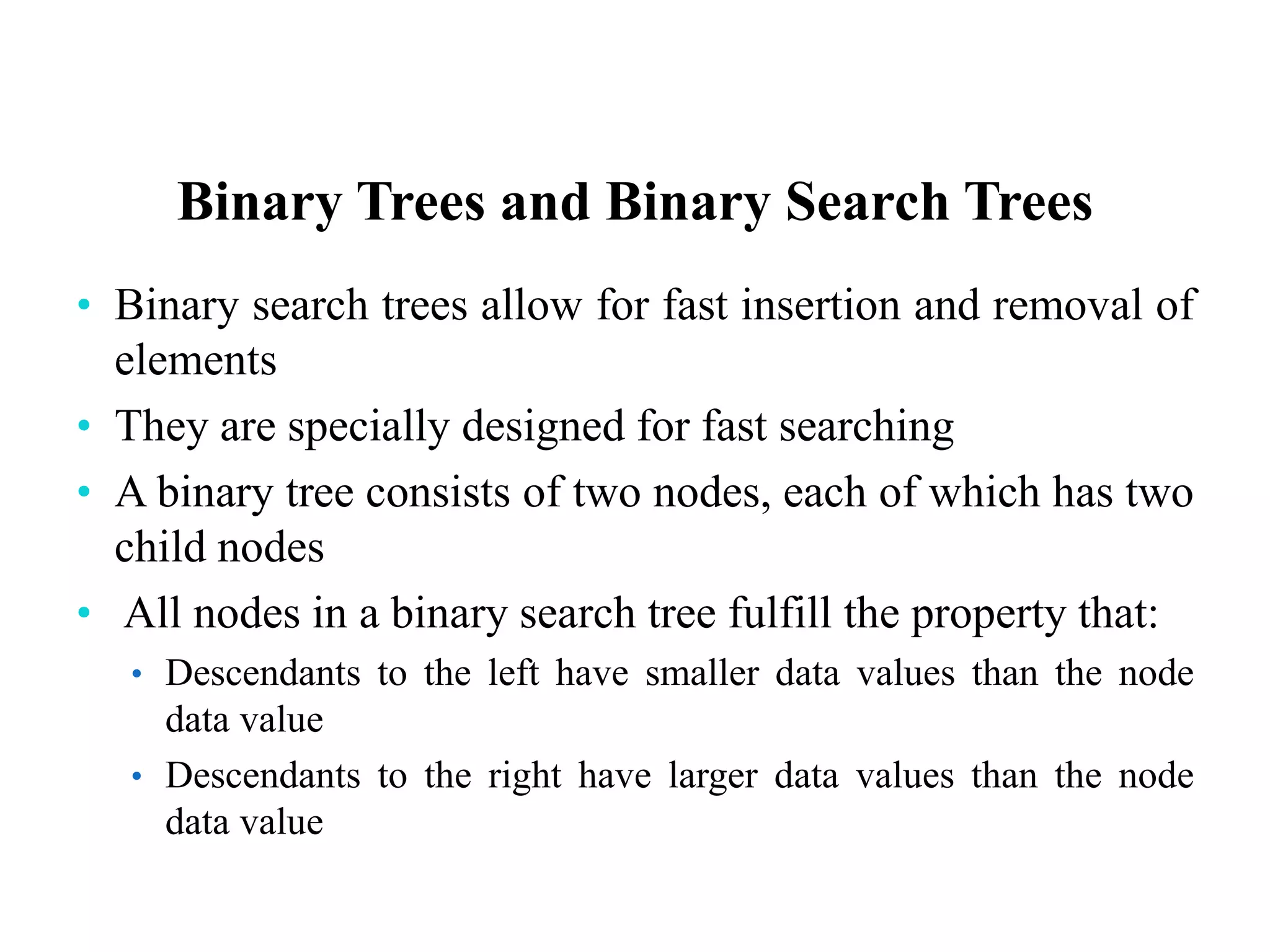
Binary Trees and Binary Search Trees
• Binary search trees allow for fast insertion and removal of
elements
• They are specially designed for fast searching
• A binary tree consists of two nodes, each of which has two
child nodes
• All nodes in a binary search tree fulfill the property that:
• Descendants to the left have smaller data values than the node
data value
• Descendants to the right have larger data values than the node
data value
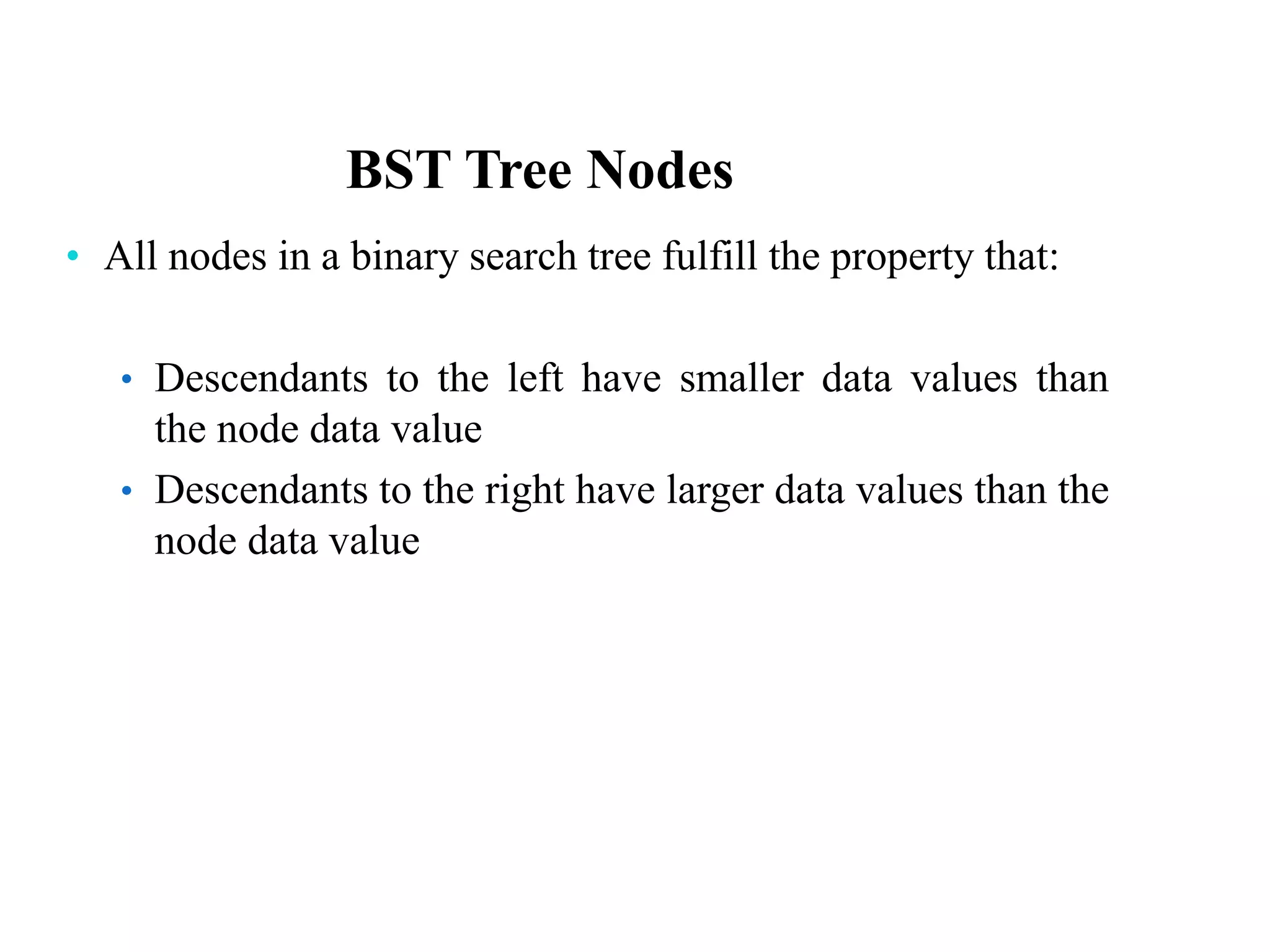
BST Tree Nodes
• All nodes in a binary search tree fulfill the property that:
• Descendants to the left have smaller data values than
the node data value
• Descendants to the right have larger data values than the
node data value
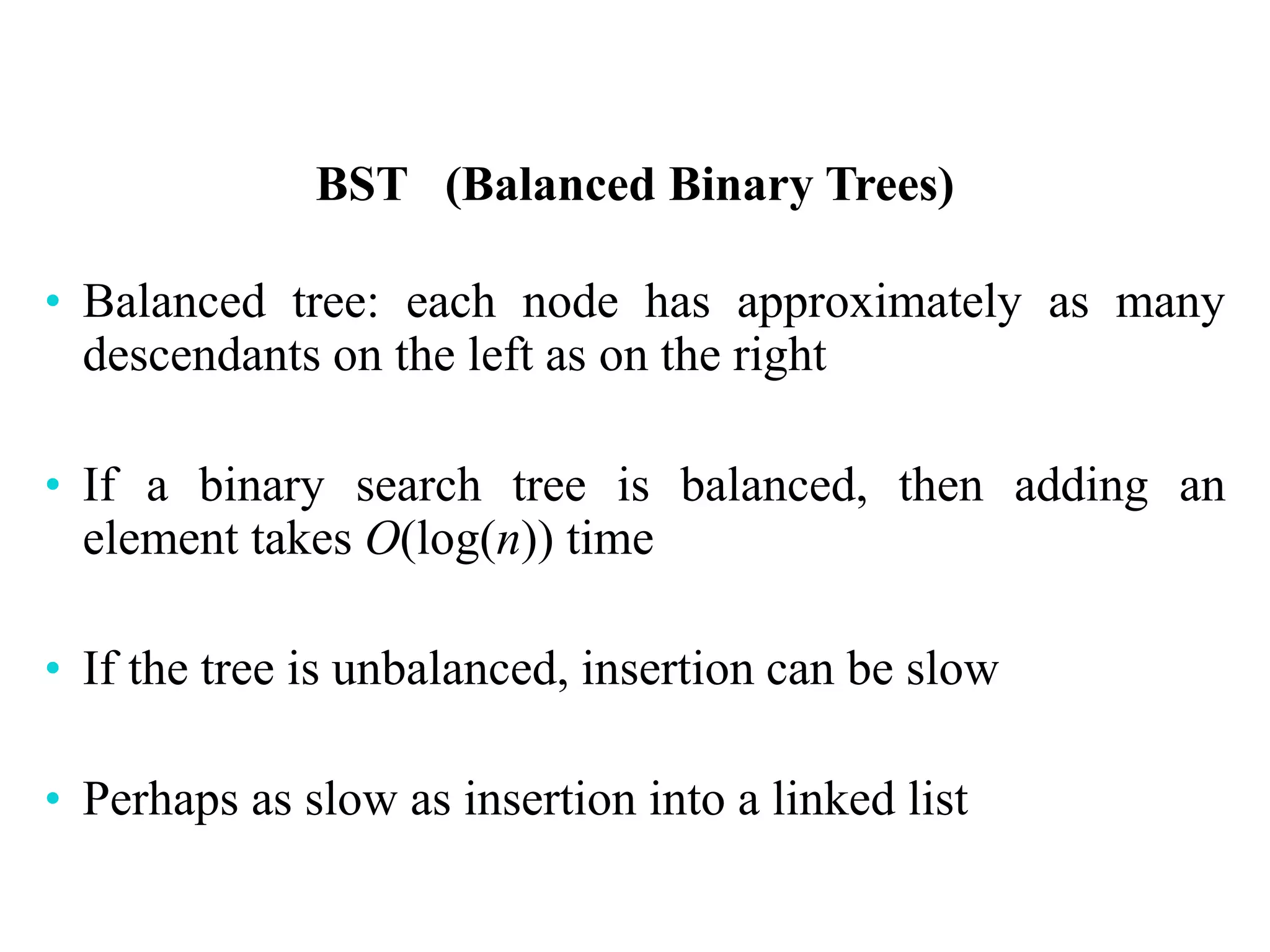
BST (Balanced Binary Trees)
• Balanced tree: each node has approximately as many
descendants on the left as on the right
• If a binary search tree is balanced, then adding an
element takes O(log(n)) time
• If the tree is unbalanced, insertion can be slow
• Perhaps as slow as insertion into a linked list
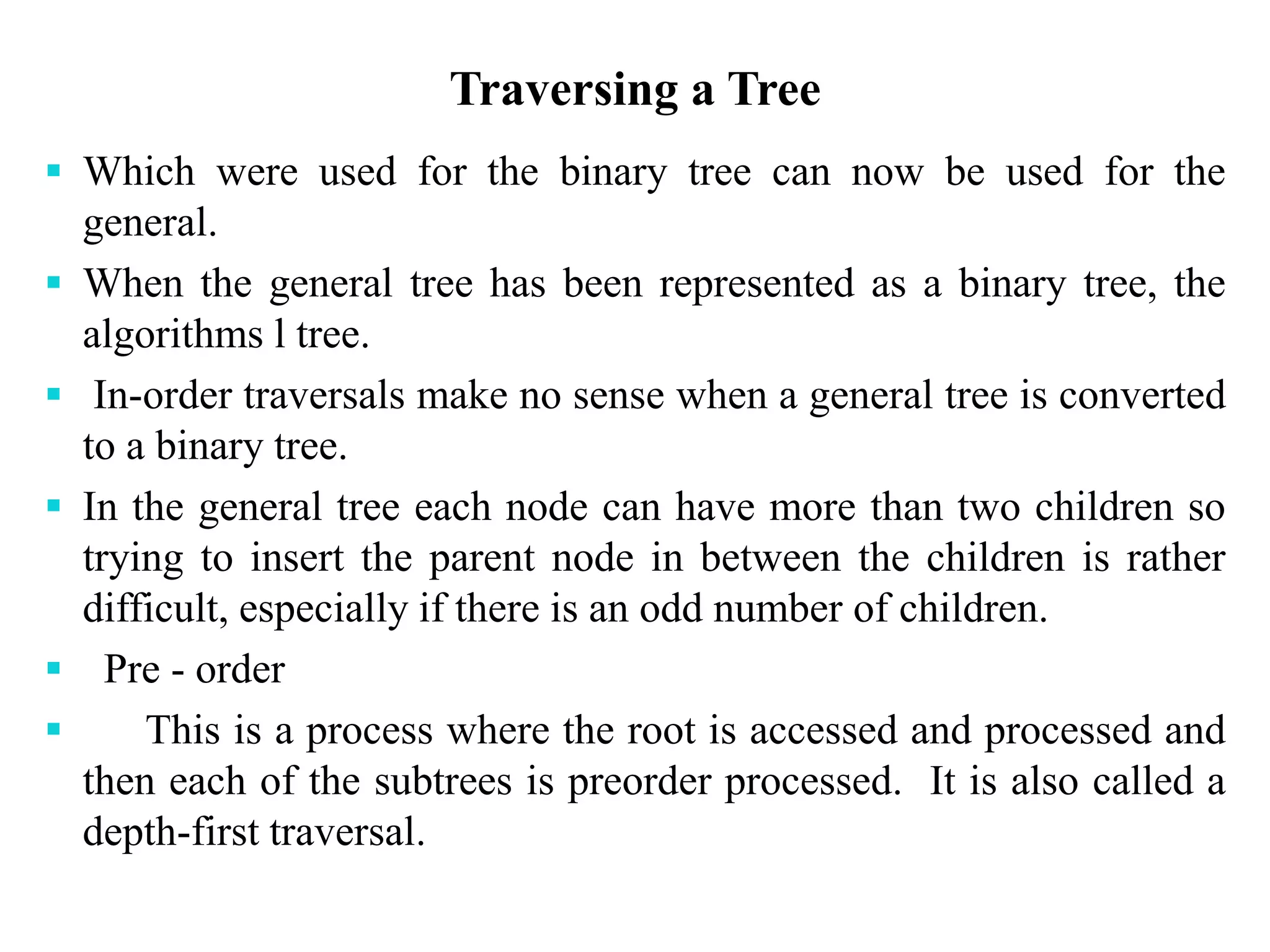
Traversing a Tree
 Which were used for the binary tree can now be used for the
general.
 When the general tree has been represented as a binary tree, the
algorithms l tree.
 In-order traversals make no sense when a general tree is converted
to a binary tree.
 In the general tree each node can have more than two children so
trying to insert the parent node in between the children is rather
difficult, especially if there is an odd number of children.
 Pre - order
 This is a process where the root is accessed and processed and
then each of the subtrees is preorder processed. It is also called a
depth-first traversal.
Traversing a Tree
 Pre-order Traversal
 In this way the resulting printout has all nodes at any given
level starting in the same tab column.
 It is relatively easy to draw lines to produce the original
general tree except that the tree is on its side with it's root at the
left rather than with the root at the top.
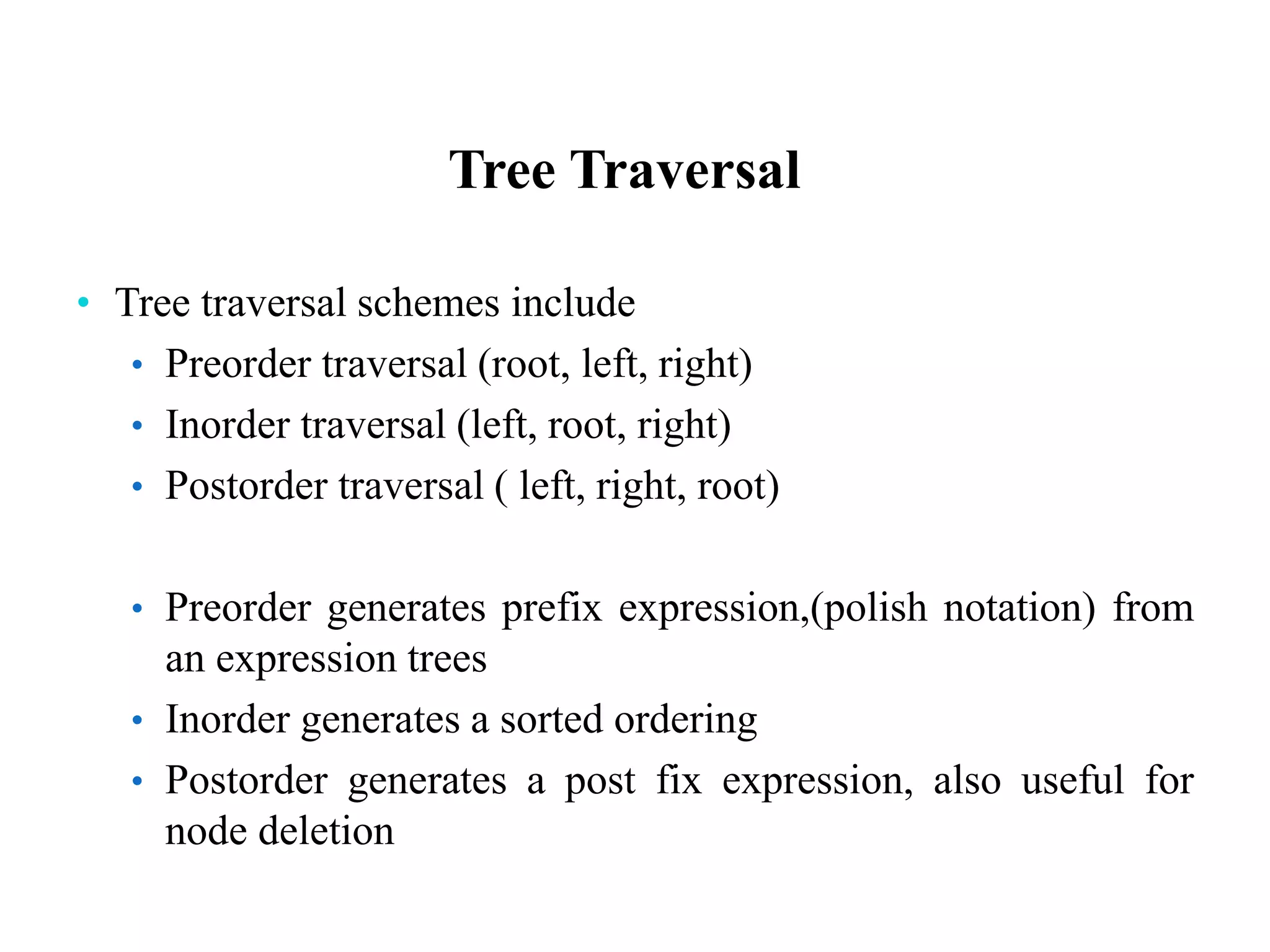
Tree Traversal
• Tree traversal schemes include
• Preorder traversal (root, left, right)
• Inorder traversal (left, root, right)
• Postorder traversal ( left, right, root)
• Preorder generates prefix expression,(polish notation) from
an expression trees
• Inorder generates a sorted ordering
• Postorder generates a post fix expression, also useful for
node deletion
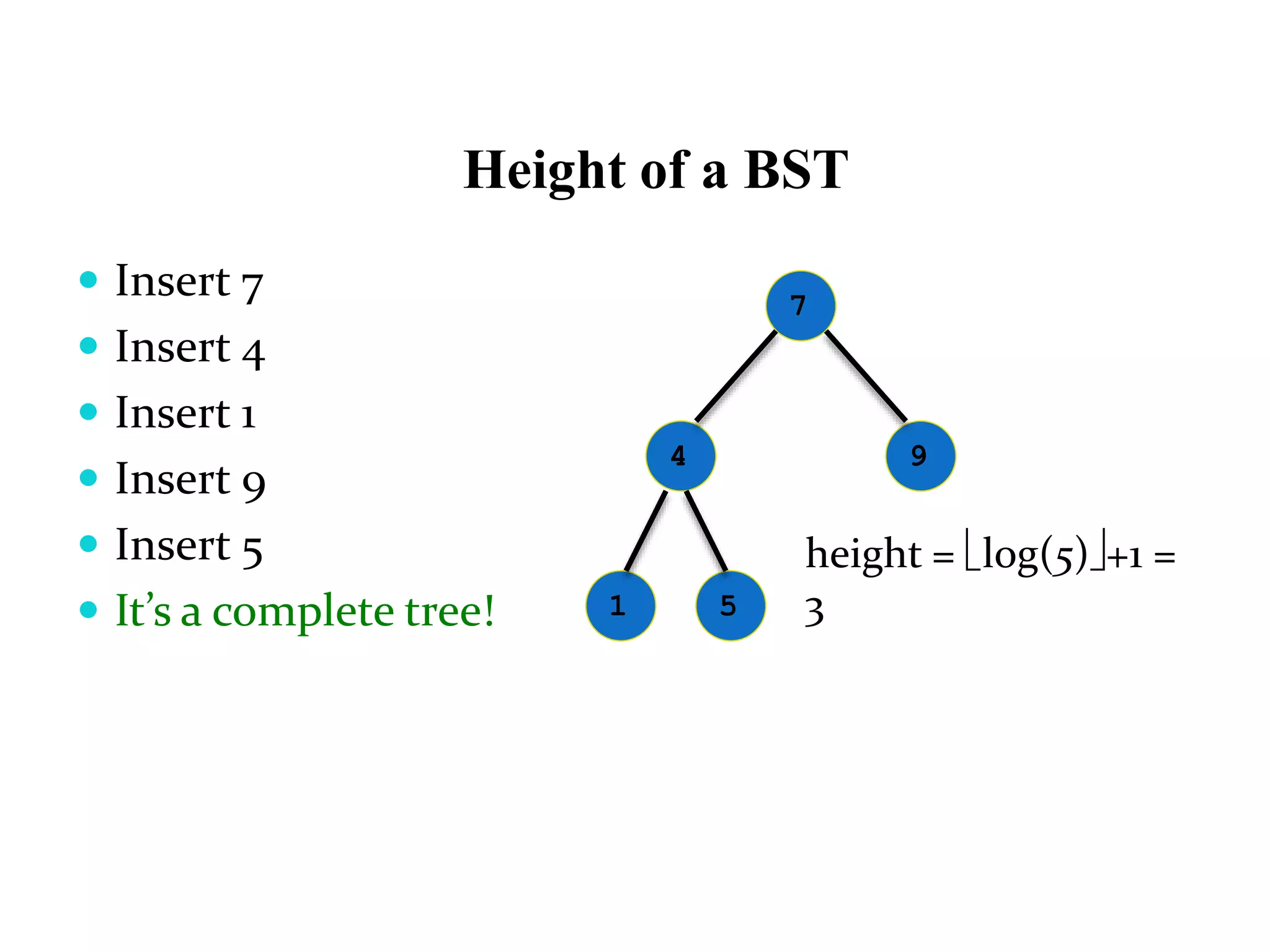
Height of a BST
 Insert 7
 Insert 4
 Insert 1
 Insert 9
 Insert 5
 It’s a complete tree!
7
4 9
1 5
height = log(5)+1 =
3
BSTs with heights O(log n)
 It would be ideal if a BST was always close to a full
binary tree
 It’s enough to guarantee that the height of tree is
O(log n)
 To guarantee that we have to make the structure of the
tree and insertion and deletion algorithms more
complex
 e.g. AVL trees (balanced), 2-3 trees, 2-3-4 trees (full
but not binary), red–black trees (if red vertices are
ignored then it’s like a full tree)
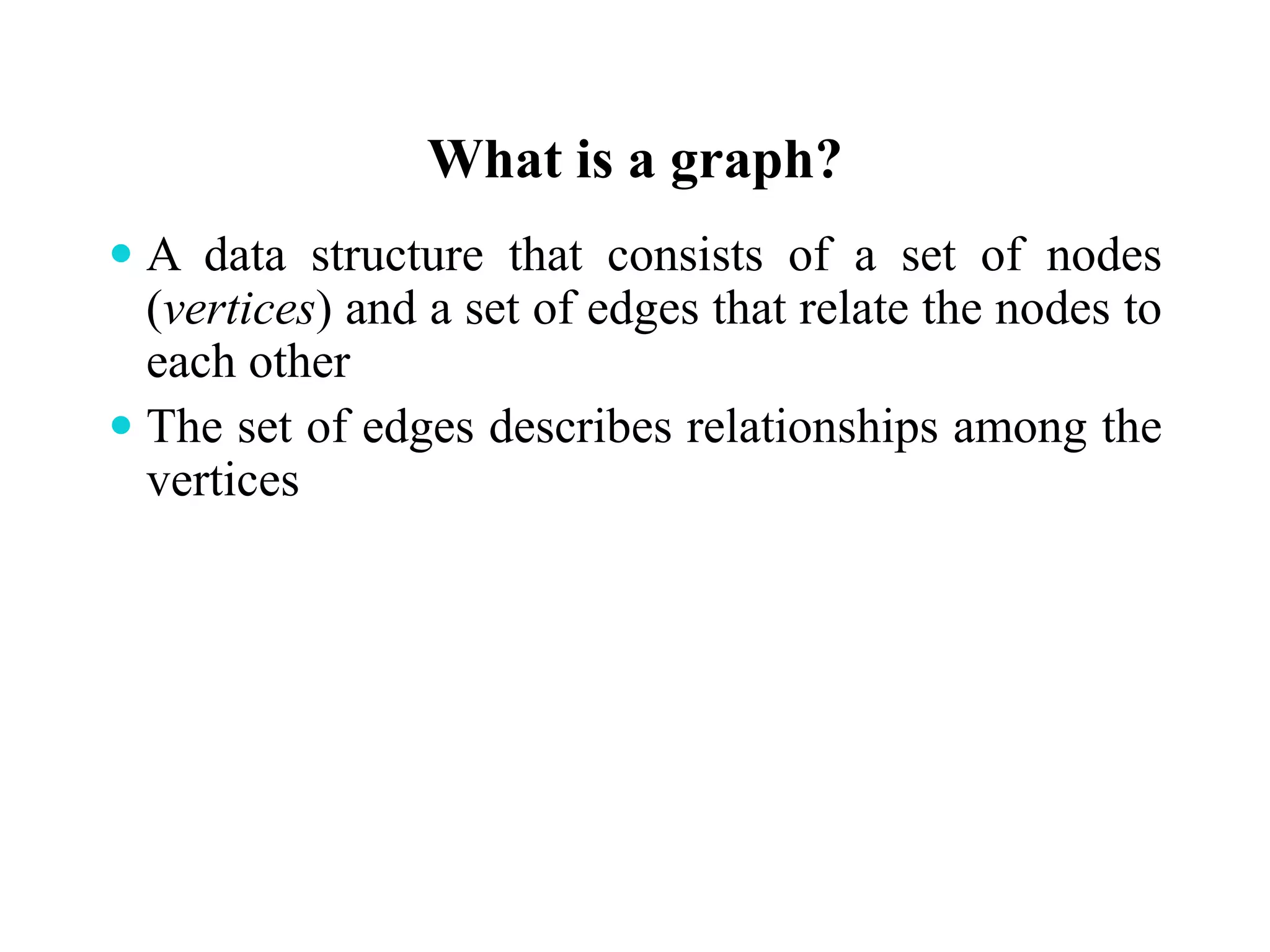
What is a graph?
 A data structure that consists of a set of nodes
(vertices) and a set of edges that relate the nodes to
each other
 The set of edges describes relationships among the
vertices
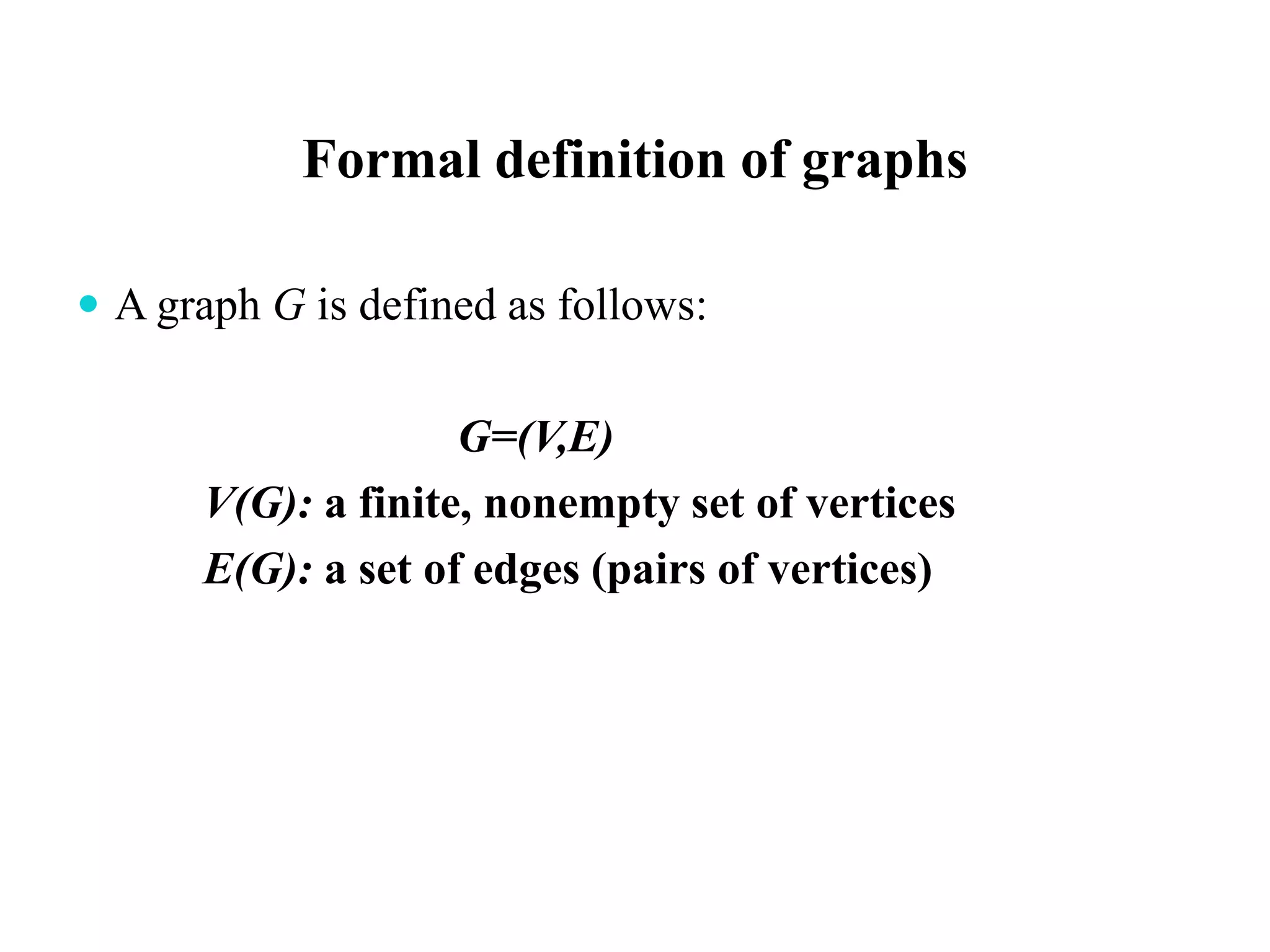
Formal definition of graphs
 A graph G is defined as follows:
G=(V,E)
V(G): a finite, nonempty set of vertices
E(G): a set of edges (pairs of vertices)
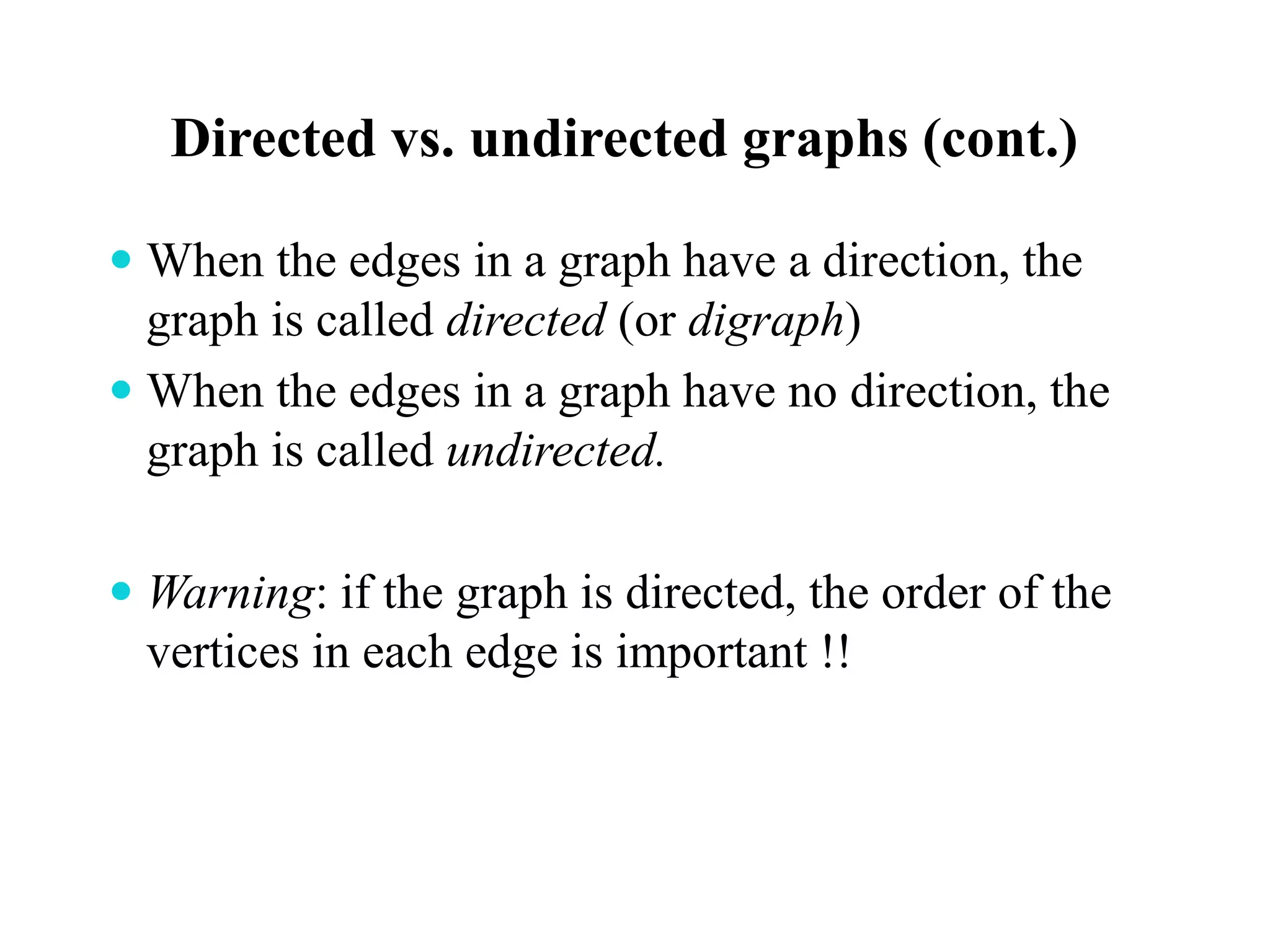
Directed vs. undirected graphs (cont.)
 When the edges in a graph have a direction, the
graph is called directed (or digraph)
 When the edges in a graph have no direction, the
graph is called undirected.
 Warning: if the graph is directed, the order of the
vertices in each edge is important !!
Breadth-first searching[1]
 A breadth-first search (BFS)
explores nodes nearest the root
before exploring nodes further
away
 For example, after searching A,
then B, then C, the search
proceeds with D, E, F, G
 Node are explored in the order
A B C D E F G H I J K L M N O P Q
 J will be found before N
L M N O P
G
Q
H JI K
FED
B C
A
Depth-first searching[2]
 A depth-first search (DFS)
explores a path all the way to a
leaf before backtracking and
exploring another path
 For example, after searching A,
then B, then D, the search
backtracks and tries another path
from B
 Node are explored in the order A
B D E H L M N I O P C F G J K
Q
 N will be found before JL M N O P
G
Q
H JI K
FED
B C
A
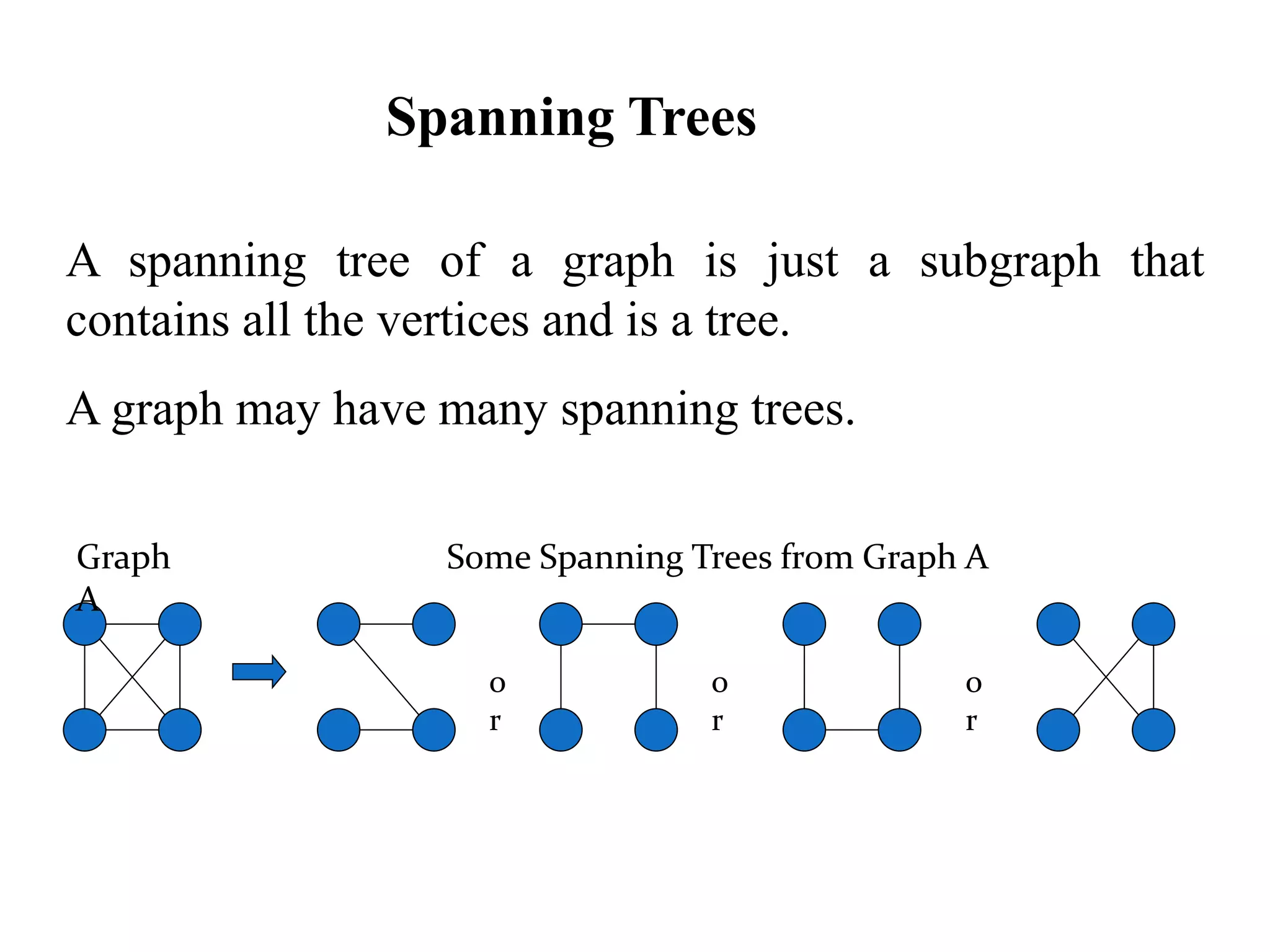
A spanning tree of a graph is just a subgraph that
contains all the vertices and is a tree.
A graph may have many spanning trees.
o
r
o
r
o
r
Some Spanning Trees from Graph AGraph
A
Spanning Trees
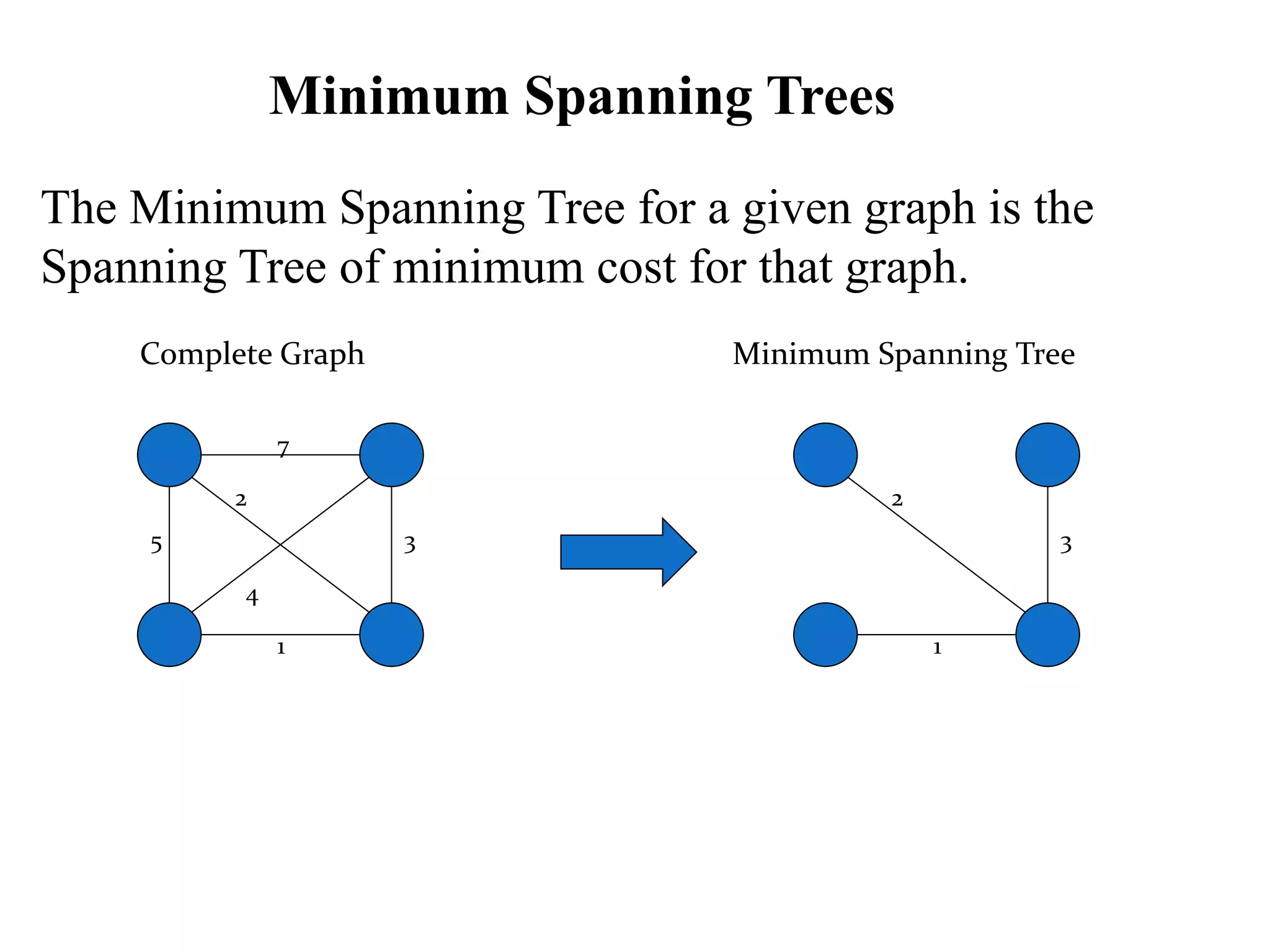
Minimum Spanning Trees
The Minimum Spanning Tree for a given graph is the
Spanning Tree of minimum cost for that graph.
5
7
2
1
3
4
2
1
3
Complete Graph Minimum Spanning Tree
References
 An introduction to Datastructure with application by jean Trembley and sorrenson
 Data structures by schaums and series –seymour lipschutz
 http://en.wikipedia.org/wiki/Book:Data_structures
 http://www.amazon.com/Data-Structures-Algorithms
 http://www.amazon.in/Data-Structures-Algorithms-Made-Easy/dp/0615459811/
 http://www.amazon.in/Data-Structures-SIE-Seymour-Lipschutz/dp
 List of Images
1. http://www.algolist.net/Algorithms/Graph/Undirected/breadth-first_search
2. http://www.expertsmind.com/questions/depth-first-search-30153061.aspx

Bsc cs ii dfs u-3 tree and graph

  • 1.
    Course: BSC CS Subject:Data Structure Unit-3 Tree and Graph
  • 2.
    NONLINEAR DATA STRUCTURE 2 primary types: • Trees • Graphs • All trees are graphs, but not all graphs are trees • Recursion is useful and is the easiest way to process them. • It helps keep track of what's been processed and what remains
  • 3.
    Graphs •Graphs can havemultiple references in and multiple references out (whereas tree node only has one reference in) •Graphs can be directed or undirected and cyclic or acyclic
  • 4.
    Trees • Single parent •0 or more children • A node with no children is called a "leaf" • The topmost node is called the "root" • N-ary trees • Binary trees
  • 5.
    N-ary Trees  Thebest example of an n-ary tree is your computer’s directory system.  It has a single starting point and then 0 or more branches.
  • 6.
    Binary Trees andBinary Search Trees • Binary search trees allow for fast insertion and removal of elements • They are specially designed for fast searching • A binary tree consists of two nodes, each of which has two child nodes • All nodes in a binary search tree fulfill the property that: • Descendants to the left have smaller data values than the node data value • Descendants to the right have larger data values than the node data value
  • 7.
    BST Tree Nodes •All nodes in a binary search tree fulfill the property that: • Descendants to the left have smaller data values than the node data value • Descendants to the right have larger data values than the node data value
  • 8.
    BST (Balanced BinaryTrees) • Balanced tree: each node has approximately as many descendants on the left as on the right • If a binary search tree is balanced, then adding an element takes O(log(n)) time • If the tree is unbalanced, insertion can be slow • Perhaps as slow as insertion into a linked list
  • 9.
    Traversing a Tree Which were used for the binary tree can now be used for the general.  When the general tree has been represented as a binary tree, the algorithms l tree.  In-order traversals make no sense when a general tree is converted to a binary tree.  In the general tree each node can have more than two children so trying to insert the parent node in between the children is rather difficult, especially if there is an odd number of children.  Pre - order  This is a process where the root is accessed and processed and then each of the subtrees is preorder processed. It is also called a depth-first traversal.
  • 10.
    Traversing a Tree Pre-order Traversal  In this way the resulting printout has all nodes at any given level starting in the same tab column.  It is relatively easy to draw lines to produce the original general tree except that the tree is on its side with it's root at the left rather than with the root at the top.
  • 11.
    Tree Traversal • Treetraversal schemes include • Preorder traversal (root, left, right) • Inorder traversal (left, root, right) • Postorder traversal ( left, right, root) • Preorder generates prefix expression,(polish notation) from an expression trees • Inorder generates a sorted ordering • Postorder generates a post fix expression, also useful for node deletion
  • 12.
    Height of aBST  Insert 7  Insert 4  Insert 1  Insert 9  Insert 5  It’s a complete tree! 7 4 9 1 5 height = log(5)+1 = 3
  • 13.
    BSTs with heightsO(log n)  It would be ideal if a BST was always close to a full binary tree  It’s enough to guarantee that the height of tree is O(log n)  To guarantee that we have to make the structure of the tree and insertion and deletion algorithms more complex  e.g. AVL trees (balanced), 2-3 trees, 2-3-4 trees (full but not binary), red–black trees (if red vertices are ignored then it’s like a full tree)
  • 14.
    What is agraph?  A data structure that consists of a set of nodes (vertices) and a set of edges that relate the nodes to each other  The set of edges describes relationships among the vertices
  • 15.
    Formal definition ofgraphs  A graph G is defined as follows: G=(V,E) V(G): a finite, nonempty set of vertices E(G): a set of edges (pairs of vertices)
  • 16.
    Directed vs. undirectedgraphs (cont.)  When the edges in a graph have a direction, the graph is called directed (or digraph)  When the edges in a graph have no direction, the graph is called undirected.  Warning: if the graph is directed, the order of the vertices in each edge is important !!
  • 17.
    Breadth-first searching[1]  Abreadth-first search (BFS) explores nodes nearest the root before exploring nodes further away  For example, after searching A, then B, then C, the search proceeds with D, E, F, G  Node are explored in the order A B C D E F G H I J K L M N O P Q  J will be found before N L M N O P G Q H JI K FED B C A
  • 18.
    Depth-first searching[2]  Adepth-first search (DFS) explores a path all the way to a leaf before backtracking and exploring another path  For example, after searching A, then B, then D, the search backtracks and tries another path from B  Node are explored in the order A B D E H L M N I O P C F G J K Q  N will be found before JL M N O P G Q H JI K FED B C A
  • 19.
    A spanning treeof a graph is just a subgraph that contains all the vertices and is a tree. A graph may have many spanning trees. o r o r o r Some Spanning Trees from Graph AGraph A Spanning Trees
  • 20.
    Minimum Spanning Trees TheMinimum Spanning Tree for a given graph is the Spanning Tree of minimum cost for that graph. 5 7 2 1 3 4 2 1 3 Complete Graph Minimum Spanning Tree
  • 21.
    References  An introductionto Datastructure with application by jean Trembley and sorrenson  Data structures by schaums and series –seymour lipschutz  http://en.wikipedia.org/wiki/Book:Data_structures  http://www.amazon.com/Data-Structures-Algorithms  http://www.amazon.in/Data-Structures-Algorithms-Made-Easy/dp/0615459811/  http://www.amazon.in/Data-Structures-SIE-Seymour-Lipschutz/dp  List of Images 1. http://www.algolist.net/Algorithms/Graph/Undirected/breadth-first_search 2. http://www.expertsmind.com/questions/depth-first-search-30153061.aspx