Data Structures and Algorithms
Unit - II
Unit II
Trees – Binary tree representations – Tree
Traversal – Threaded Binary Trees – Binary Tree
Representation of Trees – Graphs and
Representations – Traversals, Connected
Components and Spanning Trees – Shortest
Paths and Transitive closure – Activity Networks –
Topological Sort and Critical Paths.
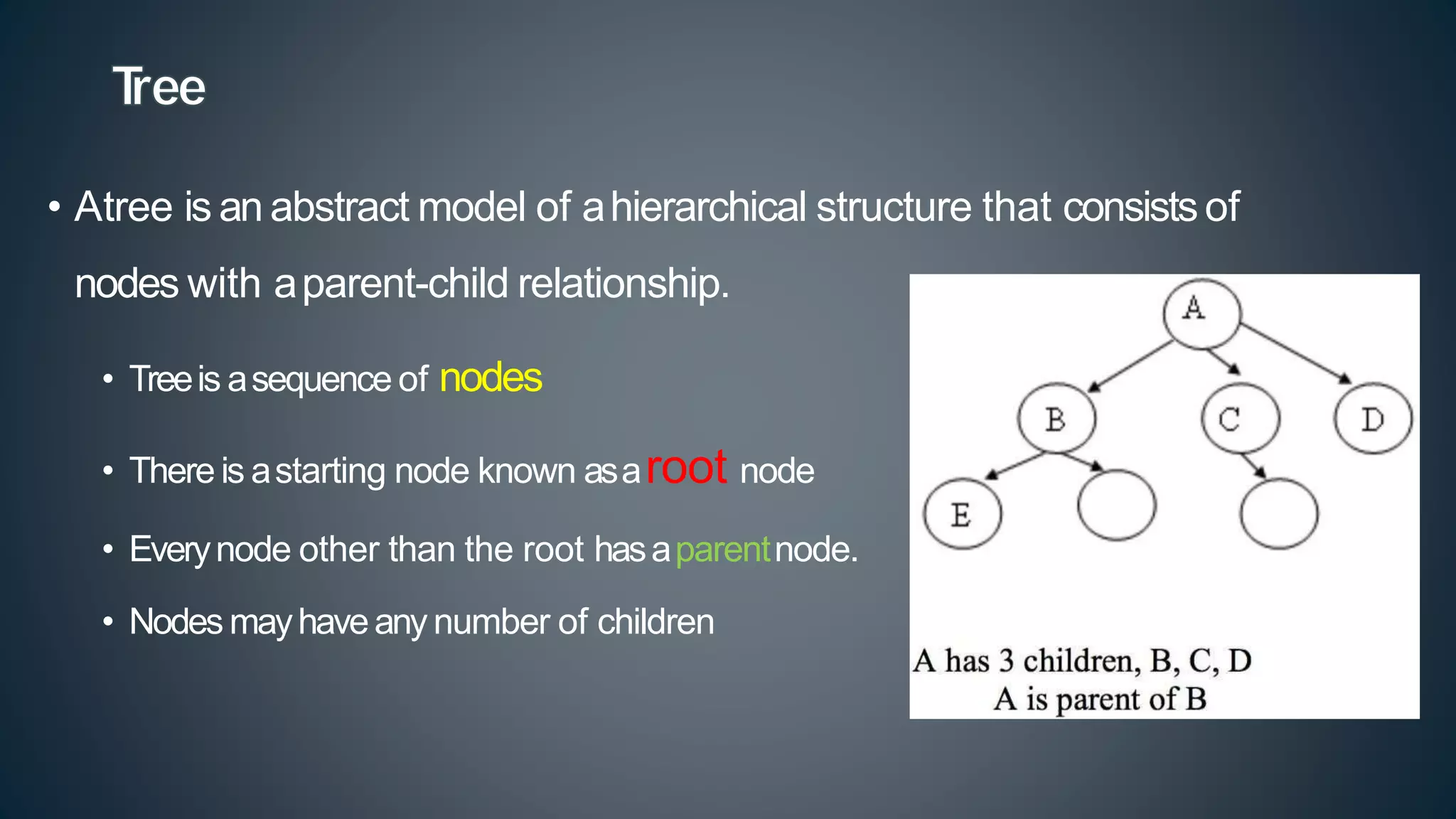
• Atree is an abstract model of ahierarchical structure that consistsof
nodes with aparent-child relationship.
• Treeis asequence of nodes
• There is astarting node known asaroot node
• Everynode other than the root hasaparentnode.
• Nodes mayhaveany number of children
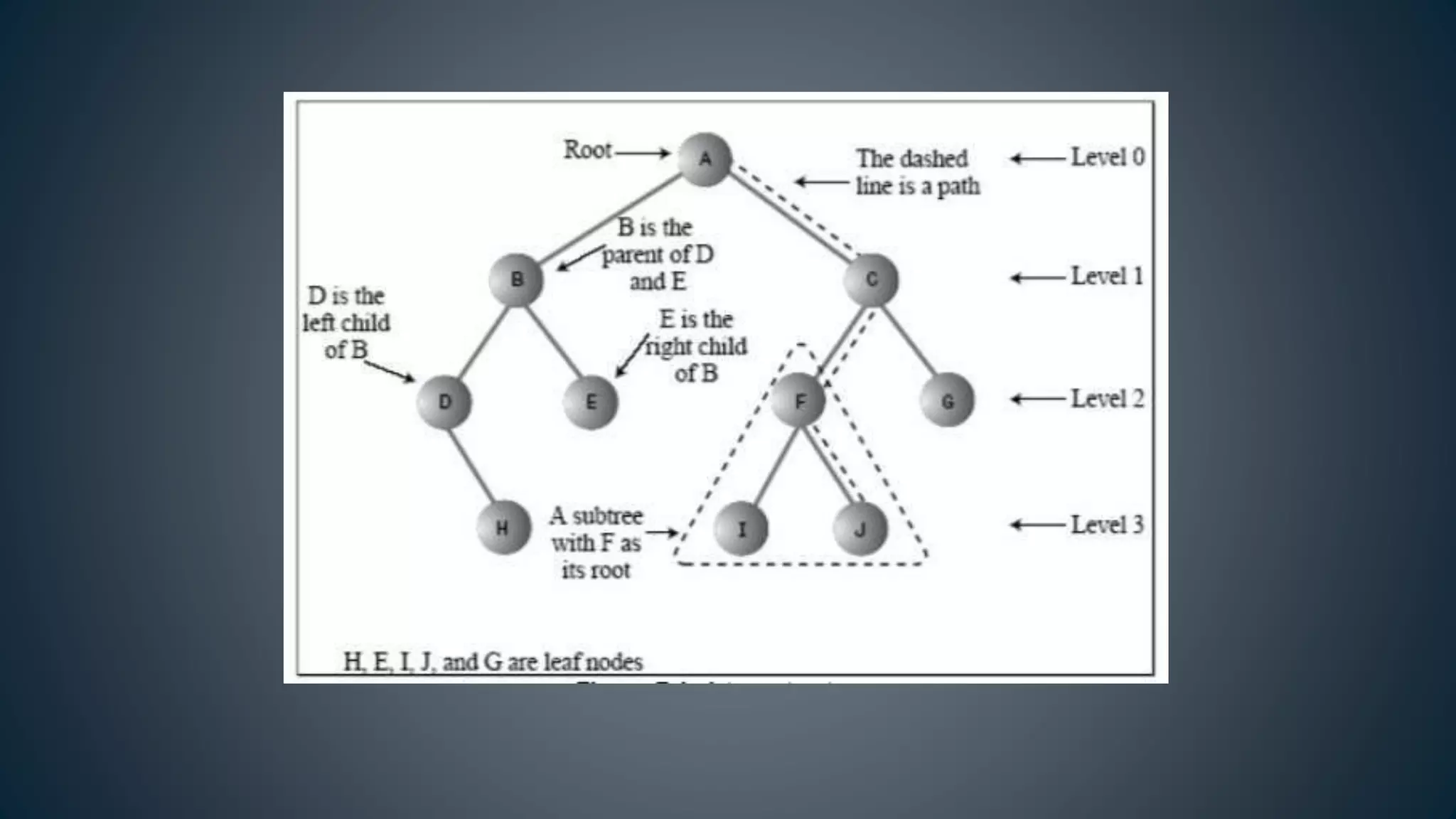
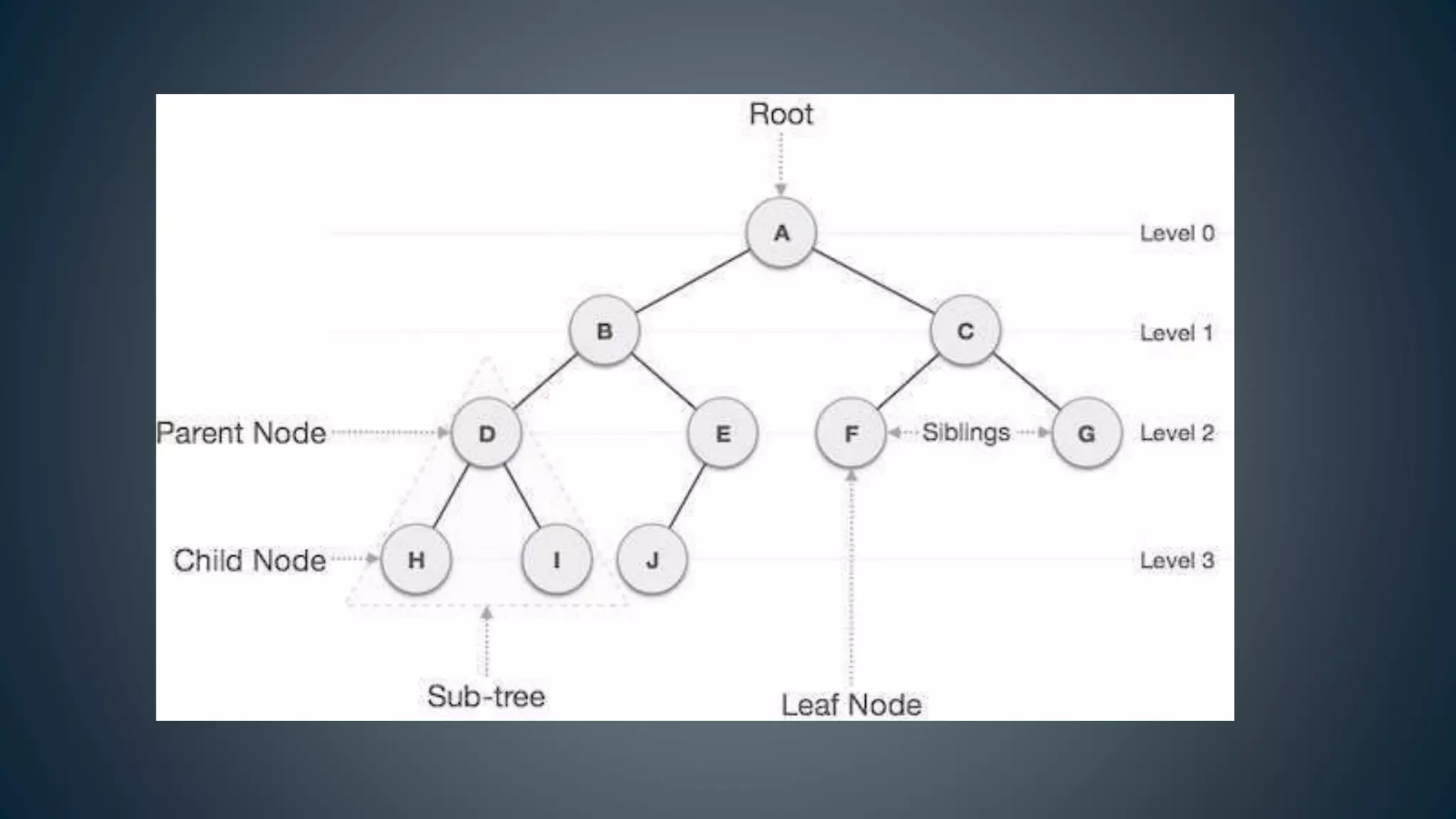
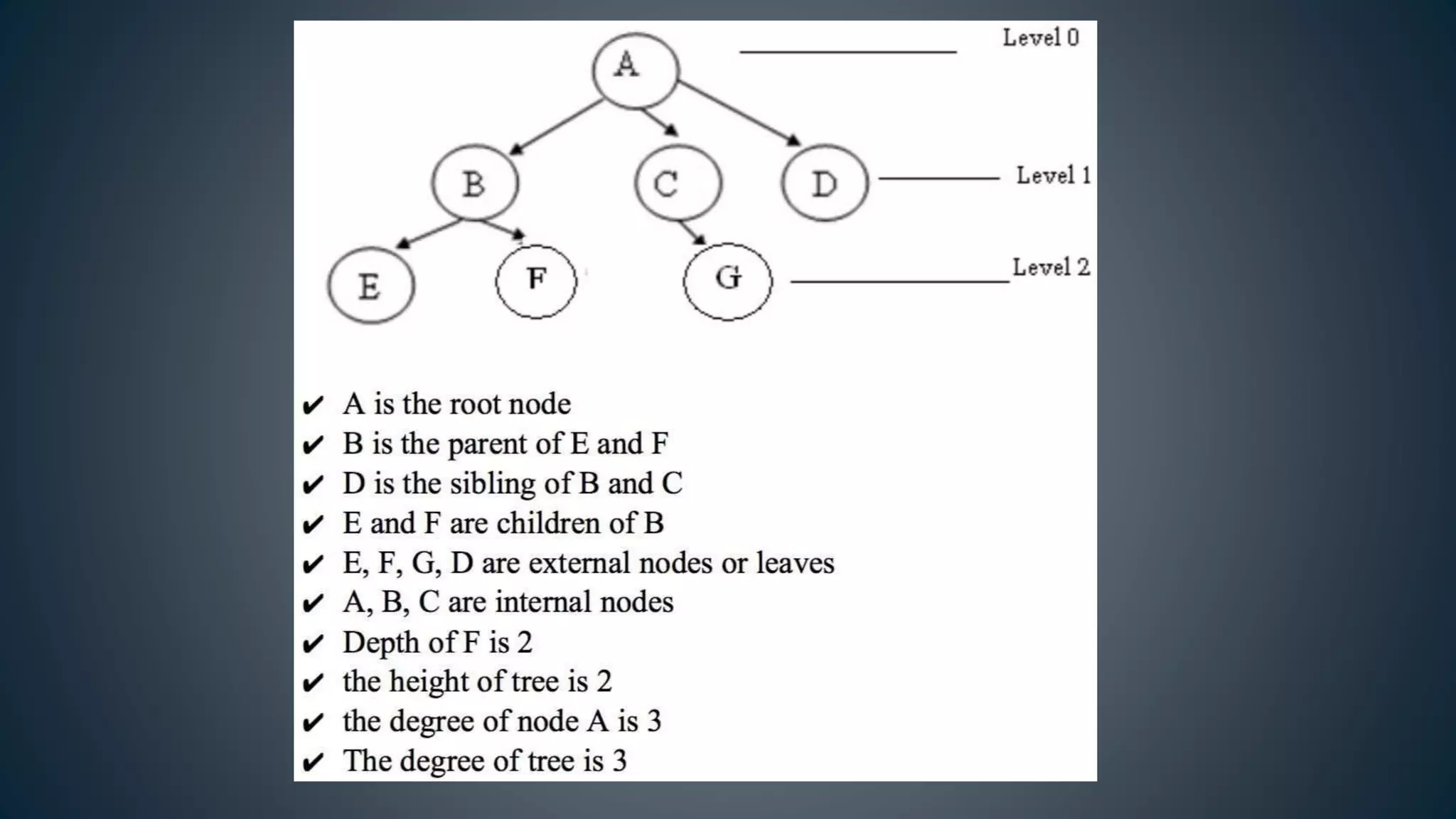
• Root −Node at the top of the treeis called root.
• Parent −Any node except root node has one edge upward to a node called parent.
• Child − Node below agiven node connected by its edge downward is called its child node.
• Sibling – Child of same node are called siblings
• Leaf −Node which does not have any child node is called leaf node.
• Subtree −Subtree represents descendants of a node.
• Levels −Level of anode represents the generation of anode. If root node is at level 0, then
itsnext child node is at level 1, its grandchild is at level 2 and soon.
• keys−Keyrepresents avalue of anode based on which asearch operation is to be carried
out for anode.
• Degree of anode:
• Thedegree of anode is the number of children of that node
• Degree of aTree:
• Thedegree of atree is the maximum degree of nodes in agiventree
• Path:
• It is the sequence of consecutive edges from source node to destination node.
• Height of anode:
• Theheight of anode is the maxpath length form that node to aleaf node.
• Height of atree:
• Theheight of atree is the height ofthe root
• Depth of atree:
• Depth of atree is the maxlevel of any leaf in the tree
• Non-linear data structure
• Combinesadvantages of an ordered array
• Searchingasfast asin ordered array
• Insertion and deletion asfast asin linked list
• Simple and fast
• Directory structure of afile store
• Structure of an arithmetic expressions
• Used in almost every 3D video game to determine what
objects need to be rendered.
• Used in almost every high-bandwidth router for storingrouter-
tables.
• used in compression algorithms, such asthose used by the .jpeg
and .mp3 file- formats.
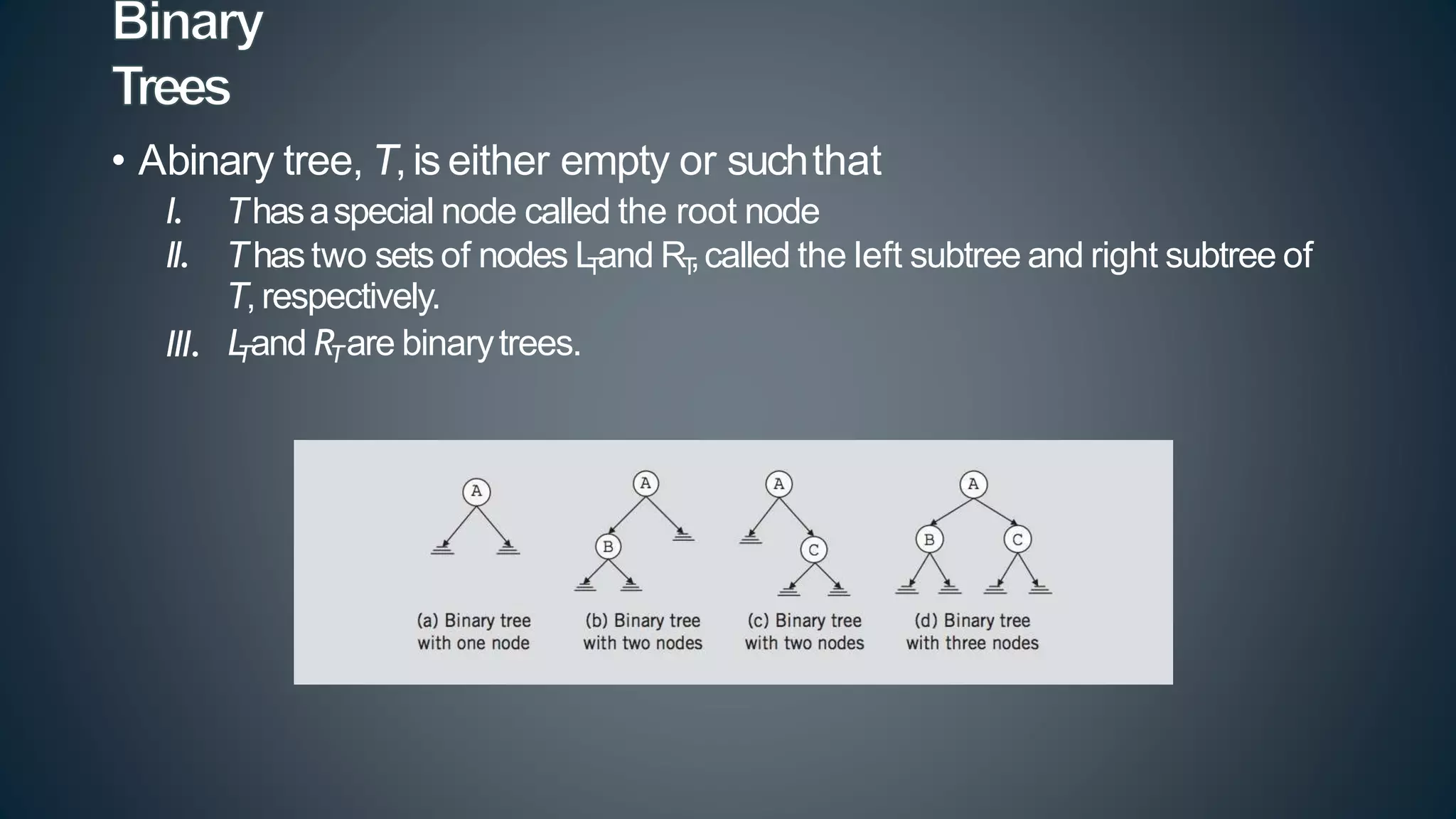
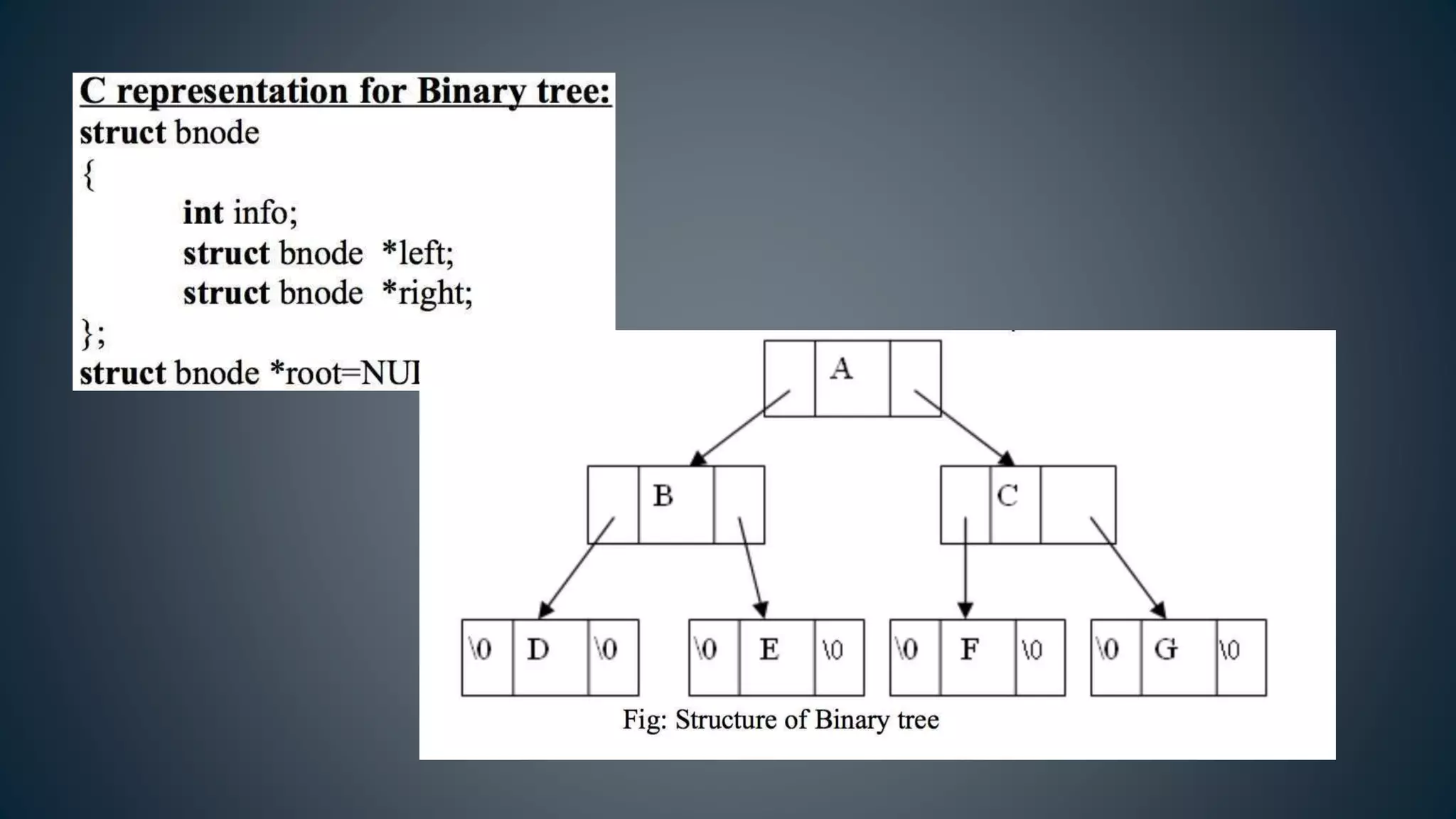
• Abinary tree, is atree in which no node canhavemore than two
children.
• Consider abinary tree T
,here ‘A’is the root node of the binary treeT
.
• ‘B’ is the left child of ‘A’and ‘C’is theright
child of ‘A’
• i.e Ais afather of BandC.
• Thenode Band Care called siblings.
• Nodes D,H,I,F
,Jare leafnode
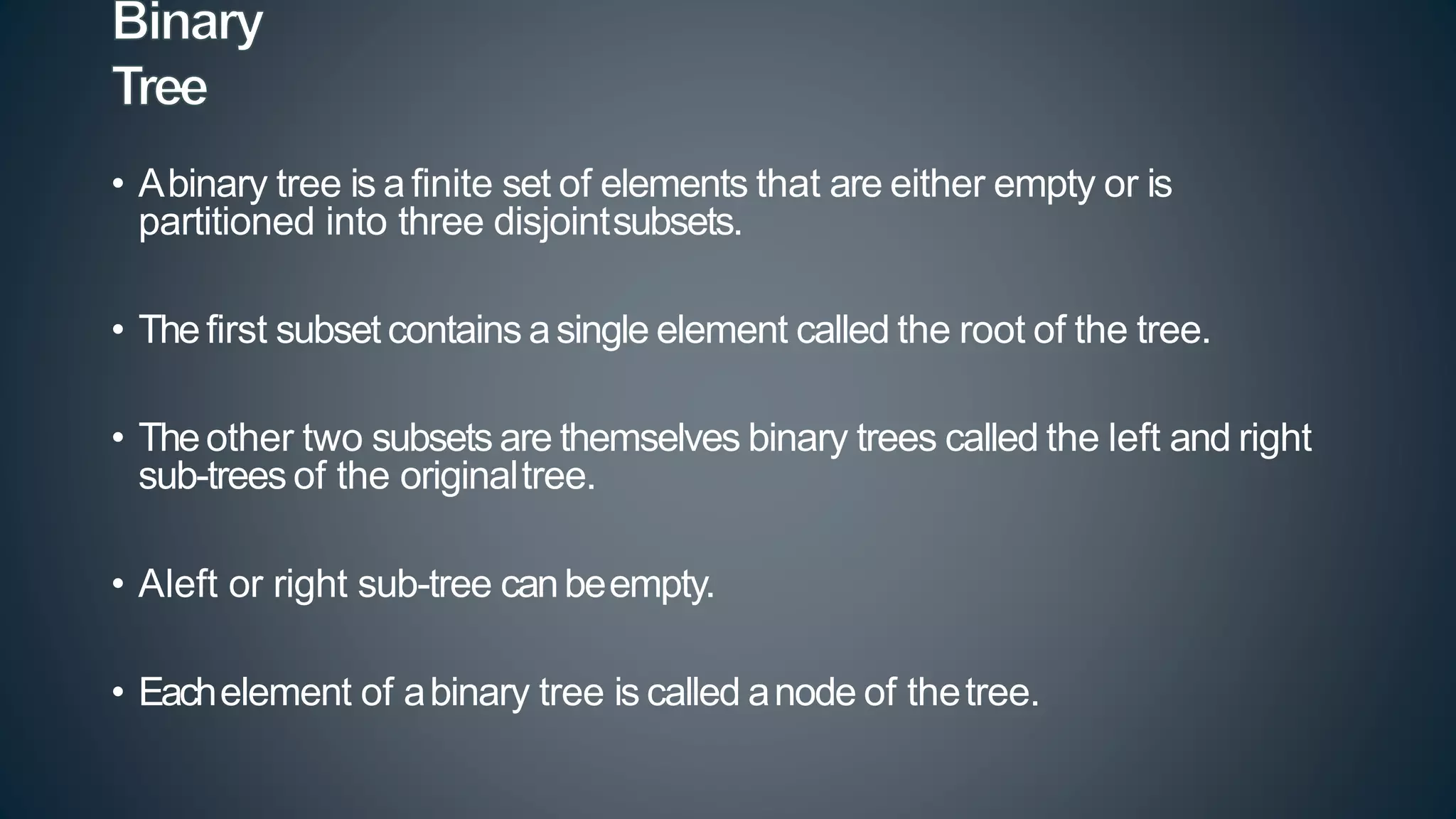
• Abinary tree, T,is either empty or suchthat
III.
I. Thasaspecial node called the root node
II. Thastwo sets of nodes L
Tand RT
,called the left subtree and right subtree of
T, respectively.
L
Tand RTare binarytrees.
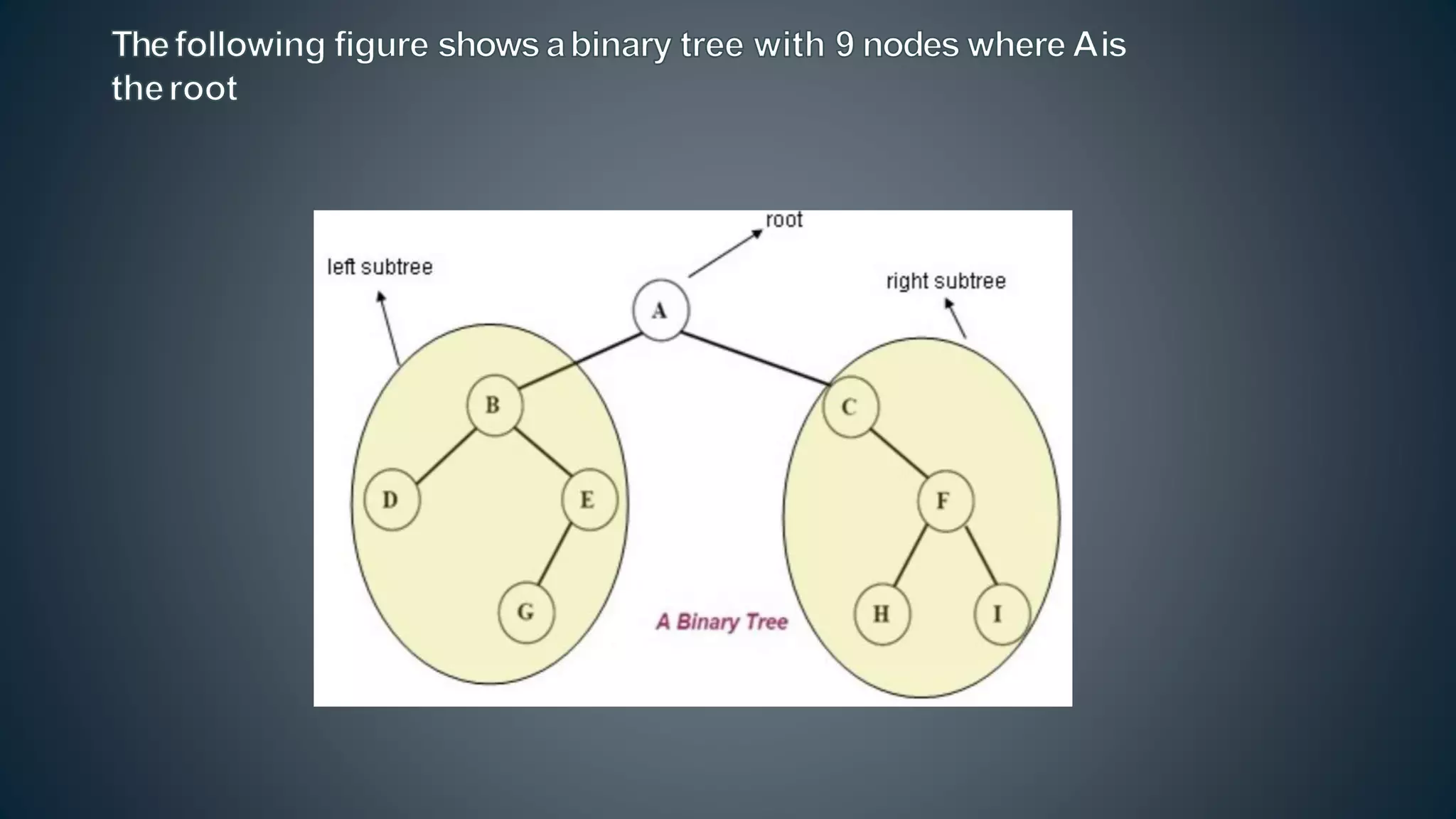
• Abinary tree is a finite set of elements that are either empty or is
partitioned into three disjointsubsets.
• Thefirst subset contains asingle element called the root of the tree.
• Theother two subsets are themselves binary trees called the left and right
sub-trees of the originaltree.
• Aleft or right sub-tree canbeempty.
• Eachelement of abinary tree is called anode of thetree.
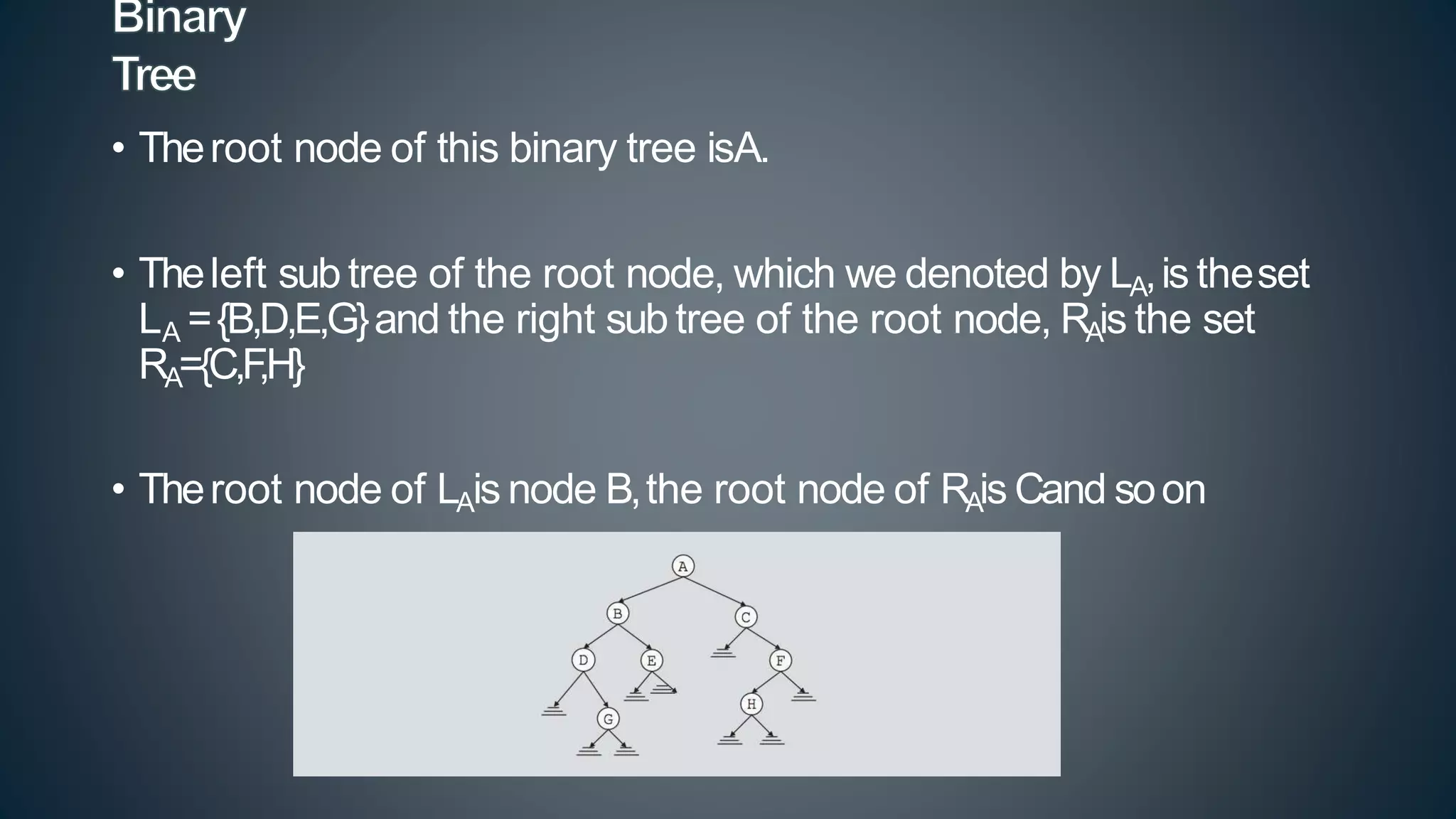
• Theroot node of this binary tree isA.
• Theleft sub tree of the root node, which we denoted by LA,is theset
LA ={B,D,E,G}and the right sub tree of the root node, RAis the set
RA={C,F
,H}
• Theroot node of LAis node B,the root node of RAis Cand soon
• Complete binary tree
• Strictly binary tree
• Almost complete binary tree
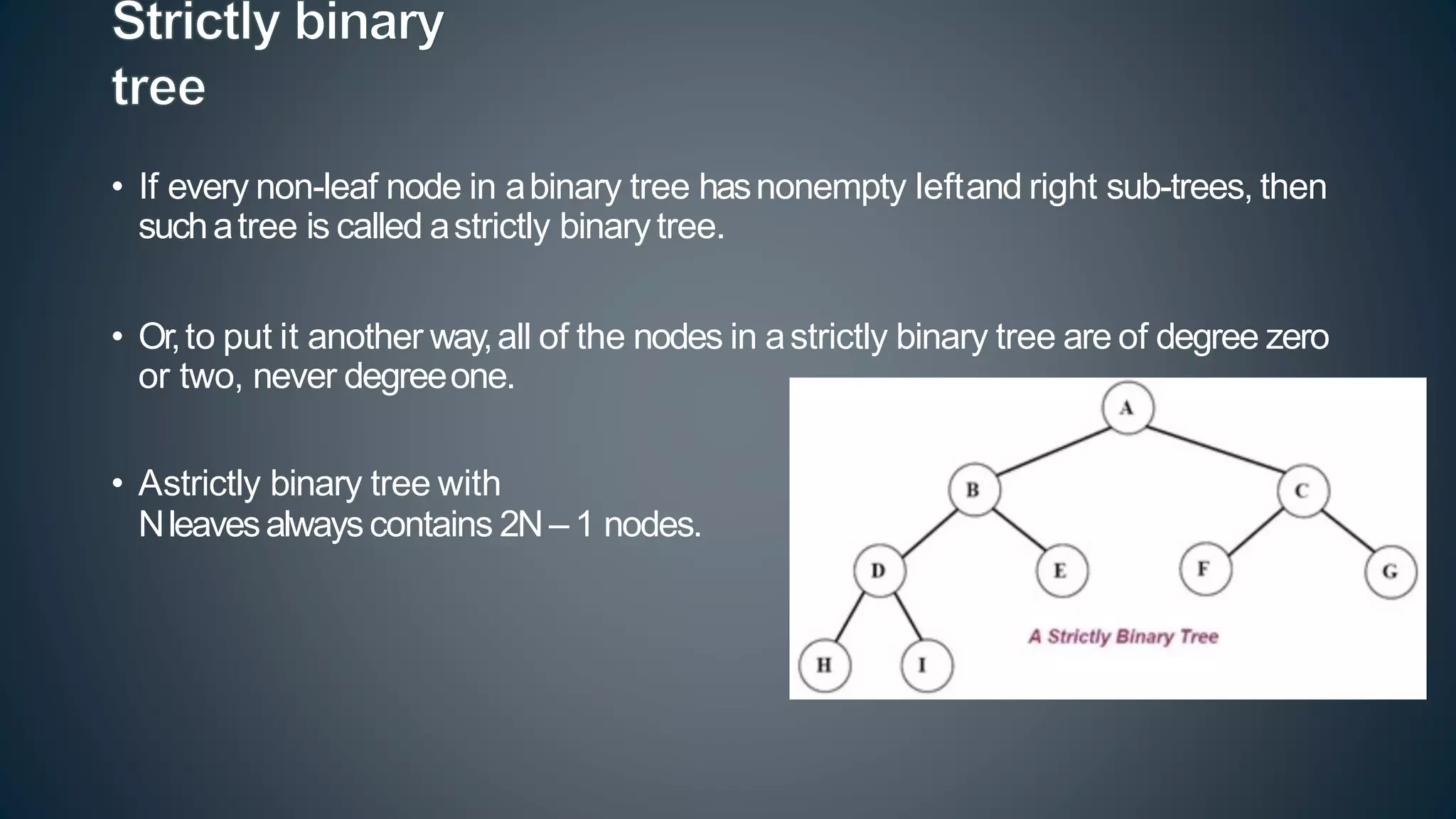
• If every non-leaf node in abinary tree hasnonempty leftand right sub-trees, then
suchatree is called astrictly binarytree.
• Or,to put it another way,all of the nodes in astrictly binary tree are of degree zero
or two, never degreeone.
• Astrictly binary tree with
Nleavesalwayscontains 2N– 1 nodes.
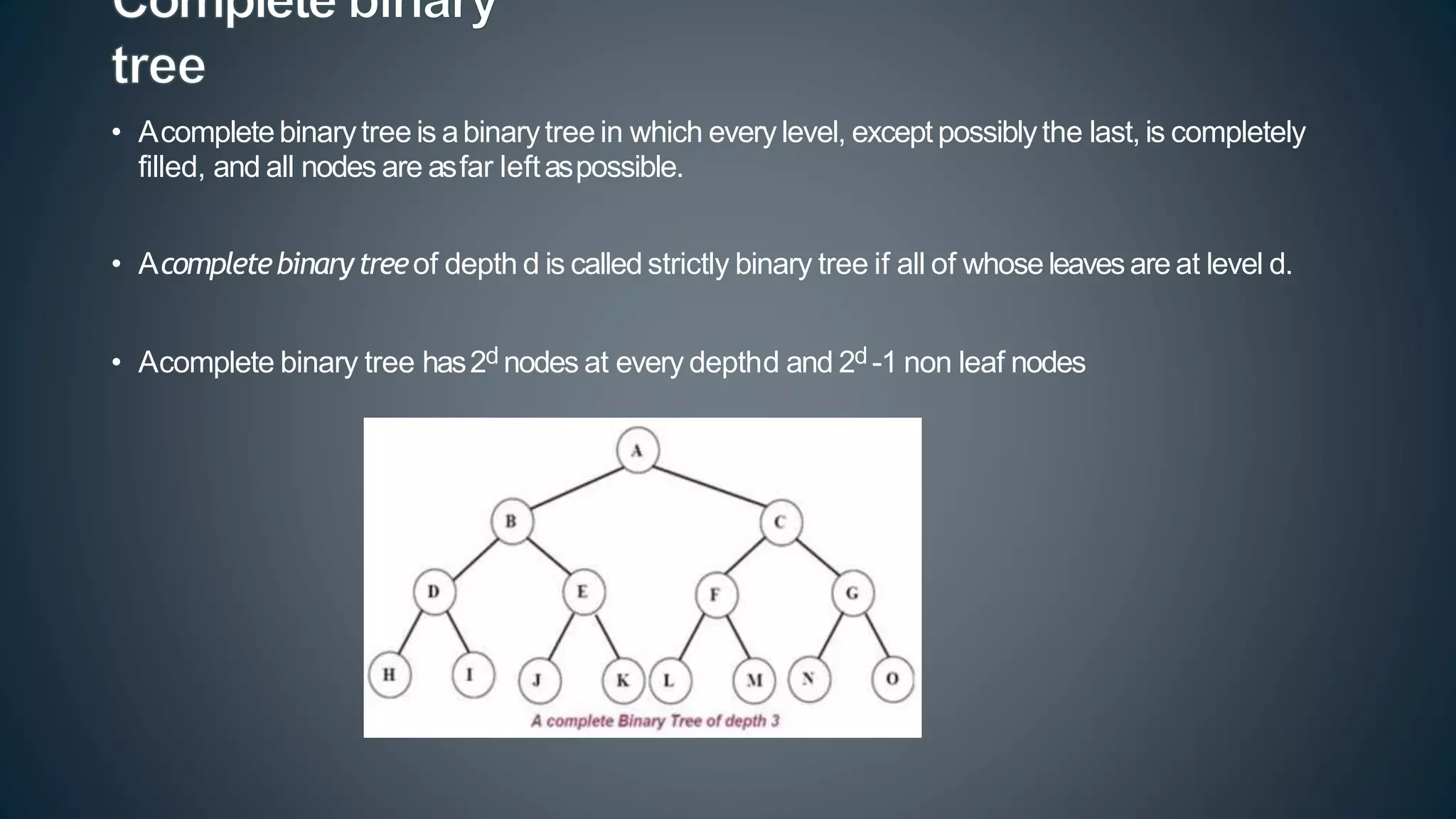
• Acompletebinarytree is abinarytree in which every level, except possiblythe last, is completely
filled, and all nodes are asfar leftaspossible.
• Acompletebinarytreeof depth d is called strictly binary tree if all of whose leavesare at level d.
• Acomplete binary tree has2d nodes at every depthd and 2d -1 non leaf nodes
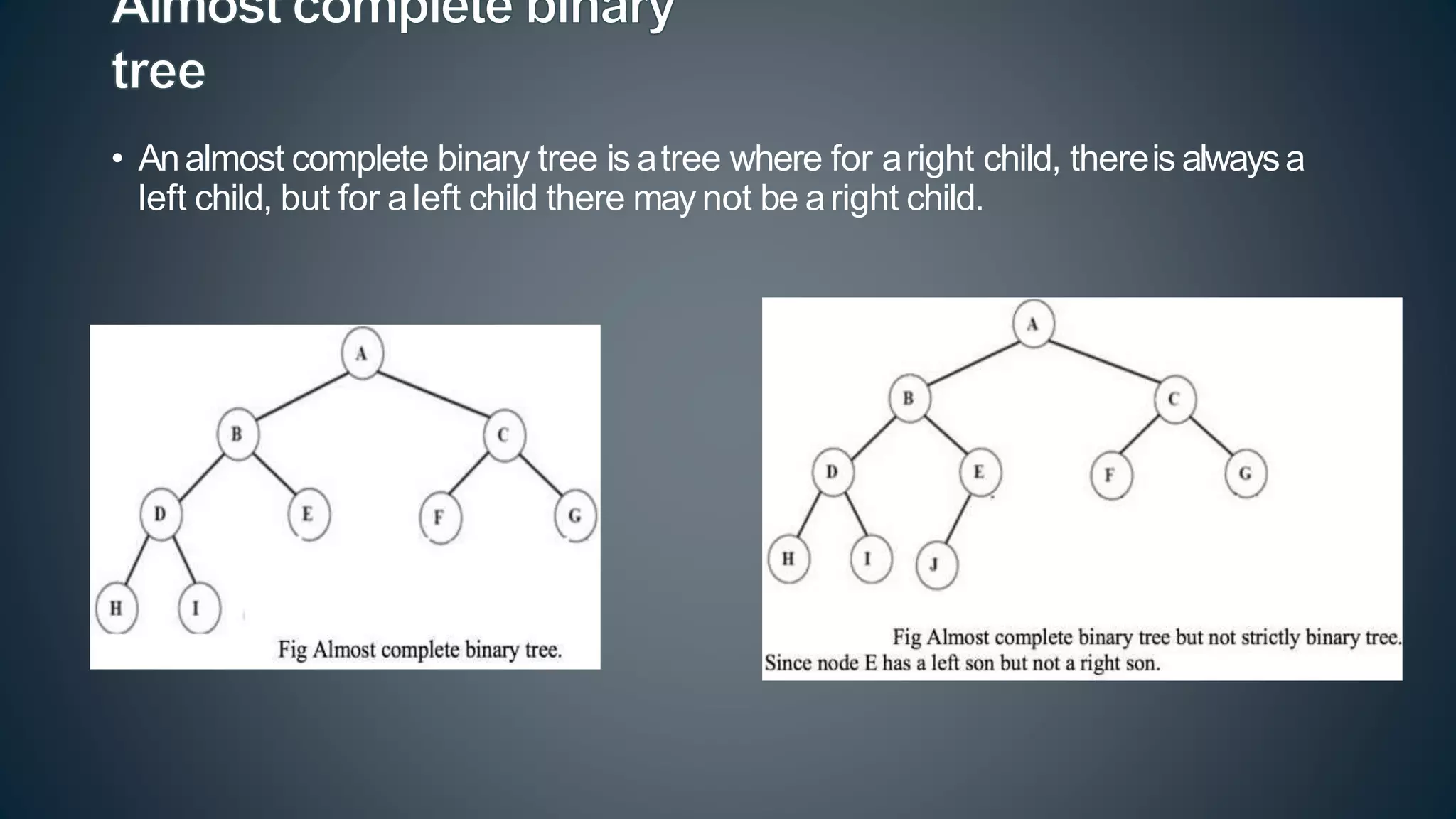
• Analmost complete binary tree is atree where for aright child, thereis alwaysa
left child, but for aleft child there may not be aright child.
• Traversalis aprocessto visit all the nodes of atree and mayprinttheir
values too.
• All nodes are connected via edges(links) we alwaysstart from theroot
(head)node.
• There are three wayswhich we useto traverse atree
• In-orderTraversal
• Pre-orderTraversal
• Post-orderTraversal
• Generally we traverse atree to search or locate given item or keyin the tree
or to print all the values it contains.
• Pre-order
<root><left><right>
• In-order
<left><root><right>
• Post-order
<left><right><root>
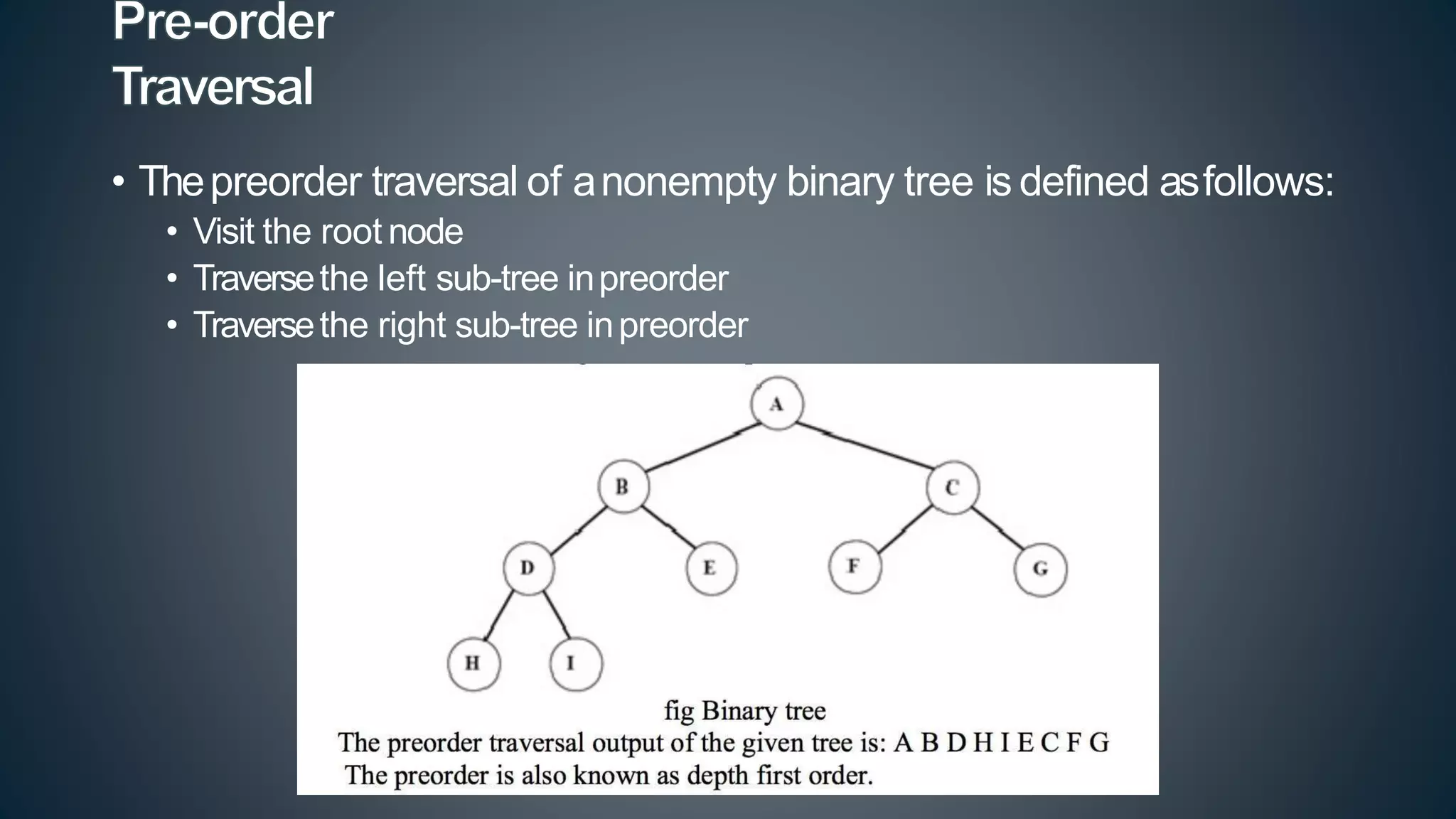
• Thepreorder traversal of anonempty binary tree is defined asfollows:
• Visit the root node
• Traversethe left sub-tree inpreorder
• Traversethe right sub-tree inpreorder
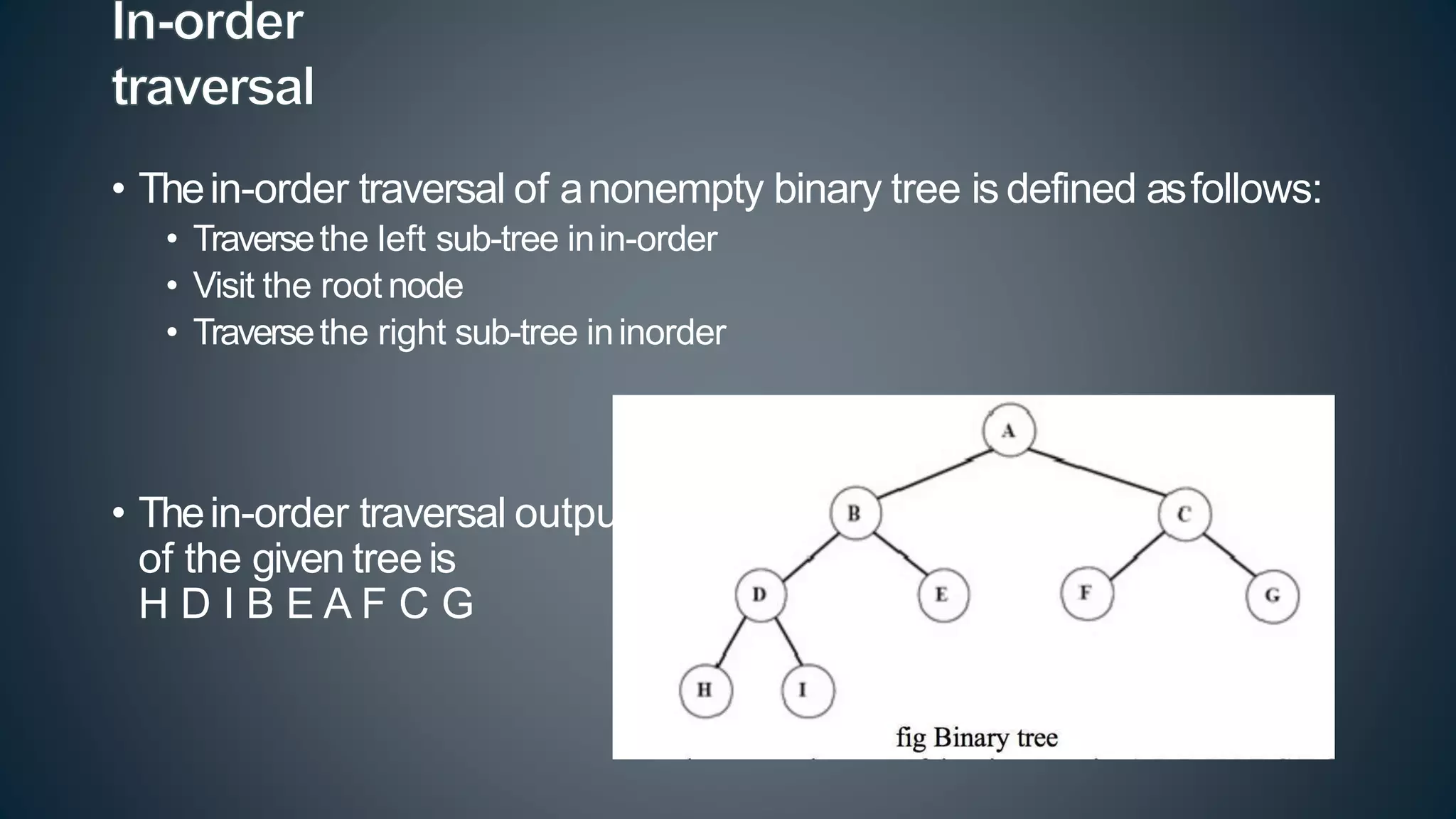
• Thein-order traversal of anonempty binary tree is defined asfollows:
• Traversethe left sub-tree inin-order
• Visit the root node
• Traversethe right sub-tree ininorder
• Thein-order traversal output
of the given treeis
H D I B E A F C G
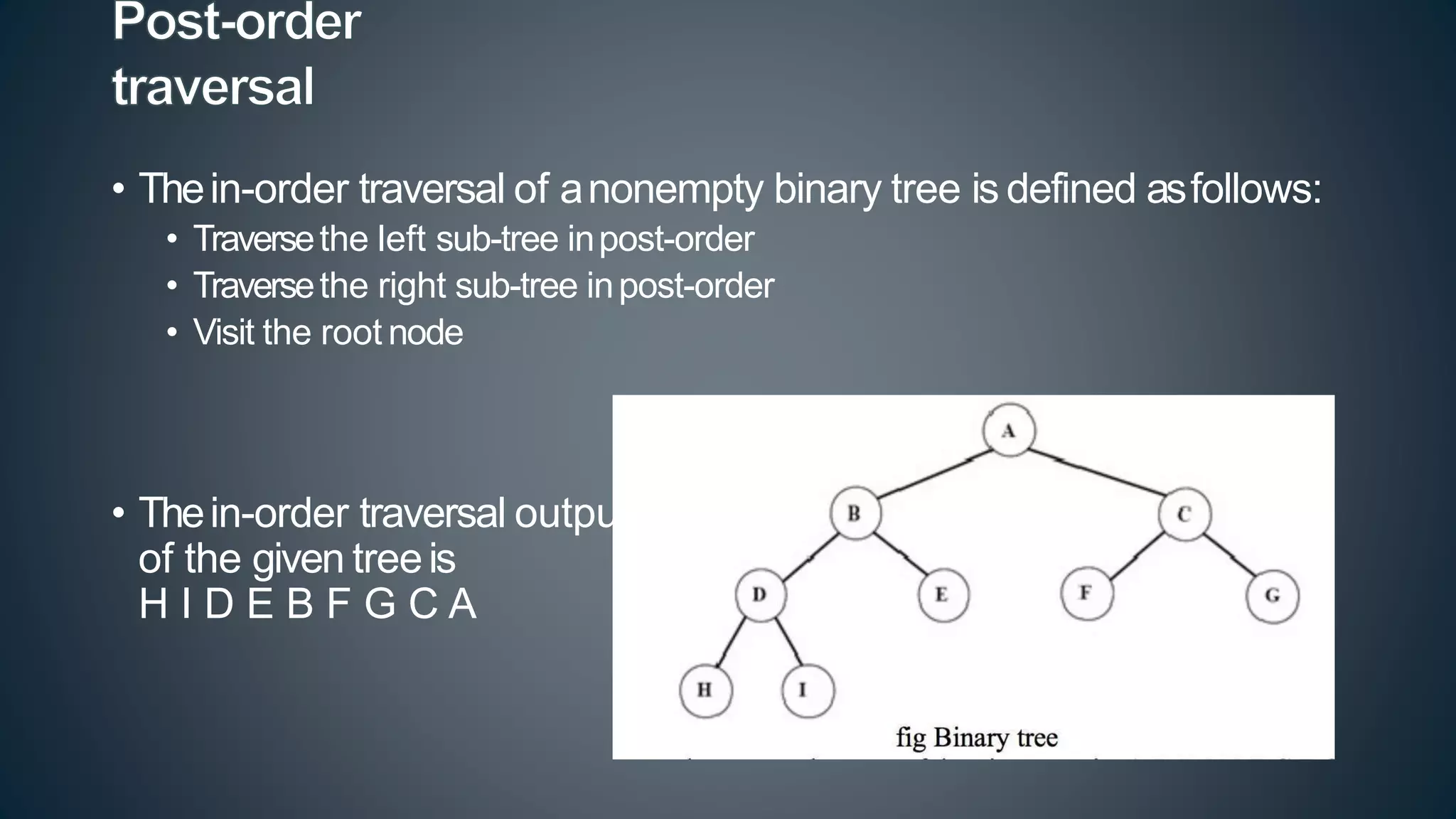
• Thein-order traversal of anonempty binary tree is defined asfollows:
• Traversethe left sub-tree inpost-order
• Traversethe right sub-tree inpost-order
• Visit the root node
• Thein-order traversal output
of the given treeis
H I D E B F G C A
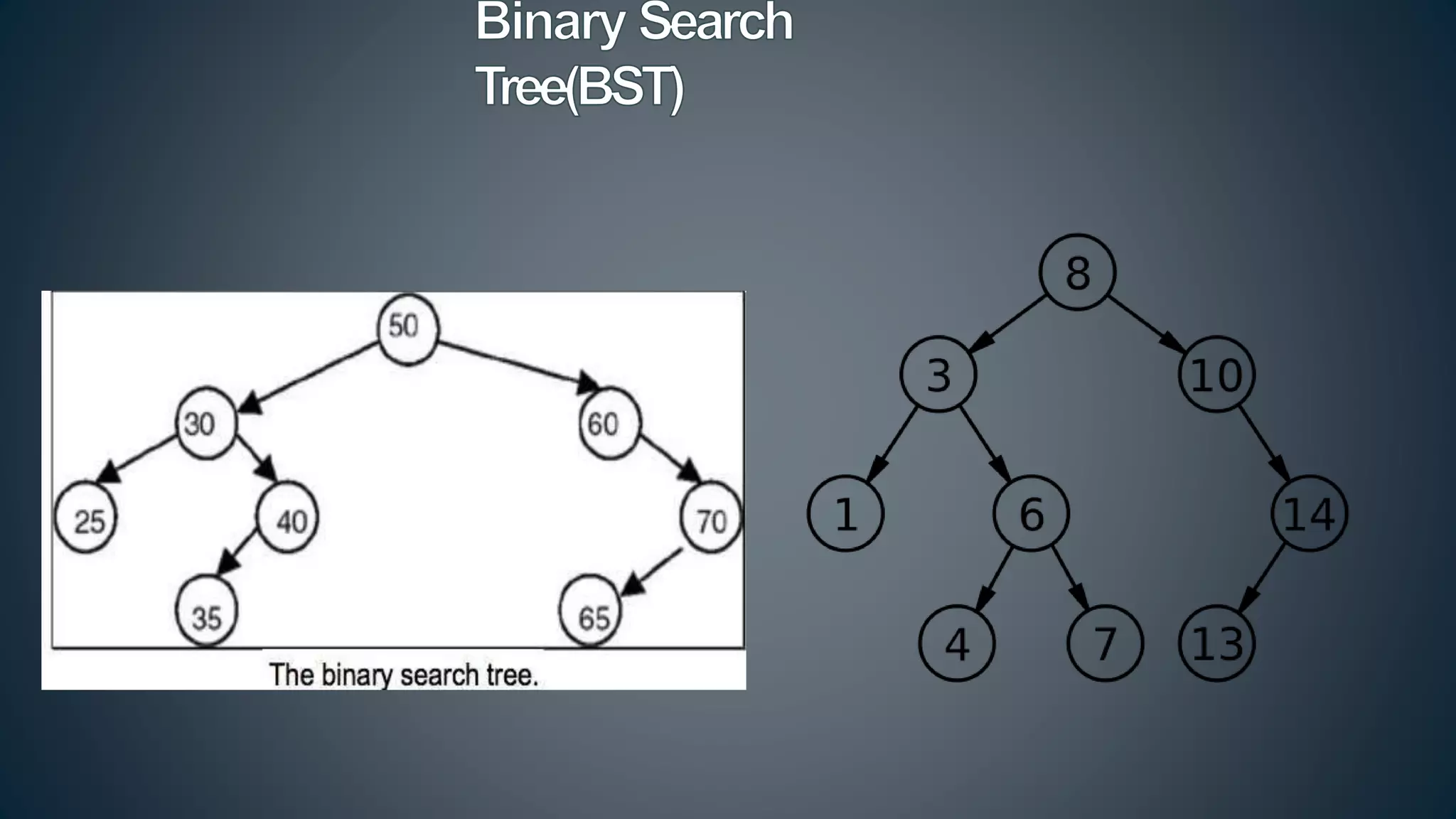
• A binary search tree (BST) is a binary tree that is either empty or in
which every node contains a key (value) and satisfies the following
conditions:
• All keys in the left sub-tree of the root are smaller than the key in the root
node
• All keysin the right sub-tree of the root are greater than the keyin the root
node
• Theleft and right sub-trees of the root are again binary search trees
• Abinary search tree is basically abinary tree, and therefore it canbe
traversed in inorder, preorder andpostorder.
• If we traverse abinary search tree in inorder and print the identifiers
contained in the nodes of the tree, we get asorted list of identifiers in
ascending order.
• Following operations canbe done in BST
:
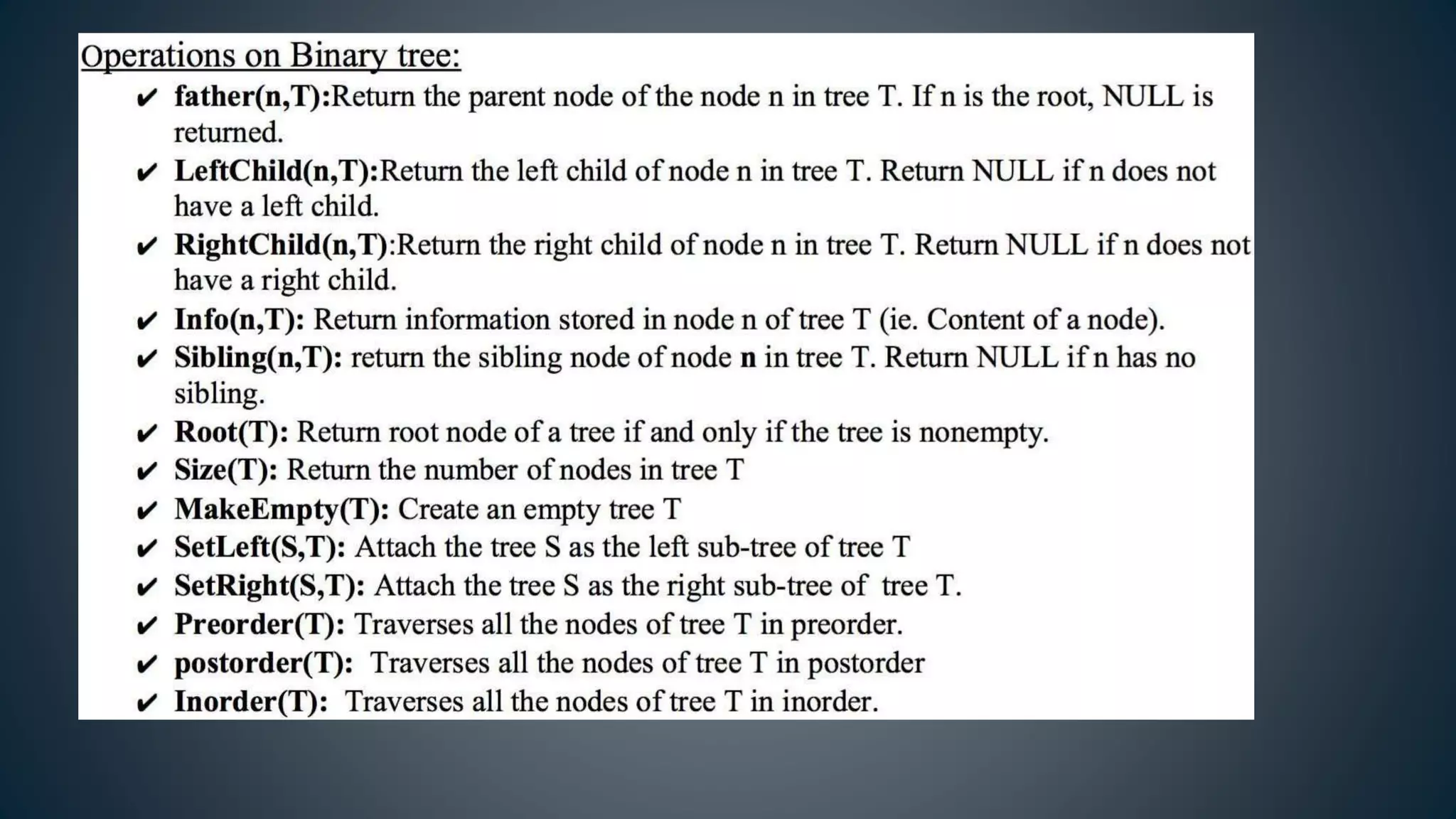
• Search(k,T):Searchfor keyk in the tree T
.If k is found in somenode oftree
then return true otherwise returnfalse.
• Insert(k,T):Insert anew node with value k in the info field in the tree Tsuch
that the property of BSTismaintained.
• Delete(k, T):Delete anode with value k in the info field from the tree Tsuch
that the property of BSTismaintained.
• FindMin(T), FindMax(T): Find minimum and maximum element from the
given nonempty BST
.
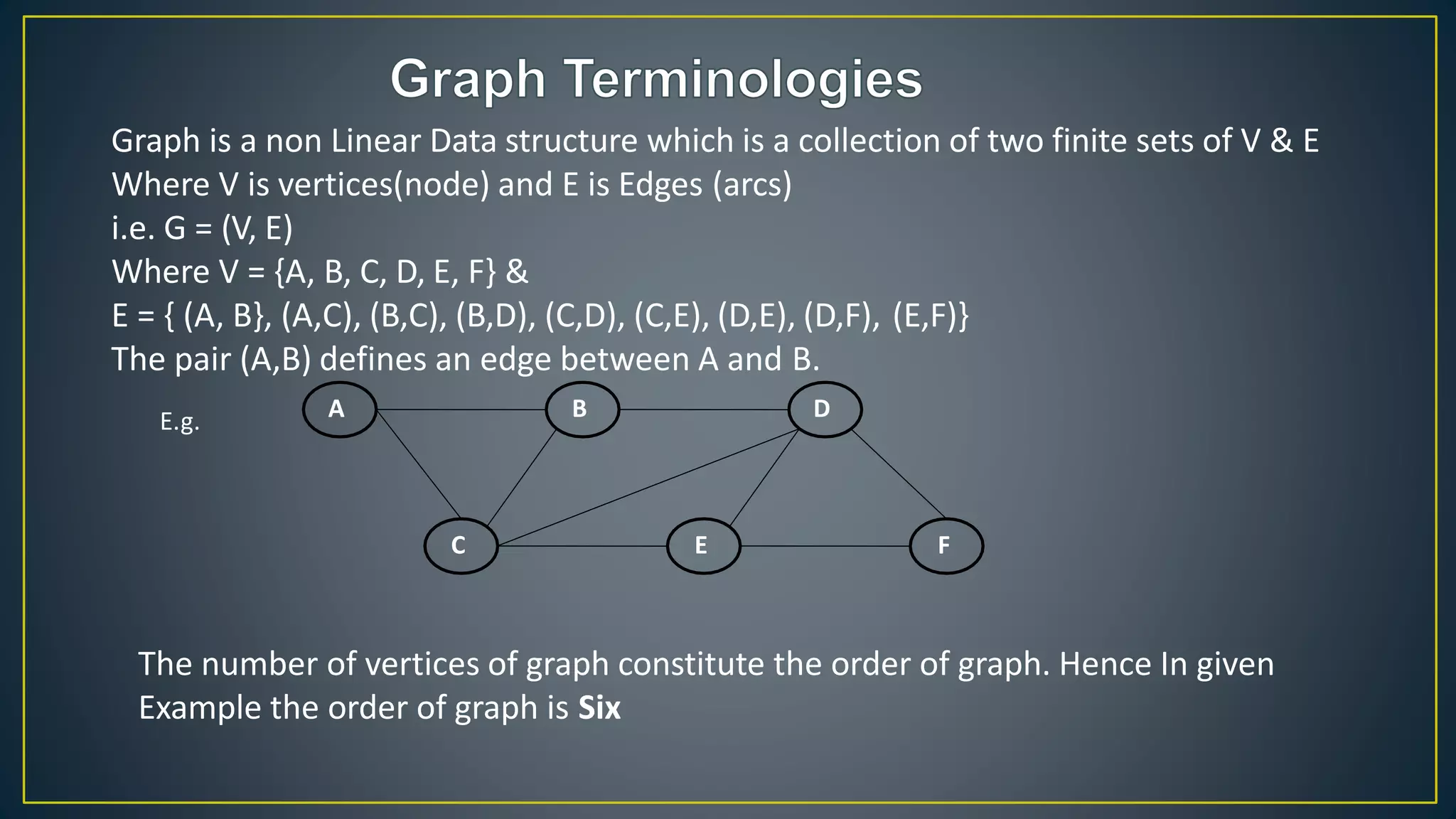
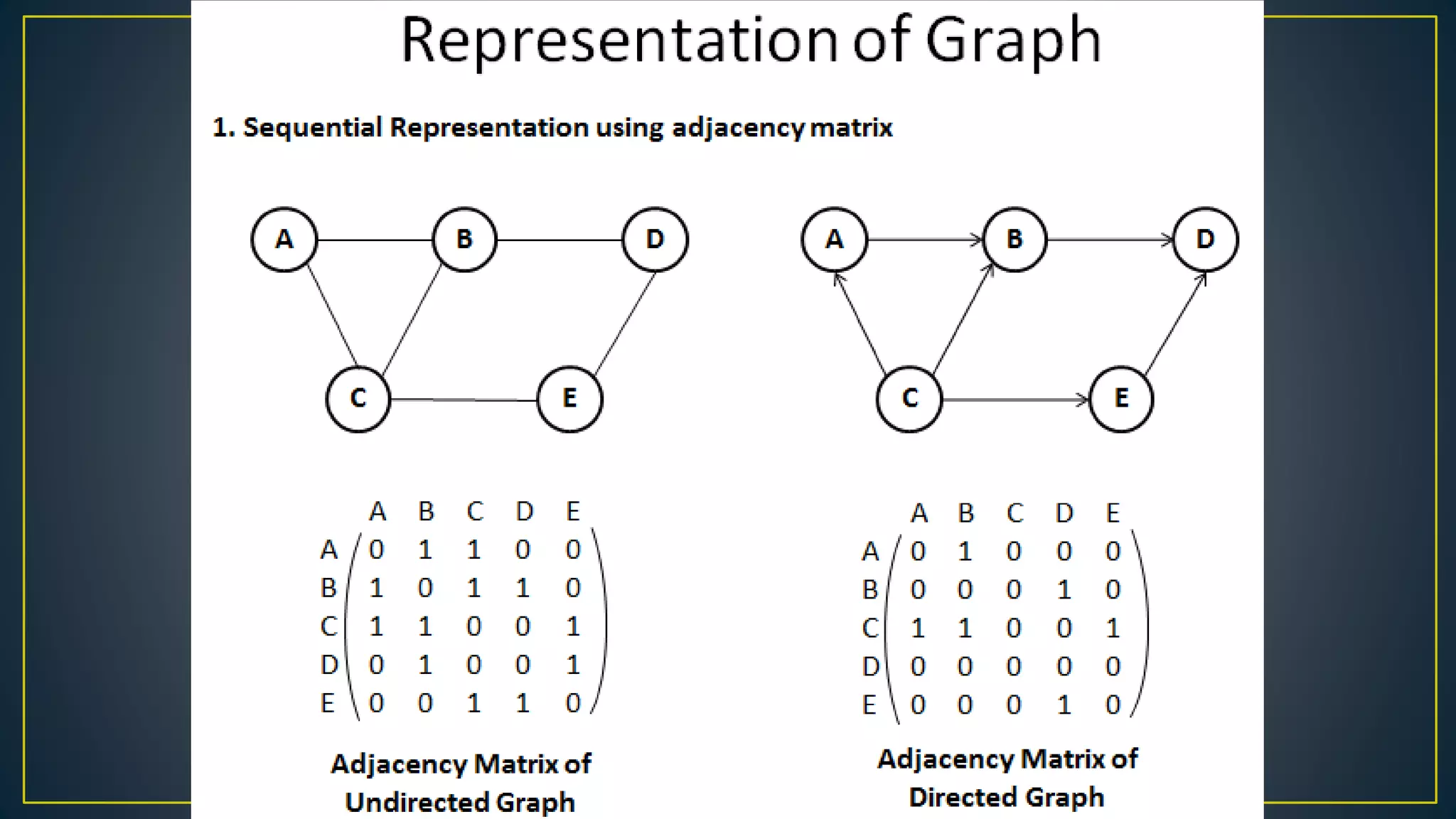
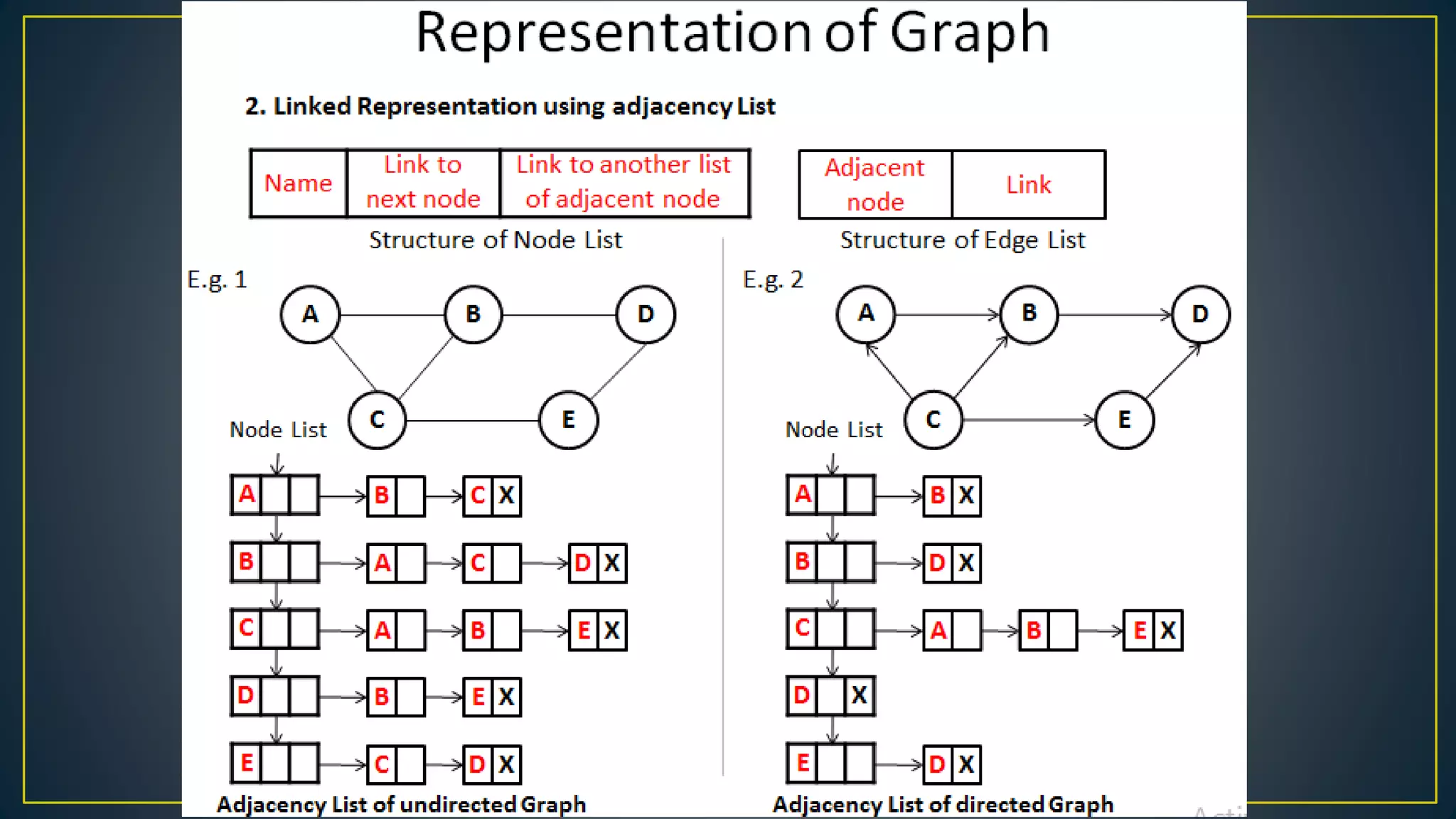
Graph is a non Linear Data structure which is a collection of two finite sets of V & E
Where V is vertices(node) and E is Edges (arcs)
i.e. G = (V, E)
Where V = {A, B, C, D, E, F} &
E = { (A, B}, (A,C), (B,C), (B,D), (C,D), (C,E), (D,E), (D,F), (E,F)}
The pair (A,B) defines an edge between A and B.
A
E.g. B D
C E F
The number of vertices of graph constitute the order of graph. Hence In given
Example the order of graph is Six
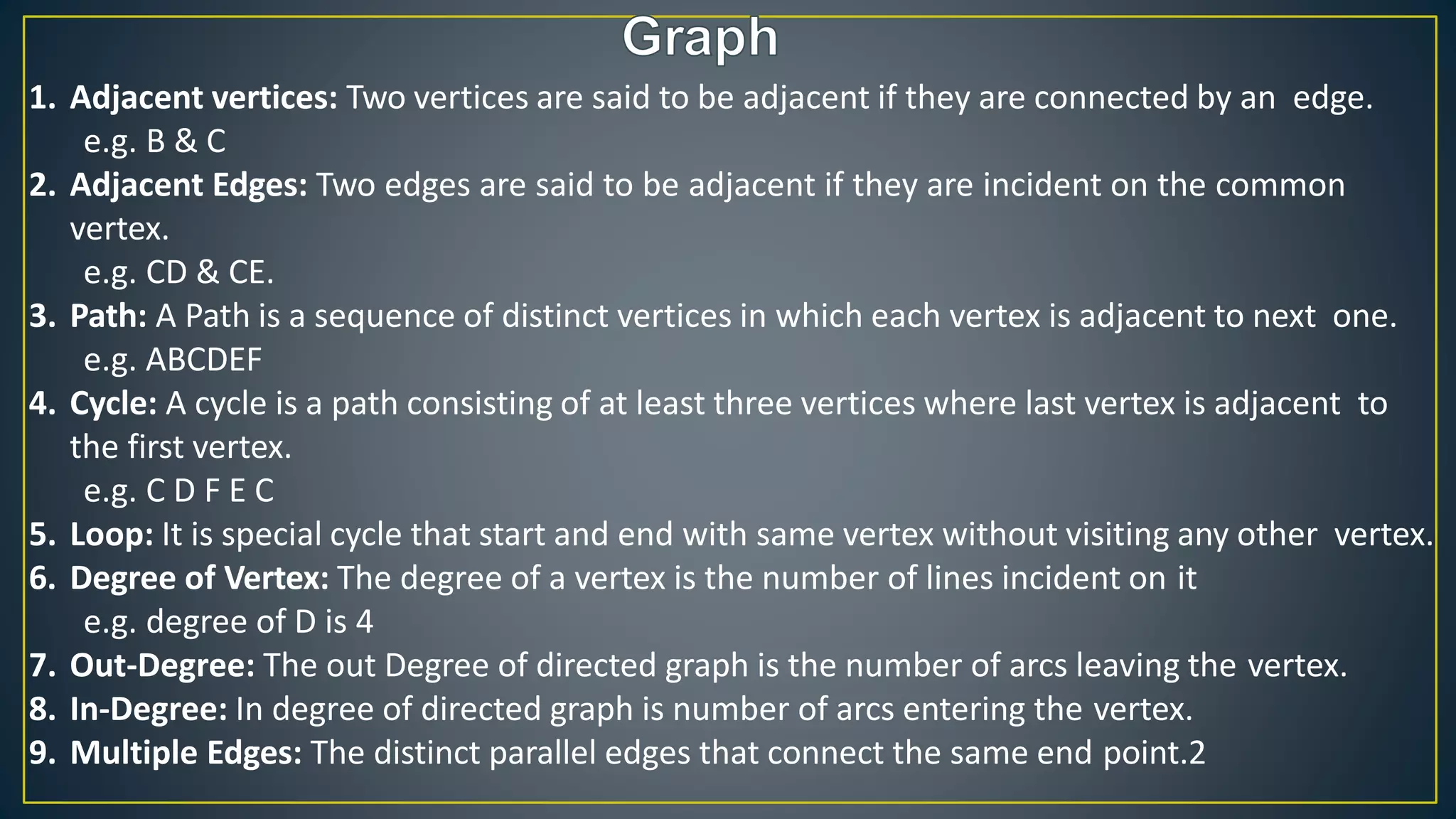
1. Adjacent vertices: Two vertices are said to be adjacent if they are connected by an edge.
e.g. B & C
2. Adjacent Edges: Two edges are said to be adjacent if they are incident on the common
vertex.
e.g. CD & CE.
3. Path: A Path is a sequence of distinct vertices in which each vertex is adjacent to next one.
e.g. ABCDEF
4. Cycle: A cycle is a path consisting of at least three vertices where last vertex is adjacent to
the first vertex.
e.g. C D F E C
5. Loop: It is special cycle that start and end with same vertex without visiting any other vertex.
6. Degree of Vertex: The degree of a vertex is the number of lines incident on it
e.g. degree of D is 4
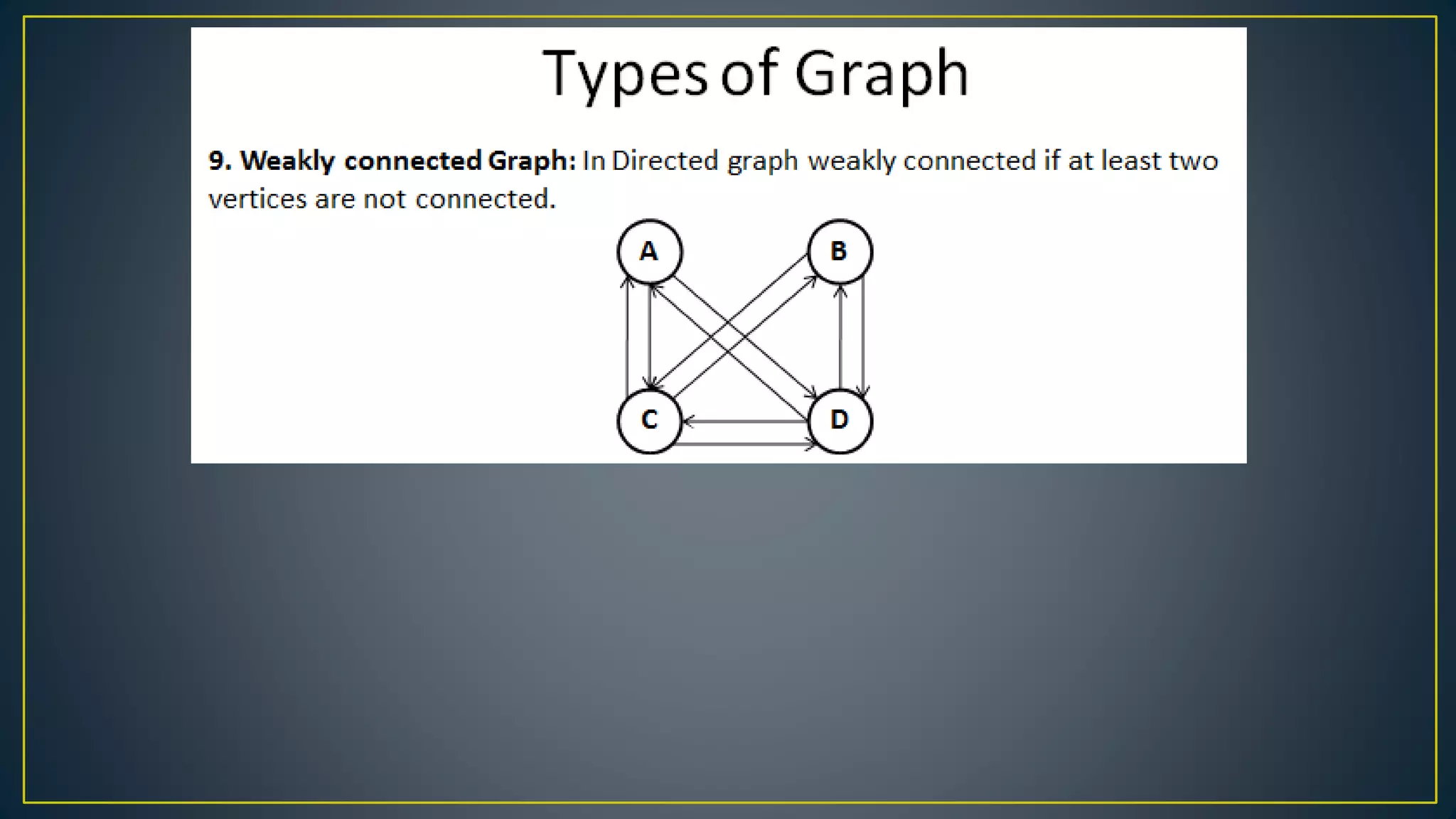
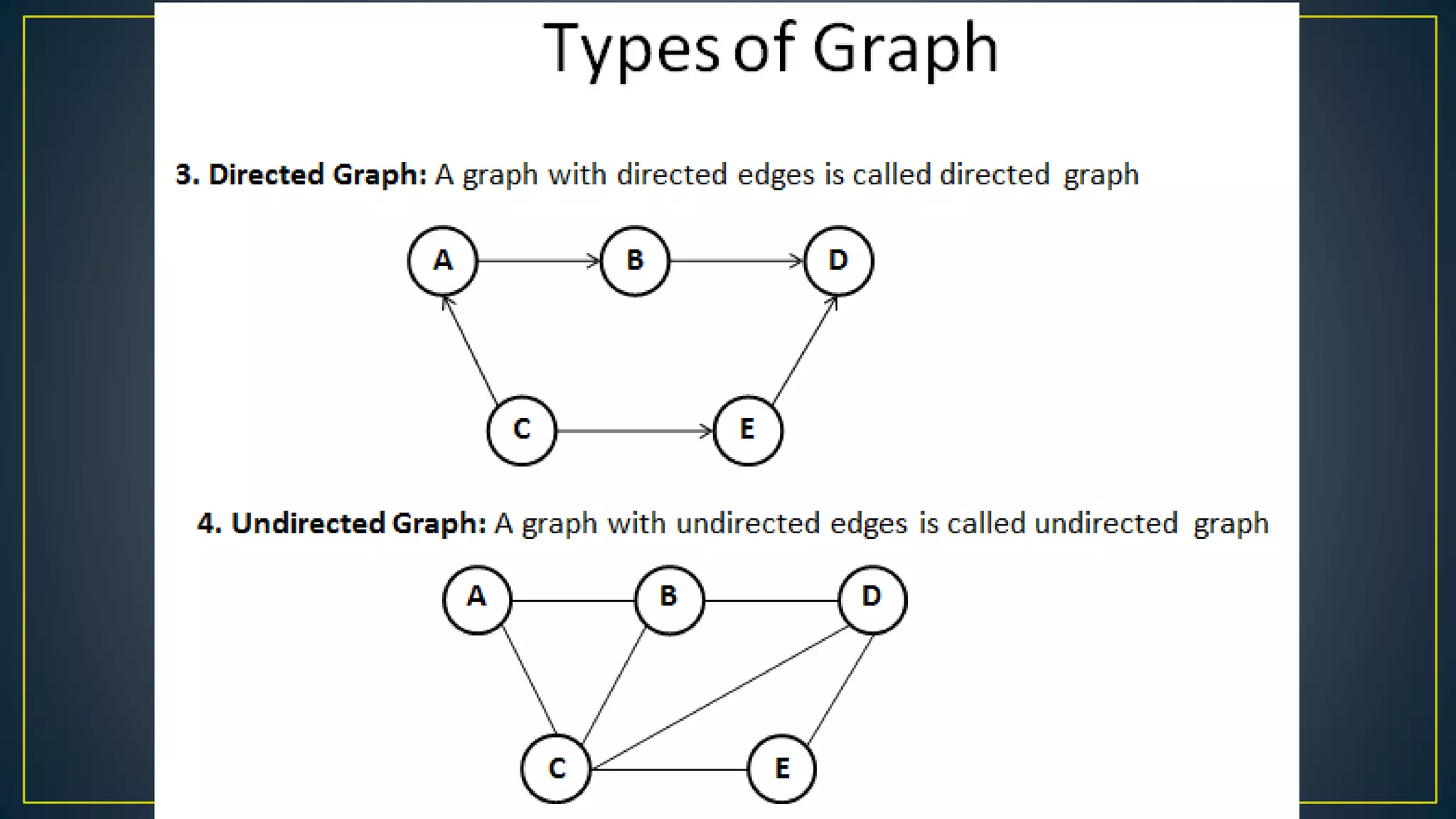
7. Out-Degree: The out Degree of directed graph is the number of arcs leaving the vertex.
8. In-Degree: In degree of directed graph is number of arcs entering the vertex.
9. Multiple Edges: The distinct parallel edges that connect the same end point.2
DSA-Unit-2.pptx
DSA-Unit-2.pptx
DSA-Unit-2.pptx
DSA-Unit-2.pptx
DSA-Unit-2.pptx
DSA-Unit-2.pptx
DSA-Unit-2.pptx

DSA-Unit-2.pptx

  • 1.
    Data Structures andAlgorithms Unit - II
  • 2.
    Unit II Trees –Binary tree representations – Tree Traversal – Threaded Binary Trees – Binary Tree Representation of Trees – Graphs and Representations – Traversals, Connected Components and Spanning Trees – Shortest Paths and Transitive closure – Activity Networks – Topological Sort and Critical Paths.
  • 3.
    • Atree isan abstract model of ahierarchical structure that consistsof nodes with aparent-child relationship. • Treeis asequence of nodes • There is astarting node known asaroot node • Everynode other than the root hasaparentnode. • Nodes mayhaveany number of children
  • 6.
    • Root −Nodeat the top of the treeis called root. • Parent −Any node except root node has one edge upward to a node called parent. • Child − Node below agiven node connected by its edge downward is called its child node. • Sibling – Child of same node are called siblings • Leaf −Node which does not have any child node is called leaf node. • Subtree −Subtree represents descendants of a node. • Levels −Level of anode represents the generation of anode. If root node is at level 0, then itsnext child node is at level 1, its grandchild is at level 2 and soon. • keys−Keyrepresents avalue of anode based on which asearch operation is to be carried out for anode.
  • 7.
    • Degree ofanode: • Thedegree of anode is the number of children of that node • Degree of aTree: • Thedegree of atree is the maximum degree of nodes in agiventree • Path: • It is the sequence of consecutive edges from source node to destination node. • Height of anode: • Theheight of anode is the maxpath length form that node to aleaf node. • Height of atree: • Theheight of atree is the height ofthe root • Depth of atree: • Depth of atree is the maxlevel of any leaf in the tree
  • 9.
    • Non-linear datastructure • Combinesadvantages of an ordered array • Searchingasfast asin ordered array • Insertion and deletion asfast asin linked list • Simple and fast
  • 10.
    • Directory structureof afile store • Structure of an arithmetic expressions • Used in almost every 3D video game to determine what objects need to be rendered. • Used in almost every high-bandwidth router for storingrouter- tables. • used in compression algorithms, such asthose used by the .jpeg and .mp3 file- formats.
  • 11.
    • Abinary tree,is atree in which no node canhavemore than two children. • Consider abinary tree T ,here ‘A’is the root node of the binary treeT . • ‘B’ is the left child of ‘A’and ‘C’is theright child of ‘A’ • i.e Ais afather of BandC. • Thenode Band Care called siblings. • Nodes D,H,I,F ,Jare leafnode
  • 12.
    • Abinary tree,T,is either empty or suchthat III. I. Thasaspecial node called the root node II. Thastwo sets of nodes L Tand RT ,called the left subtree and right subtree of T, respectively. L Tand RTare binarytrees.
  • 13.
    • Abinary treeis a finite set of elements that are either empty or is partitioned into three disjointsubsets. • Thefirst subset contains asingle element called the root of the tree. • Theother two subsets are themselves binary trees called the left and right sub-trees of the originaltree. • Aleft or right sub-tree canbeempty. • Eachelement of abinary tree is called anode of thetree.
  • 15.
    • Theroot nodeof this binary tree isA. • Theleft sub tree of the root node, which we denoted by LA,is theset LA ={B,D,E,G}and the right sub tree of the root node, RAis the set RA={C,F ,H} • Theroot node of LAis node B,the root node of RAis Cand soon
  • 16.
    • Complete binarytree • Strictly binary tree • Almost complete binary tree
  • 17.
    • If everynon-leaf node in abinary tree hasnonempty leftand right sub-trees, then suchatree is called astrictly binarytree. • Or,to put it another way,all of the nodes in astrictly binary tree are of degree zero or two, never degreeone. • Astrictly binary tree with Nleavesalwayscontains 2N– 1 nodes.
  • 18.
    • Acompletebinarytree isabinarytree in which every level, except possiblythe last, is completely filled, and all nodes are asfar leftaspossible. • Acompletebinarytreeof depth d is called strictly binary tree if all of whose leavesare at level d. • Acomplete binary tree has2d nodes at every depthd and 2d -1 non leaf nodes
  • 19.
    • Analmost completebinary tree is atree where for aright child, thereis alwaysa left child, but for aleft child there may not be aright child.
  • 22.
    • Traversalis aprocesstovisit all the nodes of atree and mayprinttheir values too. • All nodes are connected via edges(links) we alwaysstart from theroot (head)node. • There are three wayswhich we useto traverse atree • In-orderTraversal • Pre-orderTraversal • Post-orderTraversal • Generally we traverse atree to search or locate given item or keyin the tree or to print all the values it contains.
  • 23.
  • 24.
    • Thepreorder traversalof anonempty binary tree is defined asfollows: • Visit the root node • Traversethe left sub-tree inpreorder • Traversethe right sub-tree inpreorder
  • 25.
    • Thein-order traversalof anonempty binary tree is defined asfollows: • Traversethe left sub-tree inin-order • Visit the root node • Traversethe right sub-tree ininorder • Thein-order traversal output of the given treeis H D I B E A F C G
  • 26.
    • Thein-order traversalof anonempty binary tree is defined asfollows: • Traversethe left sub-tree inpost-order • Traversethe right sub-tree inpost-order • Visit the root node • Thein-order traversal output of the given treeis H I D E B F G C A
  • 27.
    • A binarysearch tree (BST) is a binary tree that is either empty or in which every node contains a key (value) and satisfies the following conditions: • All keys in the left sub-tree of the root are smaller than the key in the root node • All keysin the right sub-tree of the root are greater than the keyin the root node • Theleft and right sub-trees of the root are again binary search trees
  • 29.
    • Abinary searchtree is basically abinary tree, and therefore it canbe traversed in inorder, preorder andpostorder. • If we traverse abinary search tree in inorder and print the identifiers contained in the nodes of the tree, we get asorted list of identifiers in ascending order.
  • 30.
    • Following operationscanbe done in BST : • Search(k,T):Searchfor keyk in the tree T .If k is found in somenode oftree then return true otherwise returnfalse. • Insert(k,T):Insert anew node with value k in the info field in the tree Tsuch that the property of BSTismaintained. • Delete(k, T):Delete anode with value k in the info field from the tree Tsuch that the property of BSTismaintained. • FindMin(T), FindMax(T): Find minimum and maximum element from the given nonempty BST .
  • 35.
    Graph is anon Linear Data structure which is a collection of two finite sets of V & E Where V is vertices(node) and E is Edges (arcs) i.e. G = (V, E) Where V = {A, B, C, D, E, F} & E = { (A, B}, (A,C), (B,C), (B,D), (C,D), (C,E), (D,E), (D,F), (E,F)} The pair (A,B) defines an edge between A and B. A E.g. B D C E F The number of vertices of graph constitute the order of graph. Hence In given Example the order of graph is Six
  • 36.
    1. Adjacent vertices:Two vertices are said to be adjacent if they are connected by an edge. e.g. B & C 2. Adjacent Edges: Two edges are said to be adjacent if they are incident on the common vertex. e.g. CD & CE. 3. Path: A Path is a sequence of distinct vertices in which each vertex is adjacent to next one. e.g. ABCDEF 4. Cycle: A cycle is a path consisting of at least three vertices where last vertex is adjacent to the first vertex. e.g. C D F E C 5. Loop: It is special cycle that start and end with same vertex without visiting any other vertex. 6. Degree of Vertex: The degree of a vertex is the number of lines incident on it e.g. degree of D is 4 7. Out-Degree: The out Degree of directed graph is the number of arcs leaving the vertex. 8. In-Degree: In degree of directed graph is number of arcs entering the vertex. 9. Multiple Edges: The distinct parallel edges that connect the same end point.2