DATA STRUCTURES
Definitions
■ Data :-values or set of values.
– Each student's test score is one piece of data.
■ Information:- defined as meaningful data or processed data.
– The average score of a class or of the entire school is information that can be derived from the
given data.
DataVs Information
■ Data is raw, unorganized facts that need to be
processed.
■ Data can be something simple and seemingly
random and useless until it is organized.
■ Data is independent.
■ When data is processed, organized,
structured or presented in a given context so
as to make it useful, it is called information.
■ Information is dependent on data.
Now,What is data structure?
■ Data Structure is a way of collecting and organising data in such a way that we can
perform operations on these data in an effective way.
■ Data Structures is about rendering data elements in terms of some relationship, for
better organization and storage.
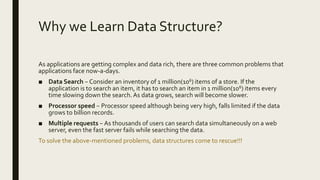
Why we Learn Data Structure?
As applications are getting complex and data rich, there are three common problems that
applications face now-a-days.
■ Data Search − Consider an inventory of 1 million(106) items of a store. If the
application is to search an item, it has to search an item in 1 million(106) items every
time slowing down the search.As data grows, search will become slower.
■ Processor speed − Processor speed although being very high, falls limited if the data
grows to billion records.
■ Multiple requests − As thousands of users can search data simultaneously on a web
server, even the fast server fails while searching the data.
To solve the above-mentioned problems, data structures come to rescue!!!
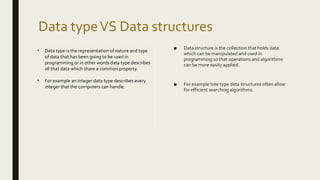
Data typeVS Data structures
• Data type is the representation of nature and type
of data that has been going to be used in
programming or in other words data type describes
all that data which share a common property.
• For example an integer data type describes every
integer that the computers can handle.
■ Data structure is the collection that holds data
which can be manipulated and used in
programming so that operations and algorithms
can be more easily applied.
■ For example tree type data structures often allow
for efficient searching algorithms.
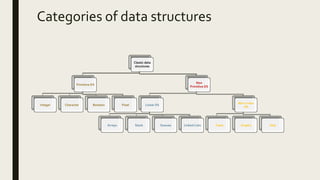
Categories of data structures
Classic data
structures
Primitive DS
integer Character Boolean Float
Non
Primitive DS
Linear DS
Arrays Stack Queues Linked Lists
Non Linear
DS
Trees Graphs Sets
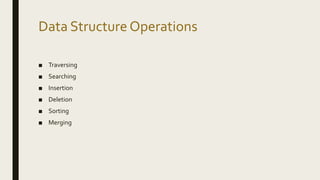
Data Structure Operations
■ Traversing
■ Searching
■ Insertion
■ Deletion
■ Sorting
■ Merging

Data structures

  • 1.
  • 2.
    Definitions ■ Data :-valuesor set of values. – Each student's test score is one piece of data. ■ Information:- defined as meaningful data or processed data. – The average score of a class or of the entire school is information that can be derived from the given data.
  • 3.
    DataVs Information ■ Datais raw, unorganized facts that need to be processed. ■ Data can be something simple and seemingly random and useless until it is organized. ■ Data is independent. ■ When data is processed, organized, structured or presented in a given context so as to make it useful, it is called information. ■ Information is dependent on data.
  • 4.
    Now,What is datastructure? ■ Data Structure is a way of collecting and organising data in such a way that we can perform operations on these data in an effective way. ■ Data Structures is about rendering data elements in terms of some relationship, for better organization and storage.
  • 5.
    Why we LearnData Structure? As applications are getting complex and data rich, there are three common problems that applications face now-a-days. ■ Data Search − Consider an inventory of 1 million(106) items of a store. If the application is to search an item, it has to search an item in 1 million(106) items every time slowing down the search.As data grows, search will become slower. ■ Processor speed − Processor speed although being very high, falls limited if the data grows to billion records. ■ Multiple requests − As thousands of users can search data simultaneously on a web server, even the fast server fails while searching the data. To solve the above-mentioned problems, data structures come to rescue!!!
  • 6.
    Data typeVS Datastructures • Data type is the representation of nature and type of data that has been going to be used in programming or in other words data type describes all that data which share a common property. • For example an integer data type describes every integer that the computers can handle. ■ Data structure is the collection that holds data which can be manipulated and used in programming so that operations and algorithms can be more easily applied. ■ For example tree type data structures often allow for efficient searching algorithms.
  • 7.
    Categories of datastructures Classic data structures Primitive DS integer Character Boolean Float Non Primitive DS Linear DS Arrays Stack Queues Linked Lists Non Linear DS Trees Graphs Sets
  • 8.
    Data Structure Operations ■Traversing ■ Searching ■ Insertion ■ Deletion ■ Sorting ■ Merging