DATA STRUCTURE
AND
ALGORITHMS
INTRODUCTION TO
DATA STRUCTURE
AND
ABSTRACT DATA
TYPES
What is Data Structure?
•Data structure is a representation of
data and the operations allowed on
that data.
• A data structure is a way to store and organize data
in order to facilitate the access and modifications.
• Data Structure are the method of representing of
logical relationships between individual data
elements related to the solution of a given problem.
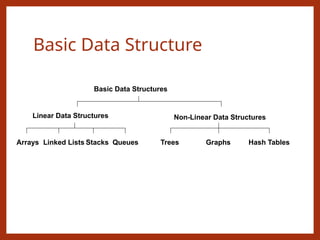
Basic Data Structure
Basic Data Structures
Linear Data Structures Non-Linear Data Structures
Arrays Linked Lists Stacks Queues Trees Graphs Hash Tables
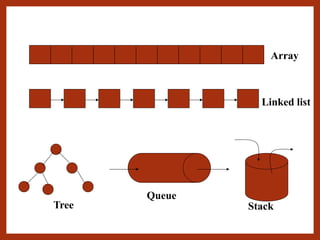
Array
Linked list
Tree
Queue
Stack
Selection of Data Structure
•The choice of particular data model
depends on two consideration:
•It must be rich enough in structure to
represent the relationship between data
elements
•The structure should be simple enough that
one can effectively process the data when
necessary
Types of Data Structure
•Linear: In Linear data structure, values
are arrange in linear fashion.
•Array: Fixed-size
•Linked-list: Variable-size
•Stack: Add to top and remove from top
•Queue: Add to back and remove from front
•Priority queue: Add anywhere, remove the
highest priority
Types of Data Structure
•Non-Linear: The data values in this
structure are not arranged in order.
•Hash tables: Unordered lists which use a
‘hash function’ to insert and search
•Tree: Data is organized in branches.
•Graph: A more general branching structure,
with less strict connection conditions than for
a tree
Type of Data Structures
•Homogenous: In this type of data
structures, values of the same types of
data are stored.
• Array
•Non-Homogenous: In this type of data
structures, data values of different types
are grouped and stored.
• Structures
• Classes
Abstract Data Type and Data
Structure
•Definition:
• Abstract Data Types (ADTs) stores data and allow
various operations on the data to access and change
it.
• A mathematical model, together with various
operations defined on the model
• An ADT is a collection of data and associated
operations for manipulating that data
•Data Structures
• Physical implementation of an ADT
• data structures used in implementations are provided
in a language (primitive or built-in) or are built from the
language constructs (user-defined)
• Each operation associated with the ADT is implemented
by one or more subroutines in the implementation
Abstract Data Type
• ADTs support abstraction, encapsulation, and
information hiding.
• Abstraction is the structuring of a problem into
well-defined entities by defining their data and
operations.
• The principle of hiding the used data structure
and to only provide a well-defined interface is
known as encapsulation.
The Core Operations of ADT
•Every Collection ADT should provide a
way to:
• add an item
• remove an item
• find, retrieve, or access an item
•Many, many more possibilities
• is the collection empty
• make the collection empty
• give me a sub set of the collection
Need to remember:
• No single data structure works
well for all purposes, and so it is
important to know the strengths
and limitations of several of
them.
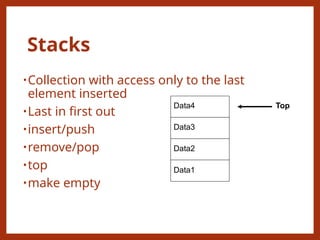
Stacks
•Collection with access only to the last
element inserted
•Last in first out
•insert/push
•remove/pop
•top
•make empty
Top
Data4
Data3
Data2
Data1
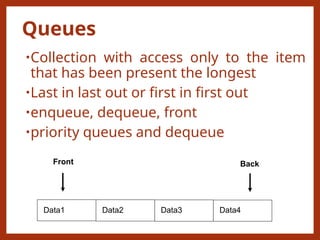
Queues
•Collection with access only to the item
that has been present the longest
•Last in last out or first in first out
•enqueue, dequeue, front
•priority queues and dequeue
Data4
Data3
Data2
Data1
Front Back
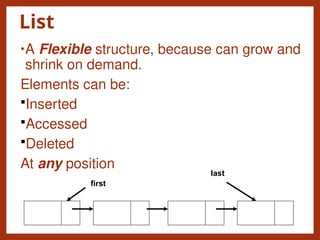
List
•A Flexible structure, because can grow and
shrink on demand.
Elements can be:
Inserted
Accessed
Deleted
At any position
first
last
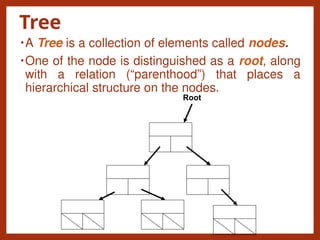
Tree
•A Tree is a collection of elements called nodes.
•One of the node is distinguished as a root, along
with a relation (“parenthood”) that places a
hierarchical structure on the nodes.
Root
523453185-Data-Structure-and-Algorithms-Lecture-1.pptx

  • 1.
  • 2.
  • 3.
    What is DataStructure? •Data structure is a representation of data and the operations allowed on that data. • A data structure is a way to store and organize data in order to facilitate the access and modifications. • Data Structure are the method of representing of logical relationships between individual data elements related to the solution of a given problem.
  • 4.
    Basic Data Structure BasicData Structures Linear Data Structures Non-Linear Data Structures Arrays Linked Lists Stacks Queues Trees Graphs Hash Tables
  • 5.
  • 6.
    Selection of DataStructure •The choice of particular data model depends on two consideration: •It must be rich enough in structure to represent the relationship between data elements •The structure should be simple enough that one can effectively process the data when necessary
  • 7.
    Types of DataStructure •Linear: In Linear data structure, values are arrange in linear fashion. •Array: Fixed-size •Linked-list: Variable-size •Stack: Add to top and remove from top •Queue: Add to back and remove from front •Priority queue: Add anywhere, remove the highest priority
  • 8.
    Types of DataStructure •Non-Linear: The data values in this structure are not arranged in order. •Hash tables: Unordered lists which use a ‘hash function’ to insert and search •Tree: Data is organized in branches. •Graph: A more general branching structure, with less strict connection conditions than for a tree
  • 9.
    Type of DataStructures •Homogenous: In this type of data structures, values of the same types of data are stored. • Array •Non-Homogenous: In this type of data structures, data values of different types are grouped and stored. • Structures • Classes
  • 10.
    Abstract Data Typeand Data Structure •Definition: • Abstract Data Types (ADTs) stores data and allow various operations on the data to access and change it. • A mathematical model, together with various operations defined on the model • An ADT is a collection of data and associated operations for manipulating that data •Data Structures • Physical implementation of an ADT • data structures used in implementations are provided in a language (primitive or built-in) or are built from the language constructs (user-defined) • Each operation associated with the ADT is implemented by one or more subroutines in the implementation
  • 11.
    Abstract Data Type •ADTs support abstraction, encapsulation, and information hiding. • Abstraction is the structuring of a problem into well-defined entities by defining their data and operations. • The principle of hiding the used data structure and to only provide a well-defined interface is known as encapsulation.
  • 12.
    The Core Operationsof ADT •Every Collection ADT should provide a way to: • add an item • remove an item • find, retrieve, or access an item •Many, many more possibilities • is the collection empty • make the collection empty • give me a sub set of the collection
  • 13.
    Need to remember: •No single data structure works well for all purposes, and so it is important to know the strengths and limitations of several of them.
  • 14.
    Stacks •Collection with accessonly to the last element inserted •Last in first out •insert/push •remove/pop •top •make empty Top Data4 Data3 Data2 Data1
  • 15.
    Queues •Collection with accessonly to the item that has been present the longest •Last in last out or first in first out •enqueue, dequeue, front •priority queues and dequeue Data4 Data3 Data2 Data1 Front Back
  • 16.
    List •A Flexible structure,because can grow and shrink on demand. Elements can be: Inserted Accessed Deleted At any position first last
  • 17.
    Tree •A Tree isa collection of elements called nodes. •One of the node is distinguished as a root, along with a relation (“parenthood”) that places a hierarchical structure on the nodes. Root