
Data Science
Data Preprocessing
(Data Cleaning)
Data Preprocessing
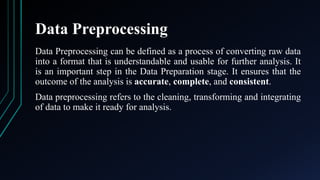
Data Preprocessing can be defined as a process of converting raw data
into a format that is understandable and usable for further analysis. It
is an important step in the Data Preparation stage. It ensures that the
outcome of the analysis is accurate, complete, and consistent.
Data preprocessing refers to the cleaning, transforming and integrating
of data to make it ready for analysis.
Data
Preprocessing
Data
Integration
Data
Transforma
tion
Data
Reduction
or
dimension
reduction
Data
Cleaning
Scaling, Normalization,
Categorical Encoding
Handling missing
values Outliers,
duplicates
Selecting relevant
features/Column, Data
Combining multiple
datasets/ Merging
Data Cleaning
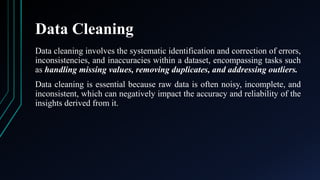
Data cleaning involves the systematic identification and correction of errors,
inconsistencies, and inaccuracies within a dataset, encompassing tasks such
as handling missing values, removing duplicates, and addressing outliers.
Data cleaning is essential because raw data is often noisy, incomplete, and
inconsistent, which can negatively impact the accuracy and reliability of the
insights derived from it.
Handling Missing Values
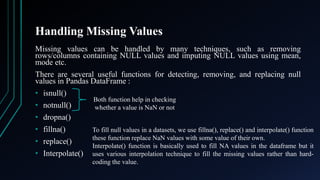
Missing values can be handled by many techniques, such as removing
rows/columns containing NULL values and imputing NULL values using mean,
mode etc.
There are several useful functions for detecting, removing, and replacing null
values in Pandas DataFrame :
• isnull()
• notnull()
• dropna()
• fillna()
• replace()
• Interpolate()
Both function help in checking
whether a value is NaN or not
To fill null values in a datasets, we use fillna(), replace() and interpolate() function
these function replace NaN values with some value of their own.
Interpolate() function is basically used to fill NA values in the dataframe but it
uses various interpolation technique to fill the missing values rather than hard-
coding the value.
Outliers
Outliers are data points that are stand out from the rest. It can be either
much higher or much lower than the other data points, and its presence can
have a significant impact on the results of machine learning algorithms.
They are unusual values that don’t follow the overall pattern of our data.
They represent errors in measurement, bad data collection, or simply show
variables not considered when collecting the data.
For example, in a group of 5 students the test grades were 29, 38, 39, 27, and
2. The last value seems to be an outlier because it falls below the main pattern of
the other grades.
27 - mean (with outlier)
33.25 - mean (without outlier)
Handling Outliers
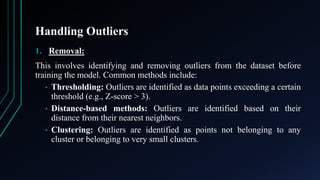
1. Removal:
This involves identifying and removing outliers from the dataset before
training the model. Common methods include:
• Thresholding: Outliers are identified as data points exceeding a certain
threshold (e.g., Z-score > 3).
• Distance-based methods: Outliers are identified based on their
distance from their nearest neighbors.
• Clustering: Outliers are identified as points not belonging to any
cluster or belonging to very small clusters.
Handling Outliers
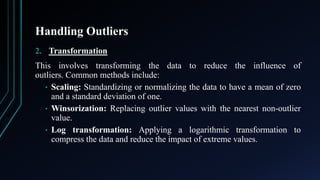
2. Transformation
This involves transforming the data to reduce the influence of
outliers. Common methods include:
• Scaling: Standardizing or normalizing the data to have a mean of zero
and a standard deviation of one.
• Winsorization: Replacing outlier values with the nearest non-outlier
value.
• Log transformation: Applying a logarithmic transformation to
compress the data and reduce the impact of extreme values.
Handling Outliers
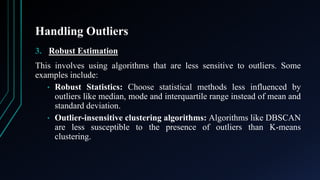
3. Robust Estimation
This involves using algorithms that are less sensitive to outliers. Some
examples include:
• Robust Statistics: Choose statistical methods less influenced by
outliers like median, mode and interquartile range instead of mean and
standard deviation.
• Outlier-insensitive clustering algorithms: Algorithms like DBSCAN
are less susceptible to the presence of outliers than K-means
clustering.
Handling Outliers
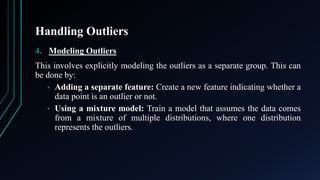
4. Modeling Outliers
This involves explicitly modeling the outliers as a separate group. This can
be done by:
• Adding a separate feature: Create a new feature indicating whether a
data point is an outlier or not.
• Using a mixture model: Train a model that assumes the data comes
from a mixture of multiple distributions, where one distribution
represents the outliers.
Handling Outliers
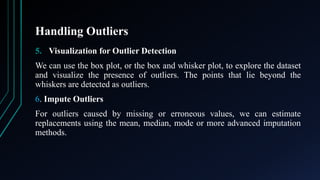
5. Visualization for Outlier Detection
We can use the box plot, or the box and whisker plot, to explore the dataset
and visualize the presence of outliers. The points that lie beyond the
whiskers are detected as outliers.
6. Impute Outliers
For outliers caused by missing or erroneous values, we can estimate
replacements using the mean, median, mode or more advanced imputation
methods.
Duplicates
Data points in a dataset that have the same values for all, or part of the
characteristics are said to have duplicate values. Due to problems with
data input, data collecting, or other circumstances, duplicate values
may appear.
These duplicate values add redundancy to our data and can make our
calculations go wrong.
Handling Duplicates
Duplicates can be handled in a variety of ways
The simplest and most straightforward way to handle duplicate data is to
delete it. This can reduce the noise and redundancy in our data, as well as
improve the efficiency and accuracy of our models.
For example, we can use the df.drop_duplicates() method in pandas to
remove duplicate rows or columns, specifying the subset, keep, and inplace
arguments.
In SQL we can use DISTINCT keyword in SELECT statement.
Thanks for Watching!

Data Science- Data Preprocessing, Data Cleaning.

  • 1.
  • 2.
    Data Preprocessing Data Preprocessingcan be defined as a process of converting raw data into a format that is understandable and usable for further analysis. It is an important step in the Data Preparation stage. It ensures that the outcome of the analysis is accurate, complete, and consistent. Data preprocessing refers to the cleaning, transforming and integrating of data to make it ready for analysis.
  • 3.
    Data Preprocessing Data Integration Data Transforma tion Data Reduction or dimension reduction Data Cleaning Scaling, Normalization, Categorical Encoding Handlingmissing values Outliers, duplicates Selecting relevant features/Column, Data Combining multiple datasets/ Merging
  • 4.
    Data Cleaning Data cleaninginvolves the systematic identification and correction of errors, inconsistencies, and inaccuracies within a dataset, encompassing tasks such as handling missing values, removing duplicates, and addressing outliers. Data cleaning is essential because raw data is often noisy, incomplete, and inconsistent, which can negatively impact the accuracy and reliability of the insights derived from it.
  • 5.
    Handling Missing Values Missingvalues can be handled by many techniques, such as removing rows/columns containing NULL values and imputing NULL values using mean, mode etc. There are several useful functions for detecting, removing, and replacing null values in Pandas DataFrame : • isnull() • notnull() • dropna() • fillna() • replace() • Interpolate() Both function help in checking whether a value is NaN or not To fill null values in a datasets, we use fillna(), replace() and interpolate() function these function replace NaN values with some value of their own. Interpolate() function is basically used to fill NA values in the dataframe but it uses various interpolation technique to fill the missing values rather than hard- coding the value.
  • 6.
    Outliers Outliers are datapoints that are stand out from the rest. It can be either much higher or much lower than the other data points, and its presence can have a significant impact on the results of machine learning algorithms. They are unusual values that don’t follow the overall pattern of our data. They represent errors in measurement, bad data collection, or simply show variables not considered when collecting the data. For example, in a group of 5 students the test grades were 29, 38, 39, 27, and 2. The last value seems to be an outlier because it falls below the main pattern of the other grades. 27 - mean (with outlier) 33.25 - mean (without outlier)
  • 7.
    Handling Outliers 1. Removal: Thisinvolves identifying and removing outliers from the dataset before training the model. Common methods include: • Thresholding: Outliers are identified as data points exceeding a certain threshold (e.g., Z-score > 3). • Distance-based methods: Outliers are identified based on their distance from their nearest neighbors. • Clustering: Outliers are identified as points not belonging to any cluster or belonging to very small clusters.
  • 8.
    Handling Outliers 2. Transformation Thisinvolves transforming the data to reduce the influence of outliers. Common methods include: • Scaling: Standardizing or normalizing the data to have a mean of zero and a standard deviation of one. • Winsorization: Replacing outlier values with the nearest non-outlier value. • Log transformation: Applying a logarithmic transformation to compress the data and reduce the impact of extreme values.
  • 9.
    Handling Outliers 3. RobustEstimation This involves using algorithms that are less sensitive to outliers. Some examples include: • Robust Statistics: Choose statistical methods less influenced by outliers like median, mode and interquartile range instead of mean and standard deviation. • Outlier-insensitive clustering algorithms: Algorithms like DBSCAN are less susceptible to the presence of outliers than K-means clustering.
  • 10.
    Handling Outliers 4. ModelingOutliers This involves explicitly modeling the outliers as a separate group. This can be done by: • Adding a separate feature: Create a new feature indicating whether a data point is an outlier or not. • Using a mixture model: Train a model that assumes the data comes from a mixture of multiple distributions, where one distribution represents the outliers.
  • 11.
    Handling Outliers 5. Visualizationfor Outlier Detection We can use the box plot, or the box and whisker plot, to explore the dataset and visualize the presence of outliers. The points that lie beyond the whiskers are detected as outliers. 6. Impute Outliers For outliers caused by missing or erroneous values, we can estimate replacements using the mean, median, mode or more advanced imputation methods.
  • 12.
    Duplicates Data points ina dataset that have the same values for all, or part of the characteristics are said to have duplicate values. Due to problems with data input, data collecting, or other circumstances, duplicate values may appear. These duplicate values add redundancy to our data and can make our calculations go wrong.
  • 13.
    Handling Duplicates Duplicates canbe handled in a variety of ways The simplest and most straightforward way to handle duplicate data is to delete it. This can reduce the noise and redundancy in our data, as well as improve the efficiency and accuracy of our models. For example, we can use the df.drop_duplicates() method in pandas to remove duplicate rows or columns, specifying the subset, keep, and inplace arguments. In SQL we can use DISTINCT keyword in SELECT statement.
  • 14.