
What is Data Science?
Applications of Data Science
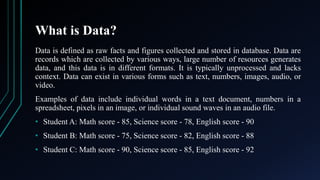
What is Data?
Data is defined as raw facts and figures collected and stored in database. Data are
records which are collected by various ways, large number of resources generates
data, and this data is in different formats. It is typically unprocessed and lacks
context. Data can exist in various forms such as text, numbers, images, audio, or
video.
Examples of data include individual words in a text document, numbers in a
spreadsheet, pixels in an image, or individual sound waves in an audio file.
• Student A: Math score - 85, Science score - 78, English score - 90
• Student B: Math score - 75, Science score - 82, English score - 88
• Student C: Math score - 90, Science score - 85, English score - 92
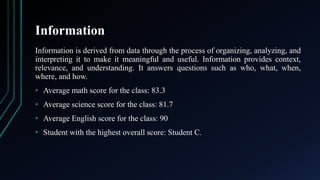
Information
Information is derived from data through the process of organizing, analyzing, and
interpreting it to make it meaningful and useful. Information provides context,
relevance, and understanding. It answers questions such as who, what, when,
where, and how.
• Average math score for the class: 83.3
• Average science score for the class: 81.7
• Average English score for the class: 90
• Student with the highest overall score: Student C.
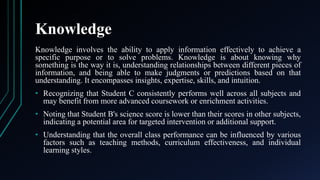
Knowledge
Knowledge involves the ability to apply information effectively to achieve a
specific purpose or to solve problems. Knowledge is about knowing why
something is the way it is, understanding relationships between different pieces of
information, and being able to make judgments or predictions based on that
understanding. It encompasses insights, expertise, skills, and intuition.
• Recognizing that Student C consistently performs well across all subjects and
may benefit from more advanced coursework or enrichment activities.
• Noting that Student B's science score is lower than their scores in other subjects,
indicating a potential area for targeted intervention or additional support.
• Understanding that the overall class performance can be influenced by various
factors such as teaching methods, curriculum effectiveness, and individual
learning styles.
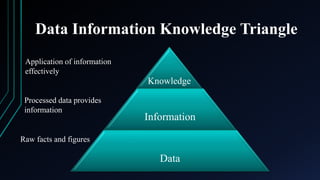
Data Information Knowledge Triangle
Knowledge
Information
Data
Processed data provides
information
Raw facts and figures
Application of information
effectively
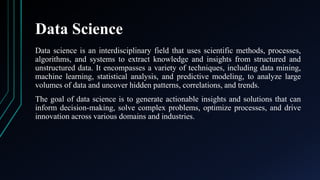
Data Science
Data science is an interdisciplinary field that uses scientific methods, processes,
algorithms, and systems to extract knowledge and insights from structured and
unstructured data. It encompasses a variety of techniques, including data mining,
machine learning, statistical analysis, and predictive modeling, to analyze large
volumes of data and uncover hidden patterns, correlations, and trends.
The goal of data science is to generate actionable insights and solutions that can
inform decision-making, solve complex problems, optimize processes, and drive
innovation across various domains and industries.
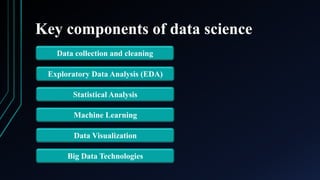
Key components of data science
Data collection and cleaning
Exploratory Data Analysis (EDA)
Statistical Analysis
Machine Learning
Data Visualization
Big Data Technologies
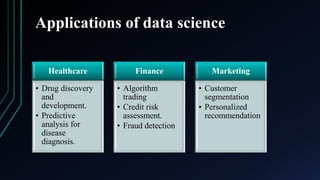
Applications of data science
Healthcare
• Drug discovery
and
development.
• Predictive
analysis for
disease
diagnosis.
Finance
• Algorithm
trading
• Credit risk
assessment.
• Fraud detection
Marketing
• Customer
segmentation
• Personalized
recommendation
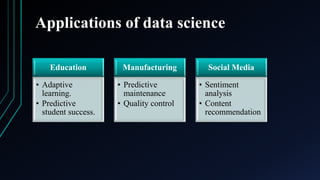
Applications of data science
Education
• Adaptive
learning.
• Predictive
student success.
Manufacturing
• Predictive
maintenance
• Quality control
Social Media
• Sentiment
analysis
• Content
recommendation
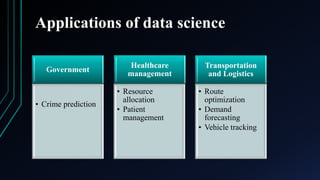
Applications of data science
Government
• Crime prediction
Healthcare
management
• Resource
allocation
• Patient
management
Transportation
and Logistics
• Route
optimization
• Demand
forecasting
• Vehicle tracking
Thanks for Watching!

Data Science Introduction, Application of Data Science.

  • 1.
    What is DataScience? Applications of Data Science
  • 2.
    What is Data? Datais defined as raw facts and figures collected and stored in database. Data are records which are collected by various ways, large number of resources generates data, and this data is in different formats. It is typically unprocessed and lacks context. Data can exist in various forms such as text, numbers, images, audio, or video. Examples of data include individual words in a text document, numbers in a spreadsheet, pixels in an image, or individual sound waves in an audio file. • Student A: Math score - 85, Science score - 78, English score - 90 • Student B: Math score - 75, Science score - 82, English score - 88 • Student C: Math score - 90, Science score - 85, English score - 92
  • 3.
    Information Information is derivedfrom data through the process of organizing, analyzing, and interpreting it to make it meaningful and useful. Information provides context, relevance, and understanding. It answers questions such as who, what, when, where, and how. • Average math score for the class: 83.3 • Average science score for the class: 81.7 • Average English score for the class: 90 • Student with the highest overall score: Student C.
  • 4.
    Knowledge Knowledge involves theability to apply information effectively to achieve a specific purpose or to solve problems. Knowledge is about knowing why something is the way it is, understanding relationships between different pieces of information, and being able to make judgments or predictions based on that understanding. It encompasses insights, expertise, skills, and intuition. • Recognizing that Student C consistently performs well across all subjects and may benefit from more advanced coursework or enrichment activities. • Noting that Student B's science score is lower than their scores in other subjects, indicating a potential area for targeted intervention or additional support. • Understanding that the overall class performance can be influenced by various factors such as teaching methods, curriculum effectiveness, and individual learning styles.
  • 5.
    Data Information KnowledgeTriangle Knowledge Information Data Processed data provides information Raw facts and figures Application of information effectively
  • 6.
    Data Science Data scienceis an interdisciplinary field that uses scientific methods, processes, algorithms, and systems to extract knowledge and insights from structured and unstructured data. It encompasses a variety of techniques, including data mining, machine learning, statistical analysis, and predictive modeling, to analyze large volumes of data and uncover hidden patterns, correlations, and trends. The goal of data science is to generate actionable insights and solutions that can inform decision-making, solve complex problems, optimize processes, and drive innovation across various domains and industries.
  • 7.
    Key components ofdata science Data collection and cleaning Exploratory Data Analysis (EDA) Statistical Analysis Machine Learning Data Visualization Big Data Technologies
  • 8.
    Applications of datascience Healthcare • Drug discovery and development. • Predictive analysis for disease diagnosis. Finance • Algorithm trading • Credit risk assessment. • Fraud detection Marketing • Customer segmentation • Personalized recommendation
  • 9.
    Applications of datascience Education • Adaptive learning. • Predictive student success. Manufacturing • Predictive maintenance • Quality control Social Media • Sentiment analysis • Content recommendation
  • 10.
    Applications of datascience Government • Crime prediction Healthcare management • Resource allocation • Patient management Transportation and Logistics • Route optimization • Demand forecasting • Vehicle tracking
  • 11.