Introduction to Quantitative
Analysis
Chapter 1
To accompany
Quantitative Analysis for Management, Tenth Edition,
by Render, Stair, and Hanna
Power Point slides created by Jeff Heyl © 2009 Prentice-Hall, Inc.
Chapter Outline
1.1 Introduction
1.2 What Is Quantitative Analysis?
1.3 The Quantitative Analysis Approach
1.4 How to Develop a Quantitative Analysis Model
1.5 Possible Problems in the Quantitative Analysis
Approach
1.6 Implementation — Not Just the Final Step
Introduction
• Mathematical tools have been used for
thousands of years
• Quantitative analysis can be applied to a wide
variety of problems
• It’s not enough to just know the mathematics
of a technique
• One must understand the specific applicability
of the technique, its limitations, and its
assumptions
Examples of Quantitative Analyses
• Taco Bell saved over $150 million using
forecasting and scheduling quantitative
analysis models
• NBC television increased revenues by over
$200 million by using quantitative analysis to
develop better sales plans
• Continental Airlines saved over $40 million
using quantitative analysis models to quickly
recover from weather delays and other
disruptions
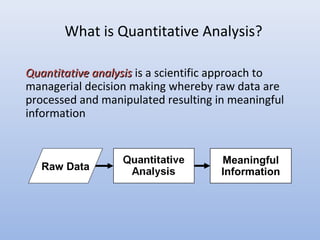
Meaningful
Information
What is Quantitative Analysis?
Quantitative analysisQuantitative analysis is a scientific approach to
managerial decision making whereby raw data are
processed and manipulated resulting in meaningful
information
Raw Data
What is Quantitative Analysis?
Quantitative factorsQuantitative factors might be different investment
alternatives, interest rates, inventory levels,
demand, or labor cost
Qualitative factorsQualitative factors such as the weather, state and
federal legislation, and technology breakthroughs
should also be considered
– Information may be difficult to quantify but can
affect the decision-making process
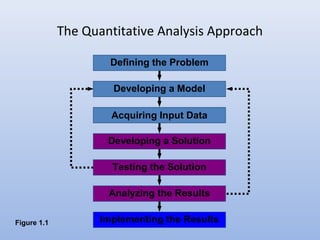
Implementing the Results
Analyzing the Results
Testing the Solution
Developing a Solution
Acquiring Input Data
Developing a Model
The Quantitative Analysis Approach
Defining the Problem
Figure 1.1
Defining the Problem
Need to develop a clear and concise statement that
gives direction and meaning to the following steps
– This may be the most important and difficult step
– It is essential to go beyond symptoms and identify true
causes
– May be necessary to concentrate on only a few of the
problems – selecting the right problems is very
important
– Specific and measurable objectives may have to be
developed
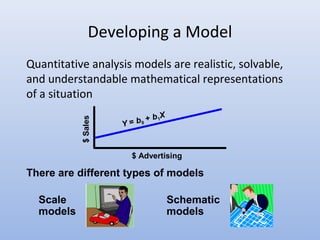
Developing a Model
Quantitative analysis models are realistic, solvable,
and understandable mathematical representations
of a situation
There are different types of models
$ Advertising
$Sales
Y = b0
+ b1
X
Schematic
models
Scale
models
Developing a Model
• Models generally contain variables (controllable
and uncontrollable) and parameters
• Controllable variables are generally the decision
variables and are generally unknown
• Parameters are known quantities that are a
part of the problem
Acquiring Input Data
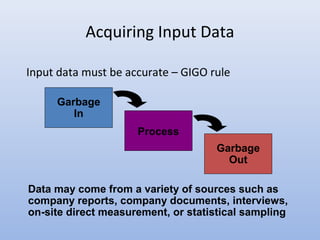
Input data must be accurate – GIGO rule
Data may come from a variety of sources such as
company reports, company documents, interviews,
on-site direct measurement, or statistical sampling
Garbage
In
Process
Garbage
Out
Developing a Solution
• The best (optimal) solution to a problem is
found by manipulating the model variables until
a solution is found that is practical and can be
implemented
• Common techniques are
– SolvingSolving equations
– Trial and errorTrial and error – trying various approaches and
picking the best result
– Complete enumerationComplete enumeration – trying all possible values
– Using an algorithmalgorithm – a series of repeating steps to
reach a solution
Testing the Solution
Both input data and the model should be tested for
accuracy before analysis and implementation
– New data can be collected to test the model
– Results should be logical, consistent, and represent the
real situation
Analyzing the Results
Determine the implications of the solution
– Implementing results often requires change in an
organization
– The impact of actions or changes needs to be
studied and understood before implementation
Sensitivity analysisSensitivity analysis determines how much
the results of the analysis will change if
the model or input data changes
 Sensitive models should be very thoroughly
tested
Implementing the Results
Implementation incorporates the solution into the
company
– Implementation can be very difficult
– People can resist changes
– Many quantitative analysis efforts have failed
because a good, workable solution was not properly
implemented
Changes occur over time, so even successful
implementations must be monitored to determine
if modifications are necessary
Modeling in the Real World
Quantitative analysis models are used
extensively by real organizations to solve real
problems
– In the real world, quantitative analysis models can
be complex, expensive, and difficult to sell
– Following the steps in the process is an important
component of success
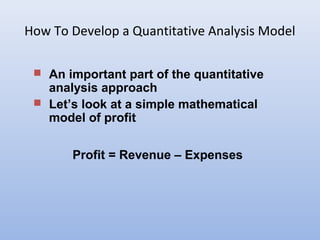
How To Develop a Quantitative Analysis Model
 An important part of the quantitative
analysis approach
 Let’s look at a simple mathematical
model of profit
Profit = Revenue – Expenses
How To Develop a Quantitative Analysis Model
Expenses can be represented as the sum of fixed and
variable costs and variable costs are the product of
unit costs times the number of units
Profit = Revenue – (Fixed cost + Variable cost)
Profit = (Selling price per unit)(number of units
sold) – [Fixed cost + (Variable costs per
unit)(Number of units sold)]
Profit = sX – [f + vX]
Profit = sX – f – vX
where
s = selling price per unit v = variable cost per unit
f = fixed cost X = number of units sold
How To Develop a Quantitative Analysis Model
Expenses can be represented as the sum of fixed and
variable costs and variable costs are the product of
unit costs times the number of units
Profit = Revenue – (Fixed cost + Variable cost)
Profit = (Selling price per unit)(number of units
sold) – [Fixed cost + (Variable costs per
unit)(Number of units sold)]
Profit = sX – [f + vX]
Profit = sX – f – vX
where
s = selling price per unit v = variable cost per unit
f = fixed cost X = number of units sold
The parameters of this model
are f, v, and s as these are the
inputs inherent in the model
The decision variable of
interest is X
Pritchett’s Precious Time Pieces
Profits = sX – f – vX
The company buys, sells, and repairs old clocks.
Rebuilt springs sell for $10 per unit. Fixed cost of
equipment to build springs is $1,000. Variable cost
for spring material is $5 per unit.
s = 10 f = 1,000 v = 5
Number of spring sets sold = X
If sales = 0, profits = ––$1,000$1,000
If sales = 1,000, profits = [(10)(1,000) – 1,000 – (5)(1,000)]
= $4,000
Pritchett’s Precious Time Pieces
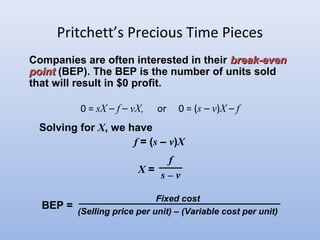
0 = sX – f – vX, or 0 = (s – v)X – f
Companies are often interested in their break-evenbreak-even
pointpoint (BEP). The BEP is the number of units sold
that will result in $0 profit.
Solving for X, we have
f = (s – v)X
X =
f
s – v
BEP =
Fixed cost
(Selling price per unit) – (Variable cost per unit)
Pritchett’s Precious Time Pieces
0 = sX – f – vX, or 0 = (s – v)X – f
Companies are often interested in their break-evenbreak-even
pointpoint (BEP). The BEP is the number of units sold
that will result in $0 profit.
Solving for X, we have
f = (s – v)X
X =
f
s – v
BEP =
Fixed cost
(Selling price per unit) – (Variable cost per unit)
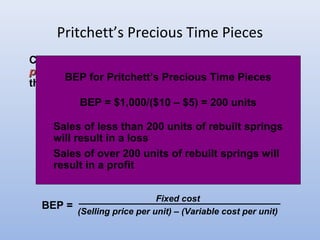
BEP for Pritchett’s Precious Time Pieces
BEP = $1,000/($10 – $5) = 200 units
Sales of less than 200 units of rebuilt springs
will result in a loss
Sales of over 200 units of rebuilt springs will
result in a profit
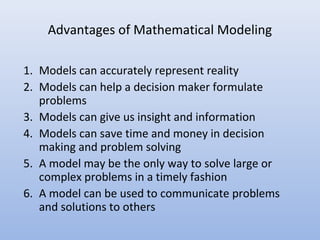
Advantages of Mathematical Modeling
1. Models can accurately represent reality
2. Models can help a decision maker formulate
problems
3. Models can give us insight and information
4. Models can save time and money in decision
making and problem solving
5. A model may be the only way to solve large or
complex problems in a timely fashion
6. A model can be used to communicate problems
and solutions to others
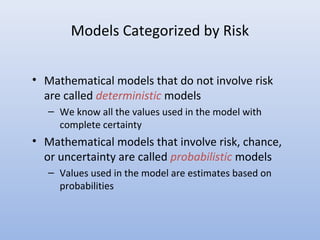
Models Categorized by Risk
• Mathematical models that do not involve risk
are called deterministic models
– We know all the values used in the model with
complete certainty
• Mathematical models that involve risk, chance,
or uncertainty are called probabilistic models
– Values used in the model are estimates based on
probabilities
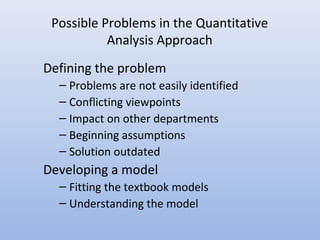
Possible Problems in the Quantitative
Analysis Approach
Defining the problem
– Problems are not easily identified
– Conflicting viewpoints
– Impact on other departments
– Beginning assumptions
– Solution outdated
Developing a model
– Fitting the textbook models
– Understanding the model
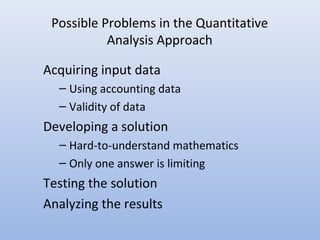
Possible Problems in the Quantitative
Analysis Approach
Acquiring input data
– Using accounting data
– Validity of data
Developing a solution
– Hard-to-understand mathematics
– Only one answer is limiting
Testing the solution
Analyzing the results
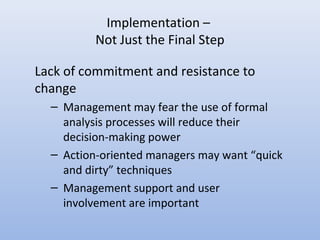
Implementation –
Not Just the Final Step
Lack of commitment and resistance to
change
– Management may fear the use of formal
analysis processes will reduce their
decision-making power
– Action-oriented managers may want “quick
and dirty” techniques
– Management support and user
involvement are important
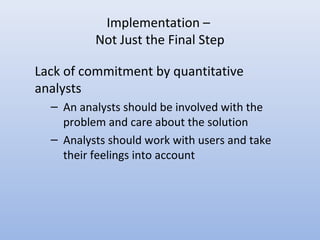
Implementation –
Not Just the Final Step
Lack of commitment by quantitative
analysts
– An analysts should be involved with the
problem and care about the solution
– Analysts should work with users and take
their feelings into account
Summary
• Quantitative analysis is a scientific
approach to decision making
• The approach includes
– Defining the problem
– Acquiring input data
– Developing a solution
– Testing the solution
– Analyzing the results
– Implementing the results
Summary
• Potential problems include
– Conflicting viewpoints
– The impact on other departments
– Beginning assumptions
– Outdated solutions
– Fitting textbook models
– Understanding the model
– Acquiring good input data
– Hard-to-understand mathematics
– Obtaining only one answer
– Testing the solution
– Analyzing the results

Render01edited 121120194704-phpapp02

  • 1.
    Introduction to Quantitative Analysis Chapter1 To accompany Quantitative Analysis for Management, Tenth Edition, by Render, Stair, and Hanna Power Point slides created by Jeff Heyl © 2009 Prentice-Hall, Inc.
  • 2.
    Chapter Outline 1.1 Introduction 1.2What Is Quantitative Analysis? 1.3 The Quantitative Analysis Approach 1.4 How to Develop a Quantitative Analysis Model 1.5 Possible Problems in the Quantitative Analysis Approach 1.6 Implementation — Not Just the Final Step
  • 3.
    Introduction • Mathematical toolshave been used for thousands of years • Quantitative analysis can be applied to a wide variety of problems • It’s not enough to just know the mathematics of a technique • One must understand the specific applicability of the technique, its limitations, and its assumptions
  • 4.
    Examples of QuantitativeAnalyses • Taco Bell saved over $150 million using forecasting and scheduling quantitative analysis models • NBC television increased revenues by over $200 million by using quantitative analysis to develop better sales plans • Continental Airlines saved over $40 million using quantitative analysis models to quickly recover from weather delays and other disruptions
  • 5.
    Meaningful Information What is QuantitativeAnalysis? Quantitative analysisQuantitative analysis is a scientific approach to managerial decision making whereby raw data are processed and manipulated resulting in meaningful information Raw Data
  • 6.
    What is QuantitativeAnalysis? Quantitative factorsQuantitative factors might be different investment alternatives, interest rates, inventory levels, demand, or labor cost Qualitative factorsQualitative factors such as the weather, state and federal legislation, and technology breakthroughs should also be considered – Information may be difficult to quantify but can affect the decision-making process
  • 7.
    Implementing the Results Analyzingthe Results Testing the Solution Developing a Solution Acquiring Input Data Developing a Model The Quantitative Analysis Approach Defining the Problem Figure 1.1
  • 8.
    Defining the Problem Needto develop a clear and concise statement that gives direction and meaning to the following steps – This may be the most important and difficult step – It is essential to go beyond symptoms and identify true causes – May be necessary to concentrate on only a few of the problems – selecting the right problems is very important – Specific and measurable objectives may have to be developed
  • 9.
    Developing a Model Quantitativeanalysis models are realistic, solvable, and understandable mathematical representations of a situation There are different types of models $ Advertising $Sales Y = b0 + b1 X Schematic models Scale models
  • 10.
    Developing a Model •Models generally contain variables (controllable and uncontrollable) and parameters • Controllable variables are generally the decision variables and are generally unknown • Parameters are known quantities that are a part of the problem
  • 11.
    Acquiring Input Data Inputdata must be accurate – GIGO rule Data may come from a variety of sources such as company reports, company documents, interviews, on-site direct measurement, or statistical sampling Garbage In Process Garbage Out
  • 12.
    Developing a Solution •The best (optimal) solution to a problem is found by manipulating the model variables until a solution is found that is practical and can be implemented • Common techniques are – SolvingSolving equations – Trial and errorTrial and error – trying various approaches and picking the best result – Complete enumerationComplete enumeration – trying all possible values – Using an algorithmalgorithm – a series of repeating steps to reach a solution
  • 13.
    Testing the Solution Bothinput data and the model should be tested for accuracy before analysis and implementation – New data can be collected to test the model – Results should be logical, consistent, and represent the real situation
  • 14.
    Analyzing the Results Determinethe implications of the solution – Implementing results often requires change in an organization – The impact of actions or changes needs to be studied and understood before implementation Sensitivity analysisSensitivity analysis determines how much the results of the analysis will change if the model or input data changes  Sensitive models should be very thoroughly tested
  • 15.
    Implementing the Results Implementationincorporates the solution into the company – Implementation can be very difficult – People can resist changes – Many quantitative analysis efforts have failed because a good, workable solution was not properly implemented Changes occur over time, so even successful implementations must be monitored to determine if modifications are necessary
  • 16.
    Modeling in theReal World Quantitative analysis models are used extensively by real organizations to solve real problems – In the real world, quantitative analysis models can be complex, expensive, and difficult to sell – Following the steps in the process is an important component of success
  • 17.
    How To Developa Quantitative Analysis Model  An important part of the quantitative analysis approach  Let’s look at a simple mathematical model of profit Profit = Revenue – Expenses
  • 18.
    How To Developa Quantitative Analysis Model Expenses can be represented as the sum of fixed and variable costs and variable costs are the product of unit costs times the number of units Profit = Revenue – (Fixed cost + Variable cost) Profit = (Selling price per unit)(number of units sold) – [Fixed cost + (Variable costs per unit)(Number of units sold)] Profit = sX – [f + vX] Profit = sX – f – vX where s = selling price per unit v = variable cost per unit f = fixed cost X = number of units sold
  • 19.
    How To Developa Quantitative Analysis Model Expenses can be represented as the sum of fixed and variable costs and variable costs are the product of unit costs times the number of units Profit = Revenue – (Fixed cost + Variable cost) Profit = (Selling price per unit)(number of units sold) – [Fixed cost + (Variable costs per unit)(Number of units sold)] Profit = sX – [f + vX] Profit = sX – f – vX where s = selling price per unit v = variable cost per unit f = fixed cost X = number of units sold The parameters of this model are f, v, and s as these are the inputs inherent in the model The decision variable of interest is X
  • 20.
    Pritchett’s Precious TimePieces Profits = sX – f – vX The company buys, sells, and repairs old clocks. Rebuilt springs sell for $10 per unit. Fixed cost of equipment to build springs is $1,000. Variable cost for spring material is $5 per unit. s = 10 f = 1,000 v = 5 Number of spring sets sold = X If sales = 0, profits = ––$1,000$1,000 If sales = 1,000, profits = [(10)(1,000) – 1,000 – (5)(1,000)] = $4,000
  • 21.
    Pritchett’s Precious TimePieces 0 = sX – f – vX, or 0 = (s – v)X – f Companies are often interested in their break-evenbreak-even pointpoint (BEP). The BEP is the number of units sold that will result in $0 profit. Solving for X, we have f = (s – v)X X = f s – v BEP = Fixed cost (Selling price per unit) – (Variable cost per unit)
  • 22.
    Pritchett’s Precious TimePieces 0 = sX – f – vX, or 0 = (s – v)X – f Companies are often interested in their break-evenbreak-even pointpoint (BEP). The BEP is the number of units sold that will result in $0 profit. Solving for X, we have f = (s – v)X X = f s – v BEP = Fixed cost (Selling price per unit) – (Variable cost per unit) BEP for Pritchett’s Precious Time Pieces BEP = $1,000/($10 – $5) = 200 units Sales of less than 200 units of rebuilt springs will result in a loss Sales of over 200 units of rebuilt springs will result in a profit
  • 23.
    Advantages of MathematicalModeling 1. Models can accurately represent reality 2. Models can help a decision maker formulate problems 3. Models can give us insight and information 4. Models can save time and money in decision making and problem solving 5. A model may be the only way to solve large or complex problems in a timely fashion 6. A model can be used to communicate problems and solutions to others
  • 24.
    Models Categorized byRisk • Mathematical models that do not involve risk are called deterministic models – We know all the values used in the model with complete certainty • Mathematical models that involve risk, chance, or uncertainty are called probabilistic models – Values used in the model are estimates based on probabilities
  • 25.
    Possible Problems inthe Quantitative Analysis Approach Defining the problem – Problems are not easily identified – Conflicting viewpoints – Impact on other departments – Beginning assumptions – Solution outdated Developing a model – Fitting the textbook models – Understanding the model
  • 26.
    Possible Problems inthe Quantitative Analysis Approach Acquiring input data – Using accounting data – Validity of data Developing a solution – Hard-to-understand mathematics – Only one answer is limiting Testing the solution Analyzing the results
  • 27.
    Implementation – Not Justthe Final Step Lack of commitment and resistance to change – Management may fear the use of formal analysis processes will reduce their decision-making power – Action-oriented managers may want “quick and dirty” techniques – Management support and user involvement are important
  • 28.
    Implementation – Not Justthe Final Step Lack of commitment by quantitative analysts – An analysts should be involved with the problem and care about the solution – Analysts should work with users and take their feelings into account
  • 29.
    Summary • Quantitative analysisis a scientific approach to decision making • The approach includes – Defining the problem – Acquiring input data – Developing a solution – Testing the solution – Analyzing the results – Implementing the results
  • 30.
    Summary • Potential problemsinclude – Conflicting viewpoints – The impact on other departments – Beginning assumptions – Outdated solutions – Fitting textbook models – Understanding the model – Acquiring good input data – Hard-to-understand mathematics – Obtaining only one answer – Testing the solution – Analyzing the results