Introduction to Neural Network and Neuro-DEVS Yan Wang August 29 th  2002
Neural Network Definition of  Artificial Neural Network Two Examples with some fundamental concepts Types of Neural Nets What they can do and where they fail
What is an Artificial Neural Network? (ANN) A neural network is a computational method inspired by studies of the brain and nervous systems in biological organisms.  A Computing system made of a number of simple, highly interconnected processing elements, which process information by their dynamic state response to external input.  given by R.Hecht-Nielsen (1989)
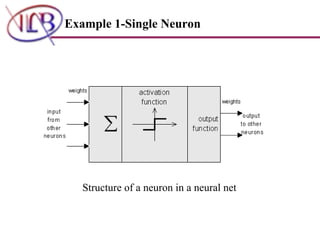
Example 1-Single Neuron Structure of a neuron in a neural net
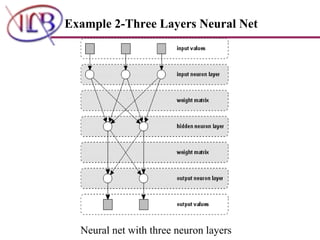
Example 2-Three Layers Neural Net Neural net with three neuron layers
They can be distinguished by: their type (feedforward or feedback) their structure  the learning algorithm they use  Types of Neural Nets
Perceptron Multi-Layer-Perceptron Backpropagation Net Hopfield  Net Kohonen Feature Map A Selection of Neural Nets
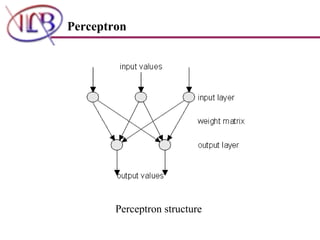
Perceptron   Perceptron  structure
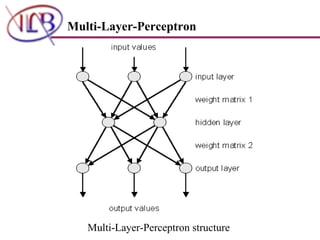
Multi-Layer-Perceptron Multi-Layer-Perceptron  structure
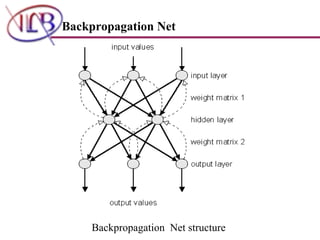
Backpropagation Net   Backpropagation  Net structure
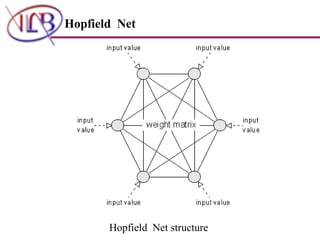
Hopfield  Net   Hopfield  Net structure
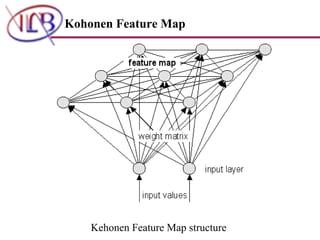
Kohonen Feature Map  Kehonen Feature Map  structure
·   pattern association  ·   pattern classification  ·   regularity detection  ·   image processing  ·   speech analysis  ·   optimization problems  ·   robot steering  ·   processing of inaccurate or incomplete inputs  ·   quality assurance  ·   stock market forecasting  ·   simulation  ·    ...   The areas where neural nets may be useful
the operational  problem encountered when attempting to simulate the parallelism of neural networks   instability to explain any results that they obtain   Limits to Neural Networks
The Advantage Using Neural Network Three Main Applications Neuro-Atomic Model and its description in DEVS An Example - Solar Energetic System Neuro-DEVS
Handle partial lack of system understanding   Create adaptive models (models that can learn)     The Advantage Using Neural Network
Concurrent simulation, where results of an ANN model are compared with results of a less realistic but validated common model to avoid a non expected behavior of the Neural-Net.  ANN as sub-components of a global model, to model subsystems that would be hard to model commonly because of a lack of understanding.  Adaptive models, "models that can learn", according to an error feedback such model would be able to adapt runtime to situations that hasn't been taken into account. Three Main Applications
Multi Layered Perceptron I/O are bounded in [0,1] for the activation to perform Pass 1: Forward Pass - Present inputs and let the activations flow until they reach the output layer. Pass 2: Backward Pass - Error estimates are computed for each output unit by comparing the actual output (Pass 1) with the target output. Then, these error estimates are used to adjust the weights in the hidden layer and the errors from the hidden layer are used to adjust the input layer.
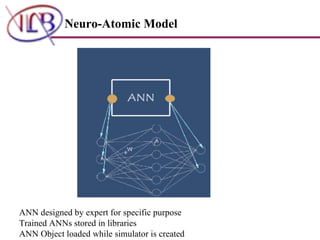
Neuro-Atomic Model ANN designed by expert for specific purpose Trained ANNs stored in libraries ANN Object loaded while simulator is created
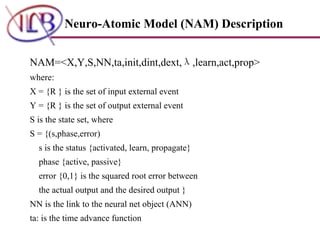
Neuro-Atomic Model (NAM) Description NAM=<X,Y,S,NN,ta,init,dint,dext, λ ,learn,act,prop> where: X = {R } is the set of input external event Y = {R } is the set of output external event S is the state set, where S = {(s,phase,error)  s is the status {activated, learn, propagate} phase {active, passive}  error {0,1} is the squared root error between the actual output and the desired output } NN is the link to the neural net object (ANN) ta: is the time advance function
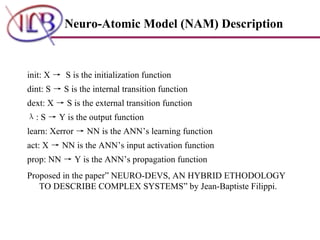
init: X  ->   S is the initialization function d int:  S  ->   S is the internal transition function d ext:  X  ->   S is the external transition function λ : S  ->   Y is the output function learn: Xerro r  ->   NN is the ANN’s learning function act:  X  ->   NN is the ANN’s input activation function prop: N N  ->   Y is the ANN’s propagation function Proposed in the paper” NEURO-DEVS, AN HYBRID ETHODOLOGY TO DESCRIBE COMPLEX SYSTEMS” by Jean-Baptiste Filippi. Neuro-Atomic Model (NAM) Description
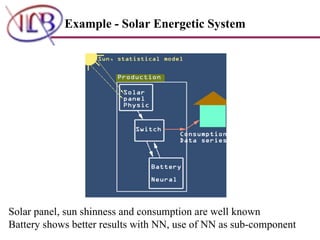
Example - Solar Energetic System Solar panel, sun shinness and consumption are well known Battery shows better results with NN, use of NN as sub-component

Nn devs

  • 1.
    Introduction to NeuralNetwork and Neuro-DEVS Yan Wang August 29 th 2002
  • 2.
    Neural Network Definitionof Artificial Neural Network Two Examples with some fundamental concepts Types of Neural Nets What they can do and where they fail
  • 3.
    What is anArtificial Neural Network? (ANN) A neural network is a computational method inspired by studies of the brain and nervous systems in biological organisms. A Computing system made of a number of simple, highly interconnected processing elements, which process information by their dynamic state response to external input. given by R.Hecht-Nielsen (1989)
  • 4.
    Example 1-Single NeuronStructure of a neuron in a neural net
  • 5.
    Example 2-Three LayersNeural Net Neural net with three neuron layers
  • 6.
    They can bedistinguished by: their type (feedforward or feedback) their structure the learning algorithm they use Types of Neural Nets
  • 7.
    Perceptron Multi-Layer-Perceptron BackpropagationNet Hopfield Net Kohonen Feature Map A Selection of Neural Nets
  • 8.
    Perceptron Perceptron structure
  • 9.
  • 10.
    Backpropagation Net Backpropagation Net structure
  • 11.
    Hopfield Net Hopfield Net structure
  • 12.
    Kohonen Feature Map Kehonen Feature Map structure
  • 13.
    ·   pattern association ·   pattern classification ·   regularity detection ·   image processing ·   speech analysis ·   optimization problems ·   robot steering ·   processing of inaccurate or incomplete inputs ·   quality assurance ·   stock market forecasting ·   simulation ·   ... The areas where neural nets may be useful
  • 14.
    the operational problem encountered when attempting to simulate the parallelism of neural networks instability to explain any results that they obtain Limits to Neural Networks
  • 15.
    The Advantage UsingNeural Network Three Main Applications Neuro-Atomic Model and its description in DEVS An Example - Solar Energetic System Neuro-DEVS
  • 16.
    Handle partial lackof system understanding Create adaptive models (models that can learn)   The Advantage Using Neural Network
  • 17.
    Concurrent simulation, whereresults of an ANN model are compared with results of a less realistic but validated common model to avoid a non expected behavior of the Neural-Net. ANN as sub-components of a global model, to model subsystems that would be hard to model commonly because of a lack of understanding. Adaptive models, &quot;models that can learn&quot;, according to an error feedback such model would be able to adapt runtime to situations that hasn't been taken into account. Three Main Applications
  • 18.
    Multi Layered PerceptronI/O are bounded in [0,1] for the activation to perform Pass 1: Forward Pass - Present inputs and let the activations flow until they reach the output layer. Pass 2: Backward Pass - Error estimates are computed for each output unit by comparing the actual output (Pass 1) with the target output. Then, these error estimates are used to adjust the weights in the hidden layer and the errors from the hidden layer are used to adjust the input layer.
  • 19.
    Neuro-Atomic Model ANNdesigned by expert for specific purpose Trained ANNs stored in libraries ANN Object loaded while simulator is created
  • 20.
    Neuro-Atomic Model (NAM)Description NAM=<X,Y,S,NN,ta,init,dint,dext, λ ,learn,act,prop> where: X = {R } is the set of input external event Y = {R } is the set of output external event S is the state set, where S = {(s,phase,error) s is the status {activated, learn, propagate} phase {active, passive} error {0,1} is the squared root error between the actual output and the desired output } NN is the link to the neural net object (ANN) ta: is the time advance function
  • 21.
    init: X -> S is the initialization function d int: S -> S is the internal transition function d ext: X -> S is the external transition function λ : S -> Y is the output function learn: Xerro r -> NN is the ANN’s learning function act: X -> NN is the ANN’s input activation function prop: N N -> Y is the ANN’s propagation function Proposed in the paper” NEURO-DEVS, AN HYBRID ETHODOLOGY TO DESCRIBE COMPLEX SYSTEMS” by Jean-Baptiste Filippi. Neuro-Atomic Model (NAM) Description
  • 22.
    Example - SolarEnergetic System Solar panel, sun shinness and consumption are well known Battery shows better results with NN, use of NN as sub-component