The Search for Dark Matter
and Dark Energy
By Zoe Zontos
Road Map
• What are dark matter/energy?
• The search for dark matter/energy
• Dark energy – chameleon fields
• Dark matter – the XENON Collaboration
• Impact of searches
The universe consists of two components on unknown
origin known as dark matter and dark energy.
• Dark energy – drives the accelerated expansion of the universe
• Dark energy = 68.3%
• Chameleon field search theory
• Dark matter – weakly interacting massive particles (WIMPs)
• Responsible for excess of gravitational interactions
• Dark matter = 26.8%
• XENON Collaboration experiment
One theory for dark energy research are
chameleon fields.
• Suppresses effects in regions of high density
• Mass depends on ambient matter density
• Light, mediates a long-range force
• In sparse environments (cosmos)
• Massive, mediates a short-range force
• In high-density environments (laboratory)
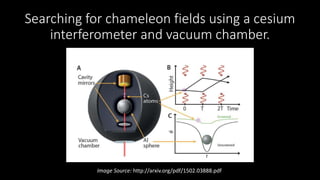
Searching for chameleon fields using a cesium
interferometer and vacuum chamber.
Image Source: http://arxiv.org/pdf/1502.03888.pdf
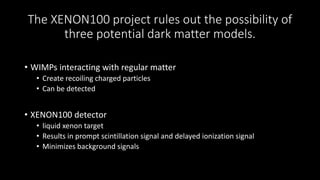
The XENON100 project rules out the possibility of
three potential dark matter models.
• WIMPs interacting with regular matter
• Create recoiling charged particles
• Can be detected
• XENON100 detector
• liquid xenon target
• Results in prompt scintillation signal and delayed ionization signal
• Minimizes background signals
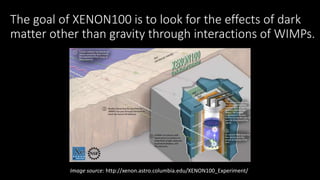
The goal of XENON100 is to look for the effects of dark
matter other than gravity through interactions of WIMPs.
Image source: http://xenon.astro.columbia.edu/XENON100_Experiment/
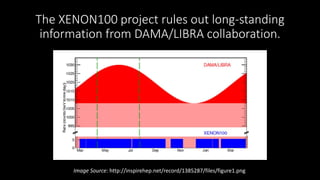
The XENON100 project rules out long-standing
information from DAMA/LIBRA collaboration.
Image Source: http://inspirehep.net/record/1385287/files/figure1.png
The experiments encourage the effort to
search for dark matter and dark energy.
• Shows how to address cosmological questions in a laboratory setting
• Brings scientists closer to probing hard to reach energy ranges
• Pushes sensitivity of types of experiments
• Many are performed at university level
• A deep understanding of very broad aspects of physics
Questions?
References
• Hamilton, P., et al. “Atom-interferometry constraints on dark energy.”
Science. Vol. 349, Issue 6250, pp. 849-851. 21 Aug. 2015.
• Schmiedmayer, Jorg and Abele Hartmut. ”Probing the dark side.”
Science. Vol. 349, Issue 6250, pp. 849-851. 21 Aug. 2015.
• The XENON Collaboration. “Exclusion of leptophilic dark matter
models using XENON100 electronic recoil data.” Science. Vol.
349, Issue 6250, pp. 849-851. 21 Aug. 2015.

Dark Matter:Energy

  • 1.
    The Search forDark Matter and Dark Energy By Zoe Zontos
  • 2.
    Road Map • Whatare dark matter/energy? • The search for dark matter/energy • Dark energy – chameleon fields • Dark matter – the XENON Collaboration • Impact of searches
  • 3.
    The universe consistsof two components on unknown origin known as dark matter and dark energy. • Dark energy – drives the accelerated expansion of the universe • Dark energy = 68.3% • Chameleon field search theory • Dark matter – weakly interacting massive particles (WIMPs) • Responsible for excess of gravitational interactions • Dark matter = 26.8% • XENON Collaboration experiment
  • 4.
    One theory fordark energy research are chameleon fields. • Suppresses effects in regions of high density • Mass depends on ambient matter density • Light, mediates a long-range force • In sparse environments (cosmos) • Massive, mediates a short-range force • In high-density environments (laboratory)
  • 5.
    Searching for chameleonfields using a cesium interferometer and vacuum chamber. Image Source: http://arxiv.org/pdf/1502.03888.pdf
  • 6.
    The XENON100 projectrules out the possibility of three potential dark matter models. • WIMPs interacting with regular matter • Create recoiling charged particles • Can be detected • XENON100 detector • liquid xenon target • Results in prompt scintillation signal and delayed ionization signal • Minimizes background signals
  • 7.
    The goal ofXENON100 is to look for the effects of dark matter other than gravity through interactions of WIMPs. Image source: http://xenon.astro.columbia.edu/XENON100_Experiment/
  • 8.
    The XENON100 projectrules out long-standing information from DAMA/LIBRA collaboration. Image Source: http://inspirehep.net/record/1385287/files/figure1.png
  • 9.
    The experiments encouragethe effort to search for dark matter and dark energy. • Shows how to address cosmological questions in a laboratory setting • Brings scientists closer to probing hard to reach energy ranges • Pushes sensitivity of types of experiments • Many are performed at university level • A deep understanding of very broad aspects of physics
  • 10.
  • 11.
    References • Hamilton, P.,et al. “Atom-interferometry constraints on dark energy.” Science. Vol. 349, Issue 6250, pp. 849-851. 21 Aug. 2015. • Schmiedmayer, Jorg and Abele Hartmut. ”Probing the dark side.” Science. Vol. 349, Issue 6250, pp. 849-851. 21 Aug. 2015. • The XENON Collaboration. “Exclusion of leptophilic dark matter models using XENON100 electronic recoil data.” Science. Vol. 349, Issue 6250, pp. 849-851. 21 Aug. 2015.