DARK MATTER 
BY : Zoe Schiaffino and Silvia Candeira
DARK MATTER (IMAGES)
INTRODUCTION 
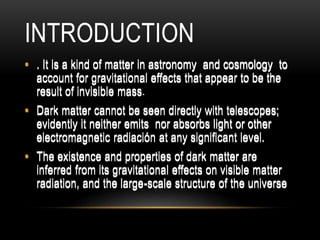
• . It is a kind of matter in astronomy and cosmology to 
account for gravitational effects that appear to be the 
result of invisible mass. 
mass 
• Dark matter cannot be seen directly with telescopes; 
evidently it neither emits nor absorbs light or other 
electromagnetic radiación at any significant level. 
• The existence and properties of dark matter are 
inferred from its gravitational effects on visible matter 
radiation, and the large-scale structure of the universe
• TODAY 
• Atoms 4.9% 
• Dark matter 26.8% 
• Dark energy 68.3% 
• 13.7 BILLION YEARS AGO 
• Neutrinos 10% 
• Photons 15% 
• Atoms 12% 
• Dark matter 63%
HISTORY SEARCH OF ITS COMPONENTS 
• Although dark matter had historically been inferred by many 
astronomical observations, its composition long remained speculative. 
• Early theories of dark matter concentrated on hidden heavy normal 
objectsas the possible candidates for dark matter, collectively known 
as massive compact.. 
• Cold dark matter – objects with a free-streaming length much smaller 
than a protogalaxy. 
• Warm dark matter – particles with a free-streaming length similar to a 
protogalaxy. 
• Hot dark matter – particles with a free-streaming length much larger 
than a protogalaxy.
BARYONIC DARK MATTER 
There are three separate lines of evidence that the majority of dark matter is not 
made of baryons: 
-The theory of Big Bang nucleosynthesis, which very accurately predicts the 
observed abundance of the chemical elements predicts that baryonic matter 
accounts for around 4–5 percent of the critical density of the Universe. 
- Large astronomical searches for gravitational microslensing, including the 
MACHO, EROS and OGLE projects, have shown that only a small fraction of the 
dark matter in the Milky Way can be hiding in dark compact objects 
- Detailed analysis of the small irregularities (anisotropies) in the cosmic microwave 
background observed by WMAP and Planck shows that around five-sixths of the 
total matter is in a form which does not interact significantly with ordinary matter or 
photons.
NONBARYONIC DARK MATTER 
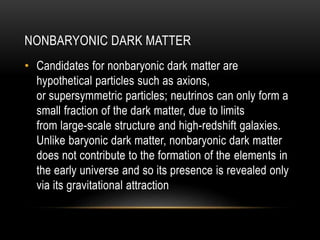
• Candidates for nonbaryonic dark matter are 
hypothetical particles such as axions, 
or supersymmetric particles; neutrinos can only form a 
small fraction of the dark matter, due to limits 
from large-scale structure and high-redshift galaxies. 
Unlike baryonic dark matter, nonbaryonic dark matter 
does not contribute to the formation of the elements in 
the early universe and so its presence is revealed only 
via its gravitational attraction

Dark matter

  • 1.
    DARK MATTER BY: Zoe Schiaffino and Silvia Candeira
  • 2.
  • 3.
    INTRODUCTION • .It is a kind of matter in astronomy and cosmology to account for gravitational effects that appear to be the result of invisible mass. mass • Dark matter cannot be seen directly with telescopes; evidently it neither emits nor absorbs light or other electromagnetic radiación at any significant level. • The existence and properties of dark matter are inferred from its gravitational effects on visible matter radiation, and the large-scale structure of the universe
  • 4.
    • TODAY •Atoms 4.9% • Dark matter 26.8% • Dark energy 68.3% • 13.7 BILLION YEARS AGO • Neutrinos 10% • Photons 15% • Atoms 12% • Dark matter 63%
  • 5.
    HISTORY SEARCH OFITS COMPONENTS • Although dark matter had historically been inferred by many astronomical observations, its composition long remained speculative. • Early theories of dark matter concentrated on hidden heavy normal objectsas the possible candidates for dark matter, collectively known as massive compact.. • Cold dark matter – objects with a free-streaming length much smaller than a protogalaxy. • Warm dark matter – particles with a free-streaming length similar to a protogalaxy. • Hot dark matter – particles with a free-streaming length much larger than a protogalaxy.
  • 6.
    BARYONIC DARK MATTER There are three separate lines of evidence that the majority of dark matter is not made of baryons: -The theory of Big Bang nucleosynthesis, which very accurately predicts the observed abundance of the chemical elements predicts that baryonic matter accounts for around 4–5 percent of the critical density of the Universe. - Large astronomical searches for gravitational microslensing, including the MACHO, EROS and OGLE projects, have shown that only a small fraction of the dark matter in the Milky Way can be hiding in dark compact objects - Detailed analysis of the small irregularities (anisotropies) in the cosmic microwave background observed by WMAP and Planck shows that around five-sixths of the total matter is in a form which does not interact significantly with ordinary matter or photons.
  • 7.
    NONBARYONIC DARK MATTER • Candidates for nonbaryonic dark matter are hypothetical particles such as axions, or supersymmetric particles; neutrinos can only form a small fraction of the dark matter, due to limits from large-scale structure and high-redshift galaxies. Unlike baryonic dark matter, nonbaryonic dark matter does not contribute to the formation of the elements in the early universe and so its presence is revealed only via its gravitational attraction