DARK MATTER
SUBMITTTED BY:
2011-MM-69
Waqas Inam
SUBMITTED TO:
Sir Rauf Akhtar
What is Dark Matter?
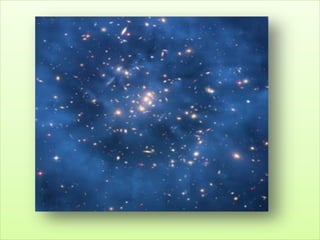
The matter which neither emits nor
absorbs light or other radiations and the
only way to identify it is its gravitational
effects on galaxies, stars etc. Therefore,
Dark matter can not be seen with
telescope. Its constituent subatomic
particle is unknown yet.
Why is it important to know about it?
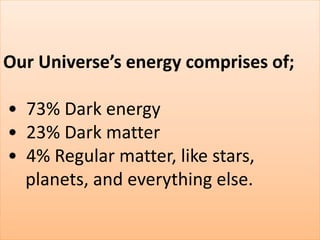
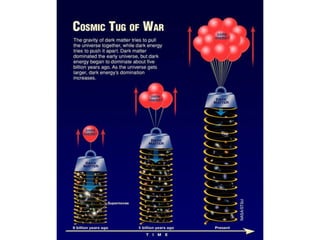
Our Universe’s energy comprises of;
• 73% Dark energy
• 23% Dark matter
• 4% Regular matter, like stars,
planets, and everything else.
Supposition Before Planck:
• Dark matter 22.7%
• Dark energy 72.8%
• Ordinary matter 4.5%
After Planck Observation:
• Dark matter 26.8%
• Dark energy 68.3%
• Ordinary matter 4.9%
The Proof of Existence of Dark Matter
Dark matter came to the attention of
astrophysicists due to difference between
the mass of large astronomical objects
determined from their gravitational effects,
and the mass calculated from the
"luminous matter" they contain: stars, gas
and dust.
That’s all
THANK YOU

Dark matter presentation

  • 1.
    DARK MATTER SUBMITTTED BY: 2011-MM-69 WaqasInam SUBMITTED TO: Sir Rauf Akhtar
  • 2.
    What is DarkMatter? The matter which neither emits nor absorbs light or other radiations and the only way to identify it is its gravitational effects on galaxies, stars etc. Therefore, Dark matter can not be seen with telescope. Its constituent subatomic particle is unknown yet.
  • 4.
    Why is itimportant to know about it?
  • 5.
    Our Universe’s energycomprises of; • 73% Dark energy • 23% Dark matter • 4% Regular matter, like stars, planets, and everything else.
  • 6.
    Supposition Before Planck: •Dark matter 22.7% • Dark energy 72.8% • Ordinary matter 4.5%
  • 7.
    After Planck Observation: •Dark matter 26.8% • Dark energy 68.3% • Ordinary matter 4.9%
  • 10.
    The Proof ofExistence of Dark Matter Dark matter came to the attention of astrophysicists due to difference between the mass of large astronomical objects determined from their gravitational effects, and the mass calculated from the "luminous matter" they contain: stars, gas and dust.
  • 11.