A Little Astrophysics-From the Big Bang to Now
III Dark Matter and Dark Energy
OLLI Fall 2022
Jim Rauf
1
What is Dark Matter?
Nobody knows!
2
Dark Matter - Some History
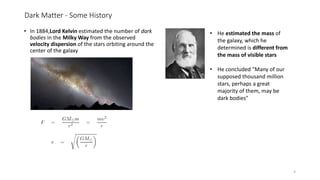
• In 1884,Lord Kelvin estimated the number of dark
bodies in the Milky Way from the observed
velocity dispersion of the stars orbiting around the
center of the galaxy
• He estimated the mass of
the galaxy, which he
determined is different from
the mass of visible stars
• He concluded "Many of our
supposed thousand million
stars, perhaps a great
majority of them, may be
dark bodies"
3
Dark Matter - Some History
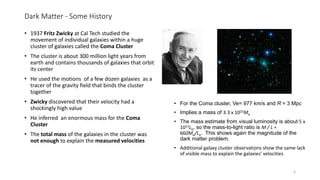
• 1937 Fritz Zwicky at Cal Tech studied the
movement of individual galaxies within a huge
cluster of galaxies called the Coma Cluster
• The cluster is about 300 million light years from
earth and contains thousands of galaxies that orbit
its center
• He used the motions of a few dozen galaxies as a
tracer of the gravity field that binds the cluster
together
• Zwicky discovered that their velocity had a
shockingly high value
• He inferred an enormous mass for the Coma
Cluster
• The total mass of the galaxies in the cluster was
not enough to explain the measured velocities
• For the Coma cluster, Ve= 977 km/s and R = 3 Mpc
• Implies a mass of 3.3 x 10¹⁵Mo
• The mass estimate from visual luminosity is about 5 x
1012Lo, so the mass-to-light ratio is M / L =
660Mo/Lo. This shows again the magnitude of the
dark matter problem.
• Additional galaxy cluster observations show the same lack
of visible mass to explain the galaxies’ velocities
4
Dark Matter - Some History
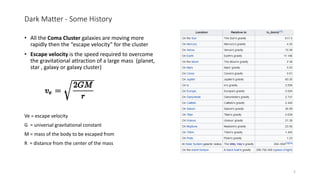
• All the Coma Cluster galaxies are moving more
rapidly then the “escape velocity” for the cluster
• Escape velocity is the speed required to overcome
the gravitational attraction of a large mass (planet,
star , galaxy or galaxy cluster)
Ve = escape velocity
G = universal gravitational constant
M = mass of the body to be escaped from
R = distance from the center of the mass
5
Dark Matter - Some History
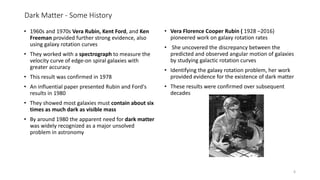
• 1960s and 1970s Vera Rubin, Kent Ford, and Ken
Freeman provided further strong evidence, also
using galaxy rotation curves
• They worked with a spectrograph to measure the
velocity curve of edge-on spiral galaxies with
greater accuracy
• This result was confirmed in 1978
• An influential paper presented Rubin and Ford's
results in 1980
• They showed most galaxies must contain about six
times as much dark as visible mass
• By around 1980 the apparent need for dark matter
was widely recognized as a major unsolved
problem in astronomy
• Vera Florence Cooper Rubin ( 1928 –2016)
pioneered work on galaxy rotation rates
• She uncovered the discrepancy between the
predicted and observed angular motion of galaxies
by studying galactic rotation curves
• Identifying the galaxy rotation problem, her work
provided evidence for the existence of dark matter
• These results were confirmed over subsequent
decades
6
Dark Matter
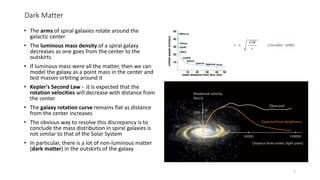
• The arms of spiral galaxies rotate around the
galactic center
• The luminous mass density of a spiral galaxy
decreases as one goes from the center to the
outskirts
• If luminous mass were all the matter, then we can
model the galaxy as a point mass in the center and
test masses orbiting around it
• Kepler's Second Law - it is expected that the
rotation velocities will decrease with distance from
the center
• The galaxy rotation curve remains flat as distance
from the center increases
• The obvious way to resolve this discrepancy is to
conclude the mass distribution in spiral galaxies is
not similar to that of the Solar System
• In particular, there is a lot of non-luminous matter
(dark matter) in the outskirts of the galaxy
7
Dark Matter
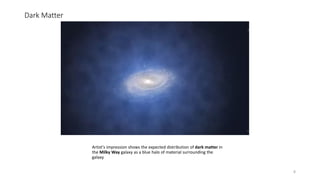
Artist's impression shows the expected distribution of dark matter in
the Milky Way galaxy as a blue halo of material surrounding the
galaxy
8
Dark Matter
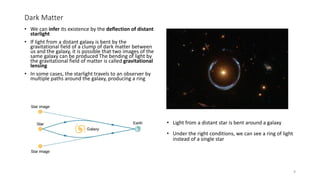
• We can infer its existence by the deflection of distant
starlight
• If light from a distant galaxy is bent by the
gravitational field of a clump of dark matter between
us and the galaxy, it is possible that two images of the
same galaxy can be produced The bending of light by
the gravitational field of matter is called gravitational
lensing
• In some cases, the starlight travels to an observer by
multiple paths around the galaxy, producing a ring
• Light from a distant star is bent around a galaxy
• Under the right conditions, we can see a ring of light
instead of a single star
9
Dark Matter-NASA
• Combining theoretical models and cosmological
observations scientists have come up with the
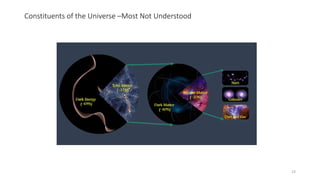
composition of the universe :
• ~ 68% dark energy
• ~ 27% dark matter
• ~ 5% normal matter
• We are much more certain what dark matter is not
than we are what it is
• It is dark, meaning that it is not in the form of stars
and planets that we see
• Observations show that there is far too little visible
matter in the universe to make up the 27%
required by the observations
• It is not in the form of dark clouds of normal
matter, matter made up of particles called baryons
• We know this because we would be able to detect
baryonic clouds by their absorption of radiation
passing through them
• It is is not antimatter, because we do not see the
unique gamma rays that are produced when
antimatter annihilates with matter
• We can rule out large galaxy-sized black holes on
the basis of how many gravitational lenses we see
• High concentrations of matter bend light passing
near them from objects further away, but we do
not see enough lensing events to suggest that such
objects to make up the required 27% dark matter
contribution
10
Dark Matter
• There are still a few dark matter possibilities that
are viable
• Baryonic matter could still make up the dark
matter if it were all tied up in brown dwarfs or in
small, dense chunks of heavy elements
• These possibilities are known as massive compact
halo objects, or "MACHOs“
• The most common view is that dark matter is not
baryonic at all
• But that it is made up of other, more exotic
particles-
• Like axions ( a hypothetical elementary
particle postulated in 1977)
• WIMPS (Weakly Interacting Massive Particles)
11
• Dark matter candidates arise frequently in
theories that suggest physics beyond the
Standard Model, such as supersymmetry
and extra dimensions
• One theory suggests the existence of a
“Hidden Valley”, a parallel world made of
dark matter having very little in common
with matter we know
CERN Dark Matter and Dark Energy
• Dark matter
• Unlike normal matter, dark matter does not
interact with the electromagnetic force.
• This means it does not absorb, reflect or emit
light, making it extremely hard to spot
• Researchers have been able to infer the existence
of dark matter only from the gravitational effect it
seems to have on visible matter
• But what is dark matter?
• One idea is that it could contain "supersymmetric
particles" – hypothesized particles that are
partners to those already known in the Standard
Model
• Experiments at the Large Hadron Collider (LHC)
may provide more direct clues about dark matter
• Many theories say the dark matter particles would
be light enough to be produced at the LHC
• If they were created at the LHC, they would escape
through the detectors unnoticed
• However, they would carry away energy and
momentum, so physicists could infer their
existence from the amount of energy and
momentum “missing” after a collision
12
Dark Matter - Large Hadron Collider (LHC) at CERN
• The term hadron refers to subatomic composite particles
composed of quarks held together by the strong force
• The best-known hadrons are the baryons such as protons
and neutrons
• A collider (LHC at CERN in Europe) is a type of a particle
accelerator which brings two opposing particle beams
together such that the particles collide
• In particle physics, colliders, though harder to construct,
are a powerful research tool because they reach a much
higher center of mass energy than fixed target setups
• Analysis of the byproducts of these collisions gives
scientists good evidence of the structure of the subatomic
world and the laws of nature governing it
• Many of these byproducts are produced only by high-
energy collisions, and they decay after very short periods
of time
• Many of them are hard or nearly impossible to study in
other ways
13
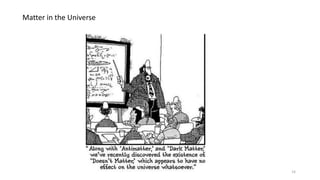
Matter in the Universe
14
What is Dark Energy?
Nobody knows!
15
Dark Energy
• Dark energy is the repulsive force that is the
dominant component of the universe
• The rest of the universe consists of ordinary matter
and dark matter
• Dark energy is relatively uniform in time and space
and is repulsive within the volume it occupies
• It is not well understood
• A kind of repulsive force was hypothesized by
Einstein in 1916 and was represented by his
cosmological constant in his general theory of
relativity in order to counteract the attractive force
of gravity
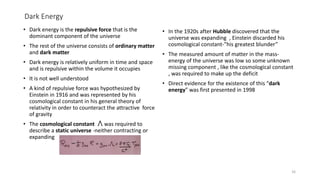
• The cosmological constant was required to
describe a static universe -neither contracting or
expanding
• In the 1920s after Hubble discovered that the
universe was expanding , Einstein discarded his
cosmological constant-”his greatest blunder”
• The measured amount of matter in the mass-
energy of the universe was low so some unknown
missing component , like the cosmological constant
, was required to make up the deficit
• Direct evidence for the existence of this “dark
energy” was first presented in 1998
16
CERN Dark Matter and Dark Energy
• Dark energy
• Dark energy makes up about 68% of the universe
and appears to be associated with the vacuum in
space
• It is distributed evenly throughout the universe,
not only in space but also in time – in other words,
its effect is not diluted as the universe expands
• The even distribution means that dark energy does
not have any local gravitational effects, but rather a
global effect on the universe as a whole
• This leads to a repulsive force, which tends to
accelerate the expansion of the universe
• The rate of expansion and its acceleration can be
measured by observations based on the Hubble
law
• These measurements, together with other
scientific data, have confirmed the existence of
dark energy and provide an estimate of just how
much of this mysterious substance exists
• In the early 1990s, one thing was fairly certain about
the expansion of the universe
• It might have enough energy density to stop its
expansion and recollapse
• It might have so little energy density that it would
never stop expanding
• But gravity was certain to slow the expansion as time
went on
• The slowing had not been observed, but,
theoretically, the universe had to slow
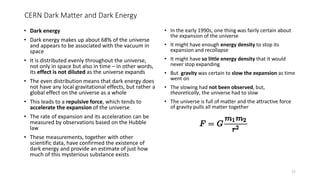
• The universe is full of matter and the attractive force
of gravity pulls all matter together
17
Dark Energy
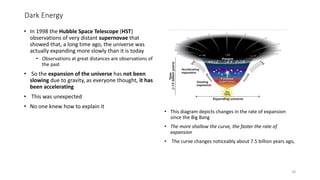
• In 1998 the Hubble Space Telescope (HST)
observations of very distant supernovae that
showed that, a long time ago, the universe was
actually expanding more slowly than it is today
• Observations at great distances are observations of
the past
• So the expansion of the universe has not been
slowing due to gravity, as everyone thought, it has
been accelerating
• This was unexpected
• No one knew how to explain it
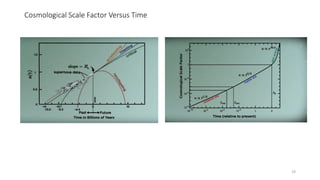
• This diagram depicts changes in the rate of expansion
since the Big Bang
• The more shallow the curve, the faster the rate of
expansion
• The curve changes noticeably about 7.5 billion years ago,
18
Cosmological Scale Factor Versus Time
19
Dark Energy
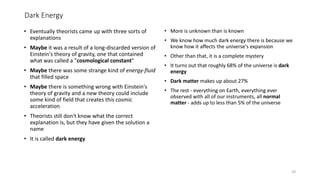
• Eventually theorists came up with three sorts of
explanations
• Maybe it was a result of a long-discarded version of
Einstein's theory of gravity, one that contained
what was called a "cosmological constant"
• Maybe there was some strange kind of energy-fluid
that filled space
• Maybe there is something wrong with Einstein's
theory of gravity and a new theory could include
some kind of field that creates this cosmic
acceleration
• Theorists still don't know what the correct
explanation is, but they have given the solution a
name
• It is called dark energy
• More is unknown than is known
• We know how much dark energy there is because we
know how it affects the universe's expansion
• Other than that, it is a complete mystery
• It turns out that roughly 68% of the universe is dark
energy
• Dark matter makes up about 27%
• The rest - everything on Earth, everything ever
observed with all of our instruments, all normal
matter - adds up to less than 5% of the universe
20
Dark Energy
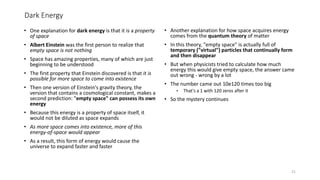
• One explanation for dark energy is that it is a property
of space
• Albert Einstein was the first person to realize that
empty space is not nothing
• Space has amazing properties, many of which are just
beginning to be understood
• The first property that Einstein discovered is that it is
possible for more space to come into existence
• Then one version of Einstein's gravity theory, the
version that contains a cosmological constant, makes a
second prediction: "empty space" can possess its own
energy
• Because this energy is a property of space itself, it
would not be diluted as space expands
• As more space comes into existence, more of this
energy-of-space would appear
• As a result, this form of energy would cause the
universe to expand faster and faster
• Another explanation for how space acquires energy
comes from the quantum theory of matter
• In this theory, "empty space" is actually full of
temporary ("virtual") particles that continually form
and then disappear
• But when physicists tried to calculate how much
energy this would give empty space, the answer came
out wrong - wrong by a lot
• The number came out 10e120 times too big
• That's a 1 with 120 zeros after it
• So the mystery continues
21
Dark Energy
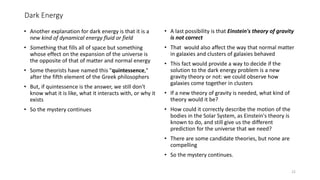
• Another explanation for dark energy is that it is a
new kind of dynamical energy fluid or field
• Something that fills all of space but something
whose effect on the expansion of the universe is
the opposite of that of matter and normal energy
• Some theorists have named this "quintessence,"
after the fifth element of the Greek philosophers
• But, if quintessence is the answer, we still don't
know what it is like, what it interacts with, or why it
exists
• So the mystery continues
• A last possibility is that Einstein's theory of gravity
is not correct
• That would also affect the way that normal matter
in galaxies and clusters of galaxies behaved
• This fact would provide a way to decide if the
solution to the dark energy problem is a new
gravity theory or not: we could observe how
galaxies come together in clusters
• If a new theory of gravity is needed, what kind of
theory would it be?
• How could it correctly describe the motion of the
bodies in the Solar System, as Einstein's theory is
known to do, and still give us the different
prediction for the universe that we need?
• There are some candidate theories, but none are
compelling
• So the mystery continues.
22
Constituents of the Universe –Most Not Understood
23
Dark Energy
• What is needed to decide among dark energy
possibilities –
• A property of space
• A new dynamic fluid
• A new theory of gravity
• More data and better data
24
DATA
Next Session
Stars
25