1	
	
Zoe	Zontos	
7	December	2015	
	
Using	LOFAR	and	Auroral	Detection	for	Exoplanetary	Research	
Introduction	
	 Many	planets	like	the	Earth	are	blessed	with	beautiful	and	naturally	occurring	
phenomena	such	as	auroras	that	light	up	the	atmosphere	in	a	dazzling	array	of	lights	and	colors.	
But	what	significance	do	auroras	hold	in	the	vast	expanse	of	the	universe?	Are	they	merely	a	
display	of	the	physics	that	governs	planetary	bodies	that	possess	a	magnetosphere?	There	are	
numerous	things	that	auroras	can	reveal	about	a	planet	and	its	characteristics;	technology	is	
advancing	enough	to	the	point	where	auroral	activity	detection	may	even	aid	in	exoplanetary	
research	and	the	discovery	of	new	planets	well	beyond	the	realm	of	the	solar	system.	An	
instrument	known	as	the	low-frequency	array	(LOFAR)	built	by	the	Netherlands	Institute	for	
Radio	Astronomy	(ASTRON)	may	have	the	capability	to	study	and	track	auroras	beyond	the	
orbit	of	Neptune	and	potentially	leading	a	new	method	of	exoplanetary	research	and	
discoveries	(“LOFAR”).	The	LOFAR	instrument	is	relatively	new	but	is	currently	being	used	for	a	
multitude	of	key	science	projects	and	has	the	capabilities	to	one	day	start	moving	forward	in	
the	search	for	auroral	activity	outside	the	solar	system	and	exoplanetary	detection.	
What	is	LOFAR?	
	 The	low-frequency	array	(LOFAR)	for	radio	astronomy	was	initially	thought	of	beginning	
in	the	1990s	when	the	Netherlands	Institute	for	Radio	Astronomy	(ASTRON)	began	studying	
aperture	array	technology.	By	2003,	ASTRON	had	set	up	the	LOFAR	Steering	Committee	and	
allocated	52	million	euro	from	the	Dutch	government	to	fund	and	start	production	for	the	
infrastructure	of	LOFAR	with	the	building	and	completion	of	the	first	operational	test	station	in	
the	same	year.	It	was	not	until	2006	that	the	first	actual	LOFAR	station	was	set	up	which	
contained	a	total	of	96	dual-dipole	antennas,	and	in	2007,	the	first	international	operational	
LOFAR	station	was	set	up	in	Germany.	In	addition,	by	2014,	multiple	base	stations	had	been	
successfully	set	up	throughout	the	Netherlands	along	with	numerous	international	stations	set
2	
	
up	and	operational	in	various	European	countries	including	Germany,	France,	the	UK,	and	
Sweden	(“LOFAR”).	Not	only	is	LOFAR	one	of	the	most	extensive	radio	telescopes	ever	built,	the	
multiple	stations	set	up	throughout	Europe	provide	a	larger	coverage	of	the	sky	and	can	gather	
a	larger	amount	of	data	than	a	conventional	telescope.		
	 With	its	successful	completion	and	operational	status,	LOFAR	is	currently	one	of	the	
largest	radio	telescopes	in	the	world,	and	it	uses	a	network	of	omnidirectional	and	dipole	
antennas	to	observe	within	low	frequency	ranges	of	10	MHz	to	250	MHz	(“The	LOFAR	
Telescope”).	These	low-cost	antennas	are	the	main	application	basis	for	LOFAR	with	two	types:	
the	Low	Band	Antenna	(LBA)	which	covers	frequencies	between	10	MHz	and	90	MHz	and	the	
High	Band	Antenna	(HBA)	which	covers	frequencies	of	110	MHz	and	250	MHz.	The	main	
stations	based	in	the	Netherlands	range	in	baseline	distances	of	50	to	1500	kilometers	(“About	
LOFAR”).	In	addition,	the	Netherlands	stations	are	spread	out	over	an	area	of	about	1000	km	in	
diameter	(“LOFAR").	With	a	telescope	that	covers	such	a	wide	area,	as	a	whole	LOFAR	contains	
thousands	of	antennas	which	ultimately	increases	the	power	and	sensitivity	to	which	it	can	
observe	its	low	frequency	ranges	with	the	LBAs	and	the	HBAs.	
LOFAR’s	Key	Science	Projects	
With	the	impressive	technology	that	LOFAR	offers,	the	projects	and	topics	(referred	to	
as	Key	Science	Projects	(KSP)	by	ASTRON)	that	it	is	being	used	for	since	its	inception	are	listed	as	
follows:	
Epoch	of	Reionization		
Noted	as	the	most	exciting	application	that	LOFAR	is	utilized	for	is	the	search	for	an	
emission	line	that	comes	from	what	is	known	as	the	Epoch	of	Reionization.	LOFAR	is	on	
the	lookout	for	a	21-cm	emission	line	that	will	aid	in	the	study	of	reionization	of	matter	
that	occurred	around	a	redshift	value	of	z=20	in	the	so-called	‘Dark	Ages’	of	the	universe	
–	a	deemed	recombination	period	where	the	neutrality	to	ionization	of	matter	within	
the	universe	occurred.	Alternative	data	suggests	that	multiple	phases	of	reionization	
may	have	occurred	between	redshift	values	of	z~6	to	z~15-20,	and	LOFAR	is	being	used	
at	a	range	of	z=11.4	(115	MHz)	to	z=6	(180	MHz)	to	probe	this	range	to	search	for	the
3	
	
emission	line	in	order	to	obtain	a	better	understanding	of	what	processes	were	going	on	
throughout	this	period	of	evolution	in	the	universe	(“Key	Science	Projects”).		
Deep	extragalactic	surveys	
One	of	the	most	important	tasks	of	LOFAR	is	conducting	large-sky	surveys.	The	
astrophysical	contributions	of	these	sky-surveys	include	researching	the	formation	of	
massive	galaxies,	clusters	and	black	holes,	focusing	on	inter-cluster	magnetic	fields	using	
different	radio	emissions	from	galaxies	and	clusters,	the	star	formation	processes	in	the	
early	universe,	and	exploration	of	new	parameters	of	the	universe	to	potentially	
uncover	new	phenomena.	Examples	of	the	data	that	has	been	found	include	
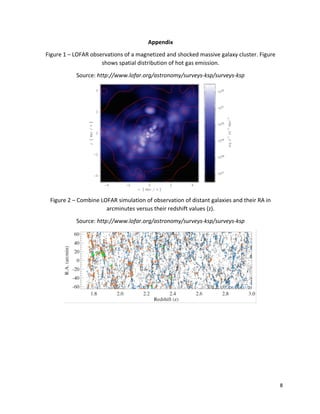
observations	of	diffuse	emissions	from	a	magnetized	galaxy	cluster	which	shows	the	
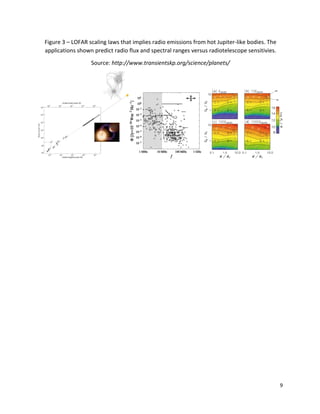
distribution	of	the	emission	from	hot	gas	(see	Figure	1)	and	simulations	of	combined	
observations	of	distant	galaxy	formation	in	respect	to	the	relationship	of	redshift	and	
right	ascension	data	(see	Figure	2)	(“The	Science	Drivers”).	
Transient	sources	
Among	observing	many	objects	and	phenomena	in	space,	LOFAR	is	also	being	used	to	
focus	on	how	studying	transient	sources	will	further	the	understanding	of	the	energies	
that	emit	from	explosive	objects,	accretions	of	black	holes,	and	rapidly	rotating	neutron	
stars.	Using	LOFAR	to	study	the	radio	emissions	from	these	objects/phenomena	helps	in	
determining	and	understanding	where	and/or	how	often	they	occur	and	how	they	
impact	their	surrounding	environment	(“The	Science	Drivers”).		
Ultra-high	energy	cosmic	rays	
In	the	areas	of	particle	and	astrophysical	particle	physics,	LOFAR	is	being	used	to	study	
the	origins	of	high-energy	cosmic	rays	(HECRs)	at	energies	between	1015
	and	1020.5	
eV.	
Scientists	are	already	using	LOFAR	to	study	galaxies,	gamma-ray	bursts,	etc.,	and	the	
cosmic	rays	that	emit	a	pulse	throughout	the	universe	are	detectable	provided	there	are	
air	showers	occurring	from	the	interaction	of	cosmic	rays	with	the	Earth’s	atmosphere	
(“Key	Science	Projects”).
4	
	
Solar	science	and	space	weather	
The	focus	on	solar	science	and	space	weather	uses	LOFAR	to	study	solar	activity	such	as	
flares	and	coronal	mass	ejections	(CMEs).	Solar	radiation	is	within	the	ideal	frequency	
for	LOFAR	detection	making	it	a	prime	source	for	studying	CMEs	that	travel	into	space	
and	the	probability	of	CMEs	hitting	the	Earth	(“Key	Science	Projects”).	These	
phenomena	influence	the	environment	of	the	Earth	and	directly	relate	to	the	field	of	
space	weather.	Solar	science	information	obtained	by	LOFAR	will	further	the	
understanding	of	space	weather	and	can	be	used	to	predict	the	effects	of	solar	
radiation/emissions	on	Earth	(“The	Science	Drivers”).			
Cosmic	magnetism	
Magnetic	fields	are	evident	everywhere	throughout	the	universe;	information	on	
magnetic	energy	relates	to	large-scale	evolutions	found	inside	galaxies,	galaxy	clusters,	
and	interstellar/inter-cluster	medium.	Magnetic	fields	also	provide	information	for	the	
pressure	found	within	interstellar	gas	and	star	formation	(“The	Science	Drivers”).	Using	
LOFAR	to	study	this	cosmic	magnetism	is	helping	to	answer	the	questions	in	
astrophysics	about	objects	such	as	dwarf	galaxies,	galactic	halos,	and	intergalactic	
material	(“Key	Science	Projects”).	
Auroral	Detection	for	Exoplanetary	Research	
The	multitude	of	projects	that	LOFAR	is	being	used	for	paves	the	way	for	other	areas	of	
research	that	it	could	possibly	be	used	for	one	day,	such	as	in-depth	auroral	research	to	
discover	exoplanets.	Detecting	exoplanets	that	are	far	away	from	their	host	star	is	a	harrowing	
process;	scientists	now	theorize	that	using	radio	emissions	from	auroral	activity	could	lead	to	
the	discovery	of	other	planetary	bodies	outside	the	solar	system	that	also	exhibit	auroras.	
According	to	Dr.	Jonathan	Nichols,	a	researcher	at	the	University	of	Leicester,	evident	data	from	
studying	auroral	processes	on	Jupiter	may	account	for	the	radio	emissions	observed	from	
certain	objects	that	ultimately	suggests	that	auroras	do	indeed	occur	on	bodies	outside	the	
solar	system.	The	notion	is	that	auroral	activity	occurs	elsewhere,	and	the	radio	emissions	are	
powerful	enough,	possibly	even	one	thousand	times	brighter	than	those	of	Jupiter,	to	be
5	
	
detectable	on	Earth	from	great	distances	(“New	Evidence”).	Looking	at	the	cosmic	magnetism	
and	radio	emission	research	that	LOFAR	is	being	used	for	includes	the	process	of	studying	the	
magnetic	fields	of	objects	by	observing	the	radio	emissions	that	are	detected	(“Key	Science	
Projects”).	Auroras	themselves	are	a	natural	occurrence	within	our	solar	system	because	they	
occur	when	charged	particles	in	an	object’s	magnetosphere	collide	with	the	atoms	in	the	upper	
atmosphere,	thus,	causing	the	beautiful	glowing	bands	of	light.	A	key	thing	to	note,	however,	is	
that	before	these	particles	hit	the	atmosphere,	they	emit	radio	waves	into	space	(“New	
Evidence”).	To	date,	scientists	only	know	of	auroras	occurring	within	the	confines	of	the	solar	
system	and	none	have	been	detected	beyond	the	orbit	of	Neptune.	However,	LOFAR	data	on	
the	auroral	activity	of	Jupiter	sheds	light	on	how	the	auroral	activity	that	occurs	within	the	solar	
system	could	aid	in	the	discovery	of	exoplanets	outside	it.	Data	on	the	location	and	motion	of	
Jupiter’s	auroral	emissions	reveals	that	high-sensitivity	observations	of	radio	emissions	will	
shed	light	on	planetary	data	as	well	as	attempt	to	detect	exoplanetary	radio	emissions	(“LOFAR	
Transients”).	Scientists	also	predict	that	these	exoplanetary	emissions	could	reach	energies	that	
are	103
	to	105	
times	those	of	Jupiter’s	which	suggests	that	they	could	be	detectable	within	a	
range	of	tens	of	parsecs	(Zarka).	Referring	to	Figure	3	shows	the	information	obtained	by	
applying	scaling	laws	to	predictions	of	radio	flux	and	spectral	ranges	compared	to	LOFAR	
sensitivities	for	possible	exoplanets.	Essentially,	LOFAR	data	on	Jupiter’s	auroral	activity	and	
radio	emissions	strongly	suggests	that	exoplanetary	radio	emitters	should	exist	(“LOFAR	
Transients”).	With	the	help	of	scientists	using	LOFAR	to	study	Jupiter’s	auroras	and	the	radio	
emissions	that	stem	from	its	auroral	regions,	the	observational	data	provides	a	high	probability	
to	allowing	researchers	to	start	focusing	on	distances	beyond	Neptune	for	any	auroras	and	
possible	exoplanets.	
Given	the	capabilities	that	LOFAR	has	to	study	auroral	activity,	the	idea	to	utilize	and	
focus	this	instrument	outside	the	solar	system	would	be	greatly	beneficial	to	planetary	science.	
The	information	that	could	be	gathered	from	a	telescope	of	this	power	and	frequency	ranges	
would	not	only	provide	a	new	method	of	exoplanetary	detection	but	studying	the	radio	
emissions	could	even	provide	information	on	the	exoplanet’s	period,	magnetic	field,	any	
orbiting	moons	around	the	planet,	and	the	host	star-planet	relationship	(“New	Evidence”).	The
6	
	
telescope	is	already	ground-based,	and	there	would	be	no	need	to	move	and/or	put	any	
part/addition	of	the	instrument	into	space.	Also,	as	mention	previously,	the	antennas	that	are	
used	at	each	station	are	cheap	which	makes	the	issue	of	cost	not	exponentially	significant.	If	
scientists	start	focusing	LOFAR	at	distances	past	the	orbit	of	Neptune,	there	is	a	great	
probability	for	collecting	new	data	to	support	this	theory	on	exoplanetary	detection	based	off	
of	auroral	activity.	A	new	method	would	increase	the	importance	of	detecting	auroras	outside	
the	solar	system,	and	if	new	exoplanets	could	be	found	based	on	radio	emission	detection,	it	
may	even	provide	new	candidates	for	hosting	life.		
Conclusion	
	 The	amount	of	research	that	LOFAR	is	currently	providing	is	impressive	in	many	areas.	
Given	the	capabilities	that	LOFAR	has,	the	evidence	supporting	the	use	of	LOFAR	to	search	for	
auroral	activity	outside	the	solar	system	in	order	to	uncover	new	exoplanets	is	extremely	
promising.	The	key	science	projects	that	LOFAR	is	focusing	on	reveals	the	power	and	sensitivity	
of	the	array	that	is	ideal	in	radio	astronomy	and	for	auroral	detection	within	the	solar	system	
and	beyond	it.	If	LOFAR	has	the	capabilities	and	the	sensitivity	to	detect	radio	emissions	that	
are	similar	to	those	that	are	produced	by	the	auroras	in	the	solar	system,	the	opportunities	to	
develop	a	new	method	for	exoplanetary	research	based	on	auroral	activity	will	provide	new	
information	to	find	these	exoplanets	and	information	on	auroral	behavior	outside	the	solar	
system.	If	scientists	decide	to	start	focusing	LOFAR	outside	the	solar	system,	the	probability	for	
this	new	type	of	research	is	almost	certainly	possible.	Not	only	is	LOFAR	a	highly	useful	radio	
telescope	for	the	current	work	it	is	being	used	for,	but	it	is	also	an	extremely	ideal	instrument	
that	could	easily	be	used	to	start	focusing	on	auroral	activity	beyond	Neptune’s	orbit	and	
finding	these	new	potential	planets.
7	
	
Works	Cited	
"About	LOFAR."	About	LOFAR.	LOFAR.	N.p.,	n.d.	Web.	22	Nov.	2015.	
"Key	Science	Projects."	LOFAR	Science.	ASTRON,	n.d.	Web.	19	Nov.	2015.	
"LOFAR."	Wikipedia.	Wikimedia	Foundation,	n.d.	Web.	10	Nov.	2015.	
"LOFAR Transients Key Project." Science Case. LOFAR, n.d. Web. 17 Nov. 2015.
"New	Evidence	Indicates	Auroras	Occur	outside	Our	Solar	System."	University	of	Leicester.	N.p.,	21	Jan.	
	 2013.	Web.	15	Nov.	2015.	
"The	LOFAR	Telescope."	Information	About	ASTRON.	ASTRON,	n.d.	Web.	19	Nov.	2015.	
"The	Science	Drivers	of	LOFAR	-	the	Key	Science	Projects	(KSP)."	LOFAR	Key	Science	Projects.	LOFAR,	n.d.	
	 Web.	22	Nov.	2015.	
Zarka,	Phillipe.	"PLANETARY	SCIENCE	WITH	THE	LOW	FREQUENCY	ARRAY	(LOFAR)."	(n.d.):	n.	pag.	
	 Observatoire	De	Paris.	Web.	20	Nov.	2015.
8	
	
Appendix	
Figure	1	–	LOFAR	observations	of	a	magnetized	and	shocked	massive	galaxy	cluster.	Figure	
shows	spatial	distribution	of	hot	gas	emission.		
Source:	http://www.lofar.org/astronomy/surveys-ksp/surveys-ksp	
	
Figure	2	–	Combine	LOFAR	simulation	of	observation	of	distant	galaxies	and	their	RA	in	
arcminutes	versus	their	redshift	values	(z).	
Source:	http://www.lofar.org/astronomy/surveys-ksp/surveys-ksp
9	
	
Figure	3	–	LOFAR	scaling	laws	that	implies	radio	emissions	from	hot	Jupiter-like	bodies.	The	
applications	shown	predict	radio	flux	and	spectral	ranges	versus	radiotelescope	sensitivies.	
Source:	http://www.transientskp.org/science/planets/

LOFAR