Shinto Japan’s Ancient Religion
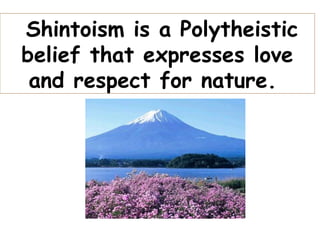
Shintoism is a Polytheistic belief that expresses love and respect for nature.
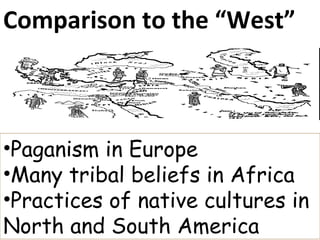
Paganism in Europe  Many tribal beliefs in Africa Practices of native cultures in North and South America  Comparison to the “West”
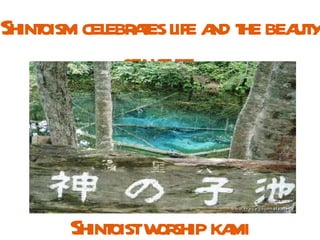
Shintoism celebrates life and the beauty of nature  Shintoist worship kami
Some kami are compared to the “gods” of the west, but are different in many ways, too.  KAMI • Kami is a general term for Shinto deities and spirits.  Kami can also be forces of nature, important people, or even natural objects.
The emperor of Japan was considered a Kami.  KAMI • A special rock, a large tree, or a waterfall, can be considered Kami.
Identifiable founder Shinto Body of religious laws. Written scriptures or Holy Text A very loosely organized priesthood • Unlike most other religions of the world, Shintoism has  NO :
The family is seen as the main force for traditions to be preserved. Main celebrations relate to birth and marriage.  The Four Affirmations of Shinto Tradition and the family:
Nature is sacred; to be in contact with nature is to be close to the Gods. Natural objects are worshipped as sacred spirits The Four Affirmations of Shinto Love of nature:
Followers of Shinto take baths, wash their hands, and rinse out their mouth often. Shinto stresses purifying that which is unclean, such as dirt, wounds, and disease. Touching the dead is considered unclean.  The Four Affirmations of Shinto Physical cleanliness:
The worship given to the kami and the ancestral spirits. The Four Affirmations of Shinto Matsuri:
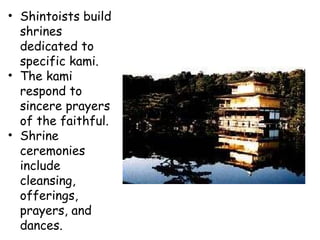
Shintoists build shrines dedicated to specific kami.  The kami respond to sincere prayers of the faithful.  Shrine ceremonies include cleansing, offerings, prayers, and dances.
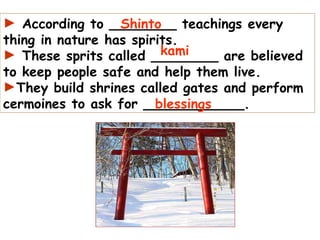
According to ________ teachings every thing in nature has spirits. These sprits called ________ are believed to keep people safe and help them live.  They build shrines called gates and perform cermoines to ask for ____________. Shinto kami blessings
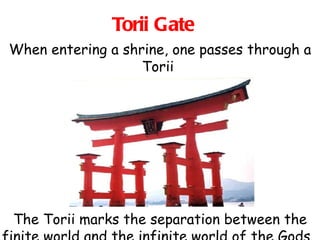
Torii Gate When entering a shrine, one passes through a Torii  The Torii marks the separation between the finite world and the infinite world of the Gods.
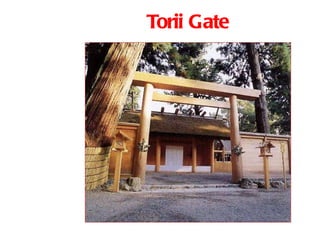
Torii Gate
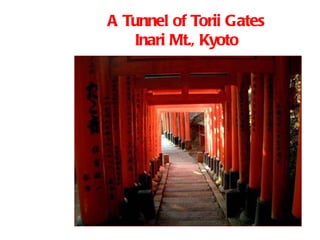
A Tunnel of Torii Gates Inari Mt., Kyoto
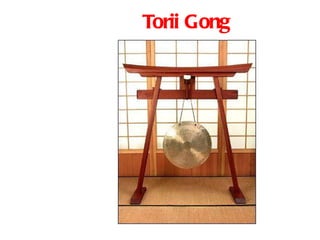
Torii Gong
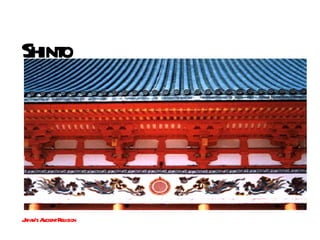
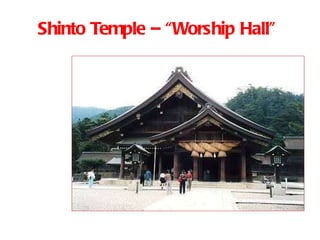
Shinto Temple – “Worship Hall”
Quick Answer: Yes But in an altered form, current Japanese religion is a combination of Shintoism, Buddhism, and Confucianism .

Shintoism

  • 1.
  • 2.
    Shintoism is aPolytheistic belief that expresses love and respect for nature.
  • 3.
    Paganism in Europe Many tribal beliefs in Africa Practices of native cultures in North and South America Comparison to the “West”
  • 4.
    Shintoism celebrates lifeand the beauty of nature Shintoist worship kami
  • 5.
    Some kami arecompared to the “gods” of the west, but are different in many ways, too. KAMI • Kami is a general term for Shinto deities and spirits. Kami can also be forces of nature, important people, or even natural objects.
  • 6.
    The emperor ofJapan was considered a Kami. KAMI • A special rock, a large tree, or a waterfall, can be considered Kami.
  • 7.
    Identifiable founder ShintoBody of religious laws. Written scriptures or Holy Text A very loosely organized priesthood • Unlike most other religions of the world, Shintoism has NO :
  • 8.
    The family isseen as the main force for traditions to be preserved. Main celebrations relate to birth and marriage. The Four Affirmations of Shinto Tradition and the family:
  • 9.
    Nature is sacred;to be in contact with nature is to be close to the Gods. Natural objects are worshipped as sacred spirits The Four Affirmations of Shinto Love of nature:
  • 10.
    Followers of Shintotake baths, wash their hands, and rinse out their mouth often. Shinto stresses purifying that which is unclean, such as dirt, wounds, and disease. Touching the dead is considered unclean. The Four Affirmations of Shinto Physical cleanliness:
  • 11.
    The worship givento the kami and the ancestral spirits. The Four Affirmations of Shinto Matsuri:
  • 12.
    Shintoists build shrinesdedicated to specific kami. The kami respond to sincere prayers of the faithful. Shrine ceremonies include cleansing, offerings, prayers, and dances.
  • 13.
    According to ________teachings every thing in nature has spirits. These sprits called ________ are believed to keep people safe and help them live. They build shrines called gates and perform cermoines to ask for ____________. Shinto kami blessings
  • 14.
    Torii Gate Whenentering a shrine, one passes through a Torii The Torii marks the separation between the finite world and the infinite world of the Gods.
  • 15.
  • 16.
    A Tunnel ofTorii Gates Inari Mt., Kyoto
  • 17.
  • 18.
    Shinto Temple –“Worship Hall”
  • 19.
    Quick Answer: YesBut in an altered form, current Japanese religion is a combination of Shintoism, Buddhism, and Confucianism .