ASHIK REZA
ID NO :11507005
Department of Marketing
Comilla university
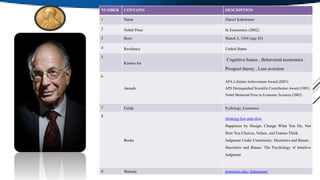
NUMBER CONTAINS DESCRIPTION
1 Name Daniel Kahneman
2 Nobel Prize In Economics (2002)
3 Born March 5, 1934 (age 83)
4 Residence United States
5
Known for
Cognitive biases , Behavioral economics
Prospect theory , Loss aversion
6
Awards
APA Lifetime Achievement Award (2007)
APS Distinguished Scientific Contribution Award (1982)
Nobel Memorial Prize in Economic Sciences (2002)
7 Fields Pychology, Economics
8
Books
thinking-fast-and-slow.
Happiness by Design: Change What You Do, Not
How You Choices, Values, and Frames Think.
Judgment Under Uncertainty: Heuristics and Biases.
Heuristics and Biases: The Psychology of Intuitive
Judgment
9 Website princeton.edu/~kahneman/
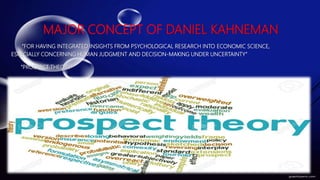
MAJOR CONCEPT OF DANIEL KAHNEMAN
“FOR HAVING INTEGRATED INSIGHTS FROM PSYCHOLOGICAL RESEARCH INTO ECONOMIC SCIENCE,
ESPECIALLY CONCERNING HUMAN JUDGMENT AND DECISION-MAKING UNDER UNCERTAINTY”
“PROSPECT THEORY”
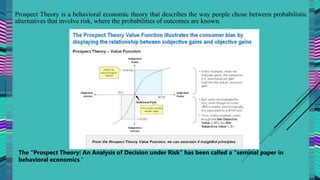
Prospect Theory is a behavioral economic theory that describes the way people chose between probabilistic
alternatives that involve risk, where the probabilities of outcomes are known.
The “Prospect Theory: An Analysis of Decision under Risk” has been called a “seminal paper in
behavioral economics.”
Uses field
To inform the judgment and decision-making under uncertainty.
calls their entry into behavioral economics "completely accident"--but after the Econometrica ,
found in a circle of innovative economists.
To cognitive psychology and social psychology.
instinctive ones and any attempt to make us act rationally must take that inbuilt bias into account or
fail.
Contributions
 Daniel Kahneman work has inspired a new generation of researchers in economics and finance .

to enrich economic theory using insights from cognitive psychology .

work spurred a great deal of work by economists on systematic departures from rational behavior.

To help share market by using the prospect theory.
 The theory now forms the basis for much of the applied research in economics.
THANK YOU

Daniel kahneman and prospect theory

  • 1.
    ASHIK REZA ID NO:11507005 Department of Marketing Comilla university
  • 2.
    NUMBER CONTAINS DESCRIPTION 1Name Daniel Kahneman 2 Nobel Prize In Economics (2002) 3 Born March 5, 1934 (age 83) 4 Residence United States 5 Known for Cognitive biases , Behavioral economics Prospect theory , Loss aversion 6 Awards APA Lifetime Achievement Award (2007) APS Distinguished Scientific Contribution Award (1982) Nobel Memorial Prize in Economic Sciences (2002) 7 Fields Pychology, Economics 8 Books thinking-fast-and-slow. Happiness by Design: Change What You Do, Not How You Choices, Values, and Frames Think. Judgment Under Uncertainty: Heuristics and Biases. Heuristics and Biases: The Psychology of Intuitive Judgment 9 Website princeton.edu/~kahneman/
  • 3.
    MAJOR CONCEPT OFDANIEL KAHNEMAN “FOR HAVING INTEGRATED INSIGHTS FROM PSYCHOLOGICAL RESEARCH INTO ECONOMIC SCIENCE, ESPECIALLY CONCERNING HUMAN JUDGMENT AND DECISION-MAKING UNDER UNCERTAINTY” “PROSPECT THEORY”
  • 4.
    Prospect Theory isa behavioral economic theory that describes the way people chose between probabilistic alternatives that involve risk, where the probabilities of outcomes are known. The “Prospect Theory: An Analysis of Decision under Risk” has been called a “seminal paper in behavioral economics.”
  • 5.
    Uses field To informthe judgment and decision-making under uncertainty. calls their entry into behavioral economics "completely accident"--but after the Econometrica , found in a circle of innovative economists. To cognitive psychology and social psychology. instinctive ones and any attempt to make us act rationally must take that inbuilt bias into account or fail.
  • 6.
    Contributions  Daniel Kahnemanwork has inspired a new generation of researchers in economics and finance .  to enrich economic theory using insights from cognitive psychology .  work spurred a great deal of work by economists on systematic departures from rational behavior.  To help share market by using the prospect theory.  The theory now forms the basis for much of the applied research in economics.
  • 7.