FOR INTERNAL USE ONLY

CAROPHYLL® Red and Yellow for
Chicken and Egg Pigmentation
VMS, 2013

F. Cisneros
FOR INTERNAL USE ONLY

Content:
•
•
•
•
•

Bright Food and carotenoids
The pigmentation process
Egg pigmentation
Chicken pigmentation
The CAROPHYLL® brand
FOR INTERNAL USE ONLY

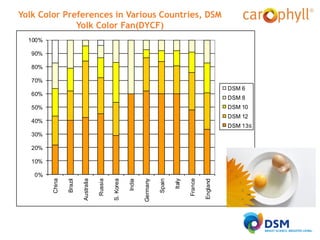
Yolk Color Preferences in Various Countries, DSM
Yolk Color Fan(DYCF)
100%
90%
80%
70%
DSM 6
60%

DSM 8
DSM 10

50%

DSM 12

40%

DSM 13≤

30%

20%
10%

England

France

Italy

Spain

Germany

India

S. Korea

Russia

Australia

Brazil

China

0%
FOR INTERNAL USE ONLY

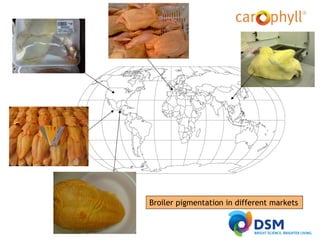
Broiler pigmentation in different markets
FOR INTERNAL USE ONLY

The color of the egg yolk and chicken skin is determined by the concentration
and type of carotenoids in the diet, as well as their absorption and overall
ingestion.

A pigmented egg always comes from a healthy hen.
FOR INTERNAL USE ONLY

Colors exist in nature due to the presence and combination of different
groups of molecules such as chlorophyll, quercetin, and carotenoids
FOR INTERNAL USE ONLY

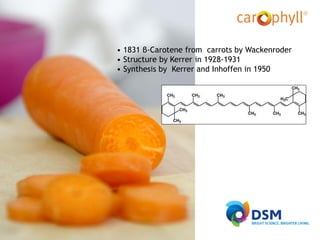
• 1831 β-Carotene from carrots by Wackenroder
• Structure by Kerrer in 1928-1931
• Synthesis by Kerrer and Inhoffen in 1950
FOR INTERNAL USE ONLY

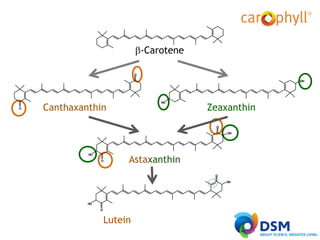
b-Carotene

400 to 600 nm
FOR INTERNAL USE ONLY

b-Carotene
O
OH

O

HO

Canthaxanthin

Zeaxanthin
O
OH

HO
O

Astaxanthin
O
OH

HO
O

Lutein
FOR INTERNAL USE ONLY

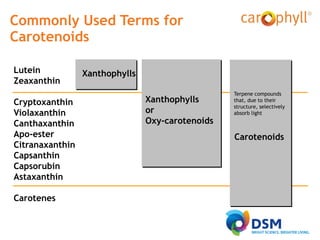
Commonly Used Terms for
Carotenoids
Lutein
Zeaxanthin
Cryptoxanthin
Violaxanthin
Canthaxanthin
Apo-ester
Citranaxanthin
Capsanthin
Capsorubin
Astaxanthin
Carotenes

Xanthophylls
Xanthophylls
or
Oxy-carotenoids

Terpene compounds
that, due to their
structure, selectively
absorb light

Carotenoids
FOR INTERNAL USE ONLY

Main Carotenoids in Poultry Pigmentation

Apo-ester
Lutein

Canthaxanthin

Zeaxanthin

445
450
Yellow Carotenoids

455

460

465

470

475

480

Wave lenght, nm

Adapted from Bauernfeind, 1981 and Schierle 2011
FOR INTERNAL USE ONLY

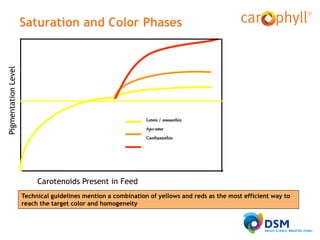
Pigmentation Level

Saturation and Color Phases

Lutein / zeaxanthin
Apo-ester
Canthaxanthin

Carotenoids Present in Feed
Technical guidelines mention a combination of yellows and reds as the most efficient way to
reach the target color and homogeneity
FOR INTERNAL USE ONLY

Egg Pigmentation
Sources of Carotenoids
Pigmentation Evaluation
FOR INTERNAL USE ONLY

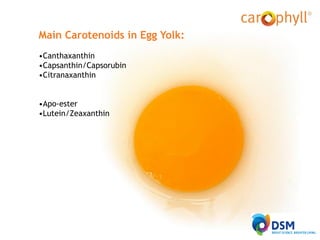
Main Carotenoids in Egg Yolk:
•Canthaxanthin
•Capsanthin/Capsorubin
•Citranaxanthin
•Apo-ester
•Lutein/Zeaxanthin
FOR INTERNAL USE ONLY

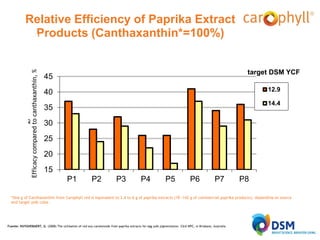
%
Efficacy compared to canthaxanthin, %

Relative Efficiency of Paprika Extract
Products (Canthaxanthin*=100%)

target DSM YCF

45

12.9

40

14.4

35
30
25
20
15
P1

P2

P3

P4

P5

P6

P7

P8

*One g of Canthaxanthin from Carophyll red is equivalent to 2.4 to 6 g of paprika extracts (19 -142 g of commercial paprika products), depending on source
and target yolk color.

Fuente: HUYGHEBAERT, G. (2008) The utilisation of red oxy-carotenoids from paprika extracts for egg yolk pigmentation. 23rd WPC, in Brisbane, Australia
FOR INTERNAL USE ONLY

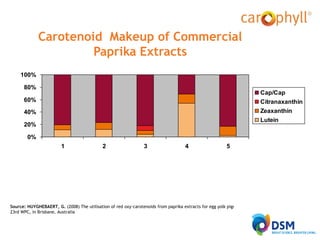
Carotenoid Makeup of Commercial
Paprika Extracts
100%
80%

Cap/Cap
Citranaxanthin

60%

Zeaxanthin
Lutein

40%
20%
0%
1

2

3

4

5

Source: HUYGHEBAERT, G. (2008) The utilisation of red oxy-carotenoids from paprika extracts for egg yolk pigmentation.
23rd WPC, in Brisbane, Australia
FOR INTERNAL USE ONLY

Citranaxanthin in Egg Yolk Pigmentation

15

RYCF

14
A poE 3 ppm

13

Lut / Ze a 9 ppm

12
11
10

Red Carotenoids (ppm)

Source: Adapted from Huyghebaert Gérard1 Piesschaert Isabelle. 4ème Journées de la Recherche Avicole, Nantes 27-29 mars 1991
FOR INTERNAL USE ONLY

DSMYCF

Effect of the Source of Yellow Carotenoid on
Egg Yolk Pigmentation
2011, France

1991, Mexico
9

RYCF

Apo-ester

Tagetes

0

Apo-ester

8

13
12
11
10
9
8
7
6
5
4
3
2

Tagetes

2

4

6

8

10 12 14 16 18 20

Yellow Carotenoids Present in Feed, ppm

7
6

3 g of tagetes equal 1 g of
Apo-ester

5
0

2

4

6

8

10

12

Carotenoids Present in Feed, ppm
Source:Vallejo, Avila & Tirado, 1991. proceeding AMENA meeting. Ixtapa, Mexico

Source: Faruk, Aurelli and Schierle. 2011. CRNA Report 00010749. France
FOR INTERNAL USE ONLY

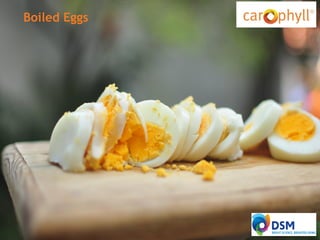
Boiled Eggs
FOR INTERNAL USE ONLY

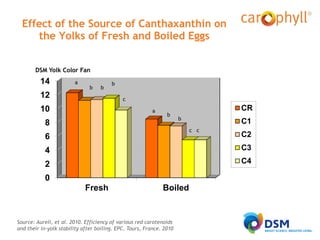
Effect of the Source of Canthaxanthin on
the Yolks of Fresh and Boiled Eggs
DSM Yolk Color Fan

14

a

b

b

12

b

c

10

a

b

8

CR
b

C1
c c

6

C2

4

C3

2

C4

0
Fresh

Boiled

Source: Aureli, et al. 2010. Efficiency of various red carotenoids
and their in-yolk stability after boiling. EPC. Tours, France. 2010
FOR INTERNAL USE ONLY

Egg Pigmentation
Sources of Carotenoids
Pigmentation Evaluation
FOR INTERNAL USE ONLY

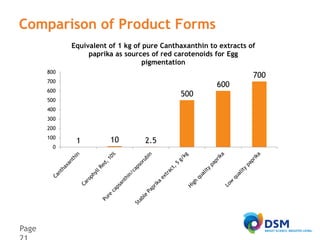
Comparison of Product Forms
Equivalent of 1 kg of pure Canthaxanthin to extracts of
paprika as sources of red carotenoids for Egg
pigmentation
800

700

700

600

600

500

500
400
300
200
100
0

Page

1

10

2.5
FOR INTERNAL USE ONLY

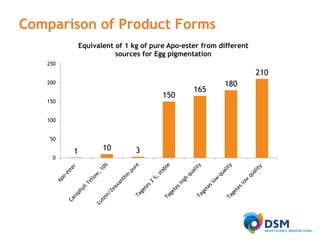
Comparison of Product Forms
Equivalent of 1 kg of pure Apo-ester from different
sources for Egg pigmentation
250

210
200

150

150
100
50
0

1

10

3

165

180
FOR INTERNAL USE ONLY

The DSM Yolk Color Fan

Pros: Standard, single measurement, inexpensive, and easy to use
Cons: Subjective, variations among individuals
FOR INTERNAL USE ONLY

Colorimeters: L*a*b* and L*C*h*
Color Spaces

Pros: Objective, repeatability, automatic, portable
Cons: Three different measurements, non-standard, higher price

https://wwws.konicaminolta.net/php/global/se_booklet_download/entry.php
FOR INTERNAL USE ONLY

Automatic Measuring Devices

http://www.tss-york.com/products/qcmrange#QCC

ORKA FOOD TECHNOLOGY
http://eggtester.com/products/egg-analyzer
FOR INTERNAL USE ONLY

Industrial Eggs
FOR INTERNAL USE ONLY

Effect of Dietary Apo-ester on Egg Yolk
Concentration and Color
14

100
Minolta Yellow

90

12
80
DSM Yolk Color Fan

10

70
60

8

50
6

40
30

4

20
Yolk Apo-ester, ppm

2

10

0

0
0

5

10

Dietary Apo-ester, ppm

CRNA RPD 00010749 DSM internal, 2012

20
FOR INTERNAL USE ONLY

Effect of Dietary Carotenoids on Egg Yolk
Concentration and Color in Hy-Line W-36
14
12

60
L* a* b* Yellow

50

DSM Yolk Color Fan

10
40
8
30
6
20

Total Egg Carotenoids, ppm

4

10

2
0

0
3.4

26.7

37.9

62.3

Carotenoids Present in Feed, ppm

Carlos de la Cruz, 2006

97.9

128.2
FOR INTERNAL USE ONLY

Effect of Two Sources of Carotenoids on the Concentration of
Carotenoids and Minolta Yellow Units in the Whole Egg
110

110

100

100

90

90

BCE, ppm

BCE, ppm,

BCE, ppm

80

70

Minolta Yellow

80

70

BCE, ppm
Minolta Yellow

60

60

50

50

40
40

60

80

40
120

140

160

180

200

220

Dietary Lutein/Zeaxanthin, ppm

Dietary Apo-ester, ppm

•Color is not a good indicator of carotenoid concentration in egg yolk

•Apo-ester can linearly increase carotenoid concentration in egg yolk

Sirri, 2007. JAPR, 16:249

240
FOR INTERNAL USE ONLY

HPLC
FOR INTERNAL USE ONLY

i-check

Schweigert,F. et al. 2010. XIII European Poultry Conference.Tours,France.
FOR INTERNAL USE ONLY

Chicken Pigmentation
Sources of Carotenoids
Pigmentation Evaluation
FOR INTERNAL USE ONLY

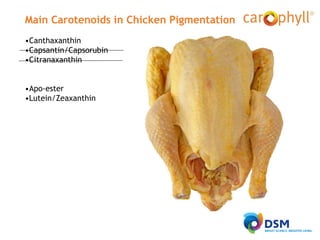
Main Carotenoids in Chicken Pigmentation:
•Canthaxanthin
•Capsantin/Capsorubin
•Citranaxanthin
•Apo-ester
•Lutein/Zeaxanthin
FOR INTERNAL USE ONLY

Apo-ester to Tagetes Equivalency
Trial details
•
416 Ross PM3 chickens, 4 treatments containing 5ppm of red base
(Canthaxanthin) for all treatments
•
Added xanthophylls according to analytical values (below average tagetes),
43% average

T1

T2

T3

T4

LZ/APE (ppm)

60/0

50/4

40/8

20/16

a (L*a*b*)

3.2a

3.6a

4.1b

4.2b

b (L*a*b*)

38a

36.3b

35.8b

31.3c

DSM Broiler Fan

103.7a

103.5a

103.6a

102.8b

a, b, c: significant differences in the same line ( P<0.001)

Source: Hamelin and Hernandez, XIIIth European Poultry Conference, Tours, 23-27 August 2010
FOR INTERNAL USE ONLY

Apo-ester to Tagetes Equivalency
Protocol:
•
•
•
•
•
•

Spanish Trial Farm
September-October 2011
Ross 308 in balanced mixed groups
Two pelleted meals (0-12 and 22-32 days)
Wheat, soybean meal, corn, barley, sorghum
240 chickens were used for the carcass color evaluation (balanced by
sex), 60 per treatment

Source: Hamelin, Martinez y Martinez. 2012. Memorias Simposio Cientifico de Avicultura. WPSAAECA, Barcelona.
FOR INTERNAL USE ONLY

Apo-ester to
Tagetes
Equivalency

Canthaxanthin
(ppm)

Apo-ester
(ppm)

Lutein +
Zeaxanthin (ppm)

5

0

30

5

20

0

30

5

20

T1
T2
T3

10

T4

DSM Broiler Fan
105.5

105.1

105

104

103.7

31

31.8
30.7

30.3

30
29

103.5
103

32

32
104.6
104.3

104.5

Minolta, b*

33

28

a

b

NS NS

27

102.5

26

102

25

5

10

Canthaxanthin, ppm

30 20/5
Lut-Zea/Apo-ester, ppm

a b
5

NS NS

10

30 20/5

Canthaxanthin, ppm

Lut-Zea/Apo-ester, ppm

Source: Hamelin, Martinez y Martinez. 2012. Memorias Simposio Cientifico de Avicultura. WPSAAECA, Barcelona.
FOR INTERNAL USE ONLY

High in Zeaxanthin

Analyzed Yellow Xanthophylls (XA)
Lutein

Zeaxanthin

T-1

30

26

25

22

24

4.4

3.4

T-2

35 ppm XA (10% Zea) + 5 ppm Cantha

34

8.5

T-3

b* Minolta Skin

No XA

40 ppm XA (25% Zea)

25

14.2

T-4

32 ppm XA (10% Zea) + 2 ppm Cantha

31

6.8

20
Deposition Rate in Skin, %

15
10
5

0

Lutein
T-2

d
T1

a
T2

c
T3

b
T4

Source: Adapted from P Vendrell, et al., 2001. Poult. Sci 80:320-326.
.

12

10

T-3

9

Zeaxanthin

9

8

T-4

12

9
FOR INTERNAL USE ONLY

Chicken Pigmentation with Tagetes, Apo-ester and
Canthaxanthin
Lutein/Zeaxanthin
(ppm)

Lutein/Zeaxanthin- Apo-esterCanthaxanthin

Grower

80

65 + 4 + 4

Finisher

90

75 + 4 + 4

18%
Lutein/Zea, Apo, Cantha

15%

Lutein/Zea

12%
9%
6%
3%
0%
26 28 30 32 34 36 38 40 42 44 46 48 50 52 54 56
b de L*a*b*
S. Fernandez, 2010. W. Nutrition Conference. Sask. Canada.
FOR INTERNAL USE ONLY

Chicken Pigmentation
Sources of Carotenoids
Pigmentation Evaluation
FOR INTERNAL USE ONLY

Pigmentation Evaluation

-

In order to establish the range of colors, chromatometer measurements were taken of
chicken skins with various degrees of pigmentation

-

The fan’s material absorbs brightness, thus reducing variability

-

Each blade is designed to include a viewing area to better compare different chicken
samples

-

The device is valid in Europe, South America, and Asia
FOR INTERNAL USE ONLY

Pigmentation Evaluation

Methodologies Used
• Minolta

• HPLC (concentration in the skin)
• i-check (concentration in the skin)
• Beta-Carotene equivalents in plasma
• Yolk Color Fan
FOR INTERNAL USE ONLY

Carophyll® is the highest quality, best recognized brand of carotenoids in
the animal nutrition market

Carophyll® red 10% is a source of the carotenoid
canthaxanthin, identical to the one found in
nature in Chanterele Mushrooms

Carophyll® yellow 10% is a source of the
carotenoid Apo-ester, a sterified version of
apocarotenoic acid, a widely distributed
carotenoid found in grass, alfalfa and other green
plants
FOR INTERNAL USE ONLY

CAROPHYLL® Characteristics:
• The best stability during the feed process in the market today
• The best uniformity
• The only sources of Canthaxanthin and Apo-ester which are animal by
product-free, so it can used in Kosher and Halal programs and well
suited breeder programs
• The only sources of Canthaxanthin or Apo-ester which are water
dispersible, allowing the reinforcing of any pigmentation program in
the water
• CAROPHYLL® is produced in France along the Rhine River and subject
to the highest environmental standards of Europe
• No recall has been ever activated for a bag of CAROPHYLL® product,
as long as our records can detect (over thirty years)
FOR INTERNAL USE ONLY

Stability of CAROPHYLL® Red 10% compared to
European sources of Canthaxanthin along the
feed process for 30 days
110%

Retention (%)

100%
CAROPHYLL Red 10%

90%

CAROPHYLL Red 10%
CAROPHYLL Red 10% Avg
Canthacol 10%

80%

Canthacol 10%
Canthacol 10% Avg
70%

Lucantin Red
Lucantin Forte

60%

50%
initial value

Pmx 30 days

Pelleting 90C

Feed 30 days

CAROPHYLL® Red showed its superior performance in premix and feed stability
Samples stored at 30 °C and 65% humidity in polyethylene (air permeable) bags. Duplicate analysis.
Three batches of CR and four batches of Canthaplus tested.
Trial VFP201234, VFP201132, VFP29036
FOR INTERNAL USE ONLY

Stability of CAROPHYLL® Red 10% compared to
different sources of Canthaxanthin along the
feed process for 30 days
100%

CAROPHYLL Red 10%

Retention (%)

90%

CAROPHYLL Red 10%
CAROPHYLL Red 10% Avg
CHNA

80%

CHNB
CHNC
CHND

70%

CHNE
CHNF
CHNG

60%

CHNH
Chinese Avg

50%
initial value

Pmx 30 days

Pelleting 90C

Feed 30 days

Chinese sources of Canthaxanthin delivered variable and mostly poor performances
when compared to CAROPHYLL® Red 10%
Samples stored at 30 °C and 65% humidity in polyethylene (air permeable) bags. Duplicate analysis.
Trial VFP201234, VFP201132, VFP29036
FOR INTERNAL USE ONLY

Retention (%)

82.7%

ApoEplus can see their Apo-ester degraded at a rate up to 0.7% for every storage day.
Therefore, even a week in premix or in the bin will make a difference.
Samples stored at 30 °C and 65% humidity in polyethylene (air permeable) bags. Two samples
per batch, duplicate analysis. Two batches of CY and four batches of ApoEPlus. Same feed and
premix formulation. Pelleting 90°C, 20 s retention.
Trials VFP201252, VFP201262
FOR INTERNAL USE ONLY

Great variability among different marigold products, even from the same brand. Low stability in most of them.
Low variability with Carophyll® Yellow, best performances, consistent results.
Samples stored at 30 °C and 65% humidity in polyethylene (air permeable) bags. Two samples
per batch, duplicate analysis. Two batches of CY . Same feed and premix formulation.
Conditioning time 20 S .
Trials VFP201252, VFP201262
Chicken & Egg Pigmentation with CAROPHYLL®

Chicken & Egg Pigmentation with CAROPHYLL®

  • 1.
    FOR INTERNAL USEONLY CAROPHYLL® Red and Yellow for Chicken and Egg Pigmentation VMS, 2013 F. Cisneros
  • 2.
    FOR INTERNAL USEONLY Content: • • • • • Bright Food and carotenoids The pigmentation process Egg pigmentation Chicken pigmentation The CAROPHYLL® brand
  • 3.
    FOR INTERNAL USEONLY Yolk Color Preferences in Various Countries, DSM Yolk Color Fan(DYCF) 100% 90% 80% 70% DSM 6 60% DSM 8 DSM 10 50% DSM 12 40% DSM 13≤ 30% 20% 10% England France Italy Spain Germany India S. Korea Russia Australia Brazil China 0%
  • 4.
    FOR INTERNAL USEONLY Broiler pigmentation in different markets
  • 5.
    FOR INTERNAL USEONLY The color of the egg yolk and chicken skin is determined by the concentration and type of carotenoids in the diet, as well as their absorption and overall ingestion. A pigmented egg always comes from a healthy hen.
  • 6.
    FOR INTERNAL USEONLY Colors exist in nature due to the presence and combination of different groups of molecules such as chlorophyll, quercetin, and carotenoids
  • 7.
    FOR INTERNAL USEONLY • 1831 β-Carotene from carrots by Wackenroder • Structure by Kerrer in 1928-1931 • Synthesis by Kerrer and Inhoffen in 1950
  • 8.
    FOR INTERNAL USEONLY b-Carotene 400 to 600 nm
  • 9.
    FOR INTERNAL USEONLY b-Carotene O OH O HO Canthaxanthin Zeaxanthin O OH HO O Astaxanthin O OH HO O Lutein
  • 10.
    FOR INTERNAL USEONLY Commonly Used Terms for Carotenoids Lutein Zeaxanthin Cryptoxanthin Violaxanthin Canthaxanthin Apo-ester Citranaxanthin Capsanthin Capsorubin Astaxanthin Carotenes Xanthophylls Xanthophylls or Oxy-carotenoids Terpene compounds that, due to their structure, selectively absorb light Carotenoids
  • 11.
    FOR INTERNAL USEONLY Main Carotenoids in Poultry Pigmentation Apo-ester Lutein Canthaxanthin Zeaxanthin 445 450 Yellow Carotenoids 455 460 465 470 475 480 Wave lenght, nm Adapted from Bauernfeind, 1981 and Schierle 2011
  • 12.
    FOR INTERNAL USEONLY Pigmentation Level Saturation and Color Phases Lutein / zeaxanthin Apo-ester Canthaxanthin Carotenoids Present in Feed Technical guidelines mention a combination of yellows and reds as the most efficient way to reach the target color and homogeneity
  • 13.
    FOR INTERNAL USEONLY Egg Pigmentation Sources of Carotenoids Pigmentation Evaluation
  • 14.
    FOR INTERNAL USEONLY Main Carotenoids in Egg Yolk: •Canthaxanthin •Capsanthin/Capsorubin •Citranaxanthin •Apo-ester •Lutein/Zeaxanthin
  • 15.
    FOR INTERNAL USEONLY % Efficacy compared to canthaxanthin, % Relative Efficiency of Paprika Extract Products (Canthaxanthin*=100%) target DSM YCF 45 12.9 40 14.4 35 30 25 20 15 P1 P2 P3 P4 P5 P6 P7 P8 *One g of Canthaxanthin from Carophyll red is equivalent to 2.4 to 6 g of paprika extracts (19 -142 g of commercial paprika products), depending on source and target yolk color. Fuente: HUYGHEBAERT, G. (2008) The utilisation of red oxy-carotenoids from paprika extracts for egg yolk pigmentation. 23rd WPC, in Brisbane, Australia
  • 16.
    FOR INTERNAL USEONLY Carotenoid Makeup of Commercial Paprika Extracts 100% 80% Cap/Cap Citranaxanthin 60% Zeaxanthin Lutein 40% 20% 0% 1 2 3 4 5 Source: HUYGHEBAERT, G. (2008) The utilisation of red oxy-carotenoids from paprika extracts for egg yolk pigmentation. 23rd WPC, in Brisbane, Australia
  • 17.
    FOR INTERNAL USEONLY Citranaxanthin in Egg Yolk Pigmentation 15 RYCF 14 A poE 3 ppm 13 Lut / Ze a 9 ppm 12 11 10 Red Carotenoids (ppm) Source: Adapted from Huyghebaert Gérard1 Piesschaert Isabelle. 4ème Journées de la Recherche Avicole, Nantes 27-29 mars 1991
  • 18.
    FOR INTERNAL USEONLY DSMYCF Effect of the Source of Yellow Carotenoid on Egg Yolk Pigmentation 2011, France 1991, Mexico 9 RYCF Apo-ester Tagetes 0 Apo-ester 8 13 12 11 10 9 8 7 6 5 4 3 2 Tagetes 2 4 6 8 10 12 14 16 18 20 Yellow Carotenoids Present in Feed, ppm 7 6 3 g of tagetes equal 1 g of Apo-ester 5 0 2 4 6 8 10 12 Carotenoids Present in Feed, ppm Source:Vallejo, Avila & Tirado, 1991. proceeding AMENA meeting. Ixtapa, Mexico Source: Faruk, Aurelli and Schierle. 2011. CRNA Report 00010749. France
  • 19.
    FOR INTERNAL USEONLY Boiled Eggs
  • 20.
    FOR INTERNAL USEONLY Effect of the Source of Canthaxanthin on the Yolks of Fresh and Boiled Eggs DSM Yolk Color Fan 14 a b b 12 b c 10 a b 8 CR b C1 c c 6 C2 4 C3 2 C4 0 Fresh Boiled Source: Aureli, et al. 2010. Efficiency of various red carotenoids and their in-yolk stability after boiling. EPC. Tours, France. 2010
  • 21.
    FOR INTERNAL USEONLY Egg Pigmentation Sources of Carotenoids Pigmentation Evaluation
  • 22.
    FOR INTERNAL USEONLY Comparison of Product Forms Equivalent of 1 kg of pure Canthaxanthin to extracts of paprika as sources of red carotenoids for Egg pigmentation 800 700 700 600 600 500 500 400 300 200 100 0 Page 1 10 2.5
  • 23.
    FOR INTERNAL USEONLY Comparison of Product Forms Equivalent of 1 kg of pure Apo-ester from different sources for Egg pigmentation 250 210 200 150 150 100 50 0 1 10 3 165 180
  • 24.
    FOR INTERNAL USEONLY The DSM Yolk Color Fan Pros: Standard, single measurement, inexpensive, and easy to use Cons: Subjective, variations among individuals
  • 25.
    FOR INTERNAL USEONLY Colorimeters: L*a*b* and L*C*h* Color Spaces Pros: Objective, repeatability, automatic, portable Cons: Three different measurements, non-standard, higher price https://wwws.konicaminolta.net/php/global/se_booklet_download/entry.php
  • 26.
    FOR INTERNAL USEONLY Automatic Measuring Devices http://www.tss-york.com/products/qcmrange#QCC ORKA FOOD TECHNOLOGY http://eggtester.com/products/egg-analyzer
  • 27.
    FOR INTERNAL USEONLY Industrial Eggs
  • 28.
    FOR INTERNAL USEONLY Effect of Dietary Apo-ester on Egg Yolk Concentration and Color 14 100 Minolta Yellow 90 12 80 DSM Yolk Color Fan 10 70 60 8 50 6 40 30 4 20 Yolk Apo-ester, ppm 2 10 0 0 0 5 10 Dietary Apo-ester, ppm CRNA RPD 00010749 DSM internal, 2012 20
  • 29.
    FOR INTERNAL USEONLY Effect of Dietary Carotenoids on Egg Yolk Concentration and Color in Hy-Line W-36 14 12 60 L* a* b* Yellow 50 DSM Yolk Color Fan 10 40 8 30 6 20 Total Egg Carotenoids, ppm 4 10 2 0 0 3.4 26.7 37.9 62.3 Carotenoids Present in Feed, ppm Carlos de la Cruz, 2006 97.9 128.2
  • 30.
    FOR INTERNAL USEONLY Effect of Two Sources of Carotenoids on the Concentration of Carotenoids and Minolta Yellow Units in the Whole Egg 110 110 100 100 90 90 BCE, ppm BCE, ppm, BCE, ppm 80 70 Minolta Yellow 80 70 BCE, ppm Minolta Yellow 60 60 50 50 40 40 60 80 40 120 140 160 180 200 220 Dietary Lutein/Zeaxanthin, ppm Dietary Apo-ester, ppm •Color is not a good indicator of carotenoid concentration in egg yolk •Apo-ester can linearly increase carotenoid concentration in egg yolk Sirri, 2007. JAPR, 16:249 240
  • 31.
  • 32.
    FOR INTERNAL USEONLY i-check Schweigert,F. et al. 2010. XIII European Poultry Conference.Tours,France.
  • 33.
    FOR INTERNAL USEONLY Chicken Pigmentation Sources of Carotenoids Pigmentation Evaluation
  • 34.
    FOR INTERNAL USEONLY Main Carotenoids in Chicken Pigmentation: •Canthaxanthin •Capsantin/Capsorubin •Citranaxanthin •Apo-ester •Lutein/Zeaxanthin
  • 35.
    FOR INTERNAL USEONLY Apo-ester to Tagetes Equivalency Trial details • 416 Ross PM3 chickens, 4 treatments containing 5ppm of red base (Canthaxanthin) for all treatments • Added xanthophylls according to analytical values (below average tagetes), 43% average T1 T2 T3 T4 LZ/APE (ppm) 60/0 50/4 40/8 20/16 a (L*a*b*) 3.2a 3.6a 4.1b 4.2b b (L*a*b*) 38a 36.3b 35.8b 31.3c DSM Broiler Fan 103.7a 103.5a 103.6a 102.8b a, b, c: significant differences in the same line ( P<0.001) Source: Hamelin and Hernandez, XIIIth European Poultry Conference, Tours, 23-27 August 2010
  • 36.
    FOR INTERNAL USEONLY Apo-ester to Tagetes Equivalency Protocol: • • • • • • Spanish Trial Farm September-October 2011 Ross 308 in balanced mixed groups Two pelleted meals (0-12 and 22-32 days) Wheat, soybean meal, corn, barley, sorghum 240 chickens were used for the carcass color evaluation (balanced by sex), 60 per treatment Source: Hamelin, Martinez y Martinez. 2012. Memorias Simposio Cientifico de Avicultura. WPSAAECA, Barcelona.
  • 37.
    FOR INTERNAL USEONLY Apo-ester to Tagetes Equivalency Canthaxanthin (ppm) Apo-ester (ppm) Lutein + Zeaxanthin (ppm) 5 0 30 5 20 0 30 5 20 T1 T2 T3 10 T4 DSM Broiler Fan 105.5 105.1 105 104 103.7 31 31.8 30.7 30.3 30 29 103.5 103 32 32 104.6 104.3 104.5 Minolta, b* 33 28 a b NS NS 27 102.5 26 102 25 5 10 Canthaxanthin, ppm 30 20/5 Lut-Zea/Apo-ester, ppm a b 5 NS NS 10 30 20/5 Canthaxanthin, ppm Lut-Zea/Apo-ester, ppm Source: Hamelin, Martinez y Martinez. 2012. Memorias Simposio Cientifico de Avicultura. WPSAAECA, Barcelona.
  • 38.
    FOR INTERNAL USEONLY High in Zeaxanthin Analyzed Yellow Xanthophylls (XA) Lutein Zeaxanthin T-1 30 26 25 22 24 4.4 3.4 T-2 35 ppm XA (10% Zea) + 5 ppm Cantha 34 8.5 T-3 b* Minolta Skin No XA 40 ppm XA (25% Zea) 25 14.2 T-4 32 ppm XA (10% Zea) + 2 ppm Cantha 31 6.8 20 Deposition Rate in Skin, % 15 10 5 0 Lutein T-2 d T1 a T2 c T3 b T4 Source: Adapted from P Vendrell, et al., 2001. Poult. Sci 80:320-326. . 12 10 T-3 9 Zeaxanthin 9 8 T-4 12 9
  • 39.
    FOR INTERNAL USEONLY Chicken Pigmentation with Tagetes, Apo-ester and Canthaxanthin Lutein/Zeaxanthin (ppm) Lutein/Zeaxanthin- Apo-esterCanthaxanthin Grower 80 65 + 4 + 4 Finisher 90 75 + 4 + 4 18% Lutein/Zea, Apo, Cantha 15% Lutein/Zea 12% 9% 6% 3% 0% 26 28 30 32 34 36 38 40 42 44 46 48 50 52 54 56 b de L*a*b* S. Fernandez, 2010. W. Nutrition Conference. Sask. Canada.
  • 40.
    FOR INTERNAL USEONLY Chicken Pigmentation Sources of Carotenoids Pigmentation Evaluation
  • 41.
    FOR INTERNAL USEONLY Pigmentation Evaluation - In order to establish the range of colors, chromatometer measurements were taken of chicken skins with various degrees of pigmentation - The fan’s material absorbs brightness, thus reducing variability - Each blade is designed to include a viewing area to better compare different chicken samples - The device is valid in Europe, South America, and Asia
  • 42.
    FOR INTERNAL USEONLY Pigmentation Evaluation Methodologies Used • Minolta • HPLC (concentration in the skin) • i-check (concentration in the skin) • Beta-Carotene equivalents in plasma • Yolk Color Fan
  • 43.
    FOR INTERNAL USEONLY Carophyll® is the highest quality, best recognized brand of carotenoids in the animal nutrition market Carophyll® red 10% is a source of the carotenoid canthaxanthin, identical to the one found in nature in Chanterele Mushrooms Carophyll® yellow 10% is a source of the carotenoid Apo-ester, a sterified version of apocarotenoic acid, a widely distributed carotenoid found in grass, alfalfa and other green plants
  • 44.
    FOR INTERNAL USEONLY CAROPHYLL® Characteristics: • The best stability during the feed process in the market today • The best uniformity • The only sources of Canthaxanthin and Apo-ester which are animal by product-free, so it can used in Kosher and Halal programs and well suited breeder programs • The only sources of Canthaxanthin or Apo-ester which are water dispersible, allowing the reinforcing of any pigmentation program in the water • CAROPHYLL® is produced in France along the Rhine River and subject to the highest environmental standards of Europe • No recall has been ever activated for a bag of CAROPHYLL® product, as long as our records can detect (over thirty years)
  • 45.
    FOR INTERNAL USEONLY Stability of CAROPHYLL® Red 10% compared to European sources of Canthaxanthin along the feed process for 30 days 110% Retention (%) 100% CAROPHYLL Red 10% 90% CAROPHYLL Red 10% CAROPHYLL Red 10% Avg Canthacol 10% 80% Canthacol 10% Canthacol 10% Avg 70% Lucantin Red Lucantin Forte 60% 50% initial value Pmx 30 days Pelleting 90C Feed 30 days CAROPHYLL® Red showed its superior performance in premix and feed stability Samples stored at 30 °C and 65% humidity in polyethylene (air permeable) bags. Duplicate analysis. Three batches of CR and four batches of Canthaplus tested. Trial VFP201234, VFP201132, VFP29036
  • 46.
    FOR INTERNAL USEONLY Stability of CAROPHYLL® Red 10% compared to different sources of Canthaxanthin along the feed process for 30 days 100% CAROPHYLL Red 10% Retention (%) 90% CAROPHYLL Red 10% CAROPHYLL Red 10% Avg CHNA 80% CHNB CHNC CHND 70% CHNE CHNF CHNG 60% CHNH Chinese Avg 50% initial value Pmx 30 days Pelleting 90C Feed 30 days Chinese sources of Canthaxanthin delivered variable and mostly poor performances when compared to CAROPHYLL® Red 10% Samples stored at 30 °C and 65% humidity in polyethylene (air permeable) bags. Duplicate analysis. Trial VFP201234, VFP201132, VFP29036
  • 47.
    FOR INTERNAL USEONLY Retention (%) 82.7% ApoEplus can see their Apo-ester degraded at a rate up to 0.7% for every storage day. Therefore, even a week in premix or in the bin will make a difference. Samples stored at 30 °C and 65% humidity in polyethylene (air permeable) bags. Two samples per batch, duplicate analysis. Two batches of CY and four batches of ApoEPlus. Same feed and premix formulation. Pelleting 90°C, 20 s retention. Trials VFP201252, VFP201262
  • 48.
    FOR INTERNAL USEONLY Great variability among different marigold products, even from the same brand. Low stability in most of them. Low variability with Carophyll® Yellow, best performances, consistent results. Samples stored at 30 °C and 65% humidity in polyethylene (air permeable) bags. Two samples per batch, duplicate analysis. Two batches of CY . Same feed and premix formulation. Conditioning time 20 S . Trials VFP201252, VFP201262