



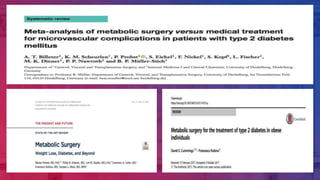




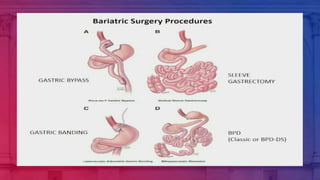
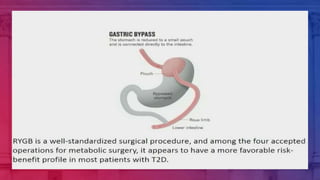




METABOLIC SURGERY
DR AMIT DANGI
DEPARTMENT OF SURGICAL
GASTROENTEROLOGY
“
Is the elusive answer to Diabetes
to be found in the gut?
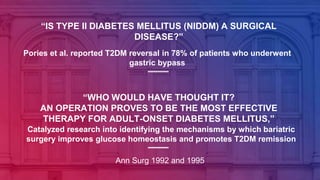
“IS TYPE II DIABETES MELLITUS (NIDDM) A SURGICAL
DISEASE?”
Pories et al. reported T2DM reversal in 78% of patients who underwent
gastric bypass
Ann Surg 1992 and 1995
“WHO WOULD HAVE THOUGHT IT?
AN OPERATION PROVES TO BE THE MOST EFFECTIVE
THERAPY FOR ADULT-ONSET DIABETES MELLITUS,”
Catalyzed research into identifying the mechanisms by which bariatric
surgery improves glucose homeostasis and promotes T2DM remission
3420 articles1990-2000
50500 articles2010-2018
38700 articles2000-2010
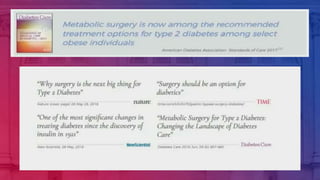
A picture is worth a thousand words
Selling a Lifetime of Insulin for $3
“
“
▣The alarming rise in the worldwide prevalence of obesity is paralleled by an increasing
burden of type 2 diabetes mellitus.
▣Most effective means of obtaining substantial and durable weight loss.
▣Surgery superior in achieving improved glycemic control, as well as a reduction in
cardiovascular risk factors.
▣Translating in better patient outcomes
▣Mechanisms extend beyond the magnitude of weight loss alone and include
improvements in incretin profiles, insulin secretion, and insulin sensitivity.
(J Am Coll Cardiol 2018;71:670–87)
THE PROBLEM
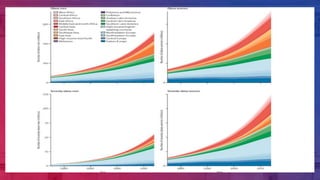
Worldwide prevalence of obesity (BMI > 30 kg/m2):
5% in 1975
13% in 2014
Severely obese (BMI >35 kg/m2) : 4%,
Morbid obesity (BMI $40 kg/m2) : 1%.
As much as one-fifth of the world population may have obesity by 2025.
▣Risk factor for T2DM.
▣T2DM accounts for upto 90% adult patients
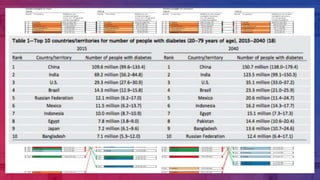
▣Parallel increase in the prevalence of T2DM, currently standing at 9% worldwide and
projected to reach 12% by 2025 (4).
Lancet 2016;387: 1377–96.
N Engl J Med 2017;377:13–27
JAMA 2014;311:806–14
J Am Coll Cardiol 2018;71:670–87
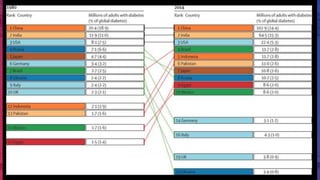
Worldwide trends in diabetes since 1980: a pooled analysis of 751 population-based studies with 4·4 million
participants
The Lancet
Volume 387, Issue 10027, Pages 1513-1530 (April 2016)
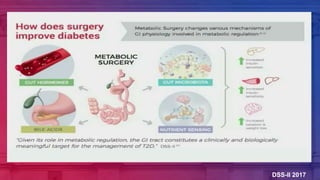
IT IS VERY MUCH PLAUSIBLE THAT IF THE GUT IS NOT
COMPLETELY THE CAUSE OF DIABETES, IT IS ALSO
NOT COMPLETELY INNOCENT.
DSS-II 2017
▣CALORIC RESTRICTION
AND WEIGHT LOSS
▣DECREASE INTAKE AND
INCREASE
EXPENDITURE
▣GLP-1
▣INCREASE AFTER
BARIATRIC
PROCEDURES
▣ELEVATED POST
PRANDIAL PEAK INSULIN
LEVELS
▣FOUND EVEN ON DAY 2
▣ROLES OF THE
FOREGUT/ REDUCED
ANTI-INCRETINS
D/T TO YPASS OF
DUODENUM AND UPPER
JEJUNUM
Let’s review some concepts
▣INTESTINAL
ADAPTATION
BA, FGF-19, AND THE
GUT MICROBIOME
FUTURE PERSPECTIVES
OTHER GLUCO-
REGULATORY EFFECTS
OG GIT
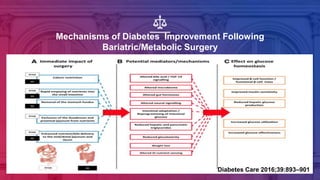
Mechanisms of Diabetes Improvement Following
Bariatric/Metabolic Surgery
Diabetes Care 2016;39:893–901
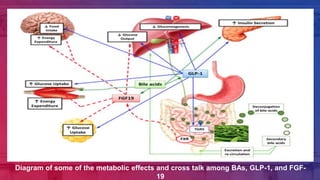
Diagram of some of the metabolic effects and cross talk among BAs, GLP-1, and FGF-
19
“
Clinical Outcomes of Metabolic
Surgery: Efficacy of Glycemic
Control, Weight Loss, and
Remission of Diabetes
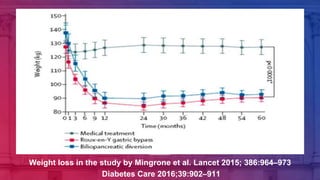
Weight loss in the study by Mingrone et al. Lancet 2015; 386:964–973
Diabetes Care 2016;39:902–911
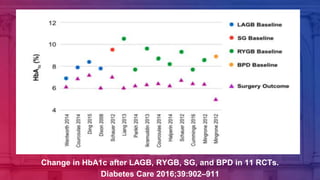
Change in HbA1c after LAGB, RYGB, SG, and BPD in 11 RCTs.
Diabetes Care 2016;39:902–911
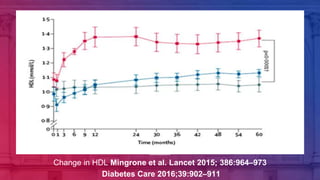
Change in HDL Mingrone et al. Lancet 2015; 386:964–973
Diabetes Care 2016;39:902–911
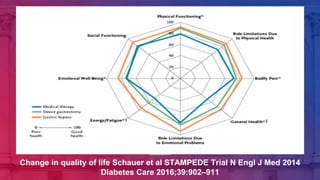
Change in quality of life Schauer et al STAMPEDE Trial N Engl J Med 2014
Diabetes Care 2016;39:902–911
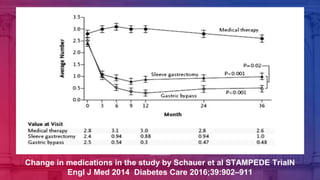
Change in medications in the study by Schauer et al STAMPEDE TrialN
Engl J Med 2014 Diabetes Care 2016;39:902–911
THE PREVENTION OF
MICROVASCULAR
COMPLICATIONS
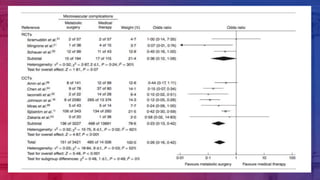
SYSTEMIC REVIEW AND META-ANALYSIS. BJS 2018
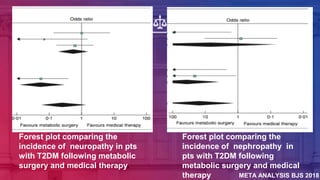
META ANALYSIS BJS 2018
Forest plot comparing the
incidence of neuropathy in pts
with T2DM following metabolic
surgery and medical therapy.
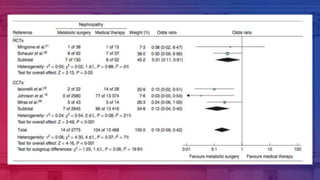
Forest plot comparing the
incidence of nephropathy in
pts with T2DM following
metabolic surgery and medical
therapy
“
Bariatric Surgery:
A Potential
Treatment for Type 2 Diabetes
in Youth
“
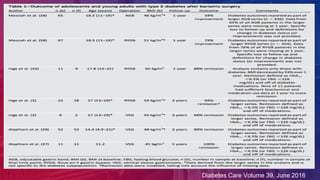
Diabetes Care Volume 39, June 2016
“
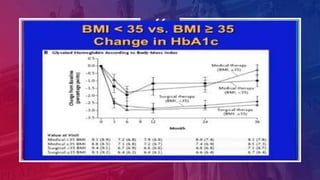
Bariatric/Metabolic Surgery to
Treat Type 2 Diabetes in Patients
With a BMI < 35 kg/m2
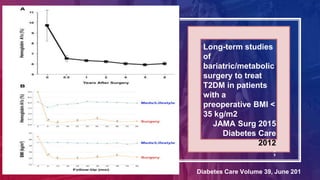
“ Long-term studies
of
bariatric/metabolic
surgery to treat
T2DM in patients
with a
preoperative BMI <
35 kg/m2
JAMA Surg 2015
Diabetes Care
2012
;
Diabetes Care Volume 39, June 201
“
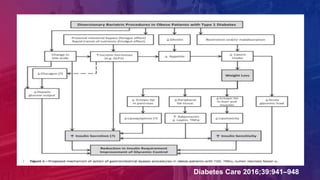
“
Bariatric Surgery in Obese Patients
With Type 1 Diabetes
“
Diabetes Care 2016;39:941–948
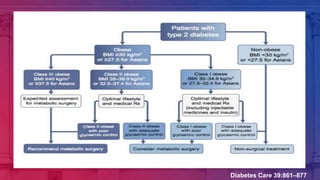
Diabetes Care 39:861–877
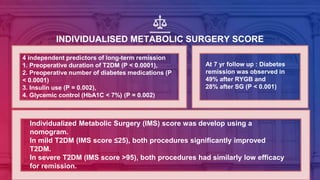
INDIVIDUALISED METABOLIC SURGERY SCORE
Individualized Metabolic Surgery (IMS) score was develop using a
nomogram.
In mild T2DM (IMS score ≤25), both procedures significantly improved
T2DM.
In severe T2DM (IMS score >95), both procedures had similarly low efficacy
for remission.
In intermediate group, RYGB was significantly more effective than SG.
At 7 yr follow up : Diabetes
remission was observed in
49% after RYGB and
28% after SG (P < 0.001)
4 independent predictors of long-term remission
1. Preoperative duration of T2DM (P < 0.0001),
2. Preoperative number of diabetes medications (P
< 0.0001)
3. Insulin use (P = 0.002),
4. Glycemic control (HbA1C < 7%) (P = 0.002)
White
Is the color of milk and fresh
snow, the color produced by the
combination of all the colors of
the visible spectrum.
“
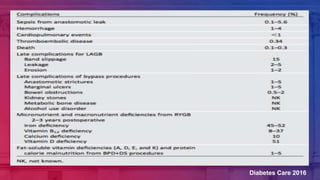
Complications of metabolic
surgery
Diabetes Care 2016
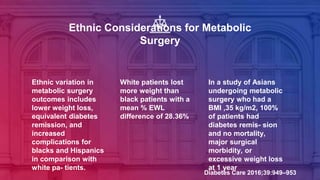
Ethnic Considerations for Metabolic
Surgery
Ethnic variation in
metabolic surgery
outcomes includes
lower weight loss,
equivalent diabetes
remission, and
increased
complications for
blacks and Hispanics
in comparison with
white pa- tients.
White patients lost
more weight than
black patients with a
mean % EWL
difference of 28.36%
In a study of Asians
undergoing metabolic
surgery who had a
BMI ,35 kg/m2, 100%
of patients had
diabetes remis- sion
and no mortality,
major surgical
morbidity, or
excessive weight loss
at 1 year
Diabetes Care 2016;39:949–953
RECENT TRIALS
STAMPED
E
SM- BOSSSOS TRIAL
Want big impact?
Use big image.
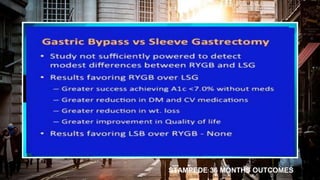
STAMPEDE 36 MONTHS OUTCOMES
PREDICTORS OF PRIMARY END POINT AT 36 MONTHS
1. CHANGE IN BMI
2. DURATION OF DIABETES
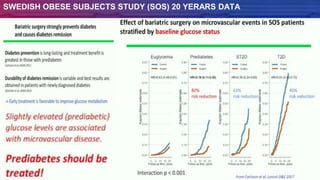
SWEDISH OBESE SUBJECTS STUDY (SOS) 20 YERARS DATA
Thanks!

Metabolic surgery

  • 1.
    METABOLIC SURGERY DR AMITDANGI DEPARTMENT OF SURGICAL GASTROENTEROLOGY
  • 2.
    “ Is the elusiveanswer to Diabetes to be found in the gut?
  • 3.
    “IS TYPE IIDIABETES MELLITUS (NIDDM) A SURGICAL DISEASE?” Pories et al. reported T2DM reversal in 78% of patients who underwent gastric bypass Ann Surg 1992 and 1995 “WHO WOULD HAVE THOUGHT IT? AN OPERATION PROVES TO BE THE MOST EFFECTIVE THERAPY FOR ADULT-ONSET DIABETES MELLITUS,” Catalyzed research into identifying the mechanisms by which bariatric surgery improves glucose homeostasis and promotes T2DM remission
  • 4.
  • 5.
    A picture isworth a thousand words Selling a Lifetime of Insulin for $3
  • 6.
  • 7.
  • 11.
    ▣The alarming risein the worldwide prevalence of obesity is paralleled by an increasing burden of type 2 diabetes mellitus. ▣Most effective means of obtaining substantial and durable weight loss. ▣Surgery superior in achieving improved glycemic control, as well as a reduction in cardiovascular risk factors. ▣Translating in better patient outcomes ▣Mechanisms extend beyond the magnitude of weight loss alone and include improvements in incretin profiles, insulin secretion, and insulin sensitivity. (J Am Coll Cardiol 2018;71:670–87)
  • 12.
    THE PROBLEM Worldwide prevalenceof obesity (BMI > 30 kg/m2): 5% in 1975 13% in 2014 Severely obese (BMI >35 kg/m2) : 4%, Morbid obesity (BMI $40 kg/m2) : 1%. As much as one-fifth of the world population may have obesity by 2025. ▣Risk factor for T2DM. ▣T2DM accounts for upto 90% adult patients ▣Parallel increase in the prevalence of T2DM, currently standing at 9% worldwide and projected to reach 12% by 2025 (4). Lancet 2016;387: 1377–96. N Engl J Med 2017;377:13–27 JAMA 2014;311:806–14 J Am Coll Cardiol 2018;71:670–87
  • 13.
    Worldwide trends indiabetes since 1980: a pooled analysis of 751 population-based studies with 4·4 million participants The Lancet Volume 387, Issue 10027, Pages 1513-1530 (April 2016)
  • 16.
    IT IS VERYMUCH PLAUSIBLE THAT IF THE GUT IS NOT COMPLETELY THE CAUSE OF DIABETES, IT IS ALSO NOT COMPLETELY INNOCENT.
  • 17.
  • 18.
    ▣CALORIC RESTRICTION AND WEIGHTLOSS ▣DECREASE INTAKE AND INCREASE EXPENDITURE ▣GLP-1 ▣INCREASE AFTER BARIATRIC PROCEDURES ▣ELEVATED POST PRANDIAL PEAK INSULIN LEVELS ▣FOUND EVEN ON DAY 2 ▣ROLES OF THE FOREGUT/ REDUCED ANTI-INCRETINS D/T TO YPASS OF DUODENUM AND UPPER JEJUNUM Let’s review some concepts ▣INTESTINAL ADAPTATION BA, FGF-19, AND THE GUT MICROBIOME FUTURE PERSPECTIVES OTHER GLUCO- REGULATORY EFFECTS OG GIT
  • 19.
    Mechanisms of DiabetesImprovement Following Bariatric/Metabolic Surgery Diabetes Care 2016;39:893–901
  • 20.
    Diagram of someof the metabolic effects and cross talk among BAs, GLP-1, and FGF- 19
  • 21.
    “ Clinical Outcomes ofMetabolic Surgery: Efficacy of Glycemic Control, Weight Loss, and Remission of Diabetes
  • 22.
    Weight loss inthe study by Mingrone et al. Lancet 2015; 386:964–973 Diabetes Care 2016;39:902–911
  • 23.
    Change in HbA1cafter LAGB, RYGB, SG, and BPD in 11 RCTs. Diabetes Care 2016;39:902–911
  • 24.
    Change in HDLMingrone et al. Lancet 2015; 386:964–973 Diabetes Care 2016;39:902–911
  • 25.
    Change in qualityof life Schauer et al STAMPEDE Trial N Engl J Med 2014 Diabetes Care 2016;39:902–911
  • 26.
    Change in medicationsin the study by Schauer et al STAMPEDE TrialN Engl J Med 2014 Diabetes Care 2016;39:902–911
  • 27.
  • 31.
    META ANALYSIS BJS2018 Forest plot comparing the incidence of neuropathy in pts with T2DM following metabolic surgery and medical therapy. Forest plot comparing the incidence of nephropathy in pts with T2DM following metabolic surgery and medical therapy
  • 32.
  • 33.
  • 34.
    “ Bariatric/Metabolic Surgery to TreatType 2 Diabetes in Patients With a BMI < 35 kg/m2
  • 35.
    “ Long-term studies of bariatric/metabolic surgeryto treat T2DM in patients with a preoperative BMI < 35 kg/m2 JAMA Surg 2015 Diabetes Care 2012 ; Diabetes Care Volume 39, June 201
  • 36.
  • 37.
    “ Bariatric Surgery inObese Patients With Type 1 Diabetes
  • 38.
  • 40.
  • 43.
    INDIVIDUALISED METABOLIC SURGERYSCORE Individualized Metabolic Surgery (IMS) score was develop using a nomogram. In mild T2DM (IMS score ≤25), both procedures significantly improved T2DM. In severe T2DM (IMS score >95), both procedures had similarly low efficacy for remission. In intermediate group, RYGB was significantly more effective than SG. At 7 yr follow up : Diabetes remission was observed in 49% after RYGB and 28% after SG (P < 0.001) 4 independent predictors of long-term remission 1. Preoperative duration of T2DM (P < 0.0001), 2. Preoperative number of diabetes medications (P < 0.0001) 3. Insulin use (P = 0.002), 4. Glycemic control (HbA1C < 7%) (P = 0.002)
  • 44.
    White Is the colorof milk and fresh snow, the color produced by the combination of all the colors of the visible spectrum.
  • 45.
  • 46.
  • 47.
    Ethnic Considerations forMetabolic Surgery Ethnic variation in metabolic surgery outcomes includes lower weight loss, equivalent diabetes remission, and increased complications for blacks and Hispanics in comparison with white pa- tients. White patients lost more weight than black patients with a mean % EWL difference of 28.36% In a study of Asians undergoing metabolic surgery who had a BMI ,35 kg/m2, 100% of patients had diabetes remis- sion and no mortality, major surgical morbidity, or excessive weight loss at 1 year Diabetes Care 2016;39:949–953
  • 48.
  • 49.
    Want big impact? Usebig image. STAMPEDE 36 MONTHS OUTCOMES PREDICTORS OF PRIMARY END POINT AT 36 MONTHS 1. CHANGE IN BMI 2. DURATION OF DIABETES
  • 50.
    SWEDISH OBESE SUBJECTSSTUDY (SOS) 20 YERARS DATA
  • 58.

Editor's Notes

  • #3 More than 100 years ago surgery (pancreatectomy) provided the fundamental clue that allowed to focus research on the pancreas, l/t discovery of insulin. Today lesson learnt from metabolic surgery point us to the gut for clues on the cause and the cure, of diabetes.
  • #4 Bariatric surgical procedures were developed in the 1950s to reduce body weight. Since the 1970s, however, there have been anecdotal reports of rapid postoperative T2DM remission. In 1984, bariatric surgery was reported to improve glucose tolerance in insulin-treated se- verely obese patients (5). In a 1992 article, “Is Type II Diabetes Mellitus (NIDDM) a Surgical Disease?”, Pories et al. reported T2DM reversal in 78% of patients who un- derwent gastric bypass (6). However, it was their subsequent article in 1995, “Who Would Have Thought It? An Oper- ation Proves to Be the Most Effective Therapy for Adult-Onset Diabetes Melli- tus,” that catalyzed research into identify- ing the mechanisms by which bariatric surgery improves glucose homeostasis and promotes T2DM remission (7).
  • #5 Surge in publications in bariatric and metabolic surgery in last 20 yrs.
  • #6 THE STANDARD T/T OF DM IS MEDICAL THERAPY. On Jan. 23, 1923, Banting, Collip and Best were awarded U.S. patents on insulin and the method used to make it. They all sold these patents to the University of Toronto for $1 each. Later that year, Banting and Macleod were awarded the Nobel Prize in medicine for the discovery of insulin
  • #7 ITS BEEN A LONG JOURNEY AND CERTAINLY THE LAST STEP IS NOT THE FINAL STEP. IT’S THE BEGINNING OF A NEW WAY OF THINKING ABOUT DIABETES. In 2009 the American Society for Bariatric Surgery(ASBS) changed its name to the American Society for Metabolic and Bariatric Surgery (ASMBS) to promote information on the beneficial effects of surgeries for weight loss in treating metabolic diseases, especially Type 2 Diabetes Mellitus (T2DM)
  • #8 2017 WAS LANDMARK YEAR FOR ALL DIABETIC/METABOLIC AND BARIATRIC SX. THERE YEARS OF RESEARCH AND BRILLIANT RESULTS PAVED WAY AND THE FORCED MEDICAL FRATERNITY TO ACCEPT AND INCLUDE METABOLIC SX IN DM STANDARDS OF CARE.
  • #9 DIABETES SURGICAL SUMMIT (2016) PRODUCED GUIDELINES THAT ARE NOW ENDORSED BY MORE THAN 50 DIABETES SOCIETY AND MEDICAL SOCIETIES INCLUDING THE MOST IMPORTANT AMERICAN DIABETES ASSOCIATION, INTERNATIONAL DIABETES FEDERATION, UK DIABETES ASSOCIATION AND MANY NATIONS INCLUDING INDIA. THERE ARE 2 THINGS THAT ARE IMPORTANT TO REMEMBER THIS IS THE BROADEST ENDORSEMENT FOR ANY NEW GUIDELINES WHEN THEY ARE PUBLISHED. NORMALLY THEY ARE PUBLISHED AS STATEMENTS FROM ONE OR TWO ORGANISATIONS. HERE IT IS REALLY A BROAD ENDORSEMENT. THIS IS THE TESTAMENT TO COLLECTIVE WORK OF MANY SURGEONS AROUND THE WORLD. THIS IS A MAJOR
  • #10 3 EXCELLENT REVIEWS PUBLISHED IN LAST ONE MONTH ABOUT METABOLIC SX INHIGH IMPACT JOURNALS
  • #12 The alarming rise in the worldwide prevalence of obesity is paralleled by an increasing burden of type 2 diabetes mellitus. Metabolic surgery is the most effective means of obtaining substantial and durable weight loss in individuals with obesity. Randomized trials have recently shown the superiority of surgery over medical treatment alone in achieving improved glycemic control, as well as a reduction in cardiovascular risk factors. The mechanisms seem to extend beyond the magnitude of weight loss alone and include improvements in incretin profiles, insulin secretion, and insulin sensitivity. Moreover, observational data suggest that the reduction in cardiovascular risk factors translates to better patient outcomes. (J Am Coll Cardiol 2018;71:670–87)
  • #13 The metabolic abnormalities associated with obesity increase the risk of cardiovascular disease, including coronary artery disease and heart failure (6). Indeed, most of the w7% of deaths for which a BMI above 25 kg/m2 appears responsible can be related to cardiovascular disease or T2DM (2). The underlying mechanisms have not been fully eluci- dated, but they may include metabolic, hemody- namic, and inflammatory effects of having an increased adipose tissue mass (6).
  • #14 Ten countries with the largest number of adults with diabetes in 1980 and 2014
  • #15 Ten countries with the largest number of underweight, obese, and severely obese men and women in 1975 and 2014 Trends in the number of obese and severely obese people by region A person is obese if they have a body-mass index (BMI) of 30 kg/m2 or higher, or is severely obese if they have a BMI of 35 kg/m2 or higher Comparison of mean change in age-standardised mean BMI before and after the year 2000
  • #18 THE MOST IMPORTANT CHANGE FOR THE ACCEPTANCE OF METABOLIC SX FOR DIABETIC CURE IS THE ACCEPTANCE THAT METABOLIC SX CHANGE THE PHYSIOLOGY AND THEREFORE THE PATHOPHYSIOLOGY OF DIABETES. EARLIER IT WAS THOUGHT THAT SX LEADS TO WEIGHT LOSS AND THEREFORE DECREASE IN THE ADIPOSITY. ITS STILL A MECHANISM BUT THE RECOGNITION OF ITS MECHANISMS IN THE GUT THAT ARE THE KEY AND ARE CRUCIAL FOR THE EFFECT OF SX AND IT IS NOT ONLY IMPORTANT FOR JUSTIFYING SX BUT TO ALSO TO UNDERSTAND DIABETES.
  • #19 In their seminal article from .20 years ago (7), Pories et al. speculated that the very rapid post-RYGB improvement of glucose tolerance, which typically occurs before significant weight loss, might result from acute caloric restric- tion plus possible additional conse- quences of excluding ingested nutrients from the proximal intestine and/or expediting delivery of nutrients to the distal intestine. At that time, Harvey Sugerman’s group published that gut hormone changes were more profound after RYGB than the purely mechanical vertical-banded gastroplasty, perhaps helping explain the superior weight- reducing and antidiabetes effects of RYGB compared with vertical-banded gastroplasty (20). Weight-independent antidiabetes effects of proximal intesti- nal bypass were subsequently demon- strated in rats in a landmark article by Rubino et al. (21) on duodenal-jejunal bypass (DJB), which replicates just the intestinal component of RYGB, and those findings have held up in nu- merous human studies. Similarly, the beneficial effects of enhanced distal in- testinal nutrient exposure were proven in rats with ileal interposition surgery (22), and these too have translated to humans.
  • #20 TO SUMMARIZE Schematic of potential mechanisms contributing to improved glycemia after RYGB and VSG. A: Immediate effects of RYGB and VSG due to anatomical changes. B: Potential mediators/mechanisms involved. Cross talk occurs among these factors. C: Effects on glucose homeostasis
  • #21 From results based primarily on mech- anistic animal studies plus complementary associative observations in humans, bile acids (BAs) are now believed to be im- portant regulators of energy balance and metabolism. The transintestinal BA flux activates intestinal FXR, inducing synthesis and secretion into the circulation of the ileal-derived enterokine FGF-19 (FGF- 15 in mice). FGF-19 inhibits expression of cholesterol 7 a-hydroxylase-1 (CYP7A1), the rate-limiting step of BA synthesis (13). In mice, FGF-15 can improve glucose tolerance by regulating insulin- independent glucose efflux and he- patic glucose production. BAs acting via TGR5 stimulate L-cell secretion of GLP-1 and PYY. Directly and indirectly through the FXR-induced antimicrobial peptides, BAs also regulate gut microbiota com- position. This, in turn, has been linked to the pathogenesis of obesity and T2DM in rodents
  • #26 Change in quality of life (31). *P , 0.05 for the comparison between the gastric bypass group and the medical therapy group; †P , 0.05 for the comparison between the sleeve gastrectomy group and the medical therapy group. Reprinted with permission from the two studies.
  • #28 metabolic surgery is much more effective than medical treatment in preventing microvascular complications. Equally, pre-existing diabetic nephropathy was much more strongly improved by metabolic surgery than by medical treatment. As the authors indicate themselves, one of the weaknesses of this analysis is that there is no information available on whether this improvement in microvascular complications was associated with increased weight loss and less severe diabetes
  • #29 Forest plot comparing the incidence of microvascular complications in patients with type 2 diabetes mellitus following metabolic surgery and medical therapy. A Mantel–Haenszel random-effects model was used for meta-analysis. Odds ratios are shown with 95 per cent con dence intervals. CCT, clinical controlled trial
  • #30 Forest plot comparing the incidence of nephropathy, in patients with type 2 diabetes mellitus following metabolic surgery and medical therapy. A Mantel–Haenszel random-effects model was used for meta-analysis. Odds ratios are shown with 95 per cent con dence intervals. CCT, clinical controlled trial
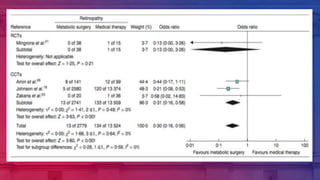
  • #31 Forest plot comparing the incidence of retinopathy in patients with type 2 diabetes mellitus following metabolic surgery and medical therapy. A Mantel–Haenszel random-effects model was used for meta-analysis. Odds ratios are shown with 95 per cent con dence intervals. CCT, clinical controlled trial
  • #32 Forest plot comparing the incidence of neuropathy and nephropathy in patients with type 2 diabetes mellitus following metabolic surgery and medical therapy.
  • #33 Prior to 1992, type 2 diabetes accounted for ;4% of new diagnoses of diabetes in adolescents (4). Recent estimates suggest that now nearly half of new cases of diabetes in teens can be termed type 2 diabetes (1,5). The rise in incident type 2 diabetes among young people largely follows the rise in childhood obesity Type 2 diabetes, once referred to as “adult-onset” diabetes, has now emerged as a formidable threat to the health of obese adolescents. Although there is growing evidence regarding the epidemiology of type 2 diabetes in youth and its multisys- tem health consequences, treatment options have lagged and progression of disease occurs even with aggressive medical therapy. Increasing interest in the application of bariatric surgery for adolescents with type 2 diabetes has evolved in part because of the evidence demonstrating improvement or remission in many adults with diabetes after surgery.
  • #34 Accumulating evidence suggests that type 2 diabetes in adolescents prog- resses rapidly and is more aggressive than type 2 diabetes in adults. Type 2 diabetes in youth results in early multi- system target organ damage over time, likely the combined result of hypergly- cemia, hypertension, and dyslipidemia among other risk factors. Data from clinical studies demonstrate substantial improvement in insulin resistance and b-cell function in severely obese youth without diabetes after gastric bypass, and several observational studies also demonstrate high rates of type 2 diabe- tes remission in youth. These observa- tions support the recommendations for bariatric surgical management of appropriately selected severely obese adolescents with type 2 diabetes (3,48). Decisions regarding optimal timing of surgery for the maximal impact on type 2 diabetes should aim to preserve b-cell secretory function.
  • #35 Numerous RCTs and high-quality non- randomized comparisons now demon- strate that bariatric/metabolic surgery is more effective than a variety of medical/ lifestyle interventions for weight loss, glycemic control, T2DM remission, and improvements in other cardiovascular disease risk factors, with acceptable complications for at least 1–5 years (2). Even though individuals with lower base- line BMI levels lose less weight after sur- gery than do more obese people, the safety and efficacy of surgery for improv- ing T2DM and other metabolic disorders appear to be similar among patients with a baseline BMI below versus above 35 kg/m2, the threshold used to determine surgical candidacy for the past 25 years. Available evidence indicates that this rather arbitrary cut point should be lowered for patients with T2DM, in accordance with new DSS-II guidelines published in this issue of Diabetes Care (9).
  • #36 Long-term studies of bariatric/metabolic surgery to treat T2DM in patients with a preoperative BMI ,35 kg/m2. A: Change in mean 6 SE HbA1c levels following RYGB among 66 patients with a baseline BMI of 30–35 kg/m2, studied with 100% follow-up for 6 years. HbA1c decreased from values representing poorly controlled diabetes, despite all patients being on diabetes medications at baseline, to nondiabetic or normal-range levels from 6 months to 6 years after RYGB, with 88% of participants off all diabetes medications at the end of the study. Reprinted with permission from Cohen et al. (25). B: Changes over 5 years in mean HbA1c and BMI among 351 Asian patients with T2DM and a BMI ,35 kg/m2 at baseline who underwent surgical (RYGB or VSG) vs. medical/lifestyle care for T2DM. aP , 0.001 for comparison between the surgical group and medical group, calculated from a repeated-measures model that con- siders data over time. Reprinted with permission from Hsu et al. (41). from the above-mentioned 3-year data from STAMPEDE (36), long-term results from RCTs of lower-BMI patients are still pending . Lakdawala et al. (42) reported that 96% of their study participants had improved metabolic status at 5 postoperative years.
  • #37 RESPONSE TO CHANGE IN HBAIC IS SIMILAR IN PATIENTS WITH BMI <35 AND >35. SO PATIENTS WITH BMI<35 ALSO ACHIEVE SIMILAR SUCCESS.
  • #38 There is a paucity of data on the impact of bariatric surgery in type 1 diabetes (T1D). Bariatric surgery leads to significant weight loss in severely obese patients with T1D and results in a significant improvement in insulin requirements and glycemic status. The favorable metabolic effects of bariatric surgery may facilitate medical management of and cardiovascular risk reduction in T1D in the setting of severe obesity. Short-term results of bariatric surgery in patients with T1D are encour- aging, but larger and longer-term studies are needed.
  • #39 The review included 17 studies with 107 individuals. Overall, the dominant procedure was gastric bypass (n = 70; 65%). All studies reported a significant reduction in excess weight. A significant reduction in weight-adjusted daily insulin requirements was shown in all case series except one. The precise mechanisms for improved glycemic status after bariatric surgery in patients with T1D are not clear. Auto- immune b-cell destruction is a hallmark of T1D that affects impaired insulin se- cretion. The rate of destruction, how- ever, can vary (59,60). In patients with T2D, bariatric surgery improves pancre- atic islet size, function, and survival (61,62).
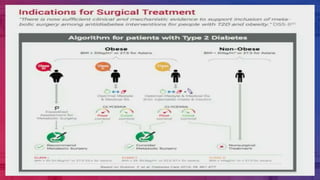
  • #40 HOW TO SCREEN PATIENTS OF DIABETES FOR POTENTIAL SURGICAL INDICATIONS. IT IS JUST NOT SAYING SX IS ALLOWED BELOW OR ABOVE BMI BUT ACTUALLY ANY PATIENT WITH TYPE II DIABETES ENTERING DOCTORS OFFICE SHOULD BE CONSIDERED FOR ANY FORM OF DIABETES TREATMENT. AND IF THE PATIENT HAD SOME CHARACTERISTICS PARTICULARLY IF PT IS NOT RESPONDING TO MEDICAL MANAGEMENT, THEN IN THESE PTS SX SHOULD BE PRIORITISED.
  • #41 DSS-II: surgery in the type 2 diabetes treatment algorithm. Algorithm for the treatment of type 2 diabetes, including the option of bariatric/ metabolic surgery, as recommended by DSS-II voting delegates
  • #42 IT IS IMPORTANT TO KNOW WHAT THESE GUIDELINES SAY REGARDING THE TYPE OF OPERATION/PROCEDURE. THERE ARE ONLY 4 PROCEDURES WHICH HAVE BEEN STUDIED AND COMPARED TO MEDICAL M/M OR STANDARD OF CARE IN MANAGING DM. THERE ARE OTHER PROCEDURES WHICH ARE EFFECTIVE BUT NOT STUDIED IN RANDOMISED TRIALS. ALL THESE PROCEDURES HAVE PROVEN THEIR SUPERIORITY TO MEDICAL THERAPY INCLUDING GASTRIC BANDING.
  • #43 RYGB IS THE MOST COMMON PROCEDURE USED IN THESE PATIENTS BUT THIS DOES NOT MEAN IT’S THE ONLY PROCEDURE. A GREAT MAJORITY CONSIDERS THAT THIS PROCEDURE HAS BETTER RISK BENEFIT PROFILE BUT THAT DOESNOT MEAN THAT IN SOME PATIENTS YOU CANNOT DO GASTRIC BANDING OR CANNOT CONSIDER SLEEVE. THIS IS JUST TO SAY GASTRIC BANDING IS SAFE PROCEDURE AND TIME AND AGAIN HAS PROVEN ITS EFFICACY AND SAFETY AND THERFORE A STANDARD OF CARE.
  • #44 PROCEDURE SELECTION BASED ON DIABETES SEVERITY. At median postoperative follow-up of 7 years (range 5-12), diabetes remission (HbA1C <6.5% off medications) was observed in 49% after RYGB and 28% after SG (P < 0.001). Four independent predictors of long-term remission including preoperative duration of T2DM (P < 0.0001), preoperative number of diabetes medications (P < 0.0001), insulin use (P = 0.002), and glycemic control (HbA1C < 7%) (P = 0.002) were used to develop the Individualized Metabolic Surgery (IMS) score using a nomogram. Patients were then categorized into 3 stages of diabetes severity. In mild T2DM (IMS score ≤25), both procedures significantly improved T2DM. In severe T2DM (IMS score >95), when clinical features suggest limited functional β-cell reserve, both procedures had similarly low efficacy for diabetes remission. There was an intermediate group, however, in which RYGB was significantly more effective than SG, likely related to its more pronounced neurohormonal effects.
  • #45 PERI-OPERATIVE M/M REQUIRES A MULTI-DISCIPLINARY APPROACH. THE DIAGNOSTIC EVALUATION AND PREOPERATIVE EVALUATION MUST BE MORE COHERENT WITH THE DISEASE. SURGEONS SHOULD MEASURE THE DIABETES AND NOT ONLY BMI AND CONSIDER MORE DIABETES MEASURES PREOPERATIVELYA AND POST OPERATIVELY. ENDOCRINOLOGISTS MUST BE INCLUDED AND MODEL OF CARE SHOULD BE AS STANDARD AS BEST MEDICAL PRECATICES.
  • #50 CIMT: CAROTID INTIMA MEDIA THICKNESS : NON INVASIVE SURROGATE MARKER FOR ATHEROSCLEROSIS. A NUMBER FACTORS WERE EVALUATED FOR PREDICTING ACHIEVING PRIMARY END POINT. ONLY CHANGE IN BMI (GREATER THE WEIGHT LOSS) AND DURATION OD DM (SHORTER THAN 8 YRS OF DM, GOOD RESPONSE.)
  • #52 SIMILAR COMPLICATIONS, SIMILAR VITAMIN DEFICIENCUES, SIMILAR DM REMISSION.
  • #53 THE DIFFERENCE IN DM REMISSION WAS SIMILAR IN BOTH SG AND RYGJ. DYSLIPIDEMIA BETTER IN BYPASS GROUP.
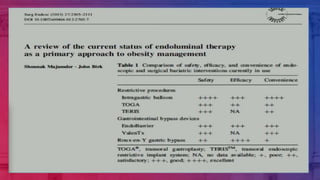
  • #56 WE MUST LOOK AT SAFETY, EFFICIACY AND CONVENIENCE.