Cyclic AMP (cAMP) Signaling Pathway
Under the supervision of
Dr. Nishant Yadav
Asst. Professor, Pranveer Singh Institute of Technology
(Pharmacy)
Sakshi Srivastava
M. Pharm 1st
year
(Pharmacology)
2422064
2
RECEPTORS
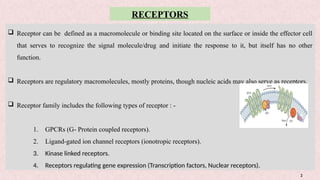
 Receptor can be defined as a macromolecule or binding site located on the surface or inside the effector cell
that serves to recognize the signal molecule/drug and initiate the response to it, but itself has no other
function.
 Receptors are regulatory macromolecules, mostly proteins, though nucleic acids may also serve as receptors.
 Receptor family includes the following types of receptor : -
1. GPCRs (G- Protein coupled receptors).
2. Ligand-gated ion channel receptors (ionotropic receptors).
3. Kinase linked receptors.
4. Receptors regulating gene expression (Transcription factors, Nuclear receptors).
3
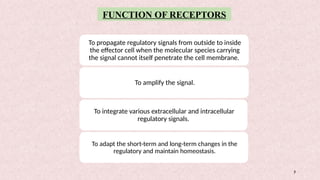
To propagate regulatory signals from outside to inside
the effector cell when the molecular species carrying
the signal cannot itself penetrate the cell membrane.
To amplify the signal.
To integrate various extracellular and intracellular
regulatory signals.
To adapt the short-term and long-term changes in the
regulatory and maintain homeostasis.
FUNCTION OF RECEPTORS
4
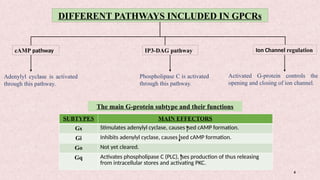
DIFFERENT PATHWAYS INCLUDED IN GPCRs
cAMP pathway IP3-DAG pathway Ion Channel regulation
Phospholipase C is activated
through this pathway.
Adenylyl cyclase is activated
through this pathway.
SUBTYPES MAIN EFFECTORS
Gs Stimulates adenylyl cyclase, causes sed cAMP formation.
Gi Inhibits adenylyl cyclase, causes sed cAMP formation.
Go Not yet cleared.
Gq Activates phospholipase C (PLC), ses production of thus releasing
from intracellular stores and activating PKC.
The main G-protein subtype and their functions
Activated G-protein controls the
opening and closing of ion channel.
5
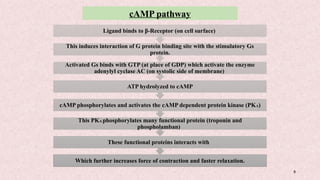
cAMP pathway
Which further increases force of contraction and faster relaxation.
These functional proteins interacts with
This PKA phosphorylates many functional protein (troponin and
phospholamban)
cAMP phosphorylates and activates the cAMP dependent protein kinase (PKA)
ATP hydrolyzed to cAMP
Activated Gs binds with GTP (at place of GDP) which activate the enzyme
adenylyl cyclase AC (on systolic side of membrane)
This induces interaction of G protein binding site with the stimulatory Gs
protein.
Ligand binds to β-Receptor (on cell surface)
6
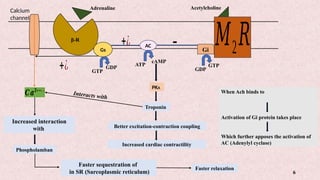
Adrenaline
β-R
Gs
+¿ GTP
GDP
+¿ AC
ATP
cAMP
PKA
Better excitation-contraction coupling
Troponin
Increased cardiac contractility
𝑪𝒂𝟐++¿¿
Increased interaction
with
Phospholamban
Faster sequestration of
in SR (Sarcoplasmic reticulum)
Faster relaxation
𝑀2𝑅
Acetylcholine
Gi
-
GDP
GTP
Calcium
channel
When Ach binds to
Activation of Gi protein takes place
Which further apposes the activation of
AC (Adenylyl cyclase)
Interacts with
7
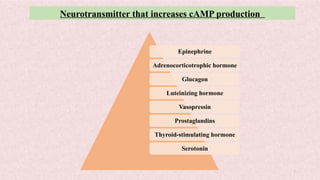
Neurotransmitter that increases cAMP production
Epinephrine
Adrenocorticotrophic hormone
Glucagon
Luteinizing hormone
Vasopressin
Prostaglandins
Thyroid-stimulating hormone
Serotonin
8
REFERNCE
1. Tripathi K.D., “Essential of medical pharmacology”, published by Jaypee brothers medical publishers
Pvt. Ltd., 8th
edition, page no. 54-56.

Cyclic AMP (cAMP) Signaling Pathway.pptx

  • 1.
    Cyclic AMP (cAMP)Signaling Pathway Under the supervision of Dr. Nishant Yadav Asst. Professor, Pranveer Singh Institute of Technology (Pharmacy) Sakshi Srivastava M. Pharm 1st year (Pharmacology) 2422064
  • 2.
    2 RECEPTORS  Receptor canbe defined as a macromolecule or binding site located on the surface or inside the effector cell that serves to recognize the signal molecule/drug and initiate the response to it, but itself has no other function.  Receptors are regulatory macromolecules, mostly proteins, though nucleic acids may also serve as receptors.  Receptor family includes the following types of receptor : - 1. GPCRs (G- Protein coupled receptors). 2. Ligand-gated ion channel receptors (ionotropic receptors). 3. Kinase linked receptors. 4. Receptors regulating gene expression (Transcription factors, Nuclear receptors).
  • 3.
    3 To propagate regulatorysignals from outside to inside the effector cell when the molecular species carrying the signal cannot itself penetrate the cell membrane. To amplify the signal. To integrate various extracellular and intracellular regulatory signals. To adapt the short-term and long-term changes in the regulatory and maintain homeostasis. FUNCTION OF RECEPTORS
  • 4.
    4 DIFFERENT PATHWAYS INCLUDEDIN GPCRs cAMP pathway IP3-DAG pathway Ion Channel regulation Phospholipase C is activated through this pathway. Adenylyl cyclase is activated through this pathway. SUBTYPES MAIN EFFECTORS Gs Stimulates adenylyl cyclase, causes sed cAMP formation. Gi Inhibits adenylyl cyclase, causes sed cAMP formation. Go Not yet cleared. Gq Activates phospholipase C (PLC), ses production of thus releasing from intracellular stores and activating PKC. The main G-protein subtype and their functions Activated G-protein controls the opening and closing of ion channel.
  • 5.
    5 cAMP pathway Which furtherincreases force of contraction and faster relaxation. These functional proteins interacts with This PKA phosphorylates many functional protein (troponin and phospholamban) cAMP phosphorylates and activates the cAMP dependent protein kinase (PKA) ATP hydrolyzed to cAMP Activated Gs binds with GTP (at place of GDP) which activate the enzyme adenylyl cyclase AC (on systolic side of membrane) This induces interaction of G protein binding site with the stimulatory Gs protein. Ligand binds to β-Receptor (on cell surface)
  • 6.
    6 Adrenaline β-R Gs +¿ GTP GDP +¿ AC ATP cAMP PKA Betterexcitation-contraction coupling Troponin Increased cardiac contractility 𝑪𝒂𝟐++¿¿ Increased interaction with Phospholamban Faster sequestration of in SR (Sarcoplasmic reticulum) Faster relaxation 𝑀2𝑅 Acetylcholine Gi - GDP GTP Calcium channel When Ach binds to Activation of Gi protein takes place Which further apposes the activation of AC (Adenylyl cyclase) Interacts with
  • 7.
    7 Neurotransmitter that increasescAMP production Epinephrine Adrenocorticotrophic hormone Glucagon Luteinizing hormone Vasopressin Prostaglandins Thyroid-stimulating hormone Serotonin
  • 8.
    8 REFERNCE 1. Tripathi K.D.,“Essential of medical pharmacology”, published by Jaypee brothers medical publishers Pvt. Ltd., 8th edition, page no. 54-56.