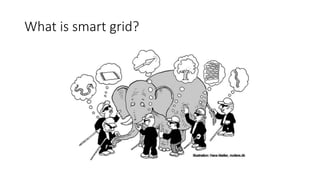
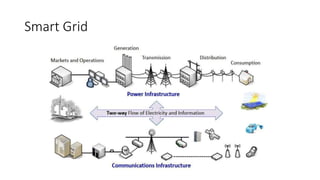
What is smart grid?
What is smart Grid?
• Smart Grid = Electric Grid + ICT
• ICT – Information & Communication Technologies / Tools ICT
– Integrated Communication Technologies
• A smart grid (SG), is also called smart electrical/power grid,
• intelligent grid, intelligrid, future grid, intergrid, or intragrid
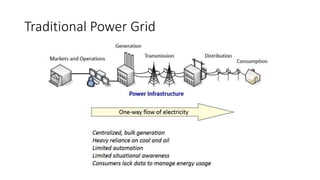
Traditional Power Grid
Smart Grid
Smart Grid – Defination
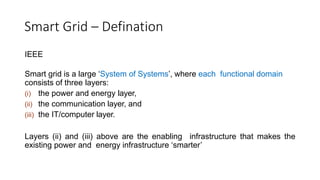
IEEE
Smart grid is a large ‘System of Systems’, where each functional domain
consists of three layers:
(i) the power and energy layer,
(ii) the communication layer, and
(iii) the IT/computer layer.
Layers (ii) and (iii) above are the enabling infrastructure that makes the
existing power and energy infrastructure ‘smarter’
Smart Grid – Defination
U. S Department of Energy
A smart grid uses digital technology to improve reliability,
security, and efficiency (both economic and energy) of the
electrical systems from large generation, through the delivery
systems to electricity consumers and a growing a number of
distributed generation and storage resources.
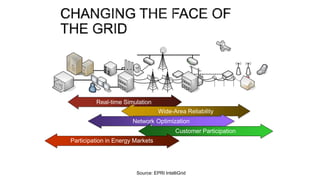
Real-time Simulation
Wide-Area Reliability
Network Optimization
Customer Participation
Participation in Energy Markets
Source: EPRI IntelliGrid
9
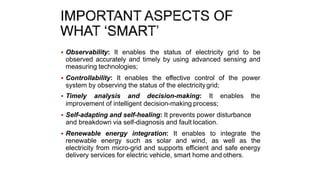
 Observability: It enables the status of electricity grid to be
observed accurately and timely by using advanced sensing and
measuring technologies;
 Controllability: It enables the effective control of the power
system by observing the status of the electricitygrid;
 Timely analysis and decision-making: It enables the
improvement of intelligent decision-making process;
 Self-adapting and self-healing: It prevents power disturbance
and breakdown via self-diagnosis and fault location.
 Renewable energy integration: It enables to integrate the
renewable energy such as solar and wind, as well as the
electricity from micro-grid and supports efficient and safe energy
delivery services for electric vehicle, smart home and others.
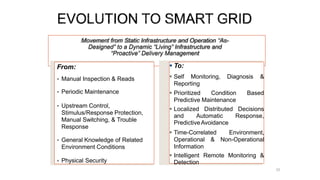
From:
 Manual Inspection & Reads
 Periodic Maintenance
 Upstream Control,
Stimulus/Response Protection,
Manual Switching, & Trouble
Response
 General Knowledge of Related
Environment Conditions
 Physical Security
 To:
 Self Monitoring, Diagnosis &
Reporting
 Prioritized Condition Based
Predictive Maintenance
 Localized Distributed Decisions
and Automatic Response,
PredictiveAvoidance
 Time-Correlated Environment,
Operational & Non-Operational
Information
 Intelligent Remote Monitoring &
Detection
Movement from Static Infrastructure and Operation “As-
Designed” to a Dynamic “Living” Infrastructure and
“Proactive” Delivery Management
10
smart grid, traditional power grids.pptx

smart grid, traditional power grids.pptx

  • 2.
  • 3.
    What is smartGrid? • Smart Grid = Electric Grid + ICT • ICT – Information & Communication Technologies / Tools ICT – Integrated Communication Technologies • A smart grid (SG), is also called smart electrical/power grid, • intelligent grid, intelligrid, future grid, intergrid, or intragrid
  • 4.
  • 5.
  • 6.
    Smart Grid –Defination IEEE Smart grid is a large ‘System of Systems’, where each functional domain consists of three layers: (i) the power and energy layer, (ii) the communication layer, and (iii) the IT/computer layer. Layers (ii) and (iii) above are the enabling infrastructure that makes the existing power and energy infrastructure ‘smarter’
  • 7.
    Smart Grid –Defination U. S Department of Energy A smart grid uses digital technology to improve reliability, security, and efficiency (both economic and energy) of the electrical systems from large generation, through the delivery systems to electricity consumers and a growing a number of distributed generation and storage resources.
  • 8.
    Real-time Simulation Wide-Area Reliability NetworkOptimization Customer Participation Participation in Energy Markets Source: EPRI IntelliGrid 9
  • 9.
     Observability: Itenables the status of electricity grid to be observed accurately and timely by using advanced sensing and measuring technologies;  Controllability: It enables the effective control of the power system by observing the status of the electricitygrid;  Timely analysis and decision-making: It enables the improvement of intelligent decision-making process;  Self-adapting and self-healing: It prevents power disturbance and breakdown via self-diagnosis and fault location.  Renewable energy integration: It enables to integrate the renewable energy such as solar and wind, as well as the electricity from micro-grid and supports efficient and safe energy delivery services for electric vehicle, smart home and others.
  • 10.
    From:  Manual Inspection& Reads  Periodic Maintenance  Upstream Control, Stimulus/Response Protection, Manual Switching, & Trouble Response  General Knowledge of Related Environment Conditions  Physical Security  To:  Self Monitoring, Diagnosis & Reporting  Prioritized Condition Based Predictive Maintenance  Localized Distributed Decisions and Automatic Response, PredictiveAvoidance  Time-Correlated Environment, Operational & Non-Operational Information  Intelligent Remote Monitoring & Detection Movement from Static Infrastructure and Operation “As- Designed” to a Dynamic “Living” Infrastructure and “Proactive” Delivery Management 10