Cyber Security
Abhishek Kr. Rai(30)
Chiranjit Adhikary(33)
Punit Kr. Ojha(34)
Mukul Kr. Yadav(43)
Manish viswakarma(41)
Cyber Security
The events of Sept. 11 2001 proved that terror attacks
on nonmilitary targets could be crippling to our
national infrastructure.
A week after the first anniversary of the day that
changed everything, the White House released a 60-
page draft plan called the National Strategy to Secure
Cyberspace, which also points out that US businesses-
-and individuals--are potential targets for cyber-
terrorism.
The experts say we can't rule anything out, but are
advising us to be realistic.
What is Cyberspace?
Cyberspace is a worldwide network of computers and
the equipment that connects them, which by its very
design is free and open to the public (the Internet)
As Stanley Konter, CEO of Savannah's Sabre
Technologies, notes, "The problem has gotten more
prevalent with always-on, high-speed internet access.
Attackers are always out there looking for that type of
computer."
We've become increasingly
reliant on the net, and it's
being used right now to
transfer everything from
friendly emails to
hypersensitive data.
Cyberspace as a Battleground?
Each day, there is an increase in the number of threats
against our nation's critical infrastructures.
These threats come in the form of computer intrusion
(hacking), denial of service attacks, and virus
deployment. Because of this problem, the National
Infrastructure Protection Center (NIPC) was created.
Located in the FBI's headquarters building in
Washington, D.C., the NIPC brings together
representatives from U.S. government agencies, state
and local governments, and the private sector in
partnership to protect our nation's critical
infrastructures.
What are the Threats?
Q: What's the biggest cyber threat facing America
today? Organized terrorism, or a bored, curious
kid?
FBI: At this point it is difficult to quantify since
computer intrusions occur daily originating from
several sources. The origination of these intrusions
and the intent of the intruders is often not obvious.
These threats come in the form of:
1. Computer Intrusion (hacking-passive or active)
2. Denial of service attacks (DOS)
3. Virus & Worms deployment.
State of the Industry
•According to the 2003 Computer Security Institute
and FBI annual study on security, 95% of
respondents detected computer security breaches in
the last 12 months.
•Companies will spend nearly $24 Billion on network
security in 2004 and it is expected this amount could
triple in the next two years.
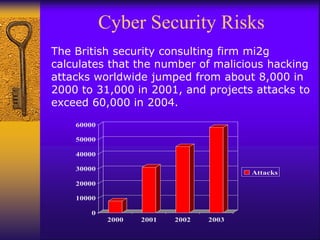
The British security consulting firm mi2g
calculates that the number of malicious hacking
attacks worldwide jumped from about 8,000 in
2000 to 31,000 in 2001, and projects attacks to
exceed 60,000 in 2004.
Cyber Security Risks
0
10000
20000
30000
40000
50000
60000
2000 2001 2002 2003
Attacks
Clean up cost of Cyber-attacks
 SirCam: 2.3 million computers affected
–Clean-up: $460 million
–Lost productivity: $757 million
 Code Red: 1 million computers affected
–Clean-up: $1.1 billion
–Lost productivity: $1.5 billion
 Love Bug: 50 variants, 40 million
computers affected
–$8.7 billion for clean-up and lost
productivity
 Nimda
–Cost still to be determined
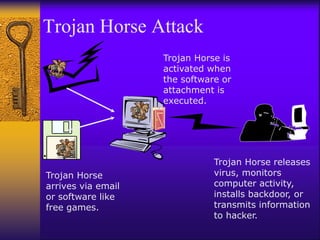
Trojan Horse Attack
Trojan Horse
arrives via email
or software like
free games.
Trojan Horse is
activated when
the software or
attachment is
executed.
Trojan Horse releases
virus, monitors
computer activity,
installs backdoor, or
transmits information
to hacker.
Spamming Attacks
•Sending out e-mail messages in bulk. It’s
electronic “junk mail.”
•Spamming can leave the information system
vulnerable to overload.
•Less destructive, used extensively for e-marketing
purposes.
What Does it Mean- “Security”?
• “Security” is the quality or state of being secure--to be free
from danger. But what are the types of security we have to be
concern with?
• Physical security - addresses the issues necessary to
protect the physical items, objects or areas of an organization
from unauthorized access and misuse.
• Personal security - addresses the protection of the
individual or group of individuals who are authorized to
access the organization and its operations.
• Operations security- protection of the details of a
particular operation or series of activities.
The Need for Security
 Industry Need for Information Security
An organization needs information security for
four important reasons:
 1. To protect the organization’s ability to
function,
 2. To enable the safe operation of applications
implemented on the organization’s IT systems,
 3. To protect the data the organization collects
and uses, and
 4. To safeguard the technology assets in use
at the organization.
Information Security Threats
• Act of Human Error or Failure (accidents, mistakes)
•Compromises to Intellectual Property (piracy,
copyright infringement)
• Acts of Espionage or Trespass (unauthorized access
and/or data collection)
• Acts of Information Extortion (blackmail of
information disclosure)
• Acts of Sabotage or Vandalism (destruction of
systems or information)
• Software Attacks (viruses, worms, macros, denial of
service)
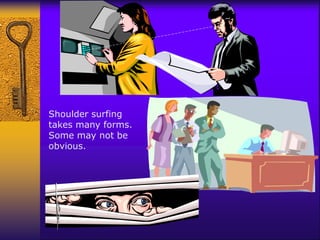
Shoulder surfing
takes many forms.
Some may not be
obvious.
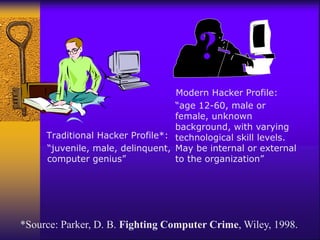
Traditional Hacker Profile*:
“juvenile, male, delinquent,
computer genius”
*Source: Parker, D. B. Fighting Computer Crime, Wiley, 1998.
Modern Hacker Profile:
“age 12-60, male or
female, unknown
background, with varying
technological skill levels.
May be internal or external
to the organization”
?
Information Security
• Tools, such as policy, awareness, training, education,
and technology are necessary for the successful application
of information security.
• The NSTISSC (National Security Telecommunications and
Information Systems Security Committee) model of
information security is known as the C.I.A. triangle
(Confidentiality, Integrity, and Availability) – these are
characteristics that describe the utility/value of information
What is Encryption ?
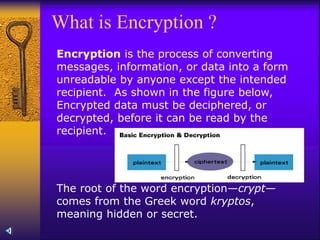
Encryption is the process of converting
messages, information, or data into a form
unreadable by anyone except the intended
recipient. As shown in the figure below,
Encrypted data must be deciphered, or
decrypted, before it can be read by the
recipient.
The root of the word encryption—crypt—
comes from the Greek word kryptos,
meaning hidden or secret.
Biometrics Devices
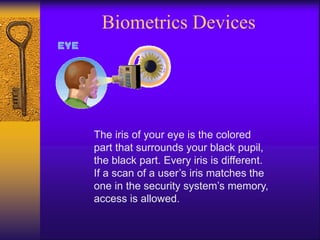
The iris of your eye is the colored
part that surrounds your black pupil,
the black part. Every iris is different.
If a scan of a user’s iris matches the
one in the security system’s memory,
access is allowed.
Biometrics Devices
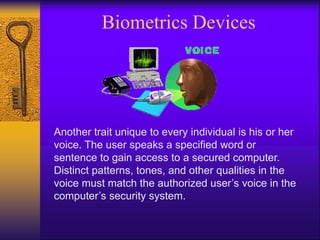
Another trait unique to every individual is his or her
voice. The user speaks a specified word or
sentence to gain access to a secured computer.
Distinct patterns, tones, and other qualities in the
voice must match the authorized user’s voice in the
computer’s security system.
Biometrics Devices
Another biometric option is
the fingerprint and its unique
identifying characteristics.
Placed on a special reading
pad, a designated finger’s
print is recognized by a
computer. A similar
biometric device scans a
person’s whole hand
Conclusion
“It is not the strongest of the
species that survive, nor the most
intelligent, but the one most
responsive to change”
Charles Darwin
Thank You!

Cyber Security in 2018

  • 1.
    Cyber Security Abhishek Kr.Rai(30) Chiranjit Adhikary(33) Punit Kr. Ojha(34) Mukul Kr. Yadav(43) Manish viswakarma(41)
  • 2.
    Cyber Security The eventsof Sept. 11 2001 proved that terror attacks on nonmilitary targets could be crippling to our national infrastructure. A week after the first anniversary of the day that changed everything, the White House released a 60- page draft plan called the National Strategy to Secure Cyberspace, which also points out that US businesses- -and individuals--are potential targets for cyber- terrorism. The experts say we can't rule anything out, but are advising us to be realistic.
  • 3.
    What is Cyberspace? Cyberspaceis a worldwide network of computers and the equipment that connects them, which by its very design is free and open to the public (the Internet) As Stanley Konter, CEO of Savannah's Sabre Technologies, notes, "The problem has gotten more prevalent with always-on, high-speed internet access. Attackers are always out there looking for that type of computer." We've become increasingly reliant on the net, and it's being used right now to transfer everything from friendly emails to hypersensitive data.
  • 4.
    Cyberspace as aBattleground? Each day, there is an increase in the number of threats against our nation's critical infrastructures. These threats come in the form of computer intrusion (hacking), denial of service attacks, and virus deployment. Because of this problem, the National Infrastructure Protection Center (NIPC) was created. Located in the FBI's headquarters building in Washington, D.C., the NIPC brings together representatives from U.S. government agencies, state and local governments, and the private sector in partnership to protect our nation's critical infrastructures.
  • 5.
    What are theThreats? Q: What's the biggest cyber threat facing America today? Organized terrorism, or a bored, curious kid? FBI: At this point it is difficult to quantify since computer intrusions occur daily originating from several sources. The origination of these intrusions and the intent of the intruders is often not obvious. These threats come in the form of: 1. Computer Intrusion (hacking-passive or active) 2. Denial of service attacks (DOS) 3. Virus & Worms deployment.
  • 6.
    State of theIndustry •According to the 2003 Computer Security Institute and FBI annual study on security, 95% of respondents detected computer security breaches in the last 12 months. •Companies will spend nearly $24 Billion on network security in 2004 and it is expected this amount could triple in the next two years.
  • 7.
    The British securityconsulting firm mi2g calculates that the number of malicious hacking attacks worldwide jumped from about 8,000 in 2000 to 31,000 in 2001, and projects attacks to exceed 60,000 in 2004. Cyber Security Risks 0 10000 20000 30000 40000 50000 60000 2000 2001 2002 2003 Attacks
  • 8.
    Clean up costof Cyber-attacks  SirCam: 2.3 million computers affected –Clean-up: $460 million –Lost productivity: $757 million  Code Red: 1 million computers affected –Clean-up: $1.1 billion –Lost productivity: $1.5 billion  Love Bug: 50 variants, 40 million computers affected –$8.7 billion for clean-up and lost productivity  Nimda –Cost still to be determined
  • 9.
    Trojan Horse Attack TrojanHorse arrives via email or software like free games. Trojan Horse is activated when the software or attachment is executed. Trojan Horse releases virus, monitors computer activity, installs backdoor, or transmits information to hacker.
  • 10.
    Spamming Attacks •Sending oute-mail messages in bulk. It’s electronic “junk mail.” •Spamming can leave the information system vulnerable to overload. •Less destructive, used extensively for e-marketing purposes.
  • 11.
    What Does itMean- “Security”? • “Security” is the quality or state of being secure--to be free from danger. But what are the types of security we have to be concern with? • Physical security - addresses the issues necessary to protect the physical items, objects or areas of an organization from unauthorized access and misuse. • Personal security - addresses the protection of the individual or group of individuals who are authorized to access the organization and its operations. • Operations security- protection of the details of a particular operation or series of activities.
  • 12.
    The Need forSecurity  Industry Need for Information Security An organization needs information security for four important reasons:  1. To protect the organization’s ability to function,  2. To enable the safe operation of applications implemented on the organization’s IT systems,  3. To protect the data the organization collects and uses, and  4. To safeguard the technology assets in use at the organization.
  • 13.
    Information Security Threats •Act of Human Error or Failure (accidents, mistakes) •Compromises to Intellectual Property (piracy, copyright infringement) • Acts of Espionage or Trespass (unauthorized access and/or data collection) • Acts of Information Extortion (blackmail of information disclosure) • Acts of Sabotage or Vandalism (destruction of systems or information) • Software Attacks (viruses, worms, macros, denial of service)
  • 14.
    Shoulder surfing takes manyforms. Some may not be obvious.
  • 15.
    Traditional Hacker Profile*: “juvenile,male, delinquent, computer genius” *Source: Parker, D. B. Fighting Computer Crime, Wiley, 1998. Modern Hacker Profile: “age 12-60, male or female, unknown background, with varying technological skill levels. May be internal or external to the organization” ?
  • 16.
    Information Security • Tools,such as policy, awareness, training, education, and technology are necessary for the successful application of information security. • The NSTISSC (National Security Telecommunications and Information Systems Security Committee) model of information security is known as the C.I.A. triangle (Confidentiality, Integrity, and Availability) – these are characteristics that describe the utility/value of information
  • 17.
    What is Encryption? Encryption is the process of converting messages, information, or data into a form unreadable by anyone except the intended recipient. As shown in the figure below, Encrypted data must be deciphered, or decrypted, before it can be read by the recipient. The root of the word encryption—crypt— comes from the Greek word kryptos, meaning hidden or secret.
  • 18.
    Biometrics Devices The irisof your eye is the colored part that surrounds your black pupil, the black part. Every iris is different. If a scan of a user’s iris matches the one in the security system’s memory, access is allowed.
  • 19.
    Biometrics Devices Another traitunique to every individual is his or her voice. The user speaks a specified word or sentence to gain access to a secured computer. Distinct patterns, tones, and other qualities in the voice must match the authorized user’s voice in the computer’s security system.
  • 20.
    Biometrics Devices Another biometricoption is the fingerprint and its unique identifying characteristics. Placed on a special reading pad, a designated finger’s print is recognized by a computer. A similar biometric device scans a person’s whole hand
  • 21.
    Conclusion “It is notthe strongest of the species that survive, nor the most intelligent, but the one most responsive to change” Charles Darwin
  • 22.