Understanding Identity Management and Security.
Starring:
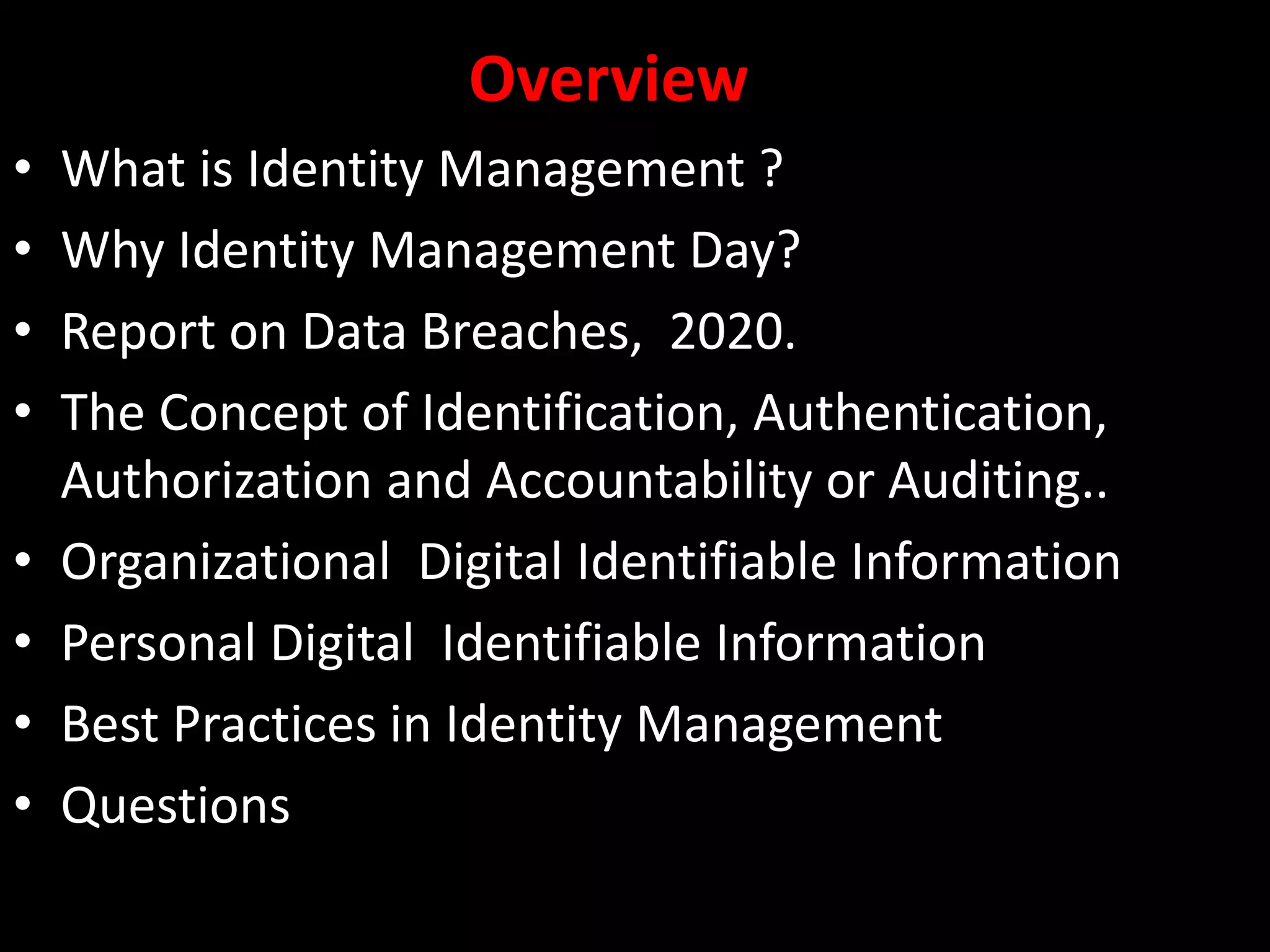
Chinatu Uzuegbu
Identity Management Day, April 13, 2021
Cyber in Africa Event
KeyNote Speaker
• Top 50 women in Cyber Security, Africa 2020 Accolade.
• Founding Cyber Security Consultant: RoseTech CyberCrime Solutions
Limited.(2016 till Date).
• President, (ISC)2 Nigeria Chapter(2018 till Date).
• Experienced BanKer(2007 to 2016):
– Afribank Nigeria Plc/Mainstreet Bank Ltd(2007 to 2015):
. IT/Application/Data Custodian (Core Banking Applications, Third Party
Applications, Enterprise Applications Development, Others).
. Information Security Assistant
– Skyebank Nig Plc(2015 to 2016):
. Business Relationship Manager
• Afribank Insurance Brokerage(2004 to 2007):
– Head, Information Technology
• Nigeria Distilleries Ltd(2002 to 2004):
-Ag, Head, Information Technology.
-Senior IT Officer
• Professional Membership in Good Standing:
– Cyber Security Experts Association of Nigeria(CSEAN)
– International Information Systems Security Certification Consortium(ISC)2
– Information Systems Audit and Control Association (ISACA)
– EC-Council
ChinatuUzuegbu
CCISO, CISSP, CISM,
CISA, CEH,…………
Overview
• What is Identity Management ?
• Why Identity Management Day?
• Report on Data Breaches, 2020.
• The Concept of Identification, Authentication,
Authorization and Accountability or Auditing..
• Organizational Digital Identifiable Information
• Personal Digital Identifiable Information
• Best Practices in Identity Management
• Questions
What is Identity Management?
Identity management (ID management) is
the organizational process for identifying,
authenticating and authorizing individuals
or groups of people to have access to
applications, systems or networks by
associating user rights and restrictions with
established identities.
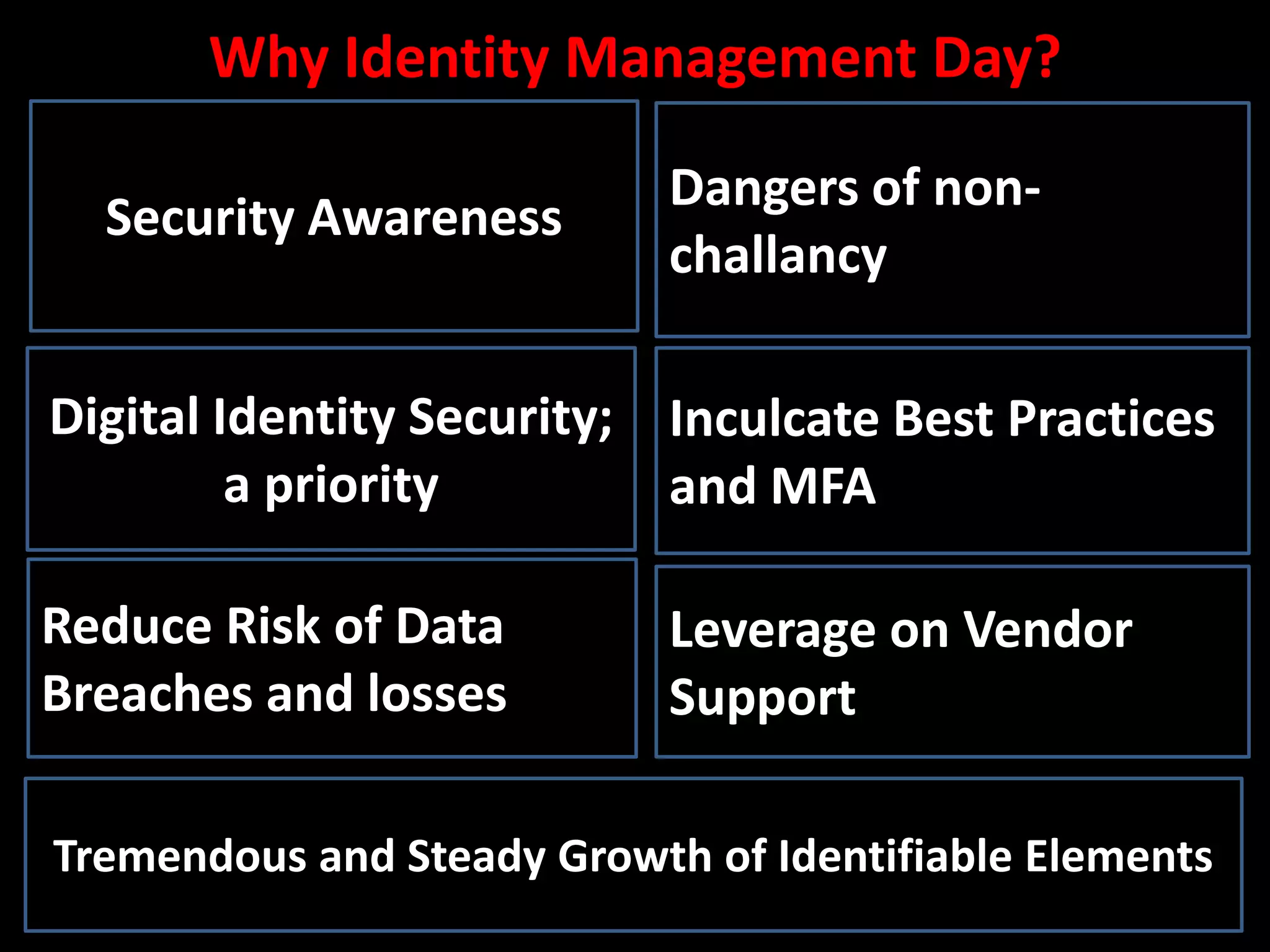
Why Identity Management Day?
Security Awareness
Digital Identity Security;
a priority
Reduce Risk of Data
Breaches and losses
Dangers of non-
challancy
Inculcate Best Practices
and MFA
Tremendous and Steady Growth of Identifiable Elements
Leverage on Vendor
Support
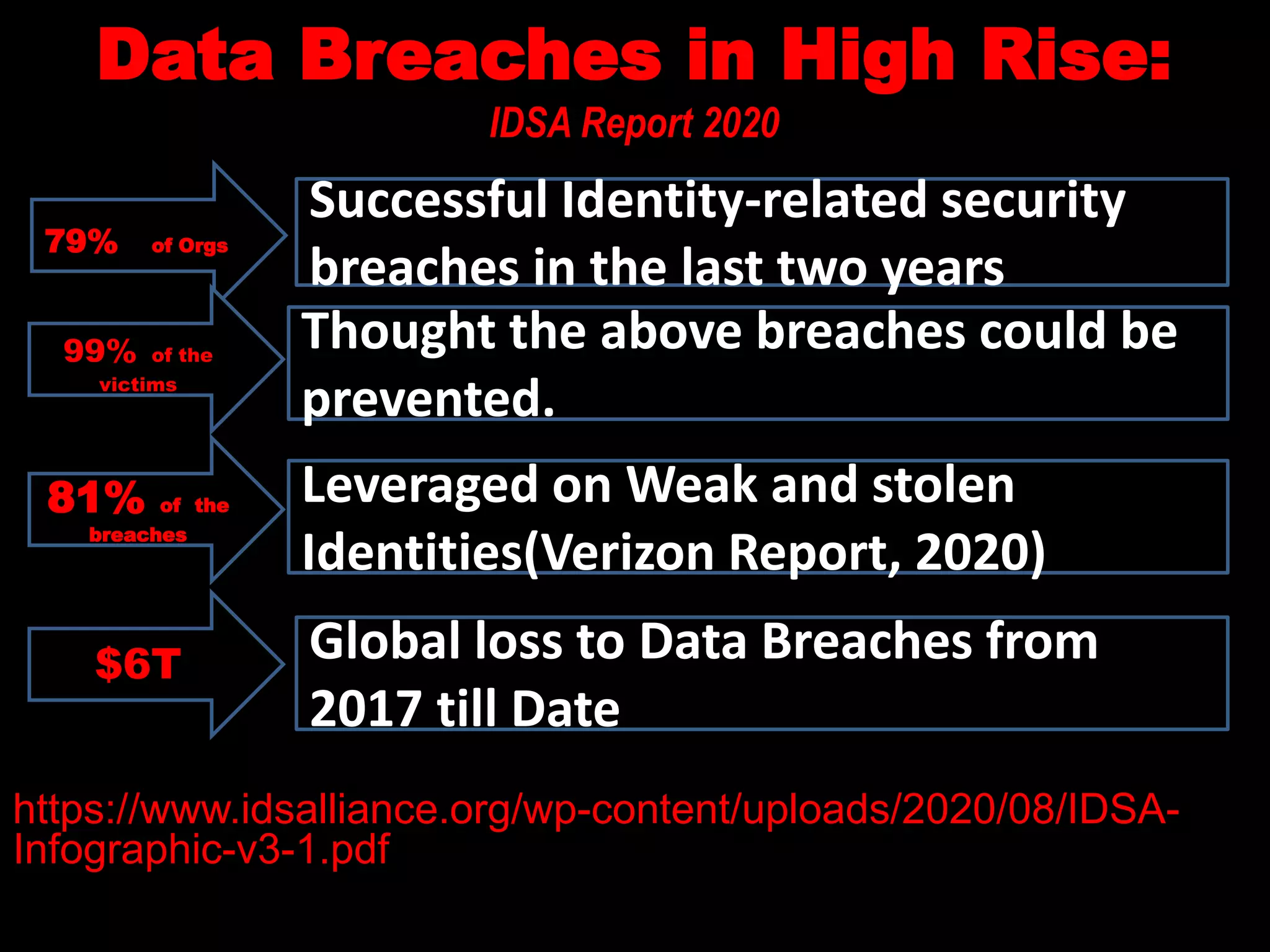
Data Breaches in High Rise:
IDSA Report 2020
https://www.idsalliance.org/wp-content/uploads/2020/08/IDSA-
Infographic-v3-1.pdf
Successful Identity-related security
breaches in the last two years
Global loss to Data Breaches from
2017 till Date
Leveraged on Weak and stolen
Identities(Verizon Report, 2020)
Thought the above breaches could be
prevented.
79% of Orgs
99% of the
victims
81% of the
breaches
$6T
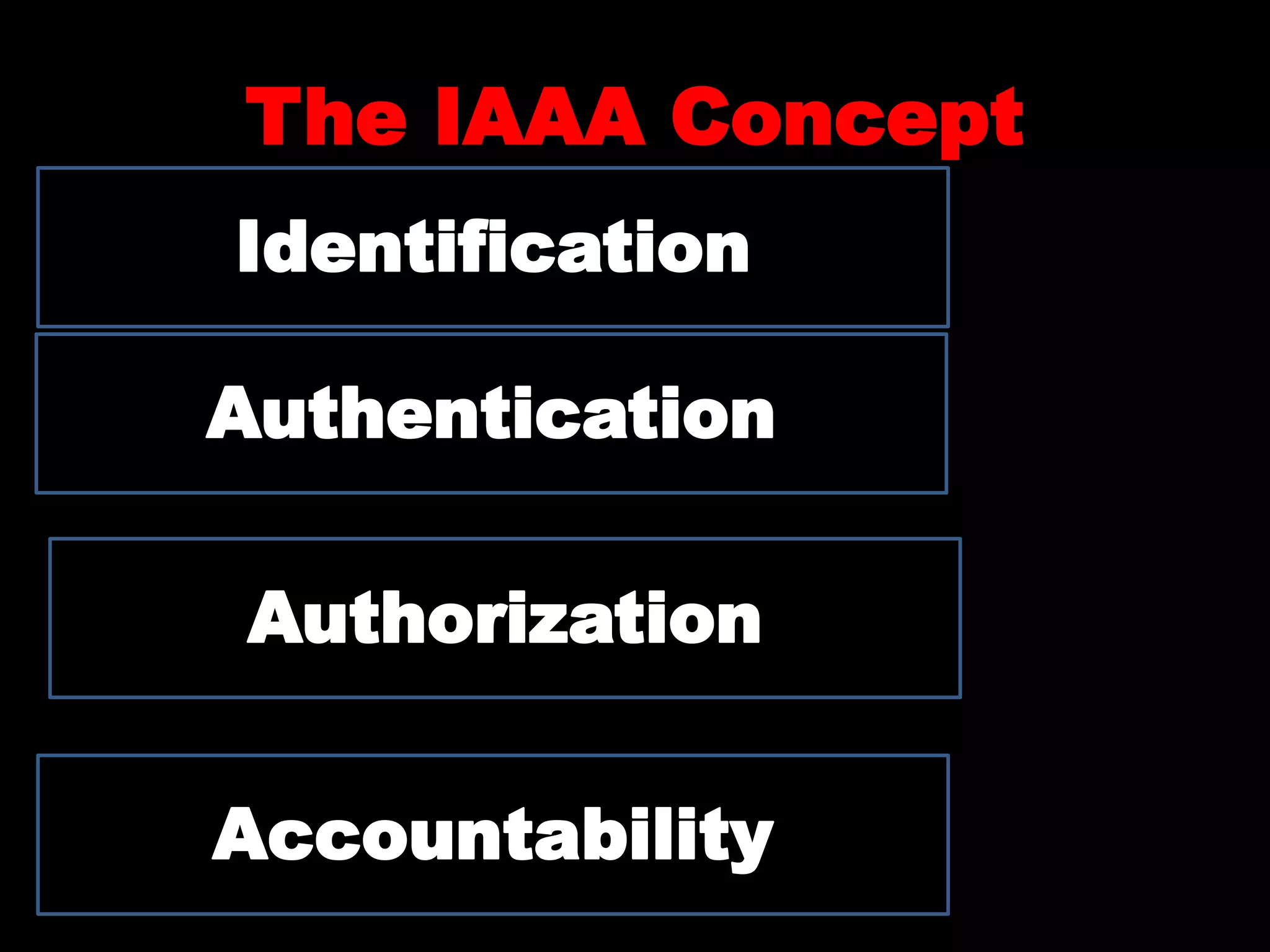
The IAAA Concept
Identification
Authentication
Authorization
Accountability
Identification
Process of making a Claim:
• Personal Identifiable Information(PII)
• Organizational Identifiable Information
Organizational Identifiable Information:
• Employees
• Contractors
• Third parties(Federated
Identities)
• Customers
• End-Users
• machines
• Bots
• RPA(Robotic Process Automation).
• Application to Application Accounts.
• Built-in IaaS, Idaas, XaaS Concept
Machine identities:
Bots(Zombie)
• An autonomous program on the
internet or another network that
can interact with systems or users.
• Botnets: group of autonomous
programs on a distributed network
of Systems mandated to interact for
a purpose.
Robotic Process Automation(RPA)
• Technology that uses software
robots to automate repetitive tasks
and manual processes.
• Enhancing the work of your
employees by interacting with
websites, business and desktop
applications, databases and people
to execute repetitive and often
mundane work.
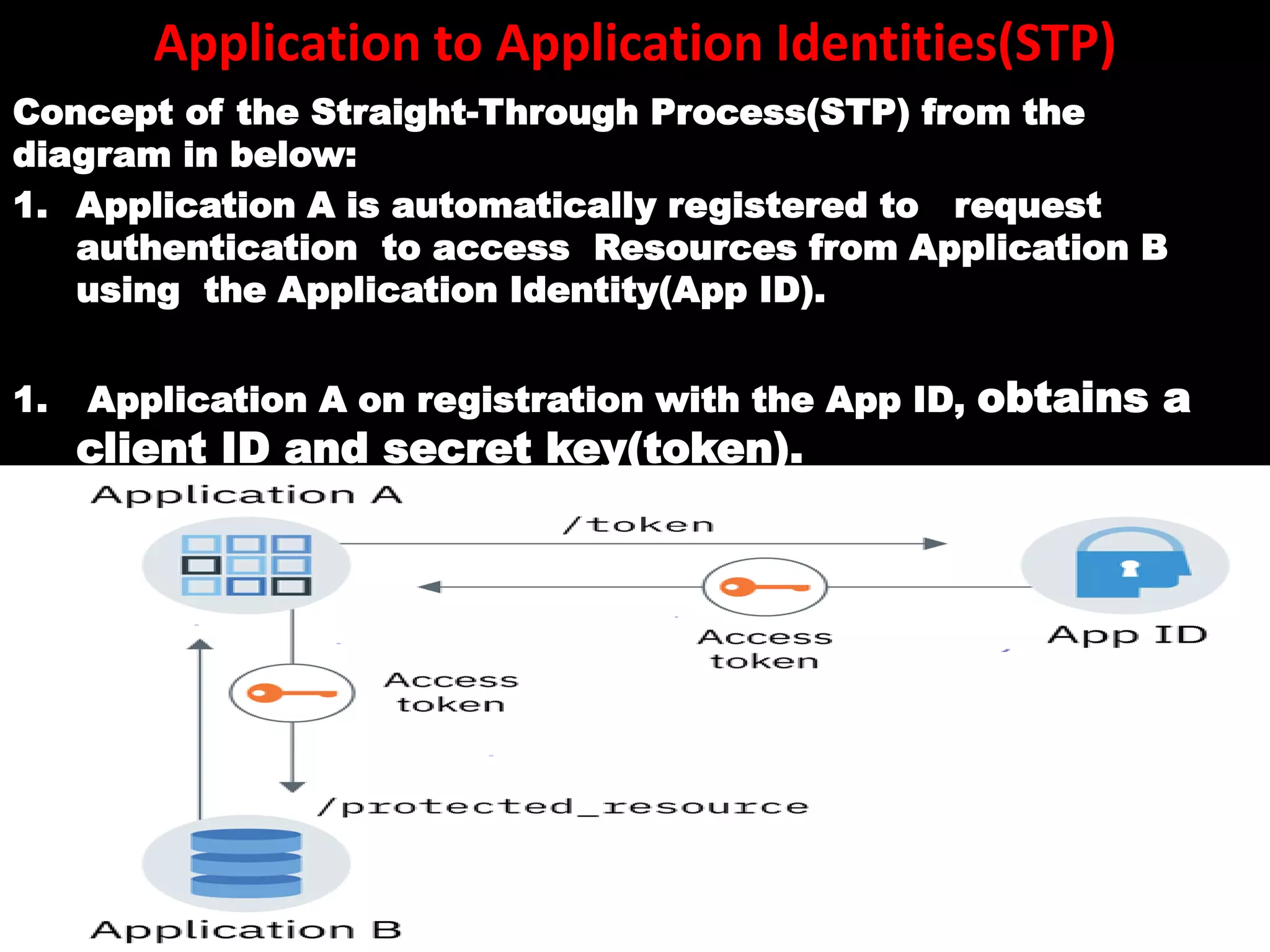
Application to Application Identities(STP)
Concept of the Straight-Through Process(STP) from the
diagram in below:
1. Application A is automatically registered to request
authentication to access Resources from Application B
using the Application Identity(App ID).
1. Application A on registration with the App ID, obtains a
client ID and secret key(token).
Application to Application Identities(STP)
Cont’d
3. On authentication with the client ID and token,
Application A requests authorization to access
Resources from Application B.
4. Application B automatically grants Application A
access rights based on the token strings(Response
Handshake) earlier issued by APP ID.
5. Application A is now able to send requests and
access Resources from Application B leveraging on
the Handshake.
Federated(Third Party) Identities
• Identities issued by an organization to
Third Party Partners(P2P),
Businesses(B2B), Regulatory bodies,
Suppliers, Escrows, Vendors and
others directly or indirectly in
Business relationship.
• Access Rights to Third Parties are
Time-bound with close monitoring as
the case may be.
Cloud-Based Identities
• Identity As a Service(IDaaS) is a
Cloud-based authentication built and
operated by a third-party provider.
• IDaaS companies supply cloud-based
authentication or identity
management to enterprises who
subscribe.
• The ID issued by the IDaaS Provider
is what the organization applies for
enrollment into the Cloud platform as
a Subscriber.
Personal Identifiable Information(PII)
• Email Address
• Security Identity
• National Identity
• Bank Account Number
• Bank Verification Number
• User Identity
• Others
Authentication
Process of Validating a Claim:
–Passwords
–Biometrics
–Smart Cards
–ATM Cards
–Tokens
–Cloud based Authentication
–Others
–Multi Factor Authentication is the way to go!
Factors of Authentication
The three Factors of Authentication:
• Something You Know: Password, PIN;
the weakest.
• Something You have : Token, Phone,
Smart Card.
• Something You are: Biometrics(Finger
prints, others); the strongest.
• A combination of two or more of the
above factors makes a strong
authentication.
Multi-Factor Authentication(MFA)
• A combination of two or more of the three
factors of Authentication.
• No critical Identifiable Information is
authenticated with single factor approach.
• MFA promotes strong authentication mechanism
as no one of the factors of authentication is
strong enough and must not be applied alone for
critical Information assets.
Authorization
• Process of assigning access rights on
authentication.
• Grant Access Rights based on Concept
of : Least Privilege and Need to Know.
• Role Based Access Control is the way to
go!
Accountability
• Process of trailing activities on the system/network
and assuring that all activities are traceable
whatsoever:
– Time Stamps
– Digital Signatures
– Audit Trails
– Non-Repudiation
– Log Files(SIEM)
– Others
NSA and IDSA Advise
To promote a secured Identity and Access Management across all Sectors,
National Security Alliance(NSA) and Identity Defined Security Alliance(IDSA)
recommend that:
• Best Practices be enforced and mandated.
• Multi-Factor Authentication(MFA) be inculcated into the
Authentication framework of organizations.
• All Access points be integrated with growth and adoption of
Technology in mind. Think IAM system and PAM system.
• Organizations establish Handshakes with Vendors for necessary
Support.
• Organizations Embrace Zero Trust Architecture around all
Infrastructures and Applications.
Identity Management Best Practices
• Clarify Ownership of ALL Identities.
• Ascertain the custodian of All Identities.
• Who is responsible for the creation, removal,
ongoing maintenance and security of an identity
within your organization?
• Imbibe the culture of Multi Factor
Authentication(MFA) for all Handshakes.
• Deploy a resilient and robust Privileged Access
Management(PAM) System.
• Deploy a resilient and robust Identity and Access
Management(IAM) System.
• Zero Trust Architecture in everything is the way to
go!
Happy
Identity Management Day
April 13, 2021
Thank You
Chinatu Uzuegbu (CCISO, CISSP, CISM,
CISA CEH, …).
Founding Cyber Security Consultant, RoseTech.
President, (ISC)2 Nigeria chapter.
chinatuuzuegbu@outlook.com
c.uzuegbu@isc2nigeriachapter.org
info@rtechccsl.com
https://www.linkedin.com/in/chinatu-uzuegbu-
67593119/
+2348037815577

Understanding Identity Management and Security.

  • 1.
    Understanding Identity Managementand Security. Starring: Chinatu Uzuegbu Identity Management Day, April 13, 2021 Cyber in Africa Event
  • 2.
    KeyNote Speaker • Top50 women in Cyber Security, Africa 2020 Accolade. • Founding Cyber Security Consultant: RoseTech CyberCrime Solutions Limited.(2016 till Date). • President, (ISC)2 Nigeria Chapter(2018 till Date). • Experienced BanKer(2007 to 2016): – Afribank Nigeria Plc/Mainstreet Bank Ltd(2007 to 2015): . IT/Application/Data Custodian (Core Banking Applications, Third Party Applications, Enterprise Applications Development, Others). . Information Security Assistant – Skyebank Nig Plc(2015 to 2016): . Business Relationship Manager • Afribank Insurance Brokerage(2004 to 2007): – Head, Information Technology • Nigeria Distilleries Ltd(2002 to 2004): -Ag, Head, Information Technology. -Senior IT Officer • Professional Membership in Good Standing: – Cyber Security Experts Association of Nigeria(CSEAN) – International Information Systems Security Certification Consortium(ISC)2 – Information Systems Audit and Control Association (ISACA) – EC-Council ChinatuUzuegbu CCISO, CISSP, CISM, CISA, CEH,…………
  • 3.
    Overview • What isIdentity Management ? • Why Identity Management Day? • Report on Data Breaches, 2020. • The Concept of Identification, Authentication, Authorization and Accountability or Auditing.. • Organizational Digital Identifiable Information • Personal Digital Identifiable Information • Best Practices in Identity Management • Questions
  • 4.
    What is IdentityManagement? Identity management (ID management) is the organizational process for identifying, authenticating and authorizing individuals or groups of people to have access to applications, systems or networks by associating user rights and restrictions with established identities.
  • 5.
    Why Identity ManagementDay? Security Awareness Digital Identity Security; a priority Reduce Risk of Data Breaches and losses Dangers of non- challancy Inculcate Best Practices and MFA Tremendous and Steady Growth of Identifiable Elements Leverage on Vendor Support
  • 6.
    Data Breaches inHigh Rise: IDSA Report 2020 https://www.idsalliance.org/wp-content/uploads/2020/08/IDSA- Infographic-v3-1.pdf Successful Identity-related security breaches in the last two years Global loss to Data Breaches from 2017 till Date Leveraged on Weak and stolen Identities(Verizon Report, 2020) Thought the above breaches could be prevented. 79% of Orgs 99% of the victims 81% of the breaches $6T
  • 7.
  • 8.
    Identification Process of makinga Claim: • Personal Identifiable Information(PII) • Organizational Identifiable Information
  • 9.
    Organizational Identifiable Information: •Employees • Contractors • Third parties(Federated Identities) • Customers • End-Users • machines
  • 10.
    • Bots • RPA(RoboticProcess Automation). • Application to Application Accounts. • Built-in IaaS, Idaas, XaaS Concept Machine identities:
  • 11.
    Bots(Zombie) • An autonomousprogram on the internet or another network that can interact with systems or users. • Botnets: group of autonomous programs on a distributed network of Systems mandated to interact for a purpose.
  • 12.
    Robotic Process Automation(RPA) •Technology that uses software robots to automate repetitive tasks and manual processes. • Enhancing the work of your employees by interacting with websites, business and desktop applications, databases and people to execute repetitive and often mundane work.
  • 13.
    Application to ApplicationIdentities(STP) Concept of the Straight-Through Process(STP) from the diagram in below: 1. Application A is automatically registered to request authentication to access Resources from Application B using the Application Identity(App ID). 1. Application A on registration with the App ID, obtains a client ID and secret key(token).
  • 14.
    Application to ApplicationIdentities(STP) Cont’d 3. On authentication with the client ID and token, Application A requests authorization to access Resources from Application B. 4. Application B automatically grants Application A access rights based on the token strings(Response Handshake) earlier issued by APP ID. 5. Application A is now able to send requests and access Resources from Application B leveraging on the Handshake.
  • 15.
    Federated(Third Party) Identities •Identities issued by an organization to Third Party Partners(P2P), Businesses(B2B), Regulatory bodies, Suppliers, Escrows, Vendors and others directly or indirectly in Business relationship. • Access Rights to Third Parties are Time-bound with close monitoring as the case may be.
  • 16.
    Cloud-Based Identities • IdentityAs a Service(IDaaS) is a Cloud-based authentication built and operated by a third-party provider. • IDaaS companies supply cloud-based authentication or identity management to enterprises who subscribe. • The ID issued by the IDaaS Provider is what the organization applies for enrollment into the Cloud platform as a Subscriber.
  • 17.
    Personal Identifiable Information(PII) •Email Address • Security Identity • National Identity • Bank Account Number • Bank Verification Number • User Identity • Others
  • 18.
    Authentication Process of Validatinga Claim: –Passwords –Biometrics –Smart Cards –ATM Cards –Tokens –Cloud based Authentication –Others –Multi Factor Authentication is the way to go!
  • 19.
    Factors of Authentication Thethree Factors of Authentication: • Something You Know: Password, PIN; the weakest. • Something You have : Token, Phone, Smart Card. • Something You are: Biometrics(Finger prints, others); the strongest. • A combination of two or more of the above factors makes a strong authentication.
  • 20.
    Multi-Factor Authentication(MFA) • Acombination of two or more of the three factors of Authentication. • No critical Identifiable Information is authenticated with single factor approach. • MFA promotes strong authentication mechanism as no one of the factors of authentication is strong enough and must not be applied alone for critical Information assets.
  • 21.
    Authorization • Process ofassigning access rights on authentication. • Grant Access Rights based on Concept of : Least Privilege and Need to Know. • Role Based Access Control is the way to go!
  • 22.
    Accountability • Process oftrailing activities on the system/network and assuring that all activities are traceable whatsoever: – Time Stamps – Digital Signatures – Audit Trails – Non-Repudiation – Log Files(SIEM) – Others
  • 23.
    NSA and IDSAAdvise To promote a secured Identity and Access Management across all Sectors, National Security Alliance(NSA) and Identity Defined Security Alliance(IDSA) recommend that: • Best Practices be enforced and mandated. • Multi-Factor Authentication(MFA) be inculcated into the Authentication framework of organizations. • All Access points be integrated with growth and adoption of Technology in mind. Think IAM system and PAM system. • Organizations establish Handshakes with Vendors for necessary Support. • Organizations Embrace Zero Trust Architecture around all Infrastructures and Applications.
  • 24.
    Identity Management BestPractices • Clarify Ownership of ALL Identities. • Ascertain the custodian of All Identities. • Who is responsible for the creation, removal, ongoing maintenance and security of an identity within your organization? • Imbibe the culture of Multi Factor Authentication(MFA) for all Handshakes. • Deploy a resilient and robust Privileged Access Management(PAM) System. • Deploy a resilient and robust Identity and Access Management(IAM) System. • Zero Trust Architecture in everything is the way to go!
  • 25.
  • 26.
    Thank You Chinatu Uzuegbu(CCISO, CISSP, CISM, CISA CEH, …). Founding Cyber Security Consultant, RoseTech. President, (ISC)2 Nigeria chapter. chinatuuzuegbu@outlook.com c.uzuegbu@isc2nigeriachapter.org info@rtechccsl.com https://www.linkedin.com/in/chinatu-uzuegbu- 67593119/ +2348037815577