IT ACT AND CYBER CRIME

Made by:
Introduction
IT Act 2000 neither defines Cyber Crime nor uses this
expression only provide definition and punishment for
certain offences.

                        Definitions
1)Narrowly defined ‘cyber crime ‘ consist of only those offences
provided in the Information Technology Act 2000.
2)Broadly stated ,’cybercrime’ can be set to be an act of
commission or omission ,committed on or through or with the
help of or connected with the internet ,whether directly or
indirectly ,which is prohibited by any law and for which
punishment, monetary and /or corporal is provided.
Classification of Cyber Crimes

• 1) Old Crimes , committed on or through the
  new medium of the Internet.
• 2) New Crimes created with Internet Itself.
• 3) New Crimes used for commission of old
  Crimes.
Classification by Nature of Usage of
                  Computer
• 1)Hacking – Computer & Network are
  essential
• 2)Cyber Pornography – medium of net is used
• 3)Cyber fraud – Only Computer is identical for
  commission
Information Technology Act 2000
• It shall extend to the whole of India and save
  as otherwise provided in this act , It applies
  also to any offence or contravention here
  under committed outside India by any person.
• It shall come into force on such date as the
  Central Government may , by notification
  , appoint and different dates may be
  appointed for different provision of the act.
Definition of IT Act
•   Access
•   Addressee
•   Data
•   Digital Signature
•   Electronic form
•   Electronic Gazette
•   Electronic Record
•   Function
•   Information
•   License
•   Private key
•   Public key
•   Secure System
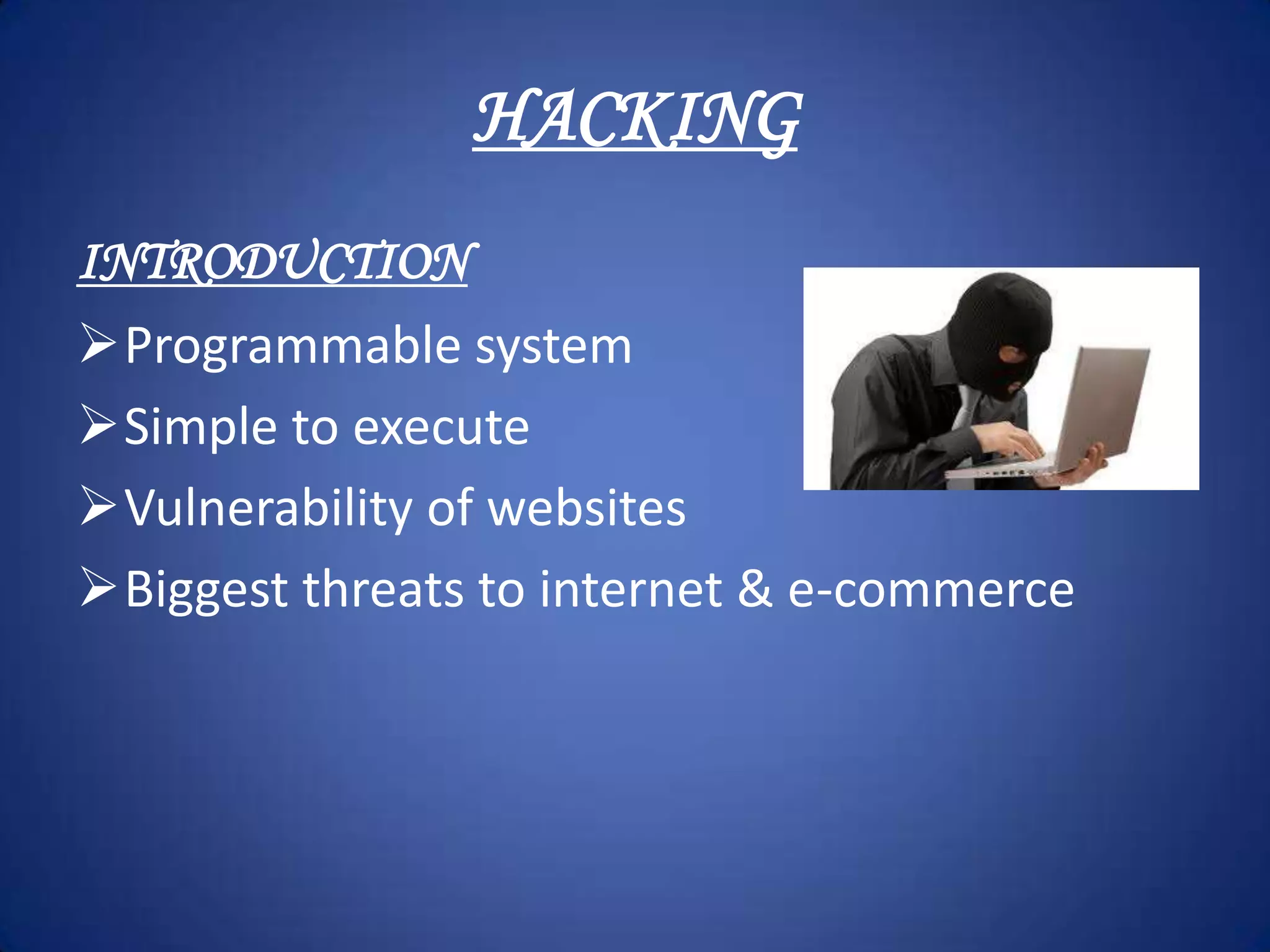
HACKING
INTRODUCTION
Programmable system
Simple to execute
Vulnerability of websites
Biggest threats to internet & e-commerce
DEFINITION
It refers to hobby or
profession of working with
computer
Destroys or deletes or
alters
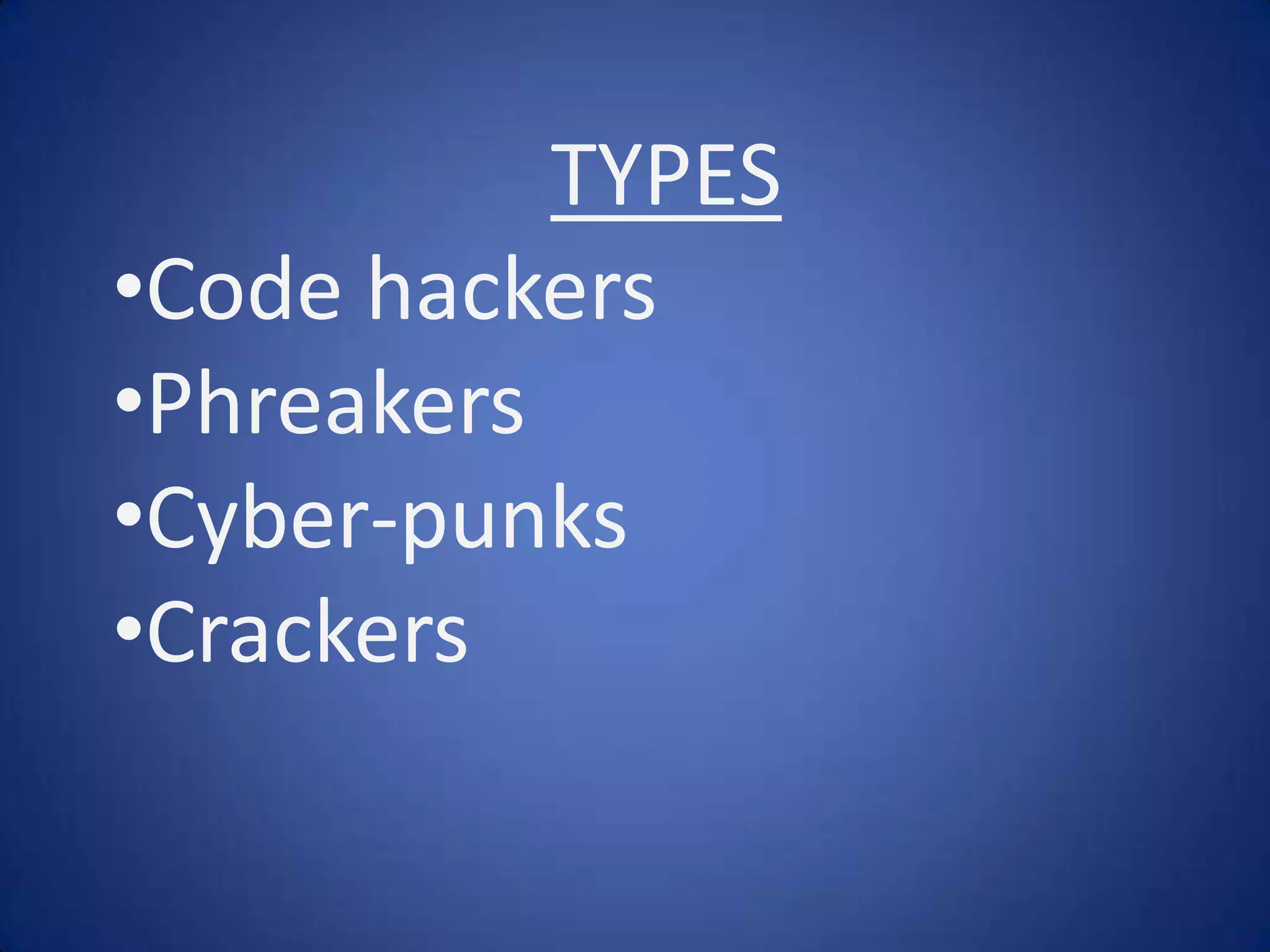
TYPES
•Code hackers
•Phreakers
•Cyber-punks
•Crackers
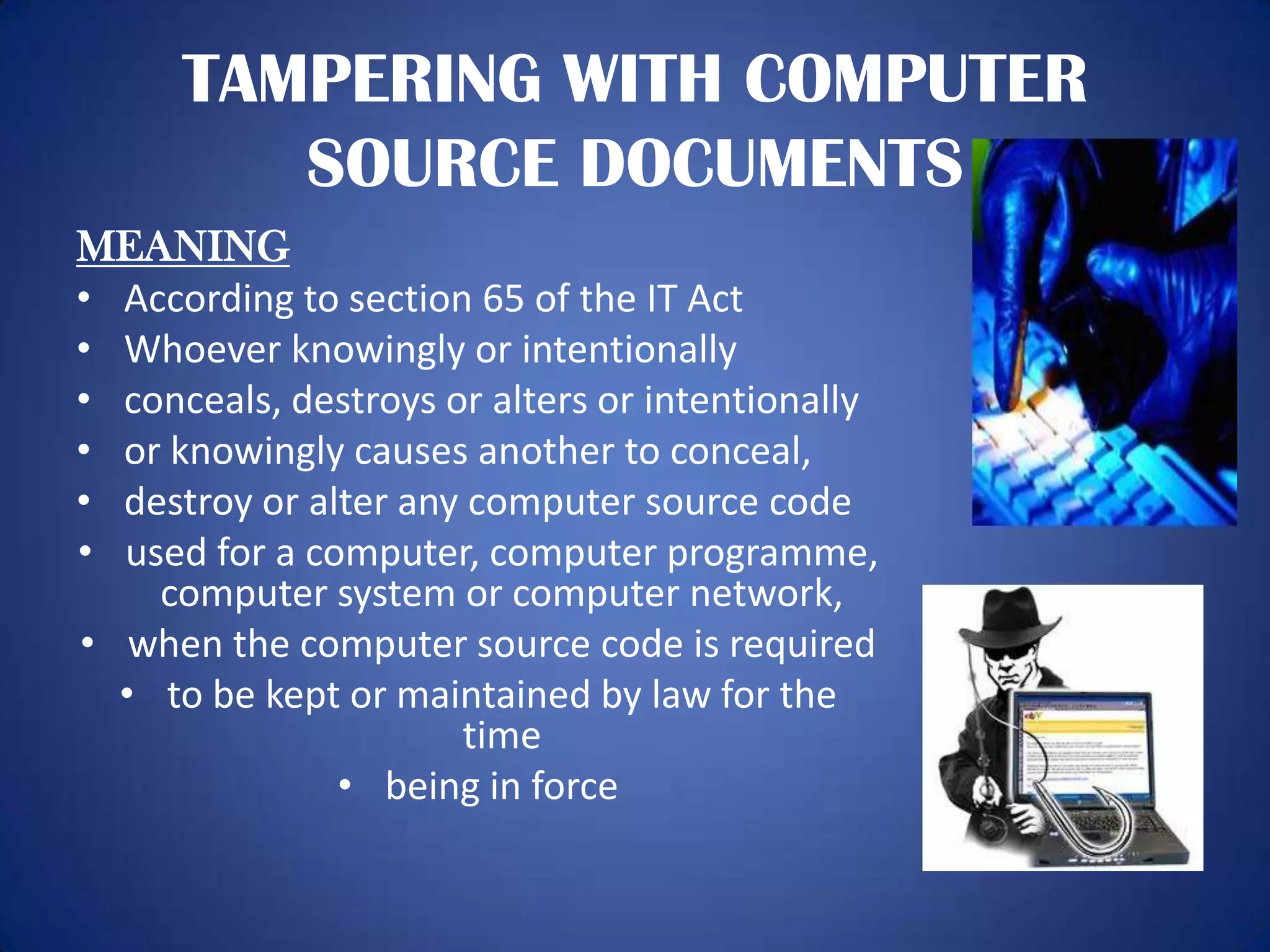
TAMPERING WITH COMPUTER
         SOURCE DOCUMENTS
MEANING
• According to section 65 of the IT Act
• Whoever knowingly or intentionally
• conceals, destroys or alters or intentionally
• or knowingly causes another to conceal,
• destroy or alter any computer source code
• used for a computer, computer programme,
    computer system or computer network,
• when the computer source code is required
  • to be kept or maintained by law for the
                      time
               • being in force
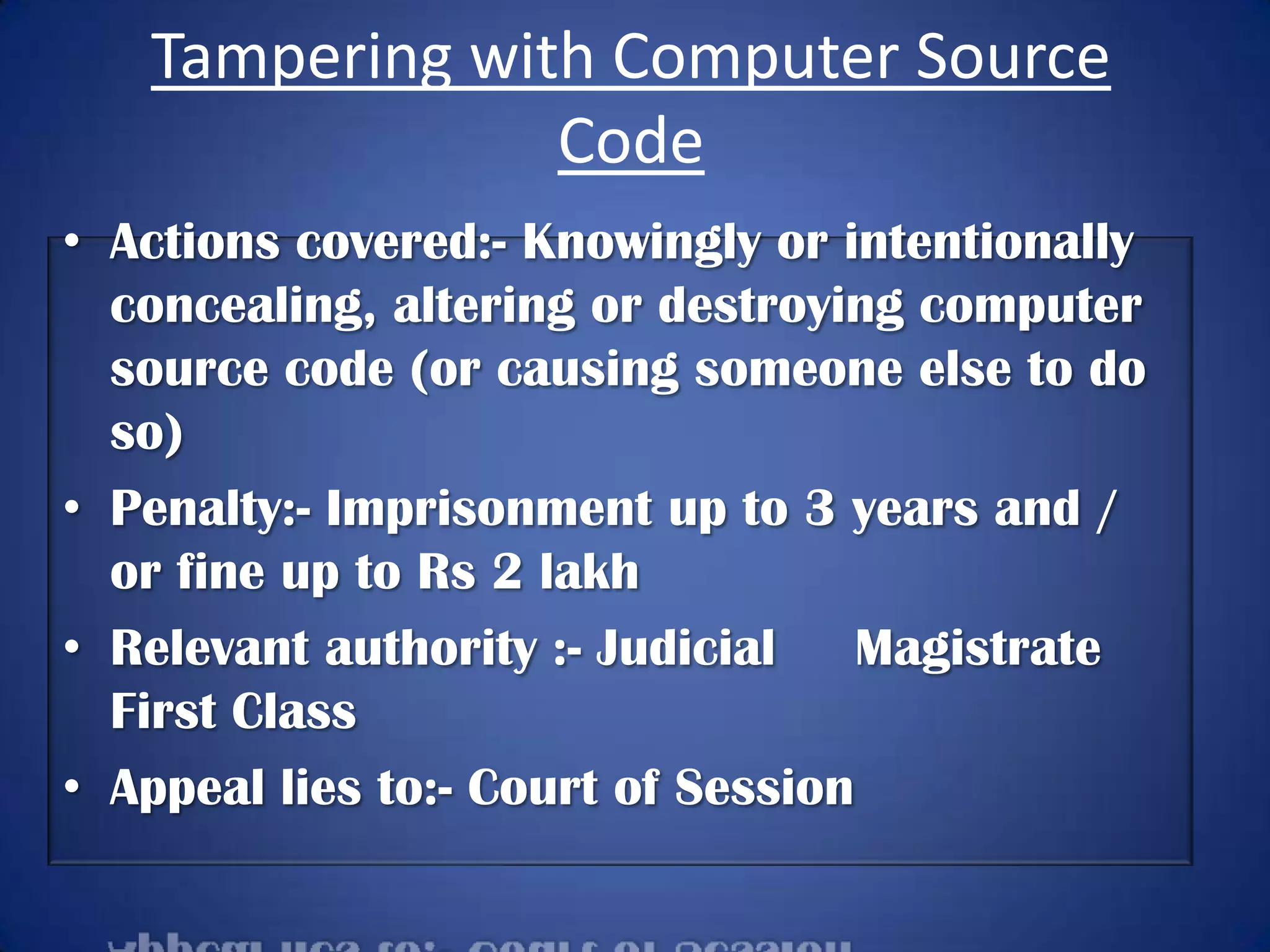
Tampering with Computer Source
                Code
• Actions covered:- Knowingly or intentionally
  concealing, altering or destroying computer
  source code (or causing someone else to do
  so)
• Penalty:- Imprisonment up to 3 years and /
  or fine up to Rs 2 lakh
• Relevant authority :- Judicial    Magistrate
  First Class
• Appeal lies to:- Court of Session
Cyber Fraud & Cheating
• Fraud on internet constitutes about one-third of all cyber
  crimes
• It has increased by a substantial 29% over the past year.
• It is the most profitable business on the Internet
• Some of the major areas of fraud and cheating on the Internet
  include misuse of credit cards by obtaining passwords by
  hacking , bogus investment/get rich schemes , deceptive
  investment newsletters containing false information about
  companies , non delivery of goods purchased from online
  auctions and websites , misappropriation & transfer of funds ,
  etc
IT Laws relating to Cyber
Fraud & Cheating
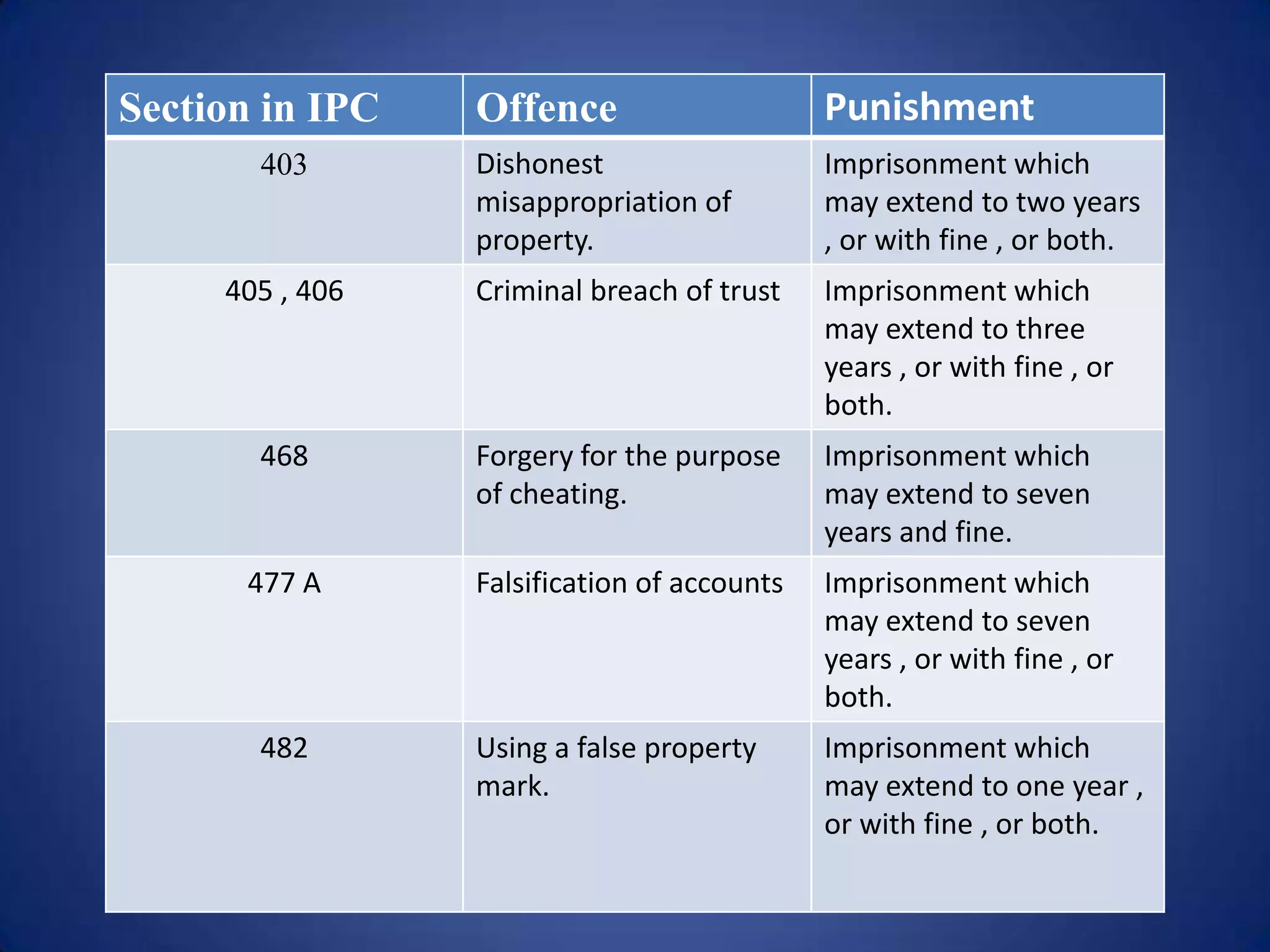
Section in IPC   Offence                     Punishment
       403       Dishonest                   Imprisonment which
                 misappropriation of         may extend to two years
                 property.                   , or with fine , or both.
     405 , 406   Criminal breach of trust    Imprisonment which
                                             may extend to three
                                             years , or with fine , or
                                             both.
       468       Forgery for the purpose     Imprisonment which
                 of cheating.                may extend to seven
                                             years and fine.
      477 A      Falsification of accounts   Imprisonment which
                                             may extend to seven
                                             years , or with fine , or
                                             both.
       482       Using a false property      Imprisonment which
                 mark.                       may extend to one year ,
                                             or with fine , or both.
CYBER TERRORISM
Government officials and Information Technology security specialists have
documented a significant increase in Internet problems and server scans
since early 2001. But there is a growing concern among federal officials that
such intrusions are part of an organized effort by cyber terrorists, foreign
intelligence services, or other groups to map potential security holes in
critical systems. A cyber terrorist is someone who intimidates or coerces a
government or organization to advance his or her political or social
objectives by launching computer-based attack against computers,
network, and the information stored on them.
Cyber terrorism in general, can be defined as an act of terrorism committed
through the use of cyberspace or computer resources (Parker 1983). As
such, a simple propaganda in the Internet, that there will be bomb attacks
during the holidays can be considered cyber terrorism. As well there are
also hacking activities directed towards individuals, families, organized by
groups within networks, tending to cause fear among people, demonstrate
power, collecting information relevant for ruining peoples' lives, robberies,
blackmailing etc.
Cyber Pornography
•   There is no settled definition of pornography or obscenity. What is
•   considered simply sexually explicit but not obscene in USA may well be
•   considered obscene in India. There have been many attempts to limit the
•   availability of pornographic content on the Internet by governments and
•   law enforcement bodies all around the world but with little effect.
•   Pornography on the Internet is available in different formats. These range
•   from pictures and short animated movies, to sound files and stories. The
•   Internet also makes it possible to discuss sex, see live sex acts, and
•   arrange sexual activities from computer screens. Although the Indian
•   Constitution guarantees the fundamental right of freedom of speech and
•   expression, it has been held that a law against obscenity is constitutional.
•   The Supreme Court has defined obscene as “offensive to modesty or
•   decency; lewd, filthy, repulsive.
Section 67 of the IT Act is
the most serious Indian
law penalizing cybercrime
•According to Section 67 of the IT Act
•Whoever publishes or transmits or causes
•to be published in the electronic form, any
•material which is lascivious or appeals to
•the prurient interest or if its effect is such as
•to tend to deprave and corrupt persons who
•are likely, having regard to all relevant
•circumstances, to read, see or hear the
•matter contained or embodied in it, shall be
•punished on first conviction with
•imprisonment of either description for a
•term which may extend to five years and
•with fine which may extend to one lakh
•rupees and in the event of a second or
•subsequent conviction with imprisonment of
•either description for a term which may
•extend to ten years and also with fine which
•may extend to two lakh rupees.
How to stop cyber crime


Anti Virus


Firewall
ON INDIVIDUAL LEVEL
• Use hard to get password

• Disconnect from internet when not in use

• Don’t give your password to anyone.

• Don’t give your personal information on
  “SOCIAL NETWORKING SITES”
On Organizational Level

   Regular backup


 Use comprehensive security software and keep your system updated


 Secure your wireless network


 Be suspicious
Thank You
  

Cyber fraud

  • 1.
    IT ACT ANDCYBER CRIME Made by:
  • 2.
    Introduction IT Act 2000neither defines Cyber Crime nor uses this expression only provide definition and punishment for certain offences. Definitions 1)Narrowly defined ‘cyber crime ‘ consist of only those offences provided in the Information Technology Act 2000. 2)Broadly stated ,’cybercrime’ can be set to be an act of commission or omission ,committed on or through or with the help of or connected with the internet ,whether directly or indirectly ,which is prohibited by any law and for which punishment, monetary and /or corporal is provided.
  • 3.
    Classification of CyberCrimes • 1) Old Crimes , committed on or through the new medium of the Internet. • 2) New Crimes created with Internet Itself. • 3) New Crimes used for commission of old Crimes.
  • 4.
    Classification by Natureof Usage of Computer • 1)Hacking – Computer & Network are essential • 2)Cyber Pornography – medium of net is used • 3)Cyber fraud – Only Computer is identical for commission
  • 5.
    Information Technology Act2000 • It shall extend to the whole of India and save as otherwise provided in this act , It applies also to any offence or contravention here under committed outside India by any person. • It shall come into force on such date as the Central Government may , by notification , appoint and different dates may be appointed for different provision of the act.
  • 6.
    Definition of ITAct • Access • Addressee • Data • Digital Signature • Electronic form • Electronic Gazette • Electronic Record • Function • Information • License • Private key • Public key • Secure System
  • 7.
    HACKING INTRODUCTION Programmable system Simple toexecute Vulnerability of websites Biggest threats to internet & e-commerce
  • 8.
    DEFINITION It refers tohobby or profession of working with computer Destroys or deletes or alters
  • 9.
  • 10.
    TAMPERING WITH COMPUTER SOURCE DOCUMENTS MEANING • According to section 65 of the IT Act • Whoever knowingly or intentionally • conceals, destroys or alters or intentionally • or knowingly causes another to conceal, • destroy or alter any computer source code • used for a computer, computer programme, computer system or computer network, • when the computer source code is required • to be kept or maintained by law for the time • being in force
  • 11.
    Tampering with ComputerSource Code • Actions covered:- Knowingly or intentionally concealing, altering or destroying computer source code (or causing someone else to do so) • Penalty:- Imprisonment up to 3 years and / or fine up to Rs 2 lakh • Relevant authority :- Judicial Magistrate First Class • Appeal lies to:- Court of Session
  • 13.
    Cyber Fraud &Cheating • Fraud on internet constitutes about one-third of all cyber crimes • It has increased by a substantial 29% over the past year. • It is the most profitable business on the Internet • Some of the major areas of fraud and cheating on the Internet include misuse of credit cards by obtaining passwords by hacking , bogus investment/get rich schemes , deceptive investment newsletters containing false information about companies , non delivery of goods purchased from online auctions and websites , misappropriation & transfer of funds , etc
  • 14.
    IT Laws relatingto Cyber Fraud & Cheating
  • 15.
    Section in IPC Offence Punishment 403 Dishonest Imprisonment which misappropriation of may extend to two years property. , or with fine , or both. 405 , 406 Criminal breach of trust Imprisonment which may extend to three years , or with fine , or both. 468 Forgery for the purpose Imprisonment which of cheating. may extend to seven years and fine. 477 A Falsification of accounts Imprisonment which may extend to seven years , or with fine , or both. 482 Using a false property Imprisonment which mark. may extend to one year , or with fine , or both.
  • 16.
    CYBER TERRORISM Government officialsand Information Technology security specialists have documented a significant increase in Internet problems and server scans since early 2001. But there is a growing concern among federal officials that such intrusions are part of an organized effort by cyber terrorists, foreign intelligence services, or other groups to map potential security holes in critical systems. A cyber terrorist is someone who intimidates or coerces a government or organization to advance his or her political or social objectives by launching computer-based attack against computers, network, and the information stored on them. Cyber terrorism in general, can be defined as an act of terrorism committed through the use of cyberspace or computer resources (Parker 1983). As such, a simple propaganda in the Internet, that there will be bomb attacks during the holidays can be considered cyber terrorism. As well there are also hacking activities directed towards individuals, families, organized by groups within networks, tending to cause fear among people, demonstrate power, collecting information relevant for ruining peoples' lives, robberies, blackmailing etc.
  • 17.
    Cyber Pornography • There is no settled definition of pornography or obscenity. What is • considered simply sexually explicit but not obscene in USA may well be • considered obscene in India. There have been many attempts to limit the • availability of pornographic content on the Internet by governments and • law enforcement bodies all around the world but with little effect. • Pornography on the Internet is available in different formats. These range • from pictures and short animated movies, to sound files and stories. The • Internet also makes it possible to discuss sex, see live sex acts, and • arrange sexual activities from computer screens. Although the Indian • Constitution guarantees the fundamental right of freedom of speech and • expression, it has been held that a law against obscenity is constitutional. • The Supreme Court has defined obscene as “offensive to modesty or • decency; lewd, filthy, repulsive.
  • 18.
    Section 67 ofthe IT Act is the most serious Indian law penalizing cybercrime
  • 19.
    •According to Section67 of the IT Act •Whoever publishes or transmits or causes •to be published in the electronic form, any •material which is lascivious or appeals to •the prurient interest or if its effect is such as •to tend to deprave and corrupt persons who •are likely, having regard to all relevant •circumstances, to read, see or hear the •matter contained or embodied in it, shall be •punished on first conviction with •imprisonment of either description for a •term which may extend to five years and •with fine which may extend to one lakh •rupees and in the event of a second or •subsequent conviction with imprisonment of •either description for a term which may •extend to ten years and also with fine which •may extend to two lakh rupees.
  • 20.
    How to stopcyber crime Anti Virus Firewall
  • 21.
    ON INDIVIDUAL LEVEL •Use hard to get password • Disconnect from internet when not in use • Don’t give your password to anyone. • Don’t give your personal information on “SOCIAL NETWORKING SITES”
  • 22.
    On Organizational Level  Regular backup  Use comprehensive security software and keep your system updated  Secure your wireless network  Be suspicious
  • 23.
    Thank You 