4. INTRODUCTION
Focus of the IT Act 2000 was recognition of electronic records and
facilitation of e –commerce
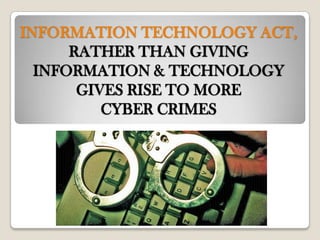
The amended IT Act 2008 focuses on Cyber Terrorism and Cyber Crime
Issues related to electronic transactions, digital signatures, hacking and
network service providers are covered
5. CYBER CRIME
‘Cyber Crime is any criminal activity done
using computer and a network'
AS ALSO
‘Criminal exploitation of the internet’
6. MOST COMMON CYBER CRIMES
Phishing
Hacking
Publishing of Obscene Content
Cyber Squatting
Cyber Defamation
8. DIGITAL SIGNATURES
• It is a mathematical scheme for demonstrating the authenticity of a
digital message or document
• Section 3A: Any subscriber may authenticate electronic records by
Electronic Signatures
• Now ‘Digital Signature’ has been made a subset of ‘Electronic Signature’
• Ensures Authentication, Integrity and Non-repudiation
9.
10. LICENSED CAs IN INDIA
Safescrypt (www.safescrypt.com)
NIC (www.nic.in)
IDRBT (www.idrbtca.org.in)
TCS (www.tcs-ca.tcs.co.in)
MTNL Trustline (www.mtnltrustline.com)
GNFC (www.ncodesolutions.com)
e-Mudhra CA (www.e-Mudhra.com)
12. RELEVANT SECTIONS OF THE IT ACT
• Section 66 :
• Hacking and gaining unauthorized access
• Any person who dishonestly, fraudulently indulges in actions like
unauthorized access, theft/misuse of data, etc.
• Caselet:
• Mphasis BPO – Citibank Theft Case
• Section 67 :
• Publishing content in electronic form which is obscene
• Any person who circulates/publishes sexually explicit/pornographic
content in electronic form
• Caselet:
• Delhi Public School MMS Scandal Case
13. VALIDITY OUTSIDE INDIA
• Section 75 :
• Act to apply for offence or contravention committed outside India
• The provision for the act shall also apply to any offence or
contravention committed outside India by any person irrespective of
his nationality
• Caselet:
• State Bank of India Cyber-Squatting Case.
14. NETWORK PROVIDERS
• Section 79 :
• Network Service providers not to be liable in certain cases
• An intermediary shall not be liable for any third party information data
or communication link made available or hosted by him; subject to
some conditions.
• Caselet:
• Insulting images of Warrior Shivaji on Google’s Orkut.
15. OFFENCES BY COMPANIES
• Section 85:
• Company shall be liable
• Director, Manager or Secretary or any other
official shall be liable
• Caselet:
• The Bank NSP Case.
16. STATISTICS
2009 2010 % change
CYBER CRIMES
Cases Arrested Cases Arrested Cases Arrested
1. Tampering computer 1216.7
21 6 64 79 204
source documents
2. Hacking with computer system
a. Loss and damage to 269.8
115 63 346 233 200.8
computer resource
b. Hacking 118 44 164 61 38.9 38.6
3. Publication and
transmission of obscene 139 141 328 361 135.9 156
material
TOTAL (Including Other
420 288 966 799 128.4 177.4
Cases)
17. ADVANTAGES OF THE ACT
Empowers the government departments to accept filing, creating and
retention of official documents in the digital format
The Act legalizes the e-mail as a mode of communication
Digital Signatures and Digital Records can be used as legal and valid
proof for launching litigation in a court of law
Provides statutory remedy to corporates in case the crime against the
accused for breaking into their computer systems or network and
damaging and copying the data is proven
18. LOOPHOLES IN THE ACT
Inapplicability
Digital Signatures: Recognizes only PKI System
Misuse of Police Powers
No IPR Protection Guaranteed
ISP not held liable.
19. AWARENESS SURVEY ANALYSIS
Received Spam Mail? What did you do about it?
No Deleted
13% Marked it after
as spam opening
29% it
21%
Deleted
Yes it
87% without
opening
it
50%
Do you check for Secured
Connections?
No
10%
Unaware of
such a
concept
17%
Yes
73%
20. NASSCOM
• A consortium that serves as an interface to the Indian Software industry
& the Indian BPO industry.
• Role
• Objective:
To build a growth led and sustainable technology and business services
sector in the country.
• Functions:
• Partnership with the government
• Research on IT and ITES
• Protection of Intellectual Property Rights
• Reinforce the brand equity of Indian IT and ITES industries
21. ROLE OF IT IN INDIAN BANKING SECTOR
• Post liberalization, increasing competition & emergence of new banks
led to a paradigm shift.
• Crucial Landmarks:
• Committee on Computerisation in Banks (1988) headed by Dr.
C.R. Rangarajan, Deputy Governor of RBI. (MICR – Standardized
cheque forms and encoders & centralized clearing systems)
• Committee on Technology Issues (1994) headed by Mr. W.S.
Saraf, ED, RBI. (EFT systems)
• The Information Technology Act, 2000 has given legal recognition to
creation, transmission and retention of an electronic (or magnetic) data
to be treated as valid proof in a court of law.
22. ADVANTAGES TO BANKING SECTOR
• Improved the factors in service quality like:
responsiveness, communication and access.
• Provides 24 hour access
• Allows access to one’s account from virtually
anywhere
• Enhances speed and reliability of financial operations
• Facilitates newer delivery channels like:
• ATMs
• Mobile Banking
• Use of De-mat accounts helps users trade shares online
23. COMBATING CYBER CRIME
• Spam – Filters for E-mails
• Regular Backup of Important data
• Periodic Virus Scan, Malware Scan & Spyware Scan.
• Avoid publishing personal details online.
• While transacting online:
• Check for Valid SSL Certificate
• Check for secured connection (HTTPS)
• In case of any attack or suspicion, do not hesitate to lodge a complaint
with the Cyber Crime Investigation Cell in your city.
• Visit: http://infosecawareness.in/cyber-crime-cells-in-india to find
your nearest CCIC.
24. CONCLUSION
The IT Act is a comprehensive piece of legislation which aims at policing
some of the activities over the Internet
Biggest challenges are lack of awareness & non-compliance
Overhaul of judicial system and entire mechanism to deliver justice at
quick speed
Stringent punishments to kill the motive of the
criminals
The Act is not the end but only a beginning to a
plethora of legislation that still needs to be formed.