


IT ACT AND CYBER CRIME
IT Act 2000 – An Overview
• Information Technology Act, 2000 is India’s mother
legislation regulating the use of computers, computer
systems and computer networks as also data and
information in the electronic format.
• It is developed to promote the IT industry, regulate
ecommerce, facilitate e-governance and prevent
cybercrime
• Cyber law encompasses laws relating to –





Cyber crimes
Electronic and digital signatures
Intellectual property
Data protection and privacy
Cyber crime on the rise
• As per the cyber crime data maintained by the National Crime
Records Bureau (NCRB), following were the total Cyber Crime
cases registered under the Information Technology Act





2007- 217 cases
2008- 288 cases
2009- 420 cases
2010- 966 cases

• The age-wise profile of persons arrested in cyber crime cases
showed that 58.6% of the offenders were in the age group 18–30
years (695 out of 1184) and 31.7% of the offenders were in the
age group 30-45 years
• One in three adults online Indians (32%) have been either social or
mobile cybercrime victims.
Types of Cyber Crime being committed
• Email spoofing
It is one that appears to originate from one source
but actually has been sent from another false
source.
• Web jacking/ Hacking
This occurs when someone forcefully takes control
of a website (by cracking the password and later
changing it). The actual owner of the website does
not have any more control over what appears on
that website.
Types of Cyber Crime being committed
• Cyber Defamation
India’s first case of cyber defamation was reported when a
company’s employee started sending
derogatory, defamatory and obscene e-mails about its
Managing Director. The e-mails were anonymous and
frequent, and were sent to many of their business associates
to tarnish the image and goodwill of the company, Later he
was Identified and accordingly penalized.
• Cyber stalking
Cyber stalking involves following a person’s movements
across the Internet by posting messages (sometimes
threatening) on the bulletin boards frequented by the
victim, entering the chat-rooms and constantly bombarding
the victim with emails etc.
Types of Cyber Crime being committed
• Email bombing
Email bombing refers to sending a large number of emails to the
victim resulting in the victim’s email account or mail servers crashing.
Example: In one case, a foreigner who had been residing in Simla,
India for almost thirty years wanted to avail of a scheme introduced
by the Simla Housing Board to buy land at lower rates. When he
made an application it was rejected on the grounds that the scheme
was available only for citizens of India. He decided to take his
revenge. Consequently he sent thousands of mails to the Simla
Housing Board and repeatedly kept sending e-mails till their
servers crashed
• Virus / worm attacks
Viruses are programs that attach themselves to a computer or a file
and then circulate themselves to other files and to other computers
on a network. They usually affect the data on a computer, either by
altering or deleting it.
Cyber Pornography
Accessing pornography or sharing obscene
content is illegal and punishable under the
law
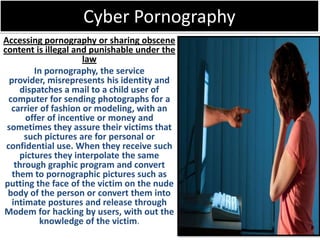
In pornography, the service
provider, misrepresents his identity and
dispatches a mail to a child user of
computer for sending photographs for a
carrier of fashion or modeling, with an
offer of incentive or money and
sometimes they assure their victims that
such pictures are for personal or
confidential use. When they receive such
pictures they interpolate the same
through graphic program and convert
them to pornographic pictures such as
putting the face of the victim on the nude
body of the person or convert them into
intimate postures and release through
Modem for hacking by users, with out the
knowledge of the victim.
Social Networking Sites- Source to
Cyber Crime
• The recent incident of a 17-year-old girl from
a south Delhi Public School alleging that she
was sexually assaulted by two MNC
employees , whom she had befriended on a
social networking website, is a reminder on
how the internet can be a source of danger
for young generation.
Emergency Contact
• Indian Computer Emergency Response Team
Department of Information Technology,
Ministry of Communications and Information
Technology, Government of India
Electronics Niketan, 6 CGO Complex, Lodhi Road,
New Delhi – 110003 ph. – 011-24368572

Cyber crime

  • 1.
    IT ACT ANDCYBER CRIME
  • 2.
    IT Act 2000– An Overview • Information Technology Act, 2000 is India’s mother legislation regulating the use of computers, computer systems and computer networks as also data and information in the electronic format. • It is developed to promote the IT industry, regulate ecommerce, facilitate e-governance and prevent cybercrime • Cyber law encompasses laws relating to –     Cyber crimes Electronic and digital signatures Intellectual property Data protection and privacy
  • 4.
    Cyber crime onthe rise • As per the cyber crime data maintained by the National Crime Records Bureau (NCRB), following were the total Cyber Crime cases registered under the Information Technology Act     2007- 217 cases 2008- 288 cases 2009- 420 cases 2010- 966 cases • The age-wise profile of persons arrested in cyber crime cases showed that 58.6% of the offenders were in the age group 18–30 years (695 out of 1184) and 31.7% of the offenders were in the age group 30-45 years • One in three adults online Indians (32%) have been either social or mobile cybercrime victims.
  • 5.
    Types of CyberCrime being committed • Email spoofing It is one that appears to originate from one source but actually has been sent from another false source. • Web jacking/ Hacking This occurs when someone forcefully takes control of a website (by cracking the password and later changing it). The actual owner of the website does not have any more control over what appears on that website.
  • 6.
    Types of CyberCrime being committed • Cyber Defamation India’s first case of cyber defamation was reported when a company’s employee started sending derogatory, defamatory and obscene e-mails about its Managing Director. The e-mails were anonymous and frequent, and were sent to many of their business associates to tarnish the image and goodwill of the company, Later he was Identified and accordingly penalized. • Cyber stalking Cyber stalking involves following a person’s movements across the Internet by posting messages (sometimes threatening) on the bulletin boards frequented by the victim, entering the chat-rooms and constantly bombarding the victim with emails etc.
  • 7.
    Types of CyberCrime being committed • Email bombing Email bombing refers to sending a large number of emails to the victim resulting in the victim’s email account or mail servers crashing. Example: In one case, a foreigner who had been residing in Simla, India for almost thirty years wanted to avail of a scheme introduced by the Simla Housing Board to buy land at lower rates. When he made an application it was rejected on the grounds that the scheme was available only for citizens of India. He decided to take his revenge. Consequently he sent thousands of mails to the Simla Housing Board and repeatedly kept sending e-mails till their servers crashed • Virus / worm attacks Viruses are programs that attach themselves to a computer or a file and then circulate themselves to other files and to other computers on a network. They usually affect the data on a computer, either by altering or deleting it.
  • 8.
    Cyber Pornography Accessing pornographyor sharing obscene content is illegal and punishable under the law In pornography, the service provider, misrepresents his identity and dispatches a mail to a child user of computer for sending photographs for a carrier of fashion or modeling, with an offer of incentive or money and sometimes they assure their victims that such pictures are for personal or confidential use. When they receive such pictures they interpolate the same through graphic program and convert them to pornographic pictures such as putting the face of the victim on the nude body of the person or convert them into intimate postures and release through Modem for hacking by users, with out the knowledge of the victim.
  • 9.
    Social Networking Sites-Source to Cyber Crime • The recent incident of a 17-year-old girl from a south Delhi Public School alleging that she was sexually assaulted by two MNC employees , whom she had befriended on a social networking website, is a reminder on how the internet can be a source of danger for young generation.
  • 10.
    Emergency Contact • IndianComputer Emergency Response Team Department of Information Technology, Ministry of Communications and Information Technology, Government of India Electronics Niketan, 6 CGO Complex, Lodhi Road, New Delhi – 110003 ph. – 011-24368572