CYBER CRIME AND SECURITY
If we can defeat them sitting at
home……who needs to fight with tanks
and guns!!!!
Presented By
Jasjit Singh.
ELE-3, 2nd Year.
Roll-101304044.
THAPAR UNIVERSITY.
INTRODUCTION
The internet in India is growing rapidly. It has given
rise to new opportunities in every field we can think of
be it entertainment, business, sports or education.
There’re two sides to a coin. Internet also has it’s
own disadvantages is Cyber crime- illegal activity
committed on the internet.
DEFINING CYBER CRIME
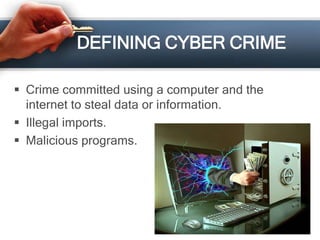
 Crime committed using a computer and the
internet to steal data or information.
 Illegal imports.
 Malicious programs.
Cyber crime
is nothing but where the computer used as an
object or subject of crime..
HISTORY
The first spam email took place in
1978 when it was sent out over the
Arpanet (Advanced Research
Projects Agency Network).
The first virus was installed on an
Apple computer in 1982 when a high
school student, Rich Skrenta,
developed the Elk cloner.
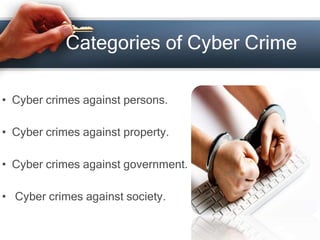
Categories of Cyber Crime
• Cyber crimes against persons.
• Cyber crimes against property.
• Cyber crimes against government.
• Cyber crimes against society.
TYPES OF CYBER CRIME
• Hacking
• Denial of service attack
• Virus Dissemination
• Computer Vandalism
• Cyber Terrorism
• Software Piracy
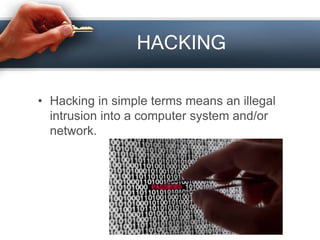
HACKING
• Hacking in simple terms means an illegal
intrusion into a computer system and/or
network.
DENIAL OF SERVICE ATTACK
• Act by the criminal, who floods the
bandwidth of the victims network.
• Is his e-mail box with spam mail depriving
him of the services.
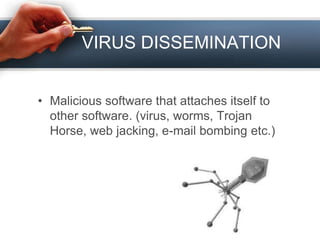
VIRUS DISSEMINATION
• Malicious software that attaches itself to
other software. (virus, worms, Trojan
Horse, web jacking, e-mail bombing etc.)
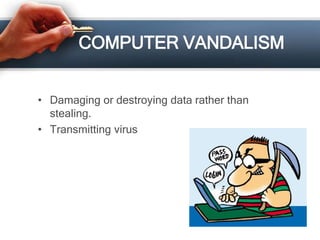
COMPUTER VANDALISM
• Damaging or destroying data rather than
stealing.
• Transmitting virus
CYBER TERRORISM
• Use of Internet based attacks in terrorist activities.
• Technology savvy terrorists are using 512-bit
encryption, which is impossible to decrypt.
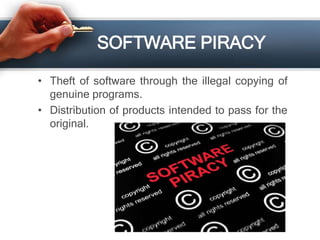
SOFTWARE PIRACY
• Theft of software through the illegal copying of
genuine programs.
• Distribution of products intended to pass for the
original.
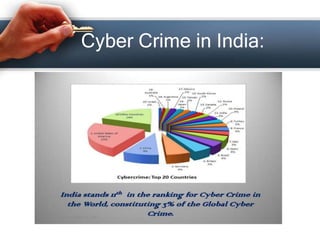
Cyber Crime in India:
WHY INDIA?
– A rapidly growing online user base:
– India has bypassed Japan to become the world’s third largest Internet
user after China and the United States
– Its users are significantly younger than those of other emerging
economies.
– India now has nearly 74 million Active Internet users, a 31 per cent
increase over March 2012, the report says
– 46+ Million Social Network Users
– 50 Million users shop online on Ecommerce and Online Shopping Sites
– The Telecom Regulatory Authority of India (TRAI) pegged the number
of Internet subscribers in India at 164.81 million as of March 31, 2013,
with seven out of eight accessing the Internet from their mobile phones.
CYBER CRIMES IN INDIA
• The majority of cybercrimes are centered
on forgery, fraud and Phishing.
• India is the third-most targeted country for
Phishing attacks after the US and the UK.
• Social networks as well as ecommerce
sites are major targets.
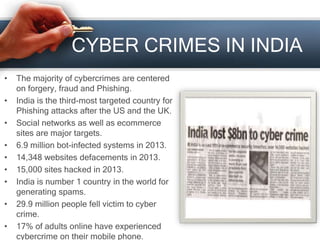
• 6.9 million bot-infected systems in 2013.
• 14,348 websites defacements in 2013.
• 15,000 sites hacked in 2013.
• India is number 1 country in the world for
generating spams.
• 29.9 million people fell victim to cyber
crime.
• 17% of adults online have experienced
cybercrime on their mobile phone.
Cyber security
DEFINATION :Cyber security standards are security standards which
enable organizations to practice safe security techniques to minimize
the number of successful cyber security attacks.
LEGISLATIVE ACTION AGAINST CYBER
CRIME:
• The Information Technology Act 2000 was
passed and enforced on 17th May 2000.
• OBJECTIVE: To legalise e-commerce and
further amend the Indian Penal Code 1860, the
Indian Evidence Act 1872, the Banker’s Book
Evidence Act 1891 and the Reserve Bank of
India Act 1934.
• The Government of India has brought major
amendments to ITA-2000 in form of the
Information Technology Amendment Act, 2008.
SAFETY TIPS FOR CYBER CRIME
• Use antivirus software’s.
• Insert firewalls.
• Uninstall unnecessary software
• Maintain backup.
• Check security settings.
• Stay anonymous - choose a genderless screen
name.
• Never give your full name or address to strangers.
• Learn more about Internet privacy.
CONCLUSION
Technology is destructive only in the hands of
people who do not realize that they are one
and the same process as the universe.
Cyber crime

Cyber crime

  • 1.
    CYBER CRIME ANDSECURITY If we can defeat them sitting at home……who needs to fight with tanks and guns!!!! Presented By Jasjit Singh. ELE-3, 2nd Year. Roll-101304044. THAPAR UNIVERSITY.
  • 2.
    INTRODUCTION The internet inIndia is growing rapidly. It has given rise to new opportunities in every field we can think of be it entertainment, business, sports or education. There’re two sides to a coin. Internet also has it’s own disadvantages is Cyber crime- illegal activity committed on the internet.
  • 3.
    DEFINING CYBER CRIME Crime committed using a computer and the internet to steal data or information.  Illegal imports.  Malicious programs.
  • 4.
    Cyber crime is nothingbut where the computer used as an object or subject of crime..
  • 5.
    HISTORY The first spamemail took place in 1978 when it was sent out over the Arpanet (Advanced Research Projects Agency Network). The first virus was installed on an Apple computer in 1982 when a high school student, Rich Skrenta, developed the Elk cloner.
  • 6.
    Categories of CyberCrime • Cyber crimes against persons. • Cyber crimes against property. • Cyber crimes against government. • Cyber crimes against society.
  • 7.
    TYPES OF CYBERCRIME • Hacking • Denial of service attack • Virus Dissemination • Computer Vandalism • Cyber Terrorism • Software Piracy
  • 8.
    HACKING • Hacking insimple terms means an illegal intrusion into a computer system and/or network.
  • 9.
    DENIAL OF SERVICEATTACK • Act by the criminal, who floods the bandwidth of the victims network. • Is his e-mail box with spam mail depriving him of the services.
  • 10.
    VIRUS DISSEMINATION • Malicioussoftware that attaches itself to other software. (virus, worms, Trojan Horse, web jacking, e-mail bombing etc.)
  • 11.
    COMPUTER VANDALISM • Damagingor destroying data rather than stealing. • Transmitting virus
  • 12.
    CYBER TERRORISM • Useof Internet based attacks in terrorist activities. • Technology savvy terrorists are using 512-bit encryption, which is impossible to decrypt.
  • 13.
    SOFTWARE PIRACY • Theftof software through the illegal copying of genuine programs. • Distribution of products intended to pass for the original.
  • 14.
  • 15.
    WHY INDIA? – Arapidly growing online user base: – India has bypassed Japan to become the world’s third largest Internet user after China and the United States – Its users are significantly younger than those of other emerging economies. – India now has nearly 74 million Active Internet users, a 31 per cent increase over March 2012, the report says – 46+ Million Social Network Users – 50 Million users shop online on Ecommerce and Online Shopping Sites – The Telecom Regulatory Authority of India (TRAI) pegged the number of Internet subscribers in India at 164.81 million as of March 31, 2013, with seven out of eight accessing the Internet from their mobile phones.
  • 16.
    CYBER CRIMES ININDIA • The majority of cybercrimes are centered on forgery, fraud and Phishing. • India is the third-most targeted country for Phishing attacks after the US and the UK. • Social networks as well as ecommerce sites are major targets. • 6.9 million bot-infected systems in 2013. • 14,348 websites defacements in 2013. • 15,000 sites hacked in 2013. • India is number 1 country in the world for generating spams. • 29.9 million people fell victim to cyber crime. • 17% of adults online have experienced cybercrime on their mobile phone.
  • 17.
    Cyber security DEFINATION :Cybersecurity standards are security standards which enable organizations to practice safe security techniques to minimize the number of successful cyber security attacks. LEGISLATIVE ACTION AGAINST CYBER CRIME: • The Information Technology Act 2000 was passed and enforced on 17th May 2000. • OBJECTIVE: To legalise e-commerce and further amend the Indian Penal Code 1860, the Indian Evidence Act 1872, the Banker’s Book Evidence Act 1891 and the Reserve Bank of India Act 1934. • The Government of India has brought major amendments to ITA-2000 in form of the Information Technology Amendment Act, 2008.
  • 18.
    SAFETY TIPS FORCYBER CRIME • Use antivirus software’s. • Insert firewalls. • Uninstall unnecessary software • Maintain backup. • Check security settings. • Stay anonymous - choose a genderless screen name. • Never give your full name or address to strangers. • Learn more about Internet privacy.
  • 19.
    CONCLUSION Technology is destructiveonly in the hands of people who do not realize that they are one and the same process as the universe.