RESPONDING TO CYBERCRIME: 
The South African Legal Position 
DENISE FOUCHE 
ENDCODER/ ENDCODE.ORG
CONTEXT: 
Cyber Crime awareness 
Forms of Cyber Crime in South African Law 
Cyber Crime Challenges to South African Law 
How South Africa’s Legal System is Meeting Challenges 
Cyberlaw Enforcement in South Africa 
Security Recommendations
Cyber Crime? 
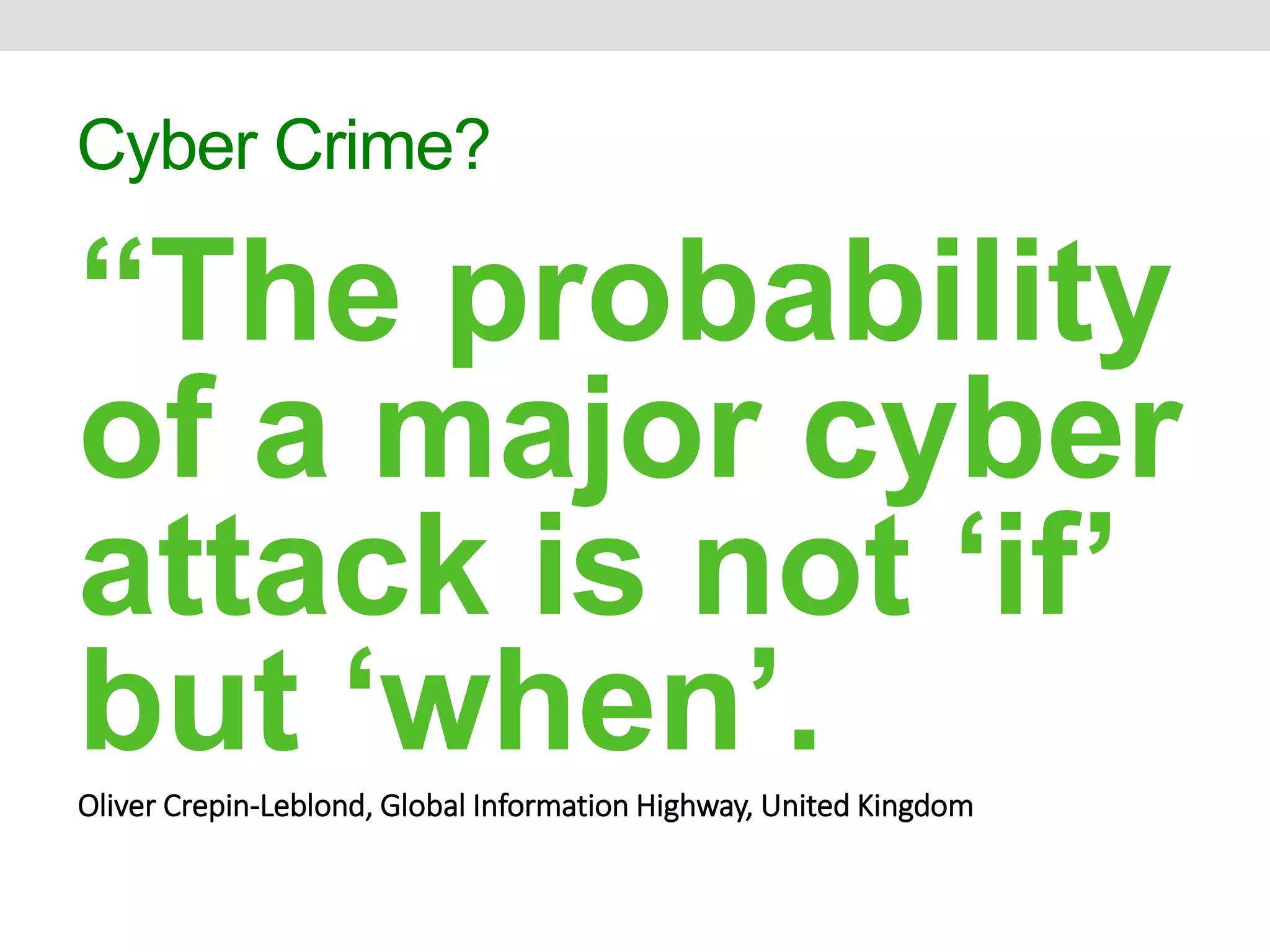
“The probability 
of a major cyber 
attack is not ‘if’ 
but ‘when’. 
Oliver Crepin-Leblond, Global Information Highway, United Kingdom
Cyber Crime? 
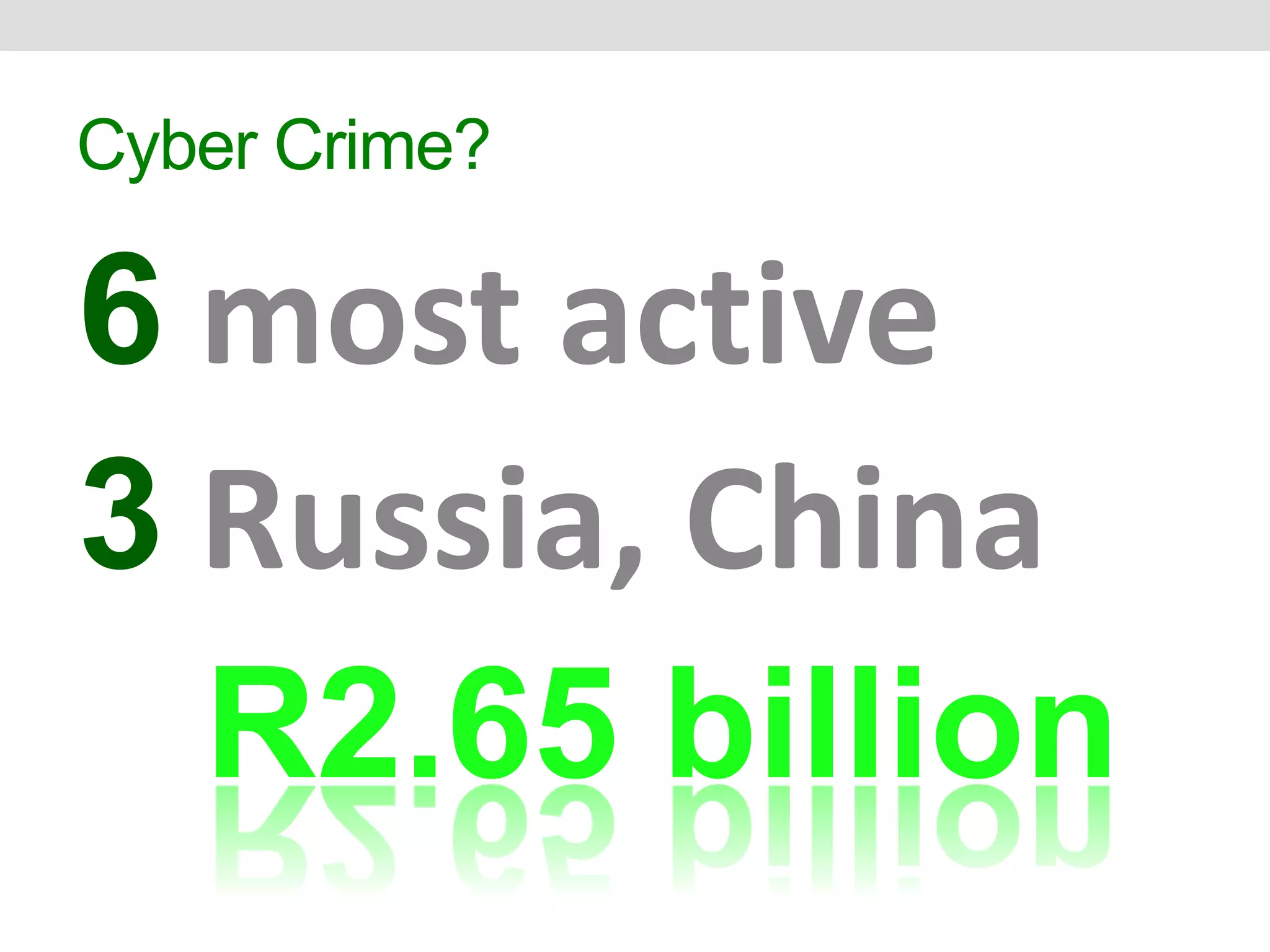
6 most active 
3 Russia, China 
R2.65 billion
Cyber Crime awareness? 
• Internet penetration, mobile devices 
• Crimes are growing, but little awareness 
• No multimedia public awareness campaign 
• No national awareness campaigns – patchwork of initiatives 
• CSIR 
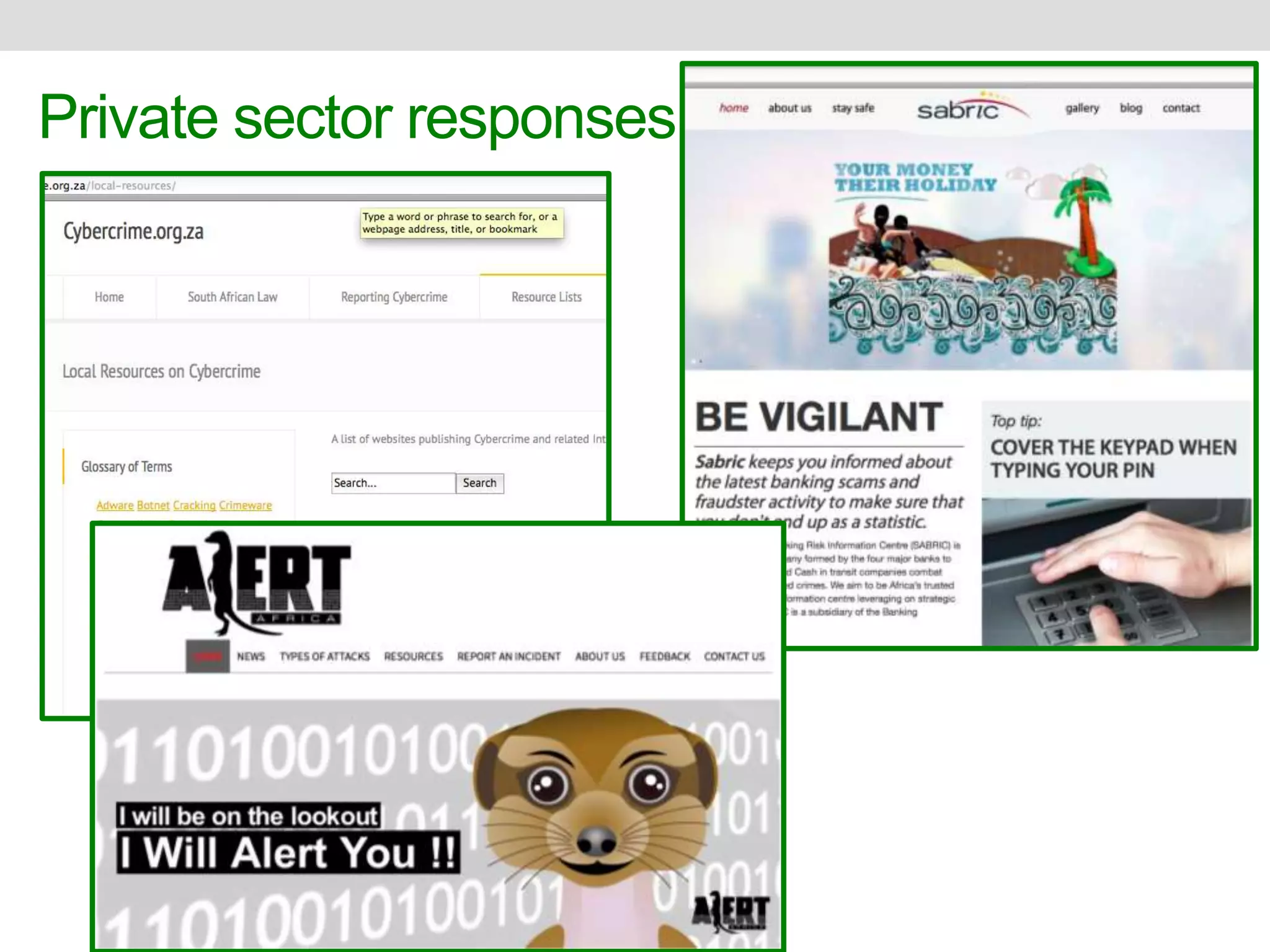
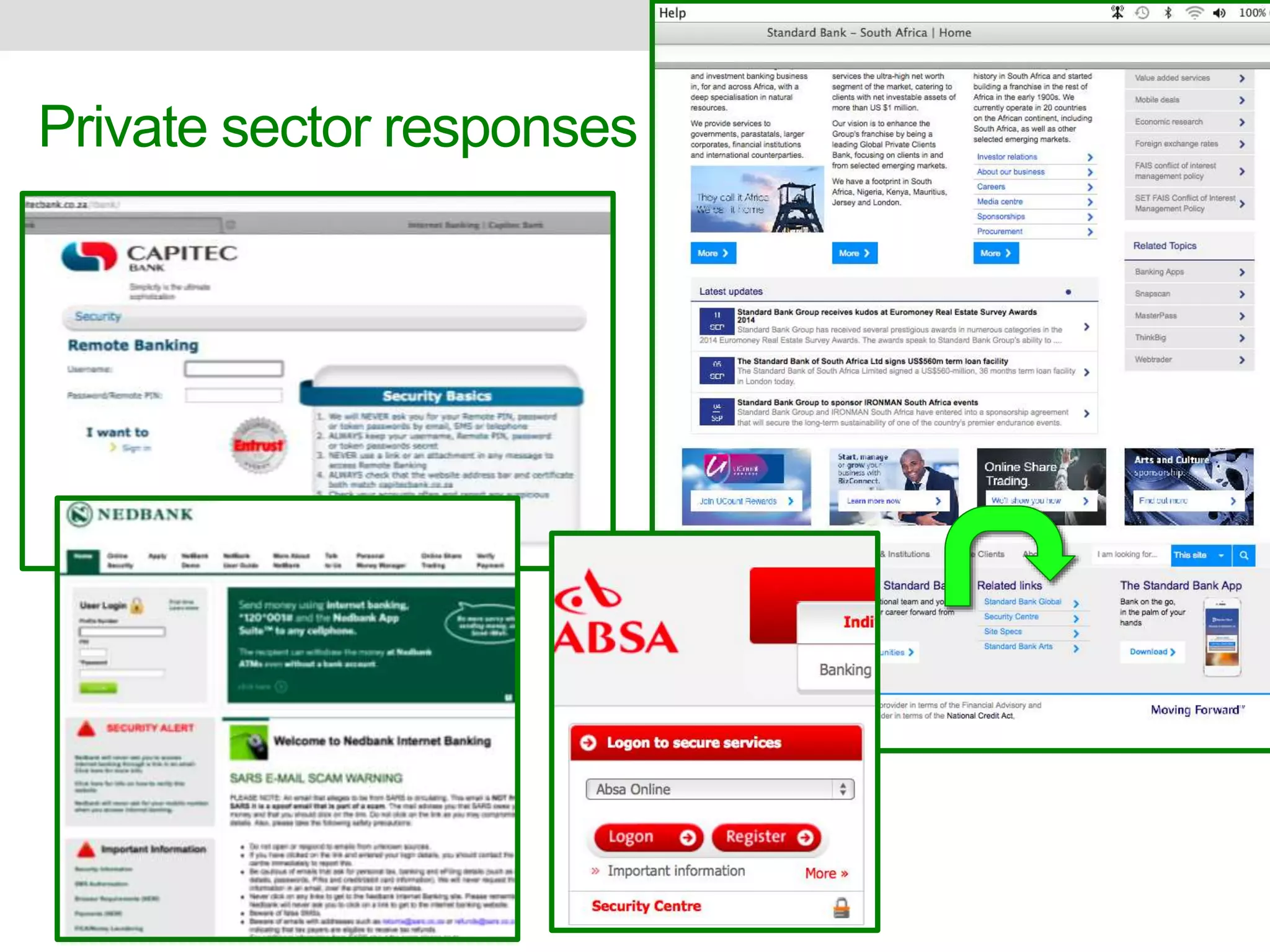
• SABRIC funded by local banks to track and respond to cybercrime in banking sector 
• Cybercrime.org.za: an awareness portal intended for informational purposes. 
• Alertafrica.com raising awareness of cyber threats in SA 
• ISG Africa 
• South African Centre for Information Security 
• FPB PROCHILD 
• SACSAA South African Cyber Security Academic Alliance NMMU; UJ; UNISA cyberaware.org.za 
• No government involvement in existing efforts 
• No cyber watch centres 
• Ethiopia: 24-hour national computer security incident response teams
Private sector responses
Cyber Crime? 
• No national cybersecurity awareness framework in place 
• Infrastructure for cybersecurity protection strong but awareness 
is low 
• Mobile usage and lack of security awareness - vulnerability 
• Although numbers have decreased, cost per victim has risen 
• 48% smartphone and tablet users do not take basic precautions 
• What information is being shared on social networking platforms 
• Perception of lawlessness, ineffective enforcement 
• ALL LEVELS OF SOCIETY TO BE ENGAGED
http://blog.logrhythm.com/wp-content/uploads/2013/11/Waking-shark-II.jpg
http://cyberarms.files.wordpress.c 
om/2013/07/bank-cyber-report-card. 
png
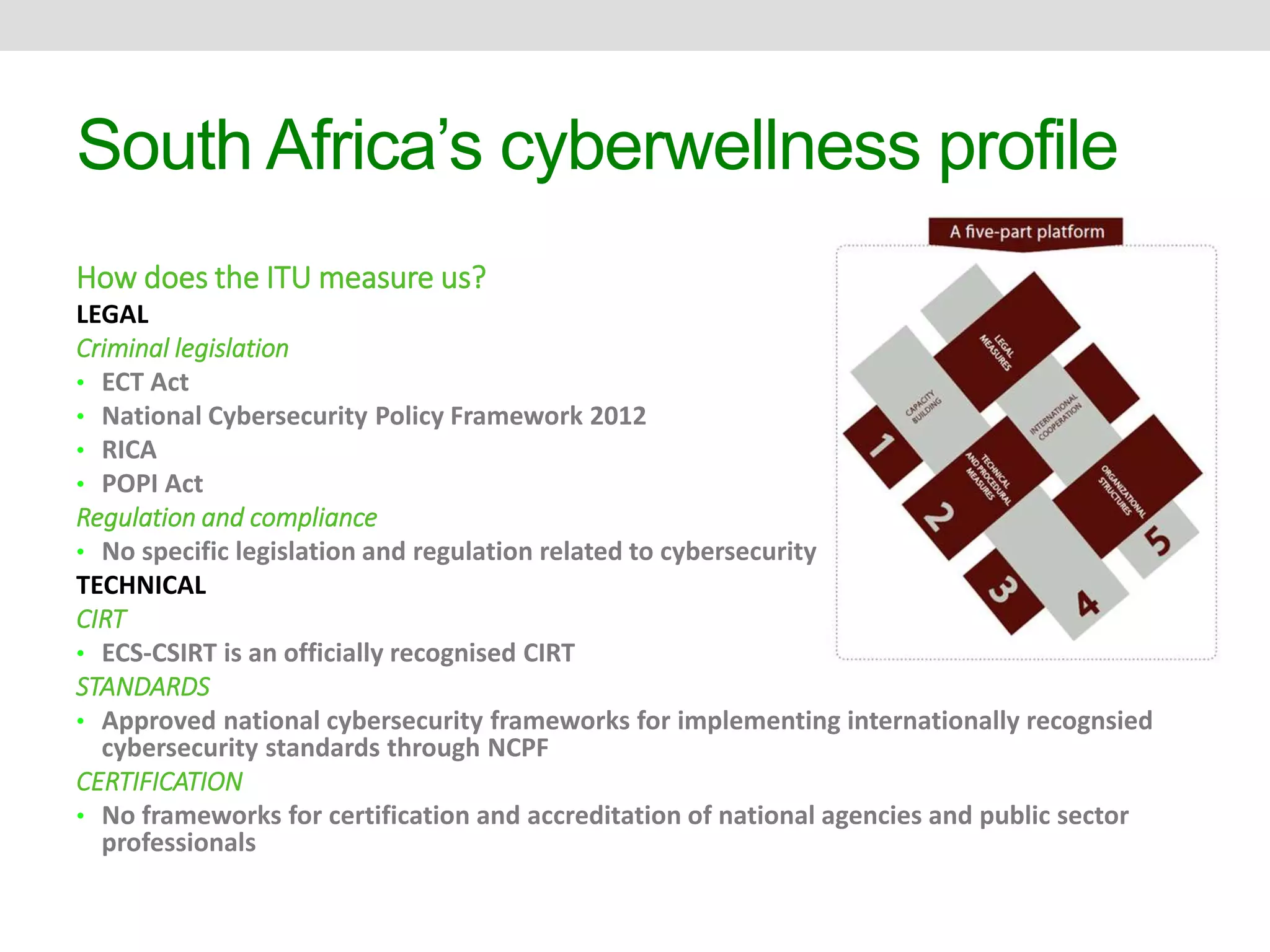
South Africa’s cyberwellness profile 
How does the ITU measure us? 
LEGAL 
Criminal legislation 
• ECT Act 
• National Cybersecurity Policy Framework 2012 
• RICA 
• POPI Act 
Regulation and compliance 
• No specific legislation and regulation related to cybersecurity 
TECHNICAL 
CIRT 
• ECS-CSIRT is an officially recognised CIRT 
STANDARDS 
• Approved national cybersecurity frameworks for implementing internationally recognsied 
cybersecurity standards through NCPF 
CERTIFICATION 
• No frameworks for certification and accreditation of national agencies and public sector 
professionals
South Africa’s cyberwellness profile 
How does the ITU measure us? 
ORGANISATION 
Policy: Officially recognised NCPF approved March 2012 
Roadmap for Governance: National Cybersecurity Implementation Plan 
Responsible Agency: State Security Agency for implementing national cybersecurity strategy, 
policy and roadmap 
National Benchmarking: No benchmarking exercises to measure cybersecurity development 
• and publci sector agencies certified under internationally recognised standards in 
cybersecurity. 
CAPACITY BUILDING 
• Standardisation development: No R&D programs for standards, best practices or guidelines to 
be applied in private or public sector 
• Manpower development: No educational and professional training programs for raising 
awareness with public, promoting courses in higher education and promoting certification 
of professional in private or public sectors 
• Professional certification: No public sector professional certified under internationally 
recognised certification programs 
• Agency certification:: No certified government and public sector agencies certified under 
internationally recognised standards
South Africa’s cyberwellness profile 
How does the ITU measure us? 
COOPERATION 
Intra-State cooperation: partnerships with 24/7 program 
Intra-Agency cooperation: : no officially recognised national or sector-specific 
programs for sharing cybersecurity assets within public sector. 
Public Sector partnership: : no programs for sharing cybersecurity assets 
within the public and private sector 
International cooperation: : member of ITU-IMPACT initiative; beneficiary 
HIPSSA; participated in international effort on cybercrime (EU GLACY 
project); on finalisation stage of draft AUC Cybersecurity Convention 
workshop
South Africa’s cyberwellness profile 
How does the ITU measure us? 
PROTECTION OF CHILDREN ONLINE 
National legislation: Amendment to Sexual Offences and Related Matters 
Act; Films and Publications Act 
UN Convention and Protocol: Convention on the Rights of the Child; Optional 
Protocol to the Convention on the Rights of the Child on the Sale of 
Children, Child Prostitution and Child Pornography 
Institutional support: no recognised agency offering institutional support on 
child online protection 
Reporting mechanism: FPB PRO CHILD phone number on website
What is Cyber Crime? 
• South African law has no formal definition 
• Internationally there is little consensus 
• Consider the following: 
• “Unlawful conduct involving a computer or computer system or computer 
network, irrespective of whether it is the object of the crime or 
instrumental in the commission of the crime.” 
(Cyberlaw @SA III)
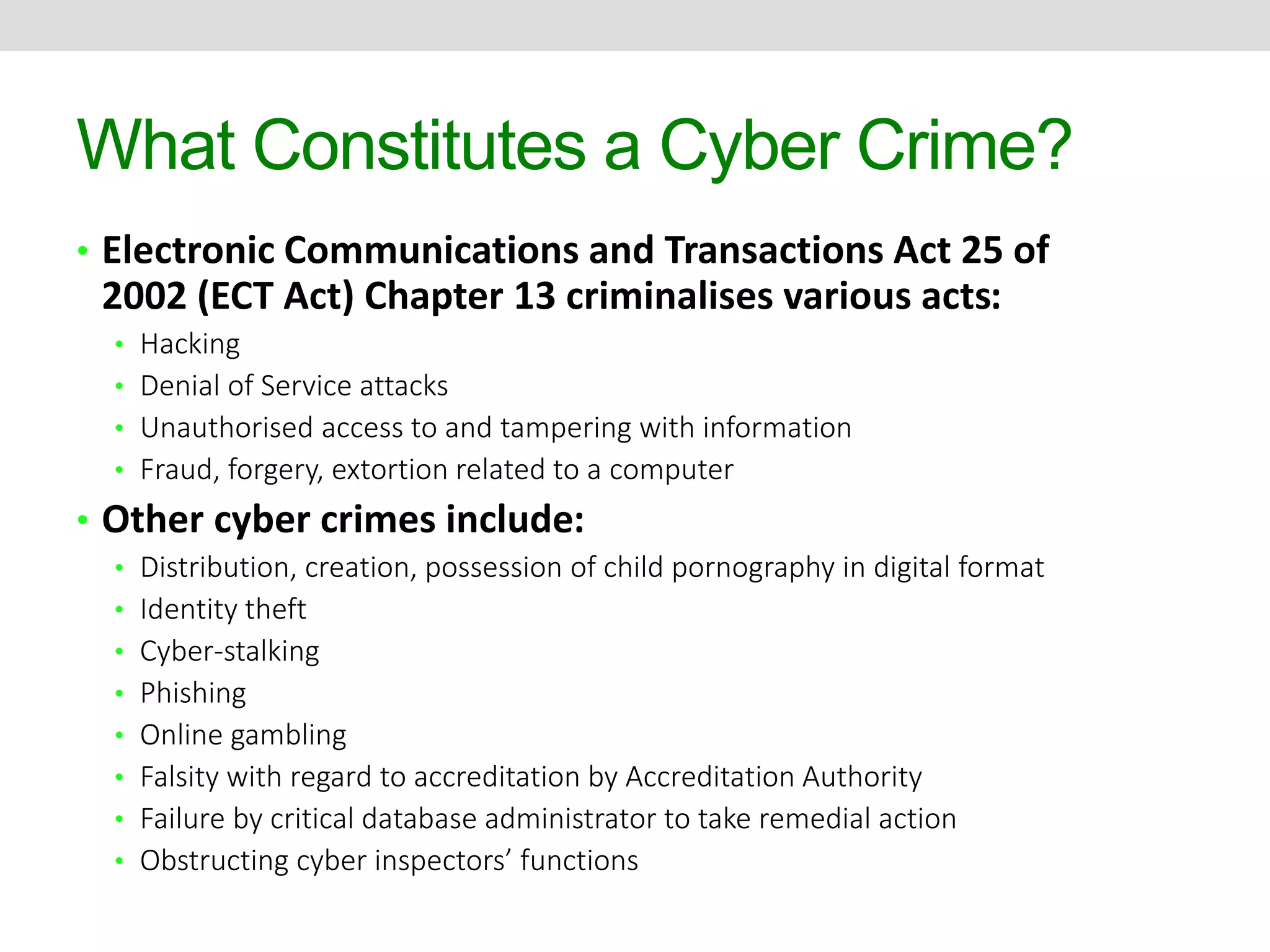
What Constitutes a Cyber Crime? 
• Electronic Communications and Transactions Act 25 of 
2002 (ECT Act) Chapter 13 criminalises various acts: 
• Hacking 
• Denial of Service attacks 
• Unauthorised access to and tampering with information 
• Fraud, forgery, extortion related to a computer 
• Other cyber crimes include: 
• Distribution, creation, possession of child pornography in digital format 
• Identity theft 
• Cyber-stalking 
• Phishing 
• Online gambling 
• Falsity with regard to accreditation by Accreditation Authority 
• Failure by critical database administrator to take remedial action 
• Obstructing cyber inspectors’ functions
Cyber Crime Challenges for SA Law 
• No single existing government agency to manage all 
aspects of cybersecurity and cybercrime
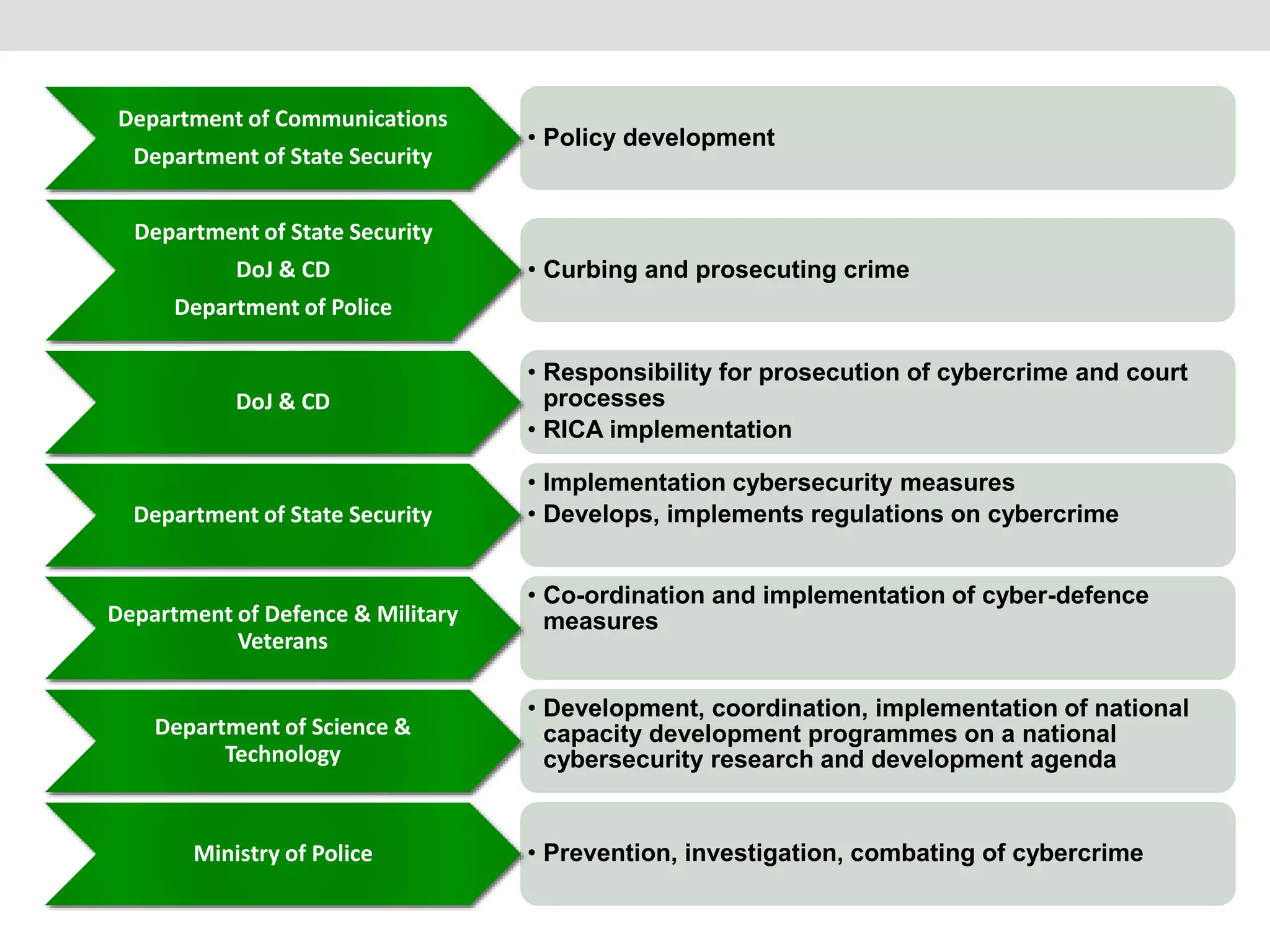
• Policy development 
Department of Communications 
Department of State Security 
• Curbing and prosecuting crime 
Department of State Security 
DoJ & CD 
Department of Police 
• Responsibility for prosecution of cybercrime and court 
processes 
• RICA implementation 
DoJ & CD 
• Implementation cybersecurity measures 
• Develops, imp Department of State Security lements regulations on cybercrime 
• Co-ordination and implementation of cyber-defence 
Department of Defence & Military measures 
Veterans 
• Development, coordination, implementation of national 
capacity development programmes on a national 
cybersecurity research and development agenda 
Department of Science & 
Technology 
Ministry of Police • Prevention, investigation, combating of cybercrime
Cyber Crime Challenges for SA Law 
• Crime across international borders 
• Jurisdictional issues 
• Relying on international assistance 
• Importance of global coherent cyber crime laws 
• Digital evidence is different 
• Evidence is information 
• Admissibility of electronic evidence 
• Protecting the veracity of electronic evidence 
• Need for ISP participation 
• Many perpetrators, many victims 
• No physical presence 
• Domestic laws govern investigation
Cyber Crime Challenges for SA Law 
• Intelligence gathering in the digital world 
• Equipping investigators with cyber skills 
• Ability to act swiftly 
• Participation of ISP 
• Flexible laws to keep pace with technology 
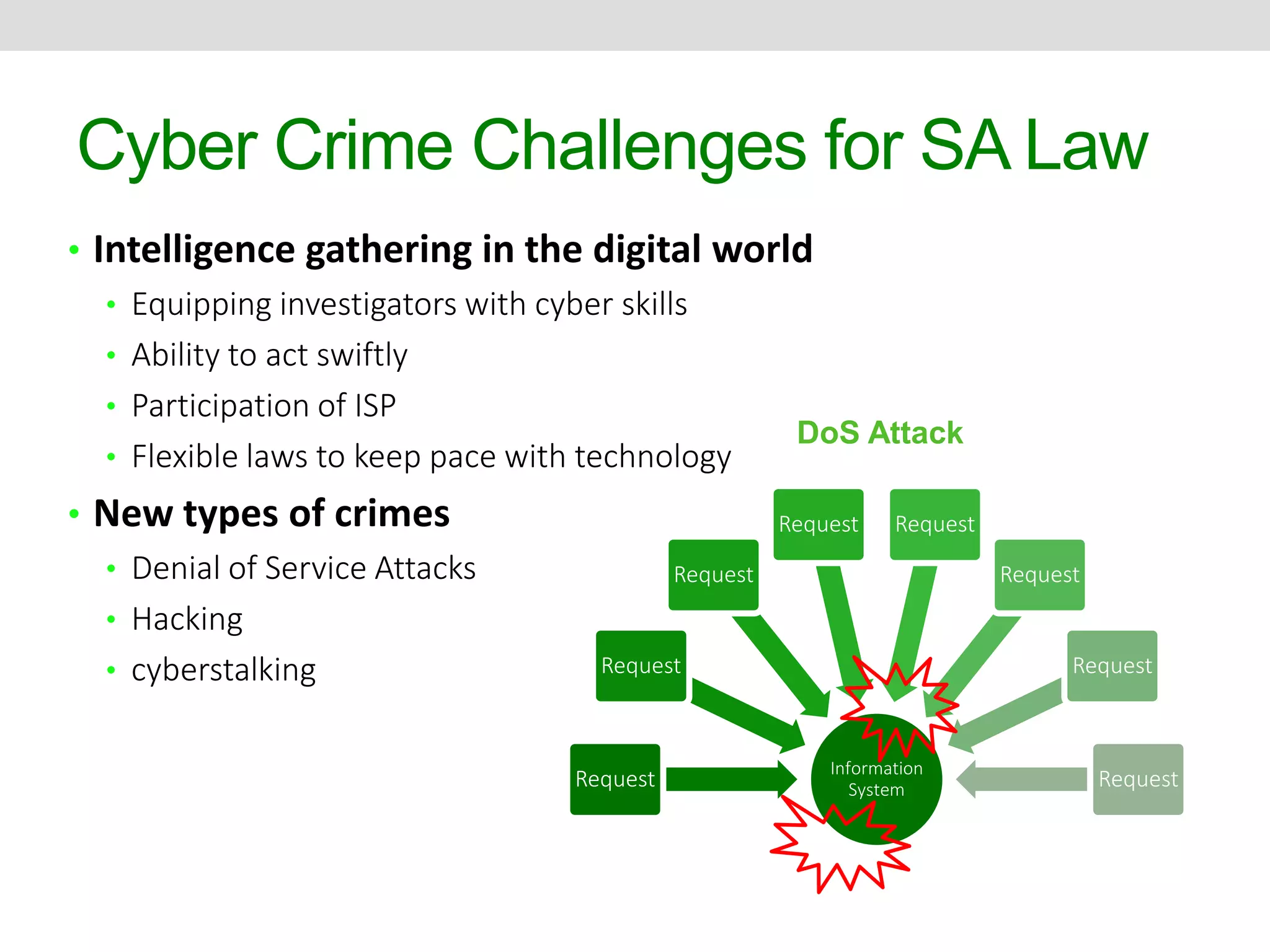
• New types of crimes 
• Denial of Service Attacks 
• Hacking 
• cyberstalking 
Request 
Request 
Request Request 
Information 
System Request 
Request 
Request 
Request 
DoS Attack
Can existing South African common 
law accommodate Cyber Crime? 
• Nullum crimen sine lege Principle 
• No crime without (prior) criminal prohibition 
• South Africa’s living, adaptable common law 
• E.g., common law crime of theft can be applied to cyber crime theft 
• S v Van den Berg 1991: electronic fraudulent misrepresentation still fraud as 
per common law 
• S v Howard 2005: “property” in crime of malicious damage to property no 
longer needs to be physical 
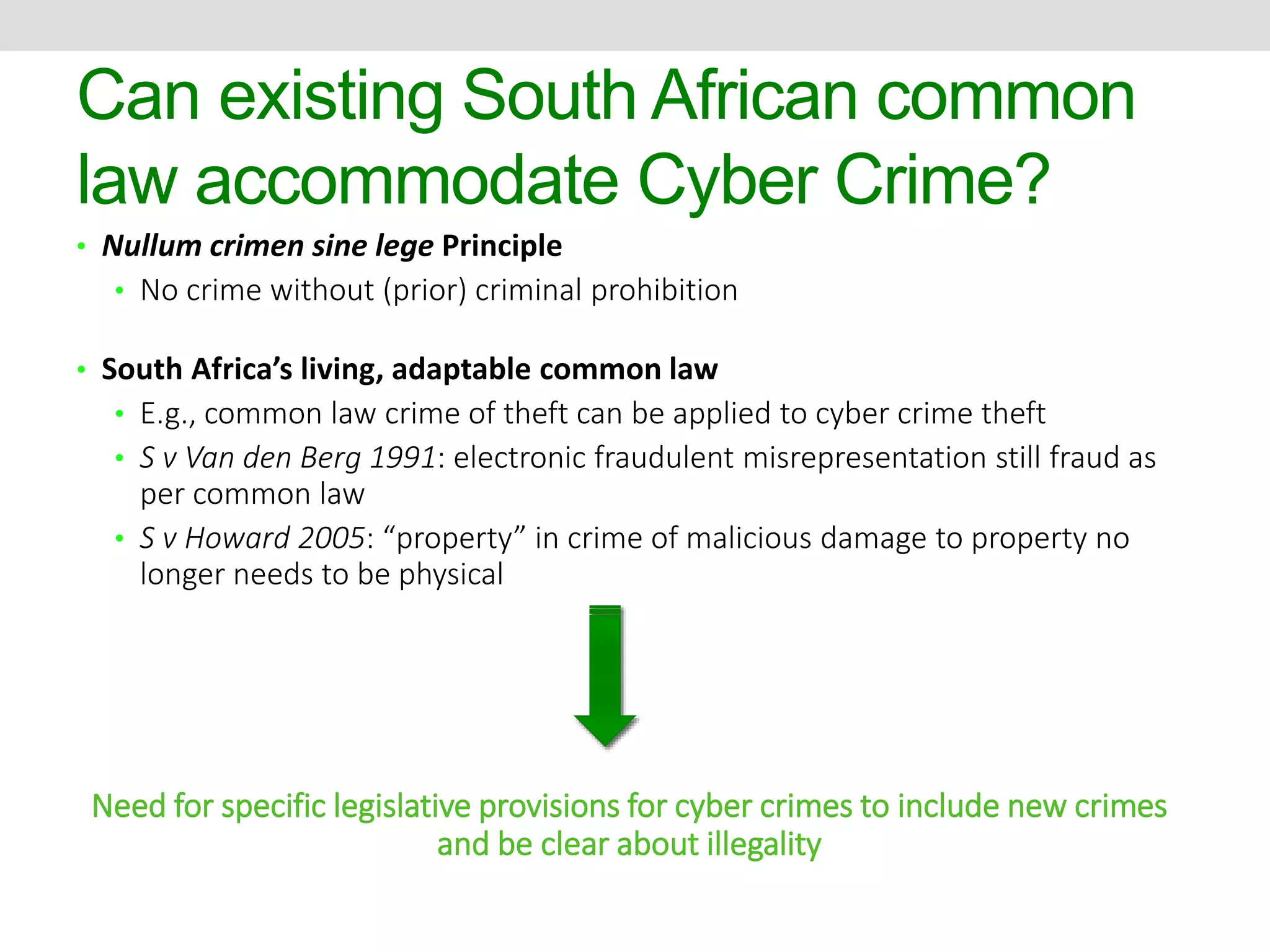
Need for specific legislative provisions for cyber crimes to include new crimes 
and be clear about illegality
How is South Africa’s Legal System 
meeting these challenges? 
What is South Africa’s position domestically? 
Substantive Laws 
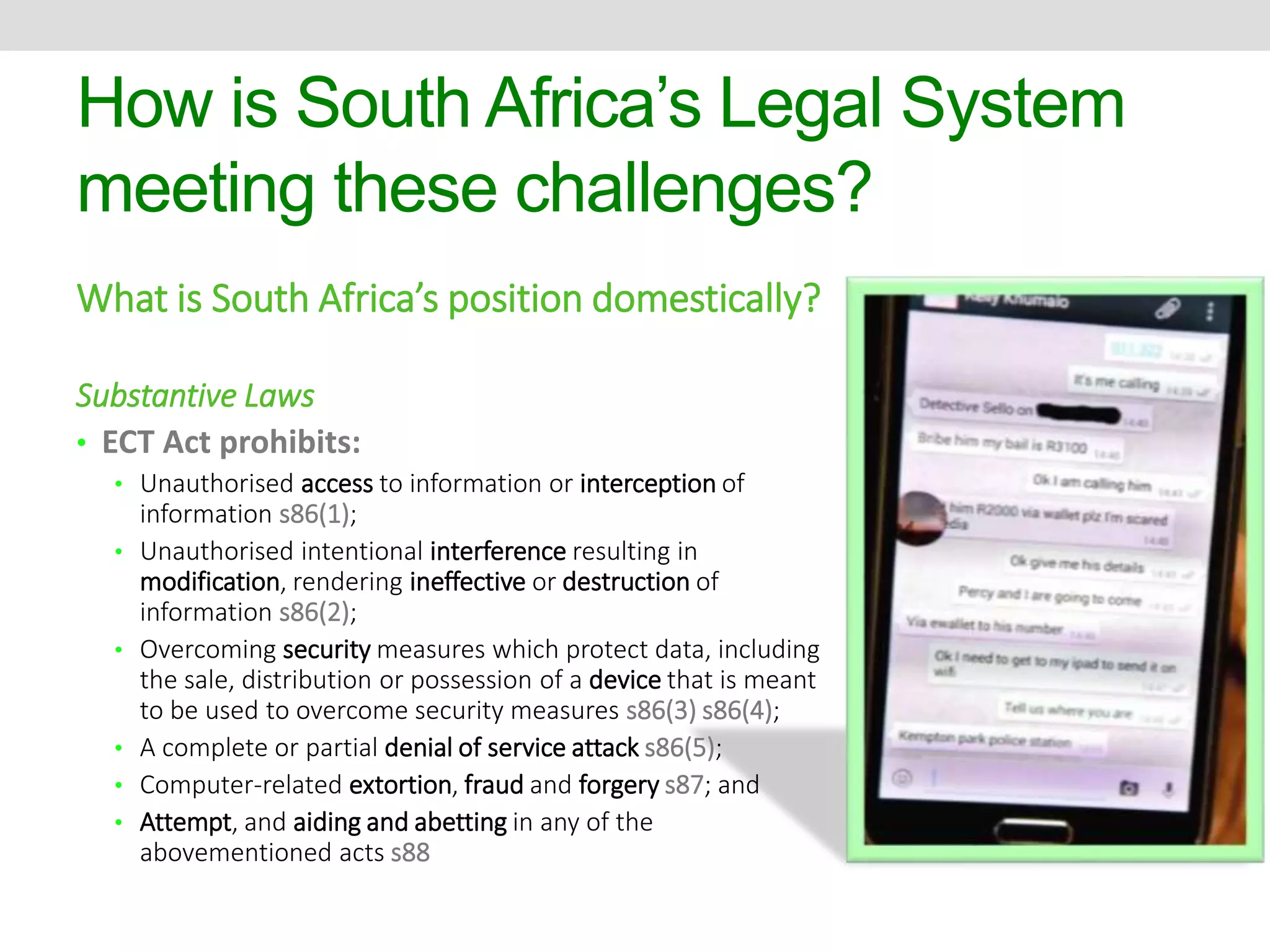
• ECT Act prohibits: 
• Unauthorised access to information or interception of 
information s86(1); 
• Unauthorised intentional interference resulting in 
modification, rendering ineffective or destruction of 
information s86(2); 
• Overcoming security measures which protect data, including 
the sale, distribution or possession of a device that is meant 
to be used to overcome security measures s86(3) s86(4); 
• A complete or partial denial of service attack s86(5); 
• Computer-related extortion, fraud and forgery s87; and 
• Attempt, and aiding and abetting in any of the 
abovementioned acts s88
How is South Africa’s Legal System 
meeting these challenges? 
What is South Africa’s position domestically? 
Substantive Laws 
• CPA & ECT Act 
• Together with the Consumer Protection Act 68 2008, the ECT Act regulates unsolicited 
communications (SPAM) 
• POPI 
• Stringent requirements imposed on collecting and processing personal information 
• electronic direct marketing prohibition 
• The Films and Publications Act 
• The Films and Publications Act 65 of 1996 imposes a statutory obligation on ISPs to prevent the 
distribution of child pornography in South Africa 
• The National Gambling Act 
• The National Gambling Amendment Act 10 of 2008, which has been adopted but not promulgated 
regulates online gambling and casinos against dishonest operations 
• Until the promulgation of the Amendment Act, online gambling is currently prohibited for South 
African residents
How is South Africa’s Legal System 
meeting these challenges? 
What is South Africa’s position domestically? 
Procedural Laws 
• RICA: 
• Minister of Communications responsible for: 
• directives to ensure electronic communication service providers must make their systems interceptible and store 
information 
• Prescribing technial, security and functional requirements of interception facilities 
• Implemented state surveillance (data collection) as an investigatory method for serious crime committed 
on the Internet 
• Direct and indirect communication included 
• Interception, data retention, decryption and monitoring are included as methods of surveillance. 
• ECT Act: 
• Provides for secure electronic transactions; cryptography services; authentication of service providers; 
consumer protection; protection of critical databases; domain name authority and administration; and 
establishment of a cyber inspectorate 
• Gives weight to evidential weight to data messages in court of law 
• Provides for the regulationof Public Key Infrastructures and authentication and accreditation of electronic 
signatures 
• Under review: electronic evidence
How is South Africa’s Legal System 
meeting these challenges? 
What is South Africa’s position domestically? 
On the Cards 
• Draft Cyber Security Policy 2010 
• Cabinet passed the National Cyber Security Policy Framework in March 2012 but is not 
publicly available 
• Guidance on how to secure cyberspace is not available 
• Draft stated milestones for establishing CSIRT (Computer Security Incident Response 
Team) and CSERT (Computer Security Emergency Response Team) end March 2012 
• Mandate challenges: milestones not met. Feb 2012 decision that State Security should 
take over responsibility from Department of Communications for drafting policy on 
cybercrime 
• Framework proposes co-operation between government, private sector and civil 
society
How is South Africa’s Legal System 
meeting these challenges? 
What is South Africa’s position domestically? 
On the Cards 
• Draft Cyber Security Policy 2010 
• Facilitate the establishment of relevant structures in support of cybersecurity 
• Ensure reduction of Cybersecurity threats and vulnerabilities 
• Foster cooperation and coordination between government and private sector 
• Promote and strengthen international cooperation on Cybersecurity 
• Build capacity and promote a culture of cybersecurity 
• Promote compliance with appropriate technical and operational Cybersecurity 
standards
How is South Africa’s Legal System 
meeting these challenges? 
What is South Africa’s position domestically? 
On the Cards 
• Draft Cyber Security Policy 2010 
• National Cybersecurity Advisory Council appointed October 2013 
• coordinates cybersecurity policies and interventions at operational and strategic levels, co-ordinated 
national approach to cybersecurity 
• Computer Incident Response Teams (CSIRT) 
• identify, analyse, contain, mitigate, report on cybersecurity threats in various sectors 
• National CSIRT, Government CSIRT, Sector CSIRT 
• Faster co-operation between government, private sector and citizens 
• Strengthen international co-operation 
• Skills development and innovation 
• Building capacity for law enforcement, judiciary, civil society requirements 
• Promoting culture of cybersecurity through development programmes that address 
government, business and user needs
How is South Africa’s Legal System 
meeting these challenges? 
What is South Africa’s position internationally? 
• The South African Constitution 
• the Constitution of South Africa states that when interpreting the Bill of Rights a court, tribunal or forum 
must take note of international law and may consider foreign law s39(1) 
• The EU Convention on Cybercrime 
• Signed by South Africa 
• Addresses crime committed over electronic media 
• The only international cybercrime treaty 
• Requires signatory countries to create domestic cyber crime law (procedural and substantive) 
• Harmonises the approach that signatory countries take to the legal provisions that they create 
• International co-operation and assistance is important for the collection of electronic evidence and 
criminal investigation
How is South Africa’s Legal System 
meeting these challenges? 
What is South Africa’s position internationally? 
• The CoE Convention on Cybercrime (Budapest Convention) 
• Only international agreement addressing cybercrime 
• First international treaty harmonising national laws 
• Oct 2014: ratified by 44 states, 9 have ratified, signed by Canada, Japan, US, SA 
• The SADC Model Law on Cybercrime 
• Harmonisation of SADC region country policies towards cybercrime 
• Primarily identifying cybercrime offences to be included in domestic laws 
• African Union Convention on Cybersecurity and Personal Data Protection 
• Adopted June 2014 
• Criticised as not acknowledging weaknesses of African security sector mecanims 
• No requirement of strong judicial oversight to strengthen privacy protection 
• National sovereignty and discretion over international law 
• Does not outline minimum threshold that national legal frameworks and lws should ocmply with
How is South Africa’s Legal System 
meeting these challenges? 
Discussion Topics: 
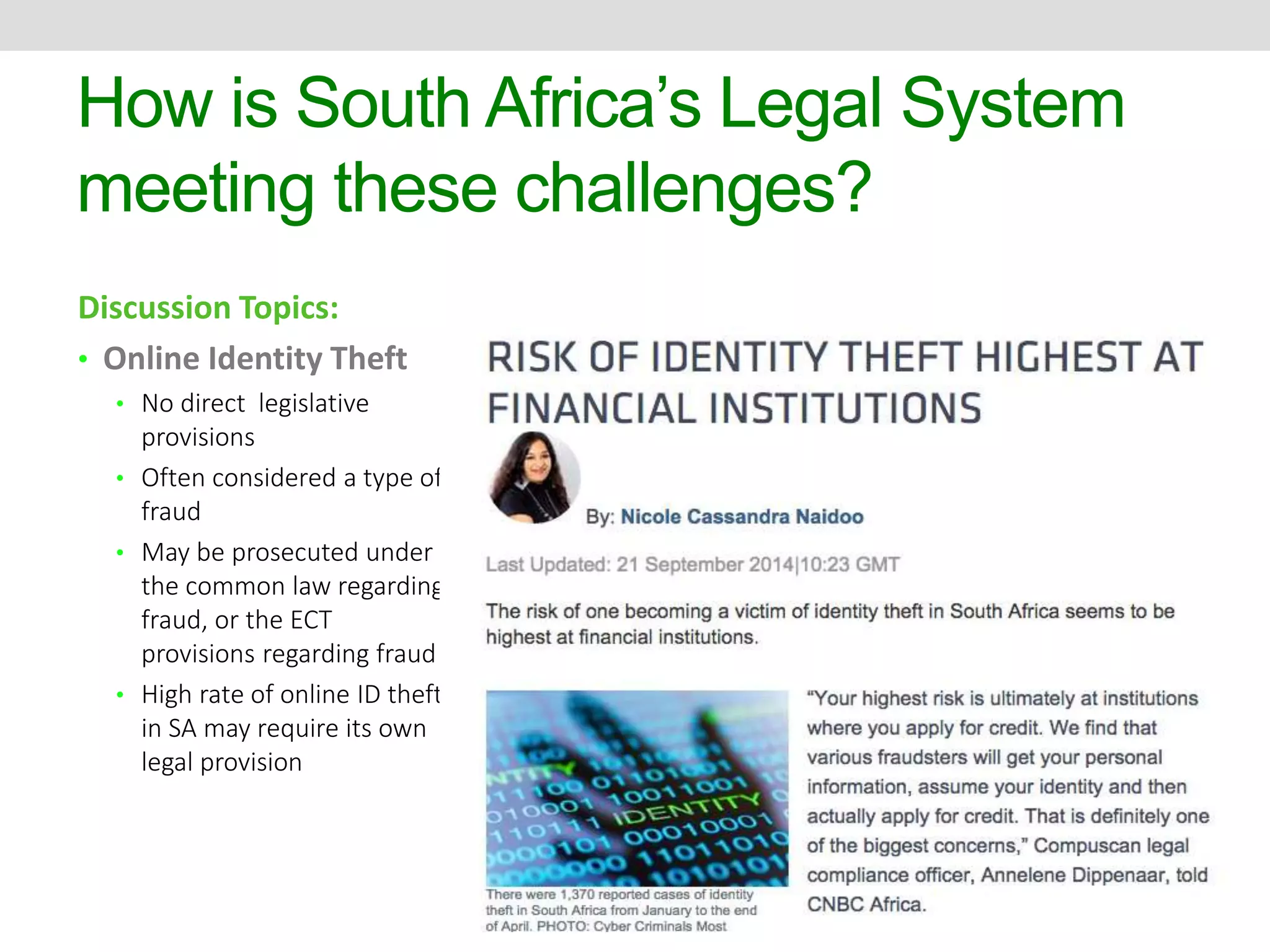
• Online Identity Theft 
• No direct legislative 
provisions 
• Often considered a type of 
fraud 
• May be prosecuted under 
the common law regarding 
fraud, or the ECT 
provisions regarding fraud 
• High rate of online ID theft 
in SA may require its own 
legal provision
How is South Africa’s Legal System 
meeting these challenges? 
Discussion Topic: 
• Personal Information 
• The Protection of Personal Information Act 4 of 2013 
• Promulgated but not in effect (information regulator provisions and definitions in effect) 
• Related to identity theft 
• Aims: 
 Protection of PI processed by private and public bodies 
 Minimum requirements for processing of PI 
 Establishment of Information Regulator 
 Codes of Conduct 
 Rights protection against SPAM and automated decision-making 
 Regulate cross-border flow
How is South Africa’s Legal System 
meeting these challenges? 
Discussion Topic: 
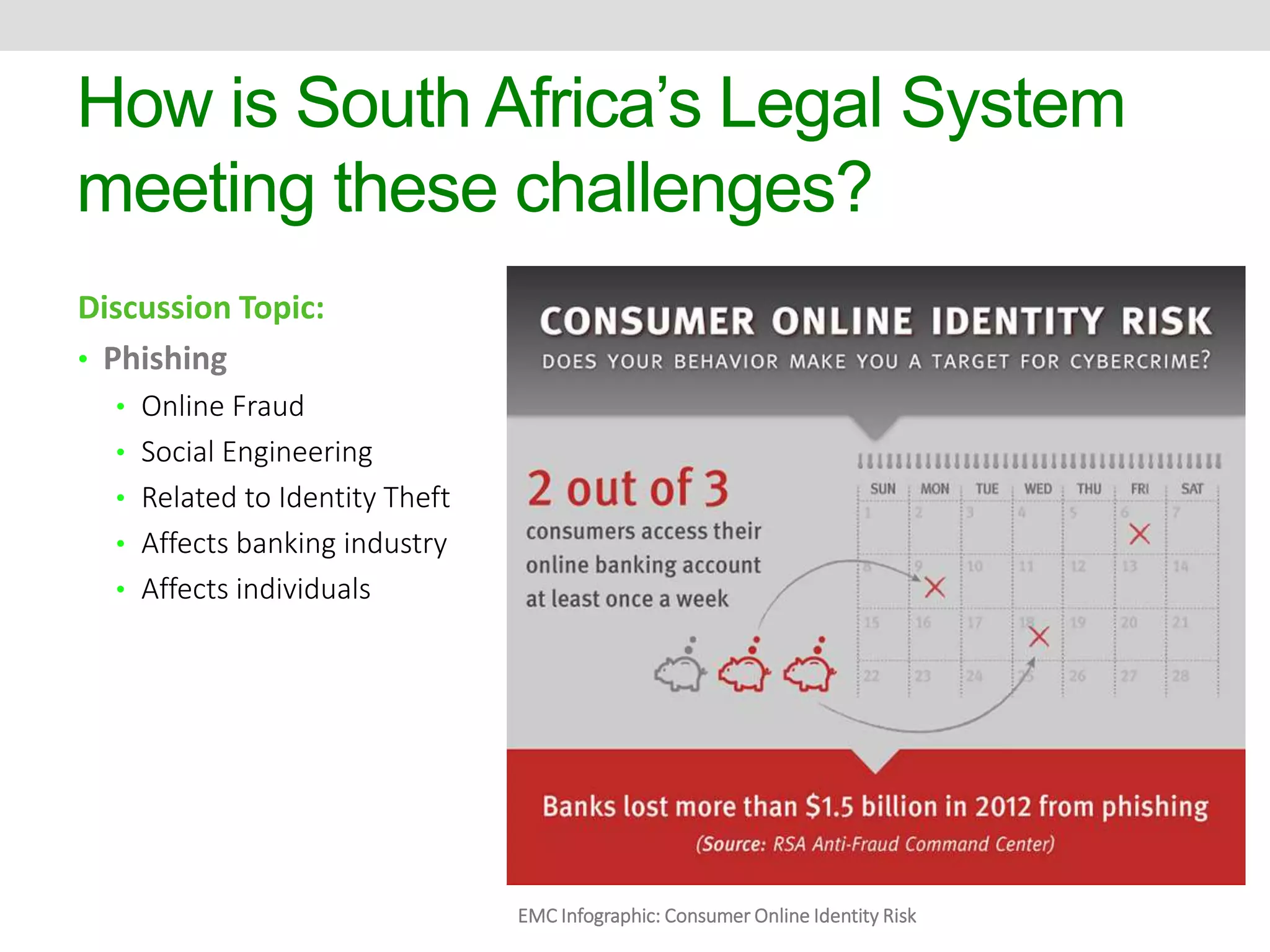
• Phishing 
• Online Fraud 
• Social Engineering 
• Related to Identity Theft 
• Affects banking industry 
• Affects individuals 
EMC Infographic: Consumer Online Identity Risk
How is South Africa’s Legal System 
meeting these challenges? 
Discussion Topic: 
• Phishing 
• Estimated losses (SA) 
• USD $222 million 
• Phishing has increased 31% in SA for 
the same time last year 
• (EMC website) 
The top 10 
countries targeted 
by phishing in 
2013: 
United States 
United Kingdom 
Germany 
India 
South Africa 
Canada 
Netherlands 
Colombia 
Australia 
Brazil
South African Cyber Law Enforcement 
How are cybercrime provisions enforced? 
• S90 ECT Act 
• Jurisdiction founded: where crime is committed, act of preparation: 
result felt; citizen or permanent resident; ship or aircraft registered in SA 
• Cyber Inspectors 
• The ECT Act makes provision for the appointment of cyber inspectors to 
monitor and inspect, search and seize upon warrant, any premises or 
information system with regards to cybercrime investigation s82. 
• However, no such inspectors have yet been assigned 
• The Act is being amended 
Lack of national effort: 
• UK has 11 centres for cyber skills development linked to universities 
• India sponsoring training of 500 000 “cyber warriors” 
• South Korea produces 5 000 cyber specialists annually 
• Kenya National Cybersecurity Strategy 2014 
• Few prosecutors understand cybercrime
South African Cyber Law Enforcement 
What Penalties Exist? 
• The courts can had out the following sentences: 
Fine or 
imprisonment 
max. 12 
months 
Unauthorised access to 
information or interception 
of information 
Unauthorised intentional 
interference resulting in 
modification, rendering 
ineffective or destruction 
of information 
The sale, distribution or 
possession of a device that is 
meant to be used to 
overcome security measures 
Last year, 54 
individuals appeared 
in the Nigel 
Magistrates Court for 
having allegedly 
defrauded thousands 
of individuals of 
almost R15 million as 
part of an inter-continental 
syndicate
South African Cyber Law Enforcement 
What Penalties Exist? 
• The courts can hand out the following sentences: 
Fine or 
imprisonment 
not more 
than 5 years 
Overcoming 
security measures 
which protect data 
Computer-related 
extortion, 
fraud and forgery 
A complete or 
partial denial of 
service attack
How is South Africa’s Legal System 
meeting these challenges? 
Discussion Topic: ECT Act Amendments on the horizon 
• Aligns with international trends and NCPF March 2012 
• ECTA Amendment Bill – deletion of S89 Penalties section 
• S45 unsolicited commercial communications: max R1 mill; 1 year 
• S84(2) confidentiality: max R2 mill; 2 years 
• S86 unauthorised access: max R10 mill; 10 years 
• S87 fraud, extortion: max R10 mill; 10 years 
• S88 aiding, abetting: R5 mill; 5 years 
Justice, Crime, Prevention and Security cluster to establish a Cybersecurity 
Hub to allocate resources to deal with incidents
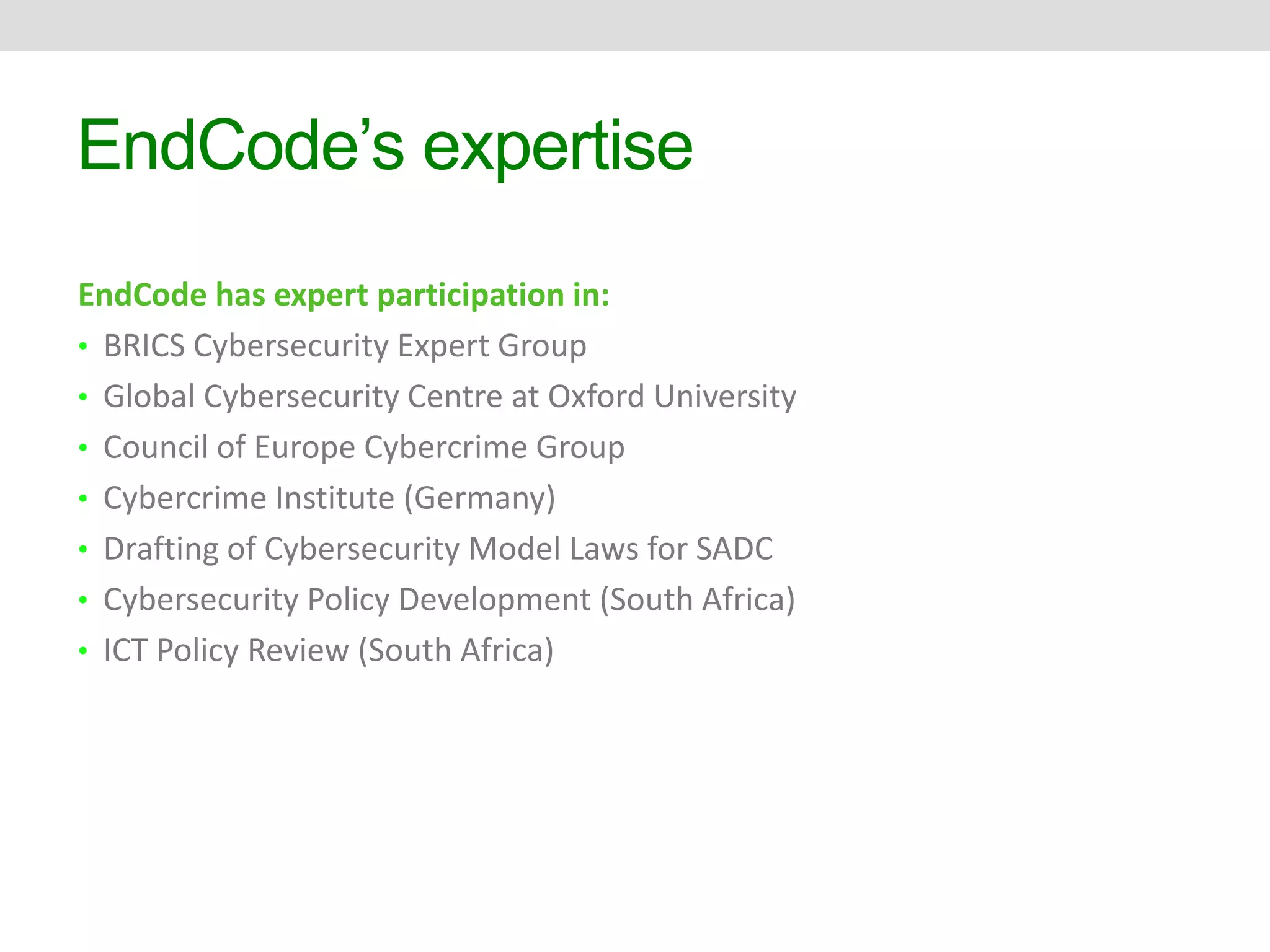
Recommendations 
Performing assessments, implementing policies: 
• ICT Acceptable Use policy 
• Electronic Communications policy 
• Information Security policy 
• Encryption policy 
• Electronic Evidence policy 
• Privacy policy 
• Monitoring and interception policy 
• Records Management policy 
• Records Retention policy 
• Employment contracts 
• Social media policy 
http://pmmanuals.com/wp-content/uploads/2012/07/pvp.jpg 
Contribute to policy-making at a sector and country level
EndCode’s expertise 
EndCode has expert participation in: 
• BRICS Cybersecurity Expert Group 
• Global Cybersecurity Centre at Oxford University 
• Council of Europe Cybercrime Group 
• Cybercrime Institute (Germany) 
• Drafting of Cybersecurity Model Laws for SADC 
• Cybersecurity Policy Development (South Africa) 
• ICT Policy Review (South Africa)
References 
• S v Van den Berg 1991 (1) SACR 104 (T) 
• http://www.cnbcafrica.com/news/southern-africa/ 
2014/09/20/identity-theft-financial-institutions/ 
• http://www.emc.com/collateral/fraud-report/rsa-online-fraud-report- 
012014.pdf 
• http://www.emc.com/infographics/consumer-online-identity-risk. 
htm 
• http://researchspace.csir.co.za/dspace/bitstream/10204/5941/1 
/Dlamini_2012.pdf 
• http://www.usatoday.com/story/tech/2014/10/29/pew-survey-cyber- 
attack/18114719/
Denise Fouche 
denise.fouche@endcode.org 
endcode.org 
THANX, QUESTIONS?

Cyber Banking Conference

  • 1.
    RESPONDING TO CYBERCRIME: The South African Legal Position DENISE FOUCHE ENDCODER/ ENDCODE.ORG
  • 2.
    CONTEXT: Cyber Crimeawareness Forms of Cyber Crime in South African Law Cyber Crime Challenges to South African Law How South Africa’s Legal System is Meeting Challenges Cyberlaw Enforcement in South Africa Security Recommendations
  • 3.
    Cyber Crime? “Theprobability of a major cyber attack is not ‘if’ but ‘when’. Oliver Crepin-Leblond, Global Information Highway, United Kingdom
  • 4.
    Cyber Crime? 6most active 3 Russia, China R2.65 billion
  • 5.
    Cyber Crime awareness? • Internet penetration, mobile devices • Crimes are growing, but little awareness • No multimedia public awareness campaign • No national awareness campaigns – patchwork of initiatives • CSIR • SABRIC funded by local banks to track and respond to cybercrime in banking sector • Cybercrime.org.za: an awareness portal intended for informational purposes. • Alertafrica.com raising awareness of cyber threats in SA • ISG Africa • South African Centre for Information Security • FPB PROCHILD • SACSAA South African Cyber Security Academic Alliance NMMU; UJ; UNISA cyberaware.org.za • No government involvement in existing efforts • No cyber watch centres • Ethiopia: 24-hour national computer security incident response teams
  • 6.
  • 7.
  • 8.
    Cyber Crime? •No national cybersecurity awareness framework in place • Infrastructure for cybersecurity protection strong but awareness is low • Mobile usage and lack of security awareness - vulnerability • Although numbers have decreased, cost per victim has risen • 48% smartphone and tablet users do not take basic precautions • What information is being shared on social networking platforms • Perception of lawlessness, ineffective enforcement • ALL LEVELS OF SOCIETY TO BE ENGAGED
  • 9.
  • 10.
  • 11.
    South Africa’s cyberwellnessprofile How does the ITU measure us? LEGAL Criminal legislation • ECT Act • National Cybersecurity Policy Framework 2012 • RICA • POPI Act Regulation and compliance • No specific legislation and regulation related to cybersecurity TECHNICAL CIRT • ECS-CSIRT is an officially recognised CIRT STANDARDS • Approved national cybersecurity frameworks for implementing internationally recognsied cybersecurity standards through NCPF CERTIFICATION • No frameworks for certification and accreditation of national agencies and public sector professionals
  • 12.
    South Africa’s cyberwellnessprofile How does the ITU measure us? ORGANISATION Policy: Officially recognised NCPF approved March 2012 Roadmap for Governance: National Cybersecurity Implementation Plan Responsible Agency: State Security Agency for implementing national cybersecurity strategy, policy and roadmap National Benchmarking: No benchmarking exercises to measure cybersecurity development • and publci sector agencies certified under internationally recognised standards in cybersecurity. CAPACITY BUILDING • Standardisation development: No R&D programs for standards, best practices or guidelines to be applied in private or public sector • Manpower development: No educational and professional training programs for raising awareness with public, promoting courses in higher education and promoting certification of professional in private or public sectors • Professional certification: No public sector professional certified under internationally recognised certification programs • Agency certification:: No certified government and public sector agencies certified under internationally recognised standards
  • 13.
    South Africa’s cyberwellnessprofile How does the ITU measure us? COOPERATION Intra-State cooperation: partnerships with 24/7 program Intra-Agency cooperation: : no officially recognised national or sector-specific programs for sharing cybersecurity assets within public sector. Public Sector partnership: : no programs for sharing cybersecurity assets within the public and private sector International cooperation: : member of ITU-IMPACT initiative; beneficiary HIPSSA; participated in international effort on cybercrime (EU GLACY project); on finalisation stage of draft AUC Cybersecurity Convention workshop
  • 14.
    South Africa’s cyberwellnessprofile How does the ITU measure us? PROTECTION OF CHILDREN ONLINE National legislation: Amendment to Sexual Offences and Related Matters Act; Films and Publications Act UN Convention and Protocol: Convention on the Rights of the Child; Optional Protocol to the Convention on the Rights of the Child on the Sale of Children, Child Prostitution and Child Pornography Institutional support: no recognised agency offering institutional support on child online protection Reporting mechanism: FPB PRO CHILD phone number on website
  • 15.
    What is CyberCrime? • South African law has no formal definition • Internationally there is little consensus • Consider the following: • “Unlawful conduct involving a computer or computer system or computer network, irrespective of whether it is the object of the crime or instrumental in the commission of the crime.” (Cyberlaw @SA III)
  • 16.
    What Constitutes aCyber Crime? • Electronic Communications and Transactions Act 25 of 2002 (ECT Act) Chapter 13 criminalises various acts: • Hacking • Denial of Service attacks • Unauthorised access to and tampering with information • Fraud, forgery, extortion related to a computer • Other cyber crimes include: • Distribution, creation, possession of child pornography in digital format • Identity theft • Cyber-stalking • Phishing • Online gambling • Falsity with regard to accreditation by Accreditation Authority • Failure by critical database administrator to take remedial action • Obstructing cyber inspectors’ functions
  • 17.
    Cyber Crime Challengesfor SA Law • No single existing government agency to manage all aspects of cybersecurity and cybercrime
  • 18.
    • Policy development Department of Communications Department of State Security • Curbing and prosecuting crime Department of State Security DoJ & CD Department of Police • Responsibility for prosecution of cybercrime and court processes • RICA implementation DoJ & CD • Implementation cybersecurity measures • Develops, imp Department of State Security lements regulations on cybercrime • Co-ordination and implementation of cyber-defence Department of Defence & Military measures Veterans • Development, coordination, implementation of national capacity development programmes on a national cybersecurity research and development agenda Department of Science & Technology Ministry of Police • Prevention, investigation, combating of cybercrime
  • 19.
    Cyber Crime Challengesfor SA Law • Crime across international borders • Jurisdictional issues • Relying on international assistance • Importance of global coherent cyber crime laws • Digital evidence is different • Evidence is information • Admissibility of electronic evidence • Protecting the veracity of electronic evidence • Need for ISP participation • Many perpetrators, many victims • No physical presence • Domestic laws govern investigation
  • 20.
    Cyber Crime Challengesfor SA Law • Intelligence gathering in the digital world • Equipping investigators with cyber skills • Ability to act swiftly • Participation of ISP • Flexible laws to keep pace with technology • New types of crimes • Denial of Service Attacks • Hacking • cyberstalking Request Request Request Request Information System Request Request Request Request DoS Attack
  • 21.
    Can existing SouthAfrican common law accommodate Cyber Crime? • Nullum crimen sine lege Principle • No crime without (prior) criminal prohibition • South Africa’s living, adaptable common law • E.g., common law crime of theft can be applied to cyber crime theft • S v Van den Berg 1991: electronic fraudulent misrepresentation still fraud as per common law • S v Howard 2005: “property” in crime of malicious damage to property no longer needs to be physical Need for specific legislative provisions for cyber crimes to include new crimes and be clear about illegality
  • 22.
    How is SouthAfrica’s Legal System meeting these challenges? What is South Africa’s position domestically? Substantive Laws • ECT Act prohibits: • Unauthorised access to information or interception of information s86(1); • Unauthorised intentional interference resulting in modification, rendering ineffective or destruction of information s86(2); • Overcoming security measures which protect data, including the sale, distribution or possession of a device that is meant to be used to overcome security measures s86(3) s86(4); • A complete or partial denial of service attack s86(5); • Computer-related extortion, fraud and forgery s87; and • Attempt, and aiding and abetting in any of the abovementioned acts s88
  • 23.
    How is SouthAfrica’s Legal System meeting these challenges? What is South Africa’s position domestically? Substantive Laws • CPA & ECT Act • Together with the Consumer Protection Act 68 2008, the ECT Act regulates unsolicited communications (SPAM) • POPI • Stringent requirements imposed on collecting and processing personal information • electronic direct marketing prohibition • The Films and Publications Act • The Films and Publications Act 65 of 1996 imposes a statutory obligation on ISPs to prevent the distribution of child pornography in South Africa • The National Gambling Act • The National Gambling Amendment Act 10 of 2008, which has been adopted but not promulgated regulates online gambling and casinos against dishonest operations • Until the promulgation of the Amendment Act, online gambling is currently prohibited for South African residents
  • 24.
    How is SouthAfrica’s Legal System meeting these challenges? What is South Africa’s position domestically? Procedural Laws • RICA: • Minister of Communications responsible for: • directives to ensure electronic communication service providers must make their systems interceptible and store information • Prescribing technial, security and functional requirements of interception facilities • Implemented state surveillance (data collection) as an investigatory method for serious crime committed on the Internet • Direct and indirect communication included • Interception, data retention, decryption and monitoring are included as methods of surveillance. • ECT Act: • Provides for secure electronic transactions; cryptography services; authentication of service providers; consumer protection; protection of critical databases; domain name authority and administration; and establishment of a cyber inspectorate • Gives weight to evidential weight to data messages in court of law • Provides for the regulationof Public Key Infrastructures and authentication and accreditation of electronic signatures • Under review: electronic evidence
  • 25.
    How is SouthAfrica’s Legal System meeting these challenges? What is South Africa’s position domestically? On the Cards • Draft Cyber Security Policy 2010 • Cabinet passed the National Cyber Security Policy Framework in March 2012 but is not publicly available • Guidance on how to secure cyberspace is not available • Draft stated milestones for establishing CSIRT (Computer Security Incident Response Team) and CSERT (Computer Security Emergency Response Team) end March 2012 • Mandate challenges: milestones not met. Feb 2012 decision that State Security should take over responsibility from Department of Communications for drafting policy on cybercrime • Framework proposes co-operation between government, private sector and civil society
  • 26.
    How is SouthAfrica’s Legal System meeting these challenges? What is South Africa’s position domestically? On the Cards • Draft Cyber Security Policy 2010 • Facilitate the establishment of relevant structures in support of cybersecurity • Ensure reduction of Cybersecurity threats and vulnerabilities • Foster cooperation and coordination between government and private sector • Promote and strengthen international cooperation on Cybersecurity • Build capacity and promote a culture of cybersecurity • Promote compliance with appropriate technical and operational Cybersecurity standards
  • 27.
    How is SouthAfrica’s Legal System meeting these challenges? What is South Africa’s position domestically? On the Cards • Draft Cyber Security Policy 2010 • National Cybersecurity Advisory Council appointed October 2013 • coordinates cybersecurity policies and interventions at operational and strategic levels, co-ordinated national approach to cybersecurity • Computer Incident Response Teams (CSIRT) • identify, analyse, contain, mitigate, report on cybersecurity threats in various sectors • National CSIRT, Government CSIRT, Sector CSIRT • Faster co-operation between government, private sector and citizens • Strengthen international co-operation • Skills development and innovation • Building capacity for law enforcement, judiciary, civil society requirements • Promoting culture of cybersecurity through development programmes that address government, business and user needs
  • 28.
    How is SouthAfrica’s Legal System meeting these challenges? What is South Africa’s position internationally? • The South African Constitution • the Constitution of South Africa states that when interpreting the Bill of Rights a court, tribunal or forum must take note of international law and may consider foreign law s39(1) • The EU Convention on Cybercrime • Signed by South Africa • Addresses crime committed over electronic media • The only international cybercrime treaty • Requires signatory countries to create domestic cyber crime law (procedural and substantive) • Harmonises the approach that signatory countries take to the legal provisions that they create • International co-operation and assistance is important for the collection of electronic evidence and criminal investigation
  • 29.
    How is SouthAfrica’s Legal System meeting these challenges? What is South Africa’s position internationally? • The CoE Convention on Cybercrime (Budapest Convention) • Only international agreement addressing cybercrime • First international treaty harmonising national laws • Oct 2014: ratified by 44 states, 9 have ratified, signed by Canada, Japan, US, SA • The SADC Model Law on Cybercrime • Harmonisation of SADC region country policies towards cybercrime • Primarily identifying cybercrime offences to be included in domestic laws • African Union Convention on Cybersecurity and Personal Data Protection • Adopted June 2014 • Criticised as not acknowledging weaknesses of African security sector mecanims • No requirement of strong judicial oversight to strengthen privacy protection • National sovereignty and discretion over international law • Does not outline minimum threshold that national legal frameworks and lws should ocmply with
  • 30.
    How is SouthAfrica’s Legal System meeting these challenges? Discussion Topics: • Online Identity Theft • No direct legislative provisions • Often considered a type of fraud • May be prosecuted under the common law regarding fraud, or the ECT provisions regarding fraud • High rate of online ID theft in SA may require its own legal provision
  • 31.
    How is SouthAfrica’s Legal System meeting these challenges? Discussion Topic: • Personal Information • The Protection of Personal Information Act 4 of 2013 • Promulgated but not in effect (information regulator provisions and definitions in effect) • Related to identity theft • Aims:  Protection of PI processed by private and public bodies  Minimum requirements for processing of PI  Establishment of Information Regulator  Codes of Conduct  Rights protection against SPAM and automated decision-making  Regulate cross-border flow
  • 32.
    How is SouthAfrica’s Legal System meeting these challenges? Discussion Topic: • Phishing • Online Fraud • Social Engineering • Related to Identity Theft • Affects banking industry • Affects individuals EMC Infographic: Consumer Online Identity Risk
  • 33.
    How is SouthAfrica’s Legal System meeting these challenges? Discussion Topic: • Phishing • Estimated losses (SA) • USD $222 million • Phishing has increased 31% in SA for the same time last year • (EMC website) The top 10 countries targeted by phishing in 2013: United States United Kingdom Germany India South Africa Canada Netherlands Colombia Australia Brazil
  • 34.
    South African CyberLaw Enforcement How are cybercrime provisions enforced? • S90 ECT Act • Jurisdiction founded: where crime is committed, act of preparation: result felt; citizen or permanent resident; ship or aircraft registered in SA • Cyber Inspectors • The ECT Act makes provision for the appointment of cyber inspectors to monitor and inspect, search and seize upon warrant, any premises or information system with regards to cybercrime investigation s82. • However, no such inspectors have yet been assigned • The Act is being amended Lack of national effort: • UK has 11 centres for cyber skills development linked to universities • India sponsoring training of 500 000 “cyber warriors” • South Korea produces 5 000 cyber specialists annually • Kenya National Cybersecurity Strategy 2014 • Few prosecutors understand cybercrime
  • 35.
    South African CyberLaw Enforcement What Penalties Exist? • The courts can had out the following sentences: Fine or imprisonment max. 12 months Unauthorised access to information or interception of information Unauthorised intentional interference resulting in modification, rendering ineffective or destruction of information The sale, distribution or possession of a device that is meant to be used to overcome security measures Last year, 54 individuals appeared in the Nigel Magistrates Court for having allegedly defrauded thousands of individuals of almost R15 million as part of an inter-continental syndicate
  • 36.
    South African CyberLaw Enforcement What Penalties Exist? • The courts can hand out the following sentences: Fine or imprisonment not more than 5 years Overcoming security measures which protect data Computer-related extortion, fraud and forgery A complete or partial denial of service attack
  • 37.
    How is SouthAfrica’s Legal System meeting these challenges? Discussion Topic: ECT Act Amendments on the horizon • Aligns with international trends and NCPF March 2012 • ECTA Amendment Bill – deletion of S89 Penalties section • S45 unsolicited commercial communications: max R1 mill; 1 year • S84(2) confidentiality: max R2 mill; 2 years • S86 unauthorised access: max R10 mill; 10 years • S87 fraud, extortion: max R10 mill; 10 years • S88 aiding, abetting: R5 mill; 5 years Justice, Crime, Prevention and Security cluster to establish a Cybersecurity Hub to allocate resources to deal with incidents
  • 38.
    Recommendations Performing assessments,implementing policies: • ICT Acceptable Use policy • Electronic Communications policy • Information Security policy • Encryption policy • Electronic Evidence policy • Privacy policy • Monitoring and interception policy • Records Management policy • Records Retention policy • Employment contracts • Social media policy http://pmmanuals.com/wp-content/uploads/2012/07/pvp.jpg Contribute to policy-making at a sector and country level
  • 39.
    EndCode’s expertise EndCodehas expert participation in: • BRICS Cybersecurity Expert Group • Global Cybersecurity Centre at Oxford University • Council of Europe Cybercrime Group • Cybercrime Institute (Germany) • Drafting of Cybersecurity Model Laws for SADC • Cybersecurity Policy Development (South Africa) • ICT Policy Review (South Africa)
  • 40.
    References • Sv Van den Berg 1991 (1) SACR 104 (T) • http://www.cnbcafrica.com/news/southern-africa/ 2014/09/20/identity-theft-financial-institutions/ • http://www.emc.com/collateral/fraud-report/rsa-online-fraud-report- 012014.pdf • http://www.emc.com/infographics/consumer-online-identity-risk. htm • http://researchspace.csir.co.za/dspace/bitstream/10204/5941/1 /Dlamini_2012.pdf • http://www.usatoday.com/story/tech/2014/10/29/pew-survey-cyber- attack/18114719/
  • 41.
    Denise Fouche denise.fouche@endcode.org endcode.org THANX, QUESTIONS?

Editor's Notes

  • #4  Experts expect a major attack within the next 11 years Almost two-third of technology experts expect a "major" cyber attack somewhere in the world that will cause significant loss of life or property losses in the tens of billions of dollars by 2025. A survey released Wednesday by the Pew Research Center found that many of analysts expect disruption of online systems like banking, energy and health care to become a pillar of warfare and terrorism. http://www.usatoday.com/story/tech/2014/10/29/pew-survey-cyber-attack/18114719/ Wolfpack study – losses across three sectors
  • #5  6 most active cybercrime country globally FBI 3rd behind Russia and China informal consensus within private sector R2.65 billion in three sectors CyberCrime Barometer 2012/2013 Wolfpack FBI
  • #6  common market for eastern and southern africa develop a holistic framework to raise awareness on the complex nature of cybercrime and cyber security issues, motivate the establishment of national Computer Emergency Response Teams (CERT), collection and sharing of cybercrime statistics/indicators and formulation of annual SADC/COMESA cybercrime reports. It will facilitate the establishment of computer emergency response teams (CERT) for Internet security incidents and as national focal points to engage in securing cyberspace and the protection of critical information infrastructure. This should then be complemented by the enactment of cyber security laws which should be in line with the recently adopted SADC harmonised cyber security model laws. CERTs have been implemented in Mauritius, South Africa and Zambia. There is a need for further cooperation among CERT extended to the collection of quantitative data on cybercrime in the sub region. CERTS should respond to cyber incidents, provide technical assistance to hacked businesses and disseminate timely notifications regarding current and potential threats. CSIRT offers limited assistance on cyber-secruity issues to government entities WASPA; CSIR; University of Fort Hare; Nelson Mandela University, Univeristy of Pretoria. SADC Model law on Computer Crime and Cybercrime adopted Nov 2012
  • #8  common market for eastern and southern africa develop a holistic framework to raise awareness on the complex nature of cybercrime and cyber security issues, motivate the establishment of national Computer Emergency Response Teams (CERT), collection and sharing of cybercrime statistics/indicators and formulation of annual SADC/COMESA cybercrime reports. It will facilitate the establishment of computer emergency response teams (CERT) for Internet security incidents and as national focal points to engage in securing cyberspace and the protection of critical information infrastructure. This should then be complemented by the enactment of cyber security laws which should be in line with the recently adopted SADC harmonised cyber security model laws. CERTs have been implemented in Mauritius, South Africa and Zambia. There is a need for further cooperation among CERT extended to the collection of quantitative data on cybercrime in the sub region. CERTS should respond to cyber incidents, provide technical assistance to hacked businesses and disseminate timely notifications regarding current and potential threats. CSIRT offers limited assistance on cyber-secruity issues to government entities WASPA; CSIR; University of Fort Hare; Nelson Mandela University, Univeristy of Pretoria. SADC Model law on Computer Crime and Cybercrime adopted Nov 2012
  • #10  First establihsed in response to 1988 internet worm. Membership in FIRST enables incident response teams to more effectively respond to security incidents by providing access to best practices, tools, and trusted communication with member teams. Waking Shark II was organised by the Securities Industry Business Continuity Management Group which drew on extensive cyber expertise to design a scenario in which a cyber-attack caused disruption to wholesale markets and the financial infrastructure supporting those markets.  Inov 2013
  • #11  First establihsed in response to 1988 internet worm. Membership in FIRST enables incident response teams to more effectively respond to security incidents by providing access to best practices, tools, and trusted communication with member teams. SIFMA Securities Industry and Financial Marketsassociation 2013July Quantum Dawn 2 was a cybersecurity exercise to test incident response, resolution and coordination processes for the financial services sector and the individual member firms to a street-wide cyber attack.
  • #12  Aug 2014
  • #13  Aug 2014 (Support for Harmonisation of the ICT Policies in Sub-Sahara Africa)
  • #14  Aug 2014 (Support for Harmonisation of the ICT Policies in Sub-Sahara Africa)
  • #15  Aug 2014 (Support for Harmonisation of the ICT Policies in Sub-Sahara Africa)
  • #17 5 days after receiving the goods, the consumer can return/cancel entire contract without penalty/and receive a full refund. Consumer pays costs to return goods 2. no opportunity to examine or inspect actual goods received prior to purchase, on delivery they are entitled to inspect. If good do not meet ‘type’ or ‘quality’ reasonably expected from agreement or if do not conform to specification in terms of a special order, consumer can refuse delivery/receive full refund/ and cancel without penalty. Supplier is liable for return costs. 3. 10 days after receiving goods consumer can return the goods if it is not suitable for the particular purpose, cancel wihtou penalty, supplier liable for return costs. Not entitled to return if public regulation prohibits or goods have been disassesmbled, altered, added to or combined with other goods and property. 4. all goods sold are sold with an implied warranty of quality that cannot be contracted out of or revoked, Warranty gives consumer right to receive goods that are reasonably suitable for purpose intended to be used for, are of good quality, free of defects and will be durable and usable for a reasonable period of time. If goods do not comply up to 6 months return or get goods replaced or get goods repaired. Without penality at supplier’s cost. ECT for 7 days after delivery for any reason without penalty but consumer liable for costs of return.
  • #18  4 instances when one can return goods under CPA: Direct marketing cooling-off period: s16 5 days after receiving, consumer can return/cancel entire contract without penalty/and receive a full refund. Consumer pays costs to return goods Goods which have not been seen before purchase: s20 (read with s19) no opportunity to examine or inspect actual goods received prior to purchase, on delivery they are entitled to inspect. If good do not meet ‘type’ or ‘quality’ reasonably expected from agreement or if do not conform to specification in terms of a special order, consumer can refuse delivery/receive full refund/ and cancel without penalty. Supplier is liable for return costs. Good do not meet particular purpose. S55(3) 10 days after receiving goods consumer can return the goods if it is not suitable for the particular purpose, cancel without penalty, supplier liable for return costs. Not entitled to return if public regulation prohibits or goods have been disassesmbled, altered, added to or combined with other goods and property. Implied warranty of quality. S56 all goods sold are sold with an implied warranty of quality that cannot be contracted out of or revoked, Warranty gives consumer right to receive goods that are reasonably suitable for purpose intended to be used for, are of good quality, free of defects and will be durable and usable for a reasonable period of time. If goods do not comply up to 6 months return or get goods replaced or get goods repaired. Without penality at supplier’s cost. ECT: consumer provisions will trump CPA. Online purchases. Reasons for return 1-3 do not apply if ECT Act provisions apply to the transaction. Instead of these right of return consumers have: a general right to return (cooling off period); for 7 days after delivery for any reason without penalty but consumer liable for costs of return.
  • #20  4 instances when one can return goods under CPA: Direct marketing cooling-off period: s16 5 days after receiving, consumer can return/cancel entire contract without penalty/and receive a full refund. Consumer pays costs to return goods Goods which have not been seen before purchase: s20 (read with s19) no opportunity to examine or inspect actual goods received prior to purchase, on delivery they are entitled to inspect. If good do not meet ‘type’ or ‘quality’ reasonably expected from agreement or if do not conform to specification in terms of a special order, consumer can refuse delivery/receive full refund/ and cancel without penalty. Supplier is liable for return costs. Good do not meet particular purpose. S55(3) 10 days after receiving goods consumer can return the goods if it is not suitable for the particular purpose, cancel without penalty, supplier liable for return costs. Not entitled to return if public regulation prohibits or goods have been disassesmbled, altered, added to or combined with other goods and property. Implied warranty of quality. S56 all goods sold are sold with an implied warranty of quality that cannot be contracted out of or revoked, Warranty gives consumer right to receive goods that are reasonably suitable for purpose intended to be used for, are of good quality, free of defects and will be durable and usable for a reasonable period of time. If goods do not comply up to 6 months return or get goods replaced or get goods repaired. Without penality at supplier’s cost. ECT: consumer provisions will trump CPA. Online purchases. Reasons for return 1-3 do not apply if ECT Act provisions apply to the transaction. Instead of these right of return consumers have: a general right to return (cooling off period); for 7 days after delivery for any reason without penalty but consumer liable for costs of return.
  • #21  4 instances when one can return goods under CPA: Direct marketing cooling-off period: s16 5 days after receiving, consumer can return/cancel entire contract without penalty/and receive a full refund. Consumer pays costs to return goods Goods which have not been seen before purchase: s20 (read with s19) no opportunity to examine or inspect actual goods received prior to purchase, on delivery they are entitled to inspect. If good do not meet ‘type’ or ‘quality’ reasonably expected from agreement or if do not conform to specification in terms of a special order, consumer can refuse delivery/receive full refund/ and cancel without penalty. Supplier is liable for return costs. Good do not meet particular purpose. S55(3) 10 days after receiving goods consumer can return the goods if it is not suitable for the particular purpose, cancel without penalty, supplier liable for return costs. Not entitled to return if public regulation prohibits or goods have been disassesmbled, altered, added to or combined with other goods and property. Implied warranty of quality. S56 all goods sold are sold with an implied warranty of quality that cannot be contracted out of or revoked, Warranty gives consumer right to receive goods that are reasonably suitable for purpose intended to be used for, are of good quality, free of defects and will be durable and usable for a reasonable period of time. If goods do not comply up to 6 months return or get goods replaced or get goods repaired. Without penality at supplier’s cost. ECT: consumer provisions will trump CPA. Online purchases. Reasons for return 1-3 do not apply if ECT Act provisions apply to the transaction. Instead of these right of return consumers have: a general right to return (cooling off period); for 7 days after delivery for any reason without penalty but consumer liable for costs of return.
  • #22  4 instances when one can return goods under CPA: Direct marketing cooling-off period: s16 5 days after receiving, consumer can return/cancel entire contract without penalty/and receive a full refund. Consumer pays costs to return goods Goods which have not been seen before purchase: s20 (read with s19) no opportunity to examine or inspect actual goods received prior to purchase, on delivery they are entitled to inspect. If good do not meet ‘type’ or ‘quality’ reasonably expected from agreement or if do not conform to specification in terms of a special order, consumer can refuse delivery/receive full refund/ and cancel without penalty. Supplier is liable for return costs. Good do not meet particular purpose. S55(3) 10 days after receiving goods consumer can return the goods if it is not suitable for the particular purpose, cancel without penalty, supplier liable for return costs. Not entitled to return if public regulation prohibits or goods have been disassesmbled, altered, added to or combined with other goods and property. Implied warranty of quality. S56 all goods sold are sold with an implied warranty of quality that cannot be contracted out of or revoked, Warranty gives consumer right to receive goods that are reasonably suitable for purpose intended to be used for, are of good quality, free of defects and will be durable and usable for a reasonable period of time. If goods do not comply up to 6 months return or get goods replaced or get goods repaired. Without penality at supplier’s cost. ECT: consumer provisions will trump CPA. Online purchases. Reasons for return 1-3 do not apply if ECT Act provisions apply to the transaction. Instead of these right of return consumers have: a general right to return (cooling off period); for 7 days after delivery for any reason without penalty but consumer liable for costs of return.
  • #23  4 instances when one can return goods under CPA: Direct marketing cooling-off period: s16 5 days after receiving, consumer can return/cancel entire contract without penalty/and receive a full refund. Consumer pays costs to return goods Goods which have not been seen before purchase: s20 (read with s19) no opportunity to examine or inspect actual goods received prior to purchase, on delivery they are entitled to inspect. If good do not meet ‘type’ or ‘quality’ reasonably expected from agreement or if do not conform to specification in terms of a special order, consumer can refuse delivery/receive full refund/ and cancel without penalty. Supplier is liable for return costs. Good do not meet particular purpose. S55(3) 10 days after receiving goods consumer can return the goods if it is not suitable for the particular purpose, cancel without penalty, supplier liable for return costs. Not entitled to return if public regulation prohibits or goods have been disassesmbled, altered, added to or combined with other goods and property. Implied warranty of quality. S56 all goods sold are sold with an implied warranty of quality that cannot be contracted out of or revoked, Warranty gives consumer right to receive goods that are reasonably suitable for purpose intended to be used for, are of good quality, free of defects and will be durable and usable for a reasonable period of time. If goods do not comply up to 6 months return or get goods replaced or get goods repaired. Without penality at supplier’s cost. ECT: consumer provisions will trump CPA. Online purchases. Reasons for return 1-3 do not apply if ECT Act provisions apply to the transaction. Instead of these right of return consumers have: a general right to return (cooling off period); for 7 days after delivery for any reason without penalty but consumer liable for costs of return.
  • #24  4 instances when one can return goods under CPA: Direct marketing cooling-off period: s16 5 days after receiving, consumer can return/cancel entire contract without penalty/and receive a full refund. Consumer pays costs to return goods Goods which have not been seen before purchase: s20 (read with s19) no opportunity to examine or inspect actual goods received prior to purchase, on delivery they are entitled to inspect. If good do not meet ‘type’ or ‘quality’ reasonably expected from agreement or if do not conform to specification in terms of a special order, consumer can refuse delivery/receive full refund/ and cancel without penalty. Supplier is liable for return costs. Good do not meet particular purpose. S55(3) 10 days after receiving goods consumer can return the goods if it is not suitable for the particular purpose, cancel without penalty, supplier liable for return costs. Not entitled to return if public regulation prohibits or goods have been disassesmbled, altered, added to or combined with other goods and property. Implied warranty of quality. S56 all goods sold are sold with an implied warranty of quality that cannot be contracted out of or revoked, Warranty gives consumer right to receive goods that are reasonably suitable for purpose intended to be used for, are of good quality, free of defects and will be durable and usable for a reasonable period of time. If goods do not comply up to 6 months return or get goods replaced or get goods repaired. Without penality at supplier’s cost. ECT: consumer provisions will trump CPA. Online purchases. Reasons for return 1-3 do not apply if ECT Act provisions apply to the transaction. Instead of these right of return consumers have: a general right to return (cooling off period); for 7 days after delivery for any reason without penalty but consumer liable for costs of return.
  • #25  4 instances when one can return goods under CPA: Direct marketing cooling-off period: s16 5 days after receiving, consumer can return/cancel entire contract without penalty/and receive a full refund. Consumer pays costs to return goods Goods which have not been seen before purchase: s20 (read with s19) no opportunity to examine or inspect actual goods received prior to purchase, on delivery they are entitled to inspect. If good do not meet ‘type’ or ‘quality’ reasonably expected from agreement or if do not conform to specification in terms of a special order, consumer can refuse delivery/receive full refund/ and cancel without penalty. Supplier is liable for return costs. Good do not meet particular purpose. S55(3) 10 days after receiving goods consumer can return the goods if it is not suitable for the particular purpose, cancel without penalty, supplier liable for return costs. Not entitled to return if public regulation prohibits or goods have been disassesmbled, altered, added to or combined with other goods and property. Implied warranty of quality. S56 all goods sold are sold with an implied warranty of quality that cannot be contracted out of or revoked, Warranty gives consumer right to receive goods that are reasonably suitable for purpose intended to be used for, are of good quality, free of defects and will be durable and usable for a reasonable period of time. If goods do not comply up to 6 months return or get goods replaced or get goods repaired. Without penality at supplier’s cost. ECT: consumer provisions will trump CPA. Online purchases. Reasons for return 1-3 do not apply if ECT Act provisions apply to the transaction. Instead of these right of return consumers have: a general right to return (cooling off period); for 7 days after delivery for any reason without penalty but consumer liable for costs of return.
  • #26  4 instances when one can return goods under CPA: Direct marketing cooling-off period: s16 5 days after receiving, consumer can return/cancel entire contract without penalty/and receive a full refund. Consumer pays costs to return goods Goods which have not been seen before purchase: s20 (read with s19) no opportunity to examine or inspect actual goods received prior to purchase, on delivery they are entitled to inspect. If good do not meet ‘type’ or ‘quality’ reasonably expected from agreement or if do not conform to specification in terms of a special order, consumer can refuse delivery/receive full refund/ and cancel without penalty. Supplier is liable for return costs. Good do not meet particular purpose. S55(3) 10 days after receiving goods consumer can return the goods if it is not suitable for the particular purpose, cancel without penalty, supplier liable for return costs. Not entitled to return if public regulation prohibits or goods have been disassesmbled, altered, added to or combined with other goods and property. Implied warranty of quality. S56 all goods sold are sold with an implied warranty of quality that cannot be contracted out of or revoked, Warranty gives consumer right to receive goods that are reasonably suitable for purpose intended to be used for, are of good quality, free of defects and will be durable and usable for a reasonable period of time. If goods do not comply up to 6 months return or get goods replaced or get goods repaired. Without penality at supplier’s cost. ECT: consumer provisions will trump CPA. Online purchases. Reasons for return 1-3 do not apply if ECT Act provisions apply to the transaction. Instead of these right of return consumers have: a general right to return (cooling off period); for 7 days after delivery for any reason without penalty but consumer liable for costs of return.
  • #27  4 instances when one can return goods under CPA: Direct marketing cooling-off period: s16 5 days after receiving, consumer can return/cancel entire contract without penalty/and receive a full refund. Consumer pays costs to return goods Goods which have not been seen before purchase: s20 (read with s19) no opportunity to examine or inspect actual goods received prior to purchase, on delivery they are entitled to inspect. If good do not meet ‘type’ or ‘quality’ reasonably expected from agreement or if do not conform to specification in terms of a special order, consumer can refuse delivery/receive full refund/ and cancel without penalty. Supplier is liable for return costs. Good do not meet particular purpose. S55(3) 10 days after receiving goods consumer can return the goods if it is not suitable for the particular purpose, cancel without penalty, supplier liable for return costs. Not entitled to return if public regulation prohibits or goods have been disassesmbled, altered, added to or combined with other goods and property. Implied warranty of quality. S56 all goods sold are sold with an implied warranty of quality that cannot be contracted out of or revoked, Warranty gives consumer right to receive goods that are reasonably suitable for purpose intended to be used for, are of good quality, free of defects and will be durable and usable for a reasonable period of time. If goods do not comply up to 6 months return or get goods replaced or get goods repaired. Without penality at supplier’s cost. ECT: consumer provisions will trump CPA. Online purchases. Reasons for return 1-3 do not apply if ECT Act provisions apply to the transaction. Instead of these right of return consumers have: a general right to return (cooling off period); for 7 days after delivery for any reason without penalty but consumer liable for costs of return.
  • #28  4 instances when one can return goods under CPA: Direct marketing cooling-off period: s16 5 days after receiving, consumer can return/cancel entire contract without penalty/and receive a full refund. Consumer pays costs to return goods Goods which have not been seen before purchase: s20 (read with s19) no opportunity to examine or inspect actual goods received prior to purchase, on delivery they are entitled to inspect. If good do not meet ‘type’ or ‘quality’ reasonably expected from agreement or if do not conform to specification in terms of a special order, consumer can refuse delivery/receive full refund/ and cancel without penalty. Supplier is liable for return costs. Good do not meet particular purpose. S55(3) 10 days after receiving goods consumer can return the goods if it is not suitable for the particular purpose, cancel without penalty, supplier liable for return costs. Not entitled to return if public regulation prohibits or goods have been disassesmbled, altered, added to or combined with other goods and property. Implied warranty of quality. S56 all goods sold are sold with an implied warranty of quality that cannot be contracted out of or revoked, Warranty gives consumer right to receive goods that are reasonably suitable for purpose intended to be used for, are of good quality, free of defects and will be durable and usable for a reasonable period of time. If goods do not comply up to 6 months return or get goods replaced or get goods repaired. Without penality at supplier’s cost. ECT: consumer provisions will trump CPA. Online purchases. Reasons for return 1-3 do not apply if ECT Act provisions apply to the transaction. Instead of these right of return consumers have: a general right to return (cooling off period); for 7 days after delivery for any reason without penalty but consumer liable for costs of return.
  • #29  4 instances when one can return goods under CPA: Direct marketing cooling-off period: s16 5 days after receiving, consumer can return/cancel entire contract without penalty/and receive a full refund. Consumer pays costs to return goods Goods which have not been seen before purchase: s20 (read with s19) no opportunity to examine or inspect actual goods received prior to purchase, on delivery they are entitled to inspect. If good do not meet ‘type’ or ‘quality’ reasonably expected from agreement or if do not conform to specification in terms of a special order, consumer can refuse delivery/receive full refund/ and cancel without penalty. Supplier is liable for return costs. Good do not meet particular purpose. S55(3) 10 days after receiving goods consumer can return the goods if it is not suitable for the particular purpose, cancel without penalty, supplier liable for return costs. Not entitled to return if public regulation prohibits or goods have been disassesmbled, altered, added to or combined with other goods and property. Implied warranty of quality. S56 all goods sold are sold with an implied warranty of quality that cannot be contracted out of or revoked, Warranty gives consumer right to receive goods that are reasonably suitable for purpose intended to be used for, are of good quality, free of defects and will be durable and usable for a reasonable period of time. If goods do not comply up to 6 months return or get goods replaced or get goods repaired. Without penality at supplier’s cost. ECT: consumer provisions will trump CPA. Online purchases. Reasons for return 1-3 do not apply if ECT Act provisions apply to the transaction. Instead of these right of return consumers have: a general right to return (cooling off period); for 7 days after delivery for any reason without penalty but consumer liable for costs of return.
  • #30  4 instances when one can return goods under CPA: Direct marketing cooling-off period: s16 5 days after receiving, consumer can return/cancel entire contract without penalty/and receive a full refund. Consumer pays costs to return goods Goods which have not been seen before purchase: s20 (read with s19) no opportunity to examine or inspect actual goods received prior to purchase, on delivery they are entitled to inspect. If good do not meet ‘type’ or ‘quality’ reasonably expected from agreement or if do not conform to specification in terms of a special order, consumer can refuse delivery/receive full refund/ and cancel without penalty. Supplier is liable for return costs. Good do not meet particular purpose. S55(3) 10 days after receiving goods consumer can return the goods if it is not suitable for the particular purpose, cancel without penalty, supplier liable for return costs. Not entitled to return if public regulation prohibits or goods have been disassesmbled, altered, added to or combined with other goods and property. Implied warranty of quality. S56 all goods sold are sold with an implied warranty of quality that cannot be contracted out of or revoked, Warranty gives consumer right to receive goods that are reasonably suitable for purpose intended to be used for, are of good quality, free of defects and will be durable and usable for a reasonable period of time. If goods do not comply up to 6 months return or get goods replaced or get goods repaired. Without penality at supplier’s cost. ECT: consumer provisions will trump CPA. Online purchases. Reasons for return 1-3 do not apply if ECT Act provisions apply to the transaction. Instead of these right of return consumers have: a general right to return (cooling off period); for 7 days after delivery for any reason without penalty but consumer liable for costs of return.
  • #31  4 instances when one can return goods under CPA: Direct marketing cooling-off period: s16 5 days after receiving, consumer can return/cancel entire contract without penalty/and receive a full refund. Consumer pays costs to return goods Goods which have not been seen before purchase: s20 (read with s19) no opportunity to examine or inspect actual goods received prior to purchase, on delivery they are entitled to inspect. If good do not meet ‘type’ or ‘quality’ reasonably expected from agreement or if do not conform to specification in terms of a special order, consumer can refuse delivery/receive full refund/ and cancel without penalty. Supplier is liable for return costs. Good do not meet particular purpose. S55(3) 10 days after receiving goods consumer can return the goods if it is not suitable for the particular purpose, cancel without penalty, supplier liable for return costs. Not entitled to return if public regulation prohibits or goods have been disassesmbled, altered, added to or combined with other goods and property. Implied warranty of quality. S56 all goods sold are sold with an implied warranty of quality that cannot be contracted out of or revoked, Warranty gives consumer right to receive goods that are reasonably suitable for purpose intended to be used for, are of good quality, free of defects and will be durable and usable for a reasonable period of time. If goods do not comply up to 6 months return or get goods replaced or get goods repaired. Without penality at supplier’s cost. ECT: consumer provisions will trump CPA. Online purchases. Reasons for return 1-3 do not apply if ECT Act provisions apply to the transaction. Instead of these right of return consumers have: a general right to return (cooling off period); for 7 days after delivery for any reason without penalty but consumer liable for costs of return.
  • #32  4 instances when one can return goods under CPA: Direct marketing cooling-off period: s16 5 days after receiving, consumer can return/cancel entire contract without penalty/and receive a full refund. Consumer pays costs to return goods Goods which have not been seen before purchase: s20 (read with s19) no opportunity to examine or inspect actual goods received prior to purchase, on delivery they are entitled to inspect. If good do not meet ‘type’ or ‘quality’ reasonably expected from agreement or if do not conform to specification in terms of a special order, consumer can refuse delivery/receive full refund/ and cancel without penalty. Supplier is liable for return costs. Good do not meet particular purpose. S55(3) 10 days after receiving goods consumer can return the goods if it is not suitable for the particular purpose, cancel without penalty, supplier liable for return costs. Not entitled to return if public regulation prohibits or goods have been disassesmbled, altered, added to or combined with other goods and property. Implied warranty of quality. S56 all goods sold are sold with an implied warranty of quality that cannot be contracted out of or revoked, Warranty gives consumer right to receive goods that are reasonably suitable for purpose intended to be used for, are of good quality, free of defects and will be durable and usable for a reasonable period of time. If goods do not comply up to 6 months return or get goods replaced or get goods repaired. Without penality at supplier’s cost. ECT: consumer provisions will trump CPA. Online purchases. Reasons for return 1-3 do not apply if ECT Act provisions apply to the transaction. Instead of these right of return consumers have: a general right to return (cooling off period); for 7 days after delivery for any reason without penalty but consumer liable for costs of return.
  • #33  4 instances when one can return goods under CPA: Direct marketing cooling-off period: s16 5 days after receiving, consumer can return/cancel entire contract without penalty/and receive a full refund. Consumer pays costs to return goods Goods which have not been seen before purchase: s20 (read with s19) no opportunity to examine or inspect actual goods received prior to purchase, on delivery they are entitled to inspect. If good do not meet ‘type’ or ‘quality’ reasonably expected from agreement or if do not conform to specification in terms of a special order, consumer can refuse delivery/receive full refund/ and cancel without penalty. Supplier is liable for return costs. Good do not meet particular purpose. S55(3) 10 days after receiving goods consumer can return the goods if it is not suitable for the particular purpose, cancel without penalty, supplier liable for return costs. Not entitled to return if public regulation prohibits or goods have been disassesmbled, altered, added to or combined with other goods and property. Implied warranty of quality. S56 all goods sold are sold with an implied warranty of quality that cannot be contracted out of or revoked, Warranty gives consumer right to receive goods that are reasonably suitable for purpose intended to be used for, are of good quality, free of defects and will be durable and usable for a reasonable period of time. If goods do not comply up to 6 months return or get goods replaced or get goods repaired. Without penality at supplier’s cost. ECT: consumer provisions will trump CPA. Online purchases. Reasons for return 1-3 do not apply if ECT Act provisions apply to the transaction. Instead of these right of return consumers have: a general right to return (cooling off period); for 7 days after delivery for any reason without penalty but consumer liable for costs of return.
  • #34  4 instances when one can return goods under CPA: Direct marketing cooling-off period: s16 5 days after receiving, consumer can return/cancel entire contract without penalty/and receive a full refund. Consumer pays costs to return goods Goods which have not been seen before purchase: s20 (read with s19) no opportunity to examine or inspect actual goods received prior to purchase, on delivery they are entitled to inspect. If good do not meet ‘type’ or ‘quality’ reasonably expected from agreement or if do not conform to specification in terms of a special order, consumer can refuse delivery/receive full refund/ and cancel without penalty. Supplier is liable for return costs. Good do not meet particular purpose. S55(3) 10 days after receiving goods consumer can return the goods if it is not suitable for the particular purpose, cancel without penalty, supplier liable for return costs. Not entitled to return if public regulation prohibits or goods have been disassesmbled, altered, added to or combined with other goods and property. Implied warranty of quality. S56 all goods sold are sold with an implied warranty of quality that cannot be contracted out of or revoked, Warranty gives consumer right to receive goods that are reasonably suitable for purpose intended to be used for, are of good quality, free of defects and will be durable and usable for a reasonable period of time. If goods do not comply up to 6 months return or get goods replaced or get goods repaired. Without penality at supplier’s cost. ECT: consumer provisions will trump CPA. Online purchases. Reasons for return 1-3 do not apply if ECT Act provisions apply to the transaction. Instead of these right of return consumers have: a general right to return (cooling off period); for 7 days after delivery for any reason without penalty but consumer liable for costs of return.
  • #35  4 instances when one can return goods under CPA: Direct marketing cooling-off period: s16 5 days after receiving, consumer can return/cancel entire contract without penalty/and receive a full refund. Consumer pays costs to return goods Goods which have not been seen before purchase: s20 (read with s19) no opportunity to examine or inspect actual goods received prior to purchase, on delivery they are entitled to inspect. If good do not meet ‘type’ or ‘quality’ reasonably expected from agreement or if do not conform to specification in terms of a special order, consumer can refuse delivery/receive full refund/ and cancel without penalty. Supplier is liable for return costs. Good do not meet particular purpose. S55(3) 10 days after receiving goods consumer can return the goods if it is not suitable for the particular purpose, cancel without penalty, supplier liable for return costs. Not entitled to return if public regulation prohibits or goods have been disassesmbled, altered, added to or combined with other goods and property. Implied warranty of quality. S56 all goods sold are sold with an implied warranty of quality that cannot be contracted out of or revoked, Warranty gives consumer right to receive goods that are reasonably suitable for purpose intended to be used for, are of good quality, free of defects and will be durable and usable for a reasonable period of time. If goods do not comply up to 6 months return or get goods replaced or get goods repaired. Without penality at supplier’s cost. ECT: consumer provisions will trump CPA. Online purchases. Reasons for return 1-3 do not apply if ECT Act provisions apply to the transaction. Instead of these right of return consumers have: a general right to return (cooling off period); for 7 days after delivery for any reason without penalty but consumer liable for costs of return.
  • #36  4 instances when one can return goods under CPA: Direct marketing cooling-off period: s16 5 days after receiving, consumer can return/cancel entire contract without penalty/and receive a full refund. Consumer pays costs to return goods Goods which have not been seen before purchase: s20 (read with s19) no opportunity to examine or inspect actual goods received prior to purchase, on delivery they are entitled to inspect. If good do not meet ‘type’ or ‘quality’ reasonably expected from agreement or if do not conform to specification in terms of a special order, consumer can refuse delivery/receive full refund/ and cancel without penalty. Supplier is liable for return costs. Good do not meet particular purpose. S55(3) 10 days after receiving goods consumer can return the goods if it is not suitable for the particular purpose, cancel without penalty, supplier liable for return costs. Not entitled to return if public regulation prohibits or goods have been disassesmbled, altered, added to or combined with other goods and property. Implied warranty of quality. S56 all goods sold are sold with an implied warranty of quality that cannot be contracted out of or revoked, Warranty gives consumer right to receive goods that are reasonably suitable for purpose intended to be used for, are of good quality, free of defects and will be durable and usable for a reasonable period of time. If goods do not comply up to 6 months return or get goods replaced or get goods repaired. Without penality at supplier’s cost. ECT: consumer provisions will trump CPA. Online purchases. Reasons for return 1-3 do not apply if ECT Act provisions apply to the transaction. Instead of these right of return consumers have: a general right to return (cooling off period); for 7 days after delivery for any reason without penalty but consumer liable for costs of return.
  • #37  4 instances when one can return goods under CPA: Direct marketing cooling-off period: s16 5 days after receiving, consumer can return/cancel entire contract without penalty/and receive a full refund. Consumer pays costs to return goods Goods which have not been seen before purchase: s20 (read with s19) no opportunity to examine or inspect actual goods received prior to purchase, on delivery they are entitled to inspect. If good do not meet ‘type’ or ‘quality’ reasonably expected from agreement or if do not conform to specification in terms of a special order, consumer can refuse delivery/receive full refund/ and cancel without penalty. Supplier is liable for return costs. Good do not meet particular purpose. S55(3) 10 days after receiving goods consumer can return the goods if it is not suitable for the particular purpose, cancel without penalty, supplier liable for return costs. Not entitled to return if public regulation prohibits or goods have been disassesmbled, altered, added to or combined with other goods and property. Implied warranty of quality. S56 all goods sold are sold with an implied warranty of quality that cannot be contracted out of or revoked, Warranty gives consumer right to receive goods that are reasonably suitable for purpose intended to be used for, are of good quality, free of defects and will be durable and usable for a reasonable period of time. If goods do not comply up to 6 months return or get goods replaced or get goods repaired. Without penality at supplier’s cost. ECT: consumer provisions will trump CPA. Online purchases. Reasons for return 1-3 do not apply if ECT Act provisions apply to the transaction. Instead of these right of return consumers have: a general right to return (cooling off period); for 7 days after delivery for any reason without penalty but consumer liable for costs of return.
  • #38 26 October 2013 Current penalties not regarded as substantive or deterrent