WHEN CONVERSATION BECOMES PUBLICATION 
Understanding Social Media Risks and the Law 
DENISE FOUCHE 
ENDCODER/ ENDCODE.ORG
CONTEXT: 
Social Media as Enterprise Risk (internal and external) 
The law as navigator 
Brand Risk 
The Law 
Pre-empting risk, encouraging innovation 
Governance 
Social Media in Africa
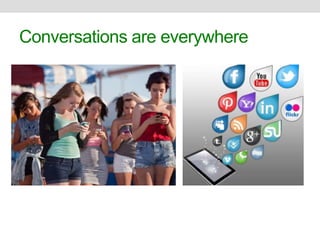
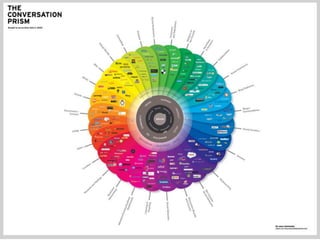
Conversations are everywhere
Monetising attention 
“As wearable technology (Google Glass, fitness bands, Samsung Galaxy Gear) becomes ubiquitous in 2014, the 
amount of data created will provide a treasure trove of insights for marketers. Not only does it let marketers 
know where their customers are but when and how fast. Obviously there is a huge risk here given the sensitivity of 
the data but the trick here is for marketers to provide the right value in exchange for this invaluable data.” 
Aaron Strout, Managing Director at W2O Group, co-author of Location-Based Marketing for Dummies 
The most disruptive digital trend I am seeing that will really begin affecting marketers in 2014 is the ‘Internet 
of Things’. We already know that we don’t search for content now, content finds you. In 2014, we’re going 
to start seeing how brands and products find you. 
Ragy Thomas, CEO and founder of Sprinklr 
"Facebook is transformed from a public space to a behavioral laboratory,” it is possible to "deanonymize 
parts of the data set," or cross-reference anonymous data to make identification possible. 
psychologist Ilka Gleibs, an assistant professor at the London School of Economics in London 
So much content shared today is private, and it often disappears, so marketers aren’t readily able to track and 
target such consumers. Expect marketers to explore new, creative ways of reaching consumers who 
prioritize privacy. 
David Berkowitz, Chief Marketing Officer of MRY
Social Media as Personal Risk 
• What would you say? 
• What would you disclose? 
• Most SM profiles contain personal information : address, telephone number, date of 
birth 
• Information used by banks to verify customers - easily used to impersonate 
23% of those surveyed post information online, which they 
normally wouldn’t disclose in real life, while almost every tenth 
user discusses private information with strangers. 
2014 survey Kaspersky Lab and B2B International
Social Media as Enterprise Risk 
• Advertising & marketing 
• Promotional offers 
• Competitions 
• Customer relations 
• Electronic commerce 
• Blurring of professional and personal voices : staff and customers becoming brand 
ambassadors 
• External 
• Ease of access = ease of reputational risk 
• Commenting without using appropriate disclaimers 
• Irresponsible conduct of senior management 
• Lack of protocol and designated employee to administer 
• Breach of confidential information
Social Media as Enterprise Risk 
• Internal 
• Strained labour relations 
• Lack of corporate social media policy 
• Distinction between social and media 
• Engaging without policy backup 
• Tendency to hide social media as part of media policy 
• Companies should implement a social business governance plan 
• Social business : integration and operationalisation of social media 
• Social media strategy 
• Collaboration strategy 
• Escalation policy
Acknowledging legal risk 
The “chain of publication” 
“It is generally safe to assume that anything published on a social network is 
considered to be in the public domain. This does not absolve the poster (or 
anyone who forwards or reposts information) from any legal liability that might 
arise from posting content that is, for example, in contempt of court, is 
defamatory or in breach of copyright.”
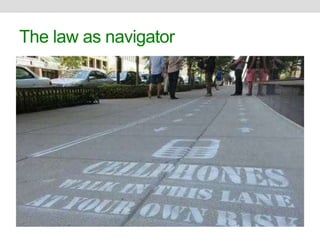
The law as navigator
The laws that bind 
• Yes, the law as you know it (or not) applies 
• No legislation explicity dealing with SM 
• Defamation 
• Hate speech 
• Harassment 
• Intellectual Property 
• Privacy 
• Labour laws 
• Contempt of court : right to fair trial 
• “sub judice rule", which allows for contempt of court prosecutions if media reports could 
prejudice a trial. The question is whether there will be "real risk" of substantial prejudice to 
the administration of justice. 
• Concerns expressed regarding the threats and harsh criticism of Judge Thokozile Masipa – 
racism and contempt of court
Primary legal risks 
• Privacy infringement 
• Intellectual Property infringement 
• Defamation 
• Consumer rights infringement 
• Loss of sensitive information (clients, suppliers, employees) 
• Security compromise - issues of enterprise security 
POTENTIAL FOR LITIGATION 
BRAND RISK 
⏏ ⏏
Privacy 
• Reasonable expectation of privacy is being challenged by SM 
• Information captured without user’s knowledge or consent 
• Gathering social media intelligence through data mining: 
• re-purposing content 
• Data-driven, location based services (iBeacon & Nike Fuel Band) 
• Personalisation of brand experiences 
• Loyalty based experiences – building customer trust 
• Social media monitoring by employers 
• Policies that prohibit employee postings on SNS 
• Screening of prospective employees – discrimination?
Privacy 
• Identity theft is cited as the major complaint received by the FTC since 1999 
• Merging of SM websites – diligence about privacy and security during rapid 
growth phase 
• Single access sign-on – one log in to use multiple websites; single site can show 
actions and activities on other sites 
• Privacy controls and legislation are not universal 
• Location-based services – greater security and privacy concerns
Intellectual Property 
Top intellectual property risks: 
• Ownership of social media accounts, content and followers 
• Cybersquatting: trademark infringement 
• Loss of IP 
• Unauthorised use of third party IP 
• Unauthorised disclosures of trade secrets by employees : publishing of information 
that establishes competitive advantage 
• Brand damage 
• Inappropriate content licensing framework
Defamation 
• A statement that “has the effect of injuring a plaintiff’s reputation”. Reputation is 
injured if the statement lowers the plaintiff in the minds of others. 
• Falsity is not a consideration 
• Information is deemed to have been published once it reaches a third party 
• Once published, a presumption of unlawfulness and intention arises 
• Social Media content is subject to defamation law 
• A statement may be in the form of words, pictures, visual images or gestures 
• Companies have the right to good name 
• The common law right to a good name and reputation (right to dignity) can trump 
freedom of expression 
• Linking to material on third party sites that contain defamatory or objectionable 
material 
• Defamation laws are not universal
Freedom of expression vs defamation 
• A balancing of rights 
• Section 16 guarantees the right to freedom of expression 
• Section 36 (limitation clause) can limit the right to freedom of expression. 
Legal limitations on hate speech, speech infringing rights of others, violations of 
copyright 
• Increasingly the right to an opinion clashes with self-censorship imposed in the 
media space : radio, sport, TV personalities
Harassment 
• The Protection from Harassment Act 2013 
• Harassment on SM involves: 
• Threatening sms, private Twitter messages and emails to an individual, regardless of the platform 
• Threatening remarks made on SM about a person 
• Sending emails containing offensive content – pornographic images, sexual references 
• Sharing media that is offensive, abusive or embarrassing or have been manipulated that it embarrasses 
of offends the individual 
• Sexual advances made through SM platform 
• There is no need for the existence of a domestic relationship between parties 
• Apply for a protection order from the clerk of a court which will be issued to accused 
harasser 
• Contravention of order will be deemed guilty of an offence and liable to a fine or 
imprisonment for a period not exceeding five years 
• The person must believe they are being harassed
Brand risk 
December 2013 – InterActive Corp, Director of Corporate Communications 
fired over a tweet to her online account: "Going to Africa. Hope I don't get 
AIDS. Just kidding. I'm white!" 
14 February 2014 -- Automotive Business Review, motoring journalist fired 
over social media comment: “I don’t blame the guy that shot the motorcyclist. 
They are obnoxious and arrogant. I cannot wait for my day to come when I will 
open my door and a motorcyclist will fly off his bike and hopefully break his 
neck!”
Brand risk 
• Well-managed, responsible brand 
• Posting of innapropriate content 
• Publication of confidential information 
• Publication of personal and sensitive information 
• Disclosures and complaints by customers 
• Defamatory comments about the company 
• Anonymous defamatory comments about the company 
• Dealing with objectionable comments 
• Duty to shareholders 
• In tune with its customers 
= building trust in the channel and the brand
TWheh ola iws sw tahtacth biningd over your brand? 
http://www.npr.org
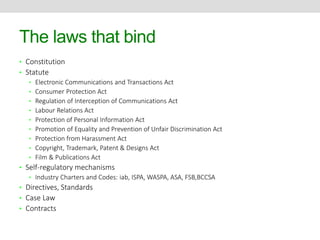
The laws that bind 
• Constitution 
• Statute 
• Electronic Communications and Transactions Act 
• Consumer Protection Act 
• Regulation of Interception of Communications Act 
• Labour Relations Act 
• Protection of Personal Information Act 
• Promotion of Equality and Prevention of Unfair Discrimination Act 
• Protection from Harassment Act 
• Copyright, Trademark, Patent & Designs Act 
• Film & Publications Act 
• Self-regulatory mechanisms 
• Industry Charters and Codes: iab, ISPA, WASPA, ASA, FSB,BCCSA 
• Directives, Standards 
• Case Law 
• Contracts
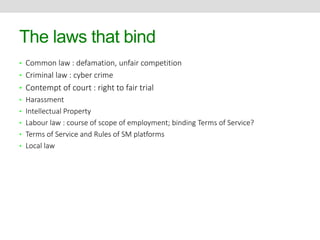
The laws that bind 
• Common law : defamation, unfair competition 
• Criminal law : cyber crime 
• Contempt of court : right to fair trial 
• Harassment 
• Intellectual Property 
• Labour law : course of scope of employment; binding Terms of Service? 
• Terms of Service and Rules of SM platforms 
• Local law
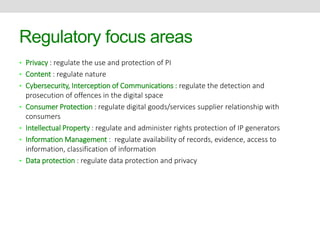
Regulatory focus areas 
• Privacy : regulate the use and protection of PI 
• Content : regulate nature 
• Cybersecurity, Interception of Communications : regulate the detection and 
prosecution of offences in the digital space 
• Consumer Protection : regulate digital goods/services supplier relationship with 
consumers 
• Intellectual Property : regulate and administer rights protection of IP generators 
• Information Management : regulate availability of records, evidence, access to 
information, classification of information 
• Data protection : regulate data protection and privacy
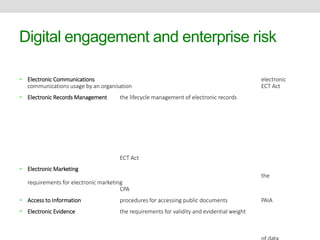
Digital engagement and enterprise risk 
• Electronic Communications electronic 
communications usage by an organisation ECT Act 
• Electronic Records Management the lifecycle management of electronic records 
ECT Act 
• Electronic Marketing 
the 
requirements for electronic marketing 
CPA 
• Access to Information procedures for accessing public documents PAIA 
• Electronic Evidence the requirements for validity and evidential weight 
of data
Legal developments 
• South African case law 
• Sedick and Another v Krisray (Pty) Ltd (2011) 8 BALR 879 (CCMA); and 
• Fredericks v Jo Barkett Fashions [2011] JOL 27923 (CCMA) 
• Media Workers Association of SA obo Mvemve v Kathorus Community Radio (2010) 31 ILJ 
2217 (CCMA) 
However, normal rules of substantive and procedural fairness do apply 
• Smith v Partners in Sexual Health (non-profit) (2011) 32 ILJ 1470 (CCMA) 
• LRA : employers may not prevent an employee from exercising rights it confers 
• The National Labour Relations Board regards SM policies as potentially chilling on 
employees’ rights to engage in activity to improve working conditions 
• In August the FPB announced it will be considering “mechanisms” to regulate online 
and new media content by 2017.
Pre-empting risk, encouraging innovation 
• Most risks are avoided by exercising COMMON SENSE 
• Observing existing codes of conduct 
• Employer duty 
• Social media Policy 
• Electronic Communications Policy 
• Appropriate Use of the Internet 
• Standards of Ethical Behaviour 
• Training : legal 
• Training : social 
• Include Terms of Use & Privacy Policy on websites 
• Social Media Disclaimers: “The postings on this site are my own and do not 
necessarily represent the company’s positions or opinions.” 
• Outsourcing of services to digital marketing specialists : governance of outsourcing 
agreement
Pre-empting risk, encouraging innovation 
• Build a culture of compliance 
• Define a strategy 
• Create policy : staff contribution guidelines, appropriate content guidelines 
• Implement policy 
• Monitor and evaluate 
• Appoint official SM spokesperson 
• Address employee activities, usage and monitoring 
• Ensure administration of sites 
• Draft Terms of Use for Users 
• Creative Commons licensing – open licensing framework 
• Protect personal information provided by customers and employees – ask permission to disclose in 
advance 
• Seek permission to save cookies 
• Public access to information and archiving practices 
• Create a response plan for posting of defamatory, offensive or obscene content 
• Evaluate SM practices 
• Evaluate Information Management practices 
• Enterprise risk evaluation 
• Pre-publicatoin moderation of content
Brand insulation 
• Who owns relationships, content, connections and communities created on SM 
platform? 
• Contractual pre-emption 
• Consistency of brand and content 
• Authorised employees to “speak” on behalf of the brand 
• Prior approval for disclosure of special projects 
• Prioritise quality of information
Governance 
• Leadership 
• Responsibility and Accountability 
• Resources 
• Policies 
• Training 
• Culture 
• Monitoring 
• Crisis Management
Governance 
• Strategy – Statement of Purpose 
• Statement of Programme Objectives 
• Statement on Risk and Mitigation of Liability 
• Statement on Legal Compliance 
• Statement on Ethics 
• Statement on e-Records Management 
• Privacy Principles 
• Confidentiality principles 
• Who owns what and why?
Policy solutions – best practice 
• Approval of social tools 
• Social media usage in an official capacity requires responsible conduct 
o Social Media Handbook for guidance on social media tools and services 
o Grant employees specific approval to use social media 
o When posting in an official capacity, remember that you represent the organisation 
o Catalogue of all personnel approved for social media 
o All sensitive, proprietary or classified information cannot be disclosed 
o Information posted on third party website should be provided on an official website 
o Follow all conduct guidelines 
• Social media usage in an unofficial/personal capacity 
o Present yourself in a manner consistent as an employee of the company 
o Use of a disclaimer – it should be clear that all views expressed are that of the 
individual and do not represent the views of the company 
o All sensitive, proprietary or classified information cannot be disclosed 
o ENSURE POLICIES ARE COMPLIANT WITH RELEVANT LEGISLATION AND INTERNAL 
POLICIES
SM Policy solutions – best practice 
• A notice and agreement that all social media accounts created or used on behalf of 
the company belong solely to the company; 
• An agreement that the company retains sole ownership of all login 
information, passwords, and the associated content of those social media accounts; 
• An agreement that the employee has no claim of ownership or 
interest in the content created and distributed through those social media accounts; 
• An agreement that the employee is responsible for managing the 
account, but that all followers, friends and social connections associated with the 
social media account belong to the company; 
• An agreement that the employees shall relinquish and not use 
social media accounts created or used on behalf of the company after termination of 
their employment.
Social Media in Africa 
• Arik Air “#ArikWhereIsMyIpad” 
• McKinsey & Company, places the continent’s internet contribution to GDP at $18 
billion. 
• Pew Research approximates 78 percent of internet usage in Africa is for social media 
• Africa’s estimated $14-billion social media industry 
• With the internet expected to contribute a minimum of $300 billion to Africa’s GDP 
by 2025, social media could contribute almost $230 billion to Africa’s growth by that 
time 
• Africa is projected to have the largest working population of any continent by 2020 
according to a 2012 report by Euromonitor International
Social Media in Africa 
• SM is impacting the way business is conducted in Africa 
• The 2012 Arab Spring provided a powerful tool for social causes in Egypt and Tunisia 
• African businesses and brands are acknowledging the communicative power and 
increased reach provided by SM 
• Jumia the leading ecommerce business in Africa reports social media networks 
generate 20% of daily traffic 
• Banks in Africa are rolling out tech-driven services on social media
Social Media in Africa 
• Thanks to SM communities have been able to speak up and pursue causes against 
governments. 
• The internet has witnessed a sustained increase in adoption rates in Africa 
• Penetration currently pegged at 16% 
• More than 167 million active users across the continent
African legal landscape 
• But the law is developing 
• Many African countries lack developed SM laws and guidance on SM 
• Developments are under way to enforce restrictions on social media 
• Nigeria : rollout of a framework for the regulation of SM 
• Malawi : warning to those exploiting absence of SM legislation to defame others 
• Ghana : call for regulations to be put in place 
• Kenya : hate speech laws blamed for violence following election of Dec 2007 
• Botswana : the army banned soldiers from FB, Twitter and other SM sites for security 
reasons 
• Initiatives to harmonise regional and international laws in the electronic commerce 
and data protection are vital 
• Africa’s voice in determining laws that will impact social and commercial mobile and 
online interactions
Denise Fouche 
denise.fouche@endcode.org 
endcode.org 
THANX, QUESTIONS?
References 
• http://www.ventures-africa.com/2014/06/africa-inside-the-continents-new-14-billion-social-media- 
industry/ 
• http://www.lexology.com/library/detail.aspx?g=7f2d55e1-27dd-44a1-92b7-5049ce542761 
• http://www.saflii.org/za/journals/DEREBUS/2012/80.html 
• http://www.ipu.org/splz-e/asgp12/guidelines.pdf 
• http://www.reputation.com/reputationwatch/articles/top-five-social-media-privacy-concerns

Social Media & Legal Risk

  • 1.
    WHEN CONVERSATION BECOMESPUBLICATION Understanding Social Media Risks and the Law DENISE FOUCHE ENDCODER/ ENDCODE.ORG
  • 2.
    CONTEXT: Social Mediaas Enterprise Risk (internal and external) The law as navigator Brand Risk The Law Pre-empting risk, encouraging innovation Governance Social Media in Africa
  • 3.
  • 4.
  • 5.
    Monetising attention “Aswearable technology (Google Glass, fitness bands, Samsung Galaxy Gear) becomes ubiquitous in 2014, the amount of data created will provide a treasure trove of insights for marketers. Not only does it let marketers know where their customers are but when and how fast. Obviously there is a huge risk here given the sensitivity of the data but the trick here is for marketers to provide the right value in exchange for this invaluable data.” Aaron Strout, Managing Director at W2O Group, co-author of Location-Based Marketing for Dummies The most disruptive digital trend I am seeing that will really begin affecting marketers in 2014 is the ‘Internet of Things’. We already know that we don’t search for content now, content finds you. In 2014, we’re going to start seeing how brands and products find you. Ragy Thomas, CEO and founder of Sprinklr "Facebook is transformed from a public space to a behavioral laboratory,” it is possible to "deanonymize parts of the data set," or cross-reference anonymous data to make identification possible. psychologist Ilka Gleibs, an assistant professor at the London School of Economics in London So much content shared today is private, and it often disappears, so marketers aren’t readily able to track and target such consumers. Expect marketers to explore new, creative ways of reaching consumers who prioritize privacy. David Berkowitz, Chief Marketing Officer of MRY
  • 6.
    Social Media asPersonal Risk • What would you say? • What would you disclose? • Most SM profiles contain personal information : address, telephone number, date of birth • Information used by banks to verify customers - easily used to impersonate 23% of those surveyed post information online, which they normally wouldn’t disclose in real life, while almost every tenth user discusses private information with strangers. 2014 survey Kaspersky Lab and B2B International
  • 7.
    Social Media asEnterprise Risk • Advertising & marketing • Promotional offers • Competitions • Customer relations • Electronic commerce • Blurring of professional and personal voices : staff and customers becoming brand ambassadors • External • Ease of access = ease of reputational risk • Commenting without using appropriate disclaimers • Irresponsible conduct of senior management • Lack of protocol and designated employee to administer • Breach of confidential information
  • 8.
    Social Media asEnterprise Risk • Internal • Strained labour relations • Lack of corporate social media policy • Distinction between social and media • Engaging without policy backup • Tendency to hide social media as part of media policy • Companies should implement a social business governance plan • Social business : integration and operationalisation of social media • Social media strategy • Collaboration strategy • Escalation policy
  • 9.
    Acknowledging legal risk The “chain of publication” “It is generally safe to assume that anything published on a social network is considered to be in the public domain. This does not absolve the poster (or anyone who forwards or reposts information) from any legal liability that might arise from posting content that is, for example, in contempt of court, is defamatory or in breach of copyright.”
  • 10.
    The law asnavigator
  • 11.
    The laws thatbind • Yes, the law as you know it (or not) applies • No legislation explicity dealing with SM • Defamation • Hate speech • Harassment • Intellectual Property • Privacy • Labour laws • Contempt of court : right to fair trial • “sub judice rule", which allows for contempt of court prosecutions if media reports could prejudice a trial. The question is whether there will be "real risk" of substantial prejudice to the administration of justice. • Concerns expressed regarding the threats and harsh criticism of Judge Thokozile Masipa – racism and contempt of court
  • 12.
    Primary legal risks • Privacy infringement • Intellectual Property infringement • Defamation • Consumer rights infringement • Loss of sensitive information (clients, suppliers, employees) • Security compromise - issues of enterprise security POTENTIAL FOR LITIGATION BRAND RISK ⏏ ⏏
  • 13.
    Privacy • Reasonableexpectation of privacy is being challenged by SM • Information captured without user’s knowledge or consent • Gathering social media intelligence through data mining: • re-purposing content • Data-driven, location based services (iBeacon & Nike Fuel Band) • Personalisation of brand experiences • Loyalty based experiences – building customer trust • Social media monitoring by employers • Policies that prohibit employee postings on SNS • Screening of prospective employees – discrimination?
  • 14.
    Privacy • Identitytheft is cited as the major complaint received by the FTC since 1999 • Merging of SM websites – diligence about privacy and security during rapid growth phase • Single access sign-on – one log in to use multiple websites; single site can show actions and activities on other sites • Privacy controls and legislation are not universal • Location-based services – greater security and privacy concerns
  • 15.
    Intellectual Property Topintellectual property risks: • Ownership of social media accounts, content and followers • Cybersquatting: trademark infringement • Loss of IP • Unauthorised use of third party IP • Unauthorised disclosures of trade secrets by employees : publishing of information that establishes competitive advantage • Brand damage • Inappropriate content licensing framework
  • 16.
    Defamation • Astatement that “has the effect of injuring a plaintiff’s reputation”. Reputation is injured if the statement lowers the plaintiff in the minds of others. • Falsity is not a consideration • Information is deemed to have been published once it reaches a third party • Once published, a presumption of unlawfulness and intention arises • Social Media content is subject to defamation law • A statement may be in the form of words, pictures, visual images or gestures • Companies have the right to good name • The common law right to a good name and reputation (right to dignity) can trump freedom of expression • Linking to material on third party sites that contain defamatory or objectionable material • Defamation laws are not universal
  • 17.
    Freedom of expressionvs defamation • A balancing of rights • Section 16 guarantees the right to freedom of expression • Section 36 (limitation clause) can limit the right to freedom of expression. Legal limitations on hate speech, speech infringing rights of others, violations of copyright • Increasingly the right to an opinion clashes with self-censorship imposed in the media space : radio, sport, TV personalities
  • 18.
    Harassment • TheProtection from Harassment Act 2013 • Harassment on SM involves: • Threatening sms, private Twitter messages and emails to an individual, regardless of the platform • Threatening remarks made on SM about a person • Sending emails containing offensive content – pornographic images, sexual references • Sharing media that is offensive, abusive or embarrassing or have been manipulated that it embarrasses of offends the individual • Sexual advances made through SM platform • There is no need for the existence of a domestic relationship between parties • Apply for a protection order from the clerk of a court which will be issued to accused harasser • Contravention of order will be deemed guilty of an offence and liable to a fine or imprisonment for a period not exceeding five years • The person must believe they are being harassed
  • 19.
    Brand risk December2013 – InterActive Corp, Director of Corporate Communications fired over a tweet to her online account: "Going to Africa. Hope I don't get AIDS. Just kidding. I'm white!" 14 February 2014 -- Automotive Business Review, motoring journalist fired over social media comment: “I don’t blame the guy that shot the motorcyclist. They are obnoxious and arrogant. I cannot wait for my day to come when I will open my door and a motorcyclist will fly off his bike and hopefully break his neck!”
  • 20.
    Brand risk •Well-managed, responsible brand • Posting of innapropriate content • Publication of confidential information • Publication of personal and sensitive information • Disclosures and complaints by customers • Defamatory comments about the company • Anonymous defamatory comments about the company • Dealing with objectionable comments • Duty to shareholders • In tune with its customers = building trust in the channel and the brand
  • 21.
    TWheh ola iwssw tahtacth biningd over your brand? http://www.npr.org
  • 22.
    The laws thatbind • Constitution • Statute • Electronic Communications and Transactions Act • Consumer Protection Act • Regulation of Interception of Communications Act • Labour Relations Act • Protection of Personal Information Act • Promotion of Equality and Prevention of Unfair Discrimination Act • Protection from Harassment Act • Copyright, Trademark, Patent & Designs Act • Film & Publications Act • Self-regulatory mechanisms • Industry Charters and Codes: iab, ISPA, WASPA, ASA, FSB,BCCSA • Directives, Standards • Case Law • Contracts
  • 23.
    The laws thatbind • Common law : defamation, unfair competition • Criminal law : cyber crime • Contempt of court : right to fair trial • Harassment • Intellectual Property • Labour law : course of scope of employment; binding Terms of Service? • Terms of Service and Rules of SM platforms • Local law
  • 24.
    Regulatory focus areas • Privacy : regulate the use and protection of PI • Content : regulate nature • Cybersecurity, Interception of Communications : regulate the detection and prosecution of offences in the digital space • Consumer Protection : regulate digital goods/services supplier relationship with consumers • Intellectual Property : regulate and administer rights protection of IP generators • Information Management : regulate availability of records, evidence, access to information, classification of information • Data protection : regulate data protection and privacy
  • 25.
    Digital engagement andenterprise risk • Electronic Communications electronic communications usage by an organisation ECT Act • Electronic Records Management the lifecycle management of electronic records ECT Act • Electronic Marketing the requirements for electronic marketing CPA • Access to Information procedures for accessing public documents PAIA • Electronic Evidence the requirements for validity and evidential weight of data
  • 26.
    Legal developments •South African case law • Sedick and Another v Krisray (Pty) Ltd (2011) 8 BALR 879 (CCMA); and • Fredericks v Jo Barkett Fashions [2011] JOL 27923 (CCMA) • Media Workers Association of SA obo Mvemve v Kathorus Community Radio (2010) 31 ILJ 2217 (CCMA) However, normal rules of substantive and procedural fairness do apply • Smith v Partners in Sexual Health (non-profit) (2011) 32 ILJ 1470 (CCMA) • LRA : employers may not prevent an employee from exercising rights it confers • The National Labour Relations Board regards SM policies as potentially chilling on employees’ rights to engage in activity to improve working conditions • In August the FPB announced it will be considering “mechanisms” to regulate online and new media content by 2017.
  • 27.
    Pre-empting risk, encouraginginnovation • Most risks are avoided by exercising COMMON SENSE • Observing existing codes of conduct • Employer duty • Social media Policy • Electronic Communications Policy • Appropriate Use of the Internet • Standards of Ethical Behaviour • Training : legal • Training : social • Include Terms of Use & Privacy Policy on websites • Social Media Disclaimers: “The postings on this site are my own and do not necessarily represent the company’s positions or opinions.” • Outsourcing of services to digital marketing specialists : governance of outsourcing agreement
  • 28.
    Pre-empting risk, encouraginginnovation • Build a culture of compliance • Define a strategy • Create policy : staff contribution guidelines, appropriate content guidelines • Implement policy • Monitor and evaluate • Appoint official SM spokesperson • Address employee activities, usage and monitoring • Ensure administration of sites • Draft Terms of Use for Users • Creative Commons licensing – open licensing framework • Protect personal information provided by customers and employees – ask permission to disclose in advance • Seek permission to save cookies • Public access to information and archiving practices • Create a response plan for posting of defamatory, offensive or obscene content • Evaluate SM practices • Evaluate Information Management practices • Enterprise risk evaluation • Pre-publicatoin moderation of content
  • 29.
    Brand insulation •Who owns relationships, content, connections and communities created on SM platform? • Contractual pre-emption • Consistency of brand and content • Authorised employees to “speak” on behalf of the brand • Prior approval for disclosure of special projects • Prioritise quality of information
  • 30.
    Governance • Leadership • Responsibility and Accountability • Resources • Policies • Training • Culture • Monitoring • Crisis Management
  • 31.
    Governance • Strategy– Statement of Purpose • Statement of Programme Objectives • Statement on Risk and Mitigation of Liability • Statement on Legal Compliance • Statement on Ethics • Statement on e-Records Management • Privacy Principles • Confidentiality principles • Who owns what and why?
  • 32.
    Policy solutions –best practice • Approval of social tools • Social media usage in an official capacity requires responsible conduct o Social Media Handbook for guidance on social media tools and services o Grant employees specific approval to use social media o When posting in an official capacity, remember that you represent the organisation o Catalogue of all personnel approved for social media o All sensitive, proprietary or classified information cannot be disclosed o Information posted on third party website should be provided on an official website o Follow all conduct guidelines • Social media usage in an unofficial/personal capacity o Present yourself in a manner consistent as an employee of the company o Use of a disclaimer – it should be clear that all views expressed are that of the individual and do not represent the views of the company o All sensitive, proprietary or classified information cannot be disclosed o ENSURE POLICIES ARE COMPLIANT WITH RELEVANT LEGISLATION AND INTERNAL POLICIES
  • 33.
    SM Policy solutions– best practice • A notice and agreement that all social media accounts created or used on behalf of the company belong solely to the company; • An agreement that the company retains sole ownership of all login information, passwords, and the associated content of those social media accounts; • An agreement that the employee has no claim of ownership or interest in the content created and distributed through those social media accounts; • An agreement that the employee is responsible for managing the account, but that all followers, friends and social connections associated with the social media account belong to the company; • An agreement that the employees shall relinquish and not use social media accounts created or used on behalf of the company after termination of their employment.
  • 34.
    Social Media inAfrica • Arik Air “#ArikWhereIsMyIpad” • McKinsey & Company, places the continent’s internet contribution to GDP at $18 billion. • Pew Research approximates 78 percent of internet usage in Africa is for social media • Africa’s estimated $14-billion social media industry • With the internet expected to contribute a minimum of $300 billion to Africa’s GDP by 2025, social media could contribute almost $230 billion to Africa’s growth by that time • Africa is projected to have the largest working population of any continent by 2020 according to a 2012 report by Euromonitor International
  • 35.
    Social Media inAfrica • SM is impacting the way business is conducted in Africa • The 2012 Arab Spring provided a powerful tool for social causes in Egypt and Tunisia • African businesses and brands are acknowledging the communicative power and increased reach provided by SM • Jumia the leading ecommerce business in Africa reports social media networks generate 20% of daily traffic • Banks in Africa are rolling out tech-driven services on social media
  • 36.
    Social Media inAfrica • Thanks to SM communities have been able to speak up and pursue causes against governments. • The internet has witnessed a sustained increase in adoption rates in Africa • Penetration currently pegged at 16% • More than 167 million active users across the continent
  • 37.
    African legal landscape • But the law is developing • Many African countries lack developed SM laws and guidance on SM • Developments are under way to enforce restrictions on social media • Nigeria : rollout of a framework for the regulation of SM • Malawi : warning to those exploiting absence of SM legislation to defame others • Ghana : call for regulations to be put in place • Kenya : hate speech laws blamed for violence following election of Dec 2007 • Botswana : the army banned soldiers from FB, Twitter and other SM sites for security reasons • Initiatives to harmonise regional and international laws in the electronic commerce and data protection are vital • Africa’s voice in determining laws that will impact social and commercial mobile and online interactions
  • 38.
    Denise Fouche denise.fouche@endcode.org endcode.org THANX, QUESTIONS?
  • 39.
    References • http://www.ventures-africa.com/2014/06/africa-inside-the-continents-new-14-billion-social-media- industry/ • http://www.lexology.com/library/detail.aspx?g=7f2d55e1-27dd-44a1-92b7-5049ce542761 • http://www.saflii.org/za/journals/DEREBUS/2012/80.html • http://www.ipu.org/splz-e/asgp12/guidelines.pdf • http://www.reputation.com/reputationwatch/articles/top-five-social-media-privacy-concerns

Editor's Notes

  • #2 As technology legal advisors considering social media law and its impact on businesses, we’re particularly interested in the point at which conversation becomes publication. The very act of conversing online equates to publication which in the legal realm introduces a host of rights and obligations. Of even greater legal importance is the content that makes up that conversation and the implications it has for the creator, compiler, the poster, the hoster, the storer and the recipient of that content. In short, each link in what the law regards as “the chain of publication” carries legal implications.
  • #4 The pervasiveness of SM is a moot point– the ubiquity of SM, our engagement with and reliance on platforms is no longer unique. SM has seamlessly become an everyday, for some all day event in our lives. Yet for something we use so freely and often unquestioningly, we are still surprised to discover that the very laws that regulate our non-digital behaviours also govern our interactions on line. As users of SM we become publishers of information, and thereby subject to the laws that apply to traditional media.
  • #5 ZenithOptimedia estimated that total social media advertising spending will reach $4.6 billion this year, up 35% from $3.4 billion in 2012; looking ahead, ZO sees social media ad spending climbing to $8.22 billion by 2015, which suggests a cumulative annual growth rate of around 35% over the next two years.
  • #6  When pressed on the legal responsbilities and implications SM agencies are yet to provide satisfactory answers with regard to awareness and programs within their organisations. "Be aware it is a space that is watched," says social psychologist Ilka Gleibs, an assistant professor at the London School of Economics in London, whose study about social networking sites for research field studies has been drawing attention since it went online in January in the journal Analyses of Social Issues and Public Policy. RELATED: Facebook posts 'contagious,' research suggests "Facebook is transformed from a public space to a behavioral laboratory," says the study, which cites a Harvard-based research project of 1,700 college-based Facebook users in which it became possible to "deanonymize parts of the data set," or cross-reference anonymous data to make student identification possible.
  • #8 Organisations use SM in the following ways: But Blurring of lines between personal and professional creates a conversation of a special type. Although SM has presented business with new channels to reach customers on an unprecedented scale often enterprises lack an understanding of the risks that arise in the social media space. And while there is a need for the law to develop in line with technological developments, many of the laws that exist without amendment do apply.
  • #11 Citing concerns for the elderly and children the City of Chongqing created footpaths for ‘texters’ to use to prevent smartphone related accidents. In much the same way should we regard the laws that apply to social media as a protection mechanism, a safety lane for SM related accidents? We wonder whether laws are adapting sufficiently to deal with technologies and how people are using them.
  • #12 SM platforms are publications subject to the same laws that govern mainstream media The law governs human behaviour, digital or otherwise statutes and the common law determine social media law parameters Content that constitutes defamatory material, hate speech, harassment, ip infringement, privacy infringement Unfair labour practices Companies can be found vicariously liable for discrimination, harassment, defamation on SM where employee’s conduct occurs in course and scope of employment
  • #16 Ownership of social media accounts: Where an employee creates a social media account in the name of the company on, for instance, Twitter and uses Twitter to communicate (tweet) information about the company, does the company or the employee own the account? Does the company or employee own the contacts (followers)? Most importantly, does the company, employee or Twitter own the content posted? Cybersquatting: Cybersquatting traditionally referred to the bad faith registration of a domain name identical to the name (trademark) of a large company with intention to profit from the goodwill of a trademark belonging to someone else or to sell the domain to the trademark owner at an inflated price. This risk has trekked to social media sites and companies such as CNN have had to purchase social media accounts incorporating the company name from the first registrants. Loss of intellectual property: Often, companies will post content to social media sites assuming that such content will be available indefinitely. A closer inspection of the Terms and Conditions of Service of specific social media sites reveals that the site may shut down at any time, without notice to the account holder and in the event of such shut down, the site owner has no obligation to retain or pass on any content to the account holder. A failure to back up the content posted may result in the instant loss of significant intellectual property. Unauthorised disclosures of trade secrets by employees: This refers to the risk of employees who are not bound to appropriate internal policies sharing confidential information or trade secrets (formulas, know how) to their contacts through social media. Brand damage: There are numerous examples of companies that have invested millions in brand building losing brand power due to consumers’ bad ratings of the company, its employees, products or services on social media sites such as Facebook and Twitter. In addition consumers are posting comparisons of services or pricing of different companies. Whilst companies may control use of social media by employees, the reality is that companies cannot control what consumers do. With this in mind, the real risk is the inability to respond appropriately when the brand is ‘hit’. Licensing framework: copyright divisible rights, reproduction rights, exclusive licences, broadcast rights, commercial use, distribution rights, modification rights, remix rights, termination of service or account
  • #18 Liability for defamation involves the balancing of the right to freedom of expression with the right to dignity Limitation has to be justifiable.
  • #19 aims to protect vulnerable members of society
  • #22 The law provides a framework against which to devise SM policy
  • #23 ECT: The Act provides an enabling framework for the reliance on ICTs for operational purposes. The Act calls for an examination of the extent to which legal risks, including unauthorised access to communications, are enterprise risks. addresses the regulation of relationships between consumers and businesses across different areas of scope. The Act aims to promote fair business practices and establishes a control framework to ensure the fairness of contracts, introduces new protective mechanisms for consumers to exit from contractual obligations and has legislative provisions on marketing and marketing practices, including pricing transparency and restrictions over direct marketing. The Regulation of Interception of Communications and provision of communication-related Information Act 70 of 2002 regulates the interception of communications and deals specifically with the interception and monitoring of communications. Employers must ensure that they comply with the Act in relation to dealings with their employees. The Labour Relations Act 66 of 1996 governs the duty to engage in fair and appropriate practices within the workplace. The clear statement of sanctions in ICT policy documentation may promote substantive fairness whilst fair and consistent procedures for disciplinary measures associated with failure to observe ICT policies is necessary to promote procedural fairness.
  • #24 The regulations that make up Social media law controls conversations that occur online
  • #27 Employees dismissed for derogatory FB status updates. Employees had not restricted their FB privacy setting and updates could be viewed by anyone. CCMA found employer enttiled to access the posts as the employees had ‘open’ FB profiles MWA a radio station employee criticised the organisation’s board and claimed its station manager was a criminal. The CCMA found that the employee was fairly dismissed as he had posted unfounded allegations on Facebook without having addressed these internally first. Smith: chief executive officer accessed an employee’s private Gmail e-mail account while she was on leave and found e-mails between her and former employees, as well as persons outside the organisation, which made reference to internal matters. The employer initially gained access to the employee’s account accidentally but subsequent access was intentional. The employee was charged with a number of offences, including bringing the employer’s name into disrepute. In her defence at a disciplinary inquiry, the employee contended that the e-mails were accessed in violation of her right to privacy and in contravention of RICA. The CCMA found that the intentional access on the second occasion contravened RICA and the evidence obtained through this access was inadmissible on the basis of an infringement of the constitutional right to privacy. The CCMA held that the employee’s dismissal was procedurally and substantively unfair. The FPB’s Strategic Plan does recognise the enormity of the task and the need to expand its infrastructure to acheive this The FPB falls within the Department of Communications
  • #35 June 2012, Japheth Omojuwa, an economist by training who has become a prominent Nigerian political advocate and social media personality, went to battle over an iPad lost on a flight with Arik Air, Nigeria’s largest indigenous airline. Omojuwa won. He launched the “#ArikWhereIsMyIpad” trend from oneof his social media platforms – a Twitter account with over 100,000 followers. Other Arik Air passengers sympathetic to his plight used the same hashtag (#) to narrate their own experiences losing valuables onboard Arik Air flights. The resulting social media campaign damaged the airline’s reputation and ultimately led the company to suspend its Twitter account. “Lions go digital: The Internet’s transformative potential in Africa,” a 2013 report by According to the 2014 “Emerging Nations Embrace Internet, Mobile Technology” report by the Pew Research Global Attitudes Project, With the steady rise of its middle class and increasing income levels, internet usage across the region will only increase, making it potentially the largest social media growth market in the world.
  • #37 Tolu Ogunlesi, a renowned Nigerian political commentator and journalist with over 61,000 followers on Twitter: “In the early 90s, the government took control of almost everything, but now social media has changed everything. “Broadband capacity has probably quadrupled, in the last five years,” said Obi Asika, founder of Dragon Africa, and CEO of Storm 360, a Nigerian entertainment company. He attributed most of the increase in internet access to an influx of new and better mobile technologies. “Mobile internet access is now really what’s the key driver,”
  • #38 . Ghanaians monitored Supreme Court verdict in 2012 elections