INTRODUCTION TO ELECTRONIC CONTRACTING 
KOMESHNI PATRICK 
ENDCODER/ ENDCODE.ORG
CONTEXT: 
Tenets of South African Contract Law 
The Electronic Communications and Transactions Act 25 of 2002 
Time and Place of electronic contracting 
Recognition of electronic contracts 
Types of electronic contracts 
Standard Terms and Conditions 
Enforcing Standard Terms and Conditions 
Automated Transactions 
Contractual Protection 
Mitigating Enterprise Risk 
Enhancing the Brand
Tenets of South African Contract Law 
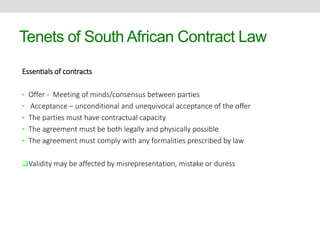
Essentials of contracts 
• Offer - Meeting of minds/consensus between parties 
• Acceptance – unconditional and unequivocal acceptance of the offer 
• The parties must have contractual capacity 
• The agreement must be both legally and physically possible 
• The agreement must comply with any formalities prescribed by law 
Validity may be affected by misrepresentation, mistake or duress
Electronic Transactions and 
Communications Act 25 of 2002 
• makes provision for the recognition and regulation of electronic commerce and its 
provisions deal specifically with how, when and where an agreement concluded 
electronically, comes into existence. 
• Section 11 entrenches the recognition of data messages for the purposes of 
conducting legally relevant acts 
• Article 5 of the UNICTRAL Model Law on Electronic Commerce 
• Signature of the parties electronically is given recognition
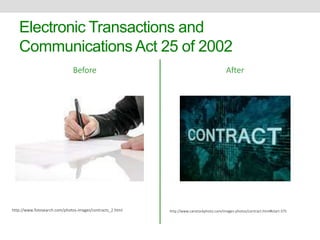
Electronic Transactions and 
Communications Act 25 of 2002 
Before After 
http://www.fotosearch.com/photos-images/contracts_2.html http://www.canstockphoto.com/images-photos/contract.html#start:375
Time and Place of conclusion of contract 
Information theory 
• a contract is concluded once the offeror has knowledge of acceptance 
• the expression of acceptance and its communication to the offeror occurs 
simultaneously 
• direct communication 
Expedition theory 
• applies when there is an interval between the expression of the acceptance of the 
offer and its communication to the offeror 
• this is applicable to contracts concluded by post which is indirect communication 
• Applies where the offer and acceptance are posted
Time and Place of electronic contracts 
Section 22 ECT Act: 
• (1) An agreement is not without legal force and effect merely because it was 
concluded partly or in whole by means of data messages. 
• (2) An agreement concluded between parties by means of data messages is 
concluded at the time when and place where the acceptance of the offer was 
received by the offeror. 
Section 26(1): the agreement is valid upon receipt of the acceptance and it is not 
necessary for the offeror to acknowledge receipt. 
Reception theory 
• The contract is concluded at the time and place when the offeror receives the 
message of acceptance 
• applies to electronic transactions including contracts concluded by email and SMS 
• Section 22(2) applies only where the parties have not expressly agreed to vary the 
terms
Proving the Time and Place of conclusion 
of electronic contracts 
Sending: s23(a) : 
a data message, must be regarded as having been sent by the originator, when it 
enters an information system outside the control of the originator or, if the 
originator and addressee are in the same information system, when it is capable of 
being retrieved by the addressee. 
Reception: s23(b) : 
a data message must be regarded as having been received by the addressee when 
the complete data message enters an information system designated or used for 
that purpose by the addressee and is capable of being retrieved and processed by 
the addressee. 
Important Elements 
• Receipt occurs when the transmitted data message enters the information system of 
the recipient mail box 
• Data message must be capable of being retrieved and processed 
Section 25 - The risk is borne by the sender of the electronic communication
Recognition of electronic contracts 
Jafta v Ezemvelo KZN Wildlife [2008] JOL 22096 (LC) 
• Jafta’s emailed letter of acceptance of a job offer was a data message, which he sent 
via a World Wide Web-based information system that was outside his control. 
• Evidence showed that Jafta’s email neither entered Ezemvelo’s information system 
nor was capable of being retrieved and processed by Ezemvelo. 
• Ezemvelo could not be regarded as having received under Section 23 of the ECT Act 
as one or other information systems had malfunctioned. 
• The Court held that SMS (short message service) is as effective a mode of 
communication as any written document or email, and that Jafta did communicate 
his acceptance of the job offer via SMS. 
• Accordingly a contract of employment came into existence which Ezemvelo 
repudiated by denying receipt of the acceptance. 
• Court held that Section 23 does not require an acceptance of an offer to come to the 
knowledge of the offeror for a contract to arise.
Recognition of electronic contracts 
Mafika v SABC Ltd 
• Court had to decide whether an SMS sent by an employee tendering a resignation 
was valid and fulfilled a requirement that resignations had to be in writing 
• Section 37(4)(a) of the Basic Conditions of Employment Act requires that notice of 
termination of a contract of employment be in writing except where the employee is 
illiterate 
• SABC personnel regulations stipulated that termination notices be “in writing” 
• Court held that “a communication by SMS is a communication in writing”
Types of electronic contracts 
• Shrink wrap agreements 
• Click wrap agreements 
• All refer to the way in which the contracts are concluded more so than the content 
thereof
Shrink wrap agreements 
• Terms of the agreement become valid and enforceable when the plastic shrink wrap 
is broken or when the software is installed 
• software licenses placed within the shrink-wrap of the software package itself 
• May be voidable if buyer’s attention not drawn to terms and conditions
Click wrap agreements 
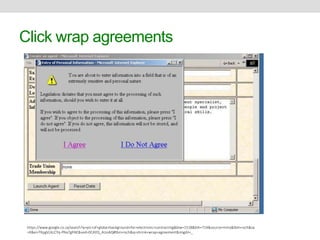
• Agreements built into web pages that you accept by clicking on certain icons or the 
“Accept” or “Agree” dialogue box and this incorporates terms into the agreement 
• The purpose of these agreements are wide ranging, but they are commonly used for: 
o Accepting terms of use,(regulating access to websites, regulating use of the 
website) 
o Containing exclusion clauses, in an effort to limit or deflect liability from the 
site owners or administrators 
o Accepting license agreements 
o Online purchases
Click wrap agreements 
https://www.google.co.za/search?q=pic+of+globe+background+for+electronic+contracting&biw=1518&bih=714&source=lnms&tbm=isch&sa 
=X&ei=TKpgVLKcCYq-PNa7gPAE&ved=0CAYQ_AUoAQ#tbm=isch&q=shrink+wrap+agreement&imgdii=_
Standard terms and conditions 
• ECT Act section 11 ensures that shrink wrap and click wrap agreements are 
enforceable 
• Section 11(1) Information is not without legal force and effect merely on the grounds 
that it is wholly or partly in the form of a data message. 
• Section 11(3) information is incorporated into an agreement or data message, even 
though it is not in the public domain only if the information is: 
o referred to in a way in which a reasonable person would have noticed it; and 
o Accessible in a form that can be read, stored and retrieved by a contracting party, 
either electronically or as a computer printout 
• Standard terms and conditions are therefore incorporated by reference into 
electronic agreements on websites 
• These are the standard terms and conditions that a business would use in all 
transactions 
• Usually address exemptions, limits on liability and disclaimers
Standard terms and conditions 
• South African position on the incorporation of standard terms and conditions 
Durban’s Water Wonderland (Pty) Ltd v Botha and Another 1999 
• A mother and her two-and-a-half-year-old daughter were on a ride at an amusement 
park when something malfunctioned in the hydraulics, throwing them off the ride. 
Durban's Water Wonderland found its defence in contract - claiming an exemption 
clause attached to the ticket. This clause was also displayed clearly on the window of 
the ticket office. As there was no ambiguity in the scope of the exemption, the 
exemption clause applied. 
o Did the contracting party know that certain words appeared on the document or ticket? Did 
they read it? 
o Did the contracting party know that these terms and conditions referred to a contract or to 
contract terms and conditions? 
o Did the party issuing the contract or ticket do everything in their power to draw the 
attention of the contracting party to the fact that the words refer to the terms of the 
contract or would a reasonable customer have taken notice of the terms and conditions?
Standard terms and conditions 
Naidoo v Birchwood Hotel 2012 
• The entrance gate of the Birchwood Hotel fell onto Naidoo who was a coach 
driver who had driven a busload of passengers to the hotel from Durban. He 
sustained fractures of the lumbar spine and ankle as a result and sued the hotel in 
delict for damages. The hotel, basing its defence on the law of contract, relied on 
the disclaimers it had posted at the gate and around the premises which Naidoo 
would have seen. It also relied on the fact that he signed the register upon the 
reverse of which were printed various terms and conditions including and exemption 
clause. 
• The court found that the hotel had not discharged the onus of proving that there 
were disclaimers posted in various locations on the hotel premises at the time the 
incident occurred. It said that even if it was wrong, Naidoo had entered the hotel 
premises for the first time at night and did not see any disclaimers. None of the 
disclaimers were brought to his attention.
Enforcing standard terms and conditions 
Section 11(3) requirements for terms and conditions incorporated by reference for 
website owners, electronic traders and issuers: 
• can be read; 
• can be printed out; 
• can be stored electronically; and 
• must be retrievable for enforcement.
Contracts are everywhere 
https://www.google.co.za/search?q=pic+of+globe+background+for+electronic+contracting&biw=1518&bih=714&source=lnms&tbm=isch&sa=X&ei=TKpgVLKcCYq- 
PNa7gPAE&ved=0CAYQ_AUoAQ#tbm=isch&q=free+pics+of+social+media&imgdii=_
Social Networking sites 
• Social network sites have standard terms and conditions regarding the following: 
• Age is specified to hold an account 
• Business accounts must be registered in the name of the business 
• password protection is always specified as the user’s responsibility 
• Unacceptable conduct is specified 
• Disclaimers for liability - third-party sites, information, materials, products, or 
services 
• Licence to use intellectual property like posts and photos 
• Privacy policies and sharing of information 
• Advertising 
• Disputes
Contracts are everywhere 
https://www.google.co.za/search?q=pic+of+globe+background+for+electronic+contracting&biw=1518&bih=714&source=lnms&tbm=isch&sa=X&ei=TKpgVLKcCYq- 
PNa7gPAE&ved=0CAYQ_AUoAQ#tbm=isch&q=free+pics+of+online+shopping
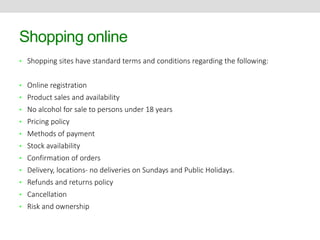
Shopping online 
• Shopping sites have standard terms and conditions regarding the following: 
• Online registration 
• Product sales and availability 
• No alcohol for sale to persons under 18 years 
• Pricing policy 
• Methods of payment 
• Stock availability 
• Confirmation of orders 
• Delivery, locations- no deliveries on Sundays and Public Holidays. 
• Refunds and returns policy 
• Cancellation 
• Risk and ownership
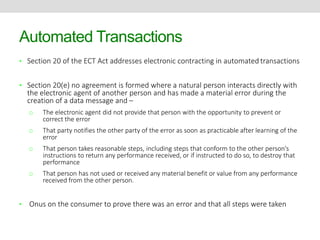
Automated Transactions 
• Section 20 of the ECT Act addresses electronic contracting in automated transactions 
• Section 20(e) no agreement is formed where a natural person interacts directly with 
the electronic agent of another person and has made a material error during the 
creation of a data message and – 
o The electronic agent did not provide that person with the opportunity to prevent or 
correct the error 
o That party notifies the other party of the error as soon as practicable after learning of the 
error 
o That person takes reasonable steps, including steps that conform to the other person’s 
instructions to return any performance received, or if instructed to do so, to destroy that 
performance 
o That person has not used or received any material benefit or value from any performance 
received from the other person. 
• Onus on the consumer to prove there was an error and that all steps were taken
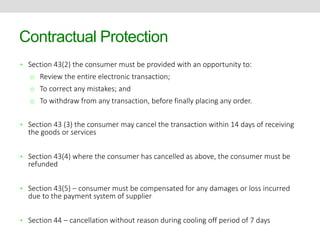
Contractual Protection 
• Section 43(2) the consumer must be provided with an opportunity to: 
o Review the entire electronic transaction; 
o To correct any mistakes; and 
o To withdraw from any transaction, before finally placing any order. 
• Section 43 (3) the consumer may cancel the transaction within 14 days of receiving 
the goods or services 
• Section 43(4) where the consumer has cancelled as above, the consumer must be 
refunded 
• Section 43(5) – consumer must be compensated for any damages or loss incurred 
due to the payment system of supplier 
• Section 44 – cancellation without reason during cooling off period of 7 days
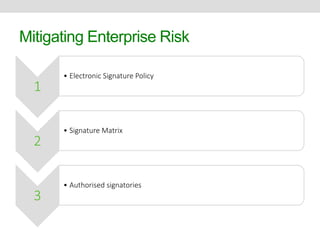
Mitigating Enterprise Risk 
1 
• Electronic Signature Policy 
2 
• Signature Matrix 
3 
• Authorised signatories
Enhancing the Brand 
• Well implemented internal policies 
• Well-managed, responsible brand 
• Negates disclosures and complaints regarding contractual practices 
• Negates defamatory comments about the company’s contract management 
practices 
• Improves relationships between suppliers and business partners 
• Upholds the duty to shareholders 
= building trust in the brand
Komeshni Patrick 
komeshni.patrick@endcode.org 
endcode.org 
QUESTIONS?

Electronic Contracting Presentation

  • 1.
    INTRODUCTION TO ELECTRONICCONTRACTING KOMESHNI PATRICK ENDCODER/ ENDCODE.ORG
  • 2.
    CONTEXT: Tenets ofSouth African Contract Law The Electronic Communications and Transactions Act 25 of 2002 Time and Place of electronic contracting Recognition of electronic contracts Types of electronic contracts Standard Terms and Conditions Enforcing Standard Terms and Conditions Automated Transactions Contractual Protection Mitigating Enterprise Risk Enhancing the Brand
  • 3.
    Tenets of SouthAfrican Contract Law Essentials of contracts • Offer - Meeting of minds/consensus between parties • Acceptance – unconditional and unequivocal acceptance of the offer • The parties must have contractual capacity • The agreement must be both legally and physically possible • The agreement must comply with any formalities prescribed by law Validity may be affected by misrepresentation, mistake or duress
  • 4.
    Electronic Transactions and Communications Act 25 of 2002 • makes provision for the recognition and regulation of electronic commerce and its provisions deal specifically with how, when and where an agreement concluded electronically, comes into existence. • Section 11 entrenches the recognition of data messages for the purposes of conducting legally relevant acts • Article 5 of the UNICTRAL Model Law on Electronic Commerce • Signature of the parties electronically is given recognition
  • 5.
    Electronic Transactions and Communications Act 25 of 2002 Before After http://www.fotosearch.com/photos-images/contracts_2.html http://www.canstockphoto.com/images-photos/contract.html#start:375
  • 6.
    Time and Placeof conclusion of contract Information theory • a contract is concluded once the offeror has knowledge of acceptance • the expression of acceptance and its communication to the offeror occurs simultaneously • direct communication Expedition theory • applies when there is an interval between the expression of the acceptance of the offer and its communication to the offeror • this is applicable to contracts concluded by post which is indirect communication • Applies where the offer and acceptance are posted
  • 7.
    Time and Placeof electronic contracts Section 22 ECT Act: • (1) An agreement is not without legal force and effect merely because it was concluded partly or in whole by means of data messages. • (2) An agreement concluded between parties by means of data messages is concluded at the time when and place where the acceptance of the offer was received by the offeror. Section 26(1): the agreement is valid upon receipt of the acceptance and it is not necessary for the offeror to acknowledge receipt. Reception theory • The contract is concluded at the time and place when the offeror receives the message of acceptance • applies to electronic transactions including contracts concluded by email and SMS • Section 22(2) applies only where the parties have not expressly agreed to vary the terms
  • 8.
    Proving the Timeand Place of conclusion of electronic contracts Sending: s23(a) : a data message, must be regarded as having been sent by the originator, when it enters an information system outside the control of the originator or, if the originator and addressee are in the same information system, when it is capable of being retrieved by the addressee. Reception: s23(b) : a data message must be regarded as having been received by the addressee when the complete data message enters an information system designated or used for that purpose by the addressee and is capable of being retrieved and processed by the addressee. Important Elements • Receipt occurs when the transmitted data message enters the information system of the recipient mail box • Data message must be capable of being retrieved and processed Section 25 - The risk is borne by the sender of the electronic communication
  • 9.
    Recognition of electroniccontracts Jafta v Ezemvelo KZN Wildlife [2008] JOL 22096 (LC) • Jafta’s emailed letter of acceptance of a job offer was a data message, which he sent via a World Wide Web-based information system that was outside his control. • Evidence showed that Jafta’s email neither entered Ezemvelo’s information system nor was capable of being retrieved and processed by Ezemvelo. • Ezemvelo could not be regarded as having received under Section 23 of the ECT Act as one or other information systems had malfunctioned. • The Court held that SMS (short message service) is as effective a mode of communication as any written document or email, and that Jafta did communicate his acceptance of the job offer via SMS. • Accordingly a contract of employment came into existence which Ezemvelo repudiated by denying receipt of the acceptance. • Court held that Section 23 does not require an acceptance of an offer to come to the knowledge of the offeror for a contract to arise.
  • 10.
    Recognition of electroniccontracts Mafika v SABC Ltd • Court had to decide whether an SMS sent by an employee tendering a resignation was valid and fulfilled a requirement that resignations had to be in writing • Section 37(4)(a) of the Basic Conditions of Employment Act requires that notice of termination of a contract of employment be in writing except where the employee is illiterate • SABC personnel regulations stipulated that termination notices be “in writing” • Court held that “a communication by SMS is a communication in writing”
  • 11.
    Types of electroniccontracts • Shrink wrap agreements • Click wrap agreements • All refer to the way in which the contracts are concluded more so than the content thereof
  • 12.
    Shrink wrap agreements • Terms of the agreement become valid and enforceable when the plastic shrink wrap is broken or when the software is installed • software licenses placed within the shrink-wrap of the software package itself • May be voidable if buyer’s attention not drawn to terms and conditions
  • 13.
    Click wrap agreements • Agreements built into web pages that you accept by clicking on certain icons or the “Accept” or “Agree” dialogue box and this incorporates terms into the agreement • The purpose of these agreements are wide ranging, but they are commonly used for: o Accepting terms of use,(regulating access to websites, regulating use of the website) o Containing exclusion clauses, in an effort to limit or deflect liability from the site owners or administrators o Accepting license agreements o Online purchases
  • 14.
    Click wrap agreements https://www.google.co.za/search?q=pic+of+globe+background+for+electronic+contracting&biw=1518&bih=714&source=lnms&tbm=isch&sa =X&ei=TKpgVLKcCYq-PNa7gPAE&ved=0CAYQ_AUoAQ#tbm=isch&q=shrink+wrap+agreement&imgdii=_
  • 15.
    Standard terms andconditions • ECT Act section 11 ensures that shrink wrap and click wrap agreements are enforceable • Section 11(1) Information is not without legal force and effect merely on the grounds that it is wholly or partly in the form of a data message. • Section 11(3) information is incorporated into an agreement or data message, even though it is not in the public domain only if the information is: o referred to in a way in which a reasonable person would have noticed it; and o Accessible in a form that can be read, stored and retrieved by a contracting party, either electronically or as a computer printout • Standard terms and conditions are therefore incorporated by reference into electronic agreements on websites • These are the standard terms and conditions that a business would use in all transactions • Usually address exemptions, limits on liability and disclaimers
  • 16.
    Standard terms andconditions • South African position on the incorporation of standard terms and conditions Durban’s Water Wonderland (Pty) Ltd v Botha and Another 1999 • A mother and her two-and-a-half-year-old daughter were on a ride at an amusement park when something malfunctioned in the hydraulics, throwing them off the ride. Durban's Water Wonderland found its defence in contract - claiming an exemption clause attached to the ticket. This clause was also displayed clearly on the window of the ticket office. As there was no ambiguity in the scope of the exemption, the exemption clause applied. o Did the contracting party know that certain words appeared on the document or ticket? Did they read it? o Did the contracting party know that these terms and conditions referred to a contract or to contract terms and conditions? o Did the party issuing the contract or ticket do everything in their power to draw the attention of the contracting party to the fact that the words refer to the terms of the contract or would a reasonable customer have taken notice of the terms and conditions?
  • 17.
    Standard terms andconditions Naidoo v Birchwood Hotel 2012 • The entrance gate of the Birchwood Hotel fell onto Naidoo who was a coach driver who had driven a busload of passengers to the hotel from Durban. He sustained fractures of the lumbar spine and ankle as a result and sued the hotel in delict for damages. The hotel, basing its defence on the law of contract, relied on the disclaimers it had posted at the gate and around the premises which Naidoo would have seen. It also relied on the fact that he signed the register upon the reverse of which were printed various terms and conditions including and exemption clause. • The court found that the hotel had not discharged the onus of proving that there were disclaimers posted in various locations on the hotel premises at the time the incident occurred. It said that even if it was wrong, Naidoo had entered the hotel premises for the first time at night and did not see any disclaimers. None of the disclaimers were brought to his attention.
  • 18.
    Enforcing standard termsand conditions Section 11(3) requirements for terms and conditions incorporated by reference for website owners, electronic traders and issuers: • can be read; • can be printed out; • can be stored electronically; and • must be retrievable for enforcement.
  • 19.
    Contracts are everywhere https://www.google.co.za/search?q=pic+of+globe+background+for+electronic+contracting&biw=1518&bih=714&source=lnms&tbm=isch&sa=X&ei=TKpgVLKcCYq- PNa7gPAE&ved=0CAYQ_AUoAQ#tbm=isch&q=free+pics+of+social+media&imgdii=_
  • 20.
    Social Networking sites • Social network sites have standard terms and conditions regarding the following: • Age is specified to hold an account • Business accounts must be registered in the name of the business • password protection is always specified as the user’s responsibility • Unacceptable conduct is specified • Disclaimers for liability - third-party sites, information, materials, products, or services • Licence to use intellectual property like posts and photos • Privacy policies and sharing of information • Advertising • Disputes
  • 21.
    Contracts are everywhere https://www.google.co.za/search?q=pic+of+globe+background+for+electronic+contracting&biw=1518&bih=714&source=lnms&tbm=isch&sa=X&ei=TKpgVLKcCYq- PNa7gPAE&ved=0CAYQ_AUoAQ#tbm=isch&q=free+pics+of+online+shopping
  • 22.
    Shopping online •Shopping sites have standard terms and conditions regarding the following: • Online registration • Product sales and availability • No alcohol for sale to persons under 18 years • Pricing policy • Methods of payment • Stock availability • Confirmation of orders • Delivery, locations- no deliveries on Sundays and Public Holidays. • Refunds and returns policy • Cancellation • Risk and ownership
  • 23.
    Automated Transactions •Section 20 of the ECT Act addresses electronic contracting in automated transactions • Section 20(e) no agreement is formed where a natural person interacts directly with the electronic agent of another person and has made a material error during the creation of a data message and – o The electronic agent did not provide that person with the opportunity to prevent or correct the error o That party notifies the other party of the error as soon as practicable after learning of the error o That person takes reasonable steps, including steps that conform to the other person’s instructions to return any performance received, or if instructed to do so, to destroy that performance o That person has not used or received any material benefit or value from any performance received from the other person. • Onus on the consumer to prove there was an error and that all steps were taken
  • 24.
    Contractual Protection •Section 43(2) the consumer must be provided with an opportunity to: o Review the entire electronic transaction; o To correct any mistakes; and o To withdraw from any transaction, before finally placing any order. • Section 43 (3) the consumer may cancel the transaction within 14 days of receiving the goods or services • Section 43(4) where the consumer has cancelled as above, the consumer must be refunded • Section 43(5) – consumer must be compensated for any damages or loss incurred due to the payment system of supplier • Section 44 – cancellation without reason during cooling off period of 7 days
  • 25.
    Mitigating Enterprise Risk 1 • Electronic Signature Policy 2 • Signature Matrix 3 • Authorised signatories
  • 26.
    Enhancing the Brand • Well implemented internal policies • Well-managed, responsible brand • Negates disclosures and complaints regarding contractual practices • Negates defamatory comments about the company’s contract management practices • Improves relationships between suppliers and business partners • Upholds the duty to shareholders = building trust in the brand
  • 27.