Physiology of the Heart Dr. George Pearce
Functions of the Heart Generating blood pressure Routing blood:   separates pulmonary and systemic circulations Ensuring one-way blood flow: valves Regulating blood supply Changes in contraction rate and force match blood delivery to changing metabolic needs
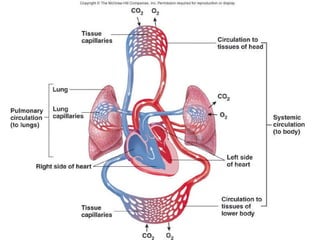
The cardiovascular system is divided into two circuits Pulmonary circuit  blood to and from the lungs Systemic circuit  blood to and from the rest of the body Vessels carry the blood through the circuits Arteries carry blood away from the heart Veins carry blood to the heart Capillaries permit exchange
 
Structural Differences in heart chambers The left side of the heart is more muscular than the right side Functions of valves AV valves prevent backflow of blood from the ventricles to the atria Semilunar valves prevent backflow into the ventricles from the pulmonary trunk and aorta Heart chambers and valves
 
Cardiac Muscle Contraction Heart muscle: Is stimulated by nerves and is self-excitable  Cardiac muscle contraction is similar to skeletal muscle contraction
Conducting System of Heart
Heart Physiology: Sequence of Excitation Sinoatrial (SA) node generates impulses about 75 times/minute Atrioventricular (AV) node delays the impulse approximately 0.1 second Impulse passes from atria to ventricles via the atrioventricular bundle (bundle of His) to the Purkinje fibers and finally to the myocardial fibers
Impulse Conduction through  the Heart
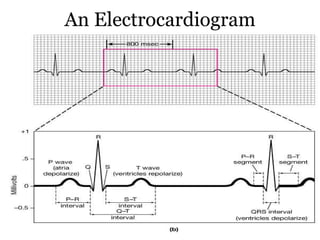
An Electrocardiogram
ECGs, Normal and Abnormal
ECGs, Abnormal Arrhythmia: conduction failure at AV node No pumping action occurs
Factors Affecting Cardiac Output Figure 20.20
Heart Rate Pulse = surge of pressure in artery infants have HR of 120 bpm or more young adult females avg. 72 - 80 bpm young adult males avg. 64 to 72 bpm HR rises again in the elderly
Preload and Afterload Figure 18.21
Effects of Hormones on Contractility Epi, NE, and Thyroxine all have positive ionotropic effects and thus   contractility Digitalis elevates intracellular Ca ++  concentrations by interfering with its removal from sarcoplasm of cardiac cells Beta-blockers ( propanolol, timolol ) block beta-receptors and prevent sympathetic stimulation of heart (neg. chronotropic effect)
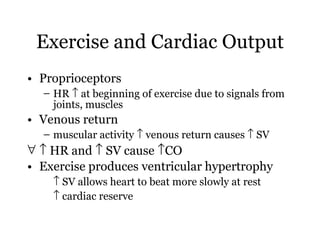
Exercise and Cardiac Output Proprioceptors HR    at beginning of exercise due to signals from joints, muscles Venous return muscular activity    venous return causes    SV    HR and    SV cause   CO Exercise produces ventricular hypertrophy    SV allows heart to beat more slowly at rest    cardiac reserve
Factors Involved in Regulation of Cardiac Output

Heart stimulation

  • 1.
    Physiology of theHeart Dr. George Pearce
  • 2.
    Functions of theHeart Generating blood pressure Routing blood: separates pulmonary and systemic circulations Ensuring one-way blood flow: valves Regulating blood supply Changes in contraction rate and force match blood delivery to changing metabolic needs
  • 3.
    The cardiovascular systemis divided into two circuits Pulmonary circuit blood to and from the lungs Systemic circuit blood to and from the rest of the body Vessels carry the blood through the circuits Arteries carry blood away from the heart Veins carry blood to the heart Capillaries permit exchange
  • 4.
  • 5.
    Structural Differences inheart chambers The left side of the heart is more muscular than the right side Functions of valves AV valves prevent backflow of blood from the ventricles to the atria Semilunar valves prevent backflow into the ventricles from the pulmonary trunk and aorta Heart chambers and valves
  • 6.
  • 7.
    Cardiac Muscle ContractionHeart muscle: Is stimulated by nerves and is self-excitable Cardiac muscle contraction is similar to skeletal muscle contraction
  • 8.
  • 9.
    Heart Physiology: Sequenceof Excitation Sinoatrial (SA) node generates impulses about 75 times/minute Atrioventricular (AV) node delays the impulse approximately 0.1 second Impulse passes from atria to ventricles via the atrioventricular bundle (bundle of His) to the Purkinje fibers and finally to the myocardial fibers
  • 10.
  • 11.
  • 12.
  • 13.
    ECGs, Abnormal Arrhythmia:conduction failure at AV node No pumping action occurs
  • 14.
    Factors Affecting CardiacOutput Figure 20.20
  • 15.
    Heart Rate Pulse= surge of pressure in artery infants have HR of 120 bpm or more young adult females avg. 72 - 80 bpm young adult males avg. 64 to 72 bpm HR rises again in the elderly
  • 16.
  • 17.
    Effects of Hormoneson Contractility Epi, NE, and Thyroxine all have positive ionotropic effects and thus  contractility Digitalis elevates intracellular Ca ++ concentrations by interfering with its removal from sarcoplasm of cardiac cells Beta-blockers ( propanolol, timolol ) block beta-receptors and prevent sympathetic stimulation of heart (neg. chronotropic effect)
  • 18.
    Exercise and CardiacOutput Proprioceptors HR  at beginning of exercise due to signals from joints, muscles Venous return muscular activity  venous return causes  SV  HR and  SV cause  CO Exercise produces ventricular hypertrophy  SV allows heart to beat more slowly at rest  cardiac reserve
  • 19.
    Factors Involved inRegulation of Cardiac Output

Editor's Notes

  • #9 Insert Process Fig. 20.13 with verbiage, Insert Animation: Conducting System of the Heart.exe